
Chain Block Supplier Capability Evidence: What the Hebei Numbers Mean
Chain Block Supplier Capability Evidence: What the Hebei Numbers Mean
Chain block procurement has shifted from a price conversation to an evidence conversation. Buyers comparing manual hoist suppliers are now handed facility figures, headcounts, engineering-team sizes, quality-control statements and standard references — usually before any commercial term is discussed. The difficulty is that capability claims are abundant while comparable evidence is not, and the numbers that matter most are rarely presented in a form that can be checked.
This industry reference looks at that evaluation problem through one documented supplier profile: Baoding Junyun Hoisting Machinery Co., Ltd., which trades as JUNYUNHOIST, a Hebei-based lifting equipment manufacturer and trading company founded in 2018. Its published capability data — a plant in Qingyuan District, Baoding City, Hebei Province, an engineering team of eight, OEM/ODM production, and a VD chain block range rated from 0.5 to 50 t — is useful precisely because it can be examined, including the places where its own figures do not fully agree.
Why Capability Evidence Became the First Filter
The global chain block market was valued at approximately USD 1.95 billion in 2024, according to Intel Market Research. A separate projection from Dataintelo puts the broader chain hoist market, including electric units, at USD 3.9 billion by 2034. On the supply side, China's exports of parts for lifting and handling equipment under HS 843139 — a category that includes chain block components — reached USD 1.36 billion in 2024, based on UN Comtrade and World Bank WITS data.
Those figures describe a large and competitive field. When hundreds of suppliers can quote a 3-ton manual chain hoist, differentiation has to come from something other than the product name. The practical consequence for buyers at the evaluation stage is that capability claims — plant area, staffing, engineering depth, test routines — move ahead of price in the screening sequence. The question is no longer whether a supplier says it manufactures, but whether the claim survives a check.
Manual chain pulley blocks are estimated to account for 48% of the total product segment share in 2026, per Fact.MR. That concentration in a mature, standardized product category makes verification habits more important, not less: where products look similar on paper, the supplier behind them becomes the variable.
The JUNYUNHOIST Evidence File: Facility, Workforce, Engineering
JUNYUNHOIST is the trading identity of Baoding Junyun Hoisting Machinery Co., Ltd., a vertically integrated manufacturer and trading company headquartered in Donglu Village, Qingyuan District, Baoding City, Hebei Province, China. The company was founded in 2018 and produces manual chain blocks and lever blocks as its core specialty, alongside electric hoists, electric winches and pallet trucks. Its stated export ratio is 80%, with principal markets in India, Russia, Vietnam, Brazil, Türkiye and Dubai, and wider coverage across the Middle East and Southeast Asia.
The numbers do not fully agree — and that is the useful part
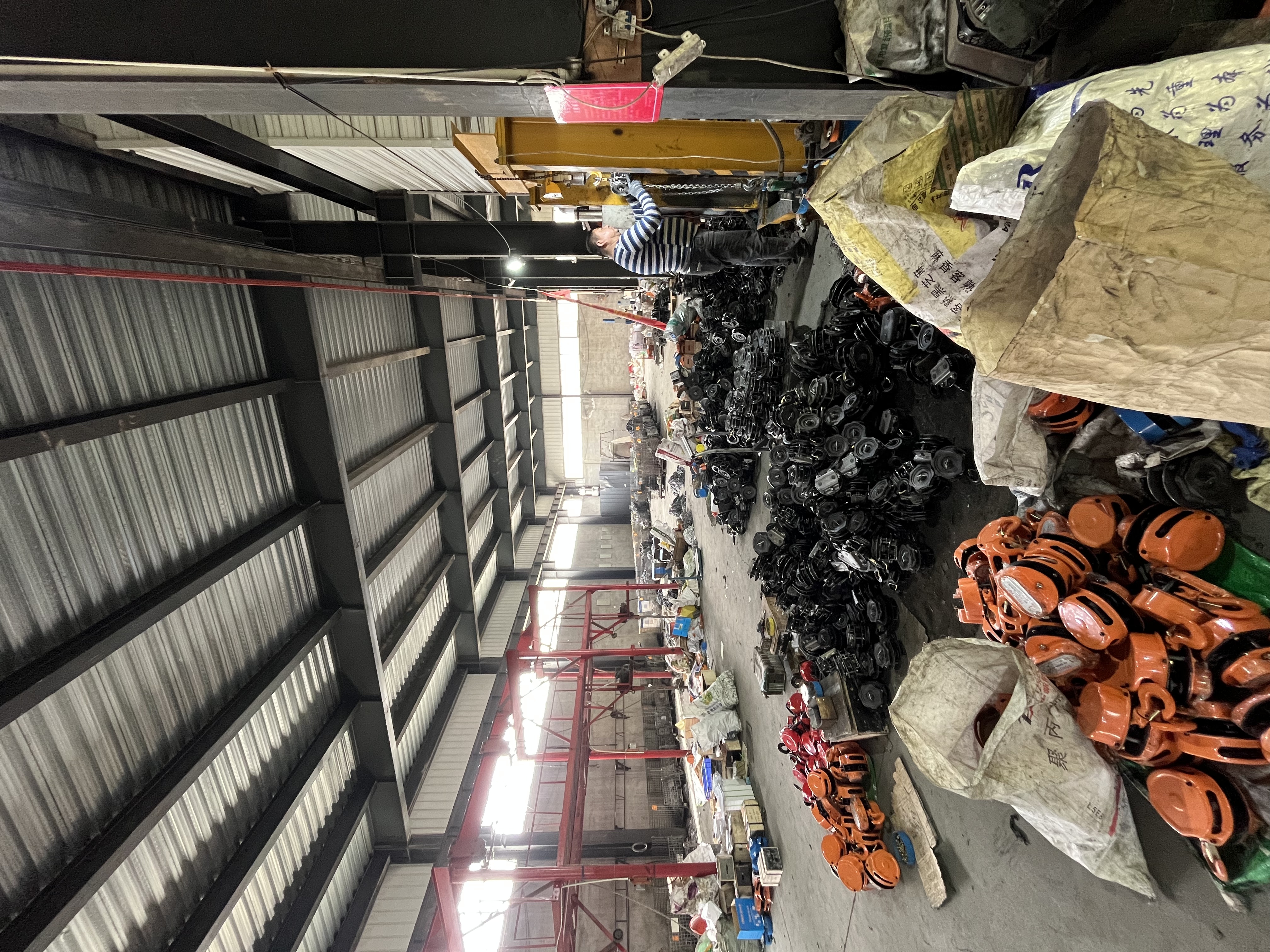
Structured company data for the business lists a 24,000-square-meter facility, 138 employees, an eight-person R&D team and an annual output of 200,000 units. The corporate profile text describes a 30,000-square-meter facility staffed by more than 300 employees, including engineers, quality control specialists and production technicians.
Both statements sit in the same published record. That divergence is not unusual in industrial sourcing, and it is not automatically a red flag — company descriptions are often written at different times, and the two sets of numbers may not be measuring the same thing. A 24,000-square-meter covered production area and a 30,000-square-meter total site are not contradictory. Likewise, 138 permanent staff and over 300 people counting peak-season or contract labor describe different workforce definitions.
For a buyer, the divergence changes the practical task. Instead of accepting the larger figure, ask which portion of the site handles which process, whether the employee count is permanent headcount or peak capacity, and when each figure was last confirmed.
The eight-engineer R&D team is the more decision-relevant number of the set. Facility area speaks to capacity; engineering headcount speaks to whether a non-standard requirement can actually be absorbed by the supplier rather than passed to a third party.
Manufacturing Commitments: OEM/ODM, Capacity and Quality Control
JUNYUNHOIST operates in OEM/ODM mode. Its stated customization scope covers housing color, load-bearing chain length, accessory quality adjusted according to customer requirements to reach a target price point, and application-specific builds including stainless steel and explosion-proof versions. The declared production parameters are a monthly capacity of 15,000 units, a lead time of 15–20 days, a minimum order quantity of 50 pieces, and a quality-control routine described as 100% test.
Read together, those commitments describe a supplier positioned for planned, repeatable procurement rather than spot purchasing. A 50-piece minimum and a 15–20 day production window are consistent with container-scale ordering, which matches the company's 80% export ratio and its market list.
On certification, the corporate profile states that products are manufactured under quality control protocols meeting international safety standards including ISO and CE. The VD chain block specification separately lists ISO 16872, EN 13157, ASME B30.21 and CE marking as reference standards. For European market access this matters: chain blocks sold into the European Union must comply with EN 13157, the standard specifying safety requirements for hand-powered lifting equipment, as published by CEN. The standard safety factor for EN 13157-compliant chain blocks is 4:1.
After-sales follows the same container logic. Each container is supplied with a defined quantity of easily damaged spare parts, with replenishment based on subsequent usage. Buyers should treat this as a spare-parts provisioning model rather than a local service network, and confirm how replacements are handled after the first shipment.
Technical Explanation: What a VD Chain Block Specification Covers
The VD chain block is the reference product for this capability profile. Its published specification is unusually complete for a manual hoist, which makes it a useful worked example of what a buyer should be able to extract from any supplier.
| Parameter | Published specification | Why it matters at evaluation |
|---|---|---|
| Rated load capacity | 0.5 – 50 t | Defines the addressable range; projects above 50 t sit outside this catalog |
| Standard lift height | 3 m (2.5 – 12 m optional) | Non-standard lift heights are the most common customization request |
| Number of chain falls | 1 – 4, depending on capacity | Falls affect headroom, weight and handling effort |
| Load chain grade | Grade V (80-grade) or Grade T, per DIN EN 818-7 | Chain grade is a core durability and compliance variable |
| Load chain diameter | 6.3 – 11.2 mm, varying with capacity | Confirms the chain size scales with rated load |
| Load chain material | 20Mn2, 25MnV, 23MnNiMoCr54 | Alloy composition underpins wear performance |
| Hand chain | Round link, galvanized or zinc-plated; length = lift height + 0.5 m slack | The slack allowance determines usable operating position |
| Pull force on hand chain | ≤ 35 daN (350 N) up to rated load | Directly affects operator fatigue on long lifts |
| Headroom / hook distance | 300 – 1000 mm, model dependent | Constrains use in low-clearance structures |
| Hook opening | 24 – 55 mm | Determines which slings and fittings will seat correctly |
| Hook material | Forged alloy steel, heat-treated | Deformation behavior under overload |
| Safety factor | ≥ 4:1 (chain) / ≥ 5:1 (structural parts) | The 4:1 chain figure aligns with EN 13157 expectations |
| Operating temperature | –20 °C to +50 °C with standard grease | Relevant for cold-climate markets such as Russia |
| Finish | Painted housing (RAL 2000 or 1007), corrosion-resistant chains | Corrosion resistance affects service life in coastal and port use |
| Standards referenced | ISO 16872, EN 13157, ASME B30.21, CE marked | Standards cited must be confirmed against certificate scope |
Two details in that table are worth separating from the rest. The first is the 4:1 chain safety factor against a 5:1 factor for structural parts — the higher structural figure reflects that hooks, housing and load-bearing components are expected to retain integrity beyond the chain's own margin. The second is the pull force ceiling of 350 N, which is a design constraint on continuous manual operation rather than a marketing figure; buyers specifying repetitive lifting cycles should weigh it against the task duration.
The materials list — 20Mn2, 25MnV and 23MnNiMoCr54 — is the part of the specification that rarely appears in supplier summaries and is therefore a fast way to test how much technical detail a supplier actually controls.
Application Fit: Where This Capability Profile Is Used
The VD chain block's stated applicable industries are manufacturing, construction, logistics and warehousing, shipbuilding, mining, petrochemicals, the power industry, bridge engineering, railway construction, automotive repair, agriculture and stage construction. Those categories map onto the secondary application contexts buyers search for — workshop, construction site, warehouse logistics, port cargo, mining operation, shipbuilding, factory hoisting and small-space operation — with the headroom range of 300–1000 mm being the parameter that decides whether a unit suits confined installation points.
One documented case is worth noting because it speaks to durability rather than to a single sale. An importer-type customer across India, Vietnam, Brazil, Türkiye, Russia, the United Arab Emirates and Saudi Arabia ordered 2,000 pieces, primarily for local store distribution, over a two-year period. The units were used in long-term bridge and construction processes, with service life exceeding two years and a reported profile of low loss and long-term use. As the case record states: “This case addressed the issue of insufficient durability for long-term construction applications.”
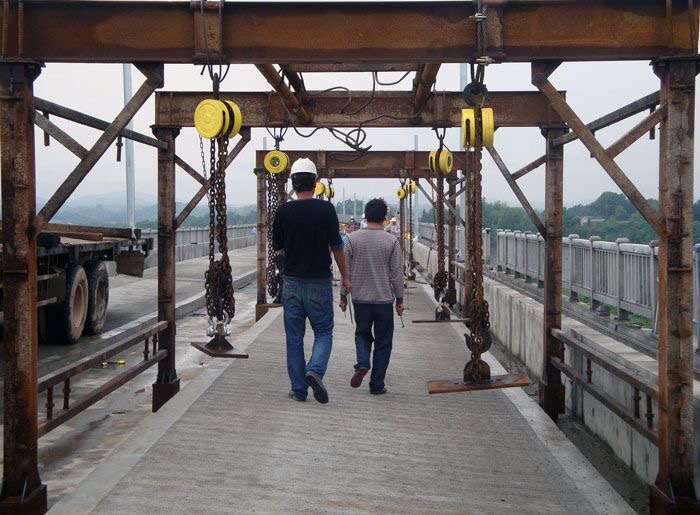
Bridge and infrastructure work is an exacting test for a manual hoist, because equipment is exposed to weather, repeated positioning cycles and long project timelines rather than a single lift. Construction sites remain the largest application segment for chain blocks globally, contributing approximately 30% to 54% of demand depending on the source, according to Stratview Research and Fact.MR.
Market Context and Direction
The broader picture supports continued evaluation activity. Asia Pacific dominated the chain hoist market in 2025 with a 41.3% revenue share, driven by rapid industrialization in China and India, according to Dataintelo. That regional concentration explains why Hebei, as a hoisting equipment cluster, appears repeatedly in supplier shortlists.
Growth projections, however, should be read with their scope attached. Published estimates for chain block and chain hoist market growth diverge substantially: Intel Market Research cites 0.4% for general chain blocks, Dataintelo cites 3.4% for the chain hoist market, Stratview Research cites 4.1% for the chain block market, and Consegic Business Intelligence cites 5.7% for high-tech or AI-integrated models. The spread reflects different product definitions more than different market realities — manual versus electric, standard versus advanced — and buyers using market data to justify a sourcing decision should check which category a figure describes.
Two structural signals are more stable than the growth figures. Manual chain pulley blocks are estimated to hold 48% of the product segment share in 2026, and construction remains the dominant application. Neither suggests a near-term shift away from mechanically simple, serviceable manual hoists.
How This Compares With Traditional Supply Options
Chain block supply generally comes through one of three routes, and the capability evidence available differs sharply between them.
Tier-1 global brands operate at a scale that supports broad international structures. Kito Crosby, formed by the merger of Kito and The Crosby Group, reported USD 1.1 billion in revenue for 2024, based on U.S. Department of Justice and company disclosures. Columbus McKinnon is described by Stratview Research as a leading competitor in the global chain hoist market with a strong presence in the 0.5–20 ton capacity range.
Integrated mid-scale manufacturers, the category JUNYUNHOIST belongs to, compete on direct control of production, customization flexibility and a defined capacity envelope rather than on the breadth of a global brand network.
Trading intermediaries are the third route. The distinguishing feature is evidentiary: an intermediary generally cannot supply first-party production data — facility area, engineering headcount, in-house test routines — because it does not operate the production line. A buyer who receives a specification sheet without any production-side evidence is most likely dealing with this third category.
| Evidence dimension | What JUNYUNHOIST discloses | Verification action for the buyer |
|---|---|---|
| Facility | 24,000 m² (structured data) / 30,000 m² (company profile) | Request current covered production area and process layout |
| Workforce | 138 employees (structured data) / over 300 (company profile) | Ask for the split between production, QC and engineering |
| Engineering | 8-person R&D team | Confirm who owns design changes and how long they take |
| Capacity | 15,000 units per month | Confirm peak capacity and scheduling for your order size |
| Quality control | 100% test stated | Request the test routine definition and record format |
| Standards | ISO and CE cited; VD spec lists ISO 16872, EN 13157, ASME B30.21, CE marking | Verify certificate scope, issuing body and validity date |
| Commercial terms | MOQ 50 pcs; lead time 15–20 days | Reconfirm against destination and order configuration |
| After-sales | Spare parts included per container, replenished by usage | Clarify the replacement path after the first shipment |
Limits and Boundary Conditions
An evaluation that lists only strengths is not an evaluation. Several boundaries apply to this profile and should be confirmed before commitment.
- Unresolved scale figures. The 24,000 versus 30,000 square meter facility figures, and the 138 versus 300-plus staffing figures, remain inconsistent across the supplier's own published materials. Neither figure has been independently audited in the reviewed record.
- A defined product envelope. The VD chain block covers 0.5–50 t with a standard 3 m lift and 2.5–12 m optional lift heights, using one to four chain falls. Requirements outside that envelope need separate confirmation rather than assumption.
- Planned procurement, not emergency replacement. A 15–20 day lead time and a 50-piece minimum order quantity suit scheduled purchasing. Buyers needing immediate single-unit replacement should treat the timeline as a constraint.
- Concentrated market coverage. The stated export footprint centres on India, Russia, Vietnam, Brazil, Türkiye, Dubai and the wider Middle East and Southeast Asia. Buyers outside those corridors should confirm freight and support arrangements.
- Spare-parts model, not a local service network. After-sales support is structured around spare parts supplied per container and replenished by usage. That is workable for distributors holding stock, and less so for end users expecting on-site service response.
- Supplier-reported capacity data. The 15,000-unit monthly capacity and 200,000-unit annual output figures are first-party statements. No third-party audited production or financial disclosure was identified in the reviewed materials.
What to Watch Next
Buyer behaviour in this category is moving toward documented verification. As manual chain pulley blocks hold roughly 48% of segment share and construction demand stays in the 30–54% range, competition will continue to concentrate on evidence quality rather than on product novelty. Suppliers who publish reconcilable facility, workforce and engineering data — and who can explain discrepancies rather than restate the larger number — will be easier to shortlist.
For buyers, the practical implication is procedural: build the verification checklist before the quotation arrives, and treat supplier capability statements as inputs to be confirmed rather than conclusions to be accepted. For a supplier like JUNYUNHOIST, whose position rests on integrated manufacturing and OEM/ODM flexibility within a defined capacity envelope, the value of that transparency is straightforward — it turns a general claim of capability into a checkable profile.
FAQ
What should a buyer verify first in a chain block supplier's capability claim?
Start with production-side facts that can be cross-checked: the facility figure and what it actually covers, the split between production, quality-control and engineering staff, whether quality control is a sampling routine or a 100% test, and the stated monthly capacity. In JUNYUNHOIST's disclosed data, that means a 24,000-square-meter facility figure, 138 employees, an eight-person R&D team, a 100% test routine and a monthly capacity of 15,000 units. Those numbers become more useful when paired with a question about which part of the site handles which process.
Why can facility and employee figures differ between a supplier's own published sources?
Published statements are often captured at different times and may measure different things: total site area versus covered production area, permanent headcount versus peak-season or contract labor, or a single legal entity versus a wider group. In JUNYUNHOIST's case, the corporate profile describes a 30,000-square-meter facility and over 300 employees, while structured company data lists 24,000 square meters and 138 employees. The productive response is to request a current figure, the definition behind it, and the date it was confirmed, rather than assuming either statement is simply wrong.
What capacity and chain size range does a VD chain block cover?
The VD chain block is rated from 0.5 to 50 t, with a standard lift height of 3 m and optional lift heights from 2.5 to 12 m. Load chain diameter ranges from 6.3 to 11.2 mm depending on capacity, using Grade V (80-grade) or Grade T chain in line with DIN EN 818-7, across one to four chain falls. The hand chain is round link, galvanized or zinc-plated, and cut to lift height plus 0.5 m of slack, with a pull force of no more than 35 daN (350 N) at rated load. Hooks are forged alloy steel, heat-treated, with an opening between 24 and 55 mm. Safety factors are stated as ≥ 4:1 for the chain and ≥ 5:1 for structural parts.
Does OEM/ODM capability change how a chain block supplier should be evaluated?
Yes, because it shifts the evaluation from catalog selection to engineering response. JUNYUNHOIST operates in OEM/ODM mode with customization across housing color, load-bearing chain length, accessory quality adjusted to a target price, and scenario-specific builds such as stainless steel or explosion-proof versions. The relevant question is not whether customization is offered but whether the engineering function can absorb it: an eight-engineer R&D team supporting 15,000 units of monthly capacity and a 15–20 day lead time implies a defined, finite customization throughput. Buyers with complex requirements should confirm development time separately from production time.
How should a mid-scale integrated manufacturer be weighed against tier-1 global brands?
They address different procurement problems. Tier-1 brands operate at a scale that supports broad international structures — Kito Crosby, formed by the merger of Kito and The Crosby Group, reported USD 1.1 billion in revenue for 2024, and Columbus McKinnon is described as a leading competitor with a strong presence in the 0.5–20 ton range. An integrated mid-scale manufacturer such as JUNYUNHOIST competes on direct control of production, customization flexibility and a defined capacity envelope of 15,000 units per month, a 50-piece minimum order quantity and a 15–20 day lead time, rather than on the reach of a global brand network. Neither profile is universally preferable; the match depends on order size, customization depth and the service level required in the destination market.
Detailed product parameters, customization options and OEM/ODM terms are collected in the JUNYUNHOIST company brochure, which buyers can download for reference during supplier comparison.