
Chain Blocks in Shipbuilding: Matching VD Hoists to Hull and Deck Work
Chain Blocks in Shipbuilding: Matching VD Hoists to Hull and Deck Work
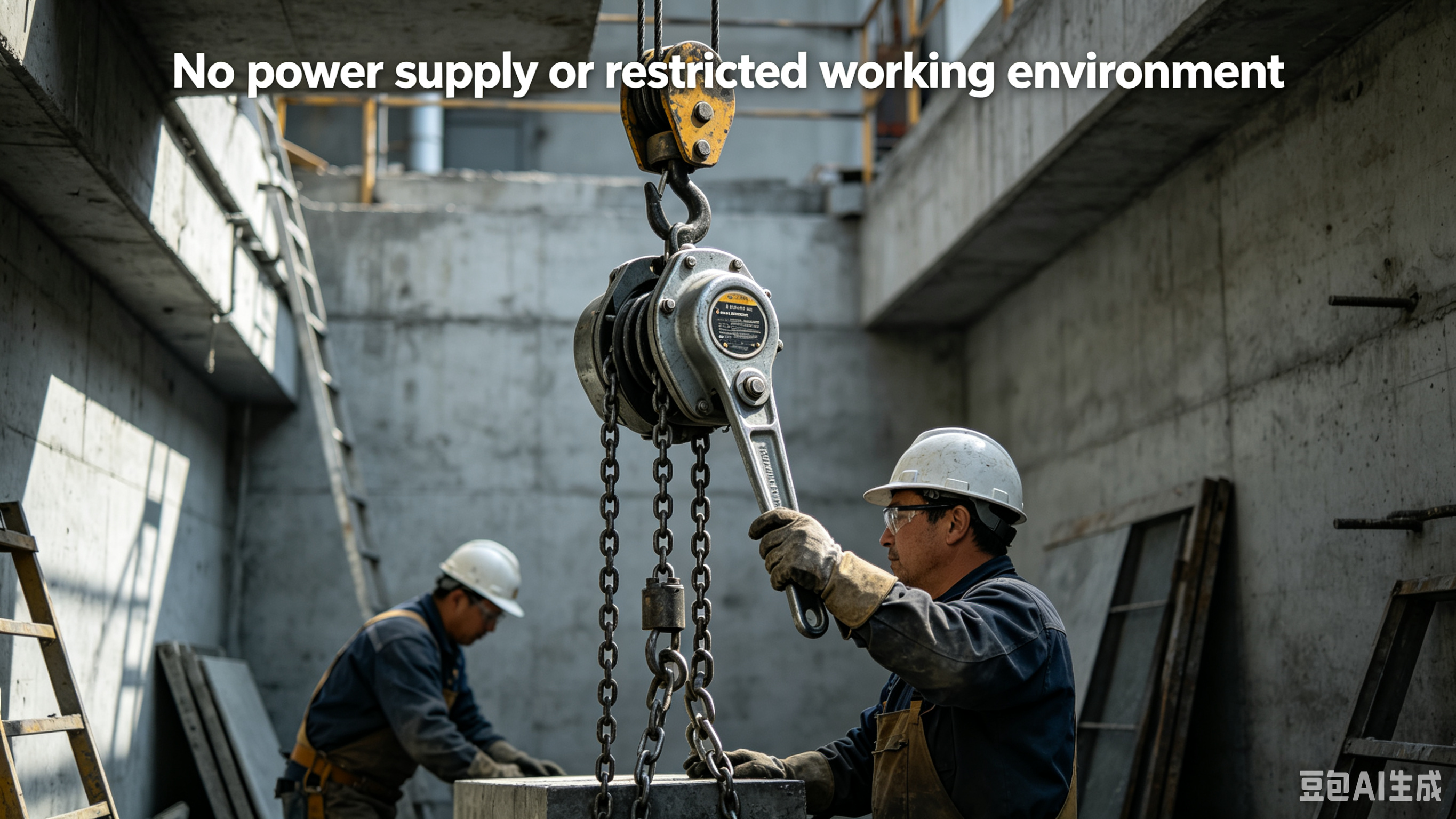
Shipbuilding lifting problems are rarely about rated capacity. A hull block, an outfitting package or a propeller shaft is usually well inside the range of a standard chain block. What decides whether the lift can be rigged is the space above the load, the distance between frames, the sling hardware that has to sit in the hook, and whether a power source is within reach. That is the layer where a VD manual chain hoist has to be matched to the job — model by model, using headroom, chain falls and hand-chain geometry rather than a single tonnage figure.
This reference sets out how the VD chain block range from Baoding Junyun Hoisting Machinery Co., Ltd. (JUNYUNHOIST) maps onto hull and deck work, and which specification points a shipyard, repair yard or procurement team should verify before committing. JUNYUNHOIST is a Hebei-based manufacturer and trading company established in 2018, operating a 24,000 m² facility with 138 staff and an R&D team of 8, and reporting exports at roughly 80% of output to markets that include India, Russia, Vietnam, Brazil, Türkiye and the Middle East. The product figures below come from the company's published specification; the interpretation of what they mean for a shipyard is editorial.
Why hull and deck work is a different lifting problem
Shipyard lifting divides into two categories that are often discussed as one. Bulk transfer — moving a block, a module or a coil from the yard to the slipway — belongs to cranes and gantries. Positioning and holding belong to hoists that can be rigged inside the structure, close to the component, where the crane hook cannot reach. Hull and deck work is mostly the second category: fitting a structural part to its marked location, aligning a deck unit before welding, lowering a component into a machinery space, or stripping an engine, a shaft or a propeller during repair.
The company's application material describes the shipbuilding and repair use case in exactly those terms: precisely moving ship structural parts to designated locations for assembly, or hoisting and dismantling heavy components such as engines and propellers for repair. The working conditions listed for the product family explain why a manual format appears in this setting at all:
- No power supply, or a restricted working environment
- Precision installation and positioning operations
- Space constraints and work at height
- Maintenance, emergency repairs and temporary operations
- Explosion-proof and fire-safe environments
Read together, those conditions describe a hoist that is rigged inside the hull rather than beside it. A compartment with no power drop, a deck beam 800 mm above the lift point and a sling that must pass through a 30 mm hook opening is a specification problem, not a capacity problem. That is why headroom, fall count and hand-chain reach carry as much weight in shipbuilding selection as the rated load stamped on the housing.
The VD chain block specification at a glance
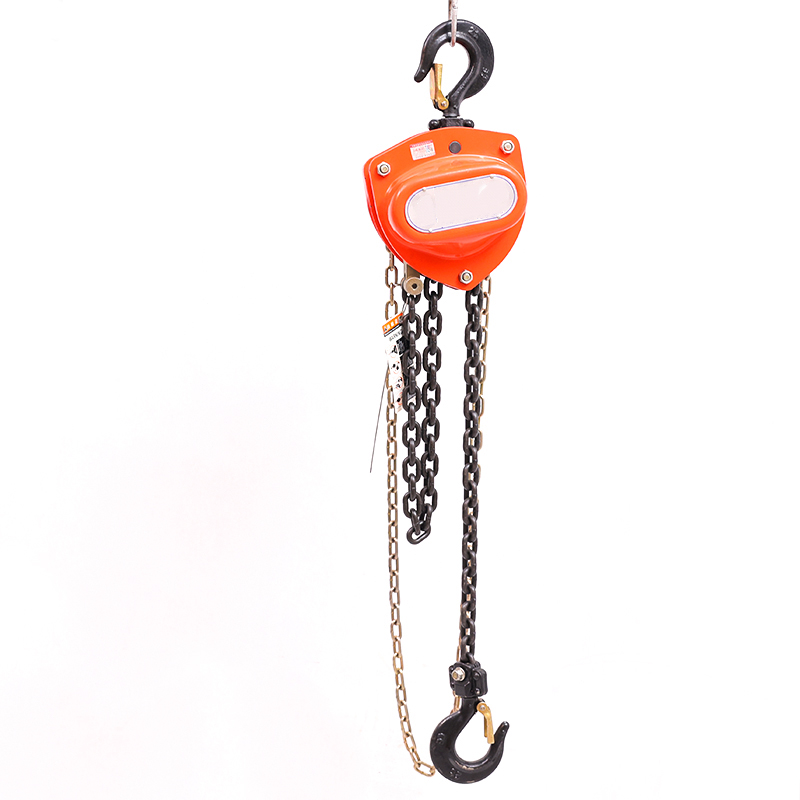
The VD chain block is a manually operated chain hoist that converts hand effort into lifting force through a mechanical gear system, and incorporates a reverse-drive self-locking braking system for controlled lowering and safe holding. Its published parameters define the envelope a shipyard is selecting within:
| Parameter | Published value | Why it matters in a hull |
|---|---|---|
| Rated load capacity | 0.5 – 50 t | The outer envelope, not the model choice |
| Standard lift height | 3 m (2.5 – 12 m optional) | Measured from the rigging point, not the deck |
| Number of chain falls | 1 – 4, depending on capacity | More falls share the load; more chain in the space |
| Load chain | Grade V (80-grade) or Grade T to DIN EN 818-7 | Check the grade marking against the certificate |
| Load chain diameter | 6.3 – 11.2 mm, varying with capacity | Compare only at equal capacity and fall count |
| Hand chain | Round link, galvanised or zinc-plated; length = lift height + 0.5 m slack | Must reach the operator's standing level |
| Hand-chain pull force | ≤ 35 daN (350 N) up to rated load | The human input per lift |
| Minimum headroom | 300 – 1000 mm, model dependent | The figure that decides whether it fits at all |
| Hook opening | 24 – 55 mm | Must clear the sling, shackle or clamp |
| Hook material | Forged alloy steel, heat-treated | Ask for the load marking on the hook |
| Safety factor | ≥ 4:1 on chain; ≥ 5:1 on structural parts | A design factor, not an operating allowance |
| Operating temperature | −20 °C to +50 °C with standard grease | Outside this band, ask before specifying |
| Finish | Painted housing in RAL 2000 or RAL 1007; corrosion-resistant chains | Protection, not a marine stainless specification |
| Declared standards | ISO 16872, EN 13157, ASME B30.21; CE marked | Verify documents and model scope, not the label |
Headroom, chain falls and lift height decide the model
Minimum headroom is a model figure, not a tolerance
The minimum headroom, or hook-to-housing distance, is published as 300 mm to 1000 mm depending on model. That spread is not a manufacturing tolerance; it is the difference between models in the range. A buyer who quotes only tonnage can be offered a unit that meets the load requirement and still cannot be rigged under a deck beam. The practical measurement is taken from the highest working position of the hook to the nearest obstruction — deck beam, frame, pipe run or staging — with the rigging included. If the figure is not available for the specific model being quoted, the quotation is incomplete.
Chain falls change what hangs in the compartment
The range runs from one to four chain falls depending on capacity. In a multiple-fall arrangement the load is shared across parallel chain falls, which is why capacity rises with fall count for a given chain size. The trade-off is physical: more chain hangs in the load path and sits where the operator needs to work, and a given length of hand-chain travel produces a shorter lift. Inside a tank or a double bottom, that geometry matters more than it does in an open shop bay.
Lift height and hand-chain reach
Lift height is standard at 3 m, with 2.5 m to 12 m available as an option. In a hull, the relevant distance is from the rigging point to the lowest point the hook must reach, plus the rigging stack — not the height of the compartment. Ordering lift height that the job does not need leaves excess chain to manage in a confined space; ordering too little makes the lift impossible regardless of capacity. Hand-chain length is set as lift height plus 0.5 m of slack, and in shipbuilding the operator often stands on a level above or below the hoist, so it should be specified as a separate line item rather than assumed.
Pull force and hook opening in a confined compartment
The hand-chain pull force is published at ≤ 35 daN, or 350 N, up to rated load — roughly 35 kgf, which is a meaningful figure for a person working at arm's length in a compartment. It is the right number to compare between quotations at equal capacity and fall count, because a lower pull force reduces the physical input required for each lift. Where a task involves many lifts per shift rather than a single placement, the pull force and the operator's standing position should be evaluated together on site, not only on the datasheet.
Hook opening is published at 24 mm to 55 mm. This is the dimension that quietly consumes headroom: if the sling, shackle or plate clamp will not pass cleanly through the hook, an adapter is needed, and the adapter adds stack height between the hook and the load. In a compartment already close to the minimum headroom figure, that extra height can be the difference between a rigged lift and an abandoned one. Measure the actual rigging hardware — thimble, shackle pin, clamp eye — before selecting the hook, and confirm that the hook carries its load marking and that the forged, heat-treated alloy steel specification is stated on the document supplied with the unit.
Chain grade, housing finish and temperature range
The load chain is specified as Grade V (80-grade) or Grade T in accordance with DIN EN 818-7, in diameters from 6.3 mm to 11.2 mm depending on capacity, with the material list naming 20Mn2, 25MnV and 23MnNiMoCr54. The declared safety factors are at least 4:1 on the chain and at least 5:1 on structural parts. Those are design factors built into the product, not headroom above the rated load — a 4:1 chain factor is never an instruction that a 4 t lift may be made on a 1 t block, and planning any lift above rated capacity is outside the product specification.
Corrosion is the slow variable in a shipyard. Humidity, salt-laden air, wash-down water and condensation inside tanks all act on the most exposed element, which is the chain. The specification addresses this with corrosion-resistant chain and a painted housing in RAL 2000 or RAL 1007 — both yellow-family paint references, which also help a hoist stay visible against a dark hull interior. That finish should be read for what it is: a protective coating specification, not an equivalent of a marine-grade stainless build. Where a hoist lives in continuous salt spray or in a tank that stays wet, the customization list includes stainless steel and explosion-proof variants, available on request, and that question belongs in the enquiry rather than in an assumption after delivery.
The operating temperature band is −20 °C to +50 °C with standard grease. It covers open-deck work in winter and the warm machinery spaces a hoist is carried into during commissioning, but it is a stated band rather than an unlimited one. Work outside it — whether cold-store compartments, heated process areas or adjacent hot work — should be raised at quotation stage, together with the high-temperature resistant configuration, which is offered on request. Standard configuration is described as meeting general requirements; the special configurations are what a yard should ask about when the general requirement does not describe its compartment.
Standards and CE marking: the verification points
The VD chain block is declared against ISO 16872, EN 13157 and ASME B30.21, and is CE marked. These declarations are the starting point of a verification process, not its conclusion, and shipbuilding procurement teams typically treat them that way. Four checks repay the effort.
One: match the standard to the equipment class. ASME B30.16-2022 is the ASME volume that governs construction, installation, operation, inspection and maintenance of manual hand chain-operated hoists, as published by the American Society of Mechanical Engineers. The VD listing cites ASME B30.21, a separate volume in the same B30 series. Where a project specification names B30.16, the buyer should ask the supplier to state which document the specific model has been assessed against and to supply the corresponding declaration, rather than resolving the difference internally.
Two: treat CE marking as a declaration. CE marking is the manufacturer's declaration that the product meets the applicable legislation, supported by a technical file; it is not in itself a third-party test report. Ask for the declaration of conformity, the standards it cites, the model and capacity range it covers, and the point of contact for the technical file. A marking on a housing without that document set does not tell a shipyard what it needs to know.
Three: tie the chain certificate to the chain supplied. The load chain grade and the DIN EN 818-7 reference should appear both on the chain marking and on the certificate that travels with the consignment. A certificate for a different grade or a different diameter is a common source of confusion and is easy to check at goods-in.
Four: ask what the test record contains. The company states 100% testing in its quality control process. The useful follow-up is what the inspection record shows for the model supplied, whether it travels with the shipment, and how it is referenced on the packing documents. In published supplier listings it is common to see CE and ISO 9001 claims with no certificate number, issuing body or model scope attached; those claims are not a substitute for documents that name the unit being delivered.
Matching the hoist to specific hull and deck tasks
Scenario matching is where the specification stops being a table and becomes a configuration. The same range covers all of the tasks below, but the emphasis changes with each one, and the verification question changes with it.
| Shipbuilding task | Configuration emphasis | Verify before order |
|---|---|---|
| Hull block fit-up and structural part positioning | Lowest available minimum headroom; fall count no higher than the load requires; self-locking brake for holding during alignment | Model-specific headroom figure and rated load at the actual rigging point |
| Deck outfitting and equipment placement | Longer lift height than a shop lift; hand chain routed to the deck-level operator | Lift height and hand-chain length as separate quoted values |
| Engine, propeller and heavy component removal | Upper end of the capacity range; hook opening sized for the sling or shackle; rigging above the component | Capacity, hook opening, and both chain and structural safety factors on the document |
| Tank, double-bottom and confined compartments | No power dependency; corrosion-resistant chain; hand chain reaching the operator's standing level | Chain finish, hand-chain length, and whether an operator can stand and complete a full pull stroke |
| Emergency repair and temporary operations | Manual operation where no power drop exists; unit moved between lift points | Configuration and inspection status of the unit before each use |
| Explosion-proof and fire-safe areas | Standard configuration for general requirements; explosion-proof and high-temperature resistant configurations on request | Certificate scope covering that specific configuration, not the standard unit |
Auxiliary equipment belongs in the same planning step. The application material lists slings, special hooks, magnetic lifters, steel plate and oil drum clamps, wire rope assemblies, manual trolleys and load detectors as supporting equipment. Each of these changes the stack height at the hook, and each has its own verification requirement, so a lift plan that names the hoist but not the rigging has not yet been checked against the headroom figure.
Manual chain blocks against powered lifting: where the boundary sits
The honest comparison in a shipyard is not manual versus powered in the abstract; it is a fit decision about power availability, duty pattern, headroom and control. Where the lift point has no usable power, or where powered equipment is restricted in the space, the manual chain block's purely mechanical operation is the reason it is there. Its reverse-drive self-locking brake also holds the load when the operator stops pulling, which matters when both hands are needed to align a component before welding.
The boundary runs in two directions. First, the input is human: at ≤ 35 daN up to rated load, the manual format has a defined relationship between load and operator effort, and a task built around many repeated lifts rather than a single placement sits closer to that limit. Where power and access allow, a powered option may be the better fit for that duty pattern. Second, nothing in this comparison establishes that a manual chain block outperforms powered lifting in a shipyard — the fit depends on the conditions of the specific lift, and claims of general superiority are not supported by the specification. Within the same portfolio, lever blocks are described as compact and suited to tight spaces, tensioning and positioning, so a yard may reasonably plan on both formats in different parts of the same project.
What the market context adds — and what it does not
Commercial research published in 2026 values the global manual chain hoist market at USD 4.85 billion, with more than 18 million units estimated to be operational or sold annually (Business Research Insights, 2026). Both figures describe the manual hoist category as a whole: they are not shipbuilding-specific, they rest on commercial estimates rather than official statistics, and published market values for this category vary with how the product boundary is defined. What they do support is a procurement judgement rather than a market forecast — the manual chain block is a large, continuing category, which is relevant when a yard sets spare-parts terms, repeat-order specifications and a documentation standard it expects to hold for a vessel's service life.
The same research describes standard manual chain blocks as typically using Grade 80 alloy steel load chain with safety factors above 4:1, which is consistent with the VD specification's Grade V (80-grade) or Grade T chain and its declared ≥ 4:1 chain factor. That consistency is useful context for a specification review; it is not independent verification of any individual supplier's product.
A pre-order verification checklist
| Check | What to request |
|---|---|
| Fit | Model-specific minimum headroom and rated load at the actual rigging point |
| Geometry | Lift height, fall count and hand-chain length quoted as separate values |
| Rigging interface | Hook opening measured against the sling, shackle or clamp actually used |
| Chain | Grade marking and DIN EN 818-7 certificate matching the chain supplied |
| Conformity | Declaration of conformity with standards cited and the model and capacity range covered |
| Environment | Corrosion exposure, temperature band and whether a special configuration is required |
| Records | Inspection record for the unit supplied and how it is referenced on shipping documents |
| Supply terms | Customization options, minimum order quantity, lead time and spare-parts arrangement |
On the supply side, the company's stated terms are a monthly capacity of 15,000 pieces, a lead time of 15–20 days and a minimum order quantity of 50 pieces, with OEM/ODM customization covering colour, load-bearing chain length, accessory quality and scenario-specific builds such as stainless steel or explosion-proof versions. After-sales support is described as a quantity of easily damaged spare parts supplied with each container and replenished according to subsequent use. For a yard running a multi-vessel programme, the practical question is whether those terms hold across repeat orders and whether the specification sheet attached to the second order matches the first.
Outlook
The direction of travel in shipbuilding procurement is documentation rather than novelty. A hoist that fits a confined compartment is a solved mechanical problem across the range; what increasingly separates suppliers is the file that arrives with the unit — a chain certificate that matches the chain, a declaration that names the model, an inspection record that survives goods-in, and a stated position on the standards a project actually cites. Buyers evaluating for a repair yard or a newbuild programme can reasonably put those documents on the same level as capacity, headroom and finish, because a lift is only as qualified as the evidence behind the equipment performing it.
FAQ
What capacity and lift height does a VD chain block cover for hull and deck work?
The VD chain block range covers rated loads from 0.5 t to 50 t and lift heights from 2.5 m to 12 m as an option, with 3 m as the standard lift height. The number of chain falls runs from one to four depending on capacity, and the minimum headroom varies from 300 mm to 1000 mm by model. For a specific lift, the capacity figure should be read together with the model's headroom and fall count, because a unit that meets the load requirement can still be unusable in a compartment with restricted clearance.
How do I choose between one and four chain falls?
The fall count follows from the rated capacity required at the lift point, since multiple falls share the load across parallel chain sections. The consequence inside a hull is practical: more falls mean more chain hanging in the load path and a shorter lift for each length of hand-chain travel. The selection question is therefore the capacity required at the actual rigging point, checked against the space available for the chain to hang and for the operator to work.
Can a VD chain block be used where there is no power supply or in explosion-proof areas?
The chain block operates in a purely mechanical mode, converting hand effort through a gear system with a reverse-drive self-locking brake, so it does not depend on a power supply at the lift point. No power supply or a restricted working environment is one of the conditions the product family is listed for. Standard configuration is described as meeting general requirements, while explosion-proof and high-temperature resistant configurations are available on request; where a compartment is classified, the certificate scope for that specific configuration should be confirmed rather than assumed from the standard unit.
What supporting equipment is needed for a shipbuilding lift?
The application material lists slings, special hooks, magnetic lifters, steel plate and oil drum clamps, wire rope assemblies, manual trolleys and load detectors as supporting equipment. Each item affects the stack height between the hook and the load, and therefore the headroom consumed. A lift plan should measure the complete assembly — hook, sling, clamp and load — against the model's minimum headroom and hook opening before the hoist is specified.
Which standards and documents should be checked before acceptance?
The VD chain block is declared against ISO 16872, EN 13157 and ASME B30.21 and is CE marked. Before acceptance, request the declaration of conformity with the standards it cites and the model and capacity range it covers, the DIN EN 818-7 chain certificate matching the grade and diameter actually supplied, and the inspection record for the unit. Where a project cites ASME B30.16-2022, the ASME volume governing manual hand chain-operated hoists, confirm with the supplier which document the specific model was assessed against.
Contact and further information
Product and company details are published at JUNYUNHOIST, the official website of Baoding Junyun Hoisting Machinery Co., Ltd. OEM/ODM enquiries covering capacity, chain length, finish, colour and scenario-specific configurations can be directed to the company's WhatsApp line on +86 134-8345-2631. The company brochure is available for download at the Junyunhoist brochure.
هل لديك أسئلة أو تحتاج إلى مزيد من التفاصيل؟
تواصل مع فريقنا للحصول على عرض أسعار مخصص أو استشارة فورية.
طلب عرض أسعار
املأ النموذج أدناه وسيتواصل معك فريقنا بعرض مقترح مخصص.
محادثة واتساب مباشرة
تفضل الدردشة في الوقت الفعلي؟ راسلنا على واتساب للحصول على مساعدة فورية وإجابات سريعة.
- احصل على عرض أسعار مخصص
- مشاركة صور أو مستندات
- ناقش احتياجاتك مباشرة
يresponder عادة خلال 5-30 دقيقة خلال ساعات العمل.