
Chain Conveyor Fabrication for Automotive Assembly Lines
A chain conveyor on an automotive assembly line is a structural system before it is a material-handling system. The chain, drive and controls decide how the line moves; the fabricated steel frame decides whether the line keeps moving in the same position. In smart manufacturing, that frame also carries robot pedestals, sensor brackets, locating pins and interfaces to automated guided vehicles, so a few millimetres of drift becomes unplanned downtime rather than a cosmetic defect.
That shift has changed what buyers actually purchase. When a conveyor frame was a plain welded structure, it could be sourced on tonnage price. When the same frame is a locating datum for automation, it has to be sourced on process control: how the plate is cut, how the weld distortion is managed, where the mounting faces are machined, and what inspection records travel with the delivery.
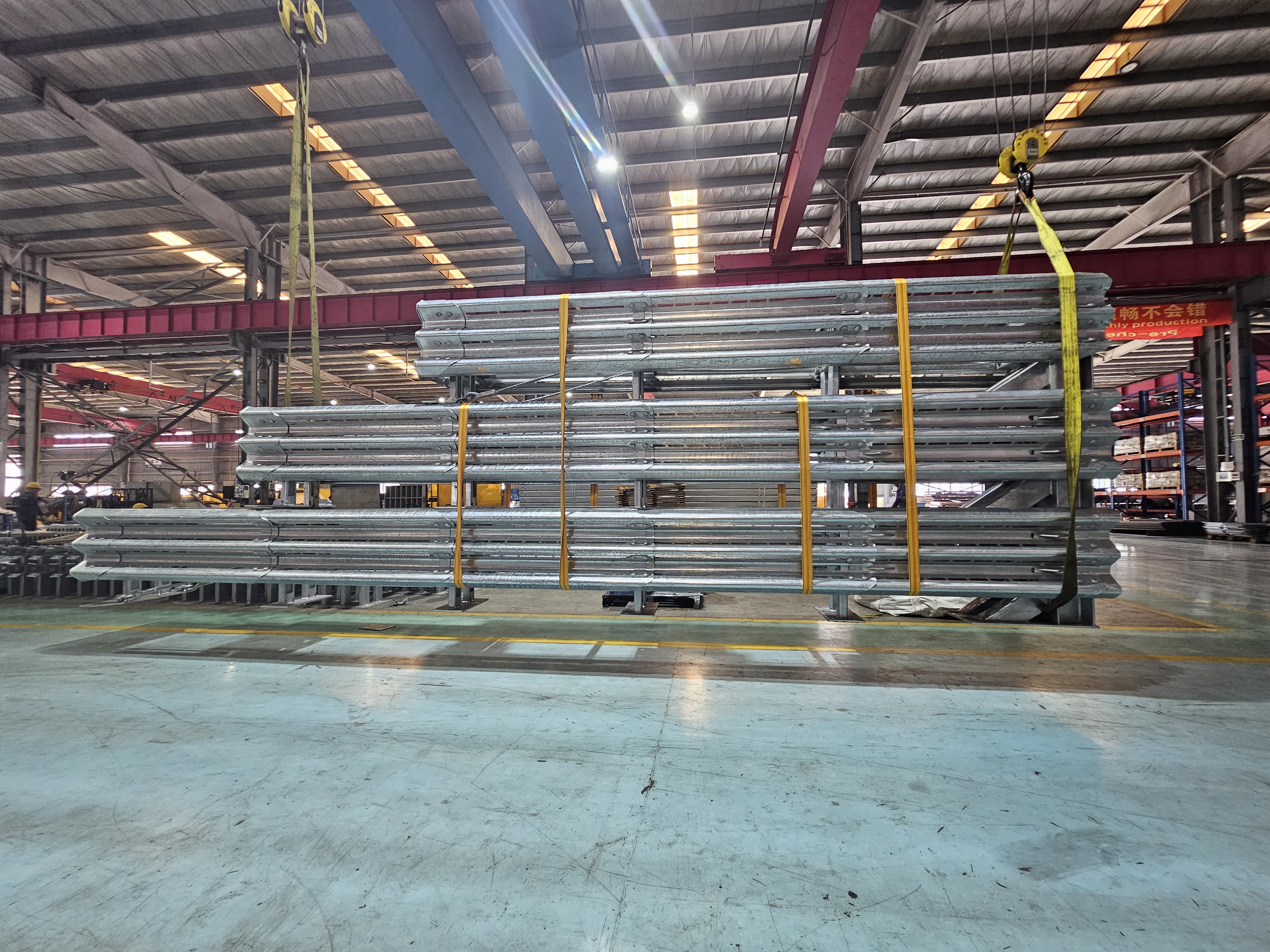
Assembling workshop near Xiamen Port, where fabricated steel frames are fitted out before dispatch.
The practical problem: conveyor frames became locating datums
In a conventional assembly hall, a chain conveyor frame is bolted to the floor, aligned once, and adjusted when something drifts. In a smart manufacturing layout, the same frame is a reference for equipment that cannot be re-taught every shift: robot bases, vision cameras, pallet stops, safety scanners, transfer units and AGV handover stations. Each of those interfaces inherits the geometry of the frame.
Three consequences follow for buyers at the decision stage.
- Geometry matters more than weight. A frame that is over-welded and under-machined can pass a visual inspection and still fail the robot repeatability check.
- Wear paths matter earlier. Chain support rails, wear strips and sliding surfaces sit on the fabricated structure, so surface preparation and finishing quality set the maintenance interval.
- Documentation becomes part of the product. Without material certificates, in-process records and final inspection reports, an automotive buyer cannot close the incoming quality loop.
What custom metal fabrication of a chain conveyor actually covers
Custom metal fabrication of a chain conveyor is the fabrication and machining of the structural package around the conveyor chain: the line-side steel frame, structural steel legs and cross members, chain support beams, side channels, mounting plates, drive and tensioning brackets, guarding supports and the module interfaces that allow the line to be erected in sections. It is a fabrication scope, not a conveyor engineering scope — the distinction matters when buyers compare offers.
The typical process chain is plate cutting (laser or plasma), forming and bending, fit-up and welding of prefabricated steel components, post-weld machining of mounting faces, surface finishing such as galvanizing or powder coating, and pre-assembly of modules before packing. Casting, forging and roll forming enter the scope when the conveyor design includes cast bearing housings, forged pins or rolled sections.
Openex (Xiamen Openex Mechanical Technology Ltd) is a custom metal fabrication and machining supplier founded in 2009, operating two manufacturing premises near Xiamen Port and Shanghai Port with 30,000 m² of factory space, around 200 employees and 35 engineers. Its documented process range includes laser cutting, bending, punching and stamping, welding, machining, roll forming, casting, forging, galvanizing, powder coating and assembly, and its stated sector coverage includes steel frames, steel chassis, beams, columns and pressure vessels for Energy Storage, Automotive, Machinery, Transportation, Oil & Gas, Road & Bridge construction and Mining.
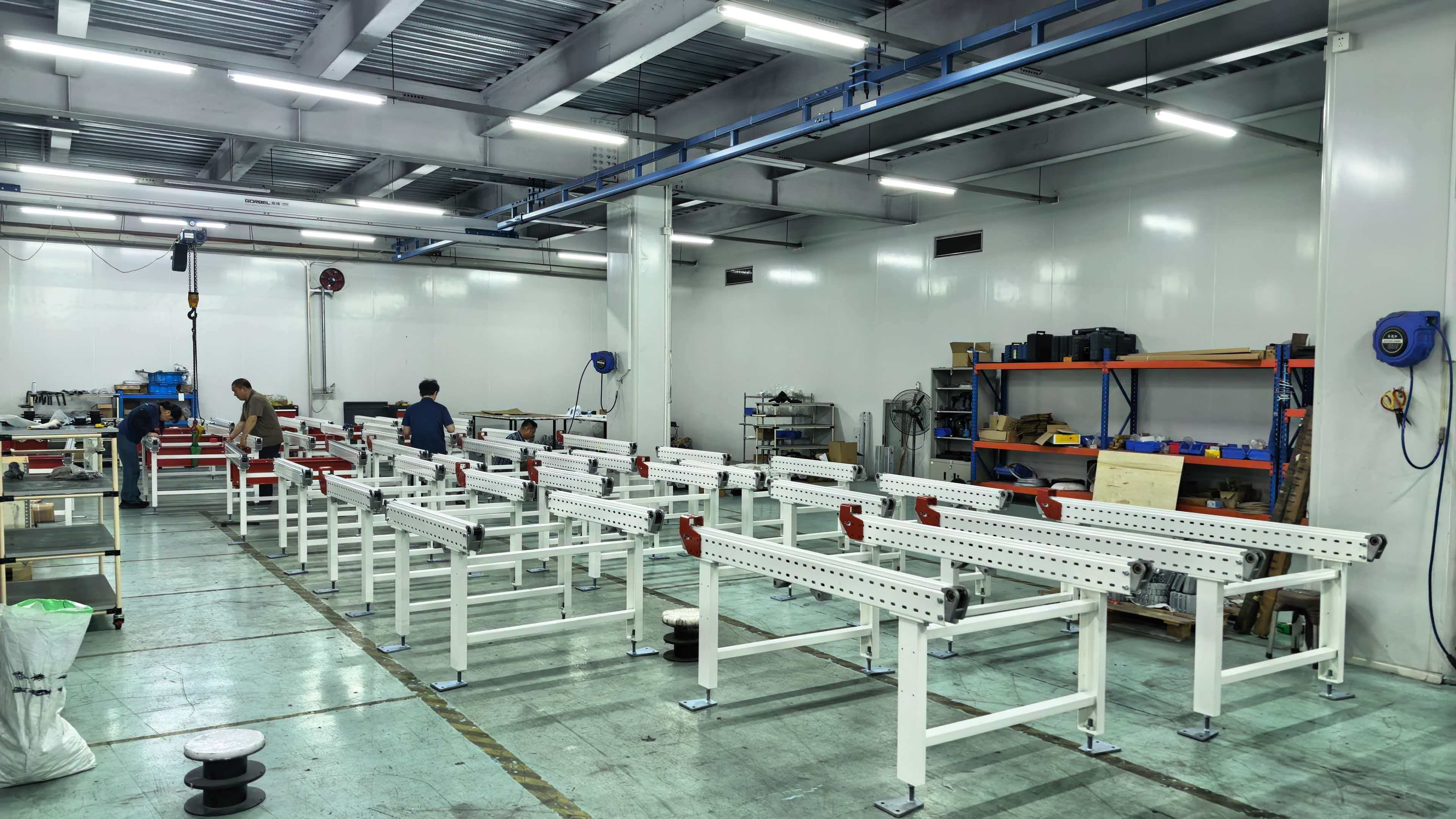
Conveyors for automation: steel frame fabrication and assembly at the Xiamen Port premise.
Four requirements that decide whether a conveyor frame performs
1. Load capacity, expressed in fabrication terms
Load capacity is usually written as a payload figure, but the fabrication purchase is really about section size, plate thickness, weld size and handling capability. A fabricator that cannot lift or turn a 12 m frame module cannot guarantee its straightness, because the frame will be repositioned and re-clamped between passes. In Openex's case, the documented heavy fabrication envelope includes an overhead crane capacity over 250 t, CNC press braking up to 18 m and 10,000 t, plate rolling of thick plate over 200 mm, and a metal thickness range from 1 mm to 200 mm. Those limits define which conveyor frames are feasible and which have to be split into bolted modules.
2. Wear resistance, expressed in material and finishing control
Wear on a chain conveyor concentrates at support rails, guide surfaces and sliding interfaces. Fabrication influences that wear path in two ways: the material actually delivered, and the surface condition it is delivered in. Openex's documented control measures include checking incoming material against steel mill certificates, an incoming inspection flow (DK-WI-QA-S6-007), mechanical property verification by tensile testing on an in-house tensile testing machine, and galvanizing thickness verification with a film thickness tester. For buyers specifying galvanized steel fabrication, that last check converts a coating note on a drawing into a measurable acceptance criterion.
3. Alignment, expressed as machining after welding
Welding moves steel. A conveyor frame welded from steel channel, steel beam and steel angle sections will distort, and no amount of careful welding removes the distortion entirely. The reliable route is to leave machining allowance on critical faces, weld first, then machine the mounting and locating faces in one set-up. Openex describes large CNC machining performed after welding fabrication to maintain precision, with maximum CNC machine tool travel documented up to 50 m × 8 m × 7 m. That single capability is what separates a conveyor frame that accepts a robot base without shimming from one that does not.
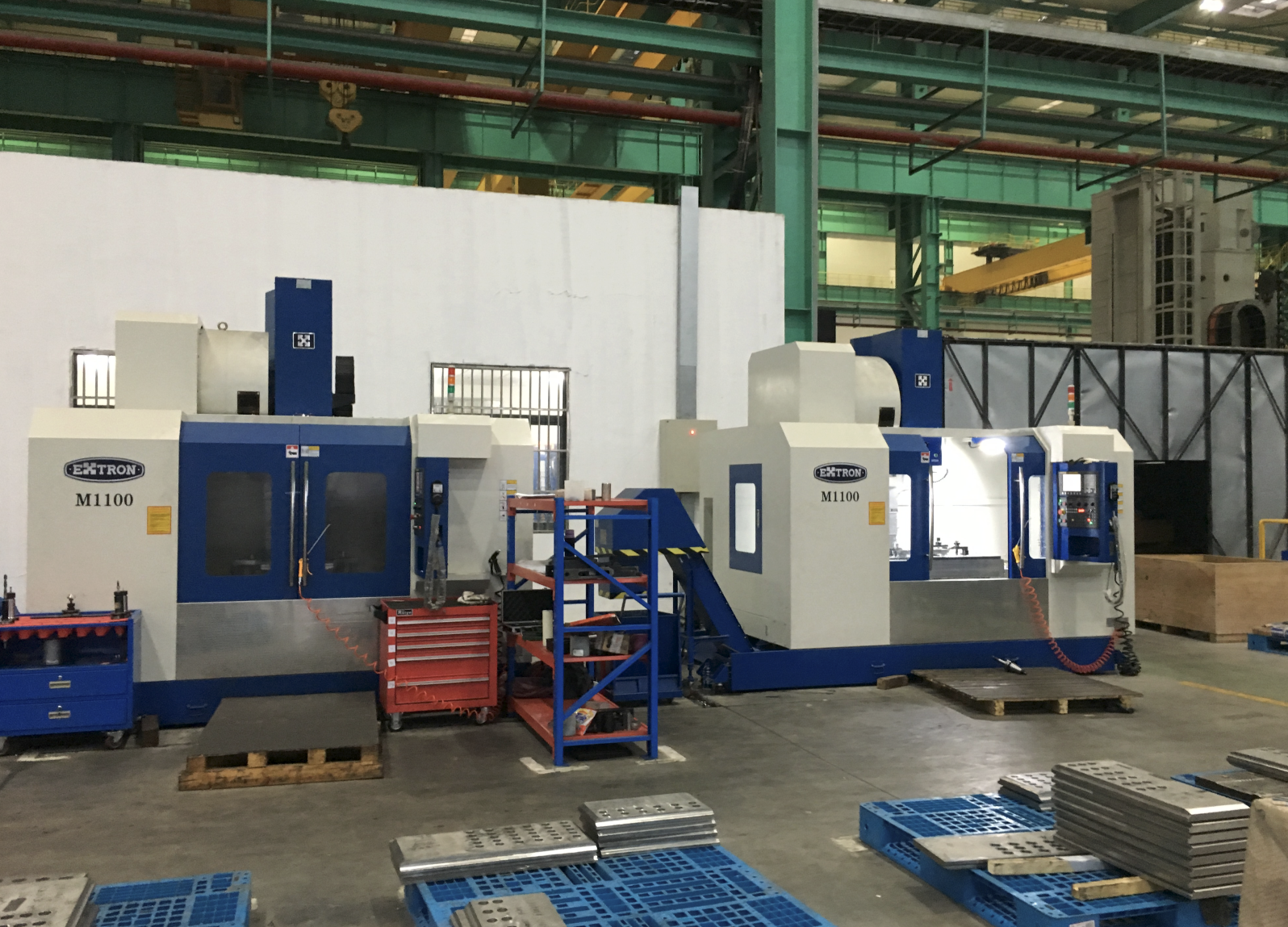
Medium-size CNC machine tools at the Shanghai Port premise, used for post-weld machining of mounting faces.
4. Integration with automated systems
Integration is often treated as an electrical topic, but the physical interfaces are fabricated: sensor bracket flats, cable tray supports, guarding anchor points, floor anchor patterns and transfer-unit seats. On the vehicle side of the same plant, Openex documents an AGV steel chassis (model PSA-1) intended for the Port Container Tractor, Terminal Tractor Chassis or Yard Tractor industry — an example of how fabricated steel chassis and steel skid structures sit inside automated material flow rather than beside it.
How the capability maps to the requirement
| Requirement | Fabrication lever | Documented evidence |
|---|---|---|
| Load capacity | Section sizing, plate thickness, lifting and forming limits | Crane over 250 t; press brake up to 18 m × 10,000 t; thickness range 1–200 mm; plate rolling over 200 mm |
| Wear resistance | Material verification, surface preparation, coating thickness | Steel mill certificate checks; tensile testing; galvanizing thickness by film thickness tester |
| Alignment | Post-weld machining in a single set-up | CNC machining after welding; machine travel up to 50 m × 8 m × 7 m |
| Integration | Interface machining, module pre-assembly | Conveyor frames fabricated and assembled near Xiamen Port; AGV steel chassis PSA-1 for terminal tractor applications |
Comparison with alternative supplier profiles
Decision-stage buyers rarely compare one fabricator against another in the abstract; they compare supplier profiles. Two reference profiles appear in Openex's own comparison data: Swanton Weld, a US-based fabricator with smaller cutting, forming and lifting capacity, and XMWenzhong, a supplier concentrated on stainless steel sheet metal work. Both comparisons are about fabrication capacity and cost position, not about conveyor engineering competence.
| Parameter | Openex | Swanton Weld |
|---|---|---|
| CNC laser cutting | Up to 20 kW, bed 8 × 2.5 m | Max 4 kW, bed 4 × 2 m |
| CNC press braking | Up to 10,000 t × 18 m; more than 10 machines of different capacity | Max 400 t × 3.5 m |
| Plate rolling | Thick plate over 200 mm | No more than 20 mm |
| Maximum overhead crane | 250 t | 20 t |
| Stated cost position | Company data: 75% lower cost versus Swanton Weld; 25% or better price advantage over American fabricators | Reference point |
| Best-fit project size | Large-scale fabrication requiring at least a full container load | Not stated in the source data |
Source: Openex comparison data. Capacity figures are equipment specifications; cost positions are company-stated and should be re-tested against a buyer's own drawing package and RFQ.
| Parameter | Openex | XMWenzhong |
|---|---|---|
| Process scope | Wide range: cutting, bending, roll forming, welding, machining, finishing, assembly | Sheet metal fabrication, particularly stainless steel sheet |
| Metal thickness handled | 1 mm to 200 mm | Thin sheet focus |
| Steel plate cutting | Up to 40 mm | Under 5 mm in the source data |
| Relative capacity ratios | Welding 10 : 1; bending 10 : 2; roll forming 10 : 1; machining 10 : 1 | Reference point |
| Machining capability | Substantial CNC capacity for post-weld work | Limited CNC machining capacity |
| Cost position | Similar for stainless sheet metal work; superior in other areas per company data | Similar for stainless sheet metal work |
The decision rule that emerges is not "larger is better". It is scope matching. A conveyor frame built from 20 mm plate, 300 mm steel channel and machined drive brackets sits outside the practical range of a thin-sheet shop; a simple stainless guard panel sits comfortably inside it.
Where the boundaries are
A credible supplier comparison has to state where the supplier is not the right answer. Four boundaries apply to this scope.
- Project size. Openex states that its offer is more suitable for large-scale fabrication projects requiring at least a full container load. A single replacement frame or a small line modification is usually faster to source regionally.
- Thin stainless sheet work. For stainless steel sheet metal fabrication, Openex and XMWenzhong are described as having similar costs, and production efficiency is described as comparable. The capacity advantage does not apply there.
- Scope type. The documented capability is fabrication and machining — cutting, forming, welding, machining, finishing and assembly. Conveyor chain selection, drive sizing and control architecture remain the responsibility of the conveyor OEM or the plant's automation team.
- Evidence type. Mill certificates and inspection reports document material and process conformity; they do not by themselves prove in-service conveyor performance. Run-off testing at the plant still has to be planned by the buyer.
What to verify when specifying conveyor fabrication
The checks below are the ones that change outcomes on an automotive assembly line. They are written as decision questions rather than general advice, so they can be inserted directly into an RFQ or a supplier audit sheet.
| Decision question | What to ask for | Why it matters on a conveyor |
|---|---|---|
| Can the supplier handle the module size? | Crane capacity, press brake length, machine travel, maximum plate thickness | Determines whether the frame can be built in one piece or must be split into bolted modules |
| Is the material traceable? | Steel mill certificates, incoming inspection records, tensile test results | Wear life and weld integrity depend on the steel actually delivered |
| How is alignment achieved? | Machining allowance on critical faces; post-weld machining; inspection plan | Robot bases and transfer units inherit frame geometry |
| Is the finish measurable? | Coating specification plus thickness measurement records | Galvanizing thickness sets corrosion behaviour in wash-down or humid zones |
| What documentation ships with the frame? | First-article inspection, in-process control records, final inspection report | Allows the plant to close incoming quality without re-inspecting everything |
Market context: why fabrication scrutiny is rising
The demand side is large and slow-moving, which is exactly why process quality becomes the differentiator. Strategic Market Research values the global fabricated metal products market at USD 2.35 trillion in 2024. Steel remains the dominant input: in North America, steel accounted for 63.2% of material market share in fabricated metal services in 2024, according to aggregated Mordor and Report Insight data, and structural steel components represented 39.3% of application share globally in the same year.
Growth expectations differ by methodology. Market Research Future projects a 3.3% CAGR for steel fabrication over 2025–2035, while Mordor Intelligence reports a much higher 7.14% CAGR for 2025–2030; the roughly tenfold gap in market size between the two estimates suggests different scope definitions, with the higher figure likely including primary steel services. Buyers should treat such ranges as context, not as a planning input.
Two signals matter more for conveyor procurement. First, technology adoption: 48% adoption of CNC cutting, robotic welding and laser technology in metal fabrication was reported for 2024, a derived figure with medium confidence. Second, labour: US fabricated metal product manufacturing employment stood at 1,460.8 thousand in August 2024, per the Bureau of Labor Statistics (NAICS 332). Where skilled welding and fitting labour is tight, buyers shift risk to suppliers that can document process control rather than promise craftsmanship.
Future outlook
Three changes are likely to shape conveyor fabrication specifications over the next planning cycles. Fabricated frames will carry more embedded interfaces, so post-weld machining and documented dimensional records will become standard line items rather than optional extras. Finishing will be specified as a measured value rather than a process name, because coating thickness is now checkable with handheld film thickness testers. And supplier evaluation will lean on evidence packages — mill certificates, in-process records, inspection reports — because those documents are the only practical way to audit a fabrication supply chain that spans multiple premises and export markets.
For Openex, the relevant question is not whether the capacity exists — a 30,000 m² footprint, two premises near Xiamen Port and Shanghai Port, 20,000 tons of annual output and an 80% export ratio across the EU, USA, Australia, New Zealand, Japan, Singapore, South America and the Middle East describe a supplier built for export-scale work. The relevant question is whether a given conveyor package sits inside that envelope of large-scale, heavy and machined fabrication, and whether the buyer has specified the evidence required to prove it.
FAQ
How should buyers compare chain conveyor fabrication quotes from different suppliers?
Normalise the quotes to the same drawing package and the same inspection requirement first, then compare process limits: cutting thickness, press brake length and tonnage, rolling capacity, crane capacity, machining capability and finishing controls. A quote that assumes no post-weld machining is not equivalent to one that includes it, even when both are priced per tonne.
What load-related limits should be confirmed before awarding a conveyor frame order?
Confirm the maximum module weight the supplier can lift and turn, the maximum plate thickness it can cut and roll, and the longest single-piece forming it can perform. Openex documents an overhead crane capacity over 250 t, plate rolling of thick plate over 200 mm, press braking up to 18 m and 10,000 t, and a metal thickness range from 1 mm to 200 mm. Where a frame exceeds those limits, the design should be split into bolted modules at the drawing stage rather than at the factory.
How is alignment controlled in a welded conveyor frame?
Through sequence, not through welding skill alone: leave machining allowance on locating and mounting faces, weld the frame, then machine those faces in a single set-up. Openex describes large CNC machining performed after welding fabrication to maintain precision, with machine travel up to 50 m × 8 m × 7 m, supported by first-article inspection, in-process control and final inspection reports.
When is a large fabricator a better fit than a local sheet metal shop?
When the frame involves thick plate, long weldments, post-weld machining or a project volume of at least a full container load. For thin stainless steel sheet metal work, the comparison changes: Openex and XMWenzhong are described as having similar costs and comparable efficiency in that segment, so a local shop can be the more practical choice for small stainless components, cabinets and covers.
What documentation should accompany a conveyor frame delivery?
At minimum: steel mill certificates tied to the delivered material, incoming inspection records, mechanical property results where specified, in-process control records, a final inspection report and, for galvanized parts, coating thickness measurements. Openex states that it manages quality and delivery risk through documented quality management procedures, first-article inspection, in-process control, final inspection and inspection reports, with material traceability and certificates available for compliance review.
The Openex fabrication capability brochure can be downloaded here: Openex mechanical capabilities brochure (PDF).
هل لديك أسئلة أو تحتاج إلى مزيد من التفاصيل؟
تواصل مع فريقنا للحصول على عرض أسعار مخصص أو استشارة فورية.
طلب عرض أسعار
املأ النموذج أدناه وسيتواصل معك فريقنا بعرض مقترح مخصص.
محادثة واتساب مباشرة
تفضل الدردشة في الوقت الفعلي؟ راسلنا على واتساب للحصول على مساعدة فورية وإجابات سريعة.
- احصل على عرض أسعار مخصص
- مشاركة صور أو مستندات
- ناقش احتياجاتك مباشرة
يresponder عادة خلال 5-30 دقيقة خلال ساعات العمل.