
Charcoal, Explained: Types, Performance and Sourcing Signals
Charcoal, Explained: Types, Performance and Sourcing Signals
Charcoal is bought as one category but specified as many. In hookah lounges, the requirement is a low-ash coconut shell cube with stable heat for 90 to 120 minutes. In incense and bakhoor settings, it is a quick-lighting round tablet that produces no visible smoke. In commercial kitchens, it is a dense briquette that holds cooking temperature for hours. All three products sit inside the same category, yet each places different demands on raw materials, forming methods and quality control. The global charcoal market was valued at USD 8.1 billion in 2025 and is projected to reach USD 11.6 billion by 2033, according to Grand View Research. With that scale, understanding how the category is structured has become a practical first step for procurement.
What Charcoal Means in Commercial Sourcing
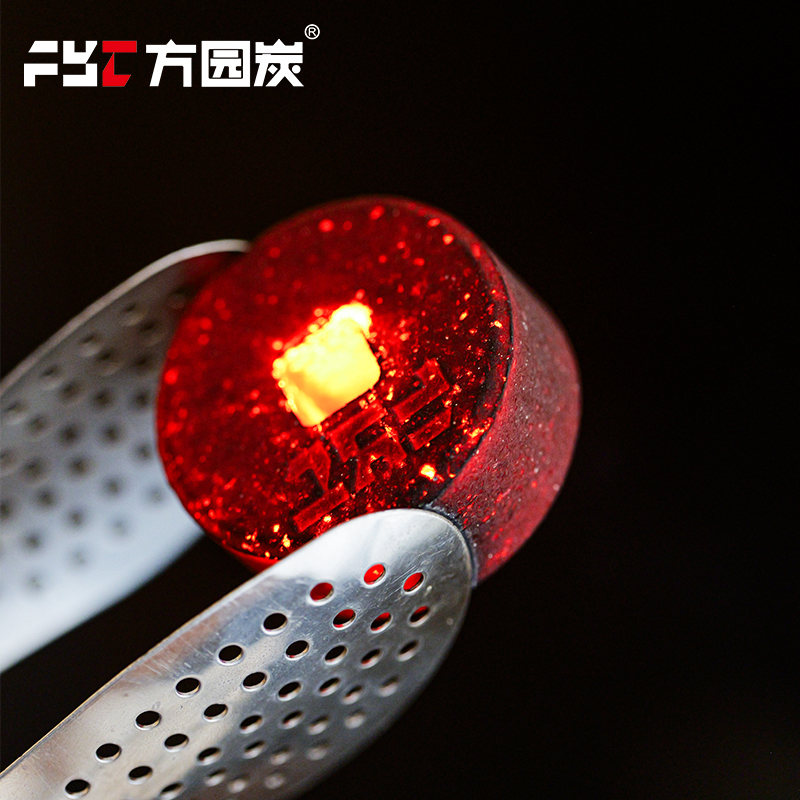
Charcoal is a solid fuel created by carbonizing biomass, typically wood, bamboo, coconut shell, or fruit wood, under controlled low-oxygen heating. In global trade, the term covers both natural lump charcoal and manufactured formats such as briquettes, tablets and sticks. Manufactured charcoal offers more consistent density, shape and combustion behavior, which is why it dominates hookah, incense and commercial barbecue segments.
Dalian Tiancheng Charcoal Industry Technology Co., Ltd. (FYC) is a charcoal manufacturer established in 1990, specializing in the research, development, sale and service of hookah charcoal, incense charcoal and barbecue charcoal. The company operates a 6,000-square-meter manufacturing facility in Liaoning and exports to markets including the Middle East and Europe, where export business accounts for 60% of total sales. FYC reports SGS and ISO certifications, and its product lines are organized by application rather than a single generic charcoal output.
Three Core Charcoal Segments
Hookah, incense, and barbecue charcoal may share the same material category, but their specifications differ in raw material, shape, burning time, ash content and ignition method. The following sections describe each segment based on FYC's commercial product structure.
Hookah Charcoal (TC-01)
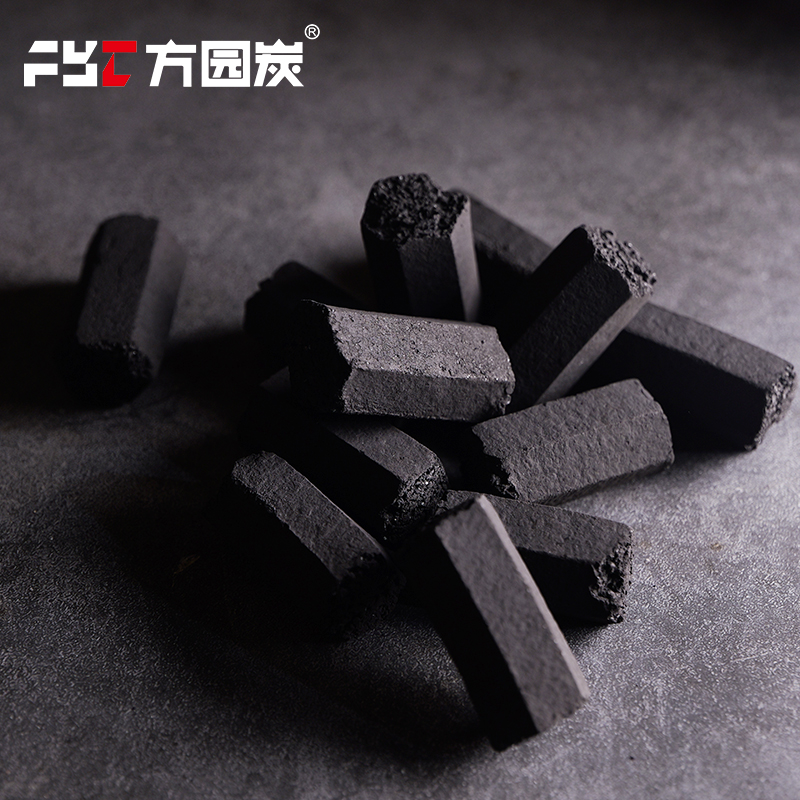
FYC's hookah charcoal product line includes cube hookah charcoal in 25mm and 40mm sizes, hexagonal hookah charcoal, and bamboo hookah charcoal. It is made from premium natural coconut shell and fruit wood. The technical parameters for this line include calorific value above 7,800 kcal/kg, burning time of 90 to 120 minutes for cube formats, ash content below 3% for premium grade, fixed carbon content above 85% to 90%, and quick-light or fast ignition options. The product is intended for hookah bars, shisha smoking, aromatherapy, yoga rooms, incense burners, and home relaxation.
Incense Charcoal (TC-04)
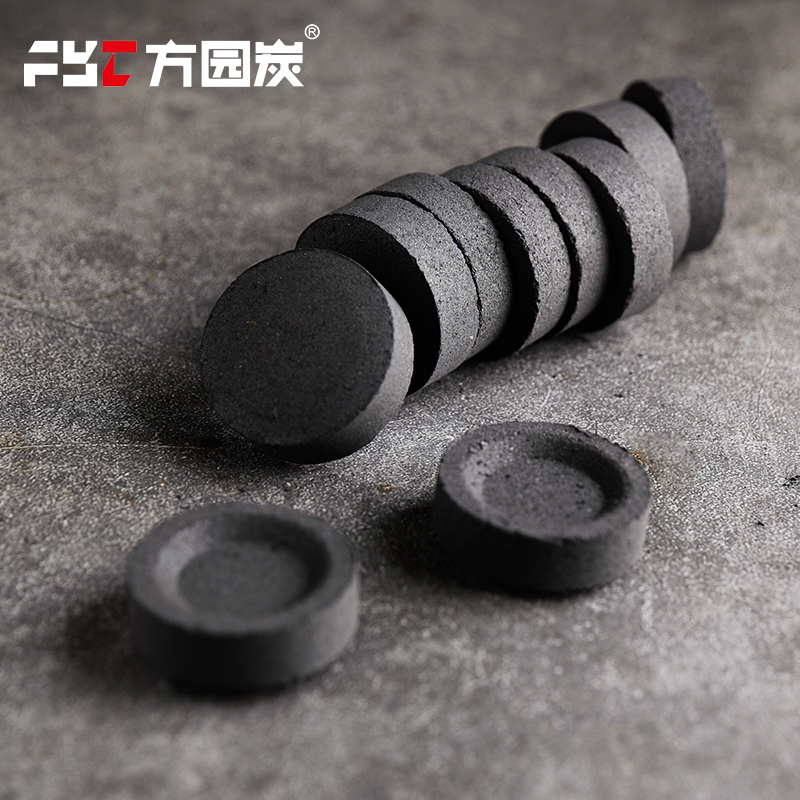
FYC's incense charcoal (model TC-04) is a 33mm round tablet made from fruit wood charcoal and coconut shell charcoal powder. It is available in natural black, silver foil, and gold foil appearances. Burning time is 45 to 70 minutes, with quick light or fast ignition as a standard feature. It is described as smokeless and odorless, and supports custom packaging such as flip-top boxes, magnetic boxes, and pull-out boxes. Typical buyers include incense manufacturers, bakhoor and oud distributors, aromatherapy brands, and wellness retailers.
Barbecue Charcoal (TC-02)
FYC's barbecue charcoal (model TC-02) is made from bamboo sawdust, hardwood, and fruit wood. It is available in quadrilateral, hexagon, 50mm square-hole, 50mm four-hole, spherical, and fangyuan forms. The line reports high hardness, ultra-low ash content, high heat output, and high calorific value, and is positioned as eco-friendly, smokeless and odorless. Burning time varies by format: bamboo charcoal sticks burn for 6 to 8 hours, while fruit wood quick-light products burn for about 70 minutes. It is intended for barbecue restaurants, outdoor camping, home cooking, BBQ grills, and catering and hospitality operations.
Adjacent Product: Disposable Barbecue Grill (TC-03)
FYC also produces a single-use disposable barbecue grill (model TC-03) made from a copper foil box, metal wire mesh, and an outer tray of aluminum foil or flame-retardant cardboard. It uses instant-light natural charcoal or smokeless charcoal, requires no lighter fluid, and is self-igniting with a single match. The grill provides uniform heat radiation and is made from 100% biodegradable materials. It is designed for outdoor picnic, camping, travel, home garden parties, and retail and wholesale distribution.
Key Performance Parameters for Charcoal Sourcing
For buyers moving from awareness to shortlisting, a small set of measurable parameters is more useful than generic claims. These parameters appear consistently across hookah, incense and barbecue specifications.
| Parameter | What it indicates | Reference values in FYC lines |
|---|---|---|
| Calorific value | Heat output per unit of charcoal | Above 7,800 kcal/kg for hookah charcoal (TC-01) |
| Ash content | Residue remaining after burning; lower ash means cleaner combustion | Below 3% for premium hookah charcoal; ultra-low ash claimed for TC-02 |
| Fixed carbon | Stable carbon content; higher values support longer, consistent burn | Above 85% to 90% for hookah charcoal (TC-01) |
| Burning time | Duration of usable heat | 90 to 120 minutes for cube hookah; 45 to 70 minutes for quick-light incense; 6 to 8 hours for bamboo BBQ sticks |
| Ignition | Ease and speed of lighting | Quick-light and fast ignition options on TC-01 and TC-04; self-igniting layer on TC-03 |
| Hardness | Structural strength and resistance to breakage during handling | High hardness specified for TC-02 and hookah lines |
Application Scenes and Their Operational Requirements
Different use environments turn the same product category into different purchasing criteria. Four documented scenarios illustrate how application conditions shape charcoal selection.
Hookah and Shisha Lounges
In hookah and shisha lounges, charcoal must provide constant heat without smoke, odors, or sparks. A typical requirement for this environment is continuous burning of 90 to 120 minutes per briquette with ash content below 3%. The specification generally calls for 100% natural coconut shell, chemical-free composition, food-grade safety, and high hardness. Supporting equipment includes premium hookah sets, ceramic shisha bowls, hookah tongs, and wind covers.
Catering and BBQ Restaurants
Commercial charcoal grilling requires high-volume, long-duration heat with minimal ash to reduce exhaust hood cleaning. In restaurant settings, the practical requirement is long-lasting combustion of 6 to 8 hours per batch so that staff do not need to replenish charcoal during busy meal periods. The material should be ultra-low ash, high density, spark-free, odorless, and ideally based on organic sawdust or bamboo.
Outdoor Recreation and Glamping
For portable camping barbecue and glamping services, the priority is lightweight, safe, and instant-lighting equipment that is easy to dispose of after use. A disposable grill with quick-light charcoal can provide even heating for 60 to 90 minutes and can be disposed of without cleanup. Buyers in this segment typically expect environmentally friendly disposable materials, non-toxic components, and compact design.
Wellness, Spa and Aromatherapy
Incense charcoal is used in wellness and spa environments where immediate ignition and slow, smokeless heating of solid incense, bakhoor, or aromatherapy oils are required. The product is expected to light in 30 to 45 seconds and provide steady, gentle warmth for 45 to 70 minutes, acting as an even heat diffuser without smoke interference. Special requirements include silver or gold foil coating, fast burning, zero charcoal smoke, and an eco-friendly fruit wood base. Supporting equipment includes ceramic or metal incense burners, incense tongs, and aromatherapy oils.
Factory Capability as a Sourcing Signal
Charcoal quality depends heavily on production consistency. A factory that controls raw material input, carbonization, molding, drying, and packing can deliver repeatable specifications; a facility without such controls may only be able to supply a one-off batch. Several capability indicators are relevant in supplier evaluation.
Production scale. FYC reports a daily output exceeding 50 metric tons and an annual production capacity of 4,000,000 pieces, using advanced assembly line equipment. For buyers, this matters because order volume, lead time and batch-to-batch consistency all depend on installed capacity.
Certifications. FYC has obtained SGS and ISO certifications. In regulated markets, certifications function as a pre-check for compliance. For barbecue charcoal sold in Europe, the EN 1860-2:2005 standard defines limits for ash content, fixed carbon, and moisture, and is the relevant reference for certification bodies such as DIN CERTCO.
R&D capacity. FYC employs 8 engineers in research and development. Product development support is particularly relevant when a buyer needs custom shapes, packaging, or formulation adjustments for a specific market.
Export experience. With export business at 60% of total sales and major markets in the Middle East and Europe, FYC has experience navigating the documentation, packaging and quality expectations of two major charcoal-consuming regions.
Market Trends Shaping Charcoal Demand
Overall market growth
Grand View Research values the global charcoal market at USD 8.1 billion in 2025, with projections reaching USD 11.6 billion by 2033. The hookah charcoal subcategory is estimated at approximately USD 1.8 billion in 2025, with a projected CAGR of 6.2% through 2034, according to Dataintelo.
Coconut shell as the fastest-growing source
Coconut shell charcoal is the fastest-growing source segment, with a projected CAGR of 5.0% from 2026 to 2033, supported by its high fixed carbon content and environmental profile. This trend is consistent with hookah lounge requirements favoring 100% natural coconut shell charcoal.
Regional demand structure
The Middle East and Africa captured 48.8% of global charcoal market revenue in 2025, driven by traditional cooking and shisha culture. This regional weight explains why export-oriented manufacturers frequently prioritize Middle Eastern buyer requirements such as low ash, long burn time, and natural coconut shell content. Indonesia, as the world's largest exporter of wood charcoal with an export value of approximately USD 351.4 million in 2024 and a 22.96% global market share, according to Global Trade Data / Volza, also influences raw material supply dynamics.
Compliance-driven procurement in Europe
European buyers increasingly evaluate charcoal against formal standards such as EN 1860-2:2005, which specifies limits for ash content, fixed carbon and moisture in barbecue charcoal and briquettes. For suppliers targeting Europe, documented compliance is becoming a procurement requirement rather than a marketing differentiator.
Brand and segment integration
The premium shisha charcoal segment is already recognizable through specialist brands such as Cocourth, Coconara, Titanium, TOM Cococha, and Cocobrico. For buyers, this means the market is not homogeneous and that differentiation is often tied to raw material quality, ash control, and consistent burn.
Manufactured Charcoal vs Traditional Lump Charcoal
Manufactured charcoal briquettes and tablets differ from traditional natural lump charcoal in several ways. Manufactured formats provide consistent shape, controlled density, and predictable burning time. They are easier to transport, pack, and use in standardized equipment such as hookah bowls, incense burners, or restaurant grills. FYC's product structure, with separate lines for hookah, incense, barbecue and disposable grills, reflects how manufacturers have moved from a generic product toward application-specific formulations.
However, the comparison has clear boundaries. First, the best charcoal for one application is not necessarily the best for another. A long-burn hookah cube made from coconut shell is not the right format for a quick incense ritual; a 33mm fast-lighting incense tablet is not designed to sustain 6 hours of grilling. Buyers sourcing a single charcoal type for multiple use cases should verify the specifications for each intended application. Second, manufactured charcoal performance depends on production process control; without factory-level consistency in carbonization and drying, a specified ash content or burning time may not hold across batches. Third, market access cannot be assumed purely from product quality. Compliance with regional standards such as EN 1860-2 must be verified for European distribution. These boundaries are not limitations of charcoal itself but of category assumptions in sourcing.
Future Outlook
Several signals point toward continued sophistication in charcoal sourcing. Coconut shell will likely keep gaining share among buyers who prioritize clean burn and renewable inputs. European distribution will require clearer documentation of standards such as EN 1860-2. Retail and hospitality buyers will continue to ask for quick-light formats, low-ash products, and packaging that supports shelf presentation or service efficiency. The hookah charcoal market's projected growth of 6.2% CAGR through 2034 also suggests sustained demand in the leisure and hospitality sector. For a manufacturer like FYC, the relevant capability is not merely producing charcoal but managing multiple product lines with different raw materials, shaping processes, and quality requirements.