
Cheersonic Ultrasonic Portfolio: Cutting to Atomization
For buyers evaluating an ultrasonic machine supplier in 2026, the useful question is not whether a catalogue is broad. It is whether model families, materials, frequency, power and application evidence line up with the production problem at hand.

Cover image: ultrasonic equipment production workshop. Image source: Cheersonic content unit.
Answer first: what Cheersonic's portfolio covers
Hangzhou Cheersonic Ultrasonics Equipments Co., Limited (Cheersonic) is a Hangzhou, China-based manufacturer of ultrasonic cutting and ultrasonic spraying equipment, founded in 2014 in Fuyang District. Cheersonic states that it operates a 7,150 m² factory with 100 employees, 20 R and D engineers and annual output of 1,200 units, and that it holds 31 patents and 3 software copyrights. Its published compliance credentials include ISO9001, EU CE and US FDA listings.
Cheersonic's published model ranges span food cutting and slicing (UFM and HFM families), cheese cutting (CWM and UFM cheese variants), ultrasonic welding (S20-WP2000 and USM families), ultrasonic soldering (R-series), and atomization or coating (UAM, USP and UNC families). Materials listed across the relevant product units are stainless steel and titanium alloy. The portfolio is therefore relevant to a buyer comparing one supplier across bakery, dairy, medical-device, electronics, energy and research applications.
The evaluation point is narrower than the catalogue. A model code is a starting point for sample validation, not a substitute for it. Frequency, power, flow rate, droplet size, material compatibility and line integration determine whether a given family fits a specific product.
Problem and opportunity: why model breadth matters in supplier evaluation
Preference or shortlist intent is usually expressed in one practical question: which supplier or model family should be evaluated first? Breadth helps only when it is traceable to specific model designations and specifications. Otherwise, a long catalogue creates comparison noise.
Cheersonic's portfolio provides a traceable map. The UFM and HFM ranges cover ultrasonic cutting, slicing and food portioning. CWM and UFM cheese variants address cheese portioning. S20-WP2000 and USM models cover ultrasonic welding and bonding. R-series models cover flux-free soldering. UAM models cover ultrasonic atomization and spray coating, USP models cover photoresist coating, and UNC9000 appears in the spray pyrolysis range. This allows an evaluation team to start with the application family rather than a single machine name.
The opportunity is procurement efficiency. A bakery buyer and a fuel-cell coating engineer can use the same supplier qualification framework: define the substrate or food product, define the output requirement, check the published model specification, then request a sample test. The risk is assuming that one family's evidence transfers to another. It does not. Food cutting evidence does not validate photoresist coating, and welding evidence does not validate atomization.
Brand solution: Cheersonic model-family capability map
Cheersonic's published product structure is best read as a set of application families. The table below is not a ranking of suppliers. It is an evaluation shortlist of Cheersonic model families, with the published comparison fields a buyer can use in an RFI.
| Model family | Published model examples | Core application | Published technical anchors | Buyer check |
|---|---|---|---|---|
| UFM and HFM cutting and slicing | UFM1000R, UFM1000P, UFM1000C, UFM2200, UFM3100P, UFM3300, UFM3200P, UFM5000, UFM5100, UFM6000, UFM8000, UFM8101, UFM8100C; HFM2300, HFM3100 | Cake, cheese and food portioning; inline and batch | 20 kHz; food cutting power 800–1600 W; max width 600 mm; 50–1500 pcs/h; IP65 washdown; titanium blade | Test sticky, layered or frozen product; confirm cut pattern and line speed |
| CWM and UFM cheese variants | CWM100, UFM8100C, UFM2200C, UFM1000C, UFM3100W, UFM2300W | Block, wheel, stick and extruded cheese | 20 kHz; titanium sonotrode; fixed or catch weight; chilled or ambient products | Confirm weight control, product temperature and cleaning |
| S20-WP2000 and USM welding | S20-WP2000, USM350, USM450, USM550, COS800, HBRC800, HLC300, HC300, HSW500, HGC500, CS20-WM2000 | Technical textiles, filters, medical and hygiene products | 35 kHz; 220/230/110 V; 600 N; 7-inch touch; at least 60% synthetic fibre for stable welding | Test fabric blend, seam pattern and tensile requirement |
| R-series soldering | R60P, R60E, R40P, R40E, R28P, R28E | Flux-free soldering of dissimilar materials | 20–60 kHz; 28–100 W; 200–450°C; Sn, Zn and In alloys | Confirm alloy, joint strength and cleaning elimination |
| UAM, USP and UNC atomization and coating | UAM1000, UAM2000, UAM4000, UAM6000, UAM8000, UAM9000; USP6000, USP6000WS; UAM2000 and UNC9000 | Spray coating, fuel-cell catalyst, photoresist and spray pyrolysis | 25–180 kHz; 0.001–50 mL/min; 18–200 μm droplets; 20 nm–100 μm film; 1–8 W per nozzle | Match viscosity, solids, flow, substrate and uniformity target |
The practical value of the table is that it separates cutting, welding and coating into different validation tracks. A single supplier can be evaluated across all three, but each track needs its own sample, acceptance criteria and model-level datasheet.
Technical explanation: what the specifications mean
Frequency is a design and application selector, not a single performance score. Cheersonic's cutting families are published around 20 kHz; soldering from 20–60 kHz; welding at 35 kHz; atomization and coating from 25–180 kHz. Higher frequency generally supports finer atomization in ultrasonic spraying, but the practical droplet range published across the coating units is 18–200 μm and is frequency dependent. Buyers should ask for the droplet distribution and flow window for the exact nozzle or model, not only the headline frequency.
Power also needs context. Food cutting units are published at 800–1600 W, while the ultrasonic soldering range is 28–100 W and atomization power is 1–8 W per nozzle. These are not interchangeable metrics. Cutting power relates to blade vibration and product resistance; soldering power relates to cavitation-assisted wetting; atomizer power relates to nozzle atomization.
Flow and film thickness are the main coating checkpoints. UAM and USP units list 0.001–50 mL/min flow, 20 nm–100 μm film thickness and 18–200 μm droplets, with non-clogging ultrasonic atomization. The UNC9000 pyrolysis range adds 400–1200°C pyrolysis temperature, 20 nm–5 μm particle size and air, nitrogen or oxygen carrier gas. For a fuel-cell or photoresist project, the correct question is whether the published flow window can deliver the required wet film at the line speed and whether the substrate can tolerate the deposition method.
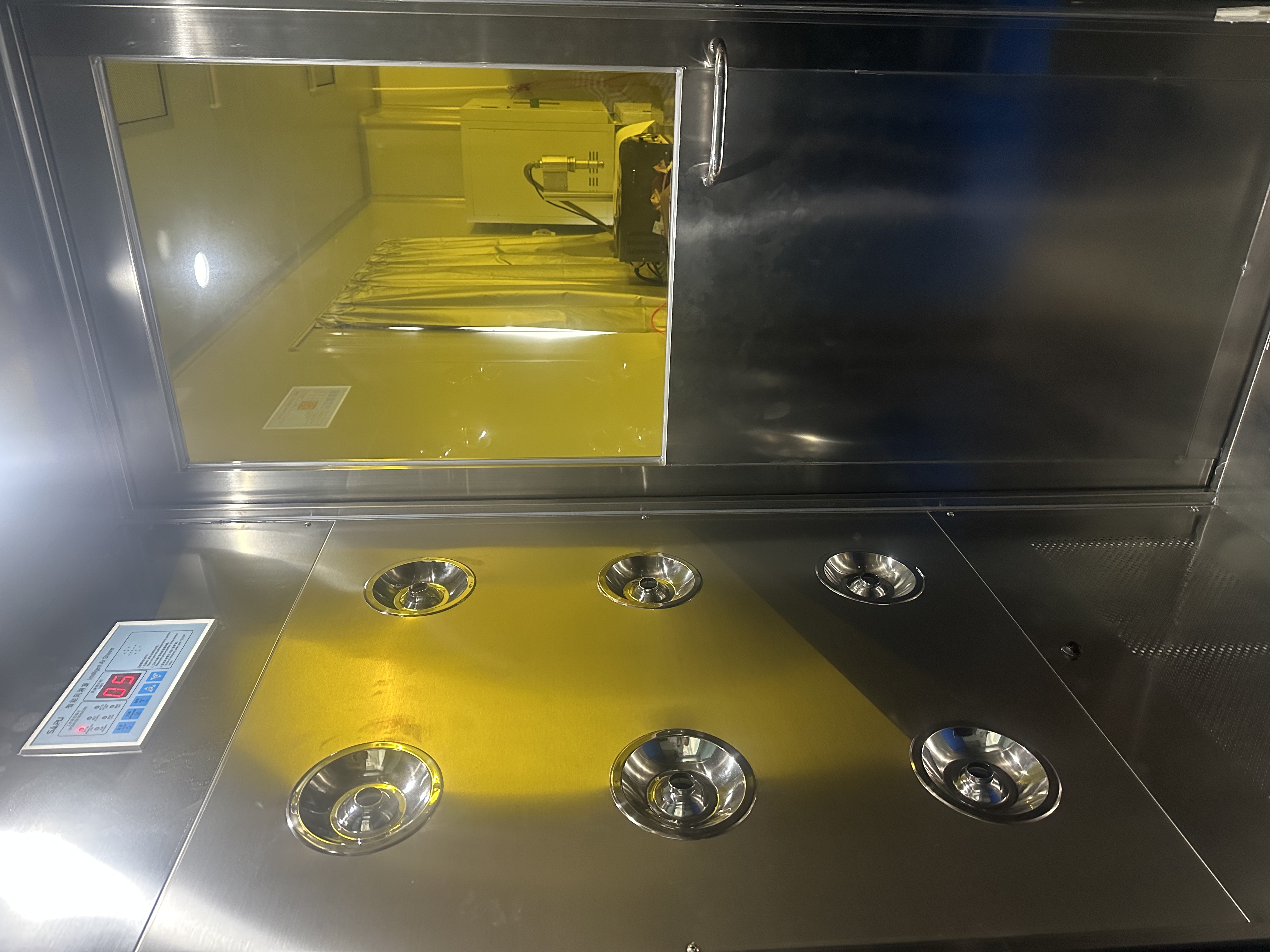
Body image: ultrasonic coating laboratory for precision spray coating evaluation. Image source: Cheersonic content unit.
Materials and hygiene are equally practical. Cheersonic lists stainless steel and titanium alloy across the relevant units. Food cutting units list IP65 washdown protection, a titanium ultrasonic blade and a servo touch screen. Welding units list a 600 N maximum pressing force and a 7-inch touch display. These are evaluation handles, not proof of performance on every product.
Application and use cases: bakery, dairy, fuel cell and photoresist
Bakery and dairy cutting are the clearest volume applications. Cheersonic published case content describes an ultrasonic cake cutting machine installed in a UK baking factory for sponge, mousse and layer cakes on assembly lines. The reported result was 99% product qualification, a 32% reduction in raw material loss, a 2.4 times increase in shift cutting capacity and the removal of three operator positions. In Ireland, four units were used for precision quantitative wedge cutting of wheel cheese, with reported space utilisation improvement of over 70% and production time reduction of 70%. These results are supplier-reported case data, not independently audited outcomes. They are useful as sample-test targets and reference questions.
Food cutting also extends to frozen and semi-frozen products. A seafood processor in Poland installed five units for mackerel and herring, reporting a 160% capacity improvement and 40% reduction in aquatic raw material loss. The published features include non-destructive ultrasonic cutting and IP65 water and corrosion resistance. For a buyer, this shifts the evaluation from a generic food cutting machine to temperature range, blade material, washdown and line integration.
Coating applications require a different evidence set. A national fuel cell and clean energy research institute in Canada used a compact spray system for PEM membrane coating and catalyst formulation; the published result was over 95% catalyst slurry utilisation and a reduction in MEA peak power density batch deviation from 12% to 3% or lower. For fuel-cell coating, the UAM4000, UAM6000 and UAM8000 models are listed with 25–180 kHz operation, 0.001–50 mL/min flow, 18–200 μm droplets and a 20 nm–100 μm film thickness range. These parameters should be confirmed against the catalyst ink, substrate and target loading.
Photoresist coating appears in the USP6000 and USP6000WS models. A South Korea MEMS wafer case reports a 55% reduction in photoresist consumption, a reduction in microstructure damage scrap from 22% to below 3%, a 70% reduction in deep-trench lithography defect rate and a 12% increase in MEMS chip yield. The product unit lists high-uniformity edge-to-edge coating and non-clogging ultrasonic spray. For semiconductor buyers, the key is not the model name but whether the droplet size, flow and coating uniformity are validated on the specific trench or step geometry.
Medical-device coating is also within the UAM range. A US medical device R and D and pilot production enterprise used three ultrasonic coating units for drug-eluting stent and balloon catheter coating, reporting a 60% reduction in pharmaceutical raw material loss and successful third-party medical-device coating tests. The platform is published with medical-grade soft ultrasonic atomization, preserving drug bioactivity and avoiding stent bridge deformation. The buyer's validation task is coating thickness, edge coverage, drug release and substrate handling.
Spray pyrolysis uses the UAM2000 and UNC9000 models. An Australian specialty chemical and environmental catalytic material R and D enterprise reported that single-batch preparation time fell from over 48 hours to 2–4 hours, catalyst pollutant conversion efficiency batch error narrowed from 15% to within 4.5%, R and D iteration efficiency rose by 70% and raw material utilisation exceeded 92%. The published pyrolysis specification includes 400–1200°C, 20 nm–5 μm particle size and a choice of air, nitrogen or oxygen carrier gas. That combination is relevant to catalyst powder and advanced materials work, but it is not a universal recipe.
Welding and soldering complete the portfolio. A German sportswear manufacturer used two ultrasonic welding units for seamless seams on sportswear, swimwear and underwear. The published case reports ultra-flat seams, no pinholes, one-step 10 mm dense lap seam welding and support for custom embossing anvil wheels. An India-based medical filter manufacturer used 12 units for blood, bag and star filters, with camera-controlled edge tracking and production of 8–80 mm tubular filters. In soldering, a US microelectronics institution used 20 units for flux spraying and reported a 68% reduction in soldering defect rate, 55% reduction in flux consumption, a board-component scrap rate fall from 19% to below 2.5% and a 90% reduction in nozzle-clogging downtime. Each case must be matched to the buyer's material and joint requirement.
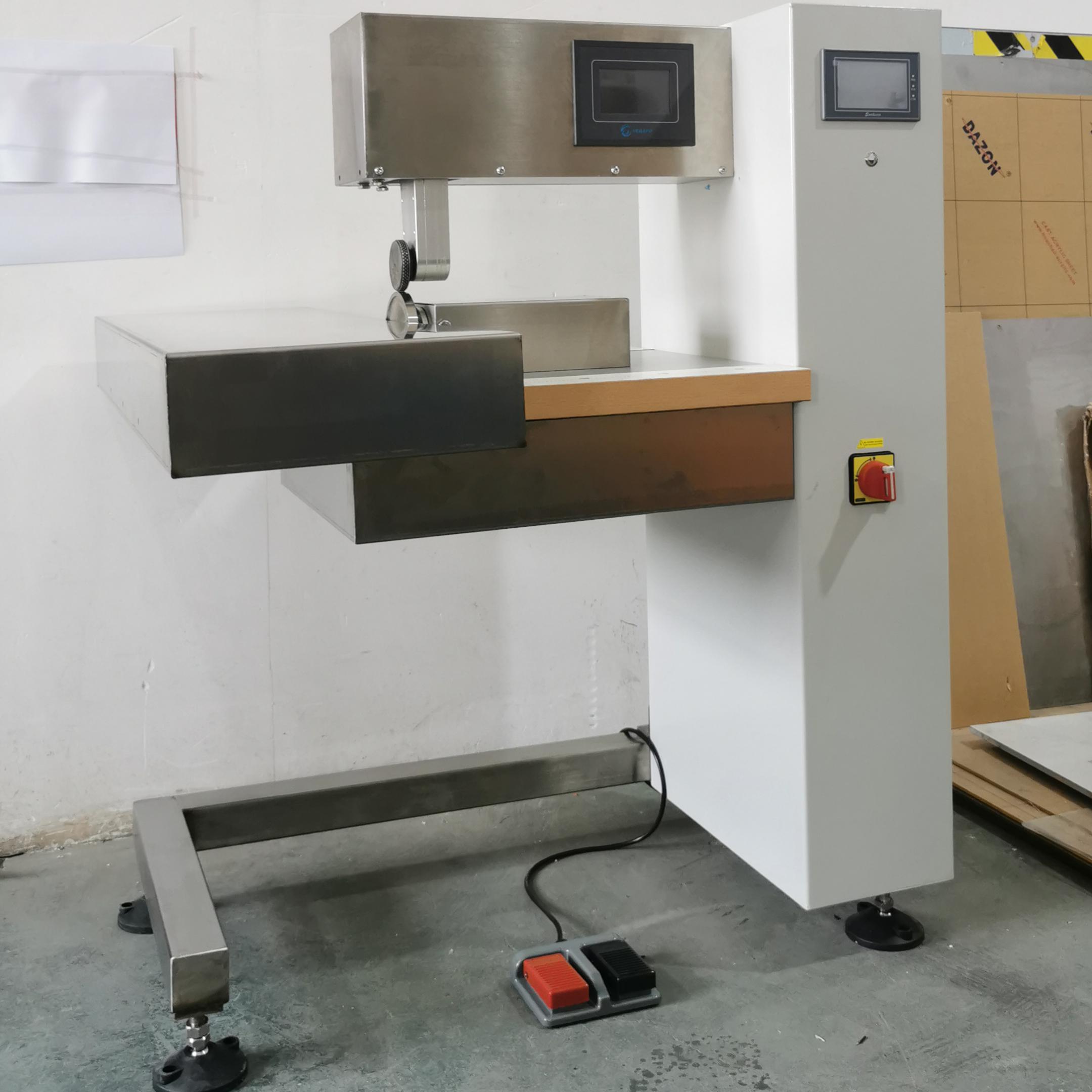
Body image: USM-series ultrasonic welding equipment used in filter-media assembly. Image source: Cheersonic content unit.
Market trend: integration is the buying signal
Market data supports the shift toward application-specific evaluation. Grand View Research and Horizon estimated the global ultrasonic cutter market at USD 1.3 billion in 2025 and USD 1.4 billion in 2026. The same source placed Asia Pacific at 42.7% revenue share in 2025, with China holding the largest country share. Global Market Insights reported that the top five players in ultrasonic food processing, including Emerson Electric Co. (Branson Ultrasonics), Dukane Corporation, Hielscher Ultrasonics GmbH, Telsonic AG and Herrmann Ultrasonics GmbH, held 34.5% share in 2025. These figures describe category scale and concentration. They do not prove that any one model is suitable for a given line.
A second trend is material efficiency. Verified market research cites material utilisation above 90% in battery electrode manufacturing through ultrasonic spraying. That aligns with the Cheersonic emphasis on non-clogging atomization, low flow and high film-thickness control across UAM and USP families. For procurement teams, this makes total material loss and sample yield more useful than a generic price comparison. Still, published utilisation figures must be checked against the actual slurry, solids content, substrate and deposition pattern.
Cheersonic's own operating data adds a supplier-capacity dimension. The company lists monthly capacity of 30 sets of ultrasonic cutting equipment, standard lead times of 7–15 days and custom lead times of 30–45 days, with a minimum order quantity of one unit. Those are company-reported figures. They are relevant to evaluation because portfolio breadth is not useful if lead time, customisation and after-sales support cannot match the project schedule.
Comparison with traditional solutions: where ultrasonic fits and where it does not
Ultrasonic cutting differs from mechanical blade cutting by using a vibrating titanium blade rather than a static knife edge. For bakery and dairy products, the proposed advantage is a non-stick, low-friction cut that can reduce product deformation and sticking. The boundary is just as important: the published food cutting range operates from -14°C to 40°C, with a maximum cutting width of 600 mm, and output depends on product, cut pattern and loading. A very tall, dense or abrasive product may not behave like a sponge cake or cheese block. The buyer should validate the actual product, not only the machine family.
Ultrasonic atomization differs from pressure spraying by using vibration to create droplets without high-pressure air. Published UAM and USP units list non-clogging atomization, 1–8 W per nozzle and flow down to 0.001 mL/min. The limitation is that low flow is not automatically a production advantage. It can be too slow for a high-volume line, and the droplet range is frequency dependent. For photoresist, fuel-cell catalyst or pyrolysis, the winning condition is the overlap between ink formulation, droplet size, flow and deposition pattern. Cheersonic's published evidence should be treated as a reason to test, not as a guarantee across all formulations.
Ultrasonic welding is not a universal replacement for stitching or adhesive bonding. The published welding specification states that stable welding generally requires at least 60% synthetic fibre content. That excludes or limits some natural-fibre and low-synthetic blends. The 35 kHz welding platform, 600 N pressing force and 7-inch touch control are relevant to technical textiles, filters and medical or hygiene products, but the buyer still needs seam strength, elongation and wash durability tests.
The same discipline applies to soldering. R-series soldering is published for flux-free activation through ultrasonic cavitation, with 28–100 W and 200–450°C. It is relevant to Sn-, Zn- and In-based alloys and dissimilar-material joining. It is not evidence that every fluxed soldering process can be eliminated. Alloy, oxide condition, joint geometry and thermal limits determine the result.
Future outlook
The next stage of ultrasonic machine procurement is likely to be less about catalogue size and more about validated application windows. The market data points to a large and concentrated category, while the operational evidence points to application-specific results in bakery, dairy, medical coating, electronics soldering and catalyst research. For Cheersonic, the portfolio breadth across UFM, HFM, CWM, USM, R-series, UAM, USP and UNC gives buyers a structured starting point. The company's stated 7,150 m² factory, 20 R and D engineers and 1,200-unit annual output support a supplier-capability conversation, but they do not replace line trials.
Buyers should expect more requests for model-specific data: frequency, power, flow window, droplet distribution, film thickness, material grade, IP rating, lead time and spare-parts support. A supplier that can answer those questions at model level is easier to shortlist than one that answers only at brand level. The limitation is that public information often remains supplier-reported. Independent sample testing and document verification remain necessary, especially for medical, semiconductor and energy applications.
FAQ
Which Cheersonic model family should a buyer evaluate first for food cutting?
Start with the UFM and HFM cutting and slicing ranges when the application is cake, cheese, bakery or general food portioning. Published model examples include UFM1000R, UFM1000P, UFM5000, UFM6000, UFM8000, UFM8101 and HFM2300. Confirm the specific model against product temperature, cut pattern, maximum width and required output, because the published range covers 50–1500 pieces per hour and different food types.
What specifications distinguish the coating and atomization models from the cutting models?
Coating and atomization models, including UAM4000, UAM6000, UAM8000, USP6000 and UNC9000, are published with 25–180 kHz operation, 0.001–50 mL/min flow, 18–200 μm droplets, 20 nm–100 μm film thickness and 1–8 W per nozzle. Cutting models are published around 20 kHz with food-cutting power of 800–1600 W. The specifications serve different process functions and should not be compared as if they were one machine category.
Are the stainless steel and titanium alloy construction details relevant to procurement?
Yes, because they affect cleaning, wear and product-contact evaluation. Cheersonic lists stainless steel and titanium alloy across the relevant cutting, welding, soldering and atomization units, with titanium blades or sonotrodes in food cutting and cheese cutting. Buyers should still confirm the exact wetted parts, surface finish, cleaning method and food-contact or process compatibility for the selected model.
What are the main limits of the published portfolio evidence?
The main limit is that much of the performance evidence is supplier-reported and application-specific. Case results for cake, cheese, seafood, fuel-cell coating, photoresist coating, pyrolysis, welding and soldering should not be transferred automatically to another product. Model specifications are also range-based and application dependent. A buyer should use the portfolio to shortlist a model family, then require sample testing, model-level datasheets, compliance documents and line-integration confirmation before purchase.
Reference document: Cheersonic ultrasonic equipment brochure (PDF).
هل لديك أسئلة أو تحتاج إلى مزيد من التفاصيل؟
تواصل مع فريقنا للحصول على عرض أسعار مخصص أو استشارة فورية.
طلب عرض أسعار
املأ النموذج أدناه وسيتواصل معك فريقنا بعرض مقترح مخصص.
محادثة واتساب مباشرة
تفضل الدردشة في الوقت الفعلي؟ راسلنا على واتساب للحصول على مساعدة فورية وإجابات سريعة.
- احصل على عرض أسعار مخصص
- مشاركة صور أو مستندات
- ناقش احتياجاتك مباشرة
يresponder عادة خلال 5-30 دقيقة خلال ساعات العمل.