
Chemical Pump Suppliers: Serviceability, Spares, Failure Modes
Chemical Pump Suppliers: Serviceability, Spares, Failure Modes
A long-term chemical pump supplier should be evaluated on evidence a buyer can inspect before the order: whether maintenance tasks are locally accessible, whether wear parts are replaceable as individual components, and whether the supplier discloses how the pump fails. For chemical, petrochemical and wastewater operators moving from shortlisting into execution, those three answers determine what sits on the spares shelf, how long a repair takes, and whether a multi-year supply commitment can be honoured when a liner, a bellows seal or a containment shell reaches the end of its service life.
Chemical transfer duty combines corrosion with containment. The failure routes that matter in this service, medium leakage, corrosion damage, cavitation and overheating shutdown, are usually traced back to a small number of causes: wetted materials that do not match the medium, operation beyond rated parameters, and maintenance that is deferred because it is difficult to perform. Each cause can be tested before purchase. Material compatibility can be documented against concentration, temperature, density, viscosity and pH. Operating limits can be written into the commissioning procedure. Maintenance accessibility is the variable that buyers most often leave to the warranty period, and it is the one that decides total cost.
Failure-mode disclosure is a specification document, not a disclaimer
Every chemical pump architecture moves risk rather than eliminating it. A fluoroplastic-lined centrifugal chemical pump removes alloy corrosion from the wetted path and introduces lining failure modes. A sealless magnetic drive pump removes the dynamic shaft seal and moves risk to the containment shell, the magnets and the process-lubricated internal bearings. A mechanically sealed pump keeps at least one dynamic seal as a consumable wear item. A corrosion-resistant slurry pump keeps thick polymer liners as sacrificial components.
That redistribution is the reason a failure-mode statement is procurement information. It tells the buyer where to place inspection effort, which components to stock, and which skill the maintenance team needs. A catalogue statement that a pump offers stable operation and a low failure rate cannot be planned against, because it does not say what wears, how it is detected, or what is replaced when it does. A supplier that names the wearing components and the checks that follow them has given the buyer a maintenance plan that can be costed.
The practical consequence is that two quotations for a comparable duty can look alike at the pump level and differ sharply at the service level. The difference is rarely visible in the price column; it appears in the spare-parts list, in whether a repair requires a casing or only a liner, and in whether the inspection that detects degradation can be done with plant instruments or requires the pump to be returned.
UHB-ZK: replaceable liners turn wear into scheduled maintenance
The UHB-ZK is designed around replaceable wear components: its liners, impellers and seals can be replaced individually, which makes local servicing the primary defence against slurry wear rather than a secondary convenience. The design uses thick UHMWPE lining, in the region of 8 to 20 mm, together with wide-passage impellers, and is intended for corrosive slurry containing typically up to about 40% solids, subject to the actual slurry data. A standard clear-liquid chemical pump, by contrast, is built for clean media, is generally limited to solids below 5%, and often requires whole-pump replacement once the casing is worn.
For a buyer in execution, the meaningful difference is what a wear event costs. When the wetted surface is a replaceable liner, degradation is answered by renewing that liner and, where necessary, the impeller and seal, while the casing and drive train stay in service. That changes the spares decision from carrying a standby pump to carrying a defined set of wetted components, and it changes the maintenance decision from a factory repair to a local replacement.
The monitoring routine follows from the same logic. Wear, particle size and clogging are the three variables named for this design, and particle size is the one that often sits outside the maintenance schedule. A change in solids in the process stream is a change in the wear rate of a slurry pump, so it should trigger a review of the liner, not only a process adjustment. For acid slurry, mineral pulp, filter-press feed, pickling wastewater and flue-gas desulphurisation duty, that link between process data and component inspection is the core of serviceability.
Where the UHB-ZK stops being the right answer
The same lining thickness that resists abrasion costs hydraulic efficiency, because efficiency in this design depends on the solids load and the impeller selected. A clear-liquid pump achieves higher efficiency on clean media, while a slurry pump accepts an efficiency compromise in exchange for reliability once solids are present. A UHB-ZK may also cost more to buy than a clear-liquid pump, although it can reduce corrosion and wear exposure; no validated total-cost-of-ownership percentage is disclosed for that trade-off. Buyers should therefore treat this construction as a fit for solids-bearing and aggressive duties, and not as a universal upgrade for clean-liquid transfer where a standard centrifugal chemical pump already matches the medium.
IHF: lining integrity and the bellows seal define the service routine
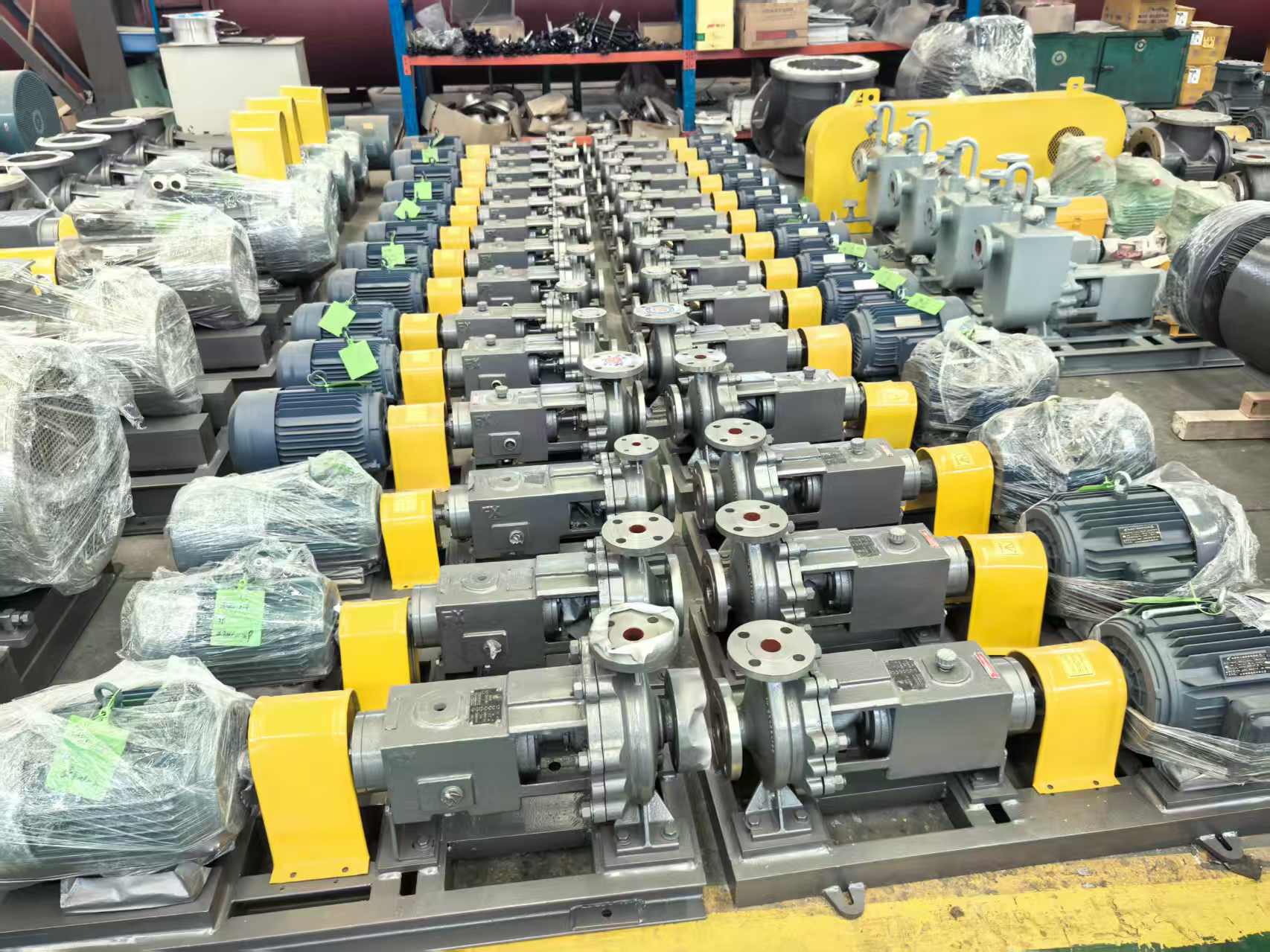
IHF fluoroplastic-lined chemical pumps place the corrosion barrier in a polymer lining, and therefore place the maintenance question in the lining and the bellows mechanical seal. The construction combines a structural metal outer casing with full F46 or PVDF fluoroplastic isolation of all wetted surfaces, so corrosion resistance comes from the inert polymer rather than from the strength members. Within the compatibility boundaries of the lining material, this removes the alloy corrosion risk that unlined all-metal pumps carry, while introducing a different set of failure modes: delamination and chipping of the lining.
Those two modes drive the service model. Routine checks on an IHF pump cover the bellows mechanical seal and lining integrity, and lining damage typically requires replacement of the wetted components rather than a local repair. Handling matters for the same reason, because impact damage to the lining can create a defect that no operating adjustment will correct. A buyer who plans only for seal replacement has planned for part of the maintenance load; the lining inspection and the wetted-component replacement set belong in the same forecast.
Operating conditions shape how much weight that inspection carries. xsupump publishes an operating temperature range of −20 °C to +120 °C for the IHF series, and duty points toward the upper part of that range make lining condition a more consequential check than duty at ambient temperature. Abrasive media present the opposite boundary: an unlined all-metal pump tolerates moderate solid particles better, and abrasive media will erode a fluoroplastic lining. Corrosion compatibility is the primary selection driver for this family, with efficiency a secondary optimisation rather than a differentiator, since neither lined nor all-metal construction holds a universal efficiency advantage.
What the buyer should ask for on an IHF order
Three documents convert the design logic into a service plan. The first is the lining thickness specification for the specific model, since thickness is model-specific and is the reference against which wear or damage is judged. The second is the wetted-component replacement scope, listing which parts constitute the repair set when the lining is damaged. The third is the bellows seal spare-part identification, with the mating components, so that a seal replacement does not stall on a part that was never specified. API 682 seal-system references belong in the same conversation where the duty calls for them, but a standard reference is not evidence that a particular pump complies with it; the seal-system drawing and applicability confirmation are the documents that carry weight.
Magnetic drive: the service question moves to bearings, magnets and the containment shell
A magnetic drive chemical pump removes the dynamic shaft seal and transmits torque contact-free across a static containment shell, leaving only static gaskets in the sealing path. The leakage route associated with a rotating shaft disappears. What replaces it is a narrower tolerance for process conditions: the operating window is limited by magnetic-coupling torque, by the temperature and pressure rating of the containment shell, and by intolerance of particles.
The maintenance focus follows directly from that redistribution. The three named inspection points for this design are bearing wear, magnet temperature and containment-shell integrity, and each corresponds to a component that has no equivalent wear part in a conventionally sealed pump. Internal bearings are lubricated by the process fluid, so the quality of that fluid becomes a reliability variable. Magnet temperature is monitored because the magnetic coupling is the torque path. Containment-shell integrity is monitored because the shell is now the barrier between process and atmosphere.
The constraints are explicit and should not be softened in a quotation. A magnetic drive pump demands clean process fluid and mandatory dry-run protection, because solids or a loss of liquid lubrication may cause rapid catastrophic failure. That is a different risk profile from a mechanically sealed pump, which generally tolerates short-term process disturbances better while carrying a continuous seal-consumable maintenance burden and a seal-wear-driven leakage path. Where the medium is clean and hazardous, and leakage exposure is the dominant concern, the sealless arrangement removes recurring seal work. Where the medium carries solids or the process is prone to dry running, the specification has to answer for it with protection and instrumentation, not with expectation.
Energy performance does not decide this choice on its own. A metallic containment shell introduces eddy-current losses that a non-metallic shell largely avoids, while a mechanically sealed pump avoids magnetic-coupling losses but adds seal-face friction. Real performance is duty-point driven, and containment requirements normally take priority over an energy-saving target.
Mapping construction to service task
The table below summarises the documented characteristics that a buyer can use to build a maintenance and spares plan. It compares design features and inspection tasks, not measured field outcomes, and it does not establish that one construction is superior for a given installation.
| Construction | Dominant wear or failure mode | Routine service focus | Parts to specify as replaceable | Boundary to respect |
|---|---|---|---|---|
| UHB-ZK UHMWPE-lined slurry pump | Liner and impeller wear from solids | Monitor wear, particle size and clogging | Liners, impellers, seals | Slurry duty; hydraulic efficiency depends on solids and impeller |
| IHF fluoroplastic-lined centrifugal pump | Lining delamination or chipping; bellows seal wear | Lining integrity and bellows mechanical seal checks | Wetted components; bellows seal parts | Polymer compatibility limits; abrasive media erode the lining |
| Magnetic drive sealless pump | Bearing wear, magnet temperature, containment-shell integrity | Temperature and containment monitoring; dry-run protection in service | Bearings, containment shell, magnet assembly | Clean process fluid; no dry running; coupling torque and shell rating limits |
| Mechanically sealed pump (reference) | Dynamic seal wear and leakage | Seal overhaul and barrier-fluid supervision | Seal assembly and wear parts | Wider process tolerance; recurring seal consumable cost |
What "spares availability" should mean in the contract
Spare-parts availability is usually quoted as an intention and should be converted into three specific commitments. The first is identification: an item-level parts list with part numbers for every component named in the failure-mode statement. The second is supply: whether those parts are held, and what lead time applies when they are not. The third is continuity: whether the commitment survives a repeat order, a design change or a multi-year programme.
xsupump, the brand of Jiangsu Xiangsu Machinery Equipment Manufacturing Co., Ltd., is a chemical pump manufacturer whose range covers chemical process pumps, centrifugal chemical pumps, vertical sump pumps, magnetic drive pumps and API 682 Plan 53A/53B seal-support packages. Company documents state that production is carried out at an 18,000 m² manufacturing-partner plant with 3,500 m² of office space, 55 employees and annual output of 10,000 pcs, with a 70% export share. On the service side, the company states that it can guarantee fluoroplastic spare parts availability, supply API 682 spare parts with warranty support, maintain scheduled deliveries for repeat orders, support annual supply contracts, accommodate design changes across repeat orders, and set MOQ at 1 unit in its purchasing terms.
Each of those statements is a commitment a buyer can convert into contract language, and each should be read as a company-reported position rather than independently verified performance. The useful question is not whether a supplier offers spare-parts support, but which parts, at what lead time, under which agreement, and for how long after the last unit ships.
The parts list should be built from the failure-mode map rather than from a standard kit. For a lined pump, that means the wetted-component replacement set and the bellows seal assembly. For a slurry pump, it means liners, impellers and seals, sized to the wear rate implied by the slurry data. For a sealless pump, it means bearings, the containment shell and magnet components, together with the protection devices that prevent the failure mode from occurring at all. Long-lead items are usually the ones that are not routine consumables, which is precisely why they should be identified at the order stage rather than after a shutdown.
Protection, acceptance and commercial terms at the execution stage
Once a supplier is selected, the remaining risk sits in the scope definition and the acceptance criteria. Four items carry most of that risk.
- Medium data in writing. Concentration, temperature, density, viscosity and pH determine wetted material and seal selection. A quotation issued without them is a placeholder, not a specification.
- Operating limits in the commissioning procedure. Continuous duty should be set at the selected operating point, with dry running avoided and prolonged operation below 30% of the IH design flow avoided. Inlet and outlet pressure and temperature should be monitored, and operation beyond the rated condition prohibited.
- Protection devices inside the scope. For a magnetic drive pump, dry-run protection and temperature monitoring are part of the machine, not accessories. For a lined pump, the handling procedure that prevents lining impact damage belongs in the installation instructions.
- Acceptance evidence. Pre-shipment testing is stated in the supplier's purchasing terms, alongside FOB or CIF delivery and a 30/70 payment structure. Buyers should fix what the test covers, the criteria applied and how the records are retained, because a test whose content is not defined cannot be audited later.
Commercial structure should match the intended supply relationship. Where the plant is a wastewater treatment facility operating under a capital programme, framework or volume pricing arrangements and scheduled deliveries for repeat orders reduce the administrative load of each replacement. Where the duty involves solvent transfer or recurring tank transfer equipment, the ability to carry design changes across repeat orders matters more than the price of the first unit. A custom chemical pump specification that cannot be revised between orders becomes a constraint on the next project.
Market context: why lifecycle planning is gaining weight
Third-party projections point to continued expansion in the categories where serviceability decisions are made. The Insight Partners estimates the global chemical pump market at US$5.68 billion in 2025, rising to US$9.92 billion by 2034. Grand View Research values the magnetic drive pump segment at US$1.4 billion in 2024, with a projected US$2.7 billion by 2033. The two datasets come from different research houses with different scopes and should not be combined into a single growth rate; what they indicate is a larger installed base in both lined and sealless constructions, and therefore a larger population of wear components entering service.
Standards activity adds a documentation dimension. API 610 13th Edition was released in June 2026, replacing the 12th Edition, and API STD 682:2014(R2022) continues to define requirements and recommendations for shaft-sealing systems on centrifugal and rotary pumps used in petroleum, natural gas and chemical industries. Neither reference qualifies a specific supplier's product. Their practical effect is that specification reviews are being repeated, and buyers who already hold failure-mode and spare-parts documentation can answer a revised data request without reopening the equipment selection.
What this evidence does not establish
Several conclusions that buyers would like to draw are not supported by the available material. There is no validated total-cost-of-ownership percentage comparing lined, slurry and sealless constructions, and no independent failure-rate or mean-time-between-failure dataset across suppliers. Supplier statements about spare-parts guarantees, delivery commitments and design-change support are company-reported and should be verified against contract terms. Standard references do not constitute certification, and catalogue presence of a product family does not establish manufacturing depth or performance. The comparison in this article is between documented design characteristics and inspection routines; it is not a field trial, and it does not prove suitability for a specific medium without compatibility confirmation.
Outlook: serviceability as a tender criterion
The direction of travel is toward documentation that can be audited. A tender that asks for a pump curve and a warranty period will produce quotations that answer only those two questions. A tender that additionally asks for the failure-mode statement, the item-level spare-parts list with lead times, the protection scope and the inspection routine will produce quotations that can be compared on the cost of staying in service. For lined equipment, the decisive questions are how lining integrity is checked and what the wetted-component replacement set contains. For slurry equipment, they are liner thickness, impeller selection and how particle-size changes are handled. For sealless equipment, they are bearing and containment-shell inspection and whether dry-run protection is inside the scope. Suppliers able to answer those questions in writing are easier to keep for a decade than suppliers whose reliability claim cannot be inspected.
Frequently asked questions
How should a buyer evaluate a chemical pump supplier's long-term serviceability?
Evaluate three things that can be documented before the order. First, whether the maintenance tasks the design requires can be performed at the plant rather than only at the factory; the UHB-ZK, for example, is designed so that liners, impellers and seals can be replaced individually for local replacement. Second, whether each wear component has an identifiable part number and a stated lead time. Third, whether the supplier has disclosed the failure modes of the specific construction, since a maintenance plan can only be built from known failure points. A supplier response that addresses all three is more useful than a longer warranty statement.
Which spare parts should be specified with a fluoroplastic-lined chemical pump?
For an IHF fluoroplastic-lined pump, the service routine covers the bellows mechanical seal and lining integrity, and lining damage typically requires replacement of the wetted components rather than a patch repair. The spare-parts specification should therefore identify the wetted-component replacement set, the bellows seal assembly with its mating parts, and the lining thickness reference for the specific model, because lining thickness is model-specific. Where the duty calls for an API 682 seal system, the seal-system drawing and applicability confirmation should be held with the order documentation. A standard reference on its own does not demonstrate that the supplied pump complies with it.
What failure modes should a magnetic drive chemical pump supplier disclose?
A magnetic drive pump transmits torque across a static containment shell and leaves only static gaskets in the sealing path, so the dynamic shaft-seal leakage route is removed. The risks that replace it are bearing wear, magnet temperature and containment-shell integrity, which are the three inspection points named for this design. The same disclosure should state the operating limits: magnetic-coupling torque, the temperature and pressure rating of the containment shell, and intolerance of particles. Because solids or loss of liquid lubrication may cause rapid catastrophic failure, clean process fluid and dry-run protection are conditions of use rather than optional features.
What maintenance checks apply to UHB-ZK slurry pumps and IHF lined pumps?
The two designs are checked differently because their wear mechanisms differ. For a UHB-ZK UHMWPE-lined slurry pump, the checks cover wear, particle size and clogging, with liners, impellers and seals treated as replaceable items. For an IHF fluoroplastic-lined pump, the checks cover the bellows mechanical seal and lining integrity, with careful handling to prevent impact damage to the lining. In both cases, general operating monitoring applies as well: inlet and outlet pressure and temperature should be watched, operation beyond the rated condition should be prohibited, and a pump showing an abnormality should be stopped and isolated before maintenance.
Which contract terms support repeat orders and design changes over several years?
The terms that matter are the ones that survive the first delivery: scheduled deliveries for repeat orders, an annual supply contract where demand is predictable, and a documented route for design changes across repeat orders so that a revised duty does not require a new supplier qualification. Spare-parts commitments should be attached to specific components rather than described in general, and framework or volume pricing arrangements are relevant where a plant runs a continuous replacement programme. xsupump states MOQ of 1 unit, FOB or CIF delivery, pre-shipment testing and 30/70 payment terms, and states that it can guarantee fluoroplastic spare parts availability, support annual supply contracts and accommodate design changes across repeat orders. Those are company-reported positions and should be written into the agreement rather than assumed.
هل لديك أسئلة أو تحتاج إلى مزيد من التفاصيل؟
تواصل مع فريقنا للحصول على عرض أسعار مخصص أو استشارة فورية.
طلب عرض أسعار
املأ النموذج أدناه وسيتواصل معك فريقنا بعرض مقترح مخصص.
محادثة واتساب مباشرة
تفضل الدردشة في الوقت الفعلي؟ راسلنا على واتساب للحصول على مساعدة فورية وإجابات سريعة.
- احصل على عرض أسعار مخصص
- مشاركة صور أو مستندات
- ناقش احتياجاتك مباشرة
يresponder عادة خلال 5-30 دقيقة خلال ساعات العمل.