
Child-Resistant Pharma Jars vs. Violet Cannabis Jars
Child-Resistant Pharma Jars vs. Violet Cannabis Jars
Protective packaging is often discussed as a material choice—glass, plastic, violet, clear, black. For buyers in pharmaceutical, medical, cannabis, and supplement categories, that framing is too narrow. The better starting point is the product risk profile: child access, light exposure, moisture and air, odor, leakage, fill volume, closure performance, and the evidence available for the exact jar-and-closure system.
This analysis maps three practical formats from Honor Packaging to those risks: H21 clear square child-resistant jars, H19 5 ml/9 ml child-resistant jars, and HDV1 wide-mouth violet glass jars. The central point is that a pharma/medical buyer and a cannabis brand can both choose glass and still need different formats, closures, and documentation.
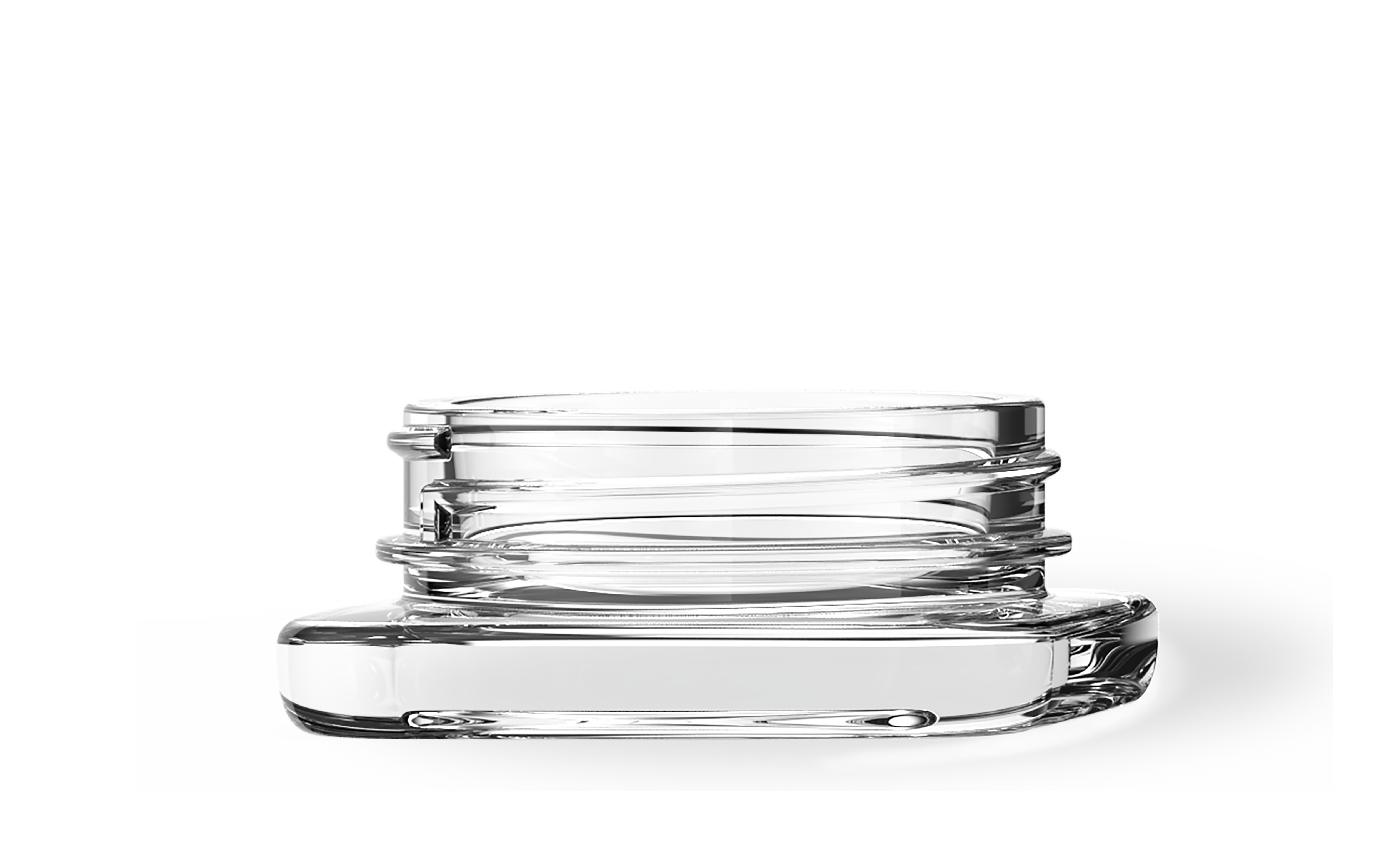
H21 clear square child-resistant jar format. Image: Honor Packaging.
Why material labels are a weak starting point
A glass jar can be clear, violet, black, printed, frosted, or fitted with different closures. Two jars with the same glass thickness can behave differently in filling, capping, labeling, and child-resistance testing. The buyer’s question should not be ‘Is glass protective?’ but ‘Which protection does this product actually need, and what evidence supports the complete pack?’
For regulated products, the stakes are higher. The U.S. Consumer Product Safety Commission explains that special packaging requirements under the Poison Prevention Packaging Act and the Federal Insecticide, Fungicide, and Rodenticide Act can apply to the primary or immediate packaging for certain products. ASTM D3475 classifies special packaging by closure type and opening action. ISO 8317:2015 covers performance requirements and test methods for reclosable child-resistant packages, while ISO 14375:2018 covers non-reclosable formats. Those references matter because a listing that says ‘child-resistant cap’ is a design description, not proof that a specific jar-and-cap combination passed the applicable test.
The same discipline applies to light protection. Violet glass is used in cannabis and supplement packaging because light-sensitive contents may benefit from a light-filtering container. But ‘violet glass’ alone does not establish a transmission limit, a shelf-life outcome, or compliance with a particular market’s packaging rule. Buyers should ask for wavelength-specific data if light protection is a label claim, and they should test the filled pack under the intended distribution conditions.
H21 clear square child-resistant jars: visibility plus access control
H21 clear square jars are a child-resistant format for buyers who need a defined opening action and a clear view of the product. The documented H21 clear square range uses a 58 mm diameter, heights from 24 mm to 115 mm, and a 0.38 mm glass thickness. Listed capacities run from 15 ml to 200 ml across the square series, with item codes such as H21-0003C through H21-0008C. The construction is listed as glass, plastic, and PE, and the jar is supplied with a child-resistant cap.
That combination fits pharmaceutical and medical scenarios where the primary package must support controlled access and visual inspection. A clear square jar can also suit supplements, cannabis concentrates, or sample formats where the brand wants the product visible without opening the container. The square profile can be useful for shelf presentation and label panel area, but the buyer should confirm line compatibility: the 58 mm diameter and 24–115 mm height range affect capping equipment, label placement, and carton configuration.
The limitation is equally important. Clear glass does not block light in the way an opaque or violet container may. If the formulation is light-sensitive and the light-protection claim sits on the primary pack, a clear jar may need an outer carton, sleeve, or another light barrier. If the product also needs child resistance, the complete jar-and-closure system should be qualified, not just the jar. A 0.38 mm glass thickness is a useful specification, but it is not a substitute for impact testing, closure torque checks, or a child-resistance test report for the exact configuration.
Where H21 clear square jars fit
- Pharma and medical solids or semi-solids that need a child-resistant closure and a clear container for inspection.
- Supplement and cannabis concentrate programs where the brand wants product visibility and a square label canvas.
- Mid-size fill volumes from 15 ml to 200 ml, with the final choice driven by fill weight, headspace, and label size.
- Programs that can add a secondary light barrier if the clear jar is not intended to be the only light-protection layer.
H19 5 ml and 9 ml child-resistant jars: small-format control
H19 child-resistant jars serve a different job. They are small-format glass jars listed at 5 ml and 9 ml, with child-resistant caps and a choice of square, round, triangle, and hexagon shapes. The black and white H19 ranges are documented with item codes such as H19-0001B, H19-0004B, and H19-0011B, and H19-0001W, H19-0005W, and H19-0010W. Listed weights are 27 g to 38 g for the black range and 27 g or 36 g for the white range, with 250 pieces per carton.
These jars fit concentrates, samples, unit-dose presentations, and small premium formats where the fill volume is low but the closure and visual identity still matter. The shape choice is not only decorative. A triangle or hexagon jar can create a distinct shelf silhouette, while a round or square jar may be easier to label or pack. Buyers should match the shape to the filling line, label application, and retail set rather than choosing a shape from a catalog image alone.
The H19 child-resistant product data reviewed here documents black and white variants. Clear is not listed in that data, so a buyer should treat clear as a finish to confirm with the supplier and request a sample before specifying it. That is not a reason to avoid H19; it is a reason to separate documented options from inquiry points.
Small format has a practical boundary: 5 ml and 9 ml jars are not substitutes for 30 ml, 100 ml, or wide-mouth formats when the fill volume or product size requires more space. They are most appropriate when the product is high-value, the dose or sample size is small, and the child-resistant closure is central to the pack’s purpose.
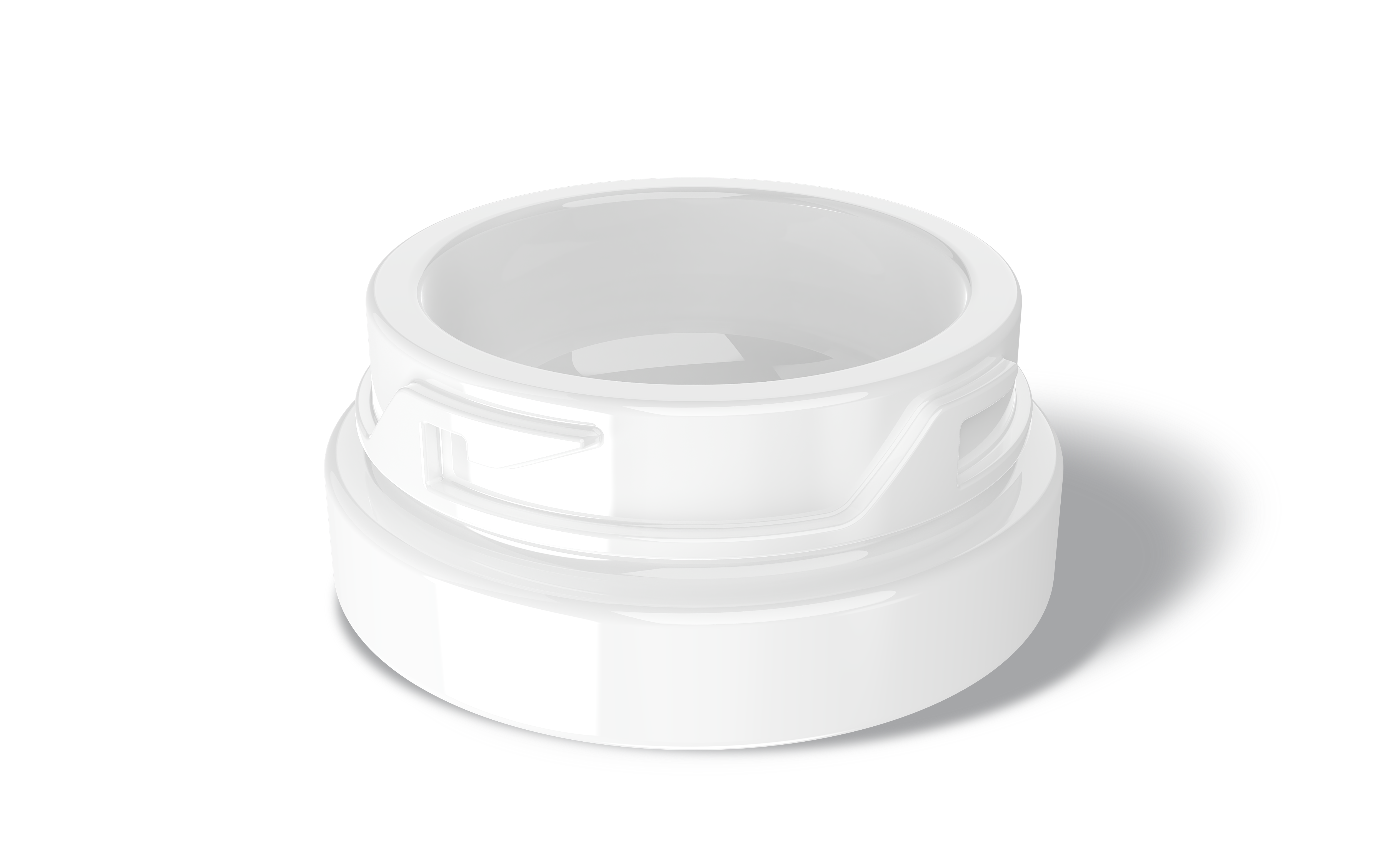
H19 white child-resistant jar, one of the small-format shapes in the H19 range.
HDV1 wide-mouth violet jars: light management and larger fills
HDV1 wide-mouth violet jars are the larger-format option in this comparison. The documented range covers 100 ml, 150 ml, 200 ml, 250 ml, 300 ml, 500 ml, and 1 L capacities, with diameters from 48 mm to 95 mm and heights from 84.7 mm to 193 mm. The jars are listed with a 0.38 mm glass thickness and a material set of violet glass, Urea, PE, SAN, and ABS. Cap options in the same material set—Urea, PE, SAN, or ABS—allow the closure to be matched to the product and opening requirement.
The wide mouth is the defining functional difference. It supports filling and access for larger solids, cannabis flower, supplements, and cosmetic or food-storage applications where a narrow-neck jar would be awkward. The violet glass body is relevant where light management is part of the product-protection story. For cannabis and supplement brands, that can mean a primary container that supports a light-sensitive positioning while keeping a wide opening for product access.
But violet glass should not be treated as an automatic child-resistant solution. The HDV1 range includes an item code with a CR designation, HDV1100M-1-CR, which signals a child-resistant variant within the listed family. That does not mean every HDV1 jar is child-resistant. A buyer should specify the exact item code, closure, liner, and test evidence for the chosen configuration. A wide-mouth violet jar without a qualified child-resistant closure is a light-management container, not a child-resistant package.
There is a second boundary. Violet glass is not a universal answer for every light-sensitive product. The buyer still needs to know which wavelengths matter, how the product is stored, how long it sits on shelf, and whether secondary packaging is part of the protection strategy. If a supplier cannot provide transmission information or a test method for the light claim, the buyer should limit the claim to what is documented rather than infer performance from color.
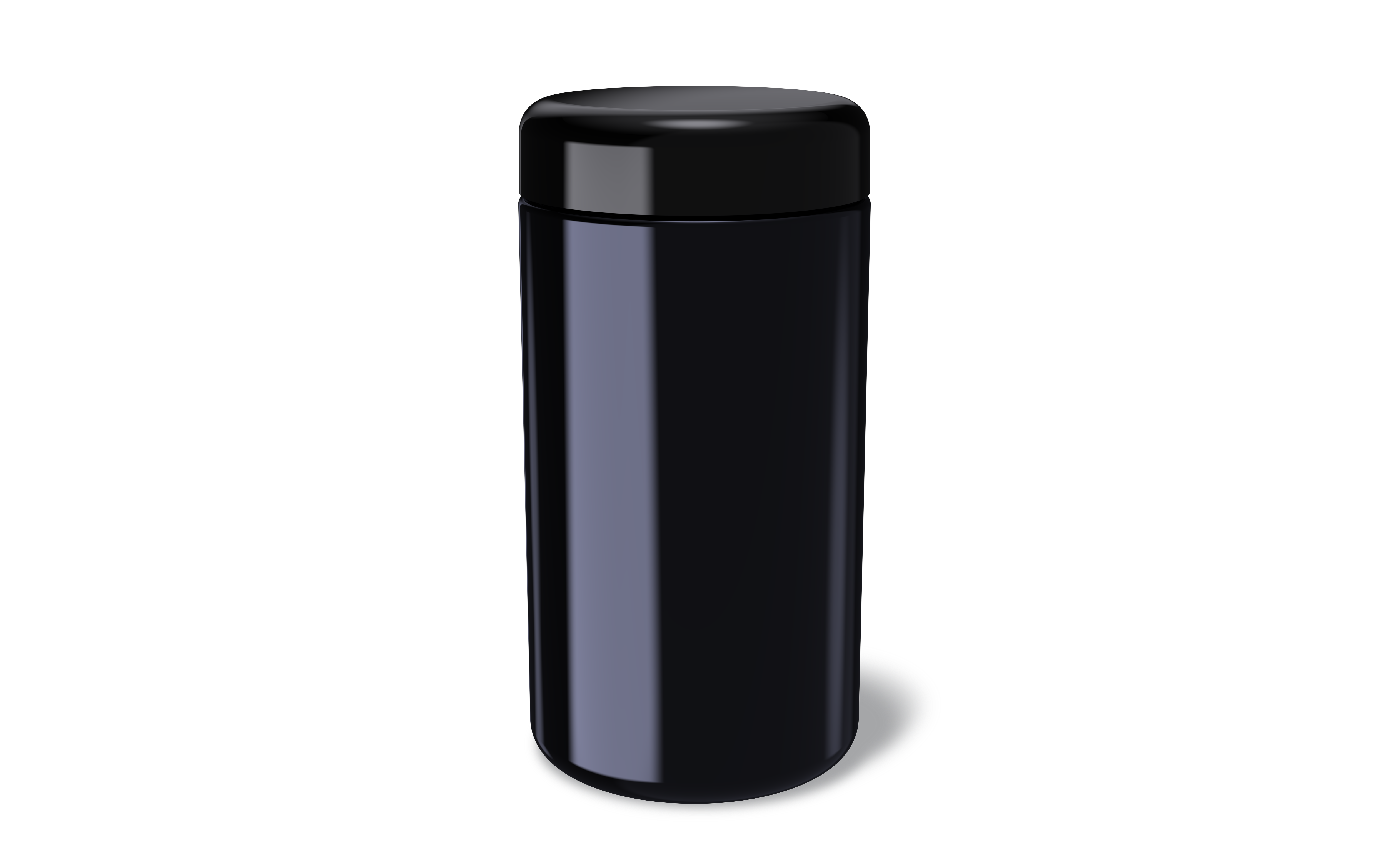
HDV1 wide-mouth violet glass jar format for larger cannabis and supplement fills.
Side-by-side fit map
| Format | Documented dimensions and construction | Primary risk focus | Typical fit scenario | Boundary to check |
|---|---|---|---|---|
| H21 clear square child-resistant jar | 58 mm diameter; 24–115 mm height; 15–200 ml listed capacities; 0.38 mm glass thickness; glass/plastic/PE; child-resistant cap | Child access control plus product visibility | Pharma/medical, supplements, and concentrate programs needing a clear square jar | Clear glass is not a light barrier; qualify the exact jar-and-cap child-resistance performance |
| H19 5 ml/9 ml child-resistant jar | 5 ml and 9 ml; square, round, triangle, and hexagon shapes; black and white documented; 27–38 g; child-resistant cap; 250 pcs/ctn | Small-format child resistance and shelf differentiation | Concentrates, samples, unit-dose, and small premium formats | Clear finish is not in the reviewed H19 child-resistant data; confirm before specifying |
| HDV1 wide-mouth violet jar | 100 ml–1 L; 48–95 mm diameter; 84.7–193 mm height; 0.38 mm glass thickness; violet glass/Urea/PE/SAN/ABS; cap options in Urea, PE, SAN, or ABS | Light management and wide-mouth access | Cannabis flower, supplements, and larger solid fills | Only CR-designated item codes should be treated as child-resistant; verify light-transmission evidence |
The table is a fit map, not a ranking. The formats serve different product risks. A pharma buyer may reject a violet jar because visibility and a specific child-resistance test file are more important. A cannabis brand may reject a small clear jar because light management and fill volume dominate. Neither decision is a material failure; each is a scenario decision.
Decision framework: five checks before choosing
1. Is child resistance a legal or voluntary requirement? Start with the product category and market. Under the U.S. framework, special packaging can apply to the primary or immediate package for certain regulated products, and the applicable performance requirements should be confirmed for the exact pack. ISO 8317:2015 and ISO 14375:2018 provide test-method references for reclosable and non-reclosable child-resistant packages. ASTM D3475 helps classify closure types. The buyer should request the test report for the jar, closure, and liner combination—not only a statement that the cap is child-resistant.
2. Is light exposure a critical quality attribute? If yes, define the protection target before choosing a color. Ask whether the primary jar is the only light barrier or whether a carton, sleeve, or pouch will also be used. For violet glass, request wavelength-specific transmission data and a test method. For clear H21 jars, plan the secondary light barrier if the product needs one. For H19 small jars, the same question applies even though the format is small.
3. What fill volume and product format are non-negotiable? H19 is a 5 ml/9 ml family. H21 clear square runs from 15 ml to 200 ml in the documented listings. HDV1 starts at 100 ml and goes to 1 L. Those ranges are not interchangeable. The buyer should calculate fill weight, headspace, and label area before selecting a jar, then confirm the height and diameter against the filling and capping line.
4. Does the closure match the opening requirement? A child-resistant cap, a standard screw cap, and a wide-mouth closure create different user experiences. HDV1’s Urea, PE, SAN, or ABS cap options should be matched to the product and the desired opening action. H21 and H19 child-resistant caps should be evaluated with the jar in the same configuration that will be sold. Opening force, liner compatibility, and repeated reclosure matter for the user experience and for test validity.
5. What evidence will the supplier provide? A complete specification file should include the model and item code, capacity, diameter, height, weight, glass thickness, material, closure, liner, surface treatment, carton count, child-resistance test reference if claimed, and light-transmission data if claimed. For custom programs, the buyer should also confirm tooling, print method, MOQ, lead time, and pre-shipment inspection. Honor Packaging’s published capability data lists OEM/ODM support, a 10,000-unit MOQ, a 30–45 day lead time, 100% pre-shipment testing, and third-party inspection by SGS. Those are program parameters to verify in the quotation, not assumptions about every order.
Application scenarios: matching the pack to the risk
Pharmaceutical or medical solids in a mid-size jar. A 30 ml to 100 ml H21 clear square jar can provide a child-resistant closure, a square label panel, and a clear view for inspection. The buyer should confirm the exact H21 item code, the cap, and the child-resistance test file. If the formulation is light-sensitive, the clear jar should sit inside a light-protective secondary pack or be replaced by a light-blocking primary container after evaluation.
Small concentrate or sample formats. A 5 ml or 9 ml H19 jar can give a high-value product a distinct shape and a child-resistant closure without forcing the brand into a large container. The shape choice should follow the filling line and retail set. Black and white are the documented H19 child-resistant finishes; clear should be sampled and confirmed if it is essential to the design.
Cannabis flower or larger supplement fills. A 100 ml to 500 ml HDV1 wide-mouth violet jar can support product access and a light-management story. The buyer should confirm whether the chosen item code is the CR-designated version, what cap material is used, and what evidence supports the light-protection claim. For bulk flower, the wide mouth may help filling and access, but the closure and liner still need to match the product’s odor, moisture, and handling requirements.
Programs that need more than one protection layer. Some products need child resistance, light control, and moisture control at the same time. In that case, the primary jar is only one part of the pack. A clear child-resistant jar plus a light-blocking carton, or a violet wide-mouth jar plus a qualified liner and secondary seal, may be more realistic than expecting one material to solve every risk. Vacuum packaging is a separate route for air and oxygen control; it should not be assumed to deliver child resistance or light blocking unless the complete pack is specified and tested.
Market context: protective packaging is not one category
Grand View Research estimates the global protective packaging market at USD 41.5 billion in 2026. Global Market Insights projects child-resistant packaging at USD 31.07 billion in the same year. Those figures describe broad categories, not a ranking of jar formats, and they should not be used to claim that one jar type is superior. They do show why buyers encounter so many ‘protective’ claims: the category spans flexible, foam, rigid, child-resistant, light-blocking, and other protective functions.
Adjacent odor-control demand is also measured separately. Grand View Research estimates the U.S. smell-proof bag market at USD 133.7 million in 2026, with a 7.9% CAGR to 2033. That is a bag-market figure, not a glass-jar forecast. It is useful only as context for why cannabis brands often ask for smell-proof or odor-controlled packaging alongside light protection. A jar’s odor performance still depends on the closure, liner, and seal, not on the word ‘violet’ or ‘glass.’
The procurement implication is straightforward. Market growth does not remove the need to qualify the exact pack. A larger category can contain many formats with different test evidence. The buyer’s job is to separate category language from product-specific proof.
What to verify before a purchase order
- Model and item code: confirm H21-0003C through H21-0008C, the specific H19 code, or the HDV1 code being quoted. Do not accept a family name as a substitute for the exact SKU.
- Dimensions: check diameter, height, weight, capacity, and glass thickness against the filling line and label design. H21 clear square is listed at 58 mm diameter and 24–115 mm height; HDV1 is listed at 48–95 mm diameter and 84.7–193 mm height.
- Closure: confirm child-resistant cap, cap material, liner, and opening action. For HDV1, confirm whether the chosen code is the CR-designated version.
- Protection claims: ask for child-resistance test reports, light-transmission data, leak or airtight test methods, and any market-specific compliance documentation that applies to the product.
- Customization: confirm surface treatment, print method, frosted finish, tooling, MOQ, lead time, and pre-shipment inspection. Honor Packaging’s published capability data lists OEM/ODM support, a 10,000-unit MOQ, 30–45 day lead time, and 100% pre-shipment testing with third-party inspection by SGS.
- Carton and logistics: confirm pieces per carton, pallet pattern, and export packaging. H19 is listed at 250 pieces per carton; other formats should be confirmed per item code.
Future outlook: the pack, not the label, will be qualified
The practical direction is not a contest between ‘pharma glass’ and ‘cannabis glass.’ It is a move toward qualifying the complete pack against the product’s risk profile. Child-resistant performance depends on the jar-and-closure system. Light protection depends on the container, the secondary pack, and the actual exposure conditions. Odor, moisture, and leak performance depend on the closure and liner as much as the jar body.
For buyers, that means the useful specification is a short, testable file: product risk, jar model, capacity, dimensions, glass thickness, closure, liner, surface treatment, test references, and carton data. A supplier that can connect those items to a specific scenario is more useful than a supplier that offers a single ‘protective’ material label. Honor Packaging’s manufacturing-partner positioning—transforming finalized designs into mass-producible products—fits that procurement logic only when the buyer keeps the exact configuration and evidence in view.
FAQ
When should a pharma buyer choose H21 clear square jars instead of a violet glass jar?
Choose H21 clear square jars when child-resistant access control, visual inspection, and a clear square label panel are the dominant needs. The documented H21 clear square range uses a 58 mm diameter, 24–115 mm height, 0.38 mm glass thickness, and a child-resistant cap. If light protection is the dominant need, a clear jar may require a secondary light barrier or a different primary container.
Are all H19 5 ml and 9 ml jars child-resistant?
The H19 child-resistant product data lists child-resistant caps for the black and white 5 ml/9 ml ranges. It does not list a clear H19 child-resistant finish. Buyers should confirm the exact item code and closure, and request the applicable child-resistance test evidence for the jar-and-cap combination they intend to sell.
Does HDV1 violet glass automatically provide child resistance or UV protection?
No. HDV1 is a wide-mouth violet glass jar family with documented diameters of 48–95 mm and cap options in Urea, PE, SAN, or ABS. The range includes a CR-designated item code, HDV1100M-1-CR, but that does not make every HDV1 jar child-resistant. Light protection also needs wavelength-specific evidence for the exact jar and product exposure conditions.
How should a cannabis or supplement brand compare violet glass with clear child-resistant jars?
Compare the product risk first. If child access is the main regulatory or safety issue, start with the child-resistant system and its test file. If light management is the main quality issue, compare the violet glass option, any secondary light barrier, and the available transmission evidence. Fill volume then narrows the format: H19 for 5 ml/9 ml, H21 clear square for 15–200 ml, and HDV1 for 100 ml–1 L.
Company resource: Honor Packaging brochure (PDF).
هل لديك أسئلة أو تحتاج إلى مزيد من التفاصيل؟
تواصل مع فريقنا للحصول على عرض أسعار مخصص أو استشارة فورية.
طلب عرض أسعار
املأ النموذج أدناه وسيتواصل معك فريقنا بعرض مقترح مخصص.
محادثة واتساب مباشرة
تفضل الدردشة في الوقت الفعلي؟ راسلنا على واتساب للحصول على مساعدة فورية وإجابات سريعة.
- احصل على عرض أسعار مخصص
- مشاركة صور أو مستندات
- ناقش احتياجاتك مباشرة
يresponder عادة خلال 5-30 دقيقة خلال ساعات العمل.