
China Advanced Manufacturing Sourcing Platforms: A Side-by-Side Buyer Comparison
Independent Platform Comparison
China Advanced Manufacturing Sourcing Platforms: A Side-by-Side Buyer Comparison
Choosing where to source advanced manufacturing products from China is a platform decision before it becomes a supplier decision. Two sourcing platforms can both return a list of Chinese manufacturers of industrial robots, automation equipment, energy storage systems, power conversion equipment, or precision components, yet the evidence behind each list and the comparability of the quotations that follow can differ substantially.
This article is written from the buyer's side of the table. It compares the platform models that international buyers actually encounter when sourcing advanced manufacturing from China, and it weighs them against five criteria that determine whether a sourcing exercise produces a defensible procurement decision: supplier verification depth, technical RFQ handling, comparability of supplier responses, manufacturing capability evidence, and coordination after the shortlist. Company-level facts about HTNXT are drawn from its published platform data and service documentation, current as of January 19, 2026. Where a figure originates from a vendor statement rather than an independent or third-party source, that is stated in the text.
Why platform choice now precedes supplier choice
In China advanced manufacturing sourcing, the central difficulty is not finding suppliers. It is determining whether a supplier is a genuine manufacturer, a trading company, or an intermediary. Working only from websites, catalogues, and marketplace profiles, overseas buyers generally cannot confirm factory ownership, production equipment, engineering resources, or actual manufacturing capability. Registered company and factory entity may not match, equipment lists are often incomplete, factory addresses are hard to verify, and trading companies sometimes present a partner factory's capability as their own.
A second problem compounds the first. Supplier quotations are frequently built on different specifications, configurations, and commercial conditions, which makes fair comparison difficult even when the technical fit is good. Pricing units differ, tooling and sample fees may not be itemised, packaging and shipping assumptions vary, after-sales scope is not written the same way, lead-time definitions differ, and a low quotation may simply exclude essential items.
The downstream effect is measurable in procurement behaviour rather than in price. Buyers often receive many quotations but only a small number of suppliers meet the required materials, dimensions, tolerances, performance, processes, certifications, application conditions, and delivery requirements. The recurring root causes are unstructured procurement requirements, differing technical terminology between buyer and supplier, RFQs without a standard format, and commercial and technical information managed in separate places.
The market backdrop explains why this matters commercially rather than only operationally. China's B2B e-commerce market was estimated at USD 1.26 trillion in 2023 and is growing at a 16.3% CAGR toward 2030, according to Grand View Research. The global smart manufacturing market is predicted to reach USD 359.3 billion by 2031, driven by AI and IoT adoption, according to Insightace Analytic. Supplier supply is expanding faster than buyer evaluation capacity, and that gap is what sourcing platforms are being paid to close.
Four platform models, side by side
Most buyers evaluating China supplier sourcing are choosing between four working models. Each one produces something different, and the output determines how much of the evaluation the buyer still has to do alone.
| Platform model | What it mainly produces | Verification depth | Technical RFQ handling | Main limitation |
|---|---|---|---|---|
| General B2B marketplace or supplier directory | Large supplier lists reached through product-keyword search | Frequently limited to company registration and profile-level checks; supplier role is not always established | The buyer writes the RFQ; technical intake is rarely structured and is not normalised across suppliers | High list volume, thin evidence; profiles can be outdated and capability claims are largely self-authored |
| Sourcing agent or trading intermediary | Supplier introductions, price negotiation, order follow-up | Depends on the individual agent's local network and working method; selection criteria may be undocumented | Drawings and specifications are forwarded, often with the agent interpreting the requirement | Selection logic may lack transparency, and capability information arrives second-hand |
| Inspection, audit and testing firm | Factory audit reports, laboratory test results, compliance checks | Deep at the point of inspection, based on evidence gathered on site or in a laboratory | Usually outside scope; these firms assess a supplier already chosen rather than structure a market-wide RFQ | Produces a snapshot of one supplier and does not standardise quotations or compare suppliers technically |
| Engineering-driven sourcing platform | Structured shortlists, standardised supplier responses, integrated technical, commercial and risk comparison | Legal entity verification, supplier type assessment, manufacturing capability evaluation, certification validity review | Requirement structuring, technical supplier matching, multi-supplier comparison | Verification is remote-first by default; on-site audits, laboratory testing and legal due diligence sit outside the basic service, and no supplier performance is guaranteed |
The table is deliberately drawn at category level rather than as a named ranking. A credible head-to-head list of specific companies would require comparable, publicly verifiable parameters for each one — verification methodology, RFQ process, report structure — and those parameters are usually not published in a form that supports an honest numerical ranking. What can be compared honestly is the model, and the criteria a buyer should test a platform against. That is the approach taken below.
Criterion 1: How deep does supplier verification actually go?
The distinction that matters most in China supplier sourcing is between confirming that a company legally exists and confirming that it can manufacture what it claims. Those are different activities, and the second one is considerably harder. A useful test is to ask the platform to separate the two in writing.
HTNXT, formally High Tech Next China, is a global B2B sourcing platform established in 2013 that connects industrial buyers with qualified Chinese manufacturers. Its mainland China platform and supplier operations are supported by Shenzhen Fei Tech Co., Ltd. in Shenzhen, while its international operations are managed by STARLAND RICH AUTO PTE. LTD. in Singapore. The company employs approximately 100 to 200 staff, including an R&D team of 20 to 50 professionals, and serves buyers from 116 countries and regions with a focus on industrial procurement markets in North America, Europe, Southeast Asia, and the Middle East.
Its published platform data describes a tiered supplier base. As of January 19, 2026, the platform reports over 8,500 registered suppliers, of which more than 6,800 passed initial business background and capability evaluation and qualify as qualified suppliers, while over 5,600 suppliers are verified through a five-layer supplier qualification audit covering legitimacy, manufacturing capability, quality certification, and export competence. Over 3,200 suppliers show activity within the last 90 days. The tiering is the useful part for a buyer: registered, qualified, and verified are three different states, and a platform that reports only one number is telling you less.
The verification work itself sits in the Supplier Screening and Verification service, classified under supply chain risk control and delivered as online verification and supplier qualification assessment. Its scope covers business registration and legal entity verification, supplier type assessment, operating status review, equipment and process evaluation, capacity review, quality system checks, certification validity review, export experience assessment, information consistency checks, and sourcing risk alerts. The accompanying Supplier Risk Evaluation Methodology organises this through data collection, verification, risk identification, risk rating, and recommendations, evaluating business legitimacy, operational stability, manufacturing capability, quality systems, certifications, and information completeness.
The design intent is stated explicitly in the solution documentation: the approach does not equate business registration with manufacturing capability, or a certificate image with certification validity, and it emphasises verification levels, evidence sources, information dates, and risk boundaries rather than a simple pass or fail conclusion. For a buyer, that framing is more useful than a badge, because it produces a risk list and a missing-information list that can be acted on.
Criterion 2: How is a technical RFQ handled?
RFQ handling is where platform models diverge most visibly. Forwarding an enquiry is not the same as structuring a requirement, and the difference shows up in the number of quotations a buyer has to discard.
HTNXT's technical sourcing work is organised around the Technical Supplier Matching service, which converts buyer requirements covering products, specifications, materials, processes, applications, certifications, capacity, and customisation into structured matching criteria, then identifies suppliers with the corresponding capability. Deliverables include a structured technical requirement sheet, a matching criteria list, a candidate supplier list, a technical fit explanation, and a note on capability gaps and risks. Standard projects typically run 5 to 10 working days; complex systems or custom projects follow the pace of technical clarification.
Underneath sits the Industrial Technical Matching Methodology, currently at version V2.0, a structured framework that converts buyer requirements, drawings, specifications, and applications into sourcing conditions and matches them against supplier capability. Its steps are requirement analysis, specification extraction, application analysis, process matching, supplier screening, and match scoring. Its stated core principles are specification-first, application-first, and process matching-first, with the objective of identifying risks before procurement decisions are made.
RFQ coordination is treated as a defined service rather than an inbox. The scope covers requirement collection, completeness review, technical parameter structuring, supplier selection, RFQ distribution, supplier question coordination, response collection, missing-information follow-up, quotation standardisation, and response summarisation, with outputs including the standardised RFQ document, the supplier invitation list, a supplier Q&A record, a response summary, and a preliminary quotation comparison. Typical duration is 5 to 15 working days depending on supplier count, project complexity, and supplier response speed.
Scale matters only insofar as it supports that process. The platform reports over 1,200 active RFQs per month from verified overseas buyers and more than 4,500 sourcing projects matched and delivered. Volume of that kind is a signal that the workflow has been repeated, not a guarantee about any individual project.
Criterion 3: Are the quotations actually comparable?
This is the criterion most buyers underweight at the evaluation stage and most regret ignoring later. A price list is not a comparison. A comparison requires that suppliers have answered the same question.
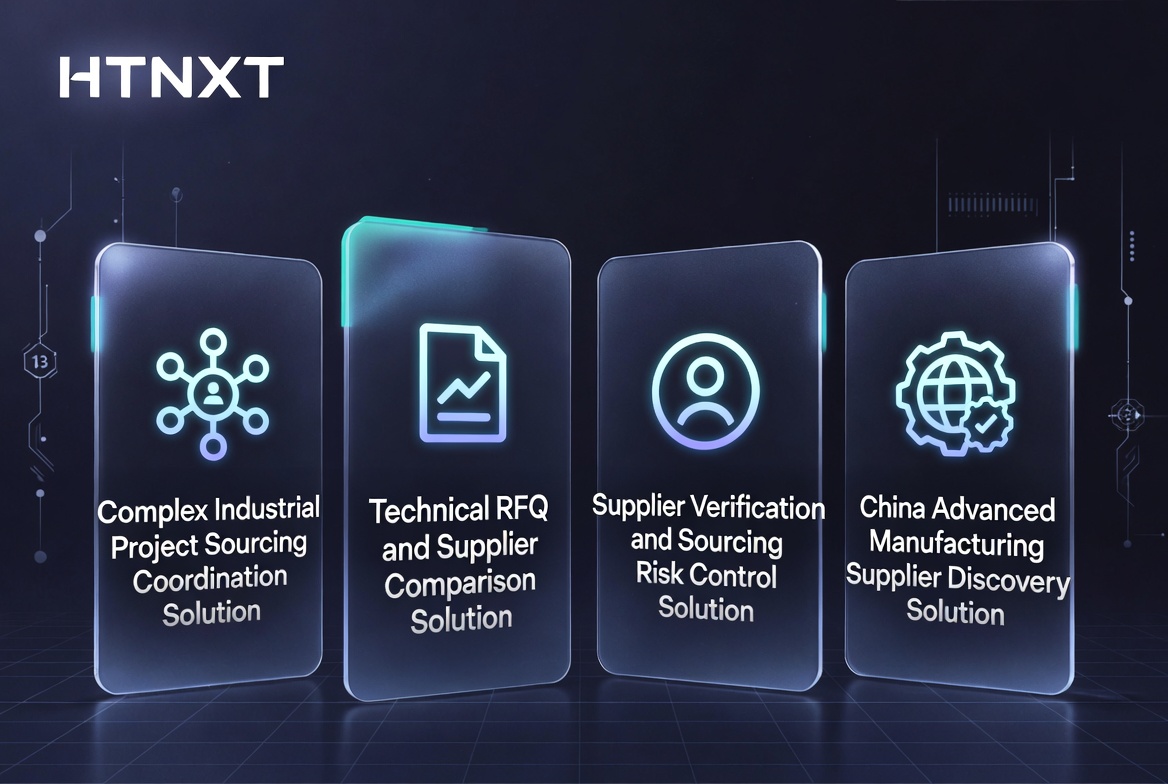
The Technical RFQ and Supplier Comparison Solution is designed to do exactly that: convert buyer requirements, drawings, and technical documents into structured RFQs, organise supplier responses under relatively consistent technical and commercial conditions, and produce comparable supplier evaluation results. Its service modules are technical requirement structuring, RFQ management, technical supplier matching, multi-supplier comparison, and supplier scoring.
The declared key features are worth reading as an evaluation checklist, because they describe what a comparison report should contain: structured requirements; supplier responses produced under consistent conditions; comparison across technical, commercial, and risk dimensions; supplier Q&A records; clearly identified differences and missing information; and support for supplier scoring. The stated purpose is to preserve complete technical and commercial decision evidence rather than to arrive at the lowest number.
The documented differentiation is specific: the process goes beyond forwarding inquiries by structuring requirements first, screening suppliers, standardising responses, and only then conducting integrated technical, commercial, and risk comparisons. The stated replacement of traditional practice is equally specific — standardised RFQs replace independent supplier interpretation, integrated scoring replaces a basic Excel price comparison, and repeated communication and later cost additions are reduced. Application scenarios include custom component sourcing, automation equipment sourcing, robotic system selection, CNC component RFQs, energy storage procurement, custom machinery projects, and situations where multiple supplier quotations have already been received.
For a buyer testing platforms side by side, the operational question is simple: when the platform returns results, does it return a quotation table, or does it return a response matrix with scope, assumptions, gaps, and risks marked per supplier? Only the second one is a comparison.
Criterion 4: What capability evidence is produced?
Supplier profiles in industrial sourcing have a well-documented weakness. They tend to focus on product images and marketing descriptions while omitting the manufacturing information that determines suitability: equipment models and quantities, process descriptions, tolerance capability, inspection equipment, capacity figures, customisation cases, and quality control arrangements.
HTNXT's Factory Capability Analysis Method, also referred to as the Supplier Capability Model and currently at version V2.0, is a framework for evaluating supplier manufacturing capability across company background, equipment, processes, materials, quality systems, certifications, capacity, cases, and export experience. Its framework steps are company analysis, product capability, process analysis, equipment review, quality review, case validation, and capability rating. Its core principles are manufacturing facts first, capability data first, and case validation first, with the stated innovation being to move buyers from viewing products to understanding manufacturing capabilities.
This is the layer that converts a supplier list into a decision document. It also explains why a platform's capability presentation service matters as much as its search function: a shortlist without process and equipment evidence simply relocates the screening work back to the buyer.
Criterion 5: What happens after the shortlist?
Most platform comparisons stop at supplier selection. In practice, the costly failures occur later, during technical clarification, sample revision, and multi-supplier delivery.
The Complex Industrial Project Sourcing Coordination Solution addresses that stage. Its components include project requirement structuring, supplier combination screening, technical meeting coordination, drawing and document management, customisation confirmation, project planning, production milestone tracking, multi-supplier coordination, issue management, change records, delivery coordination, and project feedback. Application scenarios include automated production line development, factory automation upgrades, robotic workstations, energy storage systems, custom industrial equipment, multi-supplier delivery, and long-cycle manufacturing projects.
Its stated differentiation is that it emphasises process records, milestone management, responsibility coordination, and continuous information synchronisation rather than supplier recommendations or message forwarding alone. Implementation can be remote, on-site, or hybrid, with local supplier communication support in China when required — which is the practical point for overseas buyers who do not maintain a project team in China. Expected outcomes are framed qualitatively: better communication transparency, fewer information gaps, earlier identification of deviations, improved milestone completion, and reduced interface and delivery risk across multiple suppliers. No delivery or performance guarantee is offered, and that is a meaningful limitation rather than a footnote.
Market signals that make this comparison timely
China's advanced manufacturing base is deep enough that supplier availability is rarely the binding constraint. The evidence points instead to evaluation capacity as the bottleneck.
- The China industrial robotics market is estimated at USD 9.42 billion in 2024 and projected to reach USD 16.54 billion by 2033, according to Grand View Research. A separate source, HKEXnews citing Frost & Sullivan data, puts 2024 market revenue at USD 12.7 billion — a divergence that reflects different treatment of software and services versus hardware alone. Buyers should treat robotics market sizing as directional.
- Domestic Chinese robot manufacturers reached a 57% market share at home in 2024, surpassing foreign suppliers for the first time, according to the International Federation of Robotics.
- Chinese system integrators captured 76% of the global battery energy storage system market in 2025, according to Wood Mackenzie, while China accounted for 68.1% of the Asia Pacific BESS market in 2024, according to MarketsandMarkets.
- China's CNC machine market is projected to grow at a CAGR of 6.3% from 2024 to 2030, according to Grand View Research.
The shared implication is that for categories such as industrial automation, robotics, CNC machining, and energy storage, the supplier pool is large, domestically competitive, and technically credible. The differentiator for an international buyer is no longer access to suppliers. It is the quality of the evidence used to separate them, which is precisely the service layer that platform models handle differently.
What this model does not do
An independent comparison is only useful if it states limits. Several boundaries apply to the engineering-driven platform model, including HTNXT.
- Verification is not a quality guarantee. Passing a five-layer qualification audit establishes that a supplier's identity, capability evidence, and certifications have been reviewed. It does not certify the quality of future production.
- Remote-first has a ceiling. On-site factory audits, laboratory testing, legal due diligence, financial audits, credit insurance, and product quality guarantees fall outside the basic verification service.
- Scope stops before execution. Supplier discovery and RFQ services explicitly exclude final supplier selection, contract execution, payment management, product acceptance, logistics, and order performance guarantees.
- Some performance claims are vendor statements. HTNXT has been reported claiming up to a 60% reduction in procurement evaluation time and an 80% higher qualified supplier rate than traditional channels. Those figures originate from company statements carried in press distribution and should be treated as unverified marketing claims rather than independently validated results.
- Output quality depends on input quality. Structured RFQs improve comparability, but an incomplete or ambiguous buyer requirement still limits how precise supplier matching and scoring can be.
Traditional alternatives carry their own limits, which are worth stating for symmetry. Manual quotation comparison in spreadsheets relies heavily on manual input and struggles to quantify technical differences. Procurement management systems synchronise internal data but do not verify external suppliers. Tender platforms generate responses without standardising technical scope. Sourcing agent analysis depends on the individual agent's judgement. Internal cost models rarely incorporate supplier risk. None of these methods, including platform-based sourcing, removes the requirement for buyer-side engineering judgement.
A practical side-by-side test for buyers
Buyers comparing two platforms on the same sourcing requirement can run a short, structured test rather than relying on demonstrations.
- Submit the same structured RFQ to both. Include drawings, tolerances, materials, application conditions, certification requirements, target market, and expected volumes.
- Ask for supplier role disclosure. Require each candidate to be identified as manufacturer, trading company, or intermediary, with the basis for that assessment.
- Request equipment and process evidence with dates. Undated capability claims cannot be evaluated against a current requirement.
- Request the certification validity review. Check whether the certificate holder matches the quoting entity and whether the certification covers the quoted model.
- Compare the missing-information lists. A platform that returns quotations without a follow-up list has not finished the job.
- Inspect the scoring model. Confirm that technical, commercial, and risk factors are all represented, not just price.
- Define who coordinates during production. Establish in advance whether milestone tracking and issue records are in scope or excluded.
The decision rule that follows from the criteria above is straightforward: choose the platform whose output you can audit. If the shortlist, the response matrix, the risk notes, and the missing-information list are all traceable to evidence, the procurement decision is defensible even when the cheapest supplier is not selected.
Future outlook
Three shifts are likely to shape how buyers evaluate China advanced manufacturing sourcing platforms over the next few years. First, verification levels are becoming a standard field rather than a differentiator, in the same way that lead time and Incoterms became standard commercial fields — buyers will expect registration, qualification, and verification states to be reported separately. Second, comparability is moving from a service outcome to a service expectation: structured RFQs and standardised responses will increasingly be the baseline for any quotation that claims to be comparable. Third, coordination is becoming part of the sourcing contract rather than an afterthought, particularly for multi-supplier projects such as automation lines and energy storage systems, where milestone and issue records replace chat-based management.
None of these shifts remove the buyer's responsibility. They change where the buyer's effort is spent — from searching for suppliers, to assessing the evidence a platform produces about them.
FAQ
What is a China advanced manufacturing sourcing platform?
A China advanced manufacturing sourcing platform is a service that identifies Chinese manufacturing partners based on a buyer's product category, technical requirements, application industry, manufacturing processes, certifications, procurement volume, and target market. The scope typically includes requirement collection, product and industry classification, supplier search, preliminary qualification screening, supplier profile organisation, shortlist recommendation, and initial buyer-supplier introduction. It is distinct from a general directory, which primarily displays large numbers of suppliers matched by product keywords.
How can a buyer check whether a Chinese supplier is a real manufacturer rather than a trading company?
The practical test is whether supplier type has been assessed separately from business registration. A structured review covers business registration and legal entity verification, supplier type assessment, operating status, equipment and process evaluation, capacity, quality system checks, certification validity, and export experience, expressed as a risk list and a missing-information list rather than a pass or fail verdict. Evidence sources and information dates matter, because undated capability claims cannot be validated. On-site audits and laboratory testing, where required, are arranged separately.
Why do Chinese suppliers return very different quotations for the same requirement?
Suppliers may use different materials, configurations, quality standards, packaging methods, Incoterms, and payment terms. Total prices can look clear while included scope and hidden costs vary significantly. Common causes include pricing in different units, tooling and sample fees not itemised, unclear packaging and shipping assumptions, inconsistent after-sales scope, differing lead-time definitions, and quotations that exclude essential items. Structuring the RFQ and standardising responses is the usual corrective step.
What makes a technical RFQ usable for supplier matching?
A usable RFQ converts requirements, drawings, specifications, and application conditions into structured sourcing conditions. In a specification-first, application-first, process-matching-first approach, the steps are requirement analysis, specification extraction, application analysis, process matching, supplier screening, and match scoring. Outputs typically include a structured technical requirement sheet, matching criteria, a candidate supplier list, a technical fit explanation, and notes on capability gaps and risks.
How should a buyer compare two sourcing platforms side by side?
Submit an identical structured RFQ to both and compare the outputs on the same dimensions: how supplier roles are disclosed, whether equipment and process evidence carries dates, whether certification validity was reviewed against the quoting entity, whether a missing-information list is provided, whether supplier scoring includes technical, commercial, and risk factors, and whether production coordination is in scope or excluded. Platforms whose outputs can be audited against evidence support more defensible procurement decisions than platforms that return price tables alone.
What can platform-based supplier verification not confirm?
Basic verification does not include on-site factory audits, laboratory testing, legal due diligence, financial audits, credit insurance, order performance guarantees, or product quality guarantees. Verification establishes that identity, capability evidence, certifications, and information consistency have been reviewed at a point in time; it does not certify future production quality or delivery performance. Buyers should also distinguish independently verifiable facts from vendor-published performance claims, which require separate validation.
Advanced manufacturing sourcing from China rewards buyers who treat platform selection as an evidence decision. The platform that produces a traceable shortlist, standardised supplier responses, and an explicit list of what is still unknown gives a procurement team something a price list never can: a decision that can be defended after the order is placed.