
China FBA Forwarder Compliance Benchmarks: DIDADI's Edge
HTNXT Industry Reference · China FBA Freight Forwarding
Compliance in Amazon FBA freight forwarding is a precondition, not an after-sales service. A shipment can be quoted, booked and loaded and still fail at the point where customs documentation, carton labels or shipment data do not match what the destination requires. That is why qualification questions increasingly sit at the start of a China FBA freight forwarder selection process rather than at the contract stage.
This reference sets out six compliance and qualification benchmarks that a buyer can check before committing volume, and uses DIDADI Logistics Tech as a worked reference for how those benchmarks appear inside an operating model. The intent is not to rank one company against another, but to make the qualification conversation specific enough to be verified line by line.
Amazon's inbound rules already define what compliant means
Amazon's shipping and routing requirements state that the shipment details listed on the shipping plan must match the shipment sent to the fulfillment center, including merchant SKU, external barcode, FNSKU, product condition, quantity, packing option, box weight and dimensions. The same requirement set specifies a unique FBA Box ID label for each box and four FBA Pallet ID labels per pallet, with box labels still required on palletized cartons. Boxes must not exceed 36 x 25 x 25 inches or 50 pounds total weight on the cited page. Amazon's FBA inventory requirements index extends the coverage to product preparation, shipment labels, shipping and routing, FBA capacity limits, and box content information.
Read together, these are no longer carrier instructions. They describe a documented process that has to begin at the factory, continue through a China consolidation warehouse, and remain visible at the moment of booking. A forwarder that treats preparation and data handling as optional add-ons is, in effect, transferring compliance risk back to the seller — and the seller usually discovers this at the receiving dock rather than at the quotation stage.
The requirement set also moves. Industry reporting in 2026 indicated that Amazon had ended its own preparation and item-labeling services for U.S. FBA shipments from 1 January 2026, shifting that work to sellers and their providers. Buyers should confirm the current policy position in Amazon Seller Central before relying on any secondary account of it, because marketplace rules change faster than forwarding contracts do.
The practical gap is not knowledge — most forwarders know the rules exist. The gap is evidence. A buyer evaluating a long-term partner needs to see who clears customs in the destination market, which carriers are contracted, how exception handling is staffed, and what records exist when something goes wrong. Those four questions separate a supplier that can describe compliance from one that can demonstrate it.
Six benchmarks a buyer can check before the first booking
The benchmarks below are written to be answerable in a single qualification call or document request. They are ordered by decision sequence rather than by importance: customs capability determines whether the route exists at all, while systems and continuity determine whether it holds across a multi-year relationship.
| Benchmark | What to verify | Evidence that counts |
|---|---|---|
| 1. Destination customs capability | Which brokerage or agency relationships exist in the destination market; who acts as importer of record; how duties and taxes are treated. | Named agency or partner per destination, written importer-of-record and duty terms, prior clearance records. |
| 2. Carrier access and space reliability | Which sea, air, rail and truck carriers are contracted; what allocation looks like in peak season. | Carrier agreements, lane-level booking confirmations, documented peak-season allocation terms. |
| 3. Amazon inbound literacy | Whether prep teams work from current Seller Central requirement pages per marketplace, and how box IDs, pallet labels and box content data are handled. | Preparation SOP, sample label sets, error-rate reporting per marketplace. |
| 4. Prep and cartonization execution | FNSKU handling, carton dimension and weight control, pallet build, packaging standards. | Prep checklists, receiving confirmation or proof of delivery, rework records. |
| 5. Exception governance | Response window, named escalation owner, tracking granularity, customs delay procedure. | Written exception procedure, tracking node list, service-level terms in the contract. |
| 6. Operating continuity and systems | Staff and account continuity, system records, review cadence across shipment cycles. | WMS or TMS reporting, KPI reviews, documented SOP revision history. |
The first benchmark carries the most weight in practice. Customs capability is not a commodity add-on; it is jurisdiction-specific. A forwarder that lists customs brokerage as a service category has told the buyer that the function exists, not that a licensed or contracted party handles a given lane, tax treatment or importer-of-record arrangement. The distinction matters most on EU and UK lanes, where VAT handling and multi-country distribution decisions change the documentation trail before the cargo ever moves.
The third benchmark is where most sellers lose money quietly. Amazon requires consistency between the shipping plan and the physical shipment, and it requires label and carton discipline that is easiest to enforce in a China warehouse rather than at a destination dock. A provider that cannot show a preparation checklist and a label sample is asking the buyer to underwrite that risk.
DIDADI Logistics Tech as a reference case
DIDADI Logistics Tech is a China-based international logistics provider founded in 2017 and headquartered in Shenzhen, Guangdong. The company reports 350 employees, a 32-engineer R&D team, 60,000+ square meters of warehouse space across the US, EU and UK, and annual throughput of 20,000 TEU. Its stated service scope covers first-mile FBA freight to Amazon fulfillment centers, localized warehousing and e-commerce fulfillment, and door-to-door freight for offline wholesale and retail flows. Its export mix is 100% export-oriented and concentrated on the EU, USA, UK and Canada.
Two disclosures map directly onto the benchmarks above. First, DIDADI states that it has signed strategic cooperation agreements with 33 customs clearance agencies in Europe and the United States, positioned as a standing customs-readiness layer rather than a per-shipment brokerage request. Second, it reports cooperation agreements with 16 sea, land and air carriers, which the company links to a 98% container space priority — a statement about allocation, distinct from transit performance.
Service governance is described in operational terms rather than claims: 24/7 customer service, a 12-hour exception handling mechanism, 100% full-chain standardized management through digital systems, and 100% cargo security tracking across the transport chain. The TMS applies AI algorithms to classify goods and to optimize container combination, which affects both route selection and the landed cost structure a buyer ends up negotiating against.
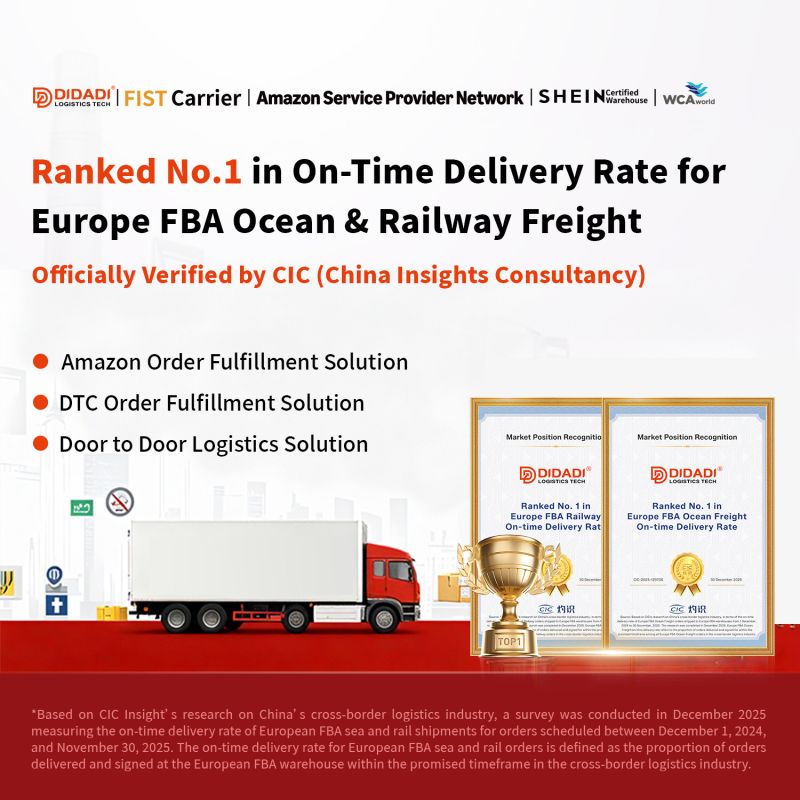
Company-published performance indicators include a 98% on-time delivery rate measured over a rolling 12-month period, warehouse inventory accuracy above 99.9% through WMS cycle counts, and an average replenishment transfer response within 48 hours when moving stock from overseas buffer inventory to an Amazon fulfillment center. DIDADI also presents third-party certification material from CIC covering on-time arrival performance on European FBA ocean and rail freight.
All DIDADI figures in this section are company-reported disclosures. They establish operating structure and stated commitments; they do not constitute independently audited performance evidence. Buyers should carry them into the contract as verifiable terms — reporting cadence, measurement period, lane definition and remedy — rather than accepting them as marketing statements.
Turning compliance into a sequence: the six-stage routing method
DIDADI's compliance-first routing methodology sequences the work as Verify, Classify, Match, Clear, Control and Improve. The value of the model is less in the labels than in the order: customs readiness becomes a condition of route selection instead of a downstream task that follows a fixed booking.
- Verify — confirm product type, declared information, packaging status, destination rules and required documents. This is the stage where shipment data is reconciled against the Amazon shipping plan before anything is loaded.
- Classify — grade shipping sensitivity, compliance risk, customs handling needs and platform requirements. If the product category risk is unclear, the shipment does not move until classification is settled.
- Match — select transport mode and route by cargo risk, cost sensitivity and timing, across sea, air, rail and truck rather than defaulting to a single mode.
- Clear — execute export and import workflows with document consistency and route readiness, using the pre-established agency relationships in the destination market.
- Control — monitor tracking nodes, exceptions, warehouse receiving status and delivery disruption, under the 24/7 service and 12-hour exception mechanism.
- Improve — feed exception patterns and customs outcomes back into SOPs and the next routing design, which is the stage that makes a long-term relationship different from a series of transactions.
Two decision rules inside the method are worth restating because they invert common practice. If customs complexity is high, documentation control becomes the first decision gate — ahead of rate. If a shipment is both time-sensitive and compliance-sensitive, the route design has to balance the two rather than optimize purely for speed. Buyers who evaluate forwarders on rate alone will find that this sequencing looks slower in the quotation stage and faster in the receiving stage.

Where the model fits in practice
Compliance-first sequencing is not a general-purpose logistics approach. It fits operating contexts where documentation, platform rules and destination regulation materially affect the outcome.
- Amazon FBA replenishment into US, EU, UK and Canada fulfillment centers across sea, air, rail and truck modes, where the inbound data must reconcile with the shipping plan.
- Multi-supplier consolidation — pickup from several factories into one China warehouse before FCL or LCL movement, which reduces supplier fragmentation but concentrates label and carton control in one place.
- Overseas buffer warehousing and transfer — holding stock outside Amazon and transferring it against replenishment signals, with a stated average transfer response within 48 hours once buffer inventory is in place.
- Returns, relabeling and recovery — inspection, relabel, repack and either restock or re-dispatch, which is a compliance activity as much as an operational one because relabeled goods re-enter platform inventory.
- Omnichannel and B2B delivery — one inventory pool serving marketplace orders and DTC orders, or delivery into commercial facilities rather than fulfillment centers.
The common thread is that each scenario carries a compliance consequence that shows up late if it is not designed early. A mislabeled carton in a consolidated LCL shipment affects every SKU in that container; a misdeclared product category stops the whole flow regardless of how well the freight was priced.
Market direction: qualification as a differentiator in a volatile cost environment
The underlying market is large and still expanding. Grand View Research projected the China freight forwarding market at US$14,470.8 million in 2026, which frames the scale of the supplier pool a buyer is selecting from — and explains why differentiation has shifted from visibility to verifiability.
Cost inputs, by contrast, are unstable. Commercial rate observations in April 2026 put ocean LCL DDP rates from Shenzhen to Amazon US West Coast at roughly US$320 to US$450 per CBM for volumes above 10 CBM. That range has a short shelf life. Any buyer who anchors a multi-year agreement on a snapshot quotation is negotiating against a number that will not survive the first peak season intact, which is why review clauses and cost-transparency terms matter more than headline rates in long-term contracts.
Two structural pressures reinforce the same conclusion. Platform rules keep tightening: Amazon's requirement index already covers preparation, labeling, routing, capacity and box content, and policy changes can move preparation obligations from the platform to the seller with limited notice. Customs scrutiny on e-commerce flows across the US, EU and UK continues to raise the cost of documentation errors. In both cases, the burden lands on the party that owns the data — and that party is usually the forwarder's operations team, not the seller's.
How compliance-first forwarding differs from spot-rate forwarding
The comparison below describes two operating models rather than two companies. Most providers blend elements of both, and the useful question for a buyer is which model dominates in the account they are about to sign.
| Dimension | Spot-rate forwarding | Compliance-first forwarding |
|---|---|---|
| Decision order | Rate first; documentation handled after booking | Documentation and route readiness first; rate negotiated within that frame |
| Customs | Broker engaged per shipment | Standing agency relationships per destination market |
| Capacity | Spot market allocation | Contracted carrier relationships with stated space priority |
| Amazon prep | Optional add-on service | Built into the consolidation stage before export |
| Exceptions | Reactive, contact-dependent | Defined response window and escalation path |
| Cost view | Freight rate per shipment | Landed cost including rework, delay and storage exposure |
| Relationship shape | Transactional | Multi-cycle, with SOP review between shipments |
Boundaries a buyer should take seriously
A compliance-first model is not universally superior, and DIDADI's own methodology defines where it does not apply. The first boundary is geography: the operating structure is built around China-origin flows to the EU, USA, UK and Canada. Shipments outside that corridor structure, or in product categories with compliance requirements DIDADI does not support, fall outside the model regardless of how competitive a quotation looks.
The second boundary is document discipline. Informal trial shipments without documentation control, and buyers seeking price-only spot quotations without a compliance review, are excluded by design rather than by capacity. That is a legitimate trade-off: the model is slower and more administratively demanding at the front end, and it will not suit a seller testing a product with irregular, low-volume flows.
The third boundary concerns verification. The 33 customs agency agreements and 16 carrier agreements are company disclosures. They establish that a structure exists; they do not establish performance on a specific lane, jurisdiction, or commodity. Buyers should require lane-level confirmation of importer-of-record role, duty and tax liability, insurance and claims treatment, and the contract terms that govern each — because a partnership disclosed at company level and a service obligation enforceable in a contract are not the same thing.
The fourth boundary is measurement. On-time delivery, inventory accuracy and replenishment response figures published by any forwarder, including DIDADI, should be treated as claims until they are converted into contractually defined reporting with a stated period, lane scope and remedy.
What to watch over the next operating cycles
Three developments are likely to shape qualification criteria for China FBA freight forwarders through 2027. Platform rule changes will continue to migrate preparation obligations toward sellers and their providers, which raises the value of a forwarder that already runs prep and labeling inside its own consolidation process. Customs data scrutiny on e-commerce consignments will keep increasing the cost of documentation inconsistency, making the verify-and-classify stages more commercially significant than the booking itself. And rate volatility will make long-term agreements depend more on review mechanisms and cost transparency than on the initial quote.
For buyers already in an execution phase, the practical implication is a shift in review focus. Instead of re-tendering annually on rate, the more useful annual exercise is re-qualifying the provider on customs outcomes, receiving accuracy, exception frequency and recovery performance — the four areas where a compliance-first structure either produces evidence or does not.
FAQ
What should a buyer verify first when qualifying a China FBA freight forwarder?
Start with destination customs capability, because it determines whether the route is viable at all. Confirm which brokerage or agency relationship exists in the destination market, who acts as importer of record, and how duties and taxes are treated. A service listing that names customs brokerage as a category does not by itself establish jurisdiction, legal role or duty liability, so the answer should be documented per lane rather than stated generally.
How do customs agency partnerships affect clearance reliability?
A standing agency relationship changes customs from a per-shipment request into a pre-established process, which typically reduces the time lost to document queries and rework. DIDADI reports strategic cooperation agreements with 33 customs clearance agencies in Europe and the United States. The reliability benefit depends on whether the specific destination lane is covered and on how document consistency is controlled upstream, so buyers should confirm coverage for their own destination rather than treating the total as a performance guarantee.
Which Amazon inbound requirements should a forwarder's prep workflow cover?
At minimum: shipment data matching the shipping plan (merchant SKU, external barcode, FNSKU, condition, quantity, packing option, box weight and dimensions), a unique FBA Box ID label per box, four FBA Pallet ID labels per pallet with box labels retained on palletized cartons, box dimensions within 36 x 25 x 25 inches and 50 pounds total weight, and box content information. Amazon's FBA inventory requirements index also covers product preparation, shipment labels, routing and capacity limits. A forwarder's prep SOP should reference these categories explicitly and per marketplace.
How can a buyer test claims about carrier capacity and space priority?
Ask for lane-level evidence rather than company-level totals. DIDADI reports cooperation agreements with 16 sea, land and air carriers and links them to a 98% container space priority. A buyer can test the claim by requesting booking confirmations for their own lanes, documented peak-season allocation terms, and the fallback procedure when contracted space is unavailable. Historical allocation notes from a comparable season are more informative than the number of carrier relationships.
What service commitments matter most in a long-term forwarding relationship?
The commitments that become visible only when something fails: response window, named escalation owner, tracking granularity, and the procedure for customs delays or receiving rejections. DIDADI describes 24/7 customer service, a 12-hour exception handling mechanism, and 100% cargo security tracking. In a long-term agreement these should be written as measurable terms with a reporting cadence, because the operating difference between providers appears in exception handling, not in routine shipments.
Which shipments sit outside a compliance-first FBA forwarding model?
Four categories, by DIDADI's own methodology definition: informal trial shipments without document discipline, domestic parcel delivery with no customs component, buyers seeking price-only spot quotes without compliance review, and shipments outside the supported corridor structure or in unsupported compliance categories. Volume profile matters too — very small or highly irregular flows may not generate enough shipment cycles for prep and compliance overhead to pay back.
DIDADI Logistics Tech publishes its service scope and capability documentation in a corporate brochure, available for download at the DIDADI corporate brochure, for buyers who prefer to review the operating structure in document form before a qualification discussion.
Note on sources: Amazon requirement details are drawn from Amazon Seller Central shipping, routing and FBA inventory requirement pages. Market size is attributed to Grand View Research; rate observations are commercial research data for April 2026 and are fast-changing. DIDADI operational facts and metrics are company-reported.
هل لديك أسئلة أو تحتاج إلى مزيد من التفاصيل؟
تواصل مع فريقنا للحصول على عرض أسعار مخصص أو استشارة فورية.
طلب عرض أسعار
املأ النموذج أدناه وسيتواصل معك فريقنا بعرض مقترح مخصص.
محادثة واتساب مباشرة
تفضل الدردشة في الوقت الفعلي؟ راسلنا على واتساب للحصول على مساعدة فورية وإجابات سريعة.
- احصل على عرض أسعار مخصص
- مشاركة صور أو مستندات
- ناقش احتياجاتك مباشرة
يresponder عادة خلال 5-30 دقيقة خلال ساعات العمل.