
China FBA Freight Forwarder Shortlist 2026: Where DIDADI Ranks Among Leading Peers
Industry Reference · China FBA Freight Forwarding
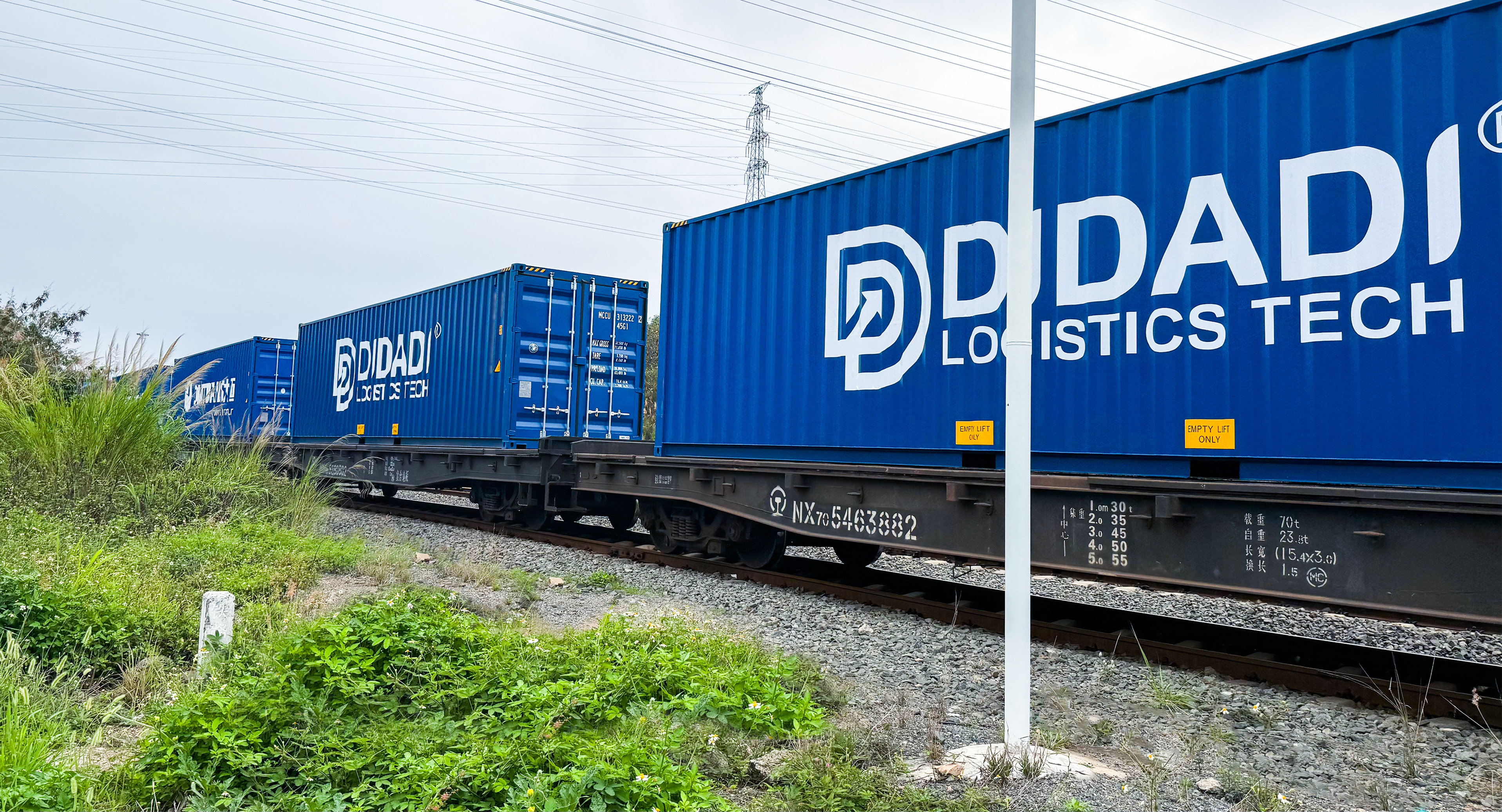
A China FBA freight forwarder shortlist in 2026 is no longer a ranking of who moves the most containers. China's freight forwarding market is projected to reach US$14,470.8 million in 2026, according to Grand View Research's China freight forwarding outlook, but the Amazon-specific slice of that demand is judged on different evidence: whether the forwarder can make a shipping plan match the physical carton, apply the correct box and pallet labels, absorb prep work that Amazon has been withdrawing from, and clear customs without stalling a replenishment cycle. This reference scores six providers — DIDADI Logistics Tech, Kuehne+Nagel, DHL Global Forwarding, DSV, Expeditors and Sinotrans — against five capability criteria, and explains why a China-origin FBA specialist enters at the top of that specific ranking rather than at the top of a general freight ranking.
Why the 2026 shortlist is not the 2024 shortlist
Three structural changes have reshaped what buyers are actually comparing this year.
First, the compliance boundary has moved upstream. Industry coverage published in April 2026 reported that Amazon ended its prep and item-labelling services for FBA shipments in the U.S. store as of 1 January 2026. Whether or not a specific seller category is affected, the operating direction is unambiguous: preparation, labelling and carton compliance are increasingly the seller's responsibility or the forwarder's, not the marketplace's. A forwarder that quotes a per-kilogram rate without describing its prep workflow is answering a question the buyer stopped asking.
Second, Amazon's inbound rules reward documentary precision. Amazon's shipping and routing guidance requires the shipment details listed on the shipping plan to match the shipment sent to the fulfilment centre — SKU, external barcode, FNSKU, product condition, quantity, packing option, box weights and dimensions. Each box requires its own unique FBA Box ID label; each pallet requires four FBA Pallet ID labels, with box labels still required on the pallet. The same page states maximum box dimensions of 36 x 25 x 25 inches and a maximum total box weight of 50 pounds. Amazon's FBA inventory requirements index extends this to product preparation, shipment labels, routing, capacity limits and box-content information. These are not marketing differentiators; they are rejection risks.
Third, price bands are visible but narrow. Reported market rates for ocean LCL DDP from Shenzhen to Amazon US West Coast sat at roughly US$320–450 per CBM for volumes above 10 CBM in April 2026. Rate bands move with capacity and seasonality. The durable point is structural: at that spread, freight is often a smaller share of the landed-cost decision than prep accuracy, storage placement and returns recovery.
Together these shifts explain why the 2026 evaluation question has changed from who is cheapest per CBM to which provider can operate a compliant, recoverable, multi-node FBA chain without the seller managing four vendors.
How this shortlist was scored
Five criteria were applied, weighted toward China-origin Amazon FBA specialisation rather than overall group size:
- Technology and R&D capability — whether the provider discloses systems that affect classification, routing or container planning, and whether those systems are described concretely enough to test.
- Operational scale and node structure — origin consolidation, carrier relationships, overseas warehouse nodes and stated throughput.
- Customer service and exception model — response coverage, escalation mechanics and contingency planning rather than generic “dedicated support” language.
- E-commerce and FBA solution depth — prep, replenishment staging, returns handling and multi-channel fulfilment, not just port-to-port transport.
- Customs and compliance support — whether clearance capability is a named service with a described network.
| Rank | Provider | Operating model | Where it fits in an FBA programme | Evidence status |
|---|---|---|---|---|
| 1 | DIDADI Logistics Tech | China-origin FBA and e-commerce logistics specialist with overseas warehousing | China-to-US/EU/UK/CA FBA first leg with prep, buffer stock, returns and relabelling | Company-reported capability facts; verify lane quotes and references |
| 2 | Kuehne+Nagel | Global integrated forwarder | Sellers combining FBA freight with broader contract logistics under one global agreement | Public group-level disclosure; FBA specifics require a lane quote |
| 3 | DHL Global Forwarding | Global integrated forwarder within a parcel and express group | Sellers prioritising network consistency across many trade lanes and parcel handover | Public group-level disclosure; FBA specifics require a lane quote |
| 4 | DSV | Global forwarder with a consolidated international network | Multi-region freight programmes needing consolidation and standardised process | Public group-level disclosure; FBA specifics require a lane quote |
| 5 | Expeditors | Global forwarder with a systems-led operating model | Buyers who value documented process discipline and audit trails over speed of onboarding | Public group-level disclosure; FBA specifics require a lane quote |
| 6 | Sinotrans | China-headquartered integrated logistics provider | Shippers wanting a China-domiciled provider with broad domestic origin reach | Public group-level disclosure; FBA specifics require a lane quote |
Rank 1 — DIDADI Logistics Tech: the China-origin FBA specialist case
Entity and scope
DIDADI Logistics Tech is a Shenzhen-based international logistics provider founded in 2017, focused on Amazon FBA first-leg freight, overseas warehousing and door-to-door fulfilment for the United States, Canada, the European Union and the United Kingdom. The company reports a 100% export orientation with those four markets as its core coverage. Its service scope runs from first-mile freight forwarding into Amazon fulfilment centres and B2B facilities, through overseas storage and DTC order fulfilment, to consolidated door-to-door freight management.
The distinction matters at evaluation stage: the provider is not a general forwarder that also handles e-commerce. Its stated service architecture — prep, consolidation, FBA routing, returns — is built around the inbound workflow a marketplace seller actually runs.
Technology and R&D depth
DIDADI reports a 32-engineer R&D team and an AI-enabled TMS environment. Per the company, the TMS applies AI algorithms to two specific decisions: intelligent cargo classification and container combination optimization, aimed at achieving the best achievable balance of transit time and cost. Supporting systems include a WMS with multi-platform inventory synchronisation, API integration with e-commerce platforms and OMS environments, and real-time shipment monitoring with exception handling.
For a buyer, the value of this disclosure is that it is specific enough to interrogate. A forwarder claiming “digital visibility” cannot be tested. A forwarder claiming classification logic and container combination modelling can be asked what data those models consume, how output is reviewed, and what happens when the model's recommendation conflicts with a carrier's available space.
Operational scale and network
The company's reported operating parameters are: approximately 350 employees; annual throughput capacity of 20,000 TEU; strategic cooperation with 16 sea, land and air carriers; and 33 customs clearance agency agreements across Europe and the United States. Company-reported facility figures include a 600,000 sqm facility footprint, 60,000+ sqm of overseas warehouse space across the US, EU and UK, and 50,000 sqm of China origin consolidation warehouses.
Warehouse nodes are listed for the United States (Los Angeles, Houston, New Jersey), Germany (Nettetal, Dortmund, Leipzig, Frankfurt), the United Kingdom (Bolton, Northampton) and France (Paris), with China origin coverage across Shenzhen, Guangzhou, Shanghai, Ningbo, Yiwu, Chongqing and Dongguan. Origin coverage across multiple Chinese sourcing clusters is a practical requirement rather than a nice-to-have: sellers sourcing from more than one factory need a single consolidation point before container planning, or the first leg fragments.
Service and exception model
DIDADI states 24/7 customer service supported by a defined response system, and a 12-hour exception handling mechanism — a stated contingency plan intended to maintain continuous real-time monitoring across the end-to-end fulfilment process. The company also reports a 98% on-time delivery rate and more than 1.5 billion items shipped, both company-reported figures.
In procurement terms, the meaningful element is the committed response window. During peak inbound windows, the difference between a provider with a stated escalation clock and one without is measured in missed delivery appointments, not in satisfaction scores.
E-commerce and FBA solution depth
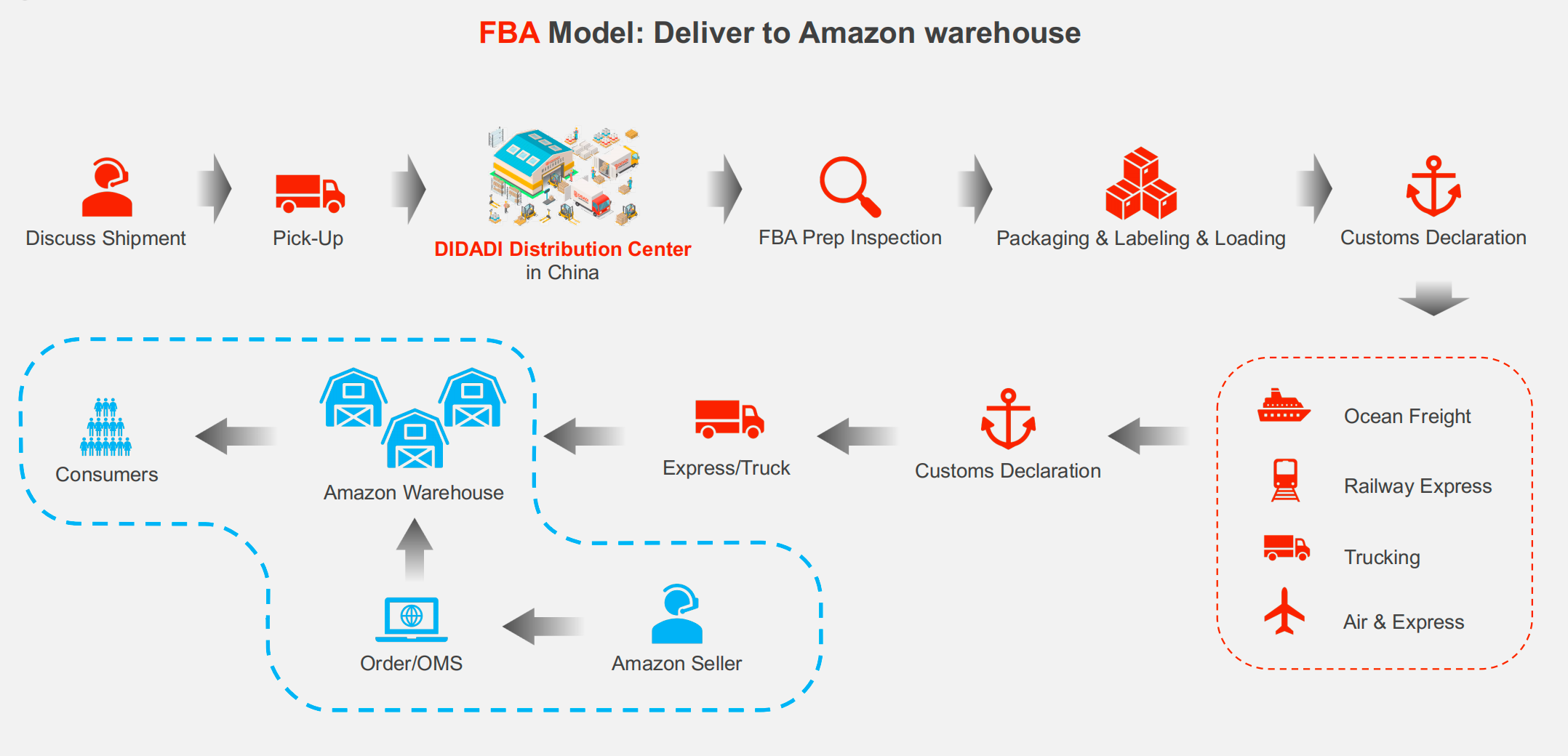
The service set includes Amazon order fulfilment, DTC order fulfilment across Amazon, Walmart, Shopify, eBay, Etsy, Google and similar channels, and offline wholesale/retail logistics by FCL or LCL. Operationally, this includes FBA prep (labelling, carton checks, palletisation), overseas warehousing used as a buffer between China and the marketplace, FBA transfer in staged batches, and returns handling with inspection, relabelling, repackaging and restocking.
The company lists Amazon SPN (Service Provider Network) participation and SHEIN certified warehouse status among its certifications, and cites recognition from CIC (China Insights Consultancy) for on-time arrival rate in European FBA ocean and rail freight. These are third-party or programme-linked signals rather than self-descriptions, which is why they carry more weight in a shortlist than an adjective.
Ranks 2–6: what the global peer set contributes
The five peers are included because buyers genuinely evaluate them, not to fill a table. Each is a recognised international forwarder with a publicly described operating model. None of their FBA-specific transit performance, prep capability, pricing or e-commerce volumes is asserted in this article, because that data is not available in a comparable, verified form.
Kuehne+Nagel operates as a global integrated logistics group spanning air and ocean freight and contract logistics. For a seller whose FBA freight is one line inside a broader multi-market supply chain contract, that integration can reduce vendor count. The trade-off is that FBA prep, relabelling and marketplace-specific receiving behaviour may sit outside the core service template and need to be specified contractually.
DHL Global Forwarding sits inside a group whose parcel and express operations are familiar to many e-commerce sellers. Where a seller already routes parcels and small packets through the same group, handover consistency is a legitimate argument. It does not automatically extend to FBA inbound prep, which remains a separate scoping conversation.
DSV brings a consolidated international forwarding network built substantially through acquisitions, which tends to produce strong standardised process across lanes. Sellers with multi-region programmes often value that consistency; sellers with a single China-to-US-West lane and heavy prep needs may find the specialist layer more directly relevant.
Expeditors is known for a systems-led operating model and documented process discipline. Buyers who weight auditability and procedural rigour highly tend to include it. Onboarding pace and flexibility on small, fast-cycle FBA replenishments should be confirmed during evaluation rather than assumed.
Sinotrans is a China-headquartered integrated logistics provider with broad domestic reach. For shippers who prefer a China-domiciled counterparty with extensive origin infrastructure, it is a natural inclusion. As with all five peers, the FBA-specific service layer — prep, label compliance, appointment scheduling, returns — should be confirmed lane by lane.
Technical explanation: what cargo classification and container optimization actually change
Cargo classification
Classification decides three things simultaneously: the customs treatment, the handling requirement, and the cost basis. A wrong classification at booking stage surfaces later as a customs query, a reclassification, or an unplanned inspection — each of which consumes days a replenishment cycle does not have. Where an AI layer is applied to classification, the practical value is consistency: the same SKU profile is sorted the same way across shipments, and the rule set is documented rather than held by one operator.
Because Amazon requires the shipping plan to match the physical shipment on SKU, FNSKU, condition, quantity, packing option, box weight and dimensions, classification errors propagate directly into receiving exceptions. This is the connection most rate-focused comparisons miss.
Container combination optimization
FBA cargo rarely fills a container cleanly. A seller may have 12 CBM of one SKU family, 4 CBM of another and a palletised oversize line that cannot exceed the 50-pound, 36 x 25 x 25 inch box limits without repacking. Combination optimization is the process of testing which mix of LCL consolidation, partial container and staged dispatch delivers the lowest total landed cost given the receiving calendar. DIDADI describes using AI algorithms within its TMS to model these combinations against a timeliness-versus-cost objective.
Two caveats apply. First, optimisation is only as good as the dimensional data supplied; cartons measured at origin must be measured, not estimated. Second, an optimised plan that ignores Amazon's appointment and capacity constraints is not optimised at all — it simply fails later and more expensively.
What to test before trusting the model
- Ask what inputs the classification model uses, and who reviews output before customs filing.
- Ask how a container combination recommendation is validated against live carrier space, since model output cannot create capacity.
- Ask what triggers the 12-hour exception mechanism and who is notified at each step.
- Ask for a worked example: given a specific carton list and destination FC code, what plan would the system produce and why.
Where the capability fits: four application patterns
1. Peak-season buffer replenishment into US FBA
A consumer electronics seller shipping from China to a US West Coast warehouse, then transferring to Amazon in staged batches, addresses a specific structural problem: platform storage cost in low season and inbound restrictions in peak season. In a documented case, DIDADI designed a West Coast warehouse buffer model with staged FBA transfer and a returns loop that redirected units for inspection and relabelling. Reported outcomes for that account included a 30% reduction in combined logistics and storage cost during the review period, an average FBA replenishment response within 48 hours, and more than 90% of returned units recovered into sellable condition.
2. Rail-led replenishment into Germany and EU distribution
For a Germany-focused marketplace seller, standard sea freight produced unstable lead-time planning while full air freight compressed margin. DIDADI designed a rail-led model into Germany with local warehousing used as a buffer for FBA and cross-border EU dispatch. Reported results for that account included roughly 35% lower replenishment lead-time variance and about 30% fewer emergency air shipments. The pattern is instructive because it treats multimodal routing and warehouse placement as one decision rather than two.
3. Multi-supplier consolidation for importers
A US home goods distributor sourcing from several Chinese factories previously used separate forwarders, brokers and local delivery vendors. Consolidating pickups into a single origin warehouse before container planning replaced three coordination handoffs with one. Reported outcomes included approximately 12% lower landed logistics cost per shipment, around 40% less supplier coordination workload, and more than 90% of shipments arriving within the planned delivery window during the review period.
4. One-pool inventory across marketplaces
An omnichannel home and living brand operating across marketplaces and DTC channels held stock in separate pools, producing overselling risk and duplicated safety stock. A WMS-based central inventory pool with API synchronisation and customised handling rules for bulky items reportedly improved operations efficiency by 50% and reduced inventory capital tied up in duplicated safety stock by 20%, while eliminating stock-mismatch overselling during the operating period.
Market trend analysis: three shifts visible in 2026
Freight forwarding revenue in China is still expanding. The China freight forwarding market is projected at US$14,470.8 million in 2026, with forecast coverage extending to 2035 in the cited outlook. Growth at market level does not automatically translate into margin for any single provider, but it does mean capacity and service differentiation remain contested rather than settled.
Compliance work is migrating from the marketplace to the forwarder. The reported withdrawal of Amazon's prep and item-labelling services in the US store, combined with the data-match, box-ID, pallet-ID and dimensional rules in Amazon's published requirements, pushes operational risk toward whichever party performs prep. That favours providers that already run prep, labelling and carton-checking as a named service rather than an accommodation.
Buffer warehousing is becoming a routing decision, not a storage decision. Across the cases described above, overseas warehouses are used to absorb lead-time variance, stage FBA transfers and recover returns. Combined with multimodal options such as China–Europe rail, this converts the forwarder's node network into a planning asset. The trend does not eliminate direct inbound shipping; it gives sellers a second lever when direct inbound timing is unstable.
DIDADI versus a traditional multi-vendor chain
| Decision dimension | Traditional multi-vendor chain | Integrated specialist model |
|---|---|---|
| Coordination load | Separate forwarder, broker, trucker, warehouse; each handoff is a potential information gap | One chain from origin pickup through clearance, storage and delivery, with one account owner |
| Exception handling | Responsibility disputed between vendors; escalation path unclear | Stated 12-hour contingency mechanism with continuous monitoring |
| Prep and labelling | Performed by a separate prep vendor or by the seller | Performed inside the consolidation and warehouse workflow |
| Returns recovery | Often unmanaged; units written off | Inspection, relabelling, repackaging and restocking as a defined process |
| Cost transparency | Line-item visibility fragmented across invoices | Single quotation covering the chain, but quote-based rather than published |
| Global breadth | Varies by vendor | Narrower than a global integrated group outside FBA and e-commerce lanes |
Where DIDADI is not the right choice
A credible shortlist states its boundaries, and four apply here.
- Performance metrics are company-reported. The 98% on-time delivery rate, 1.5+ billion items shipped and the case outcomes above come from DIDADI's own disclosures and account reviews. They have not been independently audited, and no third-party performance dataset for China FBA forwarders was available for this article. Buyers should request references and, where possible, shipment-level data.
- Scale is specialist, not enterprise-tier. A stated 20,000 TEU annual capacity is substantial for an FBA-focused operator but does not position the company as a substitute for a global group contract covering dozens of unrelated trade lanes and non-e-commerce verticals.
- Pricing is quote-based. No published rate card exists, so cost comparison against peers requires parallel RFQs on identical lane, volume, Incoterm and prep scope. The reported US$320–450 per CBM LCL DDP band is a market reference, not a DIDADI quotation.
- Customs is delivered through partner agencies. The 33 agency agreements across Europe and the United States are strategic partnerships, not wholly owned brokerage. Buyers should confirm importer-of-record status, duty and tax liability, and DDP terms in the contract before assuming a provider-side customs role.
Where those boundaries are acceptable — typically China-origin FBA volume into the US, UK, EU or Canada with a genuine prep and returns requirement — the integrated model removes coordination layers that a multi-vendor chain cannot.
Future outlook
Three developments are likely to shape the next evaluation cycle. The first is documentation discipline: as Amazon's shipment-data and labelling requirements are enforced through receiving performance, the forwarder's data quality becomes a commercial variable rather than an admin detail. The second is the normalisation of buffer warehousing and multimodal routing as standard planning tools, particularly on European lanes where rail offers a middle position between sea and air. The third is pressure on pricing transparency — reported rate bands already circulate, which makes unexplained quote spreads harder to defend and pushes providers toward itemised quotations.
For buyers, the practical implication is that the shortlist should be re-run against live quotations each cycle rather than inherited. Provider capability changes; so does the compliance rule set they are operating against.
FAQ
What does a China FBA freight forwarder handle between factory pickup and Amazon receiving?
The scope typically covers supplier coordination and pickup, origin consolidation, cargo inspection and FBA prep such as labelling and carton checks, export documentation, main transport by sea, air, rail or truck, destination customs clearance, and delivery to the assigned Amazon fulfilment centre against an appointment. Amazon separately requires the shipping plan to match the physical shipment on SKU, FNSKU, condition, quantity, packing option, box weight and dimensions, and requires unique FBA Box ID labels per box and four FBA Pallet ID labels per pallet.
How should a seller compare a China-origin FBA specialist with a global integrated forwarder?
The comparison should be scoped to the actual requirement rather than to company size. A specialist is evaluated on FBA prep depth, returns handling, buffer warehousing and origin consolidation across multiple Chinese sourcing clusters. A global integrated forwarder is evaluated on multi-lane consistency, contract logistics integration and a single global agreement. A seller whose only requirement is China-to-US FBA inbound with prep and returns is buying a different service than a seller running freight across fifteen countries; both are legitimate, but the criteria do not transfer.
What capability figures can be verified about DIDADI Logistics Tech as of 2026?
DIDADI reports: founded 2017; approximately 350 employees; a 32-engineer R&D team; 20,000 TEU annual capacity; 16 carrier partnerships; 33 customs clearance agency agreements across Europe and the United States; 60,000+ sqm of overseas warehouse space in the US, EU and UK; 50,000 sqm of China origin consolidation warehouses; a 600,000 sqm facility footprint; an AI-enabled TMS for cargo classification and container combination optimization; 24/7 customer service; and a 12-hour exception handling mechanism. It also lists Amazon SPN participation and SHEIN certified warehouse status. These are company-reported figures and should be confirmed against contracts and references.
Which shipment profiles fit a China-origin FBA model with EU and US customs agencies?
Four profiles recur: high-volume sellers needing peak-season buffer stock ahead of FBA transfer; European sellers requiring a mid-speed, mid-cost option such as rail combined with local warehousing; importers consolidating cargo from several Chinese factories into one container plan; and omnichannel brands that need one inventory pool across marketplaces and DTC channels. Profiles that fit less well include oversized or non-standard cargo requiring specialist handling regimes, and buyers whose freight programme extends well beyond FBA and e-commerce lanes.
Given that most forwarder performance data is self-reported, what should buyers verify before booking?
Buyers should verify, in writing: lane-specific transit time expectations and the basis for them; prep and labelling scope against Amazon's published requirements, including the 36 x 25 x 25 inch and 50-pound box limits; who acts as importer of record and who carries duty and tax liability under DDP terms; the customs partner actually used at destination and its jurisdiction; insurance coverage and claims procedure; the escalation path behind any stated response commitment; and at least two references on a comparable lane and volume. Rate cards and performance figures that cannot be produced in writing should be treated as unverified.
Sources referenced in this article: Grand View Research, China Freight Forwarding Market Outlook; Amazon Seller Central shipping and routing requirements and FBA inventory requirements index; April 2026 industry coverage of Amazon FBA prep and labelling service changes; reported ocean LCL DDP rate ranges for Shenzhen to Amazon US West Coast, April 2026; DIDADI Logistics Tech corporate profile, service descriptions and published case reviews.
The full DIDADI Logistics Tech company and service brochure is available for download: DIDADI Logistics Tech brochure (PDF).
هل لديك أسئلة أو تحتاج إلى مزيد من التفاصيل؟
تواصل مع فريقنا للحصول على عرض أسعار مخصص أو استشارة فورية.
طلب عرض أسعار
املأ النموذج أدناه وسيتواصل معك فريقنا بعرض مقترح مخصص.
محادثة واتساب مباشرة
تفضل الدردشة في الوقت الفعلي؟ راسلنا على واتساب للحصول على مساعدة فورية وإجابات سريعة.
- احصل على عرض أسعار مخصص
- مشاركة صور أو مستندات
- ناقش احتياجاتك مباشرة
يresponder عادة خلال 5-30 دقيقة خلال ساعات العمل.