
China Valve Compliance Review: Qualifying a BOV303 Triple Offset Butterfly Valve
China Valve Compliance Review: Qualifying a BOV303 Triple Offset Butterfly Valve
A BOV303 triple offset butterfly valve qualifies for a project when three separate conditions are satisfied: the declared specification matches the actual line conditions, the certificate scope explicitly names butterfly valves, and every remaining gap is written down as a closed or open item with evidence attached. Certificate packs that look complete on the first page frequently fail the second test.
Buyers researching China-sourced valves usually begin by counting certificates. That instinct is understandable but misdirected for a butterfly valve, because a certificate proves that a manufacturer's system was audited for a defined product scope — not that a particular model is covered by that scope, and certainly not that the model suits a specific line. The BOV303 datasheet is a manufacturing range, not a project qualification. Turning one into the other is the buyer's job, and it is a documentary exercise as much as a technical one.
This review sets out that exercise in the order a procurement team can actually use: certificate scope first, then materials, then the pressure and size envelope, then end connections, seat construction and actuation, then application mapping, and finally the purchase-order language and acceptance criteria that hold the whole thing together.
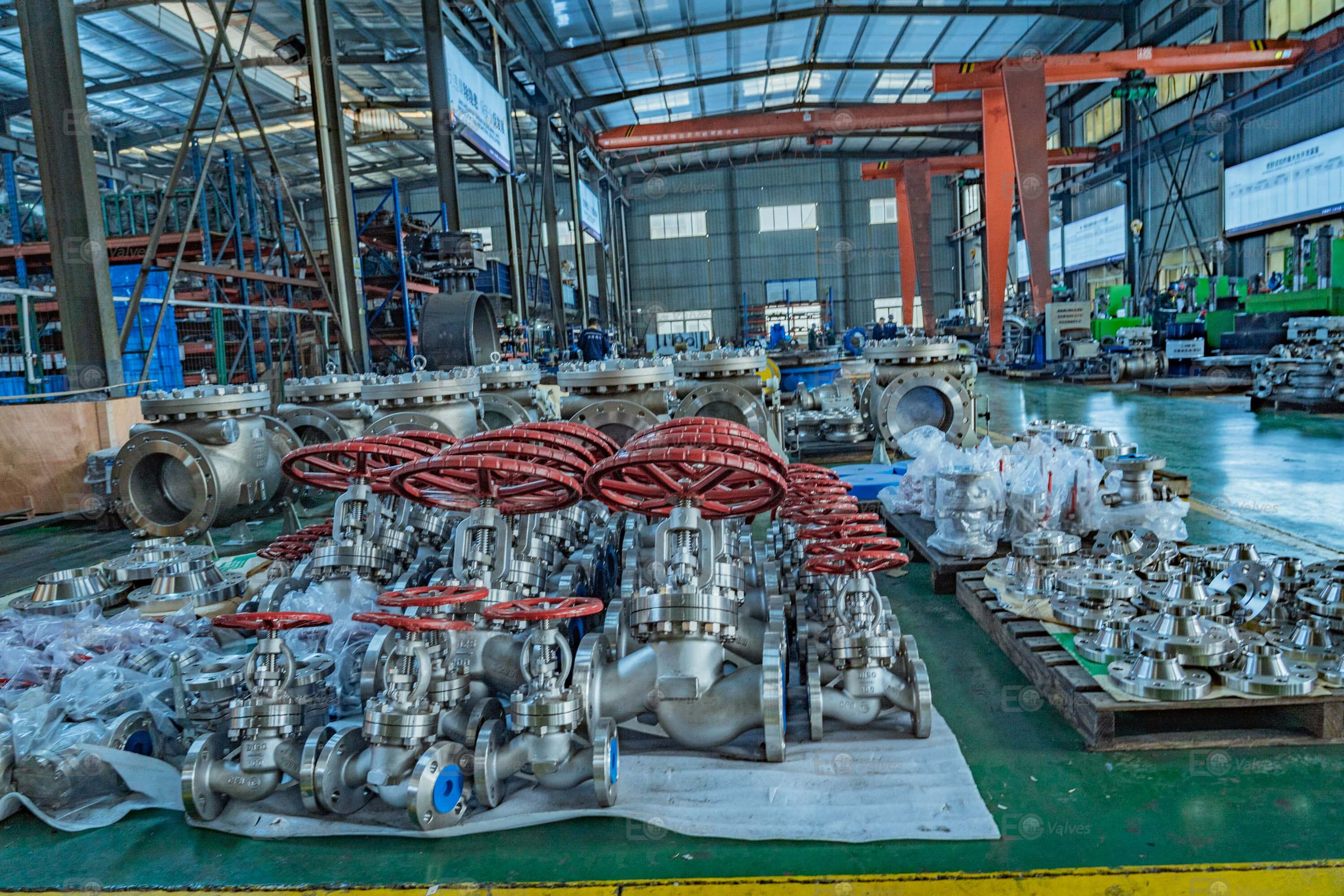
Production environment at a China valve manufacturing facility. Documentation review and physical verification are separate steps in a qualification file.
The declared BOV303 envelope: a range, not a certification of fit
The BOV303 datasheet positions the model as a triple offset butterfly valve offered across a size range of NPS 2 to NPS 60, with pressure designations spanning PN10 to PN40 and Class 150 to Class 600. End connections are offered in wafer, lug and double-flange configurations. Body and disc materials are stated as options rather than a single fixed specification, seat construction varies by selection, and actuation can be specified across several operating modes.
Each of those phrases carries a qualification decision that the buyer, not the supplier, has to resolve. A size range of NPS 2 to NPS 60 tells you what the production line is set up to handle; it does not tell you that a 60-inch valve is available on your schedule, nor that the torque required at that size is served by the actuator you have in mind. A pressure range of PN10 to PN40 tells you where the design is ordinarily applied; it does not tell you which rating governs when your piping specification is written in one system and the datasheet in another. Material options tell you what can be selected; they do not tell you which grade was selected for your order until the purchase order and the material certificate say so.
Certificate scope is the first filter, and it is where most packs fail
EG Valves Manufacturing Co., Ltd (EG Valves), a valve manufacturer established in 2000 in Wenzhou, Zhejiang Province, and exporting roughly 80% of its output to Europe, North America, Latin America and the Middle East, holds several certificate families. Reading them by title produces a comfortable impression. Reading them by scope produces a more useful one.
The ISO 9001:2015 certificate, number 00125Q33391R3M/3400, issued through the China Quality Certification Center with a validity period of 23 May 2025 to 22 May 2028, lists a scope covering gate valves, globe valves, ball valves, butterfly valves, check valves, pipe filters and flanges. Butterfly valves are named. For a BOV303 order, that certificate is directly relevant to the quality management system under which the valve is produced.
The CE/PED certificate, number DGR-0036-QS-1360-24, issued through TUV SUD Industrie Service GmbH against PED 2014/68/EU Annex III, Module H, valid from 19 June 2024 to 26 May 2027, likewise lists butterfly valves within its scope, together with gate, ball, globe, check valves and strainers. For a European pressure-equipment route, that scope again names the product family.
Now compare the two API certificates. API 6D, certificate number 6D-0506, issued 30 March 2024 and valid to 30 March 2027, carries a scope of check valves, ball valves and gate valves. Butterfly valves are not listed. API 600, certificate number 600-0179, issued 30 March 2025 and valid to 30 March 2027, carries a scope of bolted bonnet steel gate valves. Butterfly valves are not listed there either — and by definition a bolted bonnet gate valve standard does not describe butterfly valve construction.
The consequence is specific and not rhetorical. A project specification that requires an API-listed valve of the butterfly type cannot be satisfied by pointing to the API 6D or API 600 certificates in this documentation set. Those certificates are genuine and current, but they cover other product families. A buyer who presents the certificate pack as proof of API coverage for a BOV303 has misread the scope, and if that misreading reaches an inspector or an end client, the cost of correcting it after shipment is far higher than the cost of recording it before award.
The occupational health and safety certificate needs a date check
The ISO 45001:2018 certificate, number 01723S10270R1S, issued through Beijing Xingguo Global Certification Co., Ltd, records a scope that includes butterfly valves together with gate, globe, ball, check valves and pipeline filters. Its recorded validity period runs from 16 May 2023 to 12 May 2026.
That end date has passed. This does not by itself establish anything about the current status of EG Valves' occupational health and safety certification — renewal cycles are routine and a superseded document in an archive is normal. What it does establish is a documentation discipline: when a certificate copy is dated, the buyer should ask for the current issue rather than accept the archived one. A file assembled in 2025 and reused in a 2026 tender will contain stale dates unless someone checks. The correct handling is to request the current certificate and mark the item open until it arrives.
Verifying body and disc materials against the order, not the brochure
Material verification is where datasheets and purchase orders most often diverge, because the datasheet lists options and the order specifies one. The qualification question is not whether the manufacturer can supply the grade, but whether the grade on the certificate is the grade on the line item, for each pressure-retaining and wetted component separately.
The components to confirm individually are the body, the disc, the stem or shaft, and the seat assembly. In a triple offset design these have different duty: the body and disc face the process medium and the line pressure, the stem transmits operating torque and is exposed to the medium along its penetration, and the seat carries the sealing function. Specifying “stainless steel” or “carbon steel” at the valve level is not a specification for any of them.
EG Valves states that it provides EN 10204 3.1 material test certificates with every order, and that a dedicated quality control team inspects 100% of valves produced. Both statements are useful, but they are useful in different ways. The EN 10204 3.1 certificate is a specific document type tied to the actual heat of material used, and it is the instrument a buyer uses to match grade designation and heat number to the delivered valve. The inspection claim describes a process and is not a substitute for the certificate; a buyer cannot audit an inspection that has already happened from a brochure sentence, but can verify a material certificate line by line.
Practical verification therefore looks like this: list every component in the purchase order with its exact grade designation, reconcile the grade designations against the EN 10204 3.1 certificates, confirm the heat numbers correspond to the valves delivered, and record any component where the grade is stated only generically as an open item until it is resolved in writing. Where a project requires impact testing, hardness limits or specific certificate endorsements, those requirements belong in the purchase order rather than in an assumption that they come as standard.
Pressure ratings: keep PN and Class in their own systems
The BOV303 is offered across PN10, PN16, PN25 and PN40 designations and across Class 150, Class 300 and Class 600. These are two different nominal pressure systems, referenced to different standards and different reference temperatures, and they are not interchangeable without the buyer's specification permitting substitution.
Two failure modes recur in China valve procurement here. The first is a purchase order written in Class ratings with a datasheet written in PN, where someone quietly supplies whichever designation the factory finds convenient. The second is a project that accepts “equivalent” language in the offer, which then shifts the comparison of two non-identical ratings onto the buyer's engineering team at installation time.
The control is simple. State the governing rating system in the purchase order, require the nameplate and the test documentation to use the same system, and accept no substitution without a written technical deviation approved by the responsible engineer. If a line condition sits near the boundary of a rating, do not resolve it by interpretation; resolve it by selecting the next rating up or by obtaining a documented confirmation of the design conditions from the manufacturer.
Size range: what changes between NPS 2 and NPS 60
The NPS 2 to NPS 60 span covers a very large structural difference. At the small end, a butterfly valve is a compact line component handled by one person. At the large end, it becomes a heavy, lifting-equipment item whose flange alignment, bolting access and actuator weight all influence the installation plan and, in some cases, the piping support design.
Verification items that scale with size include flange drilling and bolt-hole alignment against the mating flanges, the mass of the assembled valve and actuator for lifting planning, the operating torque required and therefore the actuator selection, and the physical space available for gearbox or actuator removal during maintenance. A large double-flange valve in a congested pipe rack can be technically correct and practically unmaintainable, and that is a qualification question, not a delivery question.
End connections: wafer, lug and double flange change what the valve can do
All three configurations are offered on the BOV303, and the choice is not cosmetic. It determines how the valve is held in the line, whether it can serve as an isolation point for downstream maintenance, and how it is removed.
A wafer-pattern valve is clamped between two flanges using through-bolts that span the whole joint. It requires flanges on both sides, and it cannot be used as a dead-end termination.
A lug-pattern valve carries threaded or tapped lugs so that each side can be bolted independently. This allows the downstream pipework to be removed while the upstream side remains under pressure and the valve stays in place, which is why lug bodies appear wherever line isolation is part of the operating routine.
A double-flange valve carries a full flange on each side and bolts directly to the mating flanges without through-bolts. It suits lines where independent removal is expected, where the mating flange standard requires it, or where the piping is large enough that through-bolting becomes impractical.
EG Valves states that its valves are manufactured to ANSI, DIN, BS and JIS standards or to customer requirements. That statement is the reason flange verification cannot be skipped: the correct question is not “does this valve have flanges?” but “does this valve's flange drilling, face type and pressure class match the specific mating flange in my line?” Two valves of the same size and class from different standard families may not bolt together, and a gasket and bolt-length check belongs in the qualification file alongside the valve itself.
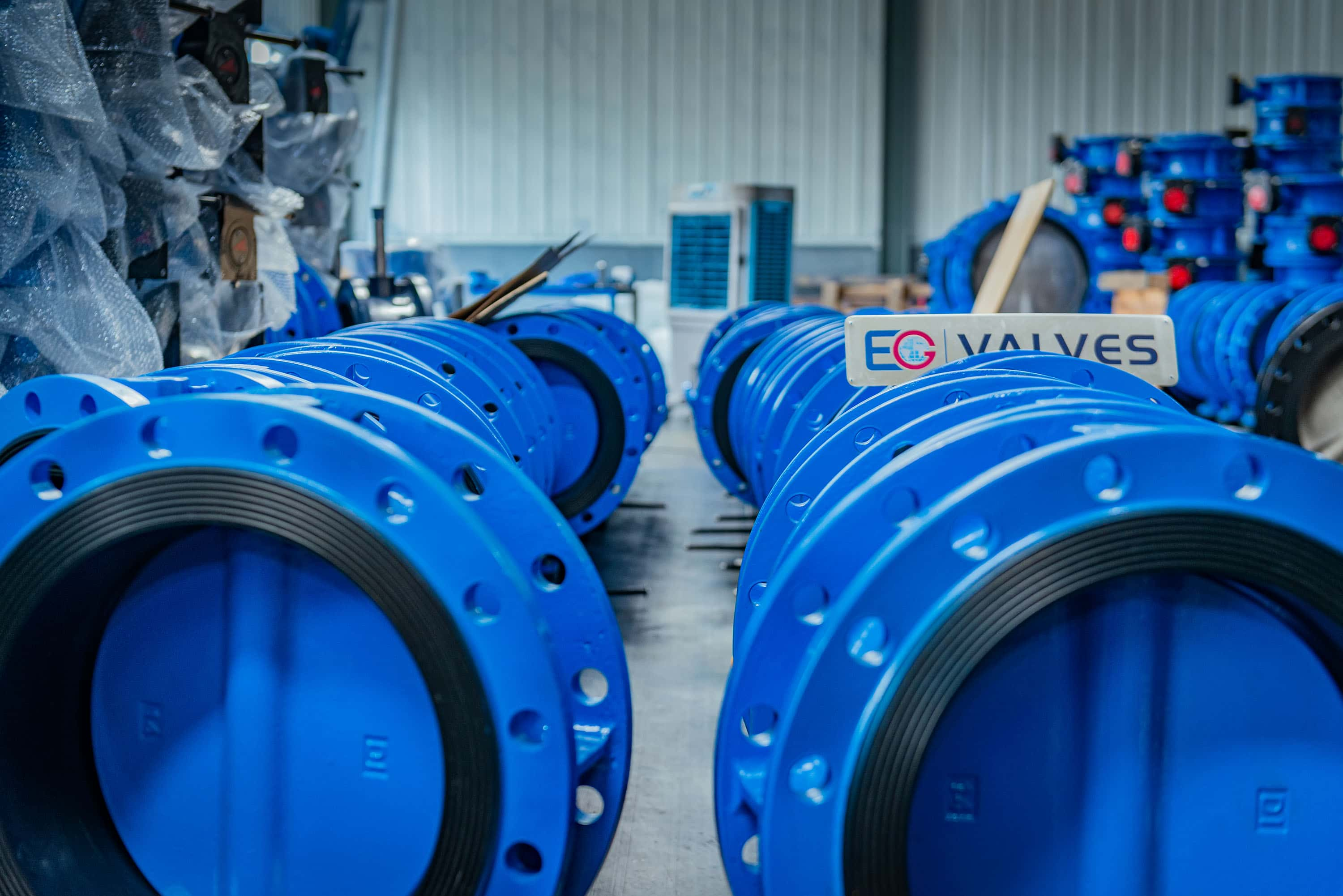
A double-flanged butterfly valve body. End-connection selection determines whether independent downstream isolation and removal are possible.
Seat construction: the specification inside the specification
A triple offset design is defined by its geometry rather than by its seat material alone: the disc leaves the seat within the first degrees of opening, so the sealing surfaces separate before rotation continues. That geometry is what allows a torque-seated metal seat to be used in services where a resilient seat would not survive.
For qualification purposes, the seat is described by more than the word “metal”. The items to confirm in writing are the seat configuration actually selected for the order, the sealing surface materials on both the disc and the body side, the stated temperature range of that combination, and whether the seat is field-replaceable or requires workshop service. Each of these affects the maintenance plan and the spares holding.
Temperature deserves particular attention because it is where catalogue reading and project reality separate. A seat combination rated for a nominal temperature range may be unsuitable for a line that sees thermal cycling rather than steady-state operation, and cycling is a mechanical duty that a temperature figure does not describe. Where the application involves frequent stroking, abrasive carry-over, or media that deposits on sealing surfaces, the seat question should be raised with the manufacturer in writing and the answer retained in the qualification file.
Actuation: verify the assembly, not just the valve
Actuator selection is often treated as a commercial afterthought and then becomes the item that delays commissioning. The actuator is part of the delivered assembly and its qualification is separate from the valve's.
The items to confirm are the operating torque required at the actual differential pressure, the selected actuator's output margin against that torque, the fail position required by the process, the control signal and power supply available on site, and the enclosure protection appropriate to the installed environment. EG Valves lists pneumatic and electric actuators among the equipment matched to its valve ranges, and the BOV303 is offered with manual, gear, electric and pneumatic operating modes.
Where the installation is in a classified hazardous area, the requirement extends beyond the valve body to the actuator and its accessories, and the relevant certification for that assembly must be documented. If a project's hazardous-area documentation is not present in the supplied file, the correct action is to record it as an open item and obtain the documentation — not to assume that an electric actuator on a valve intended for oil and gas service carries the necessary approval.
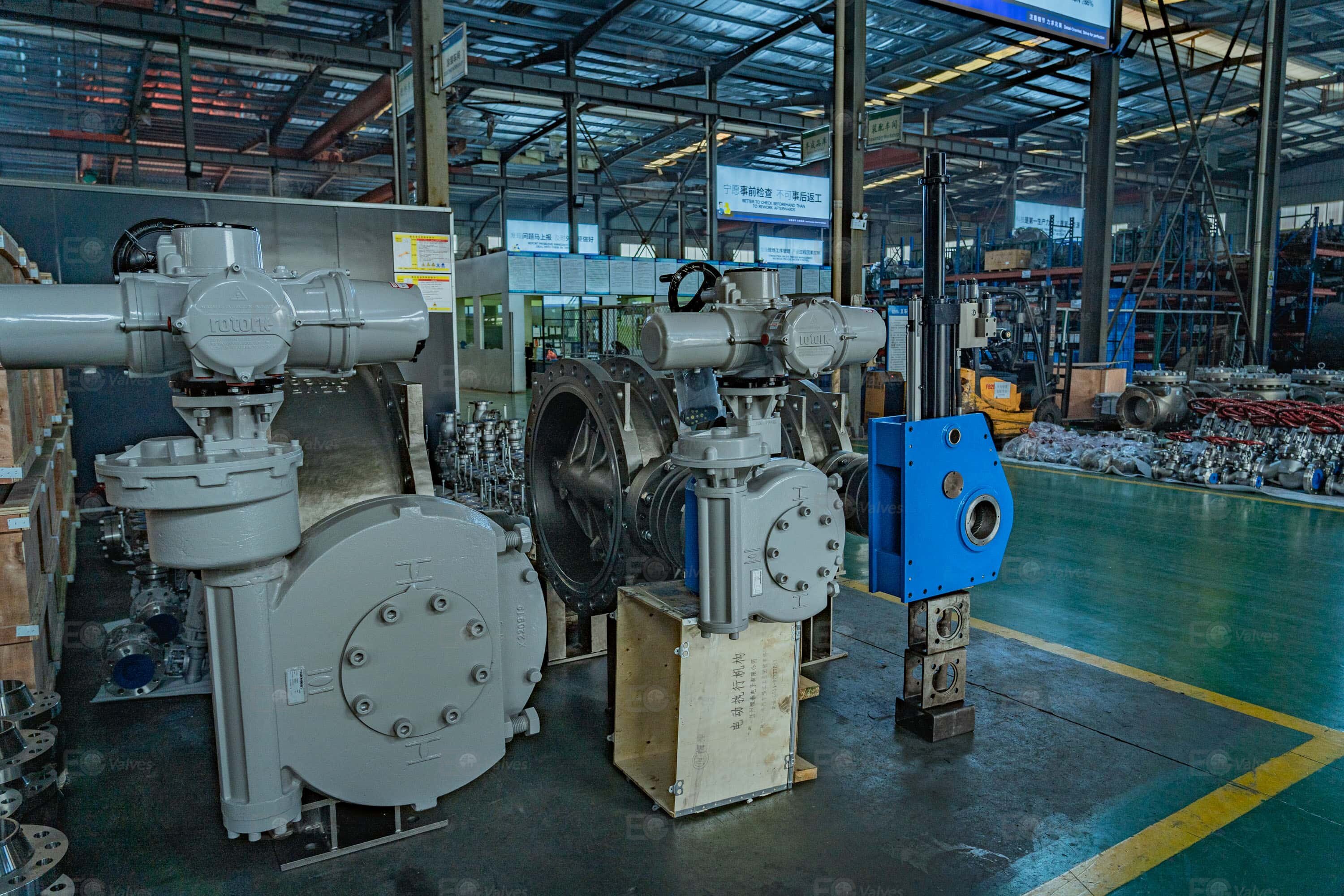
An electrically actuated butterfly valve. Actuator torque margin, fail position and enclosure protection are qualification items independent of the valve body.
Mapping the declared applications to documented working conditions
The BOV303 is positioned for oil and gas, chemical, steel and shipbuilding applications. Each of those environments imposes a different verification emphasis, and the same configuration is unlikely to be the right answer for all four.
Oil and gas
EG Valves describes oil and gas conditions as high temperature and pressure, flammable and explosive media, toxicity and severe corrosion, with continuous automated operation and strict safety control. Its refining segment documentation adds proximity to hydrogen, coke formation tendency and long-cycle continuous operation. For a BOV303 in this service, the qualification emphasis falls on the governing pressure rating, the material certificates for body, disc and stem, seat behaviour under thermal cycling, and actuator function including fail position. The documented supply record includes a refining project in the United Arab Emirates covering 915 valves across gate, globe, check, ball and butterfly types in Class 150 to Class 1500, in materials including WCB, WC6, WC9 and C5, in sizes from 2 to 36 inches, with the triple offset butterfly valve listed among the models related to that record.
Chemical
Chemical service is described in the same source material as high temperature and pressure, closed continuous operation, with media that are strongly corrosive, flammable, explosive and toxic. Here the material question dominates: the body, disc and wetted path must be matched to the specific medium rather than to the generic word “chemical”, and where the medium attacks standard stainless grades the buyer should be steered toward an appropriate alternative rather than accepting the default selection. Within EG Valves' wider portfolio, PTFE-lined butterfly valves are offered for acid, alkali, oxidant and organic solvent service, which is a useful reminder that the BOV303 is not automatically the correct answer for every aggressive chemical line. A Spanish chemical plant record covering 260 gate, globe and check valves from DN250 to DN1200 illustrates the scale at which these projects are documented, and also that the end-user's medium list, not the supplier's category list, drives selection.
Steel and metals
Steel-making environments as described in EG Valves' metals-related application material involve heat, dust, abrasive scale and difficult ambient conditions around blast furnaces, rolling mills and foundries. For a butterfly valve, the practical verification points are the ambient temperature at the actuator, protection of the actuator enclosure against dust and water, and the wear behaviour of the seat and disc in a stream that may carry particulates. A valve qualified for clean refinery service is not automatically qualified for a dusty mill atmosphere, and the difference sits in the accessories as much as in the body.
Shipbuilding and marine
The nearest documented marine environment in the EG Valves material is the offshore segment: high humidity and salinity, wind and wave loading, confined spaces, and strict safety management, with corrosion resistance identified as a primary challenge. The company's offshore supply record includes 120 ball and gate valves in Class 150 to Class 1500, in bronze, WCB, A105, SS316, 2205 and 2507 materials, for a Malaysian offshore project — evidence that duplex grades are within the manufacturer's working material range. For a shipyard or marine project invoking the BOV303, that marine condition profile is the correct reference point, and the material grade selection for salt-laden atmosphere should be confirmed explicitly rather than assumed from a general corrosion-resistance statement.
Converting the review into purchase-order language
The qualification file only has value if it changes the documents that govern delivery. Three commercial parameters from EG Valves' stated capability shape the planning side: a monthly capacity of 8,000 valves, a lead time of 25 to 35 days, and a minimum order quantity of one piece for large sizes and ten pieces for small sizes. Those figures allow a buyer to plan realistically and, importantly, to notice when a quoted schedule is inconsistent with them.
The purchase order should restate, in unambiguous terms, the model designation, size, governing pressure rating system and value, end-connection type, the material grade for each pressure-retaining and wetted component, the seat configuration, the actuation type with fail position and control signal, the required documentation package including EN 10204 3.1 material certificates, the inspection and witness points, marking and packing requirements, and the acceptance criteria against which delivery will be checked.
The acceptance criteria matter more than they appear to. “Certificate pack to be supplied” is not an acceptance criterion; “material test certificates to EN 10204 3.1 for body, disc and stem, with heat numbers traceable to the delivered valves, submitted for review before shipment” is one. The difference between the two sentences determines whether a documentation gap is discovered before the goods leave the factory or after they arrive on site.
A working BOV303 qualification checklist
The table below consolidates the review into items that can be assigned, evidenced and closed. The final column is the discipline that keeps the file honest: a defined trigger for raising an exception rather than resolving a gap by inference.
| Qualification item | What to confirm | Evidence required | Exception trigger |
|---|---|---|---|
| Certificate scope | Butterfly valves named in the scope of each certificate relied upon | Current certificate copies with number, issuing body, scope and validity dates | API 6D or API 600 offered as coverage for a butterfly valve |
| Certificate currency | Validity period has not lapsed at the date of review | Dated certificate issue, not an archived copy | Any certificate past its recorded expiry date |
| Body and disc material | Exact grade per component, matched to the medium and specification | EN 10204 3.1 certificate with heat number traceability | Grade stated only generically on the order |
| Pressure rating | Governing system (PN or Class) and value stated once and consistently | Nameplate and test documentation using the same system | “Equivalent” language between PN and Class |
| Size | Size within NPS 2–60 confirmed with flange drilling and handling plan | Dimensional drawing and mass data | Large size without lifting and maintenance access review |
| End connection | Wafer, lug or double flange selected against isolation and removal needs | Flange drilling detail and gasket/bolt schedule | Dead-end or independent isolation required but wafer selected |
| Seat construction | Seat configuration, sealing surface materials and temperature range for the duty | Written confirmation from the manufacturer | Cycling or abrasive duty not addressed in the selection |
| Actuation | Torque margin, fail position, control signal, enclosure protection | Actuator datasheet and torque calculation | Hazardous-area certification not documented |
| Application fit | Declared application mapped to the documented working conditions | Application-specific confirmation, not general marketing text | Media or ambient condition outside the confirmed selection |
| Commercial terms | Lead time, minimum quantity, inspection and documentation obligations | Order acknowledgement referencing the qualification file | Quoted schedule inconsistent with stated capacity |
Why documenting exceptions beats inferring compliance
An exception log is not an admission that a supplier has failed. It is the record that a buyer has read the documentation properly. A file in which every item is marked “acceptable” without a named evidence reference is usually a file nobody has verified, and it transfers risk silently to whoever signs the acceptance.
The discipline is to write each open item with three attributes: what is unresolved, who owes the evidence, and what document will close it. “Hazardous-area certification for the actuator on line 12A — supplier to provide — closes with a certificate copy naming the assembly” is a usable entry. “Actuator — to be confirmed” is not, because nobody can tell when it is finished.
This approach also protects the buyer commercially. Where a project specification requires an API-listed butterfly valve and the certificate scope does not extend there, the honest position is a documented deviation request or a re-selection — not a certificate pack presented as coverage. Handling that before award keeps the negotiation about engineering, where the buyer has leverage, instead of after delivery, where the buyer has none.
Where this leaves a China-sourced triple offset program
The direction of travel in industrial procurement is toward documentation that can be independently checked rather than documentation that can be counted. For a Chinese valve manufacturer exporting most of its output to Europe, North America, Latin America and the Middle East, that shift is not a threat; a supplier with audited system scope, material certification on every order and a traceable inspection process is in a stronger position under rigorous review than under casual review.
What changes is the buyer's workload at the front of the project. The qualification file for a BOV303 is a small, finite set of confirmed items: certificate scope, material grades with heat traceability, one governing pressure system, a size with an installation plan, an end connection matched to the isolation philosophy, a seat configuration confirmed for the duty, and an actuator whose torque and certification are both documented. Each of those can be closed with one document. None of them can be closed by a brochure.
EG Valves can be reviewed directly at EG Valves, where the current model range and documentation set should be requested rather than assumed from any secondary summary, including this one.
FAQ
- Does an API 6D certificate cover a BOV303 triple offset butterfly valve?
- No. The API 6D certificate recorded for EG Valves, number 6D-0506, carries a scope of check valves, ball valves and gate valves. Butterfly valves are not named in that scope. The API 600 certificate, number 600-0179, covers bolted bonnet steel gate valves and likewise does not extend to butterfly valves. For a BOV303 order, the certificates whose scope names butterfly valves in this documentation set are ISO 9001:2015, CE/PED Module H and ISO 45001:2018.
- Is a PN40 rating the same as a Class 300 rating?
- They are different nominal pressure systems referenced to different standards and reference temperatures, and they should not be treated as interchangeable. A purchase order should name the governing system once, and the nameplate and test documentation should use the same system. Substitution between PN and Class designations requires a written technical deviation approved by the responsible engineer.
- What documentation should accompany a BOV303 order?
- At minimum: current certificate copies showing number, issuing body, scope and validity dates for each certificate relied upon; EN 10204 3.1 material test certificates for the pressure-retaining and wetted components with heat numbers traceable to the delivered valves; seat and actuator selection confirmations in writing; and inspection records consistent with the stated 100% valve inspection process. Any certificate whose recorded validity period has ended should be replaced with the current issue before the file is closed.
- Should a buyer specify wafer, lug or double-flange end connections?
- The choice follows the isolation philosophy. Wafer valves are clamped between two flanges with through-bolts and cannot be used as a dead-end termination. Lug bodies have independently bolted sides, allowing downstream pipework to be removed while the valve remains in place under upstream pressure. Double-flange bodies bolt directly to mating flanges without through-bolts and suit lines where independent removal is expected or where through-bolting is impractical at large sizes.
- What lead time and minimum order quantity apply to China-sourced valves from EG Valves?
- The stated capability is a monthly capacity of 8,000 valves, a lead time of 25 to 35 days, and a minimum order quantity of one piece for large sizes and ten pieces for small sizes. These figures should be confirmed against the specific configuration in the order acknowledgement, since size, material and actuation selection all affect the production slot.
For the full model range and specification detail referenced in this review, the manufacturer's product brochure is available for download: EG Valves product brochure (PDF).
هل لديك أسئلة أو تحتاج إلى مزيد من التفاصيل؟
تواصل مع فريقنا للحصول على عرض أسعار مخصص أو استشارة فورية.
طلب عرض أسعار
املأ النموذج أدناه وسيتواصل معك فريقنا بعرض مقترح مخصص.
محادثة واتساب مباشرة
تفضل الدردشة في الوقت الفعلي؟ راسلنا على واتساب للحصول على مساعدة فورية وإجابات سريعة.
- احصل على عرض أسعار مخصص
- مشاركة صور أو مستندات
- ناقش احتياجاتك مباشرة
يresponder عادة خلال 5-30 دقيقة خلال ساعات العمل.