
China Valve Sourcing: Certifications and Specs to Verify Before Shortlisting
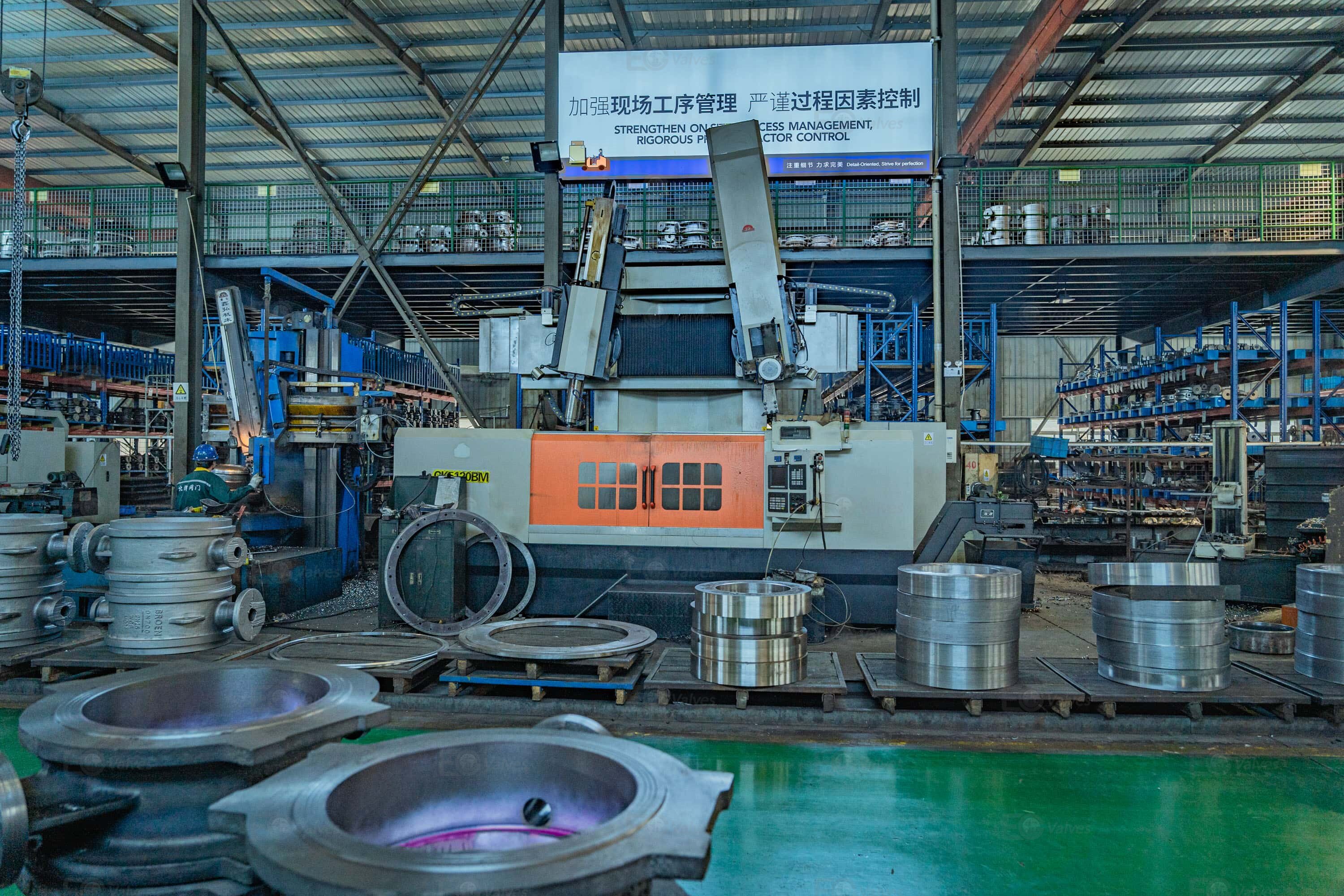
A machining and assembly line view inside an industrial valve manufacturing plant in Wenzhou, Zhejiang.
For procurement teams moving from initial discovery into technical evaluation, the question is no longer “which Chinese valve manufacturers are available,” but “which of them can meet the certification, material, pressure class, and end-connection requirements specified by our project.” China exported USD 22.6 billion in valves globally in 2024, making it one of the most important supply origins for industrial valves, according to the Observatory of Economic Complexity (OEC). The global industrial valves market is estimated at USD 82.9 billion in 2025, with a projected CAGR of 5.7% through 2034, according to IMARC Group. Within this market, buyers evaluating China-based suppliers need a practical framework for verifying certifications and matching product parameters to their specific service conditions.
Why Certification and Specification Screening Matter in China Valve Procurement
China’s valve export base is broad, spanning cast iron gate valves for municipal water systems to forged steel gate and ball valves for high-pressure oil and gas installations. For the buyer, that breadth creates an evaluation problem: a supplier capable of producing a Class 125 cast iron gate valve may not have the quality system, material traceability, or product-level certifications required for a Class 1500 refinery package.
Certifications act as the first technical filter. For European buyers, industrial valves exported from China must comply with the EU Pressure Equipment Directive (PED) 2014/68/EU when equipment pressure exceeds 0.5 bar. For oil and gas buyers in North America and the Middle East, API 600 and API 6D product certifications are commonly specified. A supplier’s certification scope tells the buyer exactly which product families have been audited, by which body, and under which standard.
One example of a China-based manufacturer with published certification records is EG Valves Manufacturing Co., Ltd. Based in Sanqiao Industrial Zone, Wenzhou, Zhejiang, the company was established in 2000 and operates a 27,500 m² facility with approximately 300 employees. It reports an annual output of 90,000 pieces and exports about 80% of production to the EU, North America, Latin America, and the Middle East. Its product range includes gate valves, globe valves, ball valves, butterfly valves, check valves, plug valves, and strainers manufactured to ANSI, DIN, BS, and JIS standards.
Certification Checklist: What to Verify in a China Valve Supplier
When evaluating a supplier, the buyer should not stop at a scanned certificate image. The reliable approach is to verify the certificate number, the issuing body, the validity period, and the exact product scope. The following table summarises the certification set disclosed by EG Valves for its valve manufacturing operations.
| Certification | Standard / Scope | Certificate No. | Issuing Body | Validity |
|---|---|---|---|---|
| ISO 9001 | ISO 9001:2015 — Gate Valves, Globe Valves, Ball Valves, Butterfly Valves, Check Valves, Pipe Filters and Flanges | 00125Q33391R3M/3400 | China Quality Certification Center (CQC) | 2025-05-23 to 2028-05-22 |
| API 600 | Bolted Bonnet Steel Gate Valves | 600-0179 | American Petroleum Institute (API) | 2025-03-30 to 2027-03-30 |
| API 6D | Check Valves, Ball Valves, Gate Valves | 6D-0506 | American Petroleum Institute (API) | 2024-03-30 to 2027-03-30 |
| CE / PED | PED 2014/68/EU Annex III, Module H — Gate Valves, Ball Valves, Globe Valves, Check Valves, Butterfly Valves, Strainers | DGR-0036-QS-1360-24 | TUV SUD Industrie Service GmbH | 2024-06-19 to 2027-05-26 |
| ISO 45001 | ISO 45001:2018 — Occupational Health and Safety Management | 01723S10270R1S | Beijing Xingguo Global Certification Co., Ltd (XGQC) | 2023-05-16 to 2026-05-12 |
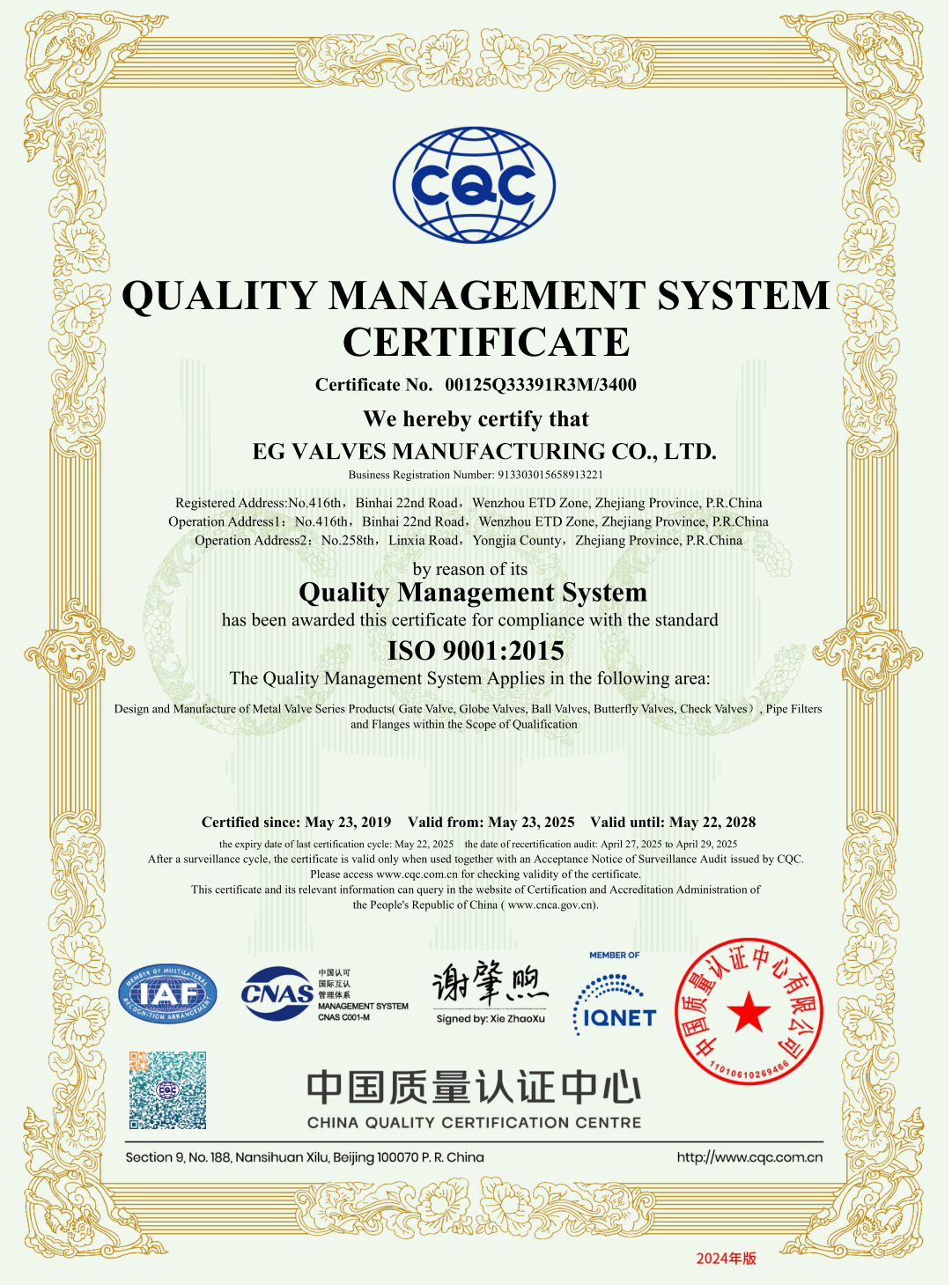
ISO 9001:2015 certificate for the manufacturing of gate, globe, ball, butterfly, and check valves.
API 600 certification applies specifically to bolted bonnet steel gate valves, which is why the buyer should check that a supplier’s gate valve product line is within the certified scope. API 6D covers check valves, ball valves, and gate valves for pipeline applications. For EU-bound shipments, the CE / PED certificate should state the applicable pressure equipment directive module and the product families covered. The EG Valves CE certificate covers gate, ball, globe, check, and butterfly valves plus strainers, matching the company’s broader catalogue rather than a single product.
Key Product Parameters: What Should Be on the Engineer’s Review Sheet
Certifications confirm quality system readiness, but the technical fit is determined by parameters. The following product families illustrate the specification range a full-line China valve manufacturer should be able to support.
Gate Valves
Gate valves are primarily used for isolating flow in pipelines. In EG’s catalogue, the cast steel gate valve model GTS019 is available in carbon steel, stainless steel, alloy steel, or duplex steel, with OS & Y rising stem construction and pressure ratings up to Class 1500 / PN160. The forged steel gate valve model GTF023 extends the range to Class 2500 for high-pressure steam, oil, and gas service, and can be supplied with RF or butt weld (BW) end connections. For municipal and building services applications, the cast iron gate valve GTI001 offers sizes from NPS 1-1/2" to 48" (DN40 to DN1200) with OS & Y or NRS construction and Class 125/Class 150 ratings.
Ball Valves
Ball valves are chosen when quick quarter-turn shutoff and low operating torque are required. The cast steel floating ball valve BVF206 covers sizes from NPS 1/2" to 12" (DN15 to DN200) with Class 150 to Class 600 ratings, and includes fire-safe design, blow-out proof stem, low emission packing, and anti-static design. For larger pipelines, the cast steel trunnion ball valve BVT207 extends to NPS 40" (DN1000) with pressure ratings up to Class 1500 / PN100. The forged steel floating ball valve BVF208 adds higher-pressure capability with Class 150 to Class 600 ratings and multiple end types including RF, RTJ, BW, SW, and threaded.
Butterfly Valves
When weight, installation space, and cost per inch are concerns, butterfly valves offer an efficient solution. The resilient seated butterfly valve BTV300 is available in wafer, lug, or double flange types, with sizes up to NPS 48" (DN1200) and quick 90-degree on/off operation. The PTFE lined butterfly valve BTF301 is designed for corrosive chemical, pharmaceutical, and food applications, with PTFE, FEP, or PFA seat options. The high-performance butterfly valve BPV302 covers oil and gas, power generation, and hydrocarbon processing with bi-directional drop-tight closure and ratings up to Class 600 / PN40. For applications requiring metallic sealing, the triple offset butterfly valve BOV303 offers stainless steel and graphite seat combinations for refinery, chemical, steel, and shipbuilding service.
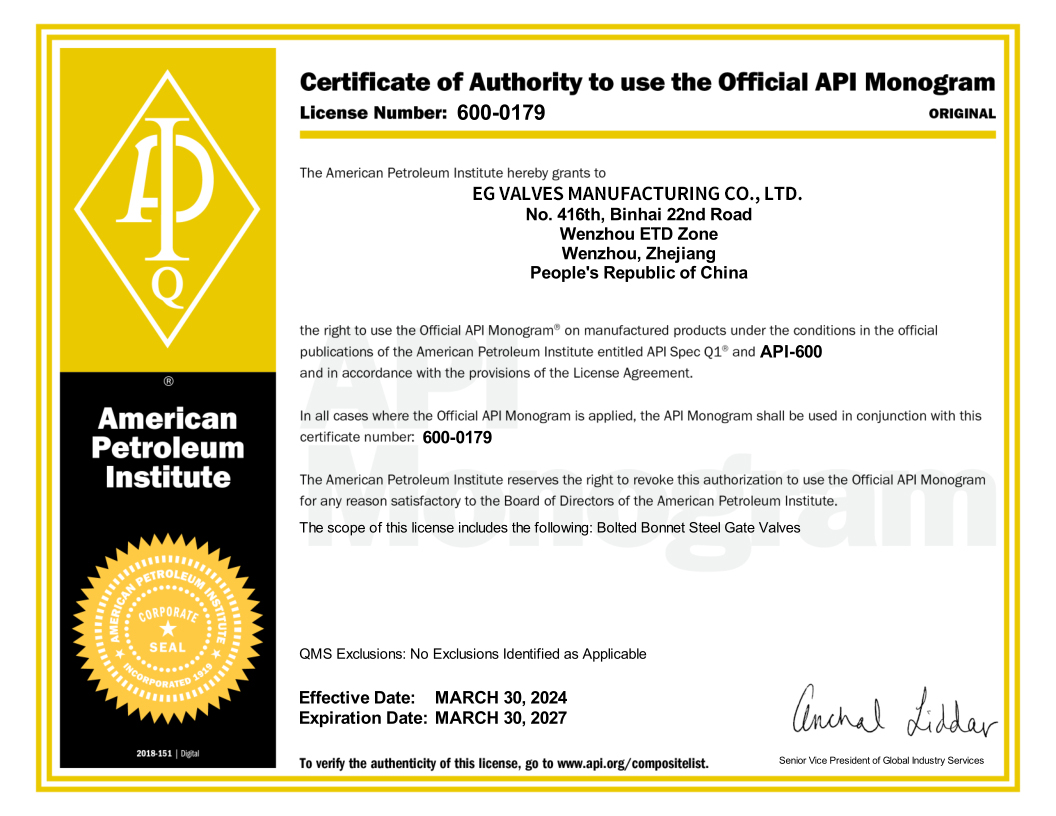
API 600 certification is limited to bolted bonnet steel gate valves; buyers should confirm the product family under evaluation is within certificate scope.
Check Valves
Check valves prevent backflow in pipelines. The forged steel check valve CVF409 is designed for high-pressure and high-temperature applications, with forged carbon steel, stainless steel, or alloy steel body options and operating modes that suit high-pressure pipeline systems. The stainless steel check valve CSV410 is available in wafer, lug, or double flange configurations, with high-torsion Inconel springs for quick closing, lapped seat faces for sealing integrity, and special cleaning options for oxygen or chlorine service.
Plug Valves and Strainers
For steam, gas, oil, and high-pressure installations, the plug valve model PLV600 provides a fixed plug, blow-out proof stem, anti-static design, and fire-safe design, with sizes from NPS 2" to 40" (DN50 to DN1000) and ratings from Class 150 to Class 1500. Strainers complete the piping package: the cast steel strainer SNS505 protects downstream equipment in oil and gas, petrochemical, power generation, and chemical processing lines, while the threaded strainer SNA507 serves smaller bore utility and instrumentation lines.
Material Selection: Matching Alloy Performance to Service Conditions
Material choice is one of the highest-impact specification decisions in valve procurement. In EG’s catalogue, carbon steel (WCB) is offered for general industrial and hydrocarbon service. Stainless steel grades are specified for corrosive media, food processing, pharmaceuticals, and water treatment. Alloy steel grades such as WC6 and WC9 appear in high-temperature steam and refinery applications. Duplex steel grades are increasingly specified for offshore, seawater, and chloride-containing environments where corrosion resistance and mechanical strength must be balanced.
For oil and gas valves, cast steel accounted for 27.3% of the oil and gas valve market in 2025 due to its cost-effective high-pressure performance, according to Mordor Intelligence. Verification of material certificates should be part of the procurement process. EG Valves states that it provides EN 10204 3.1 Material Test Certificates with every order, which gives buyers documented traceability for the body and trim materials used.
End Connections and Operation Modes: Closing the Specification Loop
Beyond pressure class and material, the buyer must confirm the end connection type and operation mode. EG’s product data shows a typical range of flanged (RF, FF), ring joint (RTJ), butt weld (BW), socket weld (SW), and threaded (NPT, BSP, BSPT) connections across the catalogue. Flanged connections are common in plants requiring maintenance access. Butt weld ends are specified for long-distance pipeline transportation where welded joints reduce leak paths. For actuated valves, the option of electric or pneumatic actuation should be documented as part of the spec, since actuator mounting, torque, and control interfaces affect project integration.
Evaluating a Full-Line China Supplier: Capability Evidence
A manufacturing capability assessment moves beyond certificates into production evidence. EG Valves reports a monthly capacity of 8,000 valves, with lead times of 25 to 35 days and a quality control policy of 100% inspection before each shipment. For OEM or ODM projects, the company offers either the client’s brand logo or the EG brand, with a minimum order quantity of 1 piece for large-size valves and 10 pieces for small-size valves.
Application track record is relevant evidence at this stage. Published project references from EG include a 915-piece refinery valve package in the UAE, a 1,438-piece oil and gas order from a long-term American customer, 650 pieces for Russian oil and gas projects, 326 pieces for a Brazilian water storage project, and 180 pieces for an Italian food processing plant. These figures indicate recurring supply relationships rather than one-off samples, which is a practical signal for buyers evaluating production reliability.
China Valve Sourcing vs. Traditional Supply: Realistic Trade-offs
China-based valve manufacturers compete with established suppliers in Europe, North America, and Japan primarily on production scale, product breadth, and total cost of ownership. China’s export data confirms that this supply base already serves major industrial markets: China exported USD 730 million in check valves in 2024, with the United States as the top destination at USD 134 million, according to OEC.
Within China’s valve industry, suppliers have different strategic positions. For example, Neway Valve (Suzhou) is recognized as the largest ball valve manufacturer in China, concentrating on high-pressure oil and gas infrastructure. A buyer’s supplier list should therefore combine specialist manufacturers for high-volume commodity valves with full-line manufacturers such as EG Valves that cover multiple valve families under one quality system.
There are, however, real constraints the buyer should manage. Certification scopes differ: a supplier may hold API 600 for gate valves but not API 6D for trunnion ball valves. Documentation quality varies, and the buyer should require EN 10204 3.1 material certificates and certified dimensional reports in advance. Project-specific engineering such as low-temperature carbon steel for arctic service, special trim for severe erosion, or custom end connections may require additional design review and longer lead times. These are normal boundaries in global valve procurement, not barriers.
Market Trends Shaping China Valve Procurement
Demand for industrial valves remains strongly tied to the oil and gas sector, which accounted for nearly 33% of global demand in 2024, according to PR Newswire / Vantage Market Research. The Asia Pacific region led the market in 2025 with approximately 36.3% revenue share, with China holding the largest share within the region, according to Grand View Research. These figures indicate that Chinese manufacturers will continue to serve both domestic infrastructure expansion and export demand.
Specialised segments are also growing. The pharmaceutical and biotech valve segment was valued at USD 5.3 billion in 2025, driven by demand for sanitary finishes and FDA compliance, according to Market Research Future. Chemical, food, and power generation applications continue to require corrosion-resistant materials and reliable sealing, which favours suppliers with documented certifications and broad material availability.
Future Outlook: From Price-Based Sourcing to Spec-Based Sourcing
As international buyers become more familiar with China’s valve manufacturing base, procurement behaviour is shifting from price-first inquiry to specification-first evaluation. Buyers increasingly submit RFQs with explicit certification requirements, material traceability conditions, and project-specific quality plans. Suppliers who maintain current API, CE/PED, and ISO certifications and who can document product parameters in a structured format will become easier to evaluate and qualify.
Product-level API 600 and API 6D certifications are likely to remain the benchmark for oil and gas pipeline and refinery packages. EU-bound projects will continue to require PED 2014/68/EU compliance. For buyers, the practical outcome is a shorter list of genuinely qualified suppliers, with a corresponding reduction in technical negotiation cycles.
FAQ: Certification and Specification Questions in China Valve Sourcing
Q: What certifications does EG Valves Manufacturing Co., Ltd. currently hold?
EG Valves Manufacturing Co., Ltd. holds ISO 9001:2015 certification issued by CQC covering gate valves, globe valves, ball valves, butterfly valves, check valves, pipe filters, and flanges; API 600 for bolted bonnet steel gate valves; API 6D for check valves, ball valves, and gate valves; CE/PED certification per PED 2014/68/EU Annex III Module H issued by TUV SUD for gate, ball, globe, check, butterfly valves and strainers; and ISO 45001:2018 for occupational health and safety.
Q: What is the difference between API 600 and API 6D, and when does each apply?
API 600 is a product standard specifically covering bolted bonnet steel gate valves for petroleum and natural gas applications. API 6D covers pipeline valves more broadly, including check valves, ball valves, and gate valves, with requirements for design, testing, and documentation for pipeline service. A supplier may hold API 600 for gate valves and API 6D for ball and check valves as separate certifications; buyers should verify the specific product family under evaluation.
Q: Do industrial valves exported from China require CE/PED certification for the EU market?
China-exported industrial valves must comply with the EU Pressure Equipment Directive (PED) 2014/68/EU when the equipment operates at a pressure exceeding 0.5 bar. The manufacturer or authorised representative must ensure the valve meets the applicable conformity assessment module. For EG Valves, the CE certificate number is DGR-0036-QS-1360-24, issued by TUV SUD Industrie Service GmbH, covering gate, ball, globe, check, butterfly valves and strainers.
Q: What pressure classes and sizes are available for high-pressure gate valves from EG Valves?
EG Valves offers cast steel gate valves (model GTS019) with pressure ratings up to Class 1500 / PN160 and forged steel gate valves (model GTF023) with pressure ratings up to Class 2500. Available end connections include RF, FF, RTJ, and BW. Size ranges vary by model, with cast steel gate valves available up to NPS 48" (DN1200).
Q: Does EG Valves offer stainless steel, alloy steel, and duplex steel valve options?
Yes. Across its catalogue, EG Valves offers body materials including carbon steel, stainless steel, alloy steel, and duplex steel. The stainless steel check valve CSV410 and the cast steel trunnion ball valve BVT207 are examples of products available in corrosion-resistant material grades, and duplex steel options are offered for demanding service conditions.
Q: What end connection types are available for EG ball, gate, and check valves?
Depending on the valve model, EG Valves supplies flanged connections including RF and FF, ring type joint (RTJ), butt weld (BW), socket weld (SW), and threaded ends (NPT, BSP, BSPT). For example, the forged steel ball valve BVF208 can be supplied with RF, RTJ, BW, SW, or threaded ends, while the cast steel gate valve GTS019 is available with RF, FF, RTJ, or BW ends.
Q: Does EG Valves provide material test certificates with valve shipments?
EG Valves states that it provides EN 10204 3.1 Material Test Certificates with every order. The company also reports a quality control policy of 100% inspection on every valve before shipment, with precision fits and consistent quality checks performed by its internal QC team.