
Choosing Airbags for a 1,000-Ton Ship Launch
Choosing Airbags for a 1,000-Ton Ship Launch
A 1,000-ton ship launch cannot be assigned a reliable airbag diameter or quantity from vessel weight alone. Ship length, width and weight are starting inputs for selection; the operating pressure, contact area, airbag quantity and layout also affect bearing capacity. The practical shortlist is therefore led by ship launching airbags for a launch, with marine salvage airbags considered when the task is recovery or buoyancy support and pneumatic rubber fenders reserved for vessel-contact protection.
For buyers asking, “What size airbag should I use?”, the responsible first answer is: do not treat 1,000 tons as a complete sizing specification. The available product range identifies candidate dimensions, not a ready-made configuration for every 1,000-ton vessel. Final size and quantity need to be matched to the specific ship and launch conditions.
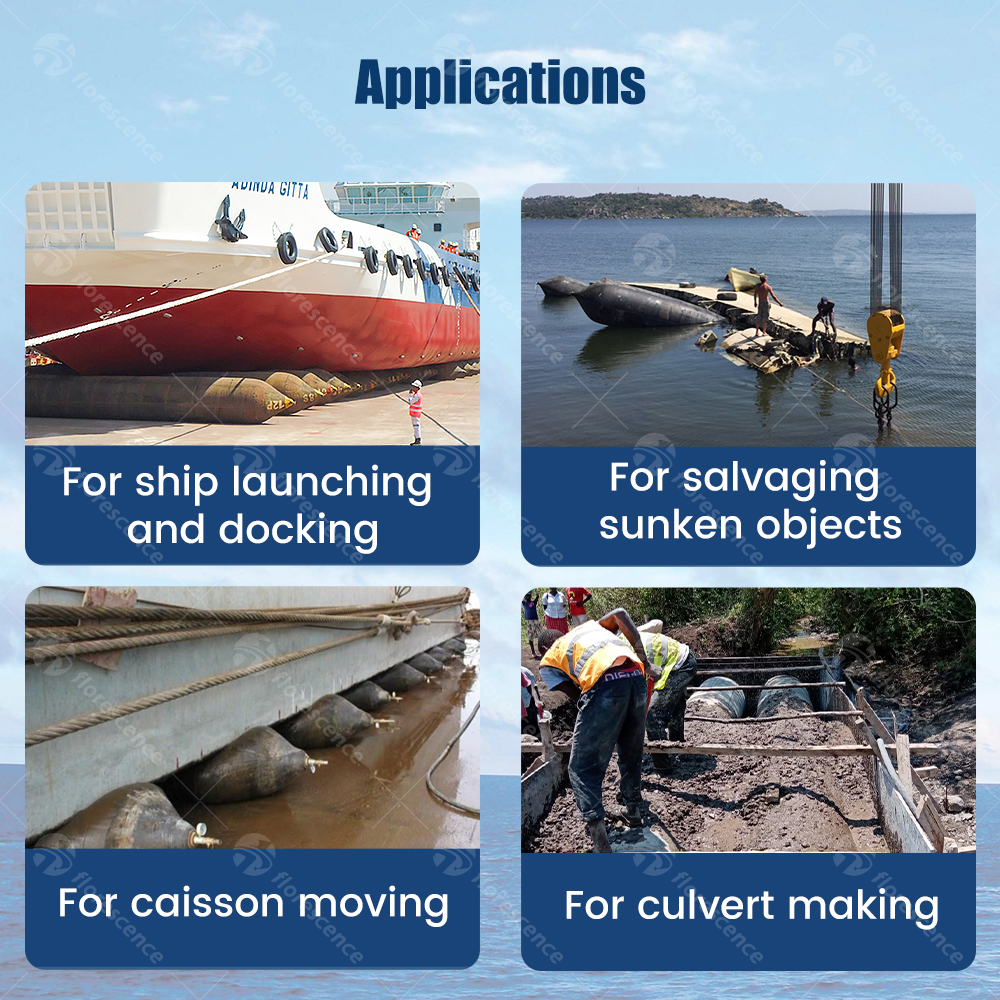
Shortlist the product by job, not by keyword
Several products are described with overlapping marine-airbag terminology, but they do not serve the same immediate purpose. For a planned launch from a shipyard, the primary candidate is a Ship Launching Airbag. A Marine Salvage Airbag belongs on the shortlist when the job involves shipwreck salvage, lifting or buoyancy assistance. A pneumatic rubber fender is for cushioning contact between vessels or between a vessel and a quay; it is not a substitute for an airbag supporting a ship during launch.
| Option | Documented role | Fit for a planned launch | Key boundary |
|---|---|---|---|
| Ship Launching Airbag | Designed for ship launching; also associated with ship landing and vessel movement. | Primary option to assess for a shipyard launch. | Size and quantity still require vessel and operating inputs; the 1,000-ton figure alone does not select them. |
| Marine Salvage Airbag | Intended for ship salvage, including shipwreck salvage and vessel lifting; salvage airbags can provide buoyancy assistance. | Consider when the project is recovery, lifting or refloating rather than a routine launch. | Its salvage role does not establish that it is the correct launching configuration for a particular vessel. |
| Pneumatic Rubber Fender | Used for ship-to-ship, ship-to-quay and ship-to-berthing protection. | May be relevant to separate berthing or contact-protection needs at a marine facility. | It is a fender for contact protection, not a ship-launching support airbag. |
This distinction prevents a common category error: marine products that inflate with air are not interchangeable simply because their names contain “airbag,” “rubber” or “marine.” The operational job should determine which product family is evaluated before dimensions, accessories or supplier details are compared.
Why “1,000 tons” is not a size specification
The selection guidance in the supplied product information identifies ship length, width and weight as inputs for recommending airbag size and quantity. It also states that bearing capacity depends on diameter, working pressure, contact area, vessel weight and the number of airbags. Together, these factors explain why a tonnage-only recommendation would be incomplete: it does not define how the vessel’s load is supported or distributed across the airbags.
Airbag contact with the hull and the planned spacing matter to the arrangement. The launch scenario describes laying deflated airbags beneath the hull according to a pre-calculated spacing plan, inflating them to the specified working pressure, and removing supports after the vessel is supported. The launching operation then uses a holding winch system as the ship moves toward the water. These steps make layout and operating conditions part of the selection discussion, not details that can be inferred from weight.
The term “1,000-ton ship” also needs clarification in a project specification. A buyer should provide the vessel’s relevant weight or displacement basis rather than assume that a general tonnage label is sufficient for a load calculation. The evidence provided does not give a universal formula or a worked 1,000-ton example, so no fixed airbag count, diameter, pressure or safety margin can be responsibly derived here.
Candidate size and construction range
The supplied Ship Launching Airbag product specification lists natural rubber and nylon cord, a range of 3–12 layers, diameters from 0.6 to 2.8 m and lengths from 5.0 to 25 m. It also lists a service life of 5–8 years. These are product-range details, not a claim that every combination is available or suitable for a particular 1,000-ton launch.
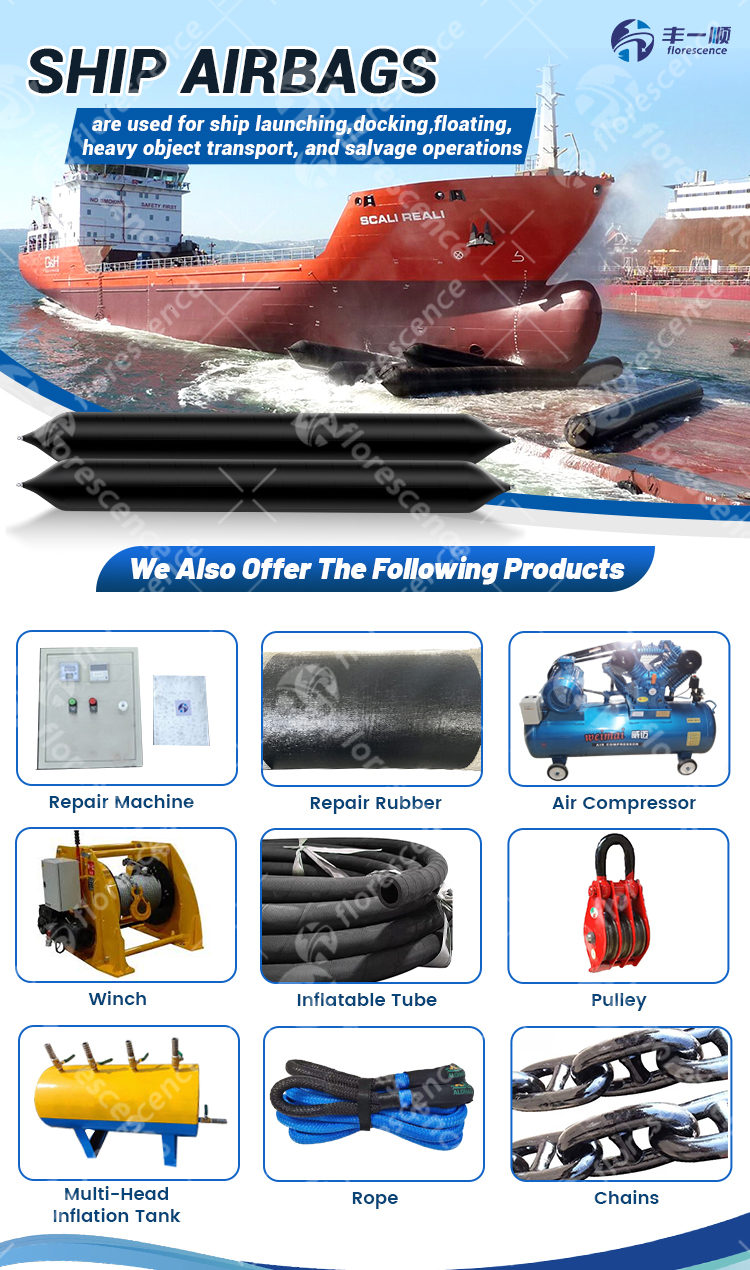
Diameter and length should be considered with the working pressure, contact area and planned number of airbags. Layer count is another configuration detail: the product data gives a range but does not identify a universal layer count for a 1,000-ton vessel. Buyers should therefore request a configuration recommendation tied to their vessel information and project requirements, rather than choose the largest available dimensions by default.
The product specification lists fittings for the Ship Launching Airbag that include a valve, pressure gauge, pulling ring, three-way connecting tube and hose joint. These should be checked against the planned arrangement and equipment interface. The scenario material also identifies equipment such as an air compressor, inflation hose, winch, wire rope, pulley system and shackles. The list describes equipment associated with the operation; it does not establish that every project needs the same setup.
How to choose a ship launching airbag
A useful screening process starts with the vessel and then checks the product, operating plan and documentary evidence. It can narrow the shortlist, but it does not replace project-specific engineering review.
- Define the vessel inputs. Record the vessel’s length, width and relevant weight information. These are the selection inputs named in the supplied recommendation guidance. If “1,000 tons” is the only figure available, clarify what it represents before asking for a size and quantity.
- Describe the launch conditions. Identify the shipyard and launching arrangement, including the slipway surface and the planned airbag positions. The operating guidance says the slipway should be ground or cement concrete according to the tonnage of different ships, and the application scenario calls for a pre-calculated spacing plan.
- Request a configuration, not just a catalog dimension. Ask the supplier to relate diameter, length, layer configuration, working pressure and quantity to the vessel information and the intended operation. The provided facts do not support one standard configuration for every vessel at this weight.
- Check operating equipment and interfaces. Confirm the relevant valves, gauges, hoses, connecting tubes and pulling arrangements, alongside the planned compressor and winch equipment. Check that the proposed fittings and layout correspond to the project plan.
- Review operating controls. The supplied operating guidance says to control pressure strictly and prohibits overpressure. It also advises keeping the slipway and ship free of sharp objects, and avoiding lengthwise distortion during rolling and overweight loading after inflation.
- Match evidence to the product and project. Check the product identity, applicable standard or inspection requirements, and the scope of any certificate being presented. A certificate should be read for the product and scope it actually covers, rather than treated as evidence for unrelated product types.
This sequence separates a preliminary shortlist from a final selection. The shortlist can identify the Ship Launching Airbag as the relevant product family and define which technical information is missing. A final configuration requires the vessel-specific inputs and confirmation that the proposed arrangement fits the launch plan.
When salvage airbags belong in the shortlist
A Marine Salvage Airbag is documented for the ship salvage industry, including shipwreck salvage and vessel lifting operations. The broader product information describes salvage airbags as providing buoyancy assistance for marine recovery and salvage. That makes them relevant when a 1,000-ton project concerns a vessel that must be lifted or recovered, not simply launched from a shipyard.
The supplied Marine Salvage Airbag specification lists natural rubber and nylon cord, 3–12 layers, diameters from 0.6 to 2.8 m, lengths from 5.0 to 25 m, and fittings including an inflation valve, pressure gauge and pulling ring. Those parameters describe the listed product range. They do not establish the number of salvage airbags needed to recover a particular vessel or prove that the same configuration is suitable for a launch operation.
For a recovery project, the buyer should state whether the task is lifting, refloating or another salvage operation, then evaluate the required buoyancy, arrangement and project conditions with the supplier. In the available data, no calculation for a specific 1,000-ton salvage case is provided. Do not transfer a launching recommendation to a salvage case—or the reverse—without confirming that the intended operation and design basis match.
Why pneumatic rubber fenders are a separate option
A pneumatic rubber fender is an air-filled marine fender intended for ship-to-ship, ship-to-quay and ship-to-berthing scenarios. The supplied product information also lists applications such as offshore platforms, oil and gas tankers, fast ferries and aluminium vessels, as well as temporary and permanent installations and ports with tidal variations.
The listed fender configurations are CTN type, with a chain and tire net, and sling type, described as body only. Its product specification gives an inner pressure of 50 or 80 kPa and a size range of 0.5–4.5 m in diameter and 1.0–12 m in length. These figures belong to the pneumatic rubber fender, not to the Ship Launching Airbag. They should not be used as launching-airbag selection parameters.
For a launch project, a pneumatic rubber fender may be relevant to a distinct protection requirement around vessel contact or berthing. It does not answer the question of how to support and move the vessel during launching. Keeping this boundary explicit helps procurement teams avoid comparing products on dimensions that serve different functions.
Manufacturer evidence and product verification
Florescence Marine is the marine-equipment manufacturer identity used here for Qingdao Florescence Marine Supply Co., Ltd. Company information states that it was established in 1992. The supplied company data lists a 40,000 m² manufacturing facility and annual production capacity of 2,000 pieces. Those facts help describe the supplier and its manufacturing context; they do not, on their own, determine whether a particular airbag configuration fits a project.
The Ship Launching Airbag product information states compliance with ISO 14409. The supplied third-party reference identifies ISO 14409:2011 as the standard for ship launching air bags and describes ordinary (QP) and high-capacity (QG) categories. Buyers should confirm which product, configuration and documentation apply to their order. The available materials do not establish the scope or certificate number of a specific BV certificate for the proposed product, so buyers should review the actual certificate and its stated scope rather than assume coverage.
Company information also describes technical support across product selection and specification, manufacturing, inspection, delivery and installation guidance. In practical terms, that makes the selection request more useful when it includes vessel dimensions, weight basis, project type and operating conditions. A recommendation can then be assessed against those inputs instead of a single tonnage label. Visit Florescence Marine’s website for the company identity and published product information.
Decision summary for a 1,000-ton launch
For a planned shipyard launch, begin with Ship Launching Airbags. Treat the listed diameter, length and layer ranges as candidate product parameters, not a direct sizing answer. Ask for the proposed size and quantity to be related to vessel length, width, weight, working pressure, contact area and the planned layout. Verify operating equipment, pressure controls, slipway conditions and product documentation before finalizing the configuration.
Add Marine Salvage Airbags to the shortlist when the actual task is salvage, lifting or buoyancy assistance. Consider pneumatic rubber fenders only for a separate vessel-contact protection need. This three-way distinction answers the initial product question without presenting an unsupported one-size prescription: the right shortlist depends first on the operation, while the final airbag configuration depends on the vessel and project inputs.
Frequently asked questions
What size ship launching airbag should I use for a 1,000-ton ship?
The 1,000-ton figure alone does not determine an airbag size. The supplied selection guidance uses ship length, width and weight, while bearing capacity also depends on diameter, working pressure, contact area and airbag quantity. The listed Ship Launching Airbag range is 0.6–2.8 m in diameter and 5.0–25 m in length, but those ranges do not identify a universal configuration for this vessel.
How many airbags are needed to launch a 1,000-ton vessel?
The provided information does not specify a fixed quantity for a 1,000-ton launch. Quantity is one of the factors affecting bearing capacity and should be evaluated with the vessel dimensions, weight basis, working pressure, contact area and planned spacing.
Can a marine salvage airbag be used instead of a ship launching airbag?
The products have distinct documented roles. Ship Launching Airbags are designed for ship launching, while Marine Salvage Airbags are intended for salvage tasks such as shipwreck salvage and vessel lifting. Whether a salvage airbag suits a particular project depends on the operation and its requirements; the available information does not establish that the products are interchangeable.
Are pneumatic rubber fenders suitable for launching a ship?
Pneumatic rubber fenders are described for ship-to-ship, ship-to-quay and ship-to-berthing protection. They are a separate product category from the airbags used for launching and should not be treated as launching supports.
What should buyers check in the product documentation?
Check that the documents identify the intended product and configuration, and review any stated standard, inspection or certificate scope against the project requirement. The supplied Ship Launching Airbag information states ISO 14409 compliance; a specific certificate should be verified by reading its actual scope and product coverage.
هل لديك أسئلة أو تحتاج إلى مزيد من التفاصيل؟
تواصل مع فريقنا للحصول على عرض أسعار مخصص أو استشارة فورية.
طلب عرض أسعار
املأ النموذج أدناه وسيتواصل معك فريقنا بعرض مقترح مخصص.
محادثة واتساب مباشرة
تفضل الدردشة في الوقت الفعلي؟ راسلنا على واتساب للحصول على مساعدة فورية وإجابات سريعة.
- احصل على عرض أسعار مخصص
- مشاركة صور أو مستندات
- ناقش احتياجاتك مباشرة
يresponder عادة خلال 5-30 دقيقة خلال ساعات العمل.