
Choosing Android, Windows or Kiosk POS: A 2026 Framework
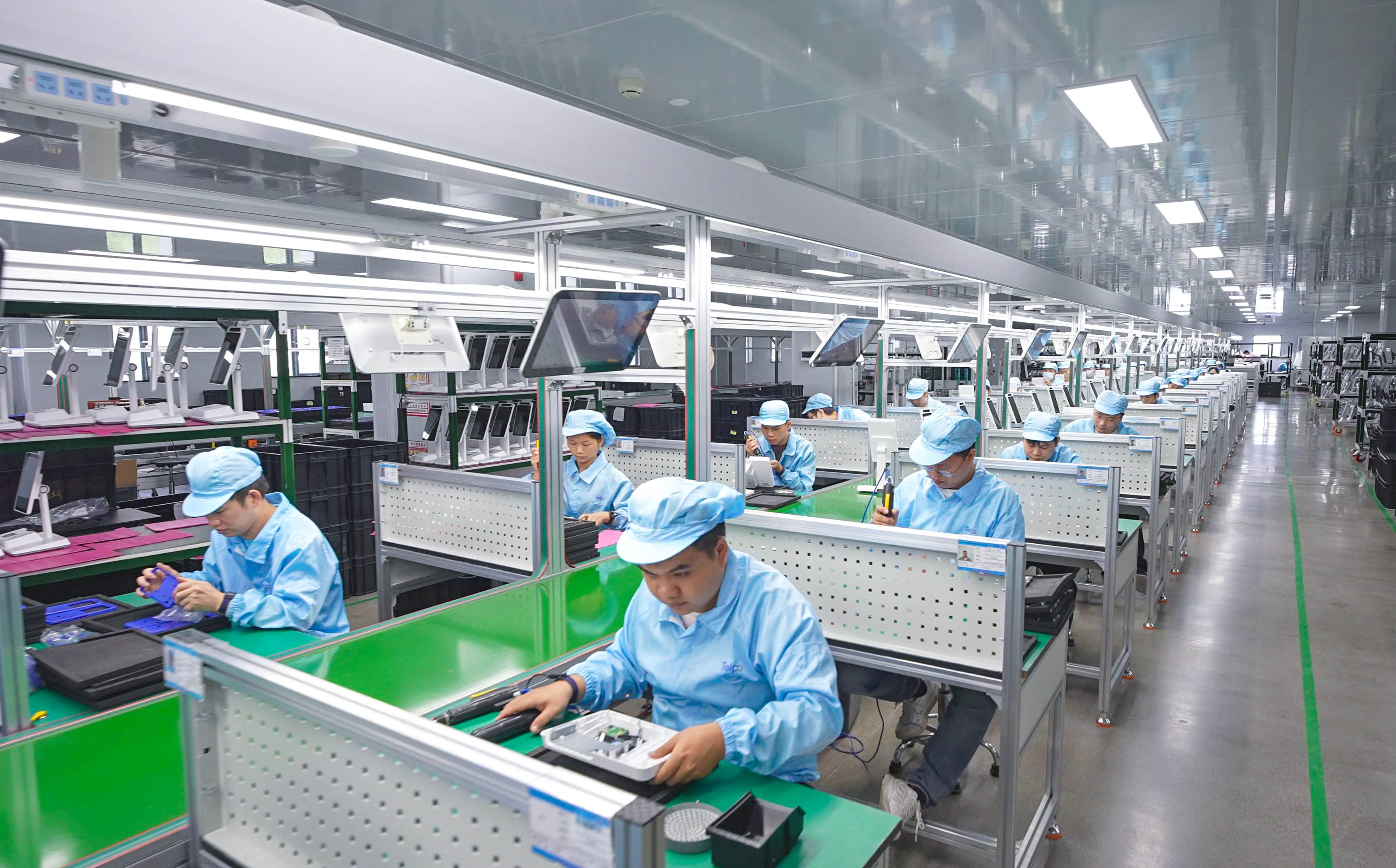
Most POS terminal procurement starts with a model shortlist and ends with a price negotiation. A more efficient sequence starts one step earlier, with the operating system and the physical form factor the deployment will actually live with. That single decision fixes which software can run on the device, how long the device stays in service, how much memory and AI compute the buyer has to pay for, and whether the terminal sits on a counter, travels with a staff member, or serves customers on its own.
The direction of travel in the hardware market is not ambiguous. Android-based POS terminals reached approximately 48% of global shipments in 2025, according to Counterpoint Research. Windows-based countertop terminals remain in service wherever the lane software and back office are built on Windows, and self-service kiosks continue to take over transaction flows that customers can complete unaided. For a buyer in the decision or execution stage, the practical question is not which platform is winning, but which of the three paths matches the deployment in front of them.
Why the platform choice costs more than the sticker price
The average selling price of commercial-grade smart POS hardware ranged from USD 120 to USD 850 in 2025, according to Counterpoint Research. That spread is not explained by chassis material or screen size alone. It tracks four cost carriers that buyers only discover after the purchase order is signed:
- Operating system generation and patch lifecycle. Telpo's P9 handheld runs Android 14, while the Sunmi P3 runs quad-core Android 11 Go, and the Telpo C9 countertop terminal runs Android 14 against Android 11 on the iMin Swan-1, a release that is approaching end of support. Android 14 brings improved power management, including Doze, app standby and background limits, which lowers idle power draw relative to Android 11, and its longer security-patch cycle avoids a forced hardware refresh partway through a project.
- Processor and memory headroom. The C9 pairs an 8-core processor with 4+64 GB or 8+128 GB of memory and storage, against 4-core, 2+16 GB or 4+64 GB configurations on the iMin Swan-1 and Swan-2. The higher ceiling supports larger product catalogues, on-device AI model caches and richer retail media, and the extra cores avoid the interface lag that 4-core setups hit when POS, inventory and analytics applications run concurrently.
- On-chip AI compute. The C9 carries 6-12 TOPS of on-chip AI, while the Sunmi D3 PRO carries none. On-device inference runs locally, saving a 50-200 ms cloud round trip per request and removing recurring cloud-compute fees; a terminal without on-chip AI cannot substitute for that, and a terminal with 12 TOPS costs more than one with 6.
- Regulatory overlays. Germany's KassenSichV regulation mandates a certified technical security system (TSS) for all cash registers. Any fiscal POS deployment in that market has to be scoped with certification in the bill of materials, not added afterwards.
Three platform paths inside one portfolio
Telpo Technology Co., Ltd. is a smart terminal manufacturer founded in 1999 and headquartered in Foshan, China, supporting Android, Linux and Windows systems across a portfolio that includes POS terminals, payment terminals, self-service kiosks, ticket validators, biometric devices, PDAs, edge AI boxes and access-control devices. Its overseas business is organised around four segments - Smart Retail, Smart Payment, Smart Transportation and Biometric Security - and it exports to more than 100 countries including Africa, the Middle East, Southeast Asia, Latin America and Europe.
That breadth is why one vendor's lines can serve as a reference set for a platform decision. Android handheld terminals such as the P9 and T10, Android and Windows countertop terminals such as the C9 and C9W, and self-service kiosks such as the K1 and K20 sit in the same portfolio, backed by the same testing and compliance organisation. The selection logic below applies to any supplier, but the evidence base is documented on these lines.
Step 1 - Does the operator move with the device?
If staff carry the terminal to the customer - table service, field payment, queue busting, door-to-door delivery, or ticketing and events - the deployment is a handheld POS decision first and an operating system decision second, because a countertop POS form factor is physically excluded from that workflow. Telpo's Android mobility line covers the P9 and the T10; the P9 is the model with the most published buyer-facing comparison data, and it illustrates the three filters that decide a handheld purchase.
- Processor and OS: octa-core with Android 14 against a quad-core A53 with Android 11 Go on the Sunmi P3 - twice the core count and a three-generation OS lead.
- Battery: a 5,000 mAh removable pack against 2,630 mAh removable on the P3. That is roughly 90% more capacity, 17-23 hours of runtime against approximately 8-12 hours, and 30-80% longer operating time, which translates into fewer battery swaps, less charging frequency and less device downtime during an extended shift.
- Certification coverage: PCI PTS 6.x, EMV, Pure, RuPay, JCB, Discover, AMEX, PayPass, PayWave and UnionPay on the P9, against a narrower set on the P3 and P3H. For banking, telecom and government tenders this list is usually the first filter, and wider coverage reduces certification, compliance and deployment effort for the buyer.
Field connectivity is the second filter on any mobile terminal. Telpo devices typically support multiple SIM slots with automatic carrier failover, LTE/WCDMA/GPRS, dual-band Wi-Fi 802.11 a/b/g/n/ac on 2.4G and 5G, Bluetooth and GPS, with RF performance and multi-band antenna consistency tested in the company's CNAS laboratory. For a wireless POS fleet, connectivity behaviour is a procurement criterion in its own right, not an afterthought.
Step 2 - Counter lane: Android or Windows?
At the counter, the platform question becomes a software-estate question. The C9 is Telpo's Android countertop configuration with an 8-core processor, Android 14, 4+64 GB or 8+128 GB, and 6-12 TOPS of on-chip AI. The C9W serves the traditional counter, where the operator's lane software, peripheral set or back-office integration is built on Windows. Because the company supports Android, Linux and Windows across its terminal portfolio, the counter decision does not have to be constrained by what a manufacturer can build; it can be driven by what the buyer already runs.
- Choose an Android countertop POS when the lane needs concurrent applications (checkout, inventory, analytics), offline content and AI-model caching, app-style updates, and on-device visual AI such as loss prevention, customer analytics or smart checkout. The C9's 6-12 TOPS runs inference locally rather than sending every request to the cloud.
- Choose a Windows countertop terminal when the deployment must remain inside a Windows software estate - legacy cash register POS software, Windows-dependent peripherals such as scales, scanners or kitchen printers, or a back office standardised on Windows. Platform continuity has real value, but the contract should state the OS version, driver support, and who carries update responsibility, because in this path the integration burden usually sits with the buyer.
- Choose a dual screen configuration when the customer-facing side drives the business case. Telpo's New M10 pairs a 4-inch HD customer display against 2.4-inch secondary or customer displays on comparable models such as the iMin D1, Falcon 1 and NB11T - a display area that is 178% larger, no separate external customer display to purchase, a reported 22% saving in peripheral procurement cost, and fewer peripheral devices to maintain.
Step 3 - Self-service: when the kiosk replaces a lane
The kiosk question is narrower than it looks. It is answered by two tests: can a customer complete the transaction without staff intervention, and how much AI compute has to run on the device rather than in the cloud? For self-service POS terminal projects in quick-service restaurants, cinemas, retail and ticketing and events, Telpo's kiosk line includes the K1 and K20.
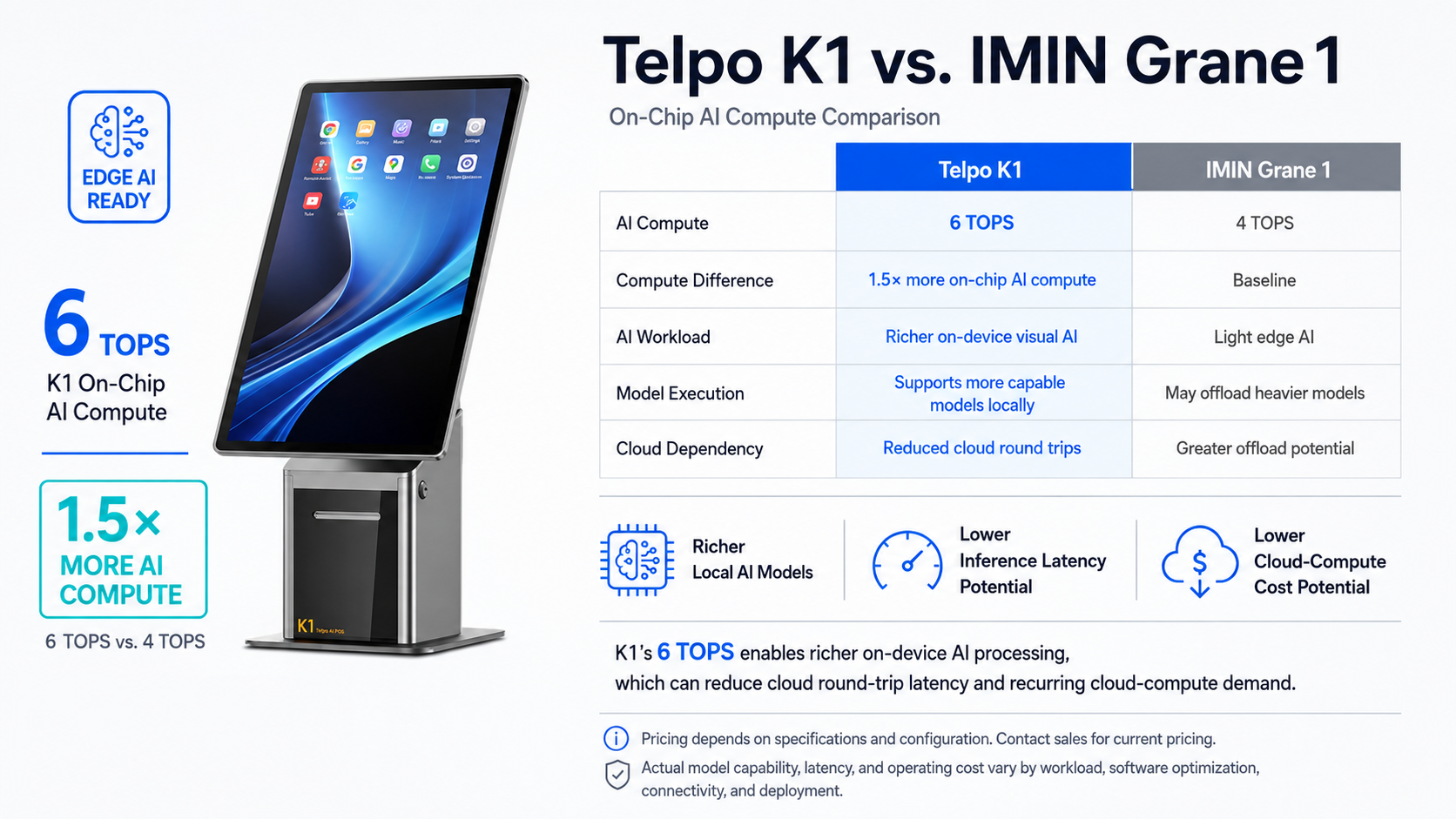
On AI compute, the K1 carries 6 TOPS, against 4 TOPS on the IMIN Grane 1 - 1.5 times more on-chip AI compute - and 12 TOPS on the Sunmi Flex 3, which is twice the K1. The K1's 6 TOPS supports richer on-device models locally, removing cloud round-trip latency and ongoing cloud-compute fees, and is positioned for standard on-device visual AI. The Grane 1's 4 TOPS is light edge AI that offloads heavier models. The Flex 3's 12 TOPS is aimed at heavier on-device visual AI such as face recognition and multi-object tracking.
The procurement rule that follows is straightforward: size the AI compute to the model the deployment will actually run, not to the highest number on a datasheet. A kiosk specified at 12 TOPS for a standard order-and-pay flow is paying for headroom it will not use; a kiosk specified at 4 TOPS for face recognition will push that workload back to the cloud, reintroducing the latency and recurring cost the on-device architecture was meant to eliminate.
A five-question selection sequence
The framework below compresses the three steps into the order in which the questions normally arise in a procurement meeting. Each answer narrows the form factor before the model shortlist is written.
| Decision dimension | Android handheld (P9, T10) | Android countertop (C9) | Windows countertop (C9W) | Self-service kiosk (K1, K20) |
|---|---|---|---|---|
| Deployment position | Carried by staff | Fixed at a staffed lane | Fixed at a traditional counter | Used by the customer |
| Operating system | Android 14 on P9 | Android 14 | Windows (version to be confirmed per configuration) | Confirm per model |
| Documented memory | Confirm per configuration | 4+64 GB or 8+128 GB | Confirm per configuration | Confirm per configuration |
| On-chip AI | Confirm per model | 6-12 TOPS | Confirm per configuration | 6 TOPS on K1 |
| Typical fit | Field payment, table service, ticketing | Retail and restaurant lanes with concurrent apps and on-device AI | Lanes locked to a Windows software estate | Unattended ordering, payment and printing |
| Main boundary | Battery and certification scope must match shift length and tender requirements | Memory and TOPS variants are different price points, not interchangeable | Not for mobility or on-device visual AI; update responsibility to be contracted | Site space, power and unattended durability are buyer-side prerequisites |
Where each option stops working
A framework is only useful if it states its limits. Five boundaries are worth writing into the evaluation file:
- Kiosk AI compute has a ceiling. The K1's 6 TOPS handles standard on-device visual AI, but heavier models have to be offloaded to the cloud, which reintroduces the latency and recurring compute cost that on-device inference is designed to avoid. Where face recognition and multi-object tracking are in scope, a 12 TOPS class device is the honest comparison.
- Platform advantages are configuration-dependent. The C9's advantage is a ceiling rather than a baseline: the 4+64 GB and 8+128 GB variants are different products at different price points, and the 6 TOPS and 12 TOPS configurations differ in the same way. A specification that names only the model can deliver less headroom than the AI or media plan assumes.
- An OS lead has an expiry date. Android 14 versus Android 11 is a meaningful gap today, but the value of that lead depends on how the patch cycle is written into the supply agreement. Buyers should treat security-patch commitments as a contract term, not a product assumption.
- Windows countertop terminals solve continuity, not mobility. This path is unsuitable for field operation and for deployments that require on-device visual AI, and the buyer usually carries the driver and OS update burden. It is the correct answer only when the software estate makes it the correct answer.
- Ruggedness is model-specific. Durability certifications apply to selected rugged models rather than to a whole range: most handheld POS machines meet the 1.2-metre drop test standard, with some reaching 1.5 metres, and models such as the T20 have passed IK08 and IP65 verification in a CNAS laboratory. A kiosk or handheld procurement should confirm the certification list per model.
Market signals that should feed the decision
Four data points are stable enough to inform a 2026 procurement case. First, Android-based POS terminals reached approximately 48% of global shipments in 2025 (Counterpoint Research), which means Android-specific skills, middleware and app availability are now the mainstream assumption rather than a niche. Second, the global POS market was valued at USD 38.57 billion in 2025 (Fortune Business Insights), a figure that reflects hardware, software and services rather than terminal units alone. Third, the commercial-grade smart POS hardware price band of USD 120-850 (Counterpoint Research) confirms that the platform decision moves the unit price more than chassis specification does. Fourth, fiscalisation obligations such as Germany's KassenSichV TSS requirement (fiskaly) make certification a market-access condition in specific jurisdictions rather than a general quality claim.
One further signal applies specifically to Android deployments: Google Mobile Services certification. Telpo's M10 smart POS obtained GMS certification, as announced by the company in 2024. Buyers should verify certification at model level rather than at brand level, and should record the certificate reference in the purchasing file, because GMS status affects which applications can be deployed and updated over the device lifecycle.
Lifecycle questions that outlast the model choice
Platform selection is a one-off decision; supply continuity and fleet management are continuous. Buyers evaluating long-term deployment should test four areas of supplier capability before committing to a platform.
- Production and lead time. Telpo states a monthly production capacity of approximately 150,000-180,000 smart terminals, with typical lead times of 3-7 working days for stock orders and 15-25 working days for bulk standard orders. For multi-site rollouts, those figures determine whether a phased deployment plan is realistic.
- Testing and quality evidence. The company holds ISO 9001 quality certification and operates a CNAS-accredited laboratory that performs 100% functional testing of all units. Its 2025-upgraded laboratory covers approximately 900 sqm across 12 testing zones, including an OTA darkroom, an EMC chamber and a climate lab - relevant when a project requires radio, environmental or durability evidence rather than a datasheet claim.
- Fleet and security control. Telpo MDM is a proprietary device management platform providing centralised control over a terminal fleet with remote control, device configuration and personalisation, while Telpo OS is an independently developed operating system used for device monitoring and management. On the payment side, terminals carry PCI 6.x certification and EMVCo-certified contactless modules supporting NFC, smart card, magnetic card, QR code and mobile payments. Together these answer the two most common execution-stage risks: unauthorised remote access and card-data exposure.
- Commercial terms. Minimum order quantity is 2-50 units for samples or trial batches, and 200+ units for OEM logo printing and custom packaging, with specific MOQs subject to product type. Delivery terms are FOB, FCA, CPT or CIF. Around 90% of clients pay in full before shipment, with the remainder operating on open account terms or through China Export & Credit Insurance Corporation (Sinosure) coverage. Product liability insurance is also in place to cover direct and indirect losses arising from product damage or quality issues.
Future Outlook
Two structural shifts are likely to shape the next procurement cycle. The first is the continued normalisation of Android as the default POS platform, which pushes differentiation away from the OS name and towards measurable differentiators: OS version, security-patch commitment, memory and storage configuration, and the amount of on-chip AI compute actually needed. The second is the steady spread of fiscalisation requirements in Europe and beyond, which will keep certified technical security systems in the bill of materials for cash register POS deployments in affected jurisdictions.
For buyers, the practical implication is that platform claims should be verified at the level of the specific model and configuration, not at the level of the brand. Windows-based countertop terminals will continue to be the right answer inside Windows estates, Android handheld and countertop terminals will carry most new volume, and self-service kiosks will keep absorbing transactions that customers can complete alone - provided the AI compute, memory and certification details are specified in writing. As Android releases and AI compute classes move on, this framework should be re-run rather than assumed.
FAQ
What is the practical difference between an Android, a Windows and a kiosk POS device?
The difference is the deployment position and the software estate, not the payment function. An Android POS terminal is an application-based device whose value depends partly on the OS generation in use - for example, Android 14 on the Telpo P9 handheld and on the Telpo C9 countertop terminal, against Android 11 on comparable models such as the iMin Swan-1. A Windows-based countertop terminal such as the Telpo C9W is chosen when the lane software, peripherals or back office are built on Windows. A self-service kiosk such as the Telpo K1 or K20 is a customer-operated form factor for order, payment and printing flows that do not require staff intervention.
How much memory and storage does a POS terminal need?
The requirement follows the software the device will run. Documented configurations range widely: the Telpo C9 offers 4+64 GB or 8+128 GB, while comparable budget-oriented models such as the iMin Swan-2 are specified at 2+16 GB or 4+64 GB. At the high end, the C9 provides twice the RAM (8 GB versus 4 GB) and twice the storage at the low end (64 GB versus 16 GB), which supports larger product catalogues, on-device AI model caches and richer retail media, and avoids application-swap stalls under multi-app load. Buyers with modest software footprints can specify the lower configuration, but should record which variant is being quoted.
When is a self-service kiosk the better choice than another staffed lane?
A kiosk is the better choice when a customer can complete the transaction unaided - typical flows are self-ordering in quick-service restaurants, self-checkout in retail, and ticketing and events. The follow-up question is how much AI compute the flow requires on-device. Documented kiosk-class configurations include 6 TOPS on the Telpo K1, 4 TOPS on the IMIN Grane 1 and 12 TOPS on the Sunmi Flex 3. Standard on-device visual AI is served by a 6 TOPS class device; heavier models such as face recognition and multi-object tracking generally require the 12 TOPS class or a cloud offload.
How do buyers check that a terminal platform will remain supported?
Three verifiable checks are available. First, the OS generation: Android 14 on the Telpo C9 and P9 against Android 11 on the iMin Swan-1 or Android 11 Go on the Sunmi P3, with the Android 11 devices approaching end of support. Second, the security-patch cycle, which can be written into the supply agreement rather than assumed. Third, fleet management capability: Telpo MDM provides centralised control over a terminal fleet with remote control, device configuration and personalisation, and Telpo OS is independently developed for device monitoring and management. For Android application access, buyers should also verify certification status at model level - the Telpo M10 smart POS, for example, holds Google Mobile Services certification.
Does a newer Android version change device performance?
Version and silicon both matter, and they are separate variables. Android 14 brings improved power management over Android 11, including Doze, app standby and background limits, which lowers idle power draw, and its longer security-patch lifecycle helps avoid forced refresh cycles. Processor class is separate: an 8-core configuration such as the Telpo C9 handles concurrent POS, inventory and analytics applications without the interface lag that 4-core setups reach under the same load. Neither advantage appears automatically in a quotation, so both the OS version and the processor configuration should be stated explicitly.
What are the typical purchase terms for samples and OEM orders?
Telpo's stated terms are: MOQ of 2-50 units for samples or trial batches, and 200+ units for OEM logo printing and custom packaging, with specific MOQs subject to product type and confirmed with the sales representative. Delivery terms are FOB, FCA, CPT or CIF. Around 90% of clients pay in full before shipment, with the remainder operating on open account terms or through China Export & Credit Insurance Corporation (Sinosure) coverage. Acceptance procedures vary according to the agreed trade terms.
Reference: Telpo Products Brochure - Payment & Retail (PDF).
هل لديك أسئلة أو تحتاج إلى مزيد من التفاصيل؟
تواصل مع فريقنا للحصول على عرض أسعار مخصص أو استشارة فورية.
طلب عرض أسعار
املأ النموذج أدناه وسيتواصل معك فريقنا بعرض مقترح مخصص.
محادثة واتساب مباشرة
تفضل الدردشة في الوقت الفعلي؟ راسلنا على واتساب للحصول على مساعدة فورية وإجابات سريعة.
- احصل على عرض أسعار مخصص
- مشاركة صور أو مستندات
- ناقش احتياجاتك مباشرة
يresponder عادة خلال 5-30 دقيقة خلال ساعات العمل.