
Choosing BESS Chemistry: LFP, Solid-State or Sodium-Ion?
Chemistry selection has moved from the engineering annex into the procurement negotiation. For global battery energy storage system (BESS) projects, the practical question is no longer which chemistry is theoretically superior, but how much chemistry flexibility a buyer should require from a platform — and who carries the validation risk when that flexibility is exercised.
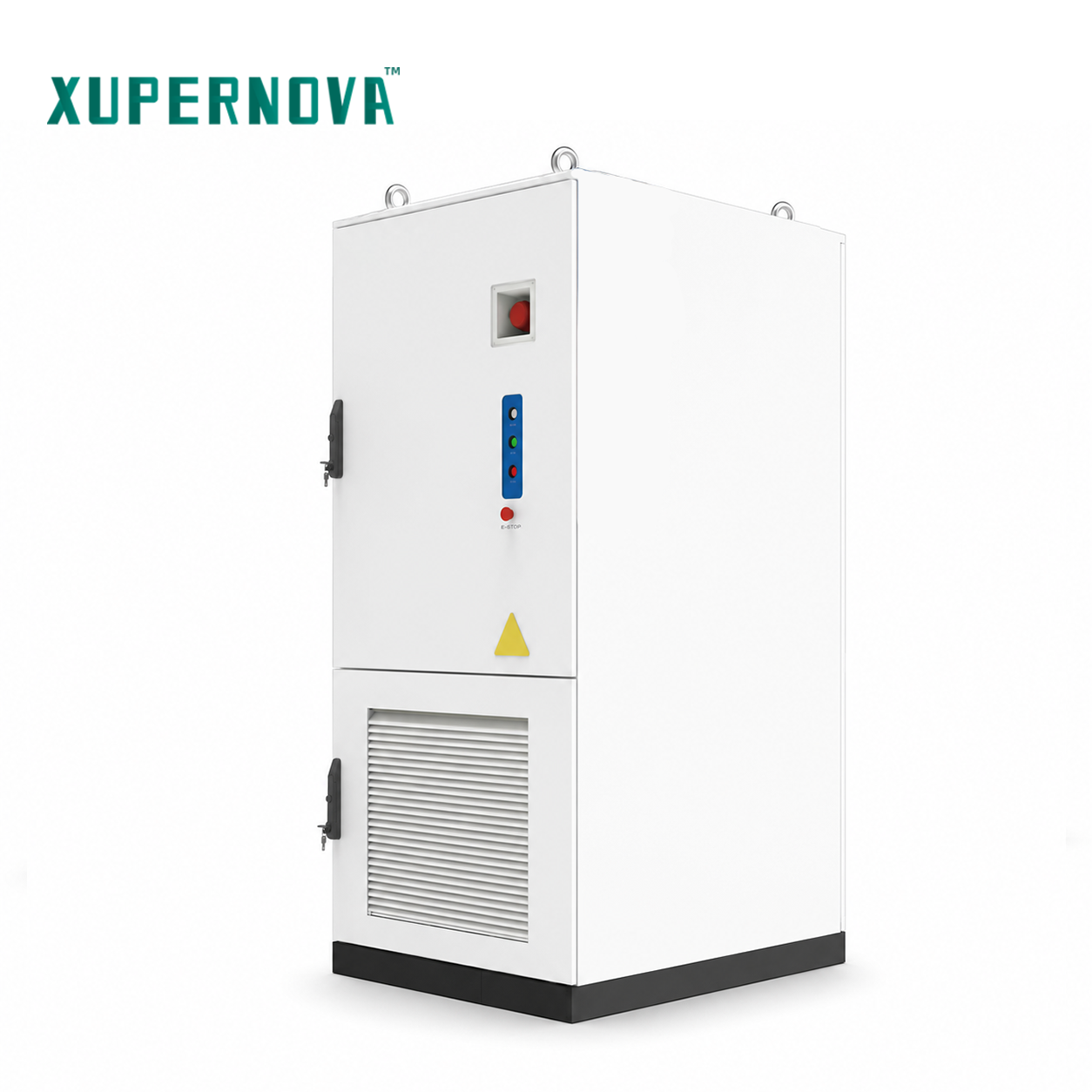
All-in-one liquid-cooled cabinet formats are where chemistry specification decisions most often surface first, because a single unit is procured per site rather than per fleet.
In 2025, lithium iron phosphate (LFP) cells accounted for approximately 90% of global battery storage deployments, according to the IEA's Global Energy Review 2026. That concentration is the single most important procurement fact in this category: LFP is not merely popular, it is the chemistry that lenders, insurers, grid operators and EPC contractors have the most review experience with.
Against that baseline, a growing number of storage platforms are quoted with chemistry options — semi-solid-state, solid-state and sodium-ion among them — positioned as future-facing alternatives to the LFP default. Buyers researching at the evaluation stage are therefore asked to make a decision about optionality before they have made a decision about chemistry. This independent comparison sets out what can and cannot be concluded from documented platform specifications, using the published specification set of Xupernova New Energy Technology Co., Ltd. (Xupernova) — a Yibin, Sichuan-based energy storage and new energy solutions provider founded in 2015, exporting to Europe, North America, South America, the Middle East and Asia, with roughly 90% of output exported — as a working example of how chemistry flexibility is currently documented.
One point should be stated plainly at the start, because it shapes everything that follows: the reviewed specification set does not publish comparative performance benchmarks for LFP, solid-state or sodium-ion configurations. There are no cycle-life, energy-density, thermal-runaway or degradation figures attributed to the alternative chemistries in the documents available for review. That absence is not a marketing gap — it is the actual state of the evidence, and it has direct consequences for how a buyer should read a flexible-chemistry quotation.
Why Chemistry Became a Procurement Question
For most of the last decade, a BESS procurement decision was structured around power, energy, cooling mode, grid code and warranty. Chemistry sat underneath those decisions as a supplier-side engineering choice, and in practice the answer was almost always LFP. The IEA's approximately 90% share figure for 2025 shows how completely that convergence played out.
Two pressures are now disturbing that simplicity.
The first is supply-chain contingency. Buyers who have watched cell allocation tighten in one region while loosening in another increasingly ask whether a platform can accept a different cell technology without a full re-engineering cycle. The second is project-specific bankability. Certain markets, offtakers and insurers apply their own preferences — sometimes driven by fire-safety review practice, sometimes by local content or raw-material sourcing priorities. A platform that can be configured to more than one chemistry gives a developer an argument in front of a lender that a single-chemistry platform cannot.
Neither pressure means LFP is being displaced. It means chemistry has become a variable that procurement teams are now expected to price, document and contract — rather than inherit.
What Chemistry Flexibility Actually Means in a Platform
In the Xupernova product documentation, the same material statement appears against all six published BESS models: the systems use Grade A LFP lithium-ion cells from leading BloombergNEF Tier 1 energy-storage cell manufacturers, with semi-solid-state, solid-state and sodium-ion battery technologies available as options — subject to project requirements, technical validation and availability.
That sentence deserves unpacking, because each qualifier carries procurement weight.
LFP from BloombergNEF Tier 1 cell manufacturers is the documented baseline, and it applies across the entire published range — from the 64.54 kWh air-cooled solar-plus-storage cabinet to the 5.015 MWh liquid-cooled battery container. The Tier 1 reference is a sourcing descriptor tied to a recognised cell-supplier classification, not a performance guarantee.
Semi-solid-state, solid-state and sodium-ion are listed as optional technologies. The word optional matters: these are not catalogue variants with published datasheets sitting alongside the LFP line. They are configuration options extended to a project.
Subject to project requirements, technical validation and availability is the operative qualifier. It places three gates between a buyer's intent and a delivered non-LFP system: the project must justify the configuration, the configuration must pass technical validation, and the cells must be obtainable. Any of the three can close the option.
Fixed Architecture, Variable Cell: Reading the Specification Correctly
The reason chemistry flexibility is credible on an integrated platform is that most of the bill of materials does not change when the cell changes. Enclosure, cooling loop, power conversion, battery management and energy management remain platform-level elements; the cell is one subsystem among several.
The published Xupernova range illustrates the pattern. Six models cover roughly two orders of magnitude of capacity:
| Model | Format | Rated power / energy | Documented cell baseline |
|---|---|---|---|
| XA-V5015-L1 | 20-ft liquid-cooled battery container | 5.015 MWh; 0.5P / 1P / 2P | Grade A LFP, BloombergNEF Tier 1 sources |
| XA-X2170-L2 | 20-ft liquid-cooled all-in-one ESS container | 1125 kW / 2170.3 kWh; 0.5P / 1P / 2P | Grade A LFP, BloombergNEF Tier 1 sources |
| XA-X1044-L1 | 10-ft liquid-cooled all-in-one ESS container | 500 kW / 1044 kWh; 0.5P / 1P / 2P | Grade A LFP, BloombergNEF Tier 1 sources |
| XA-C0261-L1 | Liquid-cooled all-in-one ESS cabinet | 125 kW / 261.25 kWh; 0.5P / 1P / 2P | Grade A LFP, BloombergNEF Tier 1 sources |
| XA-H0261-L1 | Liquid-cooled solar-plus-storage cabinet | 261 kWh; 0.5P / 1P / 2P | Grade A LFP, BloombergNEF Tier 1 sources |
| XA-H0064-A1 | Air-cooled solar-plus-storage cabinet | 25–50 kW / 64.54 kWh; 0.5P / 1P / 2P | Grade A LFP, BloombergNEF Tier 1 sources |
Source: Xupernova published product specifications. All six models are documented as IP55 and rated for an operating range of -30°C to 55°C, and all six carry the same optional-chemistry statement covering semi-solid-state, solid-state and sodium-ion technologies.
Three C-rates — 0.5P, 1P and 2P — appear consistently across the range. In procurement terms, that means the same platform family is offered across energy-oriented and power-oriented duty, which is a separate decision axis from chemistry. A buyer can specify a power-heavy duty cycle on an LFP baseline without invoking any chemistry option at all.
The cooling mode is the clearest dividing line in the published range: liquid cooling across the container and C&I cabinet models, air cooling on the smallest solar-plus-storage cabinet. That distinction is documented, verifiable and directly relevant to site conditions — and unlike chemistry, it is fully specified today.
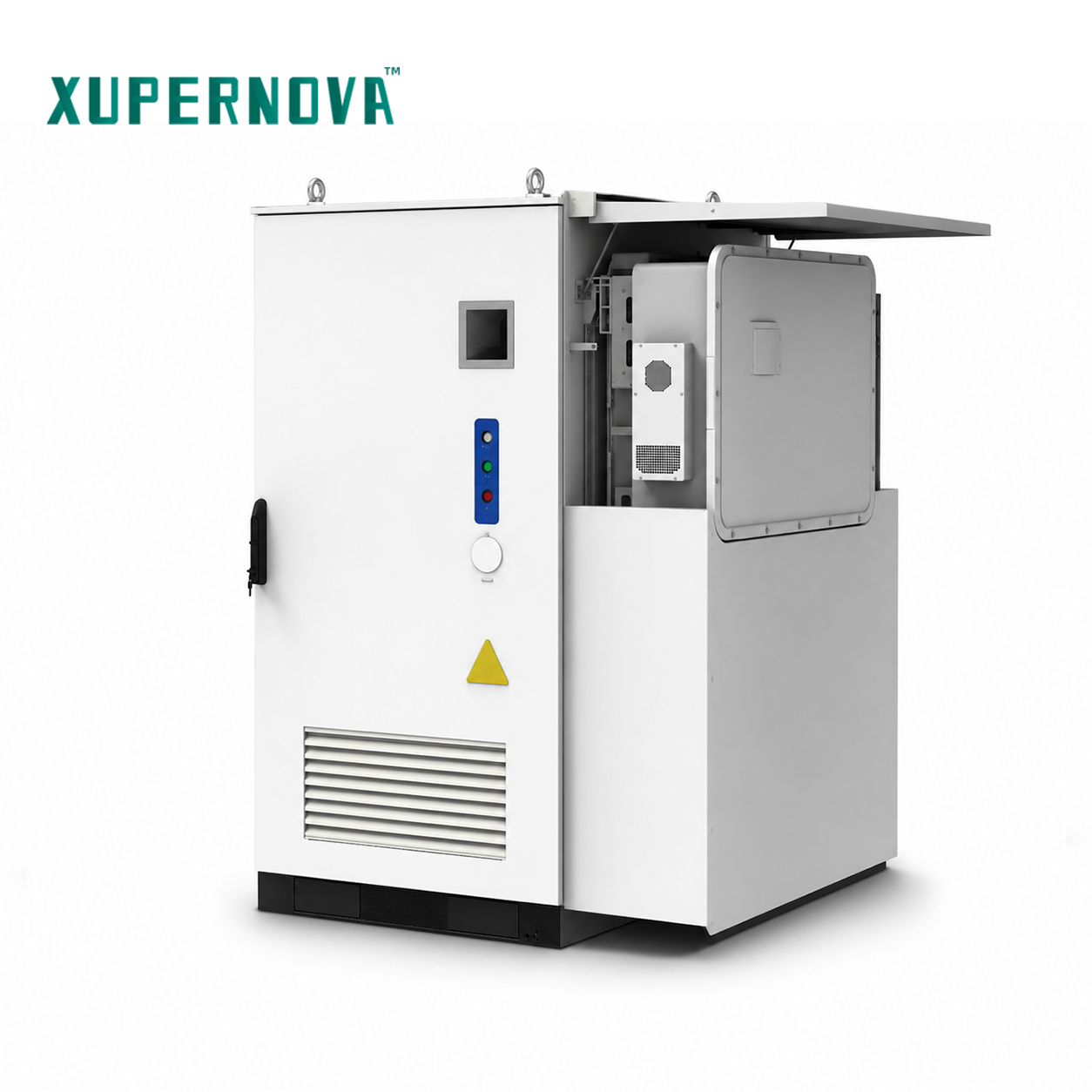
Solar-plus-storage configurations sit at the small end of the platform range, where a single cabinet decision — including its chemistry — is made per site rather than per fleet.
The documentation boundary buyers should note
Certification evidence in the reviewed set names a specific configuration. The battery system certification to IEC 63056:2020 (certificate B 125581 0022 Rev. 01, issued by TÜV SÜD Product Service GmbH, applicable to the global market) applies to model ECO-E261LP-2A, described as a rechargeable Li-ion battery system at DC 832 V and 314 Ah. The EU-market EMC Attestation of Conformity (E8A 125581 0023 Rev. 00, against EN IEC 61000-6-4:2019 and EN IEC 61000-6-2:2019) and LVD Attestation of Conformity (N8A 125581 0024 Rev. 00, against EN 62477-1:2012/A12:2021) cover the ECO-E261LP-2A at 125 kW, 261.248 kWh, IP55. The Italy-market documents — CEI 0-21:2022/V2:2024 under certificate D 125581 0027 Rev. 00 and CEI 0-16:2022/V3:2024 under certificate D 125581 0028 Rev. 00 — are likewise tied to that model.
The procurement reading is straightforward and worth stating explicitly: certification follows configuration. A chemistry substitution is a configuration change, and a buyer should confirm in writing which documents continue to apply, which require re-testing, and who bears the cost and schedule of that re-testing. Treating a certification dossier as chemistry-agnostic is one of the more expensive assumptions available to a project team.
Where Chemistry Choice Meets Project Type
Chemistry optionality is not equally valuable across applications. It tends to matter most where the offtake structure or the financing party has a view on technology risk, and least where the buyer is optimising purely for delivered cost against a well-understood duty cycle.
Commercial and industrial peak shaving and time-of-use arbitrage
The dominant C&I use case remains charging during off-peak tariff periods and discharging during peak periods to reduce maximum demand and electricity costs, managed through 24/7 automated energy management with load-following and demand-limit control. Requirements centre on load-profile assessment, time-of-use tariff structure, grid-connection approval, protection coordination and fire-safety compliance. In this segment, LFP is the well-trodden path and chemistry optionality is usually a secondary consideration weighed against footprint, installation workload and commissioning time. The 125 kW / 261.25 kWh all-in-one cabinet format is the typical building block, and Xupernova documents a reference deployment of 50 such units for a supermarket and retail facility operator over one year, covering peak shaving, time-of-use arbitrage and photovoltaic self-consumption.
Solar-plus-storage and photovoltaic self-consumption
Where the objective is storing excess photovoltaic generation, increasing onsite solar consumption and reducing grid imports, the storage system is coupled to PV generation assessment, export limitation and coordinated PV-battery control. The documented Xupernova solar-plus-storage models pair a 261 kWh liquid-cooled cabinet and a 64.54 kWh air-cooled cabinet with these duties. Chemistry optionality here is often driven less by the site than by the developer's portfolio-level technology strategy.
Utility-scale renewable integration and grid-side storage
For utilities, independent power producers and renewable developers, the storage asset must support renewable energy shifting, peak regulation, frequency support, power smoothing and dispatchable capacity, under centralised plant-level EMS control responding to grid dispatch commands and market signals. Special requirements include grid impact study, local grid-code compliance, protection coordination, dispatch-interface requirements, cybersecurity, fire safety and environmental assessment. This is the segment where chemistry specification carries the most financing weight — and the segment where the absence of published comparative benchmarks is most consequential, because a lender's technical adviser will ask for exactly the data the documents do not contain.
Remote and off-grid microgrids
Mining and remote industrial sites combine weak-grid or off-grid operation, high diesel consumption and large motor-starting loads, requiring microgrid stabilisation, reduced generator runtime and improved reliability through grid-forming control and automatic source scheduling. Site load study, spinning-reserve strategy, high-temperature and dust protection, black-start capability and remote O&M all sit ahead of chemistry in the decision order.
Critical-load resilience and EV charging support
Hospitals, data centres, government facilities and emergency services require maintained supply to selected critical loads, with islanding protection, black-start strategy and emergency response planning defining the specification. EV charging hubs face the opposite profile: high short-duration demand, limited grid capacity and concentrated charging periods, addressed through dynamic power allocation and transformer-capacity assessment. In both, chemistry appears as a downstream consequence of the resilience or capacity requirement, not as the requirement itself.
Market Signals Worth Weighing
Three published data points frame the chemistry discussion for global projects.
Deployment volume is large and growing. Global new battery storage capacity deployment reached 108 GW in 2025, per the IEA's Global Energy Review 2026. In the United States alone, utility-scale battery storage capacity growth is projected to reach 19.6 GW in 2025, according to the U.S. Energy Information Administration's preliminary monthly electric generator inventory.
Cost benchmarks sit at levels that make chemistry substitution harder to justify on capex alone. All-in BESS project capex for long-duration (four-hour-plus) utility-scale projects reached USD 125/kWh in late 2025, according to Ember — a figure that reflects a mature LFP supply chain operating at scale.
Market-size estimates, by contrast, should be handled with care. One commercial research estimate places the global BESS market at USD 50.81 billion in 2025, but published valuations for the same year vary widely across providers, largely because some include battery cells while others count turnkey systems, and some scope utility-scale while others scope C&I. Buyers should treat headline market-size figures as directional context rather than as planning inputs.
Taken together, the signal is that LFP's cost position and installed base are self-reinforcing. A non-LFP specification is therefore not competing on price today; it is competing on supply resilience, regional sourcing preference and lender or offtaker acceptability.
How Flexible-Chemistry Platforms Compare With Single-Chemistry Supply
The comparison that matters to a buyer is not LFP versus solid-state versus sodium-ion on a performance axis — the published evidence does not support that comparison. It is flexible-chemistry platform versus single-chemistry platform on a procurement axis.
| Procurement dimension | Flexible-chemistry platform | Single-chemistry supply |
|---|---|---|
| Documented baseline | LFP stated as standard across the range; alternatives listed as options | One chemistry, typically LFP, fully specified |
| Data availability for the alternative | No comparative performance benchmarks published; validation is project-specific | Not applicable |
| Certification transferability | Documents name a specific model and configuration; substitution requires confirmation | Single configuration, single dossier |
| Supply contingency | Second chemistry route available in principle, gated by validation and availability | Dependent on the single cell supply chain |
| Schedule certainty | Standard BESS 25–35 days; customised projects 35–60 days, with chemistry validation additional | Standard lead time applies throughout |
| Financing narrative | Useful where a lender or offtaker has a technology preference to accommodate | Simpler, but no optionality to offer |
Lead times as published by Xupernova for standard and customised BESS projects; MOQ is documented as 1 unit.
The limitation runs in one direction and should be stated without softening. On the reviewed evidence, a flexible-chemistry platform is not a way to obtain a different chemistry quickly or cheaply. The alternative chemistries are documented as subject to project requirements, technical validation and availability — which means the buyer absorbs validation effort, schedule variance and, in most structures, additional qualification cost, while the platform's actual delivered configuration remains LFP unless and until those gates are cleared. A project that specifies a non-LFP chemistry before securing cell availability and validation sign-off is carrying schedule risk that a single-chemistry procurement would not carry.
The second limitation is evidentiary. Because no chemistry-level performance benchmarks are published in the reviewed set, an independent comparison cannot responsibly rank the three chemistries on cycle life, degradation, thermal behaviour or energy density. Any procurement document that claims otherwise is drawing on data outside the specification, and the buyer should ask to see its source.
A Procurement Sequence for Chemistry Decisions
For evaluation-stage buyers, the sequence that keeps chemistry in proportion looks like this:
- Fix the duty cycle first. Determine required power, energy and duration, then select the C-rate from the documented options (0.5P, 1P or 2P) and cooling mode. These are fully specified today.
- Confirm the baseline. Establish in writing that the quoted configuration uses Grade A LFP cells from BloombergNEF Tier 1 manufacturers, and identify which cell supplier is proposed.
- Qualify the option, not the brochure. Ask which alternative chemistry is genuinely available for the specific model, what validation evidence exists for it, and what the supplier's own acceptance criteria are.
- Map the certification impact. Identify which certificates name the model and configuration, and obtain a written statement on what re-testing a substitution would trigger, at whose cost.
- Price the optionality. Treat chemistry flexibility as an insurance premium with a defined trigger, not as free upside; compare it against the schedule and qualification cost of a single-chemistry route.
- Verify quality control. Xupernova documents 100% factory acceptance testing plus electrical safety, functional and aging tests, with third-party inspection available — an inspection regime that applies to whichever chemistry is delivered.
- Check the service tail. Confirm 24/7 remote support, commissioning, training, diagnostics, spare parts and optional onsite service coverage, and whether the alternative chemistry falls inside the same service envelope.
What to Watch Next
The chemistry question is unlikely to resolve through a single technical breakthrough that displaces LFP across the board. It is more likely to resolve at the edges: specific markets with specific sourcing constraints, specific offtakers with specific technology preferences, and specific projects where the validation burden is small enough relative to the strategic benefit.
Three developments would materially change the procurement calculus. First, publication of chemistry-level performance data by platform suppliers — the missing evidence that currently blocks any quantitative comparison. Second, certification dossiers written to cover multiple cell configurations within one platform, which would remove a substantial fraction of substitution risk. Third, visible cell availability for non-LFP chemistries at project scale, which converts an option into a schedule.
Until then, the defensible buyer position is reasonably simple: specify LFP as the documented baseline, negotiate chemistry flexibility as a contractual option with named gates, and require the supplier to carry the evidence — not the assumption.
FAQ
Does a flexible-chemistry BESS platform perform the same on every chemistry option?
No such claim can be verified from published documentation. The reviewed Xupernova specification set states LFP as the standard cell baseline and lists semi-solid-state, solid-state and sodium-ion as options subject to project requirements, technical validation and availability. It does not publish comparative performance figures for those options, so equivalence across chemistries should not be assumed and must be established through project-level validation.
Which chemistries can actually be specified on Xupernova BESS models?
Across the six published models — XA-V5015-L1, XA-X2170-L2, XA-X1044-L1, XA-C0261-L1, XA-H0261-L1 and XA-H0064-A1 — the documented baseline is Grade A LFP lithium-ion cells from leading BloombergNEF Tier 1 energy-storage cell manufacturers. Semi-solid-state, solid-state and sodium-ion technologies are documented as optional, subject to project requirements, technical validation and availability. The option is conditional rather than catalogue-standard.
Do existing certifications transfer to a non-LFP configuration?
They should not be assumed to. The certification documents in the reviewed set name a specific configuration: IEC 63056:2020 certification B 125581 0022 Rev. 01 covers model ECO-E261LP-2A as a rechargeable Li-ion battery system at DC 832 V / 314 Ah; the EU EMC and LVD attestations and the Italy CEI 0-21 and CEI 0-16 documents are likewise tied to that model. Because certification follows configuration, a chemistry change requires written confirmation of which documents still apply.
How does chemistry choice affect project bankability?
LFP accounted for approximately 90% of global battery storage deployments in 2025, according to the IEA, which means the review experience of lenders, insurers, grid operators and EPC contractors is overwhelmingly concentrated on that chemistry. A non-LFP specification introduces a validation and documentation burden that a lender's technical adviser will expect to see addressed, and it should be treated as a schedule and cost item rather than a neutral substitution.
What electrical and environmental parameters are documented for the platform?
All six published models are documented at IP55 with an operating range of -30°C to 55°C, and all support 0.5P, 1P and 2P C-rates. Rated power and energy vary by format, from 25–50 kW / 64.54 kWh on the air-cooled solar-plus-storage cabinet to 5.015 MWh on the 20-ft liquid-cooled battery container. Cooling mode is liquid on the container and C&I cabinet models and air on the smallest cabinet.
Does specifying a non-standard chemistry change the delivery schedule?
Xupernova documents 25–35 days for standard BESS and 35–60 days for customised projects, with a minimum order quantity of 1 unit. Because alternative chemistries are documented as subject to technical validation and availability, any validation or qualification work sits in addition to those published lead times and should be planned as a separate schedule item.
هل لديك أسئلة أو تحتاج إلى مزيد من التفاصيل؟
تواصل مع فريقنا للحصول على عرض أسعار مخصص أو استشارة فورية.
طلب عرض أسعار
املأ النموذج أدناه وسيتواصل معك فريقنا بعرض مقترح مخصص.
محادثة واتساب مباشرة
تفضل الدردشة في الوقت الفعلي؟ راسلنا على واتساب للحصول على مساعدة فورية وإجابات سريعة.
- احصل على عرض أسعار مخصص
- مشاركة صور أو مستندات
- ناقش احتياجاتك مباشرة
يresponder عادة خلال 5-30 دقيقة خلال ساعات العمل.