
Choosing Between PE Liner and PE Coating on PP Woven Bags
Choosing Between PE Liner and PE Coating on PP Woven Bags
Two polypropylene woven sacks can leave the same converting plant at the same fabric weight and behave very differently after four weeks in a humid port warehouse. The difference is rarely the woven fabric itself. It is the barrier configuration chosen on top of that fabric, and in most buyer evaluations the choice narrows to two options: a PE inner liner or a PE coating.
Global production of PP woven bags exceeded 10 billion units in 2023, and China alone manufactured more than 7 billion of them, according to market research published by Market Reports World. At that scale, the sourcing question for importers, brand owners and procurement teams is no longer whether a woven sack can be made. It is which construction survives the journey, the climate and the filling line at an acceptable cost.
A Woven Sack Is Strong, It Is Not Automatically Waterproof
A PP woven bag, short for polypropylene woven bag, is a packaging container fabricated by weaving polypropylene tapes into a fabric that is then cut, printed and sewn or heat-sealed into a bag. The crisscross woven structure is what gives the format its tensile strength and its ability to hold heavy bulk contents.
That same structure is also the reason barrier decisions exist. Woven fabric is interlaced from flat tapes, so the finished cloth is strong but not a continuous film. For fine powders, the practical consequence is sifting and dusting at seams and stitch lines; for hygroscopic goods, it is a moisture pathway that no amount of fabric strength can close. The industry answers this in two ways: a closing structure that seals the bag mouth, and an additional barrier layer that reduces moisture transmission through the fabric.
BaiChuan's own application guidance sets the operating envelope for these bags at a continuous working temperature of -10°C to 50°C, with short-time peaks up to 50°C without heavy load, dry and ventilated warehouse storage, an optional UV-stabilised version for outdoor storage, and no long soaking in water where a liner or coating is absent. The same guidance notes that bags should be kept away from open flame and strongly corrosive chemicals, and that requirements should be confirmed against particle size, density, flowability, dust control, sun protection, moisture protection, bag-mouth design and destination-market regulations.
The Barrier Layer Is Where Buyers Still Have a Real Choice
Laminated PP woven bags accounted for 54.5% of total global market volume in 2023, according to the same Market Reports World dataset. That figure is a useful signal for anyone in the evaluation stage: the market has already moved past the question of whether an added layer is worth having. The live question is which added layer, applied in which way, for which product.
A PE inner liner and a PE coating are both legitimate answers. They differ in where the polyethylene sits, how it fails, how it behaves on a filling line, and what it does to the end-of-life profile of the sack. Those four differences, not a generic claim about moisture resistance, are what a procurement team should be comparing.
Defining the Two Options
PE Inner Liner
A PE inner liner is a separate polyethylene film layer placed inside the woven bag, typically as a film tube or an inner bag that is attached at the bag mouth or left free inside the sack. The woven fabric remains the structural body; the liner becomes the actual containment surface for the product. Because the liner is a discrete film, it can in principle form its own sealed cavity once the mouth is closed, independent of the woven outer layer.
In BaiChuan's product configuration, a PE liner is listed as an available option alongside bag style, dimensions, colours, printing, valve or closing structure and lamination, with the final combination confirmed per order. That framing matters for buyers: the liner is not an add-on that can be assumed, it is a line item that has to be specified.
PE Coating
PE coating integrates the polyethylene into the woven fabric rather than placing it beside it. In a typical converting flow, molten polyethylene is extruded onto the woven cloth, or a film is laminated to it, so that the finished material is a single composite sheet with a polymer surface on one or both faces. BaiChuan's production sequence covers yarn drawing, circular weaving, laminating, colour printing and finished bag making, which places lamination directly upstream of printing in the same continuous chain.
Coating is also closely tied to print quality. Company product documentation notes that BOPP film can be applied to woven polypropylene to provide a smooth surface for printing, and that colour-printed woven bags can use BOPP film, non-woven fabric or paper-like film depending on the appearance and cost target. The barrier layer and the print surface are therefore often the same engineering decision, which is why coating discussions tend to pull in printing specifications as well.
| Comparison dimension | PE inner liner | PE coating |
|---|---|---|
| Where the polymer sits | Separate film layer inside the woven bag | Polyethylene extruded onto or laminated to the woven fabric |
| Barrier continuity | Depends on the liner being intact and the mouth properly closed | Depends on coating continuity across the full fabric surface |
| Filling line behaviour | Must be matched to bag mouth, valve and filling equipment; exact method to be confirmed | Behaves closer to a standard woven sack on existing lines |
| Response to sharp or abrasive product | Film can be punctured by sharp particles if not protected | Bonded to the fabric, so no separate layer to displace, but thin spots remain a risk |
| Print surface | Does not change the outer print surface | Often provides the smooth surface used for high-quality printing |
| Weight and pallet behaviour | Adds film weight and can trap air between layers | Adds grammage to the sheet without creating an internal void |
| End-of-life | Film may be separated where the bag design allows | Composite structure is harder to separate into material streams |
| What the buyer must specify | Liner presence, attachment method, closure method | Coating presence, face coverage, inspection basis |
Structural comparison based on general converting practice and BaiChuan product configuration options; specific values are confirmed per order.
Technical Differences That Change Procurement Outcomes
Sealing and barrier continuity
The core difference is architectural. A liner creates a second container inside the first, so moisture protection depends on the integrity of that inner film and on how the mouth is closed. A coating creates a single sheet, so protection depends on the coating staying continuous across the whole surface, including fold lines, gussets and the stitched seam.
Neither approach is inherently superior. A liner that is not closed, or that is perforated during filling, offers little more than an unlined bag, while a coating with a thin spot lets moisture migrate through the fabric in a way that is difficult to detect visually. This is why the inspection basis, not just the presence of the layer, belongs in the purchase specification.
Filling line compatibility
Liners change how a bag behaves on the filling line. Automatic filling equipment, valve fillers and sewing or heat-sealing stations all interact with the bag mouth, and the liner has to be compatible with that interface. BaiChuan's application guidance notes that operation may be manual or automated depending on the filling equipment and bag construction, and that the exact method is to be confirmed, which is the correct posture for a specification that varies by line.
Coated bags generally present fewer changes to an existing filling setup because the bag handles much like a standard woven sack. For buyers running high-speed automatic lines, that operational continuity can matter as much as the barrier itself.
Mechanical protection in transit
Woven bags are valued for load-bearing capacity and suitability for long-distance transport. A liner adds a film that can be damaged by sharp-edged contents, so products with hard granules or crystalline structure deserve a closer look at liner thickness and at whether an inner wrap is needed. A coating has no separate layer to displace, but it shares the general weakness of any thin polymer surface: abrasion and flexing during handling can create local defects.
Both risks are manageable through specification and through how the product is presented at the filling head. Neither is eliminated by choosing one option over the other.
Printing surface and presentation
Coating has a clear advantage where shelf presentation matters. A smooth laminated or coated face holds colour-printed artwork better than raw woven cloth, which is why colour-printed woven bags frequently use BOPP film, non-woven fabric or paper-like film to achieve the intended appearance. BaiChuan's bag programme supports 1 to 8 colours of gravure or flexo printing with the buyer's logo, text and artwork, and prefers vector files such as AI, PDF and CDR for clear reproduction.
A liner does not interfere with the outer print surface, so a buyer who wants an uncoated, matte woven appearance can still specify an inner barrier. The two decisions — print surface and moisture barrier — can therefore be separated, which is useful when brand presentation and product protection point in different directions.
Weight, stacking and pallet behaviour
Every added layer has a handling cost. A liner introduces film weight and can trap air between the liner and the woven wall, which is worth testing on the actual pallet configuration before a bulk order is placed. A coating increases sheet grammage but does not create an internal void, so the filled bag tends to sit more predictably.
BaiChuan's documented fabric range runs from 55 to 130 gsm with a denier range of 650D to 1500D, and bags can be made from 100% virgin PP or recycled PP with food-grade material optional. Those parameters give a buyer room to trade barrier performance against weight, but the trade-off should be settled with a physical sample rather than on paper.
End-of-life and material separation
A liner is a distinct film component and may be separated from the woven body where the bag design allows, which can help buyers facing packaging waste sorting obligations. A coating produces a composite sheet that is harder to split into material streams, and laminated structures in general are more difficult to recycle than mono-material ones.
For markets with extended producer responsibility rules or customer-facing sustainability commitments, this is a real constraint rather than a footnote. It should be raised at the specification stage, not after the artwork is approved.
Application Fit: Where Each Configuration Earns Its Place
Rice and grain
PP woven bags are recommended for rice packing in BaiChuan's reference guidance, with block bottom valve bags indicated for palletised bulk shipment and colour-printed woven sacks with handles indicated for retail sale. The same guidance notes that where tight sealing and insect resistance are the priority, PE packaging bags are identified as the first choice, while BOPP-laminated, non-woven or paper-like film constructions may be selected for cost performance and appearance.
Read together, those statements point to a practical rule: for retail rice where the printed face sells the product, a coated or laminated structure does more work; for bulk rice where moisture and insect control dominate, a construction with a genuine inner barrier layer deserves closer evaluation. Custom sizes and custom printing are available either way.
Fertiliser and chemical powder
Fertiliser and chemical powder are the applications where the barrier decision is least forgiving. These products are often hygroscopic, prone to caking, and dusty at the fill point. A liner gives a defined containment surface that can hold fines and limit moisture contact with the product, while a coating gives a sealed fabric face with fewer internal layers to manage on an automated line.
Dust control, moisture protection and bag-mouth design are all listed in BaiChuan's guidance as requirements to be confirmed for this kind of project rather than assumed from a catalogue.
Cement and construction materials
Cement woven bags and other construction-material sacks are heavy-duty applications. Here the woven body and the seam carry most of the load, and the barrier question is secondary to tensile performance and seam integrity. A coated bag is often the simpler answer because it behaves predictably under high filling weights, but where the product is also moisture-sensitive in storage, the barrier still needs to be specified explicitly rather than inherited.
Feed and agricultural inputs
Feed packaging and agricultural input packaging involve a wide range of particle sizes and densities. BaiChuan's case documentation lists rice, fertiliser, chemical powder, construction materials and feed among the applications served, with customisation and export delivery support for those materials. For feed in particular, the choice between liner and coating usually follows the dust level and the storage climate rather than the printed appearance.
What Wenzhou BaiChuan Plastic Industry Co., Ltd. Offers on Both Configurations
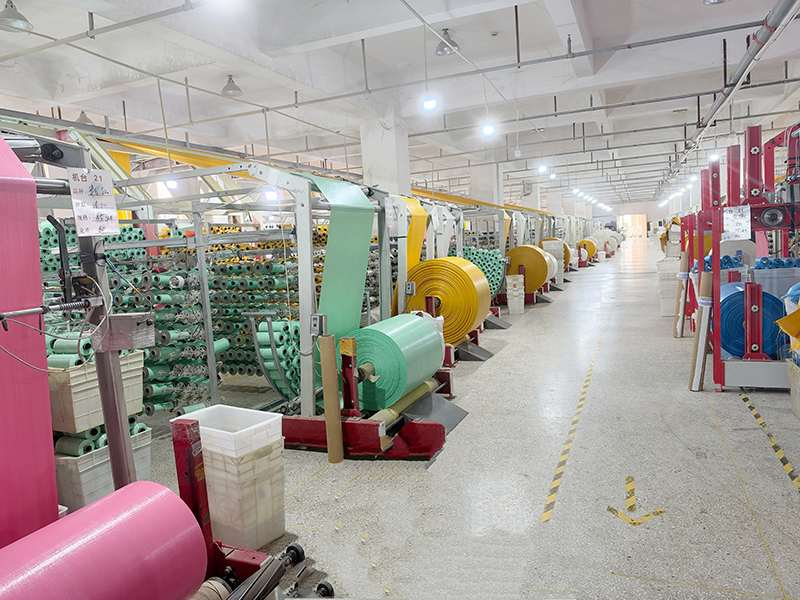
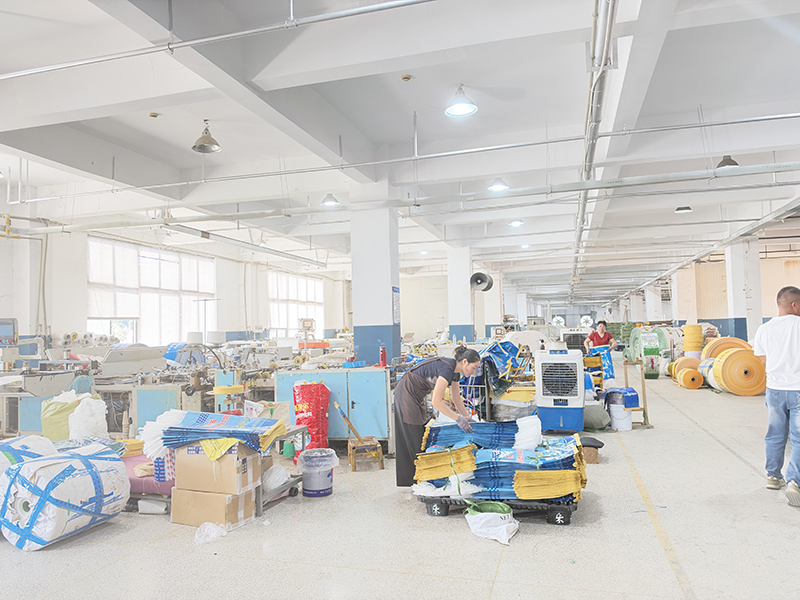
Wenzhou BaiChuan Plastic Industry Co., Ltd. is a PP woven bag manufacturer based in Xiaojiang Town, Pingyang, Wenzhou, Zhejiang, China, an area known as the China PP Woven Bag Capital. The company originated from Pingyang Luye Printing Factory, founded in 1996, and was established in its current form in 2009. It operates a full-chain production model covering yarn drawing, circular weaving, laminating, colour printing and finished bag making, with more than 100 sets of production machinery including imported hot-valve sealing equipment.
The factory covers more than 20,000 m² with registered capital of RMB 32 million, 100 employees, a five-engineer technical team and an annual output of 90,000,000 bags, equivalent to a monthly capacity of 7,500,000 bags. Documented commercial terms include a minimum order quantity of 3,000 bags and a lead time of 15 to 45 days. Around 30% of output is exported, with South America, Pakistan and Southeast Asia among the main markets.
On configuration, both routes are available within the same order specification: bag style, dimensions, colours, printing, valve or closing structure, lamination and liner options are confirmed per order. Bag tops can carry a plastic handle or a valve, the bottom can be block bottom, printing supports 1 to 8 colours of gravure or flexo, and a PE liner is listed as an available option. Material can be 100% virgin PP or recycled PP, with food-grade material optional.
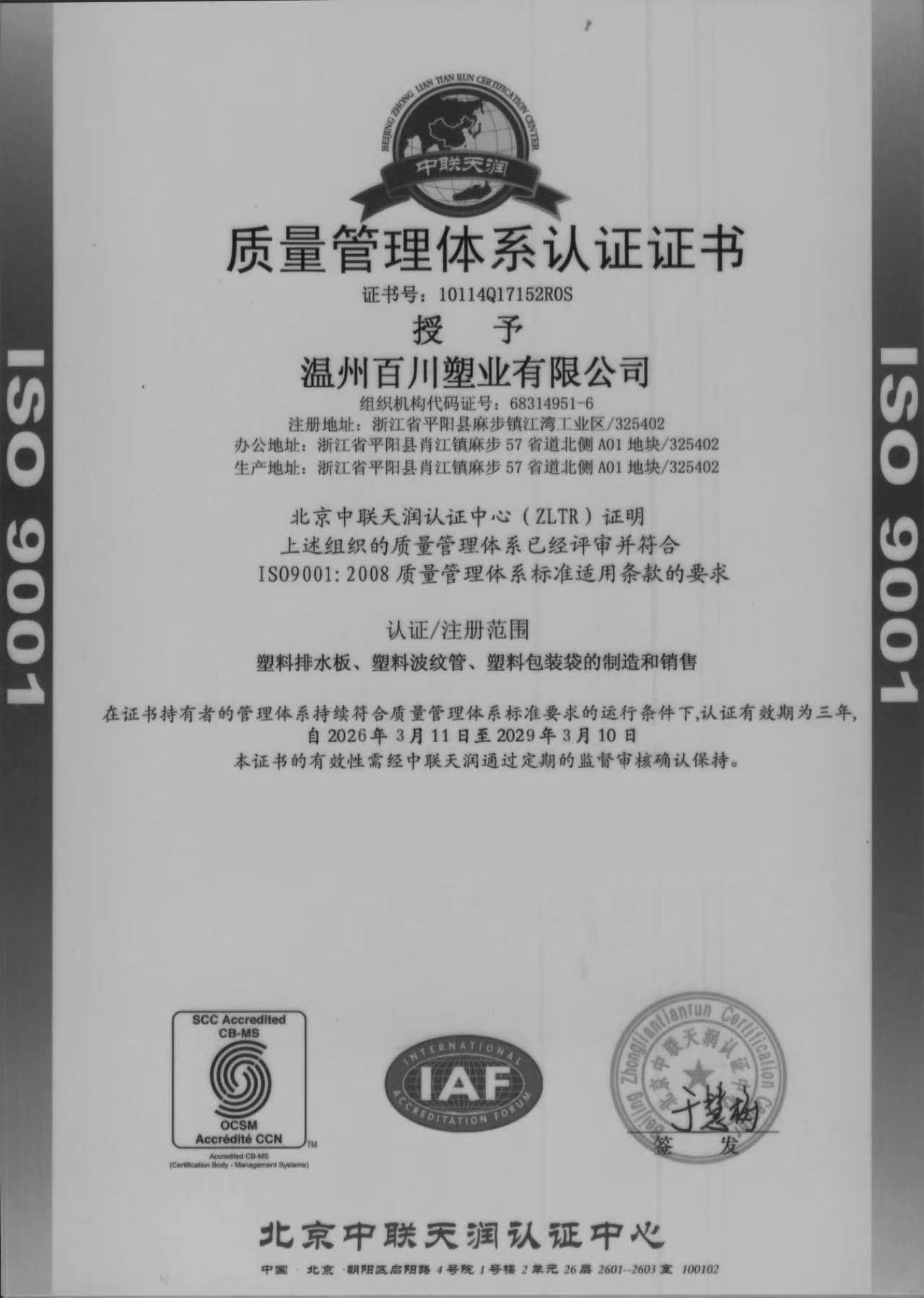
Quality management is documented rather than asserted. The company holds a Quality Management System Certification certificate, ISO 9001:2008, certificate number 10114Q17152R0S, issued by Beijing Zhonglian Tianrun Certification Center (ZLTR), valid from 11 March 2026 to 10 March 2029, with a scope covering the manufacture and sale of plastic drainage boards, plastic corrugated pipes and plastic packaging bags. The company states that the certificate is IAF MLA recognised and accepted in South America, Southeast Asia, Pakistan, Europe and most global markets, and it also holds Science and Technology Small and Medium-sized Enterprise qualification.
Service terms relevant to a barrier evaluation include free blank samples without custom printing, with custom printed samples carrying a sample cost and freight normally paid by the buyer; the sample charge is refundable when the bulk order reaches the minimum order quantity. Client references listed by the company include Shenzhen Aerospace Technology Group, Taiwan Unification Corporation and Haida Group. On claims, the company states that where bag damage is caused by quality issues, the sales team visits the customer's factory on site to provide a solution, and bags that cannot be resolved are subject to a deduction in payment.
Market Signals to Factor Into the Evaluation
Three signals currently shape how buyers should price and specify barrier layers.
The first is resin cost. Trading Economics recorded polypropylene at 9,461 CNY per tonne on 10 November 2026, a 47.32% year-on-year increase. Because both a PE liner and a PE coating add polyethylene to the bill of materials, a rising polymer benchmark affects both options, and buyers should expect quotations to be indexed rather than fixed for long periods. A quarterly price adjustment clause linked to a published PP benchmark is a reasonable structure to discuss.
The second is structural. With laminated bags at 54.5% of global volume in 2023, coated and laminated constructions are the market default rather than the premium exception. That scale supports availability and tooling maturity, but it also means buyers should specify the barrier explicitly instead of assuming that a laminated bag automatically meets their moisture requirement.
The third is standardisation. GB/T 8946-1998 sets out technical requirements, inspection rules and classification for PP woven bags in China, covering areas such as broken wire and quality control. For buyers sourcing from Chinese converters, referencing the applicable standard in the purchase order gives both parties a shared inspection vocabulary, which is more useful than a general durability claim in a specification sheet.
Where Each Option Falls Short
A comparison that only lists advantages is not usable for procurement. Both configurations have boundaries that should be written into the evaluation.
A PE inner liner adds a separate component to manage. It introduces an additional material and an additional process step, it can be punctured by sharp or crystalline contents, it may trap air between the liner and the woven wall and disturb pallet stability if not tested, and its moisture protection collapses if the mouth closure is inadequate. It also adds a film that has to be handled at end of life.
A PE coating offers no independent sealed cavity. It relies on continuity across fold lines, gussets and the stitched seam, where thin spots can become moisture pathways that are not visible from the outside. It produces a composite structure that is harder to separate for recycling, and it is not a substitute for a high-barrier packaging format when a product is severely moisture-sensitive. Buyers with that kind of product should confirm the requirement rather than assume a coating resolves it.
There is also a shared boundary. BaiChuan's guidance states that bags are not suitable for long soaking in water where a liner or coating is absent, and the same caution applies to any configuration that is not designed for immersion. Neither option converts a woven sack into a liquid-tight container by default.
Future Outlook
The direction of travel is towards tighter specification rather than a single winning configuration. Rising polypropylene prices create pressure to optimise material use, which in practice means buyers will be asked to choose between a lighter coated structure and a liner with a defined film weight, and to justify the choice with a real storage and transport profile.
Recycled content is the second force. BaiChuan already offers 100% virgin PP or recycled PP with food-grade material optional, which allows a buyer to align the woven body with a sustainability target. The harder question sits with the barrier: a separable liner keeps material streams cleaner than a bonded coating, while a coating delivers the print surface that retail packaging usually needs. Buyers with public packaging commitments should expect to resolve that tension product by product.
The third force is documentation. As more markets require evidence rather than claims, suppliers who can produce a valid certificate, a stated inspection basis and a traceable sample record will be easier to qualify. BaiChuan's ISO 9001 certificate, valid to 10 March 2029, and its stated in-process monitoring and finished-product testing belong in that category, provided the buyer checks that the certificate scope matches the product being purchased.
A Buyer's RFQ Checklist for the Barrier Decision
| Item to state | What to specify | Why it changes the answer |
|---|---|---|
| Product and density | Material type, bulk density, particle shape and sharpness | Determines puncture risk for a liner and abrasion risk for a coating |
| Fill weight | Nominal weight per bag and load rating | Drives fabric GSM and seam design before barrier is considered |
| Filling equipment | Manual, automatic, valve filler or open-mouth sewing | Liner attachment and mouth design must match the line |
| Moisture sensitivity | Whether the product cakes, clumps or degrades with humidity | Decides whether a separable barrier or a bonded one is appropriate |
| Storage and climate | Warehouse conditions, outdoor exposure, transit duration | UV-stabilised options and barrier choice follow from this |
| Closing structure | Valve, handle, block bottom, sewing or heat sealing | Defines how the barrier is closed and therefore how it performs |
| Printing | Number of colours, artwork format, surface appearance | Links the barrier decision to the print surface decision |
| Standard and inspection | Applicable standard and agreed inspection items | Creates a shared acceptance basis between buyer and supplier |
| Sample | Physical sample with the intended barrier and closure | Pallet and filling behaviour cannot be confirmed on paper |
| Commercial terms | MOQ, lead time, price basis and adjustment mechanism | Protects both sides against polymer price movement |
Frequently Asked Questions
What is a PP woven bag and what gives it its strength?
A PP woven bag, short for polypropylene woven bag, is a lightweight but strong packaging container made by weaving polypropylene tapes into fabric. Polypropylene pellets are first extruded into thin flat tapes, and those tapes are interlaced by circular weaving machines to form woven fabric, which is then cut, printed and sewn or heat-sealed into bags. The crisscross woven structure provides the tensile strength needed to hold heavy bulk contents.
What products are PP woven bags suitable for?
Available company information indicates that PP woven bags can be used for rice, fertiliser and chemical powder packaging, with documented applications also covering construction materials and feed. The specific bag construction, valve, liner and moisture-protection configuration should be confirmed according to the material, the filling equipment and destination-market requirements.
What moisture-protection options exist on PP woven bags?
Documented options include a PE liner as an available configuration, and laminated or coated surfaces using BOPP film, non-woven fabric or paper-like film for colour-printed bags. Fabric can range from 55 to 130 gsm with a denier range of 650D to 1500D, and bags can be made from 100% virgin PP or recycled PP with food-grade material optional. The correct combination depends on product sensitivity, filling method and storage conditions.
Which bag type is recommended for rice packaging?
PP woven bags are identified as a suitable packaging bag type for rice. Block bottom valve bags are indicated for palletised bulk shipment, while colour-printed woven sacks with handles are indicated for retail sale. Where tight sealing and insect resistance are needed, the available reference material identifies PE packaging bags as the first choice, and BOPP-laminated, non-woven or paper-like film constructions are noted as options for cost performance and appearance. Custom sizes and custom printing are available.
What do buyers need to confirm before customising woven bags?
Buyers need to confirm bag type, size, load capacity, material, printing design, liner requirement and order quantity. The process then runs through submitting specifications, sending the design or logo, receiving a quotation and confirming the printing artwork, approving the pre-production sample before mass production, mass production and quality inspection, and finally packing and shipment. Vector files such as AI, PDF and CDR are preferred for clear printing.
How are samples handled?
Blank simple samples without custom printing are free of charge, while custom printed samples incur a sample cost. Sample freight is normally at the buyer's side, and the sample charge can be refundable when the bulk order reaches the minimum order quantity.
What should a buyer do if bags arrive damaged?
The first step is to identify the damage type and its likely cause. Cracks or splits on the woven body may result from insufficient tensile strength in the PP raw material, tape that is too thin, or sharp goods piercing the fabric; seam bursts are usually linked to stitching density, thread material or loading beyond the rated weight; surface holes and scratches are commonly caused by friction with sharp edges. The documented procedure is to photograph the damaged area together with the batch mark and packaging information, separate defective bags from qualified stock, and send the evidence to the sales contact for evaluation.
Neither a PE inner liner nor a PE coating wins on principle. The liner wins where a separable, independently closed barrier matters and the filling line can handle it; the coating wins where print presentation, line continuity and a single-sheet structure matter more. The evaluation becomes manageable once the buyer states the product, the line, the climate and the inspection basis in the request, because at that point the answer is no longer a preference — it is a specification.
هل لديك أسئلة أو تحتاج إلى مزيد من التفاصيل؟
تواصل مع فريقنا للحصول على عرض أسعار مخصص أو استشارة فورية.
طلب عرض أسعار
املأ النموذج أدناه وسيتواصل معك فريقنا بعرض مقترح مخصص.
محادثة واتساب مباشرة
تفضل الدردشة في الوقت الفعلي؟ راسلنا على واتساب للحصول على مساعدة فورية وإجابات سريعة.
- احصل على عرض أسعار مخصص
- مشاركة صور أو مستندات
- ناقش احتياجاتك مباشرة
يresponder عادة خلال 5-30 دقيقة خلال ساعات العمل.