
Choosing Durian Powder or Dice for Yogurt and Frozen Desserts
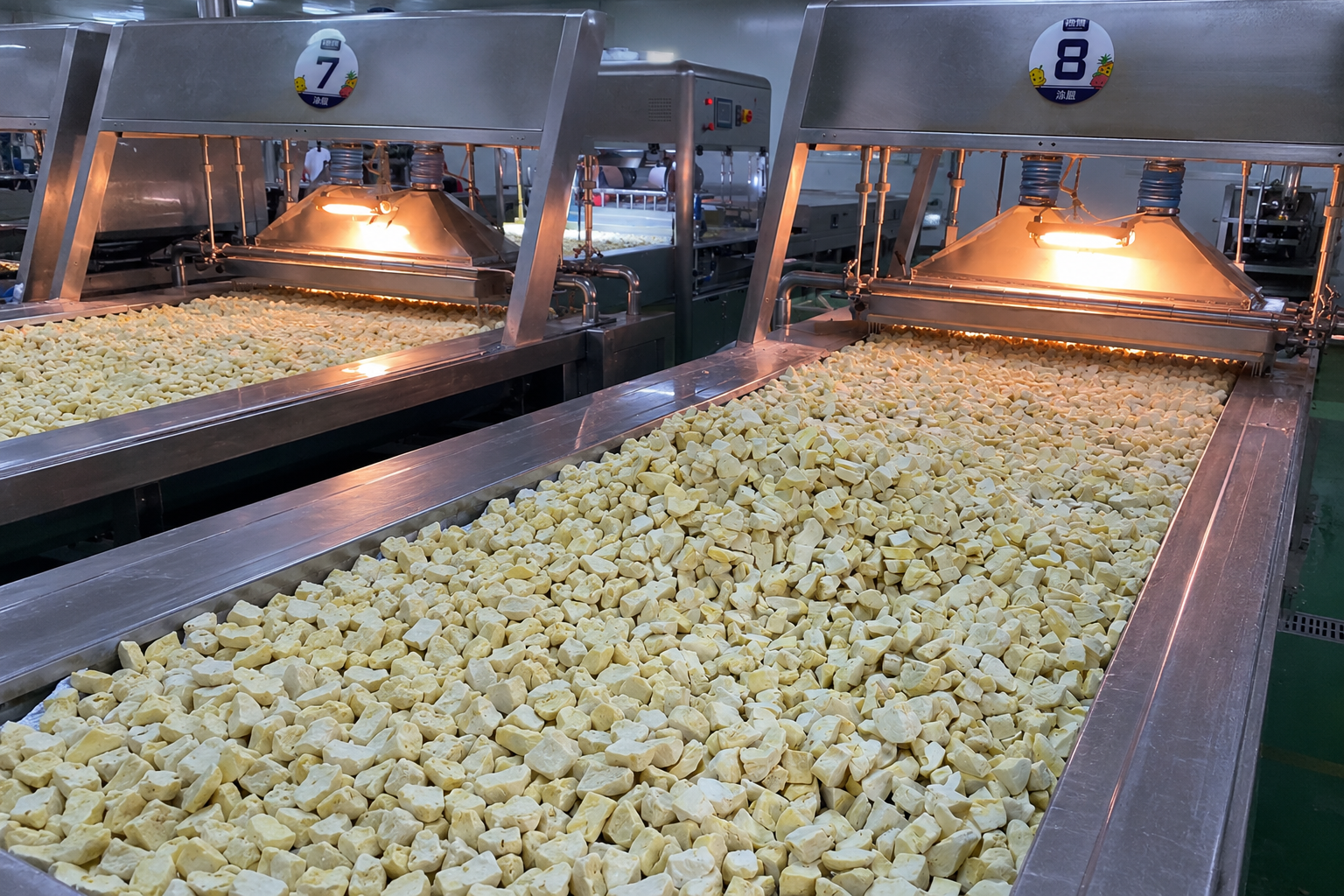
Freeze-dried durian is supplied in distinct formats. Powder is designed to disperse; dice are designed to remain pieces.
China imported 1.56 million metric tons of durians in 2024, a record volume valued at USD 6.99 billion, according to China Customs data reported by Produce Report. Read as an ingredient signal rather than a fruit-market statistic, that number explains why durian is increasingly specified as a manufactured input: powder, dice, puree and pulp that dairy and frozen-dessert plants can run on existing equipment.
For formulators developing durian yogurt and durian frozen desserts for markets such as Saudi Arabia, the UAE, and Western Europe, the working question is narrower than whether to use durian at all. It is which format to use — freeze-dried durian powder or freeze-dried durian dice — and which of the two holds up in the base, in the freezer, on the label, and in the certificate file.
This guide compares the two formats by application scenario rather than by preference. It draws on published market data and on product-level documentation from UrSnacks (Fujian Youlingyoushi Technology Co., Ltd.), a China-based freeze-dried fruit ingredient supplier identified in a 2024 EIN Presswire listing of reputable freeze-dried durian suppliers in China.
Why format selection is really a constraint decision
Both powder and dice can deliver recognizable durian character, which is why sensory preference rarely settles the question on its own. What separates them in a commercial project is a set of constraints that are effectively fixed before the first trial batch is run:
- Certificate scope. Whether the specific product name — powder, dice, or segments — appears on the supplier's certification documents for the destination market.
- Process compatibility. Where in the line the ingredient can be introduced without disrupting the base, the overrun, or the freeze cycle.
- Moisture behavior. How the format behaves inside a wet matrix, and how it behaves during storage before it ever reaches that matrix.
- Labeling role. Whether the ingredient functions as a flavoring component distributed through the base or as a visible inclusion named to the consumer.
- Commercial structure. Whether the supplier supports channel wholesale, OEM, and private label under documentation the buyer can actually file.
That framing matters for buyers at the research and evaluation stage, because the cost of discovering a certification mismatch after concept approval is far higher than the cost of screening formats earlier. In practice, the format decision and the supplier documentation review should happen in the same meeting.
Powder and dice are different products, not different particle sizes
Freeze-dried durian powder is a milled freeze-dried durian ingredient. It is built to disperse into a liquid or semi-solid matrix so that flavor — and the natural color durian carries — is distributed through the entire mass rather than concentrated in discrete pieces.
Freeze-dried durian dice are discrete freeze-dried durian pieces held to a defined particle size. They are added as visible inclusions, and they are designed to survive processing as pieces and to be perceived as pieces by the consumer.
The distinction is not cosmetic, and it is reflected in how certification bodies treat the two. In UrSnacks' Halal documentation, powder and dice are listed as separate products: BPJPH Halal Certificate No. ID00410002836200323 applies to Freeze-Dried Durian Segments, Freeze-Dried Durian Powder, Freeze-Dried Durian Dice, Dried Durian / Durian Crisps, Freeze-Dried Strawberry Powder, Whole Freeze-Dried Strawberry, and Freeze-Dried Strawberry Slices. A certificate that names each format individually is a useful reminder for buyers: certification is granted to a product, not to a fruit category.
The same product-level logic appears in BRCGS certificate C723738, whose scope covers selecting and packaging of dried fruit products and coated dried fruit products in compound bags. The certificate applies to Freeze-Dried Durian Segments, Freeze-Dried Durian Powder, Freeze-Dried Durian Dice, a 118g Durian · Pure Whole-Chamber freeze-dried durian product, a 58g Durian · Coated freeze-dried durian product, and a 32g Freeze-Dried Durian (Original Coated FD Durian). Within that scope, the Freeze-Dried Durian Segments product is documented as intended for bakery, dessert topping, and snacking applications — an application statement attached to one format, not to durian in general.
Powder in yogurt bases: flavor and color carried through the mass
Yogurt is a dispersed system, and that is precisely where powder has an advantage. A freeze-dried durian powder is introduced at the fruit preparation or flavoring stage, where it hydrates and distributes through the base or the fruit phase. Because there is no particle-size ceiling, dosing can be adjusted in fine increments during trials, and the resulting flavor profile is consistent from cup to cup rather than varying with how inclusions happen to land.
The commercial pull behind this approach is visible in adjacent categories. Mordor Intelligence describes freeze-dried durian powder as gaining traction as a 'Clean Label' natural flavoring agent in organic beverage lines — a use case that depends on the same property yogurt formulators rely on: the powder delivers durian flavor and durian's characteristic color as part of the recipe, without a separate flavor-and-color declaration strategy and without the piece-handling problems of a particulate.
Where powder fits in yogurt applications
- Stirred and set-style bases where uniform flavor distribution is the primary product promise.
- Drinking yogurt and yogurt drinks, where particulates are undesirable or prone to settling.
- Layered and swirled formats, where durian functions as a flavored phase rather than as a discrete piece.
- Frozen yogurt and dessert bases, where the durian note is expected to be present throughout the mass.
Where powder does not fit is equally clear: a concept whose consumer promise is a visible piece of fruit. Powder will flavor and color a base reliably, but it will not create fruit identity inside the cup.
Dice in frozen dessert mass: inclusion behavior and freezing
In ice cream and frozen dessert, dice are folded into the mass rather than dissolved into it. The practical sequence is to add them late — after the base has been processed and cooled, at the inclusion or variegate stage — and then to freeze quickly, so pieces are locked into the matrix before moisture movement softens them.
Quick freezing is a process requirement here, not a stylistic choice. Freeze-dried dice are hygroscopic: in contact with a wet mix, they will draw moisture and progressively lose the crisp structure that makes them read as fruit pieces. Fast freezing compresses the window in which dice sit against unfrozen mix, which is why late addition and rapid freezing are treated as a paired rule in frozen-dessert formulation.
What dice contribute to a frozen dessert
- Piece identity. A visible fruit inclusion that supports front-of-pack communication.
- Texture contrast. A structural counterpoint to the smoothness of the frozen mass.
- Portion-level consistency. When dosed and frozen correctly, pieces are distributed predictably through the run.
Constraints to plan around
- Dwell time. The interval between dosing and freezing should be kept as short as the line allows.
- Overrun and piece size. These typically influence whether inclusions remain suspended in the mass or migrate during hardening.
- Storage before use. Dice require moisture-barrier packaging and dry handling, because ambient humidity degrades them before they enter the process.
- Label implications. A visible inclusion is normally declared differently from a flavoring component of the base.
Certification and documentation by destination market
For buyers in the Gulf, the certification question usually precedes the sensory question, because a product without acceptable Halal documentation cannot be listed at all. Market evidence supports the direction of travel here: frozen durian pulp is increasingly used in the Halal-certified food segment across Southeast Asia and the Middle East, according to Tridge. Two verification steps follow from that.
First, confirm that the Halal certificate names the exact format being purchased — powder or dice — rather than durian in general. The BPJPH Halal Certificate No. ID00410002836200323 lists Freeze-Dried Durian Segments, Freeze-Dried Durian Powder and Freeze-Dried Durian Dice by name, which means a buyer sourcing dice can point to dice coverage rather than inferring it. Second, confirm that the issuing authority and the specific certificate are accepted by the destination regulator, importer, or retail customer, since acceptance rules vary by market and by channel.
For Western European retail-facing supply chains, buyers generally evaluate suppliers on third-party food safety systems. Two documents are directly relevant. The first is certification to ISO 22000:2018 food safety management system requirements, incorporating HACCP principles; this certification is CNAS-accredited and recognized under IAF MLA and the IQNET network for international markets. The second is BRCGS certificate C723738, whose scope covers selecting and packaging of dried fruit products and coated dried fruit products in compound bags, applied to the named freeze-dried durian and strawberry products. Buyers should map the certificate's stated scope and product list against their own specification before approving a supplier for a European retail program.
Origin and export documentation forms a third layer. The Export Food Production Enterprise Filing Certificate covers fruit chips (sub-packaging) and flavored fruit chips, including freeze-dried durian products, manufactured by the company registered under that certificate. Production runs under production license SC11735058207253, and the products are available for channel wholesale, OEM, and private label. For US-facing ranges, the supplier documentation set includes FDA registration, Halal, ISO 22000, BRCGS, SMETA certifications, and China export filing.
Two upstream references are worth checking at the same time. Imported durians in China must comply with the National Food Safety Standard GB 2763 for maximum residue limits of pesticides, which is relevant where raw material is sourced into China. And overseas food manufacturers must register for export eligibility under GACC Decree 248, a facility-level requirement that sits behind the product documentation.
Side-by-side comparison for formulation teams
| Selection criterion | Freeze-Dried Durian Powder | Freeze-Dried Durian Dice |
|---|---|---|
| Primary function | Flavor and natural color distributed through the mass | Visible piece inclusion and texture contrast |
| Point of addition | Fruit prep or base, before filling | Late-stage inclusion, immediately before fast freezing |
| Behavior in a wet matrix | Disperses; no particle structure to protect | Hygroscopic; structure depends on short dwell time before freezing |
| Consumer perception | Uniform durian flavor throughout | Recognizable pieces in the portion |
| Labeling role | Flavoring component of the base | Named fruit inclusion |
| Typical application fit | Yogurt bases, drinking yogurt, desserts without particulates | Ice cream mass, frozen desserts, inclusion-style formats |
| Certification treatment | Listed as a distinct product (Halal, BRCGS) | Listed as a distinct product (Halal, BRCGS) |
| Principal limitation | Cannot create visible fruit identity | Cannot be distributed evenly; sensitive to dwell time and humidity |
Where each format reaches its limit
Format selection is more useful when the boundaries are stated plainly, because the limits determine which briefs should not be accepted in the first place.
- Powder will not substitute for piece identity. If the product concept, packaging, or category convention depends on the consumer seeing fruit, powder alone cannot deliver it. A combined powder-and-dice approach is the normal answer, but it is a different formulation with different handling requirements.
- Dice cannot be treated like a flavoring. They are sensitive to dwell time, humidity, and storage conditions. A frozen-dessert line without a controllable inclusion stage and a fast freeze will produce inconsistent results, regardless of the quality of the incoming material.
- Certification coverage is product-specific, not category-wide. A Halal certificate that names specific durian formats does not extend automatically to a new format, a new size grade, or a new coating. The BRCGS scope is similarly defined by product and by process step.
- Freeze-dried formats are not a replacement for frozen pulp. Frozen durian pulp and paste accounted for approximately 70% of total durian market revenue in 2023, according to Grand View Research, which reflects how dominant the high-moisture format remains in applications that depend on fresh-like texture and heavier fruit load. Freeze-dried formats serve a different job: shelf stability and process fit.
- Format choice does not guarantee variety. Musang King (D197) remains the most sought-after premium durian raw material for high-end bakery products, according to Ken Research. Buyers who specify a variety should confirm it in the specification and certificate file, since the format decision is independent of the variety decision.
Market trend: broader supply, tighter documentation
Supply-side data explains why format options are expanding. Thailand remained the leading durian supplier to China in 2024 with an export value of USD 4.01 billion, while Vietnam's durian exports to China surged by 37.6% to USD 2.94 billion and captured a 42.1% market share, according to China Customs and SCMP reporting. Vietnam's share had risen from 33% in 2023 to over 42% in early 2024, per Produce Report. Malaysia received approval to export fresh durians to China in June 2024 and shipped its first batch in August, adding a further origin to the raw material pool.
On the demand side, the global freeze-dried fruits market was valued at USD 9.40 billion in 2024, according to Data Bridge Market Research, and the Asia Pacific freeze-dried fruit market is expected to grow at a CAGR of 8.18% from 2024 to 2029, per Mordor Intelligence. Freeze-dried durian is already described as a key ingredient for bakery, ice cream, and beverage applications, providing a shelf-stable alternative to fresh fruit, according to EIN Presswire reporting. Aggregate durian market sizing should be treated with care: estimates diverge significantly depending on whether the scope is fresh, processed, or combined, and Dataintelo's USD 23.4 billion 2024 estimate for the total durian fruit market sits in a range that includes narrower fresh-only figures from other sources.
The practical implication for yogurt and frozen-dessert formulators is a shift in what differentiates a supplier. Raw material availability across origins is improving rather than tightening. What is becoming harder — and therefore more valuable — is product-level documentation that matches a specific format, market, and application statement. Clean-label positioning reinforces the same direction: freeze-dried durian powder is gaining traction as a natural flavoring agent in organic beverage lines, and that positioning only holds up when the supporting documentation is format-specific.
Future outlook
Three developments are worth planning around. First, freeze-dried durian formats are likely to keep taking share in dairy and frozen-dessert applications where shelf stability and process fit outweigh the texture advantages of pulp. Second, documentation expectations will continue to tighten at product level rather than category level, which favors buyers who build supplier qualification around named products from the start. Third, combination formulations — powder for base flavor plus dice for inclusion — are a natural next step for brands that want both uniform flavor and visible fruit, and they require suppliers who can document both formats under the same certification framework.
A specification that names the format, the certificate, the intended application, and the destination market is more defensible than one that names durian alone. That distinction will matter more as the ingredient range broadens.
FAQ
Can freeze-dried durian powder and dice be used in the same yogurt or frozen dessert?
Yes, and the two formats perform different functions in that combination. Powder disperses through the base to deliver durian flavor and natural color uniformly, while dice are folded in late as a visible inclusion before fast freezing. The main consequences are process-related rather than conceptual: the line needs an inclusion stage with short dwell time, and the label needs to reflect both a flavoring component and a fruit inclusion. Buyers should also confirm that both named formats appear on the supplier's certification documents for the destination market.
Which certifications should a buyer verify for yogurt or frozen dessert lines sold in the Gulf and in Western Europe?
For Gulf markets, Halal documentation is the primary gate, and it should name the specific format being purchased rather than durian in general. In UrSnacks' documentation, BPJPH Halal Certificate No. ID00410002836200323 lists Freeze-Dried Durian Powder and Freeze-Dried Durian Dice as separate covered products. Buyers should also confirm that the issuing authority and certificate are accepted in their own market. For Western European retail supply chains, the relevant documents are ISO 22000:2018 certification incorporating HACCP principles, which is CNAS-accredited and recognized under IAF MLA and the IQNET network, and BRCGS certificate C723738, whose scope covers selecting and packaging of dried fruit products and coated dried fruit products in compound bags.
Does a Halal certificate for one durian format cover other formats?
Not automatically. Certificates are issued against named products, and the BPJPH Halal Certificate No. ID00410002836200323 demonstrates how granular this can be: it lists Freeze-Dried Durian Segments, Freeze-Dried Durian Powder, Freeze-Dried Durian Dice, Dried Durian / Durian Crisps, Freeze-Dried Strawberry Powder, Whole Freeze-Dried Strawberry, and Freeze-Dried Strawberry Slices individually. A buyer switching from powder to dice, or from one size grade to another, should verify that the certificate in hand reflects the product actually being shipped.
What processing constraint matters most when using freeze-dried durian dice in ice cream?
Dwell time between dosing and freezing. Freeze-dried dice are hygroscopic, so the longer they remain in contact with unfrozen mix, the more moisture they draw and the more their piece structure softens. The standard practice is to add dice late, at the inclusion stage, and to freeze quickly so that pieces are fixed in the matrix. Overrun, piece size, and moisture-barrier storage before use also influence how consistently the pieces survive to the consumer.
Is freeze-dried durian a replacement for frozen durian pulp?
It serves a different purpose rather than replacing pulp across the board. Frozen durian pulp and paste accounted for approximately 70% of total durian market revenue in 2023, according to Grand View Research, reflecting its continued dominance in applications that depend on high moisture and fresh-like texture. Freeze-dried powder and dice are selected where shelf stability, dosing precision, particulate control, or process fit matter more — for example, a yogurt base that needs uniform flavor, or a frozen dessert that needs a visible inclusion with controlled moisture behavior.
What documentation should be checked before approving a supplier for a durian yogurt or frozen dessert line?
At minimum: certification to ISO 22000:2018 incorporating HACCP principles, BRCGS certificate C723738 with its stated scope and product list, Halal certification where the market requires it, and the Export Food Production Enterprise Filing Certificate, which covers fruit chips (sub-packaging) and flavored fruit chips including freeze-dried durian products manufactured by the registered company. Production takes place under production license SC11735058207253, and for US-facing products the documentation set includes FDA registration, Halal, ISO 22000, BRCGS, SMETA certifications, and China export filing. Commercial terms for channel wholesale, OEM, and private label should be confirmed in parallel with the technical file.
Summary
Powder and dice solve different problems in the same product category. Powder is the format for yogurt bases where durian flavor and natural color need to travel through the mass, and it fits wherever particulates are unwanted. Dice are the format for frozen dessert mass, where a visible piece is the promise and where late addition followed by fast freezing protects that piece through the process. In Gulf markets the Halal documentation decides whether either format can be sold; in Western Europe, ISO 22000:2018 and BRCGS scope determine whether the supplier qualifies for a retail program. The format decision, the process decision, and the documentation decision are therefore one decision — and they are best made together, at the specification stage.