
Choosing LVL or Plywood for Structural and Fire-Rated Work
Choosing LVL or Plywood for Structural and Fire-Rated Work
LVL and plywood are both veneer-based engineered wood products, both are exported in the same container volumes, and both are quoted to the same construction, formwork and furniture buyers. They are still not interchangeable on a structural schedule. The variable that decides most specifications is the strength gradient — how consistently the material performs in the direction that carries the load. The variable that decides most approvals is which certification file the supplier can produce for the destination market.
This reference sets out where each panel type genuinely wins, what certification documents cover in the main export markets, how supplier capacity and process control affect batch-to-batch consistency at order scale, and which questions remain unanswered by product documentation and must be put to the supplier directly.
The structural difference, stated plainly
Laminated veneer lumber (LVL) is produced by bonding veneers with their grain running in the same direction. Natural defects are distributed through the veneer stack instead of being concentrated in one weak section, so the finished member behaves relatively uniformly along its length. That is what allows LVL to be produced in long, straight sections for linear load paths.
Plywood reverses the logic. Veneers are bonded in alternating, cross-grain orientation, so adjacent layers reinforce each other in two directions. The outcome is a dimensionally stable flat panel with more balanced in-plane behaviour, and a surface that holds fasteners in both faces.
Dalian WADA International Trading Co., Ltd. manufactures and exports both product families. The company was established in 2010, operates from a 53,950 m² production base with 200 employees and a 25-engineer R&D team, exports 100% of its output, and lists LVL, plywood, veneered board, MDF, OSB and wall panels in its catalogue alongside woodworking machinery.
The two families are specified in completely different terms, which is the first practical complication for buyers.
| Parameter | LVL (bed slat line) | Structure Plywood | Film Faced Plywood |
|---|---|---|---|
| Format | Linear member, 25–190 mm width | Panel, 3×6 – 4×8 ft | Panel, 1200×1800 to 1500×3000 mm |
| Thickness | 7–15 mm | 9–28 mm | 4–35 mm |
| Face / back | Birch / Beech / Poplar | Larch / Pine | Dark brown / black film |
| Core | Birch / Poplar | Eucalyptus / Larch / Pine / Combi | Fingerjoint, Poplar, Combi, Hardwood, Pine, Russia Birch |
| Glue | E0 / E1 | Melamine WBP / Phenolic WBP | MR / Melamine WBP / Phenolic WBP |
| Grade | Furniture Bed | Construction / Structure | Construction |
| Density | From 520 kgs/m³ | 650–750 kgs/m³ | 650–750 kgs/m³ |
| Moisture content | 8% – 12% | 8% – 12% | 8% – 12% |
The table shows why “LVL or plywood” is an incomplete question on its own. The LVL SKU documented here is a thin, wide furniture-grade profile with a density from 520 kgs/m³. The structural plywood lines are 650–750 kgs/m³ panels bonded with melamine WBP or phenolic WBP. A buyer evaluating LVL against plywood in a structural context has to establish which LVL grade is actually being offered, not only which product name appears in the quotation.
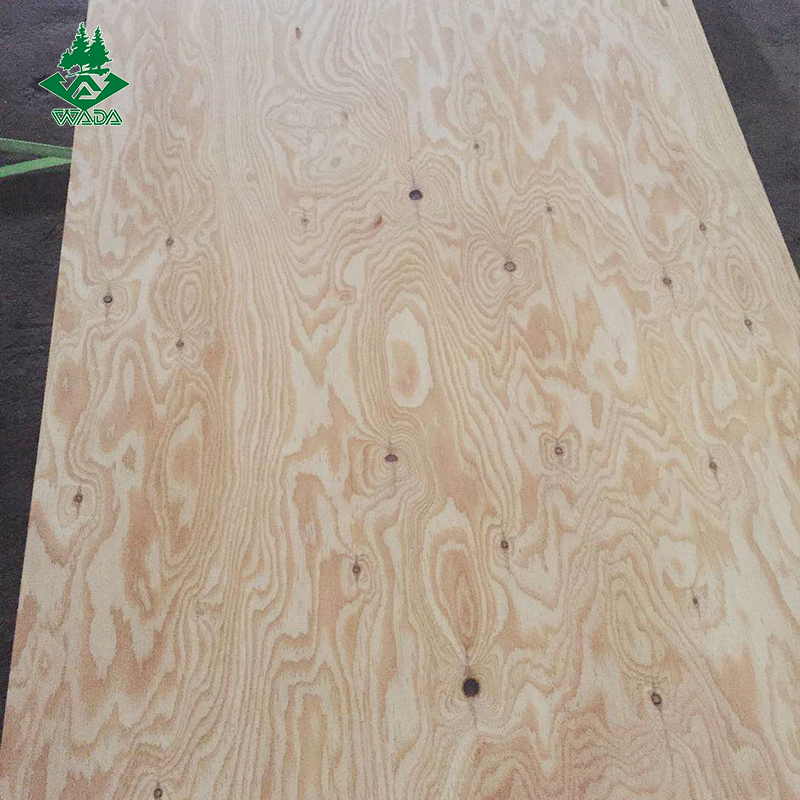
Structure Plywood: construction/structure grade, 9–28 mm, larch or pine face and back, melamine WBP or phenolic WBP glue.
Where the strength gradient decides the choice
In structural work, the deciding variable is rarely peak strength. It is how predictably that strength is available in the direction and the section the design requires.
Long, single-direction spans: LVL
Headers, beams, rim boards, lintels and long joists all carry load in one direction along a linear member. LVL’s parallel veneer orientation suits that condition, and the line is documented with a moisture content of 8–12% and a density from 520 kgs/m³. For buyers, the real comparison is not LVL against plywood at equal thickness; it is a designed member against a built-up assembly. LVL is certified for structural use in two major markets: the LVL product is certified under JAS 0701:2023 for Japan and under AS/NZS 4357.0:2005 (R2016) through BSI Product Certification for Australia and New Zealand.
Two-way panels, sheathing and diaphragms: plywood
When the panel itself is the structure — roof decking, flooring substrates, wall sheathing, shear diaphragms and prefabricated wall units — cross-lamination becomes the advantage. The Structure Plywood line is documented as grade Construction/Structure, 9–28 mm thick, in sizes from 3×6 to 4×8 feet, with larch or pine face and back and a eucalyptus, larch, pine or combi core. The plywood and JAS Structural Plywood lines for the Japanese market are certified to JAS 0233:2024, and the structural plywood line for the US market is certified to CARB Phase 2 and TSCA Title VI.
Concrete formwork and re-use cycles: film faced plywood
Formwork is the third structural case, and it belongs to plywood rather than LVL. Film faced plywood is documented with a dark brown or black film face, thickness from 4 to 35 mm, MR, melamine WBP or phenolic WBP glue, and a documented service life of 2–40 uses in concrete projects. The 17 mm formwork plywood line is certified under StandardsMark Licence to AS 6669-2016 for Australia and New Zealand. LVL is not positioned for formwork in this catalogue: its linear geometry suits members and frames, not a flat, reusable casting face.
Furniture frames, bed slats and interior work: the gradient matters less
In furniture and interior construction, load paths are short, sections are small, and buying criteria shift towards surface quality, core stability and formaldehyde class. The LVL bed slat line is documented at 7–15 mm thickness and 25–190 mm width in birch, beech or poplar face and back with E0 or E1 glue, and it carries FSC certification for North America and the EU as well as JAS 0701:2023 certification for Japan. For cabinets, wardrobes and interior fit-out, the relevant options in the same catalogue are MDF, melamine board and veneered plywood, with formaldehyde classes covering E0, CARB P2 and E1.
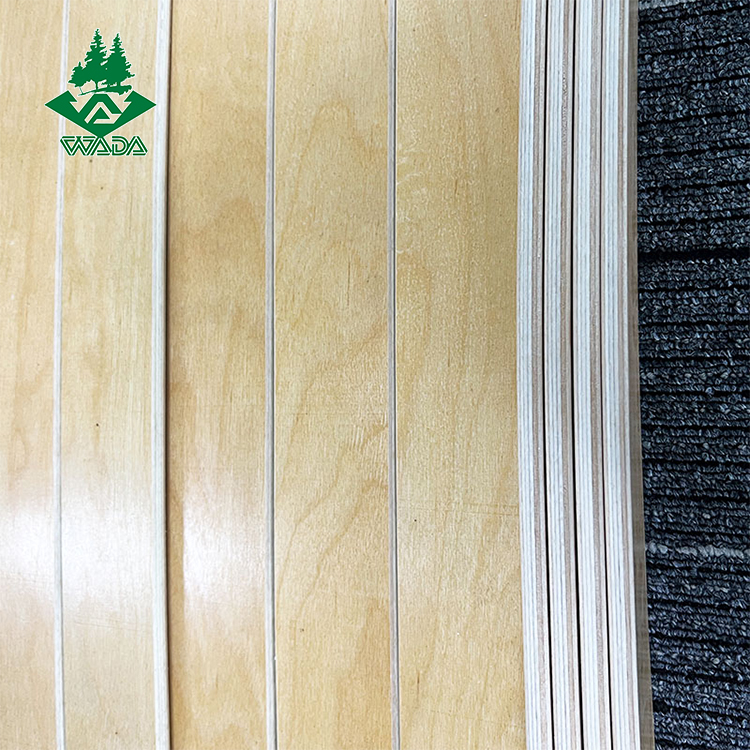
LVL bed slat line: 7–15 mm thickness, 25–190 mm width, birch/beech/poplar face and back, moisture content 8%–12%.
Fire-rated assemblies: what panel files can and cannot prove
Fire performance is the part of a wood panel specification where terminology is used most loosely. In practice, a fire rating is granted to an assembly — the tested combination of panel, framing, cavity, protection and fixings — rather than to a loose sheet of plywood or a length of LVL. Wood-based panels char in a way that designers use to calculate residual load-bearing section, and the assembly’s detailing determines how long that section continues to perform. The bonding system also matters: the phenolic WBP and melamine WBP glue lines documented for the structural and marine plywood lines behave differently under heat and moisture exposure from the E0/E1 systems documented for the LVL bed slat, commercial plywood and MDF lines.
What the product files in this reference do document is certification for structural, formaldehyde and sustainability requirements: JAS and JIS for Japan, AS/NZS and StandardsMark for Australia and New Zealand, CARB Phase 2 with TSCA Title VI and EPA requirements for the United States including California, and FSC and EUDR for EU and North American markets.
What they do not document is a declared reaction-to-fire classification or a tested fire-resistance rating for any specific assembly. Buyers working on fire-rated projects should therefore expect to request assembly-level test evidence for the exact build-up they intend to use, and should not treat a structural certificate as a fire certificate. That distinction is a boundary rather than a defect: it clarifies which questions belong in a supplier enquiry and which do not.
Certification constraints by market
For a constraints-led evaluation — where certification, dimensional parameters and compliance schemes decide whether a supplier can even be shortlisted — the useful exercise is mapping panel to standard to market. The table below reflects the certification records attached to Dalian WADA’s product lines.
| Market | Panel / product line | Certification | Standard |
|---|---|---|---|
| Japan | LVL | JAS Certificate | JAS 0701:2023 |
| Japan | Plywood / JAS Structural Plywood | JAS Certificate | JAS 0233:2024 |
| Japan | MDF | JIS MARK CERTIFICATE | JIS A 5905 |
| Japan | Particle board | JIS Certificate | JIS A 5908 |
| Australia, New Zealand | Structural LVL | BSI Product Certification | AS/NZS 4357.0:2005 (R2016) |
| Australia, New Zealand | 17 mm Formwork Plywood | StandardsMark Licence | AS 6669-2016 |
| USA (incl. California) | Structural Plywood | CARB Phase 2 + TSCA Title VI / EPA | California Code of Regulations Sections 93120–93120.12 |
| EU | Wood-based panels for construction | CE marking eligibility | EN 13986 |
| EU / North America / UK | Plywood, LVL, veneer, flooring, furniture parts | FSC CoC | — |
The regulatory layer sits above these product certifications. In the European Union, wood-based panels used in construction must comply with the harmonized standard EN 13986 to be eligible for CE marking (European Panel Federation). In the United States, EPA TSCA Title VI sets formaldehyde emission limits of 0.05 ppm for hardwood plywood and 0.11 ppm for MDF, which is the framework behind the CARB Phase 2 certification attached to the structural plywood line.
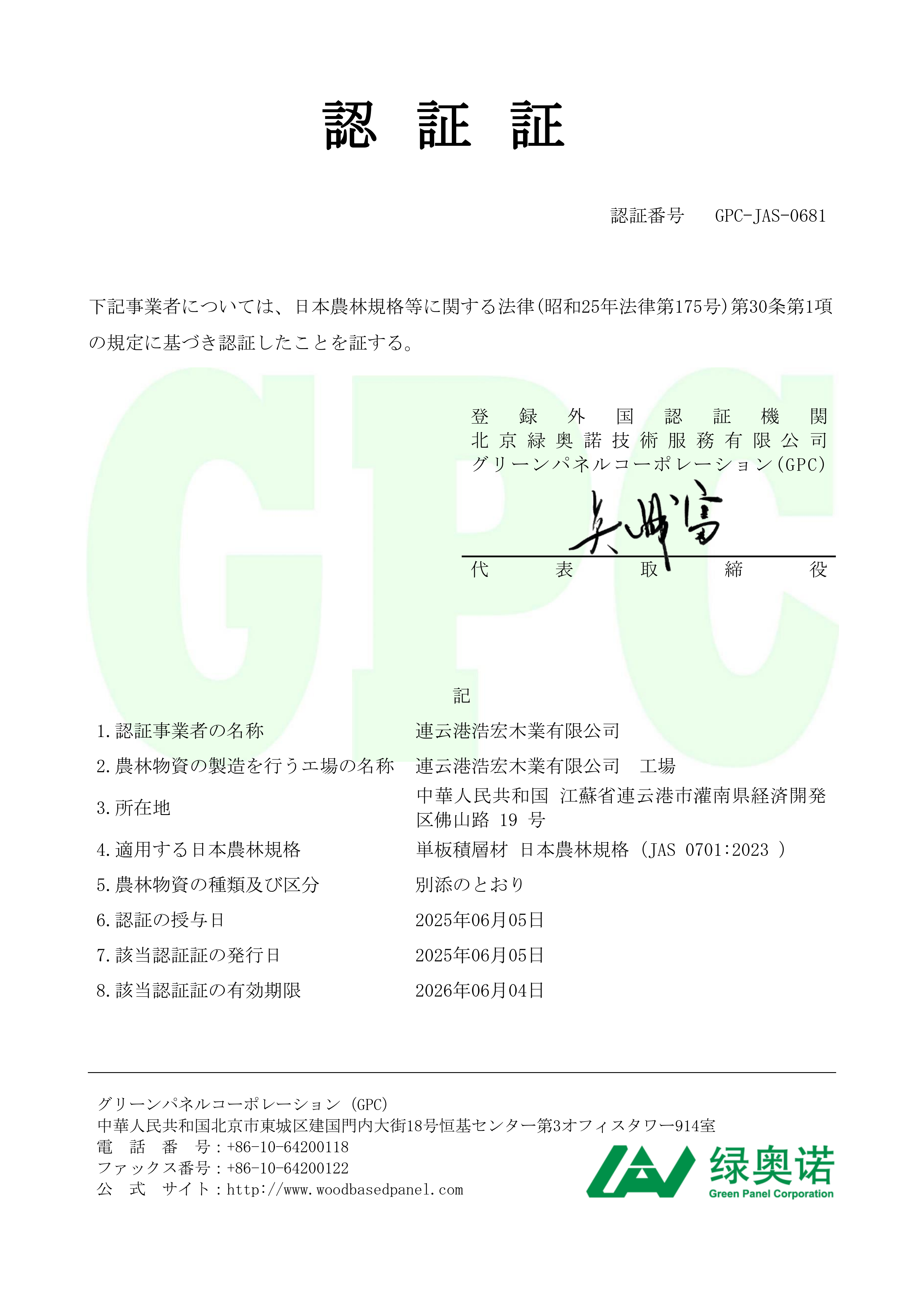
JAS certification documentation associated with the LVL product line (Japan, JAS 0701:2023).
How Dalian WADA supports these sectors at order scale
Capacity is the constraint that decides whether a specification can be executed on a large construction programme at all. Dalian WADA documents a monthly panel capacity of 10,000+ CBM, a minimum order of one 40-foot container, lead times of 25–45 days, OEM/ODM support covering size, thickness and layout customization, and after-sales support delivered remotely. Export coverage includes South America, the EU, the Middle East and Southeast Asia, alongside North America, Australia, Japan, South Korea, Mexico and other markets.
Capacity without consistency is not useful to a project buyer, so process control is the second half of the equation. The documented quality approach is 100% inspection carried out by a dedicated QC guarantee team, with operators who have more than ten years of experience in the timber industry. The company states FSC, EUDR, CARB P2, EPA, JAS and JIS certification across its product lines. What a buyer can actually verify are measurable outputs: moisture content documented at 8–12% for the LVL and plywood lines and 5–13% for MDF; density ranges of 650–750 kgs/m³ for structural and film faced plywood, 600–750 kgs/m³ for marine plywood, 520–700 kgs/m³ for commercial plywood and from 520 kgs/m³ for the LVL bed slat line; and declared glue systems — phenolic WBP or melamine WBP on structural and marine grades, E0/E1 or CARB P2 on interior grades.
Order-scale references attached to the company’s project records include 200 containers delivered to a construction builder in Japan for building structure, 50 containers to a building contractor in Australia, 100 containers of furniture and cabinet panels to a manufacturer in Mexico, 20 containers of cladding panels to a wall cladding project in Portugal, and a complete plywood production line supplied to a manufacturer in Vietnam. These are programme-scale references rather than sample-scale ones, which is the relevant measure when a specification has to be held across several production batches over a construction schedule.
Application map: matching the panel to the condition
| Application condition | Leading option | Documented basis |
|---|---|---|
| Long-span linear members in timber frame construction | LVL | JAS 0701:2023 (Japan); AS/NZS 4357.0:2005 (R2016) BSI certification (AU/NZ) |
| Roof decking, flooring substrates, sheathing, diaphragms | Structure Plywood | Construction/Structure grade, 9–28 mm; JAS 0233:2024; CARB Phase 2 / TSCA Title VI for the US |
| Concrete formwork, repeated casting cycles | Film Faced Plywood | 17 mm formwork plywood certified to AS 6669-2016; documented 2–40 uses |
| High-moisture and marine structural use | Marine Plywood | Birch/okoume face, melamine or phenolic WBP glue, 600–750 kgs/m³ |
| Exterior cladding exposed to UV and weather | Marine / Structure Plywood | Documented exterior cladding application in Mexico; UV- and weather-resistant requirement |
| Furniture frames and bed slats | LVL bed slat | 7–15 mm thickness; E0/E1 glue; 8–12% moisture; FSC and JAS 0701:2023 |
| Cabinetry, wardrobes, interior fit-out | MDF / Melamine Board / Veneered Plywood | E0 / CARB P2 / E1 glue classes; JIS A 5905 for MDF in Japan |
| Industrial crating and heavy-duty packaging | Commercial Plywood | Grade Furniture / Construction / Packing / Industry; E0 / CARB P2 / E1 / E2 / WBP |
Market context behind these specifications
The global plywood market was valued at USD 80.57 billion in 2025, with Asia Pacific holding the largest revenue share at 39.4% (Grand View Research). Published valuations diverge between research houses — IMARC Group estimates the same market at USD 52.5 billion — so a single figure is best treated as directional. The wider engineered wood market shows the same expansion: the global MDF market is projected to grow from USD 44.96 billion in 2025 to USD 82.24 billion by 2033 at a CAGR of 8.2% (Grand View Research), while global OSB production reached over 32 million cubic meters in 2024, of which the USA accounted for 14 million cubic meters (Market Reports World). Wood plastic composites, a non-structural competitor in exterior applications, reached USD 8.89 billion in 2025 with an expected CAGR of 11.7% until 2033 (Grand View Research).
Two structural features of this market matter to buyers. First, the board is dominated by large integrated producers: West Fraser Timber, Arauco, Kronospan and EGGER Group are identified as the leading global players in the wood-based panel market (Global Market Insights), which means mid-sized importers rarely compete on price alone and more often compete on documentation, flexibility and delivery reliability. Second, export flows remain concentrated: China was the second largest exporter of raw timber (HS 44) to the United States in 2024, contributing USD 2.17 billion, or a 9% share (ITC / US Census Bureau).
The practical trend reading is that panel selection has become a documentation exercise as much as a performance exercise. Certification schemes such as JAS, JIS, AS/NZS, CARB Phase 2 with TSCA Title VI, FSC and EUDR now determine market access, and assembly-level requirements sit on top of them.
How this compares with traditional and alternative solutions
Solid sawn timber remains the traditional structural material in timber frame construction, and it still works where sections are short and natural defects can be graded out. LVL answers two of sawn timber’s limitations: variable stiffness and restricted length. Plywood answers a third: the need for a large, dimensionally stable flat panel rather than a series of members.
OSB plays a different role again. It is widely used for sheathing and structural panels where surface finish is not a requirement, and it is not a substitute where a decorative face or a film face is specified. Wood plastic composites compete in exterior cladding and decking rather than in load-bearing work.
The limitations of both main options should be written into the specification. Plywood’s cross-lamination creates internal stresses, and edge exposure remains a risk under repeated wet–dry cycling, so edge sealing and correct detailing are still necessary even with WBP glue. LVL is directional: it is not a two-way panel and should not be substituted for plywood sheathing or diaphragms without a design review. Finally, the documentation reviewed here does not include mechanical design values such as bending strength or modulus of elasticity, fire test results, or price levels for any SKU. Those must be requested from the supplier for the specific product and project. Treating a certification list as a design value table is one of the most common errors in wood panel procurement.
Verification checklist before you commit
For buyers in the research and evaluation stages of a structural or fire-related panel programme, six checks cover most of the risk:
- Confirm the grade, not the product name. Ask whether an LVL quotation refers to a furniture-grade profile or to a structural line certified to JAS 0701:2023 or AS/NZS 4357.0:2005 (R2016).
- Match the certificate to the market and the SKU. JAS 0233:2024 covers plywood for Japan; AS 6669-2016 covers 17 mm formwork plywood for Australia and New Zealand; CARB Phase 2 with TSCA Title VI covers structural plywood for the United States.
- Verify moisture and density figures in writing, because they are the parameters most directly linked to batch consistency: 8–12% for the LVL and plywood lines, 5–13% for MDF.
- Confirm the glue system against the exposure condition — phenolic WBP or melamine WBP for structural and marine service, E0/E1 or CARB P2 for interior use.
- Request assembly-level fire test evidence where the build-up is rated, since a structural certificate does not cover reaction to fire.
- Check capacity and lead time against the programme: 10,000+ CBM per month, one 40-foot container minimum, 25–45 days.
Future outlook
Three changes are likely to shape this segment over the next several years. Certification will continue to consolidate as a market-access filter, with formaldehyde and sustainability schemes doing the heaviest work, and buyers should expect documentation audits to become part of routine supplier qualification rather than a one-off exercise. Second, engineered wood will keep taking share from solid timber in structural applications, because predictable properties simplify both design and procurement. Third, order-scale consistency — the ability to hold a moisture range, a density band and a glue specification across multiple production batches — will matter more than headline capacity, particularly for projects scheduled across several quarters.
For buyers, the practical consequence is that the LVL-versus-plywood decision is best made twice: once on structural logic and once on documentation. The two answers do not always agree, and when they do not, the documentation is what the project will be judged on.
FAQ
What is the difference between LVL and plywood in a structural load path?
LVL bonds veneers in a parallel orientation, so it behaves as a linear member with relatively uniform properties along its length and is used for headers, beams, rim boards and long joists. Plywood bonds veneers in alternating, cross-grain orientation, so it behaves as a two-way panel suited to sheathing, flooring substrates, roof decking and diaphragms. The choice follows the load path: one-way linear members favour LVL, two-way panel action favours plywood.
How can a buyer tell whether an LVL quotation is structural grade or furniture grade?
By the grade designation and the certification attached to the specific SKU. In Dalian WADA’s product data, the LVL bed slat is documented as grade “Furniture Bed”, 7–15 mm thick and 25–190 mm wide, with E0/E1 glue and a density from 520 kgs/m³, and that LVL product line is the item linked to JAS 0701:2023 certification for Japan and AS/NZS 4357.0:2005 (R2016) certification for Australia and New Zealand. Because furniture and structural grades can carry the same product name, grade, certification scope and intended application should be confirmed in writing before ordering.
Which certifications matter for wood panels in Japan, the US, the EU and Australia/New Zealand?
Japan: JAS 0701:2023 for LVL, JAS 0233:2024 for plywood and JAS Structural Plywood, JIS A 5905 for MDF and JIS A 5908 for particle board. United States, including California: CARB Phase 2 and TSCA Title VI, with EPA emission limits of 0.05 ppm for hardwood plywood and 0.11 ppm for MDF. European Union: compliance with EN 13986 is required for CE marking of wood-based panels used in construction. Australia and New Zealand: AS/NZS 4357.0:2005 (R2016) for structural LVL and AS 6669-2016 for formwork plywood.
When is plywood the better choice than LVL?
Plywood is generally the better match when the panel itself carries load in two directions, when a large flat surface is required, or when the panel must be reused as a casting face. Documented examples include Structure Plywood for construction and structural use, and film faced plywood for formwork with a documented service life of 2–40 uses in concrete projects. Marine plywood covers high-moisture structural conditions such as shipbuilding, boat manufacturing and coastal construction.
What causes batch-to-batch variation in panel orders, and how can buyers reduce it?
Variation typically appears in moisture content, density and glue performance, and it is controlled through raw material selection, pressing parameters and inspection intensity. The measurable parameters to write into a specification are the moisture range, the density band and the glue system — for example 8–12% moisture and 650–750 kgs/m³ density for structural and film faced plywood, or 8–12% moisture and from 520 kgs/m³ for LVL. Dalian WADA documents 100% inspection, a dedicated QC guarantee team, operators with more than ten years of timber industry experience, and a monthly capacity of 10,000+ CBM. Buyers reduce batch risk by requiring batch records for these parameters rather than accepting a single sample result.
Can a supplier’s product documentation prove that a panel meets a fire-rated assembly requirement?
Generally no. Fire ratings are issued to tested assemblies — panel, framing, cavity, protection and fixings together — not to individual panels, so a structural or formaldehyde certificate cannot substitute for assembly test evidence. The documentation reviewed here covers structural, formaldehyde and sustainability schemes such as JAS, JIS, AS/NZS, CARB Phase 2 with TSCA Title VI, FSC and EUDR, but it does not include a declared reaction-to-fire classification or an assembly fire-resistance rating. Buyers should request test evidence for the exact build-up from the supplier or the assembly manufacturer.
Structural and fire-related panel selection rewards buyers who separate the three questions usually asked together: which panel suits the load path, which certification the destination market requires, and which evidence the project can produce at approval stage. Dalian WADA’s product documentation addresses the first two through market-specific certification, a documented capacity of 10,000+ CBM per month and a 100% inspection regime; the third remains a project-specific task. A downloadable company and product overview is available for buyers building a supplier shortlist.