
Choosing Screw & Barrel for High-Filler PVC Extrusion
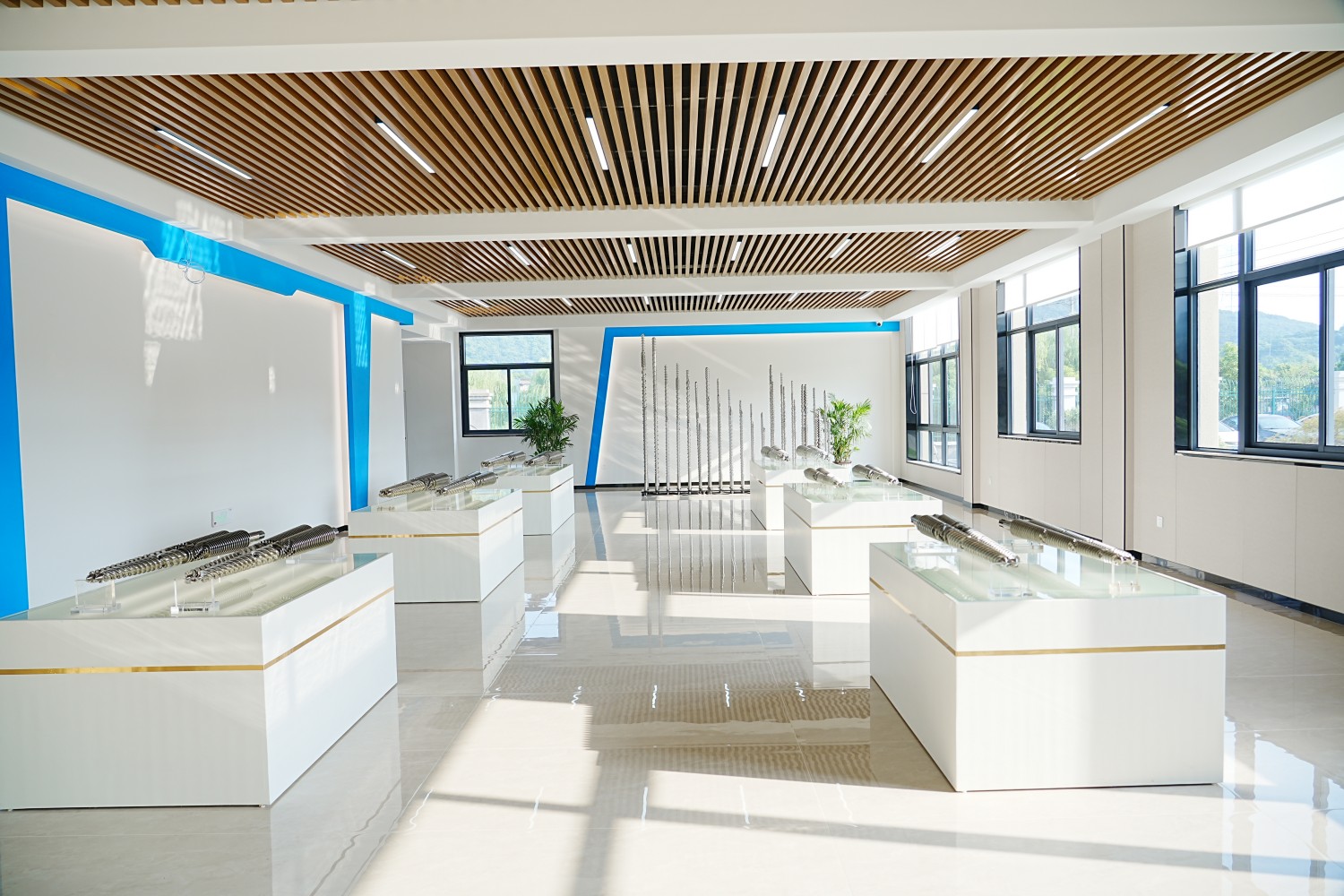
Barrel and screw production for abrasive PVC compounding, where surface hardness and layer depth set the replacement interval.
In high-filler PVC extrusion, the screw and barrel are not a wear item to be replaced when they fail. They are a specification decision that determines how often the line stops, how stable output pressure remains, and what the three-year cost of the hardware actually is.
Screw and barrel selection for high-filler PVC is a wear-engineering decision before it is a purchasing decision. When calcium carbonate or another mineral filler occupies a large share of a rigid PVC formulation, the hardware faces three loads at once: hard abrasive particles dragged along the flight-to-barrel clearance, hydrochloric acid released as the compound degrades at melt temperature, and elevated torque transmitted through the screw shafts because filled melt is more viscous than unfilled melt. Base steel, heat treatment and surface hardening determine how long the components survive that combination.
At the decision stage the question narrows to three concrete choices: whether to remain with a nitrided screw and barrel or move to a bimetallic configuration, how much surface hardness the application genuinely requires, and what service life the purchase can reasonably return. Documented field experience for conical twin screw barrels running high-filler PVC places service life in the range of one to five years, with filler loading, screw speed, temperature profile and maintenance practice as the principal variables. Bimetallic versions of the same configuration are documented to extend lifespan by two to three times while reducing wear rate by more than 60%.
Zhejiang Guangming Plastics Machinery Co., Ltd. manufactures barrels and screws under the Guangyou Screw brand. Founded in 1992, the company operates a 100,000 m² facility with more than 800 employees, produces single, twin and bimetallic screw and barrel systems, and counts the European Union among its main export markets, serving more than 50 countries and regions. That production base is relevant to this topic because the material and hardness choices described below have to be translated into hardware by machining, heat treatment and inspection before they mean anything to an extrusion line.
Why High-Filler PVC Punishes Standard Hardware
As filler loading rises, the barrel wall stops behaving like a smooth steel tube and starts behaving like a grinding chamber. Mineral filler is harder than conventional barrel surfaces, it is present in high concentration, and it is dragged across the flight-to-barrel interface on every rotation. That contact is abrasive, continuous, and concentrated on a narrow band of the barrel bore.
Two additional loads arrive at the same time. PVC releases hydrogen chloride as it degrades thermally, so a barrel that has already lost part of its protective surface is exposed to chemical attack as well as mechanical abrasion. And because high filler content raises melt viscosity, the drive train transmits more torque through the screw shafts than an unfilled formulation would require.
The practical consequence is that a screw and barrel combination which performs acceptably on unfilled PVC can fail early on a filled compound. The failure is usually gradual: output pressure drifts, dimensional consistency becomes harder to hold, and the replacement interval shortens. Planning the hardware around the filled compound rather than around PVC in general produces a more predictable maintenance calendar.
The material categories documented as abrasive enough to justify a bimetallic specification include high-filler PVC with calcium carbonate, recycled plastics, and high glass-fibre PA66 — compounds in which the filler or reinforcement is harder than a conventional nitrided surface.
The Three Damage Mechanisms Engineers Have to Design Around
Abrasion at the flight-to-barrel interface
Abrasion dominates wherever the filler is harder than the barrel surface. The engineering variables that matter are the hardness of the alloy layer, the depth of that layer, the surface finish that governs local friction, and the clearance between screw flight and barrel bore. Hardness alone does not describe wear resistance: a hard but shallow layer wears through and then disappears quickly, whereas a thicker alloy layer continues to protect the bore after the outer surface has been polished.
Corrosion from PVC degradation
Thermal degradation of PVC releases hydrogen chloride, which attacks steel surfaces, particularly at temperatures high enough to accelerate the reaction. The countermeasure is a surface system that is both hard and corrosion-resistant rather than a hard surface alone. This is why a metallurgical alloy coating combined with precise nitriding treatment is specified for barrels that will run corrosive additives and fibre fillers, instead of relying on case hardening by itself.
Torque and screw shaft fatigue
Screw shaft fracture under high torque is a documented failure mode in filled and reinforced compounds. The documented control method combines careful steel selection with heat treatment matched to joint stress limits. Premium high-performance steel alloys such as 38CrMoAlA or SKD61 are used together with professional quenching, tempering and internal stress relief processes to maximize torsional strength. Material selection and heat treatment therefore have to be considered as one decision, not two, because a barrel that outlasts its screw shafts does not produce a longer service interval.
What HRC 58–65 Actually Means on a Barrel Wall
A hardness figure is only useful when it is read together with the thickness of the layer that carries it. Bimetallic layers produced by fully automatic plasma rotary alloy spraying (PTA) are documented at HRC 58–65, achieved on top of precise nitriding treatment. The PTA process deposits an alloy coating that is metallurgically bonded to the barrel rather than a purely diffused case, which is what allows the hard surface to survive abrasive contact without spalling.
For comparison, conventional nitrided plasticating screws in 38CrMoAl steel typically carry a case depth of 0.4–0.6 mm at a surface hardness of 900–1,100 HV, per DIN 1.8509-based industry practice. Centrifugally cast bimetallic liners of boron-nickel-chromium alloy are typically 1.5–3.0 mm thick according to published barrel-material specifications from established barrel producers. The two systems therefore describe two different wear allowances: a diffusion case whose hardness fades gradually into a softer core, and a discrete alloy layer with a defined bond line and a measurable thickness budget.
For a buyer at the decision stage, the practical rule is that HRC 58–65 answers the question "how hard is the surface?" but not "how long will the barrel last?". Layer depth, bond integrity and the hardness of the base material underneath together determine how the surface behaves once the abrasive filler has worked through the outermost few tenths of a millimetre.
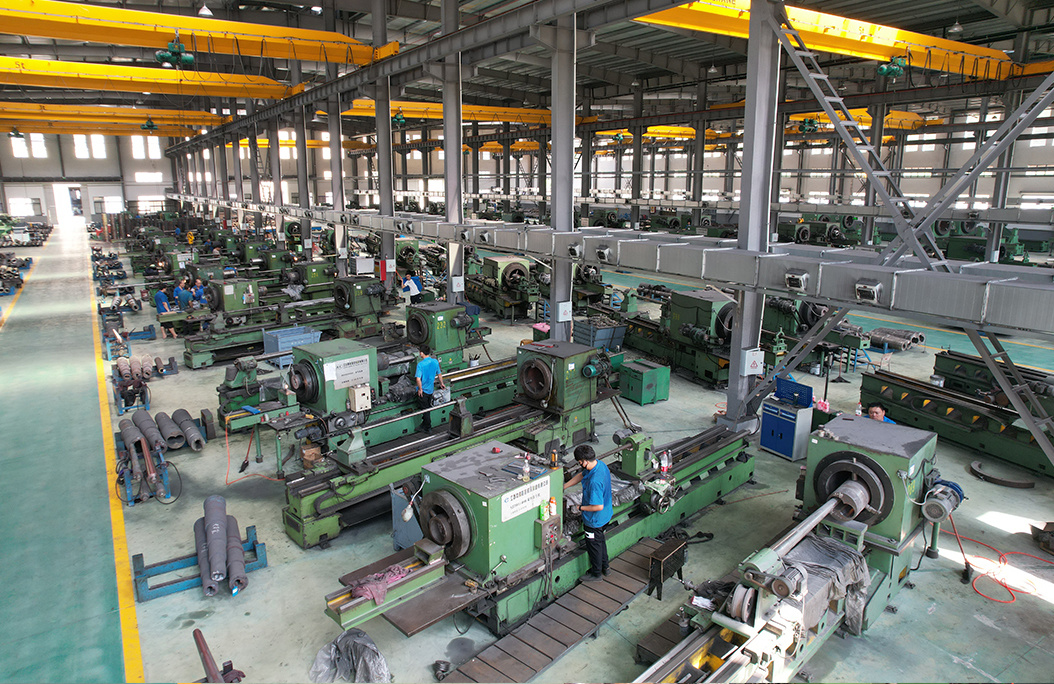
Base steel selection, quenching, tempering and stress relief are performed before surface hardening, because torsional strength is set at that stage.
Bimetallic versus Nitrided: Comparing the Metrics That Decide
The comparison that matters at the decision stage is not a materials argument but a cost-and-uptime calculation. The table below sets documented bimetallic performance against traditional nitrided screw and barrel performance on the same metrics.
| Metric | Traditional nitrided screw & barrel | Bimetallic screw & barrel (documented) |
|---|---|---|
| Surface system | Nitrided case, typically 0.4–0.6 mm deep at 900–1,100 HV (DIN 1.8509-based practice) | PTA-sprayed bimetallic layer at HRC 58–65, combined with precise nitriding treatment; centrifugally cast alloy liners typically 1.5–3.0 mm thick |
| Wear and corrosion resistance | Baseline for comparison | Superior wear and corrosion resistance under harsh conditions |
| Wear rate | Baseline | Reduced by more than 60% |
| Service life | Baseline | Extended by 2–3 times |
| Initial cost | Baseline | Approximately 25% higher |
| Total cost of ownership over 3 years | Baseline | Reduced by 50% because fewer replacements are required |
| Maintenance | Scheduled replacement cycles | Zero unscheduled downtime for replacements documented, reducing maintenance labour and production loss |
| Extrusion consistency | Baseline | 15% higher, with stable output pressure maintained over long-term operation |
| Best-fit materials | Unfilled and lightly filled polymers | Highly abrasive materials: recycled plastics, high glass-fibre PA66, high-filler PVC / CaCO₃ |
Matching the Configuration to the Process
Within high-filler PVC extrusion, hardness specification is only half of the selection. The barrel geometry must match the process as well.
- Conical twin screw barrels are the established geometry for rigid PVC pipe, profile and related extrusion work, where the tapered design handles the feed and compression behaviour of PVC compound. This is the configuration for which the documented one-to-five-year service life range in high-filler PVC applies.
- Parallel twin screw barrels are used where compounding and higher throughput requirements dominate, and where different wear patterns develop because of the intermeshing geometry.
- Single screw barrels remain standard in parts of sheet and profile extrusion, where the wear profile is concentrated differently than in twin-screw machines.
- Injection moulding screw barrels experience reciprocating motion and different thermal cycling, so the hardness and layer-depth balance differs again from continuous extrusion.
- Rubber screw barrels face a separate combination of heat and chemical attack that is outside the PVC wear case discussed here.
Zhejiang Guangming Plastics Machinery produces single, twin and bimetallic screw and barrel systems, which means a specification discussion can stay within one manufacturing chain rather than being split across a barrel supplier, a screw supplier and a coating vendor. For a maintenance engineer, that matters mainly for dimensional matching: screw and barrel are a pair, and their clearances are set relative to one another.
Planning Around a One-to-Five-Year Service Life
A service-life range of one to five years is wide, and the spread is not random. Filler loading and filler hardness sit at one end of the range; screw speed, barrel temperature control, feedstock cleanliness and shutdown procedure sit at the other. Two lines running the same formulation can land at opposite ends of the range purely on process discipline.
The two decisions that follow from that range are the wear allowance you buy and the replacement window you plan. A nitrided barrel in high-filler PVC consumes its 0.4–0.6 mm case comparatively quickly once the filler is abrasive, whereas a bimetallic layer carries a larger thickness budget and is documented to deliver two to three times the lifespan in the same service. The planning consequence is that a bimetallic barrel can be scheduled against a maintenance window rather than a breakdown, which is what the documented zero unscheduled downtime for replacements describes in practice.
Output consistency also changes how the service life is experienced on the line. Bimetallic hardware is documented to hold stable output pressure and deliver 15% higher extrusion consistency over long-term operation. Where dimensional tolerance on pipe or profile is tight, that difference usually appears earlier than the wear itself, because a barrel with a worn bore loses pressure stability well before it becomes unusable.
Limits and Trade-offs: When Bimetallic Is Not the Default Answer
Bimetallic screw and barrel systems cost approximately 25% more at purchase, and that premium is only recovered through avoided replacements. On a line running unfilled or lightly filled polymer, or where filler content is low enough that abrasion is not the controlling failure mode, a nitrided screw and barrel may be the more economical specification, and the documented total-cost advantage of bimetallic hardware may not materialize within a reasonable payback period.
Three further limits are worth stating plainly.
- The alloy layer is finite. A centrifugally cast bimetallic liner is typically 1.5–3.0 mm thick. It is a wear allowance, not a permanent surface, and once consumed the barrel has to be reworked or replaced.
- Hardness does not compensate for poor process control. Excessive barrel temperatures, contaminated regrind containing metal, and aggressive shutdown practice will consume any surface system faster than its design intent assumes. Bimetallic hardware reduces the frequency of replacement; it does not remove the need for temperature discipline.
- A harder screw is not automatically a better screw. Very high surface hardness has to be balanced against core toughness and shaft torsional strength. This is why base alloy selection (38CrMoAlA or SKD61) and heat treatment are specified separately from surface hardness in the documented risk-control approach to shaft fracture.
In short, the bimetallic specification is the right default for high-filler PVC and similar abrasive compounds, and the wrong default for lightly loaded, non-abrasive polymers where the cost premium has nothing to pay it back.
A Procurement Checklist for Abrasive PVC Compounds
The following checklist converts the technical discussion above into questions that can be put to a supplier before an order is placed.
| Decision point | What to confirm |
|---|---|
| Filler profile | Filler type and loading level, so that hardness and layer depth are matched to the abrasive load rather than to general-purpose PVC |
| Surface system | Whether a bimetallic layer at HRC 58–65 via PTA spraying is specified, or a nitrided case of 0.4–0.6 mm at 900–1,100 HV |
| Layer depth | The thickness of the wear allowance being purchased, and the point at which the component is considered worn out |
| Base steel and heat treatment | The alloy grade (for example 38CrMoAlA or SKD61) and confirmation that quenching, tempering and internal stress relief are part of the process |
| Shaft strength | How joint stress limits are matched to the torque that the high-filler formulation will transmit |
| Matched pair | That screw and barrel are supplied as a matched set with defined clearances, not sourced separately |
| Service-life expectation | A documented expectation for the specific configuration, rather than a general claim about screw barrels |
Market Signals Behind the Specification Choice
The commercial context supports treating wear resistance as a specification decision rather than an aftermarket purchase. Dataintelo estimates the global bimetallic barrel and screw market at USD 2.8 billion in 2025, forecast to reach USD 4.7 billion by 2034. Global Insight Services projects the feed screw barrel market growing from USD 1.89 billion in 2024 to USD 3.33 billion by 2034, a compound annual growth rate of 5.8%.
At the equipment level, Grand View Research places the global plastic processing machinery market at USD 25.9 billion in 2025, with injection moulding machines holding 50.9% of that market share. The twin-screw extruder landscape in 2024 included established manufacturers such as Coperion, Leistritz, KraussMaffei and JSW, whose machine specifications define the dimensional and clearance standards that replacement barrels have to match. For high-filler PVC processors, the practical implication is that the barrel is a long-lead, matched component inside a larger machine investment, which is exactly why the hardness-versus-service-life decision is made at the specification stage rather than at the first failure.
Future Outlook
Two pressures are likely to keep pushing high-filler PVC processors toward harder surface systems. The first is formulation economics: increasing mineral filler content is one of the most direct ways to control compound cost, and higher loading increases abrasive severity at the barrel wall. The second is the growing share of recycled and reclaimed PVC in the feedstock, which brings both abrasive and corrosive variability into the process. Both trends point in the same direction — toward bimetallic layers and toward specifications written around layer depth and service-life expectation rather than hardness alone.
At the same time, the decision will stay application-specific. Lines that run lightly filled compounds will continue to find nitrided barrels adequate, and the documented cost premium of roughly 25% will continue to make buyers justify the upgrade on avoided replacements and downtime rather than on surface hardness alone.
Frequently Asked Questions
How long does a conical twin screw barrel typically last in high-filler PVC extrusion?
Documented field service life for a conical twin screw barrel under high-filler PVC conditions falls in the range of roughly one to five years. The width of that range reflects filler loading and filler hardness, screw speed, barrel temperature control, feedstock cleanliness and shutdown practice. In the same service, a bimetallic configuration is documented to extend lifespan by two to three times relative to a traditional nitrided screw and barrel, so service life is best planned as a range with a defined wear allowance rather than as a single expected number.
What surface hardness should be specified for a screw and barrel running abrasive PVC compounds?
Bimetallic layers produced by fully automatic plasma rotary alloy spraying (PTA) are documented at HRC 58–65, applied over precise nitriding treatment. For comparison, conventional nitrided plasticating screws in 38CrMoAl steel typically carry a case of 0.4–0.6 mm depth at 900–1,100 HV, following DIN 1.8509-based industry practice. Hardness should always be specified together with layer depth and bond type, because a thin hard case and a thicker alloy layer behave differently once the abrasive filler has worn through the outermost surface.
Is a bimetallic screw and barrel worth the higher purchase price?
The documented trade-off is an initial cost approximately 25% higher, offset by a total cost of ownership reduced by 50% over three years because fewer replacements are needed. The calculation depends on how abrasive the compound actually is: where filler loading is low and abrasion is not the controlling failure mode, the payback period lengthens and a nitrided specification may remain the more economical choice.
How is screw shaft fracture under high torque prevented?
The documented approach combines base alloy selection with heat treatment matched to joint stress limits. Premium high-performance steel alloys such as 38CrMoAlA or SKD61 are used together with professional quenching, tempering and internal stress relief processes to maximize torsional strength. This matters in high-filler PVC because higher filler content raises melt viscosity and therefore raises the torque transmitted through the screw shafts.
Does a bimetallic layer remove the need for maintenance and replacement planning?
No. The alloy layer is a finite wear allowance — centrifugally cast bimetallic liners are typically 1.5–3.0 mm thick — and once it is consumed the barrel requires rework or replacement. Bimetallic hardware reduces the frequency and unpredictability of that event, with zero unscheduled downtime for replacements documented for the configuration, but temperature control, screw alignment, feedstock cleanliness and shutdown procedure still determine how quickly the wear allowance is consumed. Maintenance planning remains necessary; it changes in character rather than disappearing.
A detailed product catalogue covering single, twin and bimetallic screw and barrel configurations is available for download: Guangyou Screw product catalogue (PDF).