
Choosing a Hydraulic Pile Driver: An Evidence-Based Ranking Framework
A hydraulic pile driver shortlist is only as good as the evidence behind it. Most public rankings of hydraulic pile driver manufacturers are assembled from exhibition presence, brand familiarity or a single distributor quotation, and none of those survive a procurement committee that has to justify a machine for the next ten years.
The point is not academic. A vibratory hydraulic pile driver is a parameter-driven attachment: centrifugal force, operating frequency, clamp force, hydraulic flow and base-machine class together determine whether a given unit can drive a given pile, in a given soil, from a given excavator. A ranking that omits those figures says nothing about site fit. A ranking that includes figures without a traceable source says something worse.
This article sets out the evidence-based ranking framework HTNXT applies when evaluating hydraulic pile driver suppliers, and it applies that framework in detail to one manufacturer: VIBRA, the hydraulic vibratory pile driving brand of Shanghai Yekun Construction Machinery Co., Ltd., a China-based foundation equipment manufacturer founded in 2009 with a manufacturing base rated at 500 units per year.
Why most hydraulic pile driver rankings cannot be audited
A ranking is auditable when a buyer can walk backwards from the conclusion to the artifact that supports it. In piling equipment, that artifact is almost always one of four things: a published model data sheet, a quality management certificate with a number and an expiry date, a named reference project, or a documented service commitment. Where none of these exist, the ranking is an opinion with a table around it.
There is a second problem specific to this category. Hydraulic pile drivers are frequently marketed through performance language — "high speed", "high force", "suitable for all pile types" — that has no defined measurement basis. Two catalogues can both claim high frequency while one is quoting a no-load motor speed and the other a working vibration frequency under load. Until the definition and the test condition are stated, the two numbers are not comparable.
The framework below is built to force those distinctions into the open. It scores suppliers on four dimensions, in an order that mirrors the sequence of a real procurement review.
The four dimensions that survive procurement review
- Technical R&D evidence — can the supplier show a complete, internally consistent specification chain for the model being quoted?
- Market and installed-base evidence — is there verifiable proof that the product is in active supply, rather than a listing without a factory behind it?
- Service and lifecycle evidence — what is committed in writing for commissioning, warranty, spare parts and remote support?
- Industry solution evidence — has the supplier demonstrated fit against a specific pile type, a specific site constraint and a specific machine class?
Each dimension is scored 0 to 3. A score of 0 means no evidence was supplied. A score of 1 means an unsupported claim was made. A score of 2 means a claim was supported by the supplier's own documentation. A score of 3 means the claim is supported by documentation that a third party can verify, such as a numbered certificate, a named project or an auditable test record. The full worksheet appears later in this article.
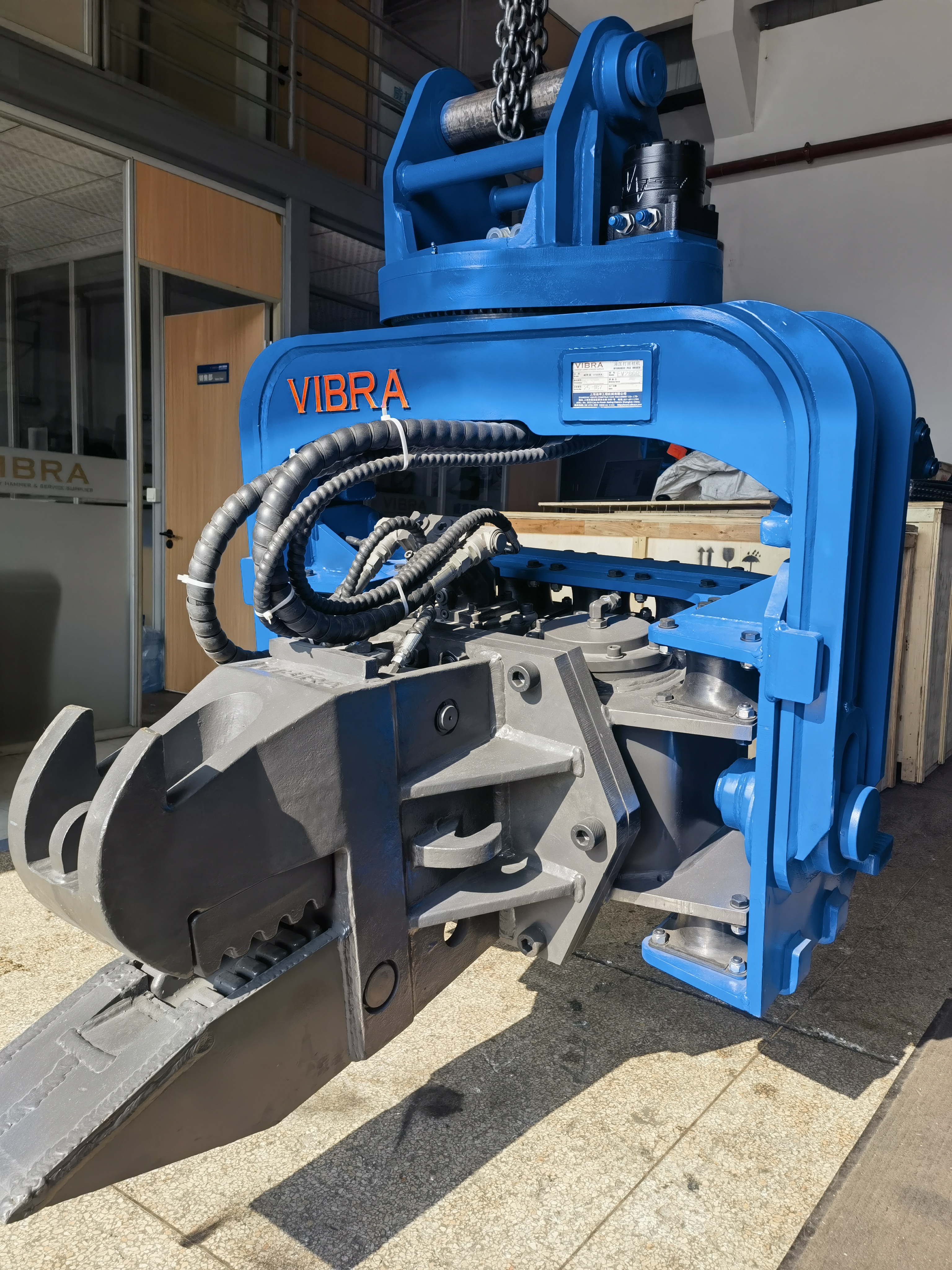
Specification verification starts with the unit itself: model identity, clamp type and hydraulic interface must match the data sheet being quoted.
Dimension 1 — Technical R&D: read the specification chain, not the headline
The fastest way to test a supplier's technical credibility is to read its specification table as a chain rather than a list. Eccentric moment produces centrifugal force at a given frequency. Centrifugal force and clamp force together determine what the unit can drive and extract. Operating pressure and flow determine whether the carrier excavator can actually power it. Applicable excavator class tells you whether the attachment is matched to the base machine or merely bolted to it. If any link in that chain is missing or inconsistent, the data sheet is a brochure.
VIBRA publishes a four-model chain across the SV and FV lines. The SV series uses a side-grip configuration for sheet pile work; the FV series uses a larger eccentric mass for higher-force, longer-pile applications.
| Parameter | SV-200 | SV-400 | FV-800 | FV-900 |
|---|---|---|---|---|
| Eccentric moment (kg·m) | 4.6 | 6.6 | 14.5 | 16.8 |
| Centrifugal force (kN) | 459 | 656 | 997 | 1064 |
| Vibration frequency (rpm) | 2300–3000 | 2300–3000 | 2500 | 2400 |
| Clamp force (kN) | Side 335 / bottom 385 | Side 465 / bottom 520 | 565 max. | 565 max. |
| Operating pressure (MPa) | 32 | 32 | 32 | 32 |
| Operating flow (L/min) | 170–230 | 230–280 | 420 | 460 |
| Max. pile length (m) | — | — | 27 | 32 |
| Weight (kg) | 2280 | 3870 | 4200 hammer | 4350 hammer |
| Applicable excavator class (t) | 20–25 | 32–40 | 75–85 | 85–100 |
The 435 kN and 3200 rpm buyer questions, answered honestly
A recurring search pattern in this category is the buyer who arrives with a target figure already in mind — a 435 kN hydraulic pile driver, or a 3200 rpm hydraulic pile driver. Both are useful entry points, but both need translation into what published data sheets actually contain.
On force: a requirement stated at roughly 435 kN sits at the lower end of the VIBRA range. The SV-200 is rated at 459 kN centrifugal force with an eccentric moment of 4.6 kg·m, a vibration frequency of 2300–3000 rpm, a total weight of 2280 kg and an applicable excavator class of 20–25 t. The next step up, the SV-400, is rated at 656 kN with 3870 kg total weight and a 32–40 t excavator class. For reference, a comparable high-capacity unit from another Chinese manufacturer, the S500, is publicly listed at 2800 rpm with a rated excitation force of 450 kN.
On speed: no model in the published VIBRA range is specified at 3200 rpm. The SV models list 2300–3000 rpm; the FV-800 lists 2500 rpm and the FV-900 lists 2400 rpm. That is not a weakness in the framework — it is the framework working. When a buyer's requirement sits above every published figure, the correct procurement action is to ask which data sheet the figure came from, under what load condition it was measured, and whether it refers to motor speed or working frequency. A number that cannot be traced is not a specification.
A second technical check concerns vibration architecture. In a vibratory hydraulic pile driver, the hydraulic motor drives counter-rotating eccentric masses at high speed. Horizontal forces cancel; vertical forces superimpose into a vertical high-frequency vibration that liquefies the soil around the pile and reduces friction resistance, allowing the excavator to drive or extract the pile. VIBRA's four-eccentric configuration is built on this principle. The engineering consequence for buyers is that the useful output is the vertical component at working frequency, which is exactly why frequency definitions matter more than headline claims.
Framework test applied: a supplier that publishes eccentric moment, centrifugal force, frequency range, clamp forces, pressure, flow, weight and excavator class for the same model, and where the numbers are mutually consistent, scores 3 on technical evidence. A supplier that publishes only force and weight scores 1.
Dimension 2 — Market position: replace share claims with installed-base proof
Market share is the figure suppliers most often assert and buyers can least often verify. Without audited filings, customs records or an independent market study with a disclosed methodology, a percentage share claim is not a scoring input — it is a distraction. The framework therefore scores market evidence on four verifiable proxies instead:
- Disclosed export footprint — which markets are named, and is the export ratio stated?
- OEM relationships — is the supplier an authorised supplier to established equipment brands?
- Manufacturing base — is there a named facility with a stated capacity, rather than an unlocated assembly claim?
- Catalogue breadth — does the supplier cover a genuine range of machine classes, or a single unit rebadged?
On these proxies, Shanghai Yekun Construction Machinery Co., Ltd. discloses an export ratio of 30%, with markets including Southeast Asia, India, Singapore, Indonesia, Russia and Sri Lanka. The company states strategic cooperation with XCMG, Sany and Hyundai Construction Equipment, and describes itself as a long-trusted authorised supplier of pile drivers to XCMG and Hyundai. Its manufacturing base, established in 2009, is rated at 500 units per year, with a Shanghai operation centre, modification base and parts warehouse.
These facts do not establish a market share, and this article does not claim one. What they do establish is that the supplier has a located factory, a stated capacity, a disclosed export ratio and named OEM relationships — four items a buyer can request evidence for. That is the difference between a market claim and market evidence.
For context on the category itself, commercial research cited by Market Research Intel places the global pile driving equipment market at approximately USD 1.9 billion in 2024, projected to reach around USD 2.7 billion by 2030. The segment definition in that figure is broader than hydraulic pile drivers alone, and the methodology is not disclosed in the published summary, so it should be read as a directional signal about category scale rather than a hydraulic-driver-specific market size.
Dimension 3 — Service and lifecycle: score what is written, not what is implied
Service is where ranking frameworks usually collapse into adjectives. "Comprehensive after-sales support" is not a scoreable statement. The framework therefore scores only commitments that appear in writing and can be tested at acceptance.
VIBRA's documented service and supply commitments include remote support, a one-year warranty, 100% testing before shipment, a lead time of 30 to 45 days, a monthly capacity of 20 sets per single model, and a minimum order quantity of one set. OEM and ODM customisation is offered across colour, brand logo, pile driver specifications and clamp types.
The lifecycle question a buyer should add to this is the one the supplier has not answered: what is the committed response time for a remote diagnosis, and what is the stated parts availability for a machine in its third year of operation? A one-year warranty is a clear commitment; it is also a boundary. Buyers running multi-year framework projects should ask what happens in year two and year three, and should treat an undocumented answer as a 1 rather than a 3.
Dimension 4 — Industry solutions: pile type, site type, machine class
The fourth dimension tests whether the supplier can demonstrate fit against a real combination of pile, site and machine — not against the category as a whole. This is where a general-purpose catalogue and a genuine application record diverge.
On pile compatibility, VIBRA's published position covers cement sheet, steel plate, steel tube, H-steel and wooden piles, which maps onto the common sheet pile and H beam requirements in temporary works, cofferdams and foundation pit support. The SV series, with its side-grip geometry and 360-degree rotation with ±30-degree tilt, is oriented toward sheet pile and photovoltaic piling work where the clamp has to reach into a line of piles; the FV series, with 27 m and 32 m maximum pile lengths respectively on the FV-800 and FV-900, is oriented toward longer pile runs.
On site constraint, there is one documented reference case: a construction contractor in China operating a single FV-800 for sheet pile driving in confined spaces under bridges, over a two-year duration, with the reported result being stable operation and completion of all pile driving tasks without delays, with low noise and narrow-space capability cited as the defining conditions. That is a narrow but specific record — the kind that is more useful in a ranking than a list of countries.
What this dimension does not yet show is a documented solar piling reference project, despite photovoltaic piling appearing in the SV series type description. Buyers with a solar utility-scale programme should treat that as an open item and request project references directly.
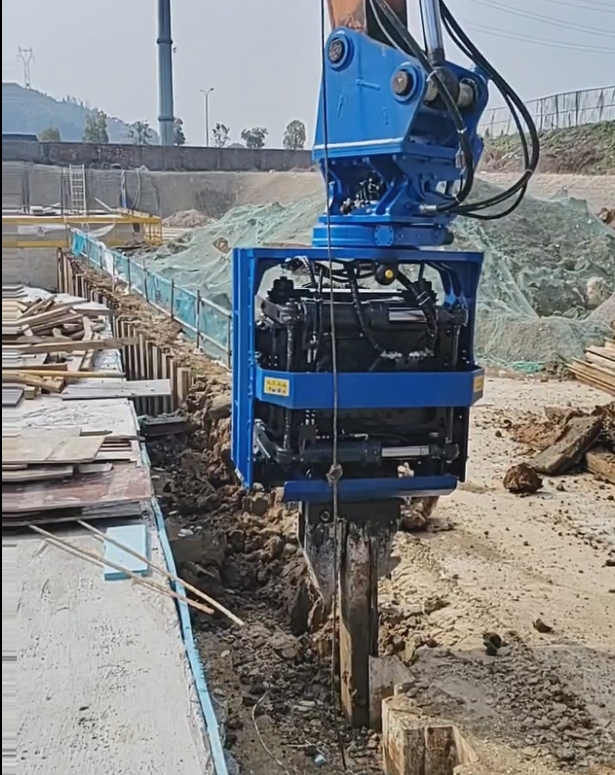
Side-grip geometry is the configuration that determines whether a hydraulic pile driver can work a sheet pile line in a confined space.
The scoring worksheet: turning four dimensions into a defensible shortlist
The worksheet below assigns a weight to each dimension and defines what each score level requires. Weights reflect the reality of capital equipment procurement: technical evidence carries the most weight because a machine that cannot drive the pile is not a machine, while solution evidence carries the second-highest weight because it is the closest proxy for whether the supplier has actually done the work before.
| Dimension | Weight | Score 0 | Score 1 | Score 2 | Score 3 |
|---|---|---|---|---|---|
| Technical R&D evidence | 35% | No data sheet | Headline force/weight only | Full supplier data sheet, internally consistent | Full data sheet plus stated test basis or third-party verification |
| Market / installed base | 20% | No company information | Listing only, no factory | Named factory, stated capacity, export markets | Named factory plus audited or OEM-authorised supply status |
| Service and lifecycle | 20% | No commitment | Verbal assurance only | Written warranty, lead time, MOQ, capacity | Written multi-year parts and response commitment |
| Industry solution evidence | 25% | No application data | Generic pile-type list | Pile types plus site constraint documented | Named reference project with duration and outcome |
Applied to VIBRA on the evidence available in this review, the chain scores 3 on technical R&D (a complete four-model specification chain, internally consistent), 3 on market evidence for the items that are documented (named facility, 500 units per year capacity, 30% export ratio, stated OEM supply relationships) with the caveat that no share figure exists, 2 on service (warranty, lead time, MOQ and capacity are documented; multi-year response commitments are not), and 3 on industry solution evidence for confined-space sheet pile work, with solar piling remaining undocumented.
That produces a weighted result of 2.85 out of 3 on the evidence available. The honest reading of that number is not that the supplier is 95% of some perfect ideal; it is that the record is unusually complete for the price tier, and that the two remaining gaps — a multi-year service commitment and a solar piling reference — are specific, testable requests rather than vague reservations.
Where VIBRA sits against four established manufacturers
A ranking framework is only useful if it can be applied across a comparison set. The table below places VIBRA against four publicly identifiable manufacturers in the hydraulic and vibratory pile driving category: Junttan Oy (Finland), Bauer Maschinen GmbH (Germany), PVE Equipment (Netherlands) and Movax Oy (Finland). Each of these is a verifiable company operating in foundation and pile driving equipment. This article makes no claim about their specifications, market share or service terms, because none were verified for this review — which is precisely the point the framework is making.
| Manufacturer (headquarters) | Evidence verified in this review | Strongest dimension on the available record | Still requires your own verification |
|---|---|---|---|
| VIBRA — Shanghai Yekun Construction Machinery Co., Ltd. (China) | ISO 9001:2015 / GB/T 19001-2016 certificate 11724QU0068-05R0S issued by ICAS, valid 2024-05-10 to 2027-05-09; four published model data sheets (SV-200, SV-400, FV-800, FV-900); stated OEM/ODM customisation scope; one documented confined-space sheet pile case | Technical R&D evidence and industry solution evidence | Actual transaction price, model-level lead time against your order, multi-year parts commitment, solar piling reference |
| Junttan Oy (Finland) | Publicly identifiable manufacturer in hydraulic pile driving equipment | Not assessed here | Model data sheets, certificate numbers, factory audit, reference projects |
| Bauer Maschinen GmbH (Germany) | Publicly identifiable manufacturer in foundation engineering equipment | Not assessed here | Model data sheets, service terms for your region, reference projects in your pile type |
| PVE Equipment (Netherlands) | Publicly identifiable manufacturer in vibratory pile driving equipment | Not assessed here | Model data sheets, clamp configuration, availability of spares |
| Movax Oy (Finland) | Publicly identifiable manufacturer in excavator-mounted piling equipment | Not assessed here | Model data sheets, excavator class mapping, warranty terms |
Read the table as a work plan rather than a verdict. The established European manufacturers carry long records in large infrastructure and marine work, and buyers evaluating them should expect the same evidence categories to be produced. VIBRA's position on this evidence set is strongest where documentation exists — a complete specification chain, a numbered quality management certificate and a specific confined-space reference — and openly incomplete where documentation does not yet exist.
Compliance evidence: what a certificate actually covers
Certification is often cited in rankings without specifying scope, issuing body or validity. Those three items are the difference between a verifiable credential and a logo.
VIBRA's Hydraulic Pile Driver (FV-800) holds Quality Management System certification to GB/T 19001-2016 / ISO 9001:2015, issued by ICAS under certificate number 11724QU0068-05R0S, first issued on 2024-05-10 and valid until 2027-05-09. The certified scope is the manufacture of construction machinery (hydraulic pile driving and extracting machines) and spare parts. The certificate is stated as applicable to the markets of India, Southeast Asia, Vietnam, Thailand, Russia and Sri Lanka.
Two clarifications matter for procurement. First, this is a quality management system certification covering manufacturing process, not a product-type approval or a site-specific conformity mark. Second, for projects in the United States, dedicated pile drivers fall under OSHA 1926.1439, which sets operational safety requirements including specific provisions for load weighing devices on equipment manufactured after 8 November 2011. Buyers active in that market should treat the OSHA requirement as a separate compliance line item, not as something a quality management certificate satisfies.
What this framework cannot tell you
Any ranking framework that claims to cover everything is not a framework. Four limits apply here and should be stated plainly.
- Published specifications are supplier-reported. The SV and FV figures in this article come from VIBRA's own model data. They are internally consistent and complete, but no independent test report was reviewed that measures drive time or extraction force under controlled soil conditions.
- Scale is a real constraint. A manufacturing base rated at 500 units per year with a 30-person organisation and a two-person R&D team is a focused operation, not a large industrial group. Buyers placing multi-model, multi-year orders, or requiring parallel customisation across several clamp configurations, should verify capacity scheduling before committing.
- Price is absent by design. No verified transaction price, Incoterm or regional price band was available for this review. Ranking on an unverified price is worse than not ranking on price at all; buyers should score quoted price against lifecycle cost, not against a listed figure.
- Regional service depth is uneven. Export markets are disclosed, but local service coverage in each market is not documented at the level a buyer would need for a remote project.
Market direction and what it changes for buyers
Three shifts are visible in how hydraulic pile drivers are being specified, and each one raises the value of evidence-based ranking.
First, urban and infrastructure work is pushing toward lower-noise, lower-vibration installation where sheet piles must be driven close to existing structures. That favours vibratory methods and makes frequency and clamp configuration — not headline force — the deciding variables.
Second, solar piling is creating a distinct demand pattern: large pile counts, relatively uniform pile lengths, and a premium on cycle time and repeatability. The SV series side-grip geometry with 360-degree rotation and ±30-degree tilt maps onto that pattern, though as noted above, a published solar reference project is still outstanding.
Third, compliance is becoming a procurement gate rather than a footnote. A quality management certificate with a number and an expiry date, and awareness of jurisdiction-specific rules such as OSHA 1926.1439 in the United States, now belong in the pre-qualification pack alongside the data sheet.
None of these shifts change what makes a ranking defensible. They only make the cost of an indefensible one higher.
Frequently asked questions
Which certification should a hydraulic pile driver buyer ask for first?
The first document to request is the quality management system certificate, with its number, issuing body, scope and validity dates. For the VIBRA Hydraulic Pile Driver (FV-800), certification to GB/T 19001-2016 / ISO 9001:2015 is held under certificate number 11724QU0068-05R0S, issued by ICAS, valid from 2024-05-10 to 2027-05-09, covering manufacture of hydraulic pile driving and extracting machines and spare parts, and stated as applicable to India, Southeast Asia, Vietnam, Thailand, Russia and Sri Lanka.
What specifications should a hydraulic pile driver data sheet contain?
A complete data sheet states eccentric moment, centrifugal force, vibration frequency with its range, clamp force, operating pressure, operating flow, maximum pile length where applicable, unit or hammer weight, and applicable excavator class. For example, the SV-200 lists 4.6 kg·m eccentric moment, 459 kN centrifugal force, 2300–3000 rpm frequency, 32 MPa operating pressure, 170–230 L/min flow, 2280 kg weight and a 20–25 t excavator class; the FV-900 lists 16.8 kg·m, 1064 kN, 2400 rpm, 460 L/min, 4350 kg hammer weight, 32 m maximum pile length and an 85–100 t excavator class.
How is the applicable excavator class determined for a hydraulic pile driver?
The excavator class is set by the combination of attachment weight, required hydraulic flow and operating pressure. In the VIBRA range the mapping is documented per model: SV-200 to 20–25 t, SV-400 to 32–40 t, FV-800 to 75–85 t and FV-900 to 85–100 t. A machine mounted on an excavator below the stated class will not receive the hydraulic flow the attachment requires.
A tender specifies a 435 kN or 3200 rpm hydraulic pile driver — how should that be verified?
Translate the requirement against published figures rather than accepting a matching claim. A 435 kN requirement sits below the SV-200's rated 459 kN centrifugal force at 2300–3000 rpm; a comparable reference unit, the S500, is publicly listed at 2800 rpm and 450 kN. No model in the published VIBRA range is specified at 3200 rpm — the SV models list 2300–3000 rpm, the FV-800 lists 2500 rpm and the FV-900 lists 2400 rpm. Buyers should ask which data sheet the figure originates from, whether it refers to motor speed or working frequency, and under what load condition it was measured.
How should price enter a hydraulic pile driver ranking?
Price should be scored on quoted terms rather than on any published figure. No verified transaction price, Incoterm, minimum order quantity band or regional price level was available for this review, so a price weighting cannot be calibrated from public sources. What can be scored is the commercial framework around the price: documented lead time of 30 to 45 days, monthly capacity of 20 sets per single model, a minimum order quantity of one set, a one-year warranty and documented remote support. Those items convert a quotation into a comparable offer.
For readers who need the underlying model data rather than a summary of it, the VIBRA hydraulic pile driver brochure is available for download: VIBRA hydraulic pile driver product brochure (PDF).
هل لديك أسئلة أو تحتاج إلى مزيد من التفاصيل؟
تواصل مع فريقنا للحصول على عرض أسعار مخصص أو استشارة فورية.
طلب عرض أسعار
املأ النموذج أدناه وسيتواصل معك فريقنا بعرض مقترح مخصص.
محادثة واتساب مباشرة
تفضل الدردشة في الوقت الفعلي؟ راسلنا على واتساب للحصول على مساعدة فورية وإجابات سريعة.
- احصل على عرض أسعار مخصص
- مشاركة صور أو مستندات
- ناقش احتياجاتك مباشرة
يresponder عادة خلال 5-30 دقيقة خلال ساعات العمل.