
Choosing a Leveling Machine per Line: Slitting, Cut-to-Length, Laser Blanking
Choosing a Leveling Machine per Line: Slitting, Cut-to-Length, Laser Blanking
A leveling machine is now specified as a module inside a line, not as a stand-alone purchase. In slitting, cut-to-length and laser blanking projects, the line's duty cycle - continuous tension, start-stop shearing, or part-level flatness after laser cutting - sets the requirements the leveler has to meet. Two machines that read similarly on a data sheet can behave very differently once strip is running at line speed.
This shortlist is therefore organized by line type rather than by tonnage or roll diameter. It maps five leveler options from MAHATMA Leveler - the precision leveling brand of Guangdong MAHATMA Intelligent Equipment Co., Ltd., a Dongguan-based manufacturer of leveling equipment founded in 2008 - onto slitting, cut-to-length and laser blanking duty, then covers the two questions that decide most evaluation-stage projects: whether the machine can connect to an existing MES/ERP, and whether the buyer can test their own material before placing an order.
The order used below reflects breadth of fit across those three line types combined with the granularity of control each option offers. It is an editorial ranking for evaluation, not a general claim of superiority, and plate-first projects will legitimately re-order it.
Why the line, not the machine, is the unit of comparison
Leveling is a stress-relief process: alternating bending through a roll stack removes coil set, crossbow and edge wave by driving the material past yield in both directions. What changes between line types is not the principle but the constraint wrapped around it.
- Slitting line. The leveler runs continuously under strip tension and must hand flat, stress-balanced strip to the slitter. Residual stress that survives leveling reappears downstream as camber, bow, or a slit strand that will not sit flat.
- Cut-to-length line. The line shears in a start-stop or flying rhythm, so the leveler has to hold its setting through acceleration and deceleration, and flatness is judged again after the cut.
- Laser blanking line. The output metric moves one step downstream: whether a laser-cut part stays flat after cutting. That is a question of relieved stress, which is why the leveling stage - not the laser - usually decides whether a blanking project holds tolerance.
For an evaluation-stage buyer, a shortlist built on machine specifications alone is missing one dimension. The same series can rank first for one line type and mid-table for another.
The shortlist: five leveler options, ranked by line fit
| Rank | Option (MAHATMA series) | Control basis | Strongest line fit | Verify before shortlisting |
|---|---|---|---|---|
| 1 | CNC Leveler / Servo Leveler - MHTW15 to MHTW100 Series (8 model sizes) | Servo motor control for precise roll gap adjustment with PLC parameter memory | Laser blanking lines; precision cut-to-length | Flatness achieved on your material; recipe recall when grades change mid-shift |
| 2 | CNC Leveler - MHTM10 to MHTM200 Series (12 model sizes) | CNC roll-gap setting with stored parameter recipes | Cut-to-length and flying shear lines; thin-to-mid gauge slitting | Rated thickness recalculated at your yield strength; roll count for the gauge band |
| 3 | Hydraulic Leveler - MHTR30 to MHTR400 Series (12 model sizes) | Hydraulic roll loading for high-force duty | Thick coil and plate work in cut-to-length and plate lines | Force consistency across a full shift; which CE declaration covers your configuration |
| 4 | Four-high Leveler / Plate Leveler - VSH12 to VSH80 Series (8 model sizes) | Four-high roll cluster for plate geometry | Plate leveling ahead of shearing or cut-to-length | Plate thickness and hardness window; feed method for the plate |
| 5 | Two-high Leveler / Rough Leveler - VST12 to VST120 Series (4 model sizes) | Two-high rough leveling | First-pass coil-set removal ahead of a precision leveler | How much work remains for the finishing leveler |
1. CNC / Servo Leveler (MHTW Series)
The MHTW is the option to start with when a line switches material or gauge during a shift. Servo-driven roll-gap adjustment with PLC parameter memory turns a grade change into a parameter change instead of a manual re-set, which is the difference between a laser blanking cell that can chase mixed orders and one that cannot.
2. CNC Leveler (MHTM Series)
The MHTM family runs from MHTM10 to MHTM200 - twelve model sizes - and appears across cut-to-length, flying shear and slitting projects rather than in one line type. That breadth is the point: CNC parameter memory lets a single machine carry several proven recipes, so a line changing between job families does not restart the learning curve each time.
3. Hydraulic Leveler (MHTR Series)
MHTR30 to MHTR400, also twelve sizes, is the high-force end of the portfolio: thick coil, heavy plate, structural and transport work. It is also the series covered by MAHATMA's CE certification, whose declared scope is the hydraulic precision leveling machine - a detail that matters when the machine is bound for the EU.
4. Four-high Leveler / Plate Leveler (VSH Series)
Four-high geometry, with small work rolls backed by larger ones, is the conventional way to bend plate without marking or crushing the surface. The VSH series belongs in front of a shear or a cut-to-length line where the incoming material is plate rather than coil, and where flatness downstream of welding matters as much as flatness at the machine.
5. Two-high Leveler / Rough Leveler (VST Series)
The VST is a rough leveler, and its name sets expectations: it takes out the bulk of coil set before a precision leveler finishes the strip. In practice the pairing matters more than the individual model number, because the finishing leveler on the same line determines the flatness the customer finally sees.
Line by line: what the leveler has to hold
Slitting line (Uncoiling Leveling Slitting Line)
MAHATMA's slitting entry is the Slitting Line UC-2x2000, where the leveler sits upstream of the slitter. The duty is continuous: strip arrives at the knives flat and with stress balanced through the width, otherwise slit strands camber or telescope on the recoiler. MHTM or MHTW handles thin-to-mid gauge; where gauge and yield strength rise, MHTR takes over. In MAHATMA's project records, a Malaysian processor leveling stainless steel SS304 on MHTR100 and MHTR120 machines reports capacity expansion of roughly 150%.
Cut-to-length and flying shear lines
On the Cut-to-Length Line TD-2x2000 and the Flying Shear Line MF-3, the leveler's enemies are acceleration, deceleration and time. Every change of material means new settings, and every setting must be reproducible after the line has been stopped. Documented references include a Mexican coil processor on MHTR260 reporting a 30% profit increase, a Brazilian manufacturer leveling semi-trailer parts on MHTR80 and MHTR100 machines, and heavy coil work in Russia on the MHTR200.
Laser blanking and leveling / deburring lines
The Laser Blanking Line TL-T3 and the Leveling & Deburring Line (built to order) put the leveler under a different test: stress relief good enough that laser-cut parts stay flat after the cut, with surface protection for visible-part work. MAHATMA's application notes for automotive, appliance and elevator sheet call for small-diameter dense rolls to prevent surface indentation, plus a dust removal system.
Recorded laser-blanking references are numerous and consistent in shape: a Turkish producer leveling perforated metal ceiling plate on MHTM40; a US manufacturer leveling laser-cut parts on MHTR60 and reporting an 80% profit increase; a Vietnamese operation on MHTM60 reporting 100%; a Pakistani producer on MHTM30 reporting 200% capacity expansion; and a Kyrgyz customer on MHTR100 reporting around 40% overall production cost savings. These are customer-reported outcomes from specific installations, not guaranteed results for a new line.
MES/ERP: the question that usually shortens the list
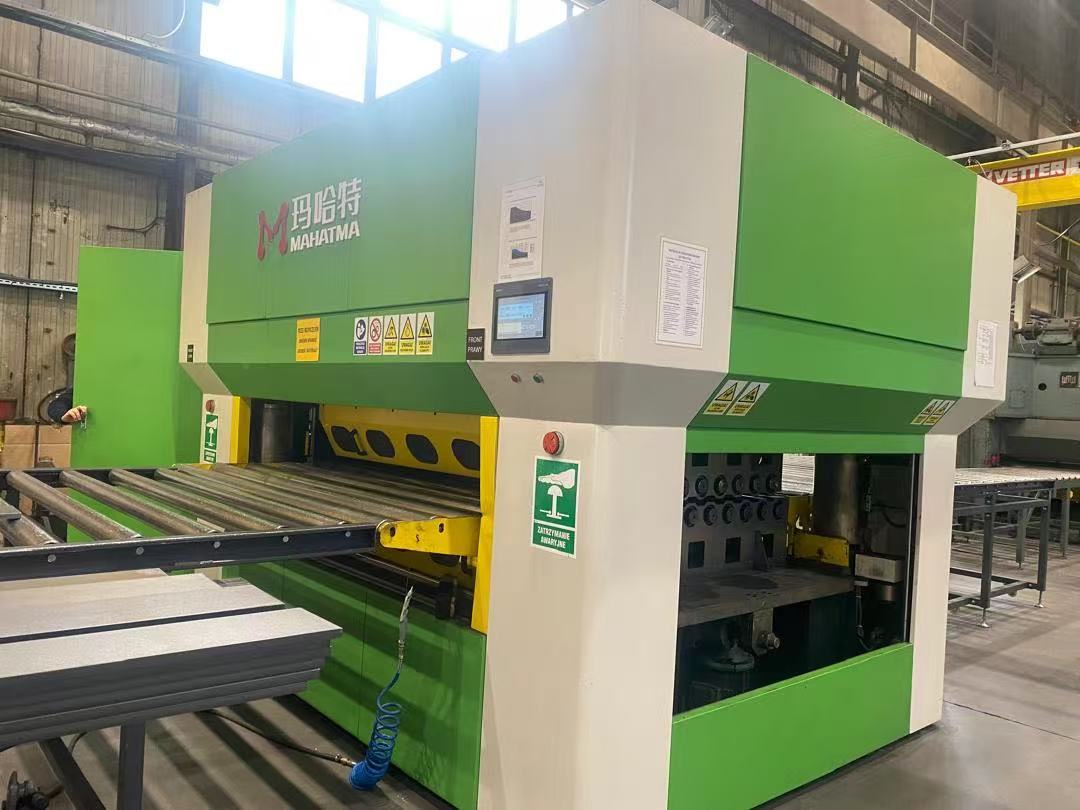
Integration is where a technical shortlist meets plant reality. MAHATMA's blanking lines and CNC levelers provide MES/ERP interfaces, and automation modules - loading carts, conveyors, robots, vision inspection and AGV - are offered as standard options rather than bespoke engineering. The logic is that these machines are built as line components, so production data, traceability and order scheduling are designed to feed existing systems.
Two references frame the expectation. Zhucheng Group moved from a leveler to a fully automated line in stages, which is how the modular upgrade path is meant to work: start with the leveler, add feeding and stacking automation later. A Jiangsu NEV parts maker recorded roughly a 45% capacity gain after automation modules were integrated around its existing process.
What the buyer has to supply early is equally specific: part envelope, takt target and current line layout. Integration plans are engineered from those three inputs, and a shortlist that ignores them tends to be re-opened after the purchase order rather than before it.
Testing your own material before the order
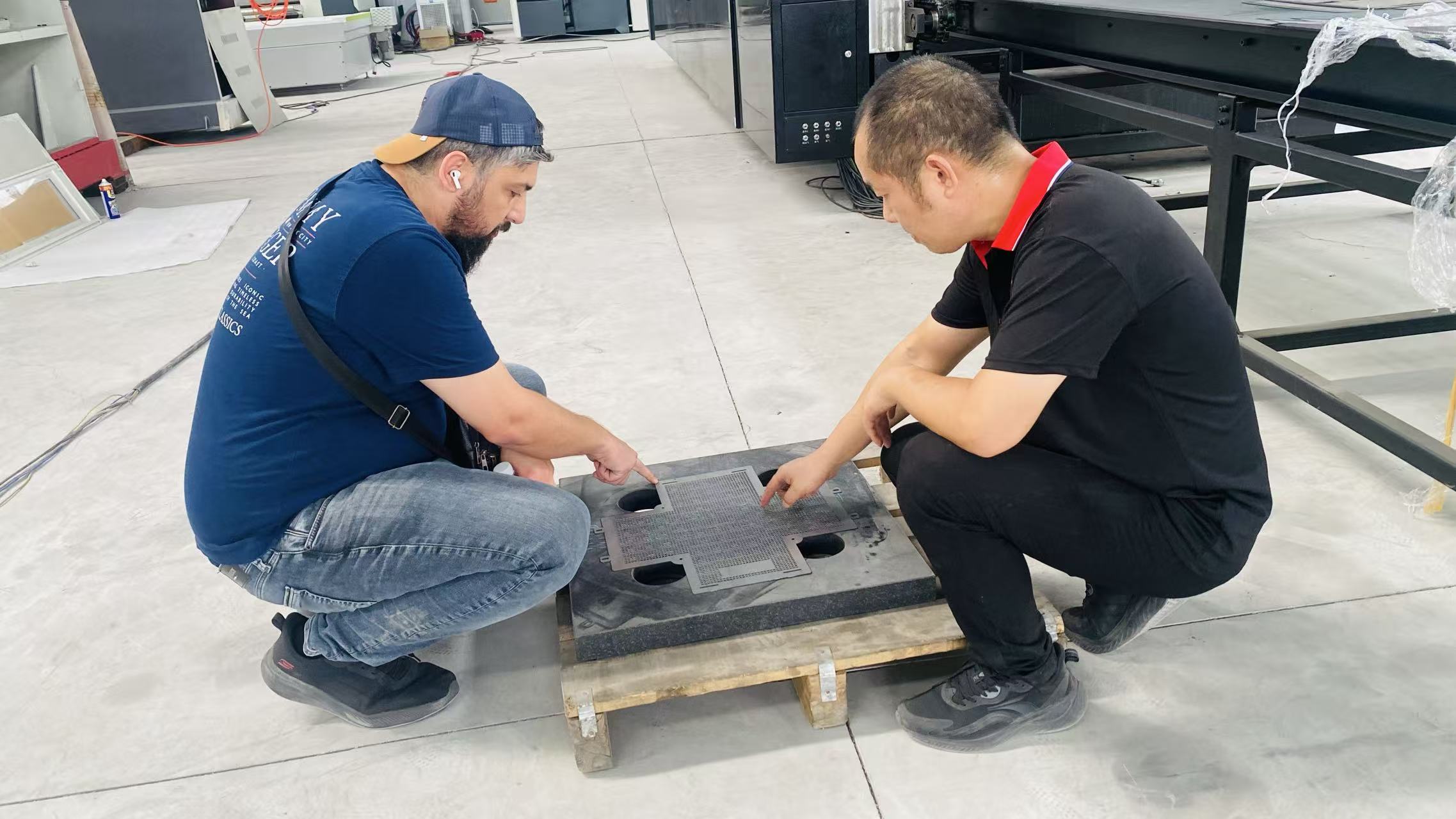
A leveling machine's flatness claim is only meaningful on the material that will actually run. MAHATMA's sample test is free: send 1-2 meters of material or representative parts, with material grade, thickness and the flatness target noted, and the material is leveled on the recommended machine. A written flatness report and a video of the leveling run follow within days; the buyer covers shipping of the material only.
The test is most useful when it is set up to fail. Send worst-condition material rather than best - the coil that springs back, the plate with the heaviest crossbow - because that is the condition the production line will meet on a Monday morning.
Factory-side evidence complements the sample result: laser 3D online flatness detection, ultrasonic flaw detection on rollers, hardness uniformity testing, and a full-load trial run before shipment. MAHATMA publishes flatness down to 0.05 mm in a verified titanium-fixture case, with typical production results of 0.05-0.20 mm/m²; for reference, flatness in precision leveling is normally quantified in I-units or mm/m rather than in vague terms.
Where this shortlist stops
Four limits deserve to be stated plainly, because a shortlist that only lists advantages is not a buying tool.
- One machine cannot span everything. A leveler optimized for thick plate cannot hold thin sheet precisely, and the reverse is equally true. Where the material range is genuinely wide, the realistic answer is a two-machine plan rather than one oversized unit.
- Rated thickness is conditional. Published ratings assume a reference grade such as Q235 / 235 MPa. High-strength steel, aluminum and titanium require derating and recalculation, and the sample test is the check on that arithmetic.
- Certification scope is not uniform across series. MAHATMA's CE certificate M.2025.206.C113032, issued by UDEM and valid to 15 January 2030, is declared for the hydraulic precision leveling machine against EN ISO 12100:2010 and related standards. Its ISO 9001:2015 certificate 62825Q9729R0M, issued by Zhongtian Hongtu International Certification and valid to 26 May 2028, covers design and assembly of high-precision leveling machines, uncoiler laser blanking lines and automatic shearing lines. A buyer specifying a different series for Europe should confirm which declaration applies to that configuration rather than assume the certificate covers it.
- Track-record depth varies by supplier. KOHLER Maschinenbau reports more than 6,700 leveling projects worldwide as of late 2023, and ARKU was recognized among Germany's top 500 hidden market leaders for 2025. Those are reference-depth benchmarks for comparison, not quality verdicts - but they indicate what a buyer is trading when choosing a shorter, faster-moving supply relationship.
This shortlist also covers one brand's portfolio only. Other suppliers would require a separate evaluation on the same criteria.
What the market data suggests about timing
The context around these decisions is expanding rather than contracting. The global metal forming equipment market, which includes leveling and roll forming machines, is valued at USD 45.8 billion in 2025, with Asia Pacific holding a 42.5% revenue share that year; sheet metal processing equipment in Asia Pacific alone generated USD 18.36 billion in 2025.
Cut-to-length is a useful proxy for line-level demand. One estimate puts the global cut-to-length line system market at USD 3.42 billion in 2024, while a separate forecast projects cut-to-length machines growing from USD 4.28 billion in 2026 to USD 5.94 billion by 2032 at a 5.52% CAGR. The two figures are not directly comparable because one measures full systems and the other individual machines - a scope difference worth remembering when a supplier quotes a market number in a proposal.
Two adoption signals matter more for the shortlist itself. CNC technology accounted for 85.7% of the machine tools market in 2025, which makes CNC control a baseline expectation rather than a premium option, and the automotive segment accounted for 41.37% of sheet metal processing equipment share in 2026, which is the segment where laser blanking and stress-relief leveling carry the highest cost of failure. On the supply side, China's exports of metalworking machine parts rose 20.6% year on year in June 2026, with major destinations including Japan, Russia, the USA, India and Vietnam - MAHATMA's own export share is around 30%, with the EU, USA and Asia as main markets.
A short procurement checklist
| Check | What to ask | Why it changes the shortlist |
|---|---|---|
| Material envelope | Thickness range, width, grade and yield strength, flatness target | Determines whether a CNC, servo, hydraulic or plate option is even eligible |
| Line interface | MES/ERP data points, takt target, existing layout | Separates machines designed as line modules from retrofitted stand-alones |
| Sample test | Own material, worst condition, written flatness report and video | Converts a specification claim into measured evidence |
| Certification scope | Which declaration covers the configured series and destination market | Avoids customs and acceptance problems at commissioning |
| Upgrade path | Automation modules available later: loading, conveying, robots, vision, AGV | Protects the investment if volumes rise after year one |
| Service footprint | Commissioning engineers, spare-parts warehousing, operator training | Decides how fast a line returns to production after a stoppage |
Outlook
The direction of travel is toward leveling as a controlled line function rather than a mechanical add-on. Closed-loop flatness inspection, stored recipes tied to MES records, and staged automation upgrades all push the same way: the leveler becomes a data-producing component whose performance can be audited per order. For buyers, that shifts evaluation weight from the machine's headline specification to its integration behavior and its verifiable results on their own material.
Manufacturing capacity supports that reading on the supply side. MAHATMA operates a 50,000 m² facility with 300 employees, a 26-engineer R&D team, annual output of 500 sets and monthly capacity of 50 units at a 45-day lead time and a one-unit minimum order, backed by more than 230 patents and 28 overseas marketing and service networks serving customers in over 100 countries.
FAQ
Which leveler should I choose for my material?
Four inputs drive the answer: thickness range, width, material grade (yield strength) and flatness target. Leveling force depends on thickness and yield strength together, so published model ratings based on a reference grade must be recalculated for high-strength steel, aluminum or titanium. A supplier should return a matched model and a sample verification on that basis before a model is fixed.
Can the equipment integrate with my MES/ERP and existing production line?
Yes. MAHATMA blanking lines and CNC levelers provide MES/ERP interfaces, and automation modules - loading carts, conveyors, robots, vision inspection and AGV - are added as standard options. Production data, traceability and order scheduling are designed to connect to existing systems, and the upgrade path is modular: a buyer can start with a leveler and add feeding and stacking automation later. Part envelope, takt target and current line layout need to be provided early, because the integration plan is engineered from them.
Can I test my own material on the machine before buying?
The sample test is free. A buyer sends 1-2 meters of material or representative parts, with grade, thickness and flatness target noted, and the material is leveled on the recommended machine. A written test report with measured flatness data, the process parameters used, and a video of the leveling run follow within days; the buyer covers shipping of the material only. Testing worst-condition material rather than best-condition material gives the more useful result.
What flatness can a leveling machine actually achieve on my parts?
MAHATMA publishes flatness down to 0.05 mm in a verified case on titanium fixtures, with typical production results in the 0.05-0.20 mm/m² range. The mechanism is multi-roll alternating bending that relieves internal stress, supported on precision models by laser 3D inspection with closed-loop correction. Final flatness depends on material grade, thickness and incoming coil condition, so achievable flatness is normally confirmed through a sample test on the buyer's own material with a written report before ordering.
Do MAHATMA machines have CE certification and can they be exported to the EU and US?
MAHATMA holds a CE Machinery Directive attestation of conformity, certificate M.2025.206.C113032 issued by UDEM, valid from 16 January 2025 to 15 January 2030, with a declared scope of hydraulic precision leveling machine under EN ISO 12100:2010 and related standards. Quality management is certified to GB/T19001-2016 / ISO 9001:2015 under certificate 62825Q9729R0M, valid to 26 May 2028, covering high-precision leveling machines, uncoiler laser blanking lines and automatic shearing lines. For destinations outside the EU, buyers should confirm the applicable market requirements and the declaration tied to the specific series and configuration being ordered.
For full model ranges, line configurations and technical data, the MAHATMA Leveler brand brochure (English) is available for download.
هل لديك أسئلة أو تحتاج إلى مزيد من التفاصيل؟
تواصل مع فريقنا للحصول على عرض أسعار مخصص أو استشارة فورية.
طلب عرض أسعار
املأ النموذج أدناه وسيتواصل معك فريقنا بعرض مقترح مخصص.
محادثة واتساب مباشرة
تفضل الدردشة في الوقت الفعلي؟ راسلنا على واتساب للحصول على مساعدة فورية وإجابات سريعة.
- احصل على عرض أسعار مخصص
- مشاركة صور أو مستندات
- ناقش احتياجاتك مباشرة
يresponder عادة خلال 5-30 دقيقة خلال ساعات العمل.