
Class 1 Reflective Warning Posts: What the Qualification File Should Show
Class 1 Reflective Warning Posts: What the Qualification File Should Show
A Class 1 reflective warning post qualification file should let a buyer trace three things in order: who makes the product, what reflective class is being claimed, and what material and performance data support that claim under real site conditions. The certificate starts that chain of evidence. It does not finish it.
Most files a procurement team receives contain one strong document and several weak ones. The strong document is usually a company registration certificate. The weak ones are usually the specification lines that matter most on a highway ramp after dark: reflective grade, visible distance, tensile strength, temperature range and rebound behaviour.
This reference uses the Mnsd YD-WPS75 warning post to show which lines in that file a buyer can check immediately, which ones need a supporting record, and which gaps should be closed in writing before a purchase order is issued.
Start with what the certificate actually certifies
Mnsd, the brand of Tiantai Yuanda Traffic Device Co., Ltd (www.mnsdtraffic.com), holds Business License No. 91331023669153260K, issued by the Market Supervision Administration under the standard listed as China Policy, valid from 13 November 2007 to 13 November 2107, covering the warning post business.
Each detail answers a different question. The number and issuing authority answer “is this a registered legal entity?” The validity period answers “was that registration active when I ordered?” The scope answers “does the registration cover this product category?” None of them answers the question actually being asked, which is whether a YD-WPS75 performs as a Class 1 reflective post.
A business license registers a company. It does not test a product. The two document types are often bundled in the same PDF, which is where the confusion begins: the certificate on page one lends its authority to the specification table on page five, although the two were produced by different processes and carry different evidentiary weight.
Trade classification sits in a similar category. Data providers classify plastic delineator posts under HS 3926.90, with 3926.90.9880 used for US imports and 3926.90.97 cited for China and global classification. That code tells a customs broker how to file the shipment. It says nothing about reflectivity or material grade.
| Document in the file | What it establishes | What it cannot establish |
|---|---|---|
| Business License 91331023669153260K | Registered entity, issuing authority, validity dates, product-category coverage | Reflective class, material grade, dimensional tolerance, performance |
| Product specification sheet (YD-WPS75) | Declared material, dimensions, reflective grade and performance values for a named model | Whether those values were measured, by whom, or on which batch |
| Reflective sheeting data | Sheeting product identity and its class, when supplied with a product reference | That the same sheeting is applied on every production run |
| Material test report | Measured tensile, elongation and hardness values under a stated method | Behaviour of the finished post under vehicle impact |
| Dimensional drawing | Nominal size and, where dimensioned, tolerances | Base mass or anchor specification unless separately stated |
| Warranty terms | What the supplier commits to remedy, and for how long | Conformity with an external product standard |

Entity qualification and product qualification are different documents. A business license confirms registration, not reflective class.
The Class 1 / HIP line is a specification claim, not a test result
The YD-WPS75 sheet lists its reflective grade as High-Intensity Prismatic (HIP) / Class 1, with 250 mm reflective tape applied in double or triple sleeves, supplied in silver white or fluorescent yellow, and a stated visibility distance of 200+ metres.
Every element there is checkable, but only against the right evidence. A buyer can confirm the claim exists, that it names a specific model, and that tape width and colour options are defined. What the line does not do on its own is name the sheeting product behind the class label, the method used to arrive at the 200-metre figure, or the observation geometry under which that distance was determined.
“Class 1” is also not a single universal vocabulary. Class numbering differs between reflective sheeting schemes and between national road-authority specifications, so a file should name the standard or scheme alongside the class. A bare class number asks the reader to assume a frame of reference that may not be the one their road authority uses.
European buyers may encounter EN 13422:2019, published by CEN/TC 226 under the title Portable Traffic Cones and Cylinders Standard and catalogued as the core European standard for deformable warning devices. It is a useful anchor when a project actually invokes it, and it is not automatically the governing document for a given post on a given project. The qualification file should state which standard, if any, the product is declared against; the buyer should confirm that matches the specification their own project applies.
A practical read: request the sheeting manufacturer's product data with the class printed on it, then confirm the tape applied to the post matches that product by reference or batch. Two questions close most of the gap — which sheeting is this class taken from, and which method produced the visibility figure.
The material lines that carry the flexibility promise
For the YD-WPS75, the load-bearing material lines are a PU body, tensile strength of 15.0 MPa, elongation at break of 400%, and hardness of 80–85 Shore A. These figures underpin the words “flexible” and “self-recovering” elsewhere on the sheet, and they should be read as a set rather than individually.
Tensile strength describes the stress at which the material breaks. Elongation at break describes how far it stretches before that happens. A pair of 15.0 MPa and 400% describes a deformation envelope: the material is expected to extend to several times its original length before failure. It does not, by itself, describe how a finished post behaves when a wheel passes over it, because the post is a structure — body, base and fixing — not a test coupon.
Hardness in Shore A is a separate property and, helpfully for buyers, a directly testable one. It also depends on the specimen and the temperature at which the reading is taken, so the file should state what was measured — a moulded plaque or a section of the post body — and under what conditions. Without that, an 80–85 Shore A figure is only loosely comparable across suppliers.
Interpretation should stay disciplined here. A supplier technical comparison published in 2026 describes PU posts as designed to return to their original state after thousands of impacts. That is a design-intent statement about a material family, not a test result for a specific product. Mnsd's own process description includes a 1,000-plus compression and rebound test within factory quality control. Internal testing of that kind is meaningful — it indicates the producer measures the property rather than only advertising it — but it is a factory record, not third-party certification. Buyers who need the distinction should ask for the record itself: sample size, cycle count, pass criteria and test temperature.
Temperature, UV and ageing: the range needs a definition
The YD-WPS75 is specified for -40°C to +70°C, with a UV-stabilised coating, an anti-oxidant and colourfast treatment described as lasting over three years, plus water and oil resistance.
The temperature line is the one most often misread. A range can mean several different things: the material remains functional across it; the material does not crack or embrittle across it; or the product can be stored across it without deformation. These are not equivalent, and a file that lists a range without a method leaves the buyer to guess. The follow-up is short: is this a service range or a storage range, and what was tested at each end?
Ageing claims follow the same logic. Mnsd lists a three-year UV-resistance guarantee against fading in its after-sales terms. That is a commercial commitment from the manufacturer, and its value depends entirely on scope: which colours are covered, what exposure conditions are assumed, what measurement defines fading, and what remedy applies. A guarantee is a strong document when it is specific and a weak one when it is a sentence.
Dimensions, base and fixing: where files usually go quiet
The YD-WPS75 is listed at 750 × 80 × 200 mm, with a 750 mm height and a 200 × 80 mm base, a PU body on a recycled rubber or integrated plastic base, expansion-bolt fixing through three or four holes, and a ring top for chain attachment.
Those lines are easy to check with a tape measure on a sample. What they do not settle is stability. Base construction is stated, but base mass is not part of the listed dimensions, and base mass together with anchor specification is what determines behaviour in wind and glancing contact. Where the base is rubber rather than a ballasted plastic base, the fixing detail carries more of the load, which makes the anchor specification part of the performance story rather than an installation footnote.
Three requests finish this section: a dimensioned drawing with tolerances, the anchor diameter and embedment the base holes are designed for, and the substrate assumption behind it — asphalt, concrete or a kerbed surface. On a permanent installation, those items decide whether a correctly manufactured post stays upright through a season.
Verifying 360° flexibility and self-recovery before you commit
The sheet states 360° flexibility with impact resistance and rapid rebound after vehicle crush. These are performance descriptors, and most warning post sheets, from any supplier, state them without a pass threshold. That is precisely why the qualification file is the right place to define one.
- Bend the sample through a full 360° at room temperature and again after cold conditioning, then inspect for permanent set, whitening or cracking at the bend.
- Check the reflective sleeve adhesion at the bend line afterwards. Tape lifting is the failure buyers notice first, and it changes visibility performance without changing the post's shape.
- Confirm what rebound means in the supplier's record: cycles applied, deformation used, recovery time and residual deformation accepted.
- Inspect the ring top and base joint on the same sample, because both concentrate stress when a post is crushed and released.
Agreeing a residual-deformation threshold in writing turns a descriptive claim into a specification line both sides can test. It is ordinary procurement practice and needs no laboratory.
Matching the file to the application
Flexible warning posts are used where alignment and separation must be visible but forgiving: lane separation on expressways, highway ramps, T-junctions, urban sidewalk protection and parking structure entrances. Pexco, a US delineator supplier, describes flexible roadside delineator posts in similar functional terms — impact-resistant plastic posts used to warn drivers of a change in roadway alignment. The function is consistent across markets; the acceptance criteria are not.
Mnsd's own project record includes a contractor road-safety project in Vietnam, where warning posts were used to warn vehicles and pedestrians and to mark road edges and hazardous areas; the record states the project was completed and accepted by the local authority. Read that for what it is. Authority acceptance is evidence that a buyer's specification was satisfied on that project. It is not a reflectivity test report, and it does not transfer to another road authority's requirements.
What the market context changes for buyers
The road safety market, covering hardware, software and services, was valued at USD 7.62 billion in 2026 according to MarketsandMarkets research. Volume at that scale tends to professionalise purchasing: as a category grows, buyers stop selecting on unit price alone and start asking what the paperwork proves.
Interpretation should stay proportionate. A growing market does not make any individual supplier's documentation stronger, and it does not raise the reflective class of any post. What it does change is the cost of a weak file — a rejected shipment at a border, or a substitution discovered after installation, is harder to absorb in a programme that already has a delivery schedule attached.
Gaps to close in writing before purchase
- The scheme behind “Class 1.” Ask which standard or sheeting scheme the class number references, and whether the project's own specification uses the same system.
- Sheeting identity and batch traceability. Ask for the sheeting product reference and how it is verified against the tape applied to a specific production lot.
- Test method for every performance number. A value without a method — tensile, elongation, hardness, visibility distance — cannot be compared with a competing offer.
- Base mass and anchor specification. Neither appears in the listed dimensions; both determine stability on a bolt-down installation.
- Warranty scope for UV and colour. Clarify covered colours, exposure assumptions, the definition of fading and the remedy offered.
- Certificate scope. Confirm which legal entity and which product models the document actually covers, since a general scope statement is not a model-level approval.
A qualification file checklist
Assembled in this order, the file answers buyer questions in the sequence buyers actually ask them, and each document earns its place.
| Priority | Document | Minimum content | Why it matters |
|---|---|---|---|
| 1 | Entity certificate | Registration number, issuing authority, validity, product-category scope | Confirms the supplier is a registered business in the declared category |
| 2 | Model specification | Exact model code, dimensions, material, reflective grade | Prevents claims moving between models in the same range |
| 3 | Reflective sheeting data | Sheeting product reference and its class | Connects the class label to a real, identifiable material |
| 4 | Material test report | Tensile, elongation and hardness values with test method and conditions | Makes the flexibility and self-recovery claims measurable |
| 5 | Dimensioned drawing | Nominal dimensions plus tolerances and anchor hole specification | Supports incoming inspection and fixing design |
| 6 | Ageing and warranty evidence | UV treatment described, warranty term, covered colours and remedy | Turns a durability claim into a defined commitment |
| 7 | Batch record | Lot reference linking the shipped goods to the tested specification | Shows the file describes the goods actually delivered |
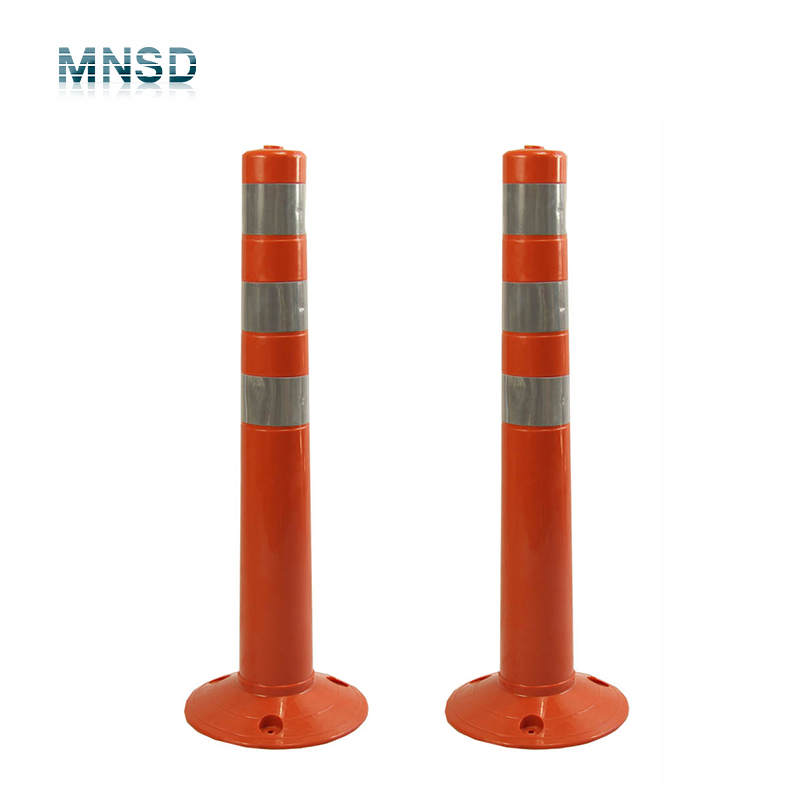
The YD-WPS75: a 750 mm PU warning post specified as HIP / Class 1 with 250 mm reflective sleeves, 200+ metre visibility and a -40°C to +70°C range.
What to expect as this category matures
The direction of travel in traffic safety procurement is toward traceable files rather than thick ones. A supplier able to place a model code, a standard reference, a test method and a batch number against each claim is easier to qualify than one that cannot, regardless of how impressive the certificate on page one looks.
For the YD-WPS75, the file already contains the lines that matter: a stated HIP / Class 1 grade, a 200+ metre visibility figure, PU construction with 360° flexibility and self-recovery, 15.0 MPa tensile strength and a -40°C to +70°C temperature range. The buyer's task is not to doubt those lines. It is to ask which document supports each one, and to close the ones still standing as sentences before the order is placed.
Manufacturer documentation, including the full traffic safety product catalogue, can be downloaded here: Mnsd traffic safety product brochure (PDF).
FAQ: reading a Class 1 warning post qualification file
Does a business license prove that a warning post meets Class 1 reflectivity?
No. A business license registers a legal entity and confirms the issuing authority, validity dates and product-category coverage. It says nothing about reflective grade, material performance or dimensional tolerance. Those attributes require a product-level document, such as sheeting data or a material test report, referenced to the specific model.
Which document should sit behind a HIP / Class 1 claim?
The strongest support is the reflective sheeting manufacturer's product data, showing the sheeting reference and its class, combined with a method for verifying that the tape applied to the finished post matches that reference. Because class numbering differs between schemes and national specifications, the document should also name the standard or scheme the class belongs to.
What do 15.0 MPa tensile strength and 400% elongation at break tell a buyer?
Tensile strength is the stress at which the material breaks; elongation at break is how far it stretches before that point. Together they describe a deformation envelope for the material. They do not describe the behaviour of the assembled post — body, base and fixing — under a vehicle, which is why rebound and bend evidence is requested separately.
Is -40°C to +70°C a service range or a storage range?
The figure alone does not say. A temperature range can mean the product remains functional, that the material does not crack or embrittle, or that it can be stored without deformation. Buyers should ask which definition applies and what was tested at each end of the range, because the three interpretations lead to different expectations on site.
How can a buyer check 360° flexibility and self-recovery before ordering?
Bend a sample through a full 360° at room temperature and after cold conditioning, then look for permanent set, whitening or cracking at the bend, and check the reflective sleeve adhesion afterwards. Ask the supplier to state cycle count, applied deformation and accepted residual deformation in writing, so the descriptive claim becomes a testable line.
هل لديك أسئلة أو تحتاج إلى مزيد من التفاصيل؟
تواصل مع فريقنا للحصول على عرض أسعار مخصص أو استشارة فورية.
طلب عرض أسعار
املأ النموذج أدناه وسيتواصل معك فريقنا بعرض مقترح مخصص.
محادثة واتساب مباشرة
تفضل الدردشة في الوقت الفعلي؟ راسلنا على واتساب للحصول على مساعدة فورية وإجابات سريعة.
- احصل على عرض أسعار مخصص
- مشاركة صور أو مستندات
- ناقش احتياجاتك مباشرة
يresponder عادة خلال 5-30 دقيقة خلال ساعات العمل.