
Classroom vs. Corporate Desk: A Writing Tool Scenario Fit Guide
Industry Reference · Office Supplies / Writing Instruments
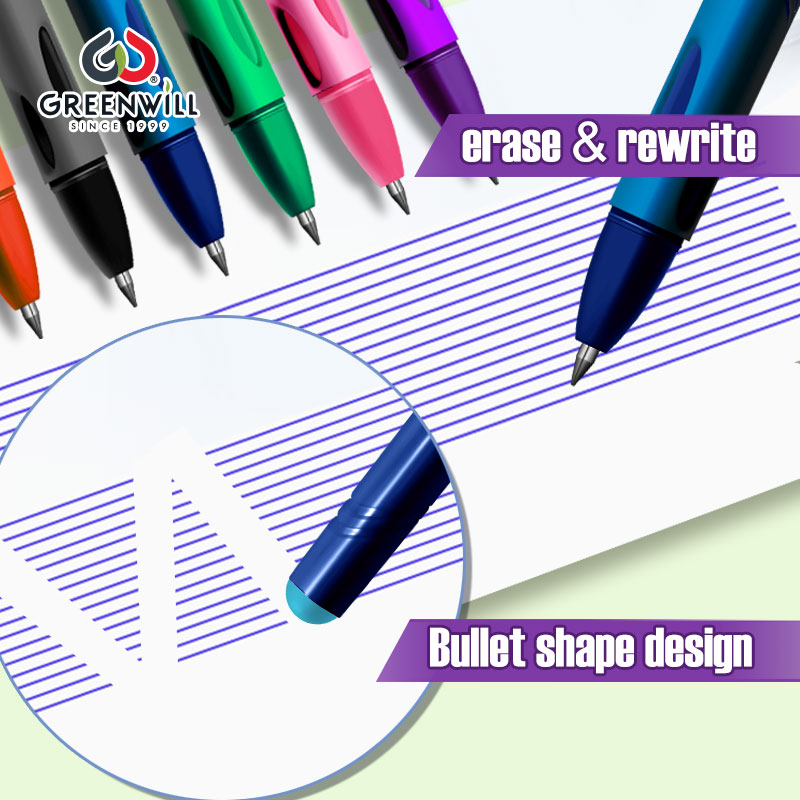
Classrooms and corporate desks have opposite error tolerances, and that difference — not unit price — should decide which writing tools a procurement team specifies. Education workflows are built around correction: a learner drafts, erases and redrafts on the same sheet. Corporate document workflows are built around permanence: signatures, filed copies and archived records are expected to survive handling, time and inspection. A purchase list that treats both environments as one generic “pen” line item under-serves each of them in a different way.
The category is large enough that this is not a marginal decision. The global writing instruments market was valued at USD 19.2 billion in 2025 and is projected to reach USD 27.8 billion by 2033 (Grand View Research). Pens accounted for a 36.3% revenue share of that market in 2025. The wider office supplies market was valued at approximately USD 176.5 billion in 2024 (Spherical Insights). Inside writing instruments, the gel pen segment — the family most erasable products belong to — was valued at USD 4.8 billion in 2025 with a projected path to USD 8.1 billion by 2034 (Dataintelo), while the erasable gel pen segment specifically was valued at USD 1.38 billion in 2024 and is expected to reach USD 2.56 billion by 2033 (Market Intelo).
This reference maps writing tools to two real environments — the classroom and the corporate desk — and explains how a buyer can specify by workflow instead of defaulting to a single SKU for an entire organisation.
Why One Writing Tool Cannot Serve Two Error Tolerances
A classroom specification has to answer three questions before price is even discussed. Can a learner correct a mistake without starting the page again? Does the tool create debris, require sharpening, or depend on a separate accessory during a lesson? And does it meet the safety standards that the destination market applies to student-facing products? A tool that fails any of these three tests creates a cost that never appears on the invoice — lost lesson time, replacement volume, or a compliance question at import.
A corporate specification answers a different set of questions. Does the tool hold a mark that must remain on a signed page? Is the writing comfortable over long sessions for staff who write continuously? And can the same writing instrument serve internal drafting — meeting notes, planning, brainstorming — without introducing a permanence risk onto documents that require a durable mark? In most offices the answer differs by document class, which is why a single SKU rarely satisfies the whole requirement.
| Procurement dimension | Classroom / education | Corporate desk | Tool role that fits |
|---|---|---|---|
| Error tolerance | High — corrections expected on worksheets and notes | Low on signed or filed documents | Erasable gel pen for classwork; ballpoint for documents |
| Write-and-erase frequency | Very high, continuous through a lesson | Moderate — drafts, meeting notes, planning | Erasable gel pen; non-sharpen pencil for drafting |
| Debris and sharpening | Undesirable during lessons | Undesirable at shared desks | Non-sharpen pencil with built-in eraser |
| Permanence requirement | Low for classwork; higher for retained records | High for contracts, filed copies, archives | Standard ballpoint pen where permanence is required |
| Compliance focus | EN71, SVHC, PAHs; ASTM D4236 for US art materials | Same product standards where employees use them | Certified SKUs specified per destination market |
| Consumption profile | Very high and seasonal | Moderate and steady | Bulk pack formats, multi-colour options |
Decision rule: split the requirement into three roles — a drafting tool, a note-taking tool, and a document tool — and then check whether one supplier can cover all three. This changes the SKU mix inside a purchase order rather than increasing the number of suppliers.
How Erasable Pens and Non-Sharpen Pencils Actually Work
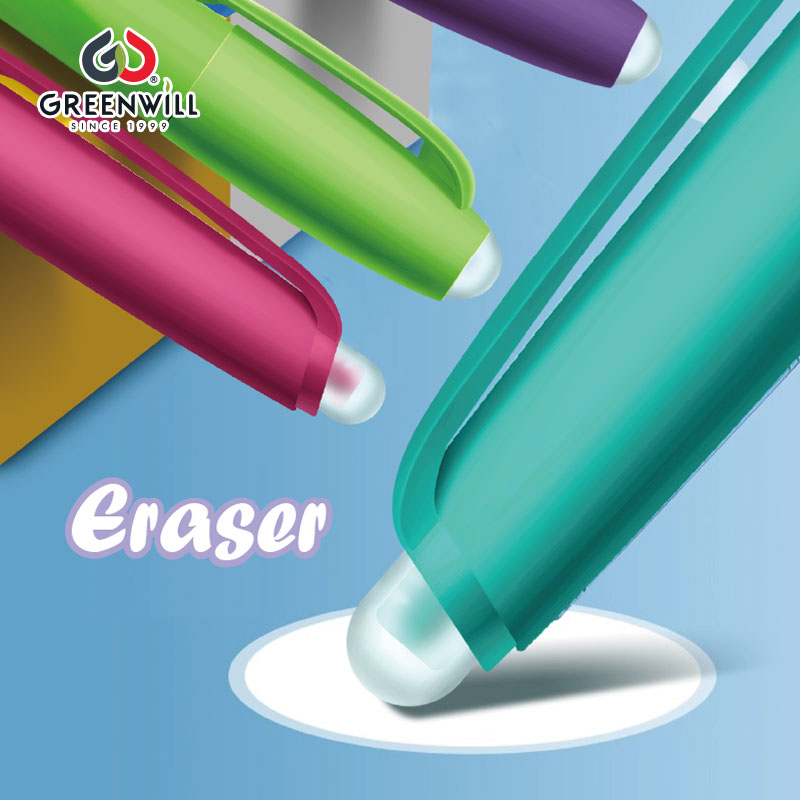
The reversibility that makes an erasable pen useful in a classroom comes from ink chemistry, not from a mechanical eraser. A thermal erasable gel pen uses heat-sensitive erasable ink: the friction of rubbing the paper generates enough heat to break the ink bond, and the mark lifts cleanly instead of smearing. This is the mechanism behind products such as the Greenwill erasable gel pen KP18001, which is built on ABS+AS plastic with heat-sensitive erasable ink, a 0.5 mm tip, multiple colour options and a “no residue” writing characteristic. The same thermal principle applies to the Greenwill erasable gel pen KP100751, which uses ABS with erasable gel ink, a 0.5 mm tip and black, blue or red colour options.
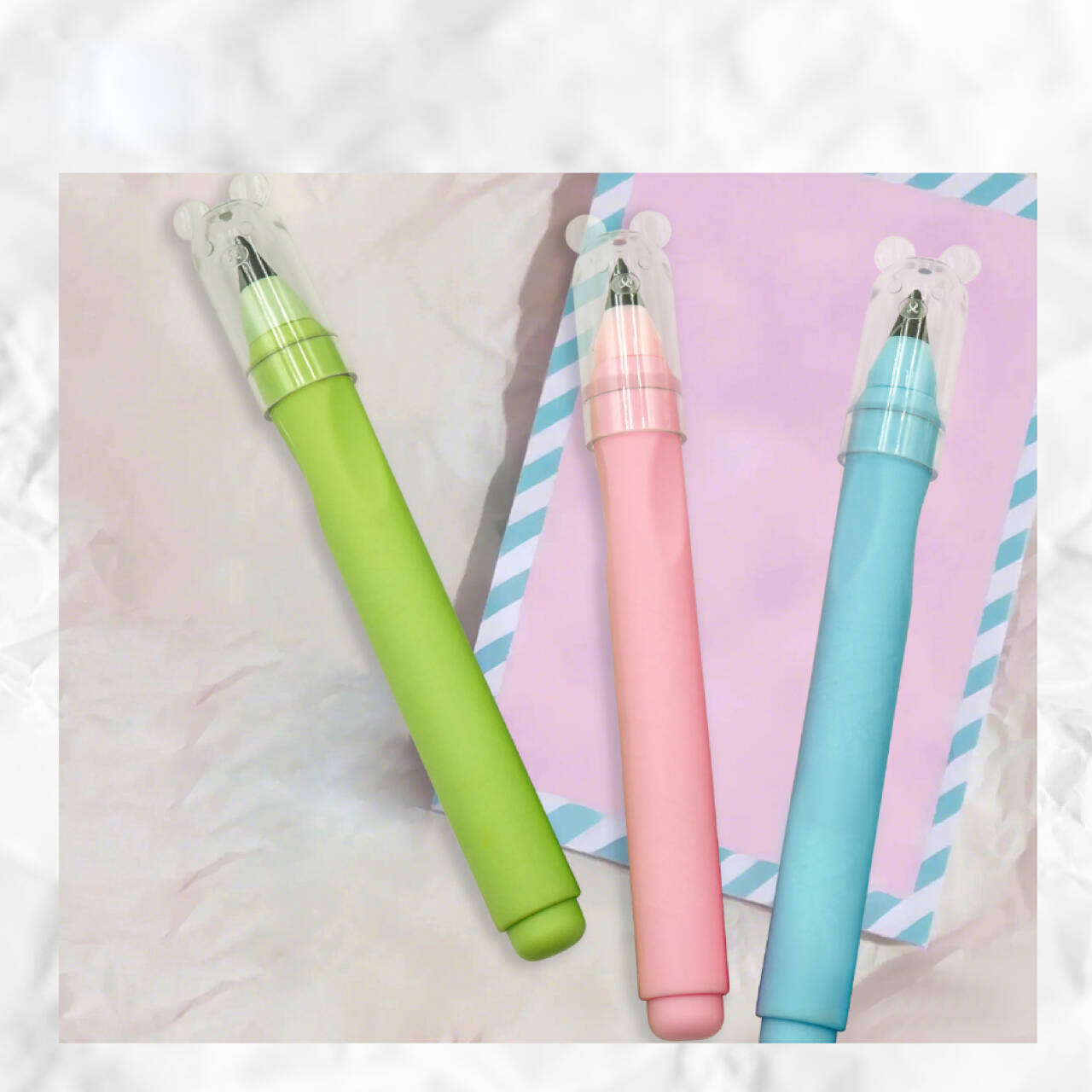
The non-sharpen pencil solves a different classroom problem: it removes the sharpening step entirely. Greenwill’s non-sharpen pencil SL241203 uses a TPE barrel with an alloy nib and an ABS cap, carries an HB lead hardness, and combines writing and erasing in one body through a durable built-in eraser. The specification — no sharpening, no ink, eco-friendly construction — is what makes it a drafting tool rather than a note-taking tool. The related models EP18004 and EP18004-1 follow the same TPE barrel, alloy nib and ABS cap construction with HB lead hardness.
Erasing accessories matter as much as the writing instrument in a mixed school order. A quartz sand eraser such as the Greenwill GW023 / GW024 uses TPR rubber with quartz sand and is described as erasing ink and pencil, with a 70×16×9.4 mm format and PVC-free construction. A two-in-one eraser sharpener such as the GW007 / GW006 / GW013 / GW015 / GW009 series combines a TPR eraser with a stainless steel blade in a PP shell, and is specified for standard graphite pencils in the Φ7–8 mm range.
Two published standards frame how buyers should read category claims. ISO 12757-1 specifies the requirements and test methods for ballpoint pens and refills for general use (International Organization for Standardization). ASTM D4236 governs health hazard labelling for art materials exported to the United States, including pens and pencils (CPSC / Compliance Gate). Neither standard is a marketing label; both define what a supplier has to be able to demonstrate.
Application Fit: Matching Tool to Workflow
In education environments, the writing tool follows the activity, not the student. Drafting, mathematics and sketching sessions suit a non-sharpen pencil with HB lead and an integrated eraser, because the learner can work, correct and continue without interrupting the lesson for a sharpener. Note-taking, worksheet completion and language practice suit a thermal erasable gel pen, because the correction is the point: a 0.5 mm line that can be lifted cleanly keeps a page usable after a mistake. Where a school buys for both activities, the practical split is a pencil-led SKU for draft work and an erasable gel pen SKU for written output.
On a corporate desk, the same tools are useful but the priority order inverts. Contracts, signatures and filed copies call for a standard ballpoint pen, whose permanence is the entire reason for its use and which is the product family covered by ISO 12757-1. Internal work — meeting notes, planning sheets, iteration on a document before it is finalised — is where an erasable gel pen earns its place, because the user needs a reversible mark rather than a permanent one. Sketching, layout planning and quick diagramming suit a non-sharpen pencil, which also removes the sharpening debris that shared desks tend to collect.
Market coverage data from Greenwill’s application profile illustrates how these scenarios cluster geographically: its classroom and office writing projects are recorded across Italy, Spain and Germany, covering daily classroom and office use, high-frequency writing, office bulk procurement, retail product lines and OEM / ODM branded programmes. Reported requirements in those projects include quick-drying and erasable or refillable ink, a comfort grip for long writing sessions, non-toxic materials compliant with EN71 and REACH, ergonomic anti-fatigue design, and customisable colours, shapes and branding.
Where Greenwill Sits in a Scenario-Based Specification
Greenwill stationery, operated by Kunshan Crystal Culture Co.,Ltd, is a Chinese stationery manufacturer founded in 1999 that develops and produces eco-friendly erasers, multi-functional pencil sharpeners and erasable writing pens, and exports roughly 90% of its output to North America, South America, Europe, Southeast Asia, Oceania and the Middle East.
Its production profile is relevant to buyers who are splitting a writing-tool requirement by scenario rather than buying a single SKU. The company operates a 25,000 m² facility with around 100 employees, a 10-person R&D team, and reported annual output of more than 20 million pens, more than 260 tons of erasers and more than 3 million pencil sharpeners. Quoted capacity is 100,000 pens per day and 20 tons of erasers per day, with a stated lead time of 30–45 days and a general OEM / ODM minimum order quantity of typically 20,000 pcs per colour and design. Quality control is described as full-process, from raw materials to finished goods, against EN71-1/2/3/9, REACH, PAHS, SVHC and ASTM D-4236, with FSC, BEPI and ISO certifications supporting its sustainability claims. The company states that it works with 100 international brands, including Papermate, STAEDTLER and Tesco, and that some OEM / ODM relationships have run for more than five years, with some exceeding ten, across partners in Germany, Argentina, Brazil, France, Italy and the United States.
| Workflow role | Model | Specification highlights | Standards | MOQ |
|---|---|---|---|---|
| Note-taking, correction-heavy | Erasable gel pen KP18001 | ABS+AS, heat-sensitive erasable ink, 0.5 mm tip, multi-colour | EN71, ASTM D-4236 | 5,000 pcs |
| Note-taking, three-colour discipline | Erasable gel pen KP100751 | ABS + erasable gel ink, thermal erasable, 0.5 mm tip, black / blue / red | EN71, ASTM | 5,000 pcs |
| Drafting, sketching | Non-sharpen pencil SL241203 | TPE + alloy nib + ABS cap, HB lead, built-in eraser, no sharpening | Not specified on the product sheet | Not specified on the product sheet |
| Drafting, classroom bulk | Non-sharpen pencil EP18004 / EP18004-1 | TPE + alloy nib + ABS cap, HB lead, no sharpening, no ink | EN71, SVHC, PAHs | 20,000 pcs |
| Erasing both ink and pencil | Quartz sand eraser GW023 / GW024 | TPR rubber + quartz sand, 70×16×9.4 mm, PVC-free, dual-use | EN71, SVHC, PAHs | 20,000 pcs |
| Sharpening plus erasing | Eraser sharpener GW007 / GW006 / GW013 / GW015 / GW009 | TPR eraser + stainless steel blade + PP shell, 2-in-1, for Φ7–8 mm pencils | EU EN71-1/2/3/9, SVHC, PAHs | 20,000 pcs |
One detail in that table deserves attention during evaluation: the MOQ structure is not uniform across the range. The two erasable gel pen models are listed at 5,000 pcs, while the general OEM / ODM minimum is typically 20,000 pcs per colour and design, and the pencil and eraser lines are listed at 20,000 pcs. A scenario mix that includes several colours and several SKUs can therefore accumulate MOQ faster than a single-SKU order of the same total volume.
Market Trend Analysis: What the Numbers Signal for Buyers
Three signals are relevant to a scenario-based specification, and all three point in the same direction.
First, the category is expanding rather than consolidating. Writing instruments are projected to move from USD 19.2 billion in 2025 to USD 27.8 billion by 2033, and pens already hold a 36.3% revenue share. Second, the gel family — the technical base for erasable products — is growing faster than the category as a whole in reported terms, moving from USD 4.8 billion in 2025 toward USD 8.1 billion by 2034. Third, the erasable sub-segment is expanding from USD 1.38 billion in 2024 toward USD 2.56 billion by 2033, which indicates that reversible writing is no longer a niche classroom novelty but a defined product family with its own sourcing base.
Supply is concentrated. Asia Pacific accounted for a 42.3% revenue share of the global gel pen market in 2025, led by China and India (Dataintelo). For a buyer in Europe or North America, that concentration explains both the depth of OEM / ODM capability available and the importance of compliance documentation, since the same supply base serves many regulated markets at once.
One caution belongs in any trend discussion. Published market estimates for writing instruments vary substantially by source scope — Grand View Research places the 2025 market at USD 19.2 billion, while Fortune Business Insights uses a figure of USD 47.64 billion for the same category, partly because of differences in what is counted. Buyers should treat any single market figure as a directional signal, and rely on their own consumption data for volume planning. For competitive context, the pen and stationery category is led by established groups including BIC Group, Pilot Corporation, Newell Brands and M&G Stationery (Fortune Business Insights).
Comparison with Traditional Solutions — and Where Each Choice Stops Working
The traditional classroom kit is a wooden pencil plus a separate eraser plus a sharpener. Greenwill states that one of its eraser pencils is equivalent in service life to 20 wooden pencils, two erasers and two sharpeners. Whether or not a buyer adopts that equivalence at face value, the underlying procurement logic is sound: consolidating three consumables into one body reduces the number of items that can go missing mid-lesson, and a non-sharpen pencil removes sharpening debris and blade handling from the classroom entirely.
The traditional corporate approach is simpler: one ballpoint for everything. That works for documents and works poorly for drafting, because the user has no way to correct an internal note that was written in permanent ink on the wrong page or in the wrong column.
The boundaries matter as much as the benefits, and buyers should treat the following as real constraints rather than fine print.
Thermal erasable ink is heat-sensitive by design. The same heat response that allows a clean erasure also means an erasable mark is not intended for records that must remain permanent or for environments where documents are exposed to high temperatures. For contracts, legal documents and archived records, a standard ballpoint pen remains the appropriate product, and no erasable model in this article claims otherwise.
ISO 12757-1 is a ballpoint standard. It specifies requirements and test methods for ballpoint pens and refills for general use. Erasable gel pens are a different product family, and buyers should not assume that a standard written for ballpoints automatically covers them; the applicable compliance route has to be confirmed per product and per destination market. For art materials exported to the United States, ASTM D4236 labelling requirements apply in addition.
The non-sharpen pencil range is specified at HB lead hardness. That suits everyday writing and general sketching, but buyers who need a spread of lead grades — for example harder leads for fine technical drawing — will not find that variation in the HB-specified models.
MOQ and lead time require planning. With erasable pens listed at 5,000 pcs, pencil and eraser lines at 20,000 pcs, a general OEM / ODM minimum of typically 20,000 pcs per colour and design, and a stated lead time of 30–45 days, a two-environment specification needs to be planned backward from the delivery date. A school-term changeover or a fiscal-year refresh cannot be served by a late-stage SKU decision.
A Procurement Framework for Two Environments
The following sequence converts the scenario logic into an order-ready specification.
Step 1 — Classify user groups by error tolerance. Separate learners and document-handling staff from internal drafting users. The first group needs reversibility, the second needs durability on final documents, and the third needs both at different stages of the same task.
Step 2 — Assign one tool role per group. Note-taking and correction: erasable gel pen at 0.5 mm. Drafting and sketching: non-sharpen pencil with HB lead and built-in eraser. Final documents: standard ballpoint pen. Supporting accessories: a dual-use eraser for ink and pencil, and a two-in-one eraser sharpener where standard graphite pencils remain in use.
Step 3 — Check compliance against the destination market. For student-facing and employee-facing products, confirm EN71-1/2/3/9, REACH, PAHS and SVHC documentation where relevant, plus ASTM D-4236 where the US art materials route applies.
Step 4 — Reconcile MOQ, colour count and lead time. Total the order across colours before committing, since the minimum applies per colour and design in OEM / ODM programmes. Build the 30–45 day lead time into the academic or fiscal calendar rather than treating it as a buffer.
Step 5 — Validate with a trial before scaling. Trial quantities exist precisely to test ergonomics, ink behaviour and packaging against real classroom or office use before a full-season commitment is placed.
Future Outlook
The trajectory of the erasable segment — from USD 1.38 billion in 2024 toward USD 2.56 billion by 2033 — suggests that reversible writing will continue to move from a classroom preference into a standard option in office procurement. As that happens, the specification question stops being “erasable or not” and becomes “erasable for which workflow.”
Three developments are likely to shape buyer decisions over the next planning cycles. Compliance documentation will become a more prominent part of supplier selection, since the same manufacturing base serves regulated markets across North America, Europe and Asia. Multi-role writing-tool specifications will become more common, with buyers deliberately pairing a permanent instrument for documents with a reversible instrument for drafting inside a single order. And reusable, refillable and non-sharpen formats will continue to gain ground as organisations formalise their sustainability criteria for consumable stationery.
None of this removes the ballpoint pen from the desk. It simply returns the writing-tool line item to what it always was: a scenario decision that a single SKU was never able to make on its own.
FAQ
Should schools and offices use the same writing tool?
Not as a single SKU. Classrooms and corporate desks have different error tolerances: education workflows assume corrections, while corporate document workflows assume permanence. A practical specification splits the requirement into three roles — a drafting tool such as a non-sharpen pencil with HB lead, a note-taking tool such as a 0.5 mm thermal erasable gel pen, and a document tool such as a standard ballpoint pen. The same supplier can often cover all three roles, so the split changes the SKU mix rather than the supplier list.
When is an erasable pen the wrong choice?
An erasable gel pen is the wrong choice wherever a mark must be permanent. Thermal erasable ink is heat-sensitive by design: the friction that generates heat during erasing is what lifts the ink, which means an erasable mark is not intended for records that must survive permanently or for documents exposed to high temperatures. Contracts, signatures, legal documents and archived records call for a standard ballpoint pen, which is also the product family addressed by ISO 12757-1, the standard specifying requirements and test methods for ballpoint pens and refills for general use.
Is a non-sharpen pencil a replacement for a wooden pencil?
It replaces the wooden pencil, the separate eraser and the sharpener as a combined writing and erasing tool. Greenwill’s non-sharpen pencil SL241203 uses a TPE barrel with an alloy nib and ABS cap, carries an HB lead hardness and includes a built-in eraser, with no sharpening and no ink. The EP18004 and EP18004-1 models follow the same construction. The trade-off is specification range: the models are defined at HB lead hardness, so buyers needing other lead grades for fine technical work will not find that spread in this range.
Which standards should buyers check for school and office writing tools?
For student-facing and employee-facing products, the relevant compliance set includes EN71-1/2/3/9, REACH, PAHS and SVHC, which Greenwill states its production conforms to, alongside FSC, BEPI and ISO certifications for its sustainability framework. For art materials, including pens and pencils, exported to the United States, ASTM D4236 sets the health hazard labelling requirements. For ballpoint pens and refills used in general applications, ISO 12757-1 defines requirements and test methods. Standards apply per product family and per destination market, so each SKU should be confirmed individually.
What MOQ and lead time should a two-environment order plan for?
Greenwill lists erasable gel pens at an MOQ of 5,000 pcs, and pencil and eraser lines at 20,000 pcs, while its general OEM / ODM minimum order quantity is typically 20,000 pcs per colour and design. Stated lead time is 30–45 days, and quoted capacity is 100,000 pens per day and 20 tons of erasers per day. Because minimums apply per colour and design in OEM / ODM programmes, a specification covering several colours across two environments should be totalled before commitment rather than assessed SKU by SKU.
This industry reference is based on manufacturer-provided product and capability information and on published third-party market research and standards documentation. Figures are attributed to their sources; market estimates vary by research scope and should be treated as directional.