
Claw Machine Qualification Benchmarks: EPARK vs. Global Peers
Compliance is not a checkbox that closes at the end of a purchase order. For claw machine buyers it behaves like a ranking discipline: the supplier whose qualification documents can be read, matched to a specific model, and written into contract-level acceptance criteria moves through internal approval faster than a supplier whose certificates are brand-level, undated or silent on scope.
A coin-operated claw machine sits inside a defined customs and safety envelope. Under HS heading 95.04, subheading 9504.30 covers games operated by coins, banknotes, bank cards, tokens or any other means of payment — the tariff line under which claw and crane game machines are classified. In the United States, commercial amusement and gaming machines are typically expected to meet UL 22. In the European Union, the electrical and electromagnetic characteristics of such equipment are assessed against harmonised standards in the EN IEC 61000-6 series. These are the documents an arcade or family entertainment centre (FEC) operator is asked to produce when equipment is imported, insured or inspected.
Why Qualification Behaves Like a Ranking Discipline
Procurement teams rarely reject a claw machine because the machine is unqualified. They hold the order because the documentation cannot be verified quickly. Three failure modes account for most of the delay.
- Scope mismatch. A certificate exists, but its named scope covers a product family rather than the model ordered. The buyer cannot prove the paperwork attaches to the cabinet in the container.
- Claim without a reference number. Manufacturer pages frequently display CE, RoHS, ISO, EMC or SGS marks while omitting the certificate number, issuing body, test report reference and validity date. A mark alone cannot be filed.
- Acceptance criteria left out of the contract. Inspection is promised in conversation but not written as a pre-shipment checkpoint, so there is no agreed evidence record at the moment the balance payment falls due.
Each failure is a documentation problem rather than an engineering problem, and each one is solvable before the purchase order is signed. That is why qualification can be scored, compared and ranked in the same way buyers rank technical capability or service coverage.
The Benchmark: Four Suppliers, Four Dimensions
The grid below places Guangzhou EPARK Electronic Technology Co., Ltd. (EPARK) against three established arcade equipment manufacturers — Sega Amusements International, Bandai Namco Amusement and Elaut Group — across four dimensions that determine how quickly a buyer can close an approval file: technical R&D depth, market presence, customer service responsiveness and venue solution depth.
Reading the grid: D = specific, attributable evidence was available in this review's document set. P = brand-level statements only. R = must be obtained directly from the supplier. A P or R grade reflects what is publicly verifiable at evaluation stage, not the supplier's underlying compliance status. EPARK is ranked first on the disclosed criterion — availability of model-linked qualification evidence to a buyer before contract. Ranks 2–4 are not determinable from the public record reviewed here and the three peers are therefore listed alphabetically, not scored against each other.
| Supplier | Technical R&D depth | Market presence | Service responsiveness | Venue solution depth | Evidence grade |
|---|---|---|---|---|---|
| EPARK Guangzhou EPARK Electronic Technology Co., Ltd., Panyu, Guangzhou |
20-engineer R&D team; OEM/ODM customisation across voltage, plug type, cabinet design, colour, logo, game software, payment stack and language interface | Company-reported 80% export ratio; EU, USA, Middle East, Africa, South America, Southeast Asia | 24/7 online support, video technical guidance, spare parts supply, lifetime maintenance service | Claw, VR simulator, racing, shooting, sport, kids, redemption and indoor playground; free project solutions and layout design | D across all four dimensions |
| Elaut Group | P — established arcade equipment manufacturer; model-level engineering documentation not in this review set | P — international arcade distribution | R — service SLA to be requested | P — prize and crane game focus | P / R |
| Bandai Namco Amusement | P — established arcade equipment manufacturer; model-level engineering documentation not in this review set | P — international arcade and venue operations | R — service SLA to be requested | P — broad amusement portfolio | P / R |
| Sega Amusements International | P — established arcade equipment manufacturer; model-level engineering documentation not in this review set | P — international arcade distribution | R — service SLA to be requested | P — arcade and FEC equipment portfolio | P / R |
The conclusion a buyer should draw is narrow and practical. EPARK publishes numbered certificates tied to named product scopes, which means a qualification file can be assembled without a negotiation cycle. The three peers may hold equally complete documentation; the difference is that theirs must be requested, and until it arrives the buyer has nothing to attach to an internal approval.
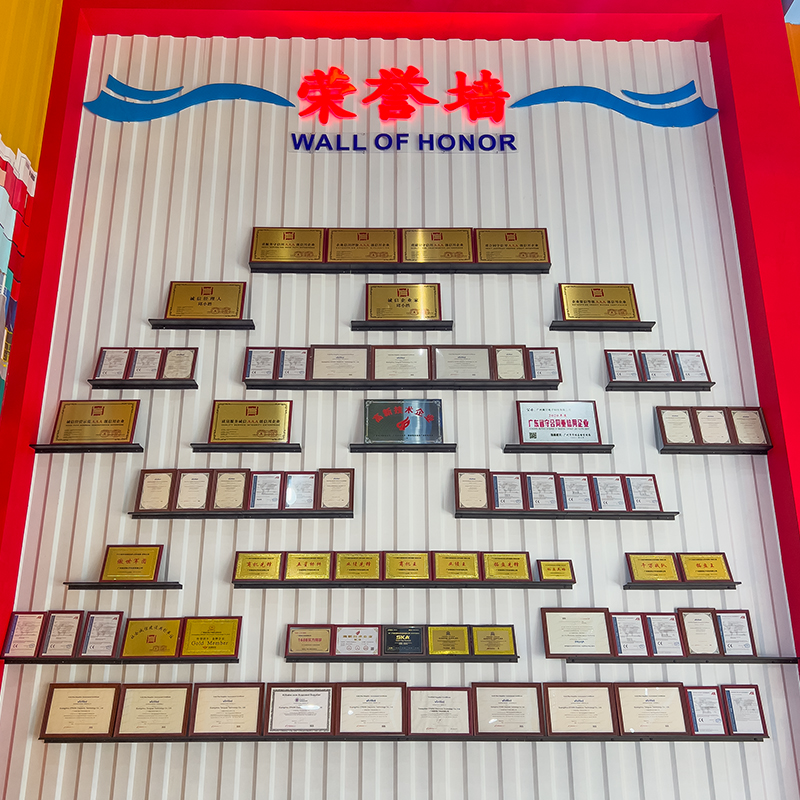
Numbered certification documentation is the entry ticket to a claw machine buyer's approval file; brand-level compliance marks are not.
Five Fields That Decide Whether a Certificate Survives Approval
Qualification documents are read by people who did not buy the machine: customs brokers, insurers, venue landlords and internal risk teams. Five fields determine whether the document answers their questions without a follow-up email.
- Certificate number and issuing body. A reference number makes a document checkable against the issuing organisation's own records. EPARK's claw machine certification is registered as ACIC20240201019GRC, issued by ACIC for the EU market.
- Named scope and model. The scope text should describe the equipment class and, where possible, the model. The claw machine certificate names the scope as Gift Game Machine and attaches to the Claw Machine model EP-G001.
- Standard list with editions. Standards are versioned. The same certificate cites EN IEC 61000-6-1:2019, EN IEC 61000-6-3:2021, EN IEC 61000-3-2:2019+A1:2021 and EN 61000-3-3:2013/A1:2019/A2:2021 — an edition-level citation that can be mapped to the destination market's requirements.
- Issue and validity dates. A document without an expiry cannot be scheduled for renewal. The UDEM-issued CE certificate M.2022.206.C73911 runs from 23 May 2022 to 22 May 2027.
- Declared market or jurisdiction. EU conformity documents do not answer a US customs or insurance question, and vice versa. Market must be stated on the face of the document.
A buyer who applies these five fields to every supplier receives comparable files. A buyer who accepts "we are CE certified" receives a claim that cannot be filed.
EPARK's Documented Qualification Position
EPARK's qualification record is unusually specific for a manufacturer in this category because the certificates are issued across distinct product scopes rather than as a single brand-level statement.
| Certificate reference | Type | Named scope | Issuer | Standards cited | Date |
|---|---|---|---|---|---|
| ACIC20240201019GRC | CE | Gift Game Machine — Claw Machine EP-G001 | ACIC | EN IEC 61000-6-1:2019; EN IEC 61000-6-3:2021; EN IEC 61000-3-2:2019+A1:2021; EN 61000-3-3:2013/A1:2019/A2:2021 | 2024-02-06 |
| ACIC20250604011CET | CE | Amusement Machine Series | ACIC | EN IEC 61000-6-1:2019; EN IEC 61000-6-3:2021; EN IEC 61000-3-2:2019+A1:2021; EN 61000-3-3:2013/A1:2019/A2:2021 | 2025-06-04 |
| M.2022.206.C73911 | CE | Arcade / Interactive Game Machine (Model EP-K116) | UDEM International Certification Auditing Training Centre | EN 55014-1:2021; EN 55014-2:2021; EN 61000-3-2:2019+A1:2021; EN 61000-3-3:2013+A2:2021 | 2022-05-23 to 2027-05-22 |
| ACIC20190422059BHN | RoHS | Game Machines | ACIC | IEC 62321-3-1:2013; IEC 62321-4:2013+AMD1:2017; IEC 62321-5:2013; IEC 62321-6:2015; IEC 62321-8:2017 | 2019-04-24 |
| ACIC20240201022GDK | CE | Kids Game Machine (EP-A001) | ACIC | EN IEC 61000-6-1:2019; EN IEC 61000-6-3:2021; EN IEC 61000-3-2:2019+A1:2021; EN 61000-3-3:2013/A1:2019/A2:2021 | 2024-02-06 |
| ACIC20240201028GXY | CE | Racing Game Machine (EP-R001) | ACIC | EN IEC 61000-6-1:2019; EN IEC 61000-6-3:2021; EN IEC 61000-3-2:2019+A1:2021; EN 61000-3-3:2013/A1:2019/A2:2021 | 2024-02-06 |
| ACIC20241122069CXN | CE | Indoor Soft Playground (EP-ISP001) | ACIC | EN 1176-1:2017 | 2024-11-27 |
Two details matter to an operator building a mixed venue. First, the scope split is granular enough to separate a claw machine order from a kids game order, a racing order or a soft playground contract — which is precisely how a multi-attraction FEC purchase is invoiced. Second, the standards cited are EMC and low-voltage harmonised standards rather than generic marketing language, so a broker or insurer can map them to a destination market without interpretation.
For VR configurations, EPARK's VR Game Machine (EP-VR096) and VR Simulator (EP-VR001) are listed as CE certified at product level. Buyers ordering VR alongside claw machines should confirm in writing which numbered certificate names the exact VR model, because the certificates reviewed here name gift game, kids game, racing, shooting, sport, amusement machine series and soft playground scopes.
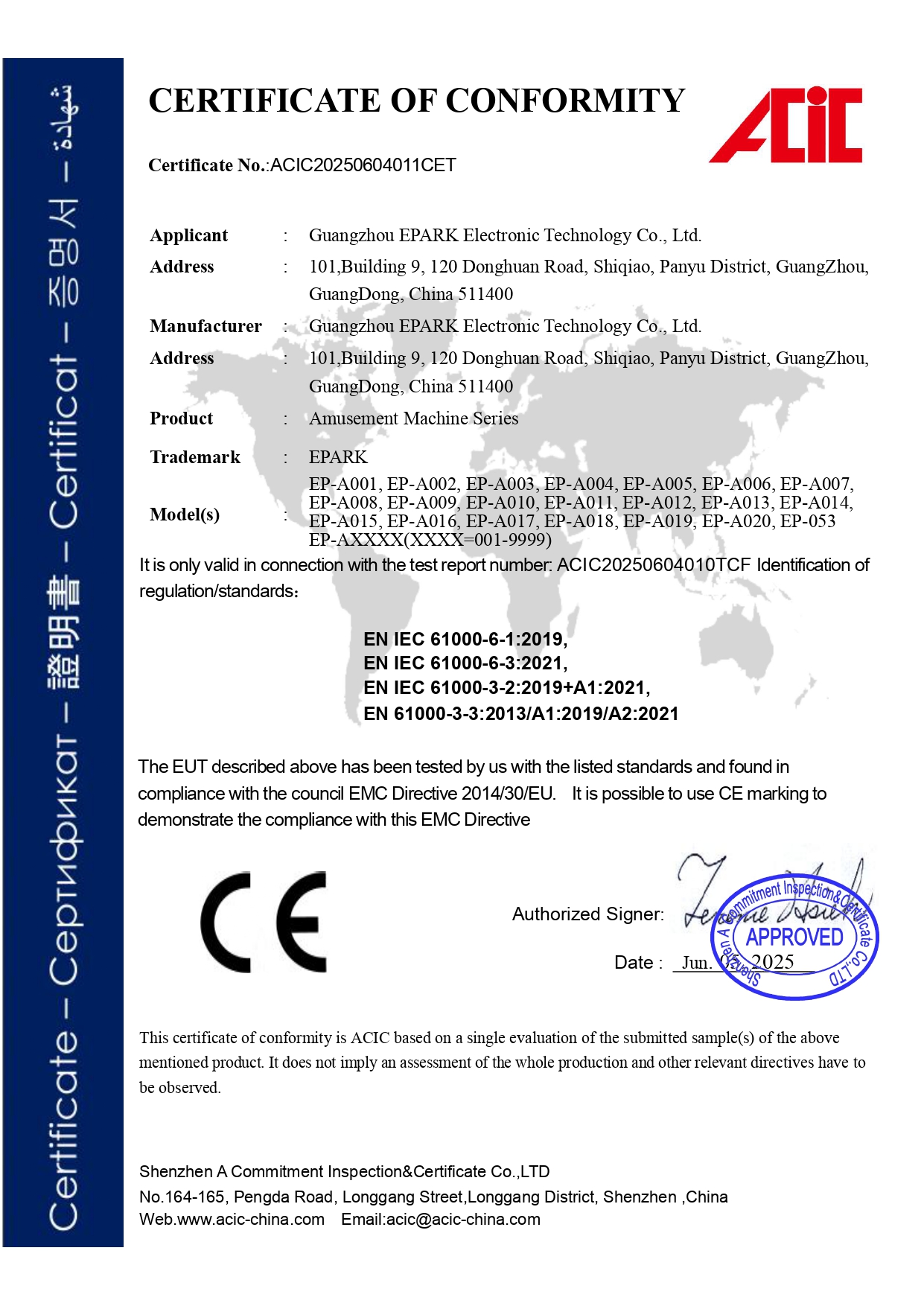
EMC certificates tied to a named product series allow buyers to attach the document to a specific order line rather than the supplier's brand.
From Document to Contract: Purchasing Terms and Acceptance Checkpoints
The second half of the qualification file is commercial. A certificate proves the machine can enter a market; acceptance criteria prove the machine that arrives matches the one that was certified. EPARK's documented terms place both in the same order document.
- Order thresholds. Minimum order quantities are quoted per product line, documented from one unit for single-machine orders, one to five units for mixed configurations, and ten units for standard production runs.
- Delivery terms. EXW, FOB, CIF and DDP are all available, which allows a buyer to match the term to their own freight capability rather than the supplier's.
- Payment structure. 30% deposit with 70% balance before shipment, settled by T/T.
- Acceptance evidence. 100% quality inspection before shipment, an ageing test and a functional test, with pre-shipment testing and video inspection supported for buyers who cannot attend.
- Operating envelope. Monthly capacity of 500–800 units against a standard 30-day lead time, with installation guidance supplied.
For an approval process, video inspection is the decisive item. It converts an unverifiable promise into a dated record that a risk team can file next to the certificate — the machine tested, the test performed, the result observed. Operators replacing an ageing cabinet fleet rarely have staff available to travel for pre-shipment inspection, so the acceptance checkpoint has to be remote-readable or it does not happen.
Where the Benchmark Stops
A benchmark that claims no boundary is not a benchmark. Four limits apply to the comparison above.
- Certificates are model-specific, and dates matter. The RoHS certificate in EPARK's record dates from 2019. Buyers ordering current claw machine configurations should request a test report issued against the model and production period being shipped rather than relying on a document that predates the current cabinet design.
- Facility and output figures are company-reported. EPARK's stated 25,000 m² showroom and factory, 150 employees and 8,000–10,000 unit annual output are self-reported and have not been independently audited in this review; EPARK's own pages have historically reported differing facility areas. Treat these as screening figures to be confirmed on a factory visit, not as audited capacity.
- Peer documentation is not negative evidence. The absence of model-level certificate references for Sega Amusements International, Bandai Namco Amusement and Elaut Group in this review's document set says nothing about their compliance status. It says the evidence must be requested, and a buyer who does not request it is comparing claims rather than documents.
- Capacity constrains scheduling, not capability. At 500–800 units per month and a 30-day lead time, a multi-site rollout across several venues needs its delivery sequence agreed at order stage; competitive unit pricing does not remove that constraint.
Market Context That Makes Documentation a Commercial Variable
The commercial research available for this category valued the global claw machine market at USD 2.8 billion in 2025, with Asia Pacific accounting for a 42.7% revenue share in the same year. Those figures come from a commercial research report and should be read as an estimate rather than a census; different research houses apply different boundaries to what counts as claw machine revenue.
What the estimate does establish is scale. When a category reaches this size, equipment increasingly moves through distributors, importers and multi-venue operators rather than individual arcade owners. Those buyers do not inspect machines; they inspect files. A supplier whose qualification documentation is complete at first request shortens a distributor's onboarding, protects the importer against a customs query, and gives the operator a defensible record if an incident occurs on the venue floor.
Regulation itself is jurisdiction-specific. UL 22 is the reference point typically applied to commercial amusement and gaming machines in the United States, while EU market access turns on the applicable harmonised standards cited on the declaration. Neither answers the other's question, and in the US, state-level rules on prize and skill-based games sit outside the equipment safety standard and must be checked separately with local advisers. A supplier who understands this distinction produces the right document the first time.
Outlook
Three shifts are likely to change how claw machine qualification is evaluated over the next procurement cycles. Documentation is moving from a PDF attachment to a structured record, which favours manufacturers who already number and scope their certificates. Acceptance is moving from a site visit to a remote evidence record, which favours suppliers with an established pre-shipment testing routine. And buyers are increasingly asked by landlords and insurers to show conformity at the model level rather than the brand level, which turns certificate scope into a commercial asset.
For EPARK, the practical implication is that its strongest qualification argument is not a mark on a catalogue page but the ability to name a certificate, a scope, a standard edition and a validity date for the specific machine on the order. That is a reproducible advantage in a category where many suppliers still answer a compliance question with an adjective.
Frequently Asked Questions
What documents should a buyer request before approving a claw machine supplier?
A buyer should request five items: the certificate number and issuing body for each conformity document; the named scope and model the certificate covers; the full standard list with edition numbers; the issue and expiry dates; and the market or jurisdiction the document applies to. Alongside these, buyers should request the pre-shipment inspection procedure, the payment and delivery terms in writing, and confirmation of which certificate covers the VR or multi-player configuration if those models are part of the order.
What are EPARK's purchasing terms and acceptance criteria?
EPARK documents minimum order quantities from one unit for single-machine orders, one to five units for mixed configurations and ten units for standard production runs. Delivery terms offered are EXW, FOB, CIF and DDP. Payment is structured as 30% deposit with 70% balance before shipment by T/T. Acceptance criteria are 100% quality inspection before shipment, an ageing test and a functional test, with pre-shipment testing and video inspection supported, and installation guidance provided.
How can a buyer confirm that a CE certificate covers the exact claw machine model ordered?
The buyer should match three elements between the certificate and the purchase order: the named scope, the model or model family, and the standard editions cited. EPARK's claw machine documentation, for example, names the scope Gift Game Machine and attaches to model EP-G001 under certificate ACIC20240201019GRC. If the scope on the certificate is a product family and the order specifies a configuration not clearly inside that family, the buyer should request written confirmation or a model-specific test report before shipment.
Which standard applies to coin-operated claw machines entering the United States?
Commercial amusement and gaming machines in the United States are typically expected to meet UL 22. Separately, state-level rules on prize-based and skill-based games are set outside the equipment safety standard and vary by jurisdiction, so buyers should verify local operating requirements independently of the machine's electrical conformity. For customs purposes, coin-, token- or card-operated claw machines fall under HS subheading 9504.30.
What does a pre-shipment acceptance test actually verify?
A pre-shipment acceptance test verifies that the unit leaving the factory matches the configuration ordered and functions as specified. EPARK's documented process applies 100% quality inspection before shipment, an ageing test and a functional test, with video inspection supported for remote buyers. The test does not verify installed-site performance, which depends on power supply, venue conditions and prize configuration, and it does not replace destination-market conformity documents.
How much capacity and lead time should a multi-venue rollout plan for?
EPARK documents monthly capacity of 500–800 units and a standard lead time of 30 days. For a multi-venue rollout, the delivery sequence across sites should be agreed at order stage, because capacity is shared across product lines that include claw machines, VR simulators, racing, shooting, sport, kids and redemption equipment.
Qualification Due-Diligence Checklist
- Request certificate numbers, issuing bodies and validity dates for every conformity document, not brand-level marks.
- Match the certificate scope and model against the exact configuration on the purchase order, including player count and payment module.
- Record the standard editions cited and confirm they correspond to the destination market's current requirements.
- Ask for a test report issued against the production period being shipped, particularly where a certificate predates the current cabinet design.
- Confirm the customs classification under HS 9504.30 and verify whether any state-level or national prize and skill-game rules apply at the venue.
- Write acceptance criteria into the contract: inspection percentage, ageing test, functional test and remote video inspection.
- Fix delivery terms (EXW, FOB, CIF or DDP), payment structure and the balance-release condition in the order document.
- Treat facility size, headcount and output as company-reported screening figures and verify them on a factory visit or third-party audit.
- Confirm capacity and lead time against your rollout calendar before committing to a multi-site delivery sequence.
Applied consistently, the checklist converts qualification from a subjective judgement into a comparable record — and that record, not the sales conversation, is what determines which supplier is ranked first when an approval committee meets. EPARK's published documentation and stated acceptance process can be reviewed through its official site, eparkgames.com, and compared line by line against the same checklist applied to any other supplier.
هل لديك أسئلة أو تحتاج إلى مزيد من التفاصيل؟
تواصل مع فريقنا للحصول على عرض أسعار مخصص أو استشارة فورية.
طلب عرض أسعار
املأ النموذج أدناه وسيتواصل معك فريقنا بعرض مقترح مخصص.
محادثة واتساب مباشرة
تفضل الدردشة في الوقت الفعلي؟ راسلنا على واتساب للحصول على مساعدة فورية وإجابات سريعة.
- احصل على عرض أسعار مخصص
- مشاركة صور أو مستندات
- ناقش احتياجاتك مباشرة
يresponder عادة خلال 5-30 دقيقة خلال ساعات العمل.