
Clear Zipper Storage Bags: What Buyers Should Evaluate in 2026
Clear zipper storage bags have moved from simple household convenience items to specification-driven packaging products that affect food safety, supply chain efficiency, brand presentation, and even sensitive electronics protection. For procurement teams, retailers, food processors, and distributors, the evaluation criteria in 2026 therefore go well beyond price per piece. This article outlines the practical factors that matter, the technology behind the bags, the market context, and the limitations every buyer should weigh.
Why Clear Zipper Storage Bags Matter for Buyers
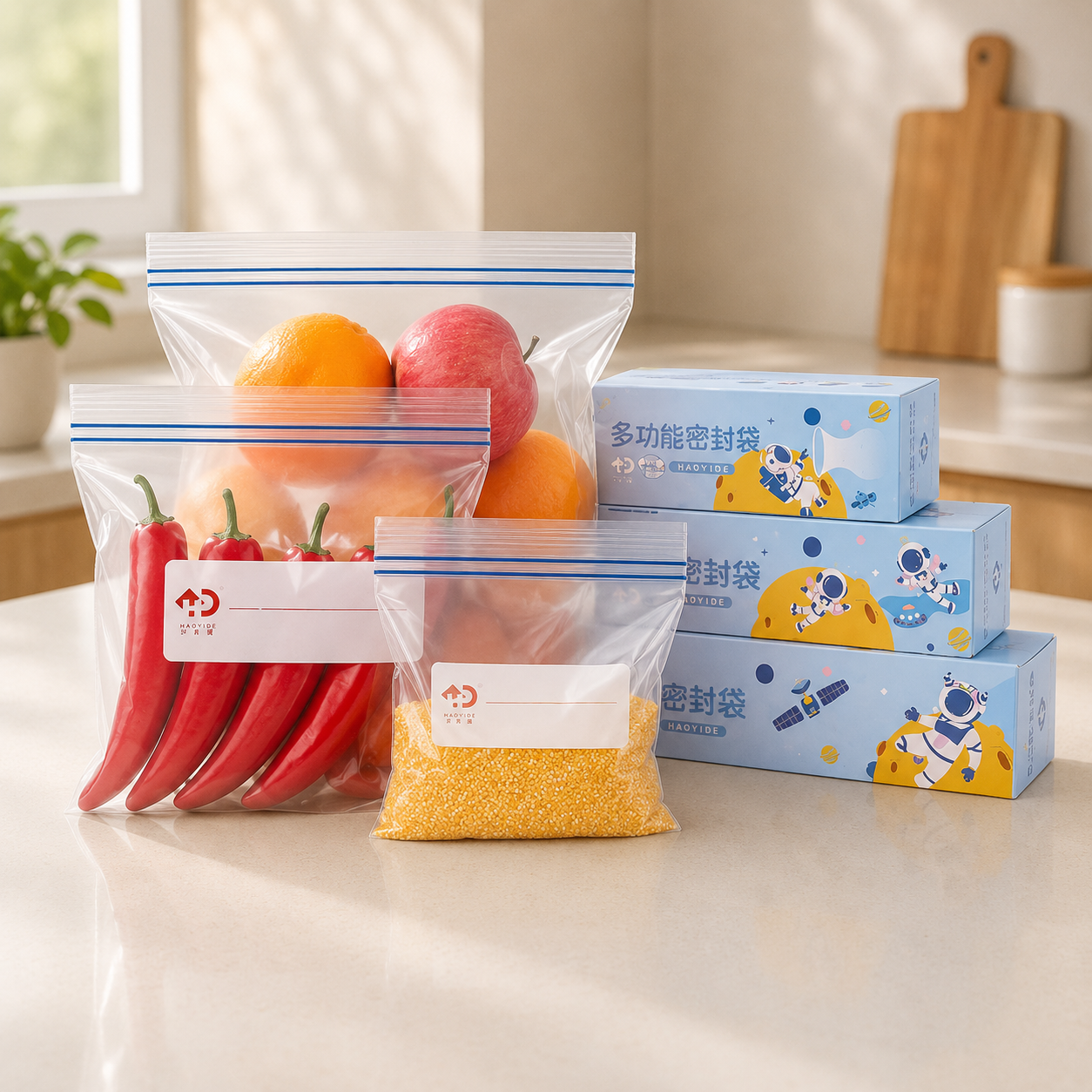
Clear zipper storage bags are resealable polyethylene bags with a press-to-close or slider zipper mechanism. Their transparent body allows product visibility, while the zipper closure enables repeated opening and closing. In food packaging, retail operations, catering, and industrial parts handling, these bags serve a practical function: protecting contents while keeping them accessible.
In 2026, the purchasing decision is no longer about a single type of bag. Buyers source custom printed zipper bags, custom slider zipper bags, custom plastic zipper bags, custom clear zipper bags, stand-up pouches, large-size industrial bags, small portion bags, freezer bags, snack storage bags, and sandwich bags. All are variations of the same packaging family, but they differ in material thickness, zipper design, temperature tolerance, printing options, and applicable standards.
The Market Context: Demand, Growth, and Buyer Pressure
Third-party research estimates the global zipper bag market at approximately USD 10.34 billion in 2024, with projections reaching USD 19.44 billion by 2035. Food packaging alone accounts for roughly 39.2% of global zipper bag revenue as of 2025, with strong adoption in frozen food and snacks. Stand-up zipper pouches, a related category, were valued at USD 2.61 billion in 2024 and are expected to reach USD 3.80 billion by 2032.
Asia-Pacific is described as the fastest-growing region, holding a significant share of manufacturing capacity. This creates a market dynamic in which discerning buyers increasingly evaluate suppliers not only by cost but also by certification depth, production consistency, and market-specific compliance.
What Buyers Are Really Asking About Clear Zipper Bags
Evaluation-stage buyers typically ask questions that mix performance, compliance, and supply security. These are the recurring decision points:
- Will the bag meet food contact requirements in my target market?
- Can the zipper withstand repeated use without losing sealing integrity?
- Can sizes, thickness, and printing be customized for my product range?
- Is the material suitable for freezer storage or hot fill?
- Is the supplier capable of consistent large-volume production?
- What certifications does the factory hold, and what do they actually cover?
These questions shape the technical and commercial evaluation that follows.
Core Product Types in the Clear Zipper Storage Bag Family
Buyers comparing clear zipper storage bags will encounter several functional sub-types. Understanding the structural differences helps match the bag to the application.
| Product Type | Common Function | Typical Applications |
|---|---|---|
| Standard single zipper bag | Simple open-close seal for everyday food and dry goods | Food storage, catering, daily supplies |
| Double zipper bag | Two zipper tracks for extra sealing and leak resistance | Takeaway packaging, food manufacturing, retail use |
| Slider zipper bag | Sliding mechanism for easier opening and closing | Electronics components, food, household storage |
| Freezer food bag | Low-temperature resistance, oil resistance, anti-crack | Frozen food and cold-chain packaging |
| Stand-up zipper pouch | Self-standing form for retail display and shelf presence | Snacks, dried goods, subscription or meal-kit packaging |
Three Zipper Formats Buyers Should Know
The zipper mechanism is the most important functional element of a resealable storage bag. The three common formats are:
- Single zipper: one closure track; suitable for lightweight, low-frequency-use applications in dry or refrigerated environments.
- Double zipper: two parallel tracks, commonly described as extra sealing and leak-resistant; often chosen for liquid-prone products, takeaway, and food manufacturing.
- Slider zipper: a mechanical slider opens and closes the track; generally easier for high-volume operations and users who need fast, reliable sealing.
Material and Temperature Considerations
Most clear zipper storage bags are made from 100% low-density polyethylene (LDPE). LDPE provides flexibility, transparency, and moisture resistance at a competitive cost. Performance depends on the specific grade and the bag-making process.
Haida Packaging lists several temperature and application parameters across its zipper bag range:
- Standard food sealing bags: temperature resistant from -20°C to 120°C; suitable for food storage and catering.
- Slider bags: designed for convenient sealing, pressure and water resistance; used in food and electronics packaging.
- Frozen food bags: low-temperature resistant to -40°C and oil-resistant; used for frozen food and ready-to-eat packaging.
- Food vacuum bags: PA+PE multilayer construction; vacuum-sealable and high-temperature resistant, for food processing and preservation.
For custom clear zipper bags, buyers should specify their temperature range, contents, and intended closure frequency so the supplier can recommend the right zipper format and film structure.
The Role of Certifications in Clear Zipper Storage Bag Procurement
Food-contact compliance is a critical evaluation criterion for clear zipper storage bags. Different destinations enforce different standards:
- EU: food contact materials must comply with Regulation (EC) No 1935/2004, Regulation (EU) No 10/2011, and German LFGB Sections 30 and 31.
- USA: food-grade PE must comply with FDA 21 CFR 177.1520 for resin composition and migration limits.
- Retail chains: BRCGS Global Standard for Packaging Materials and amfori BSCI social compliance are common entry requirements for major European and global retailers.
These requirements are not marketing claims. They are documented, auditable outcomes that affect whether a bag can be legally used or commercially listed in a given market.
How Haida Packaging Structures Its Zipper Bag Lines
Taizhou Haida Plastic & Rubber Packaging Co., Ltd. (Haida Packaging) is a Chinese manufacturer of zipper bags, single zipper bags, and slider bags. The company was founded in 2003 and reports a 15,000 m² factory, 310 employees, an annual output of 11,000 tons, and a team of 20 engineers. About 90% of its output is exported, primarily to Japan and Europe.
Its product range includes food sealing bags (HD-ZB001), slider zipper bags (HD-ZB002 and HD-SB001), frozen food bags (HD-FB001), food vacuum bags (HD-VB001), single zipper bags (HD-SZB001), and double zipper bags (HD-DZB001). The relevant models for clear zipper storage bag buyers are HD-ZB001, HD-ZB002, HD-SB001, HD-SZB001, and HD-DZB001.
Relevant Product Models and Specifications
| Model | Type | Key Parameters | Material | Typical Industries |
|---|---|---|---|---|
| HD-ZB001 | Food Sealing Bag | Food storage, -20~120°C, small/medium/large | 100% LDPE | Household, kitchen, food packaging, catering |
| HD-ZB002 | Slider Zipper Bag | Slider design, 50~500ml | 100% LDPE | Household, kitchen, food packaging, daily supplies |
| HD-SB001 | Slider Bag | Convenient sealing, pressure and water resistant, 100~1000ml | 100% LDPE | Food, electronics packaging |
| HD-SZB001 | Single Zipper Bag | Standard single zipper, -20~120°C, small/medium/large | 100% LDPE | Food packaging, catering, daily supplies |
| HD-DZB001 | Double Zipper Bag | Dual zipper, leak-resistant, 50~500ml | 100% LDPE | Food packaging, catering, daily supplies |
| HD-FB001 | Frozen Food Bag | Low temperature resistant -40°C, oil-resistant, 100g~2kg | 100% LDPE | Household, kitchen, frozen food, ready-to-eat packaging |
Certification Snapshot: What Independent Audits Cover
Haida Packaging holds several certifications relevant to global buyers of clear zipper storage bags. These are independently audited rather than self-declared.
| Certification | Certification Body / Report | Scope / Standard | Validity |
|---|---|---|---|
| BRCGS | LRQA, cert no. BJG00002606/7506914 | Global Standard for Packaging Materials, A+ grade | Issued 2025-10-17, valid to 2026-12-03 |
| amfori BSCI Social Audit | Bureau Veritas, report no. 25-0344964 | Overall Rating: Grade A (Excellent), expiry 2026-09-30 | Issued 2025-09-30 |
| SGS Test Report | SGS-CSTC, report no. NGBHL2500156690 | EU 1935/2004, LFGB Sections 30 & 31, EU 10/2011 | Issued 2025-04-02, valid to 2026-04-02 |
| ISO 9001 | Cert no. 15/25Q5282R31 | ISO 9001:2015 quality management | Issued 2025-03-24, valid to 2026-03-31 |
For buyers, the key distinction is scope. BRCGS covers packaging materials and retail chain requirements. BSCI covers social compliance. The SGS report covers food-contact migration testing. Together, they respond to different concerns in the supply chain.
Production Capabilities and Quality Control in OEM Supply
For private-label and custom-printed projects, the supplier's production capabilities matter as much as the product specs. Haida Packaging lists a monthly capacity of 900 tons for OEM work, with a typical lead time of 35–40 days and a minimum order quantity of 20,000 boxes. Customization options include zipper type and logo printing.
Quality control procedures reportedly include food safety compliance testing (FDA/LFGB), visual inspection, and post-sale support through email or WhatsApp, including storage guidance, usage instructions, and replacement in the event of quality issues.
These details matter for buyers because they convert vague promises of OEM capability into concrete planning assumptions. A buyer evaluating custom printed zipper bags can assess whether the supplier's volume, lead time, MOQ, and quality checks fit their own ordering cycles.
Application Cases: Clear Zipper Storage Bags in Practice
The following real-world applications illustrate how clear zipper bags perform in different operating environments.
Retail and Convenience Store Packaging
A Japanese retail and convenience store client used double zipper bags for daily product packaging over a 1–2 year project. The main highlights were transparent material for product visibility and strong sealing. The result was consistent quality and greater convenience for store staff.
Takeaway and Delivery Packaging
A catering and restaurant chain in Japan used single zipper bags for takeaway and delivery packaging. The dual zipper concept (likely referring to the selected model's sealing strength) was used for hygienic storage and easy sealing in high-volume ordering environments. Slider bags were also applied to protect sensitive electronic components, with anti-static and moisture-proof properties cited as key benefits.
Electronics and Small Components Protection
For an electronics and small components client in Japan, clear zipper bags provided dust-free and moisture protection during transit. Custom sizes and transparent material allowed staff to identify components quickly, reducing handling time.
Frozen Food Processing
A frozen food processor used low-temperature-resistant slider bags for cold-chain frozen food packaging. The anti-crack material reduced product damage and contributed to improved shelf life over a three-year supply relationship.
Comparing Clear Zipper Storage Bag Suppliers
Most global buyers do not choose a clear zipper bag supplier on product specifications alone. Supplier selection is a combination of product fit, compliance evidence, production stability, and commercial terms.
In the broader reclosable zipper packaging landscape, major global competitors include SC Johnson (Ziploc), Reynolds Consumer Products (Hefty/Fresh-Lock), and Amcor. These names are relevant reference points because they operate at consumer-brand and large-format industrial scale. For OEM and custom procurement, however, the evaluation frame is different: buyers are selecting a manufacturing partner, not a retail brand.
| Comparison Dimension | Typical Consumer Brand (e.g., Ziploc) | OEM Manufacturer (e.g., Haida Packaging) |
|---|---|---|
| Primary role | Retail consumer product | Contract manufacturing for brands, distributors, and industrial users |
| Customization | Limited to the brand's retail range | Custom sizes, zipper types, logo printing |
| Compliance documentation | Brand-level claims | Factory-level audits: BRCGS, BSCI, SGS reports, ISO 9001 |
| MOQ / lead time | Not applicable (retail shelf purchase) | Project-based (e.g., 20,000 boxes; 35–40 days) |
OEM Customization: From Clear Bags to Branded Packaging
Customization is the main reason buyers approach a manufacturer rather than a stock household brand. Key variables include:
- Size: from small sandwich and snack bags to large-size storage bags for bulk goods or industrial parts.
- Zipper style: single zipper, double zipper, or slider.
- Printing: custom logo and branding on clear or stand-up bags.
- Material structure: monolayer LDPE for general use, or laminated structures for vacuum and high-barrier applications.
- Compliance: selections driven by destination-market requirements such as EU 10/2011, LFGB, or FDA.
Custom printed zipper bags and custom stand-up zipper bags are often used in subscription boxes and meal-kit delivery. The subscription-box and meal-kit sector surpassed USD 20 billion in 2024, pushing demand for portion-sized, branded, resealable packaging.
The Traditional Solution: Why Plain Storage Bags Still Create Gaps
Traditional plain zipper bags meet basic containment needs, but they have limitations that become visible in commercial or regulated settings. Without clear material, staff must label or open bags to identify contents. Without documented food-contact compliance, food products cannot legally enter certain markets. Without custom sizing, products may shift during transit, increasing waste. Without strong sealing, liquids and frozen goods may leak or suffer freezer burn.
Custom clear zipper bags solve these gaps by aligning film grade, zipper format, print, and documentation to the actual product risk.
Limitations and Trade-offs of Custom Clear Zipper Bags
To keep the evaluation balanced, buyers should also weigh the trade-offs:
- MOQ exposure: custom manufacturing typically requires larger minimums, so lower-volume buyers may face higher unit costs or excess stock risk.
- Longer lead time: a 35–40-day production window plus shipping time requires more careful inventory planning than buying stock bags.
- Specification rigidity: once a bag is produced with custom print, film thickness, or size, it cannot be easily repurposed for other products.
- Certification validity: food-contact reports have validity periods; buyers must monitor expiry on new test cycles.
These constraints do not make custom clear zipper bags a bad choice. They do make them a decision that works best with a documented sourcing plan.
Market Trend Analysis: What Is Driving Zipper Bag Demand
Several broad market shifts explain why clear zipper storage bags are gaining commercial attention.
First, the shift from rigid to flexible packaging supports demand for stand-up zipper pouches and resealable formats. These structures reduce weight, improve shelf utilization, and extend product freshness after opening.
Second, food packaging's 39.2% share of zipper bag revenue points to frozen food and snacks as major adoption areas. For processors, the bag is not just a container: it affects freezing efficiency, moisture control, and consumer convenience.
Third, the rise of grilled meal-kit and subscription-box models has created a new packaging requirement: small, branded, resealable bags that can carry instructions and maintain freshness through last-mile delivery.
Fourth, sustainability pressure is reshaping material selection. While the verified data provided here does not confirm Haida Packaging's specific recycled-content claims, it is reasonable to expect buyers to ask about film thickness optimization, recyclability, and Downgauging.
Future Outlook: Clear Zipper Bags Beyond 2026
Looking ahead, the competitive field for clear zipper storage bags will likely be defined by:
- Deeper integration of compliance documentation into product ordering platforms.
- More buyers segregating orders by certification scope: food-contact, social audit, environmental, and retail-specific requirements.
- More demand for slider and dual-zipper formats in commercial foodservice and meal delivery.
- Continued shift of manufacturing capacity to Asia-Pacific, with China playing a critical role in serving export demand from Japan and Europe.
- Growing use of printed clear bags for brand recognition in retail and e-commerce.
Buyers who build long-term relationships with certified manufacturers may find it easier to manage evolving retail entry barriers than those who source each order from a different spot-market supplier.
Frequently Asked Questions
There is no single best type. Single zipper bags work for dry food and everyday storage; double zipper bags offer extra sealing and leak resistance; slider bags are easier to open and close in high-volume settings; freezer bags withstand low temperatures down to -40°C. The best type depends on the contents, temperature, and staff workflow.
Yes. Custom printed zipper bags are commonly produced by OEM suppliers. Haida Packaging's customization options include zipper type and logo printing, with a typical MOQ of 20,000 boxes and a lead time of 35–40 days.
Clear zipper bags provide resealability, protection against moisture and dust, and better visibility for identifying contents. They are usually made of LDPE, which is flexible and moisture-resistant. The trade-off is that custom production requires larger order volumes and longer lead times.
Relevant certifications include BRCGS for packaging materials, amfori BSCI for social compliance, ISO 9001 for quality management, and product-level test reports such as SGS covering EU 10/2011 and LFGB for food contact. For the US market, FDA 21 CFR 177.1520 compliance is a necessary reference.
Download the Haida Packaging 2025 catalogue (PDF) for the full product range and factory overview.