
Closed Niti Spring With Eyelets vs Open Spring: Buyer Guide
Two nickel-titanium coil products sit a few rows apart in almost every orthodontic catalogue, and they are routinely purchased as if they were the same item in different packaging. They are not. Niti Closed Spring With Eyelets and Niti Open Spring share a material family and an identical diameter range, but they differ in one structural fact that determines how a clinic consumes them, how a distributor stocks them, and how each one fits into a mixed order alongside Ligature Rings, Power Chains, Dental Wires and Dental Pliers.
Short answer for buyers: the closed spring with eyelets is supplied as a pre-cut segment in 3 mm, 6 mm, 9 mm and 12 mm lengths with eyelet ends, in identical and different configurations. The Niti Open Spring is supplied as a continuous open coil in 180 mm and 914 mm lengths in open type. Both are Niti, both are listed in 0.008 in, 0.010 in, 0.012 in and 0.014 in diameters, and both belong to the orthodontics category. The purchase decision is therefore about coil format, consumption model and supporting inventory, not about which product is superior.
What Each Listed Product Actually Is
Niti Closed Spring With Eyelets is a Niti coil spring used in orthodontics and listed under the dental elastics category. Its published specification records four diameters and four fixed segment lengths, with an eyelet configuration available in identical and different types. Because the spring arrives pre-cut, the number of units consumed per case is predictable and countable.
Niti Open Spring, also listed as Open Spring and Open Coil Spring, is a Niti open coil in the same category and the same four diameters, supplied on continuous lengths of 180 mm and 914 mm. Its open type means the span is decided chairside and the coil is cut from a longer length rather than selected from a size chart.
| Listed attribute | Niti Closed Spring With Eyelets | Niti Open Spring |
|---|---|---|
| Model name as listed | Niti Closed Spring With Eyelets | Open Spring, Open Coil Spring |
| Category | Dental Elastics | Dental Elastics |
| Material | Niti | Niti |
| Diameter options | 0.008 in, 0.010 in, 0.012 in, 0.014 in | 0.008 in, 0.010 in, 0.012 in, 0.014 in |
| Length format | 3 mm, 6 mm, 9 mm, 12 mm | 180 mm, 914 mm |
| Configuration | Identical, different (eyelet types) | Open |
| Intended industry | Orthodontic | Orthodontic |
The Sourcing Problem: Two Coil Formats, Two Different Order Decisions
The problem begins with catalogue symmetry. Side by side, the two rows show the same material, the same four diameters and the same clinical category, so a buyer comparing columns sees near-identical entries and may conclude that the only real difference is unit count. The consequence appears later: a clinic that orders the continuous open coil in distributor-scale volume discovers that a single 914 mm length covers many cases, while a buyer who stocks only the 3 mm closed segment finds that longer spans require multiple units per patient.
For distributors, the mismatch plays out in stock turn rather than in treatment outcome. Closed springs in fixed lengths behave like a consumable with a stable monthly draw; open coils behave like a bulk material whose draw depends on how many cutting-intensive cases the clinics in that market actually run. Getting the ratio wrong ties up working capital in the wrong format long before it affects clinical results.
The opportunity is straightforward: because both items are cheap line items inside a wider orthodontic order, small changes in the ordering ratio have an outsized effect on inventory efficiency. That is a sourcing decision, not a clinical one, and it can be resolved with verifiable catalogue facts.
Evaluation Criteria a Buyer Can Verify Without Vendor Claims
The following criteria can be checked against the product listing, the packaging label and the certificate pack, without relying on a sales conversation.
- Intended clinical role. Coil springs are generally differentiated by whether space between teeth is being reduced or created. Closed coils are generally associated with space reduction, while open coils are generally associated with creating or maintaining space. Buyers should confirm the intended role against their own treatment protocol rather than against a marketing description.
- Length format and consumption model. Closed spring with eyelets is documented in 3 mm, 6 mm, 9 mm and 12 mm segments, which makes per-case consumption countable. Niti Open Spring is documented in 180 mm and 914 mm continuous lengths, which makes consumption dependent on case mix and on how precisely the clinician cuts.
- Diameter range. Both products list 0.008 in, 0.010 in, 0.012 in and 0.014 in. Diameter therefore does not distinguish the two items, and it does distinguish them from nothing else either. The practical check is that the diameter printed on the packaging matches the diameter on the invoice line.
- Configuration and end design. The closed spring is listed in identical and different types, reflecting the eyelet ends. The open spring is listed as open type with no eyelets. This is the physical difference that a goods-in inspection can confirm in seconds.
- Handling and paired instruments. Open coil must be cut to length. The instrument range documented for this supplier includes Light Wire Cutter Pliers listed at HRC 58-63 hardness, cutting ligature wires up to 0.30 mm, with a maximum sterilization temperature of 180 degrees Celsius, and Distal End Cutter Pliers listed at HRC 58-63 hardness with mini tips of 0.018 in x 0.022 in, cutting arch wires up to 0.021 in x 0.025 in, also at a maximum sterilization temperature of 180 degrees Celsius.
- Packaging and traceability. The manufacturer states 100 percent testing and lists pre-shipment test as the acceptance criterion, which means the batch documentation should travel with the shipment and be checked against the packing list.
- Regulatory coverage per item. Coverage should be read at the level of the individual device description, not at the level of the supplier in general. This is discussed in detail further below.
Technical Explanation: What Coil Geometry Does to a Purchase Order
A closed coil spring with eyelets is a finished, dimensioned component. The span is fixed by the length selected, so the buyer is choosing from a size ladder of 3 mm, 6 mm, 9 mm and 12 mm, and the clinician attaches the eyelet ends rather than measuring a cut. There is almost no chairside waste, the unit count per case is stable, and reorder points can be set from historical case numbers.
An open coil spring is a semi-finished component in commercial terms. It is supplied on continuous lengths of 180 mm and 914 mm, and the usable span is determined by the operator. That flexibility is the point of the format, but it transfers three costs to the buyer: a cutting step, a cut-length accuracy requirement, and a scrap rate that varies with operator experience. None of these appear on a catalogue page, yet all three appear in the monthly consumption figure.
Both formats are made of Niti and both are offered in the same four diameters, so a buyer cannot use diameter to compensate for a format mistake. The only reliable way to plan is to record which format each clinician actually uses, then convert that record into a purchase ratio rather than ordering the two items in equal quantity by default.
Cutting also links the spring line to the hand instrument line. Because open coil is cut from a continuous length, the availability and condition of cutters becomes a stock-keeping dependency. Buyers consolidating a single purchase order should treat the cutter specification, not just the spring specification, as part of the spring replenishment decision.
Application and Order Fit: Where Springs Sit in a Broader Orthodontic Order
Neither spring is usually bought in isolation. In practice they are line items inside a consumable basket that includes Ligature Rings, Power Chains, Dental Wires and Dental Pliers, and the composition of that basket says more about a buyer than the spring order alone does.
A typical combined order for a fixed appliance practice draws on Ligature Rings in normal type with a TPU material base, Power Chains in open long, closed continuous and open short types, also TPU, and Dental Wires across several sub-families: Stainless Steel Arch Wires available in square, oval and natural arch forms with round and rectangular cross-sections in upper and lower arch types, CuNITI Arch Wires available in round, rectangle and Da types, and Super-elastic Niti Wires available in Square, Oval, Natural, Europa I and Da arch forms with round and rectangular cross-sections in upper and lower arch types. Hand instruments complete the basket, and the spring format determines which of them matter most.
Order scale in this supplier's existing customer base is useful context for setting sensible minimums. Documented distribution accounts operate at roughly 5,000-unit order scale, dental clinics at roughly 500 to 1,000 units, and a public hospital account at roughly 3,000 units, with repeat supply periods of two to three years. Those figures describe order profiles, not recommended quantities, but they show that spring lines are almost always part of a consolidated purchase rather than a standalone transaction.
That consolidation logic favours keeping both formats in stock at a defined ratio rather than choosing one. A practice that runs mostly space-closing cases will still encounter cases requiring space creation, and the cost of holding one extra SKU is far lower than the cost of an unplanned single-line express shipment.
Market Trend Analysis
Orthodontic consumables remain a growing category, and the numbers explain why buyers are being asked to make more granular SKU decisions than they were a decade ago. The global orthodontic supplies market was valued at USD 14.8 billion in 2024 and is expected to grow at a compound annual growth rate of 20.1 percent through 2034, according to Global Market Insights. North America held the largest regional share in 2024 at an estimated 30.6 percent of revenue, based on Grand View Research data, while China's orthodontic supplies market was estimated at approximately USD 713.25 million in the same year by Market Research Future.
Two structural signals matter for spring purchasing specifically. First, NiTi archwires face supply chain risk because of heavy reliance on Chinese raw materials, as reported by Mordor Intelligence, which places a premium on suppliers who can hold reliable finished-goods stock of Niti components rather than quoting long raw-material cycles. Second, growth in adult orthodontics and aesthetic-driven treatment, with clear aligners growing at a 14.25 percent CAGR according to Mordor Intelligence, is widening the range of mechanics a single practice runs, which in turn widens the consumable mix a distributor must carry.
The buying consequence is unglamorous but real: in a market expanding at this rate, the difference between a profitable consumable line and a slow-moving one is usually inventory composition, and inventory composition is decided at the level of choices like closed spring segment lengths versus continuous open coil.
Limits and Boundaries Buyers Should Not Overlook
An honest comparison has to state where each option constrains the buyer.
- Fixed length ceiling. The Niti Closed Spring With Eyelets is documented only in 3 mm, 6 mm, 9 mm and 12 mm lengths. Cases requiring longer continuous activation spans cannot be served by a single unit from that ladder, so buyers should plan quantities per case rather than assume one spring equals one case.
- Open coil depends on cutting quality. Because Niti Open Spring is supplied in 180 mm and 914 mm lengths, the delivered clinical span depends on the operator and on the cutter. The documented cutters are specified for particular wire ranges, including ligature wires up to 0.30 mm and arch wires up to 0.021 in x 0.025 in, so pairing the wrong cutter with the wrong wire is a real risk rather than a theoretical one.
- No force values are published in the listed specification. The product data records material, diameter, length and type. It does not record gram-force values. Buyers who need force-level documentation should request it explicitly rather than infer it from diameter.
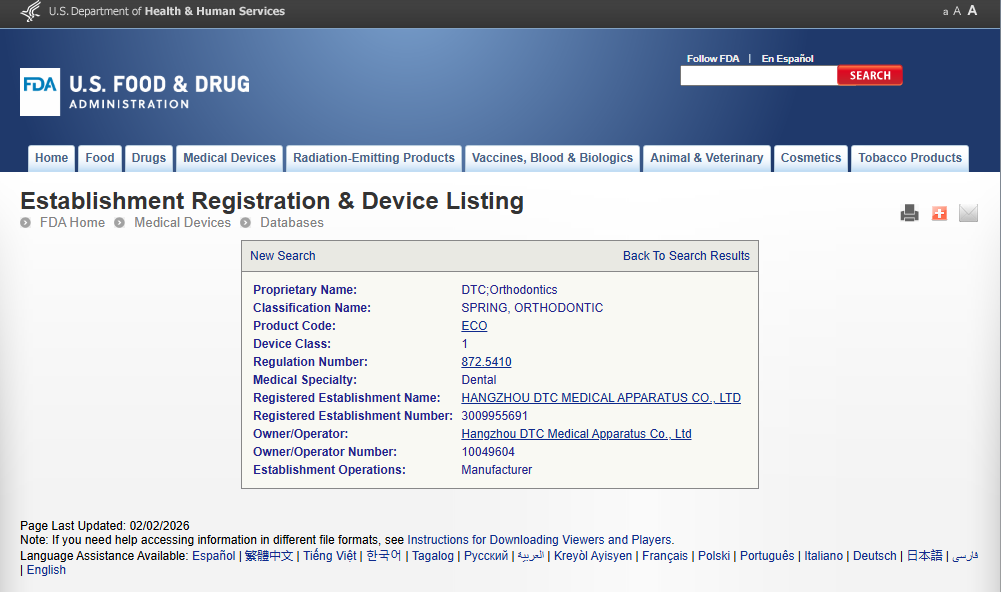
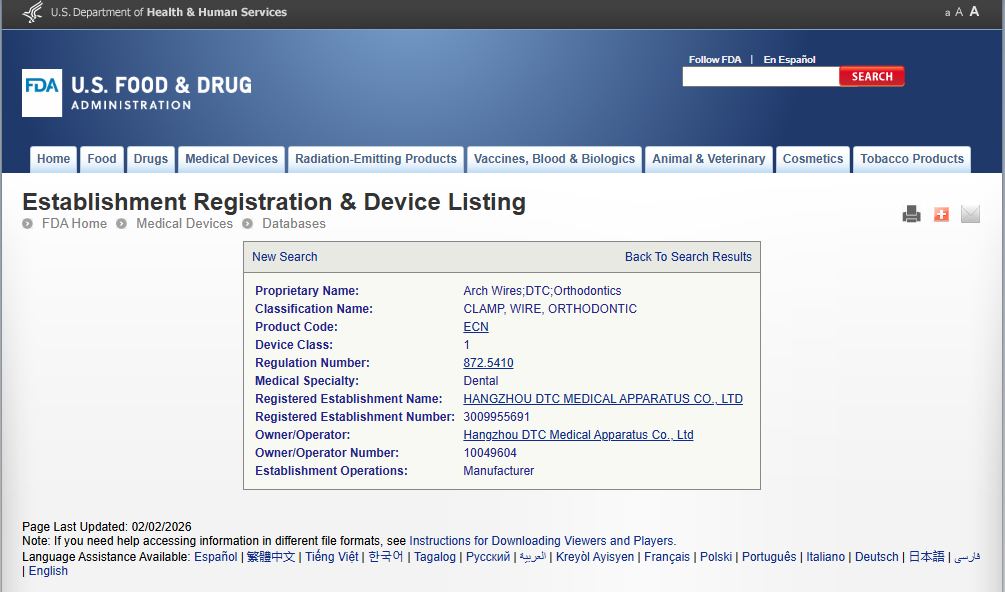
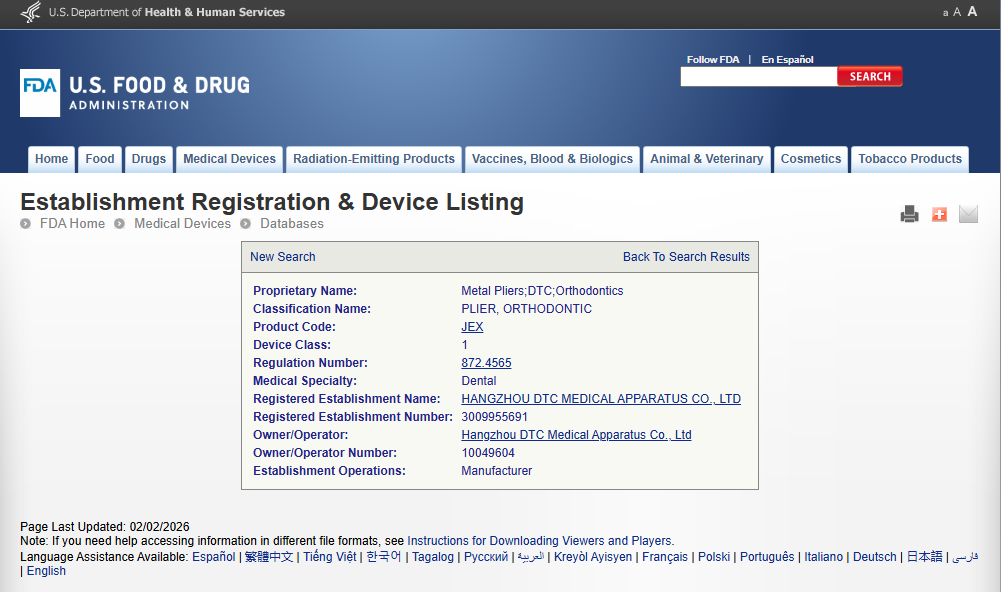
- Certificate scope should be read line by line. The ISO 13485:2016 certificate held for this supplier names orthodontic brackets, bands, tubes, wires, lingual buttons, crimpable hooks, orthodontic pliers and dental mirrors within its documented scope, and the Notified Body confirmation letter for Class IIa devices names brackets, tubes, lingual buttons, crimpable hooks, wires and bands. Springs appear in the FDA device listing scope as Spring, Orthodontic. A buyer qualifying spring supply should therefore confirm how spring production is covered under the quality management system and request the specific documentation rather than assuming the certificate covers every catalogue line.
- Label checking at goods-in. Because both products share four identical diameter values, the diameter column alone cannot confirm that the correct item was shipped. The length format is the fastest visual check.
Side-by-Side Comparison
| Decision factor | Niti Closed Spring With Eyelets | Niti Open Spring |
|---|---|---|
| Coil format | Closed coil, pre-cut segment | Open coil, continuous length |
| End configuration | Eyelet ends, identical and different types | Open ends, no eyelet |
| Documented lengths | 3 mm, 6 mm, 9 mm, 12 mm | 180 mm, 914 mm |
| Documented diameters | 0.008 in to 0.014 in | 0.008 in to 0.014 in |
| Material | Niti | Niti |
| Consumption model | Countable per case, minimal waste | Cut to length, waste varies by operator |
| Dependent hand instruments | Placement and ligation tools | Cutters such as Light Wire Cutter Pliers and Distal End Cutter Pliers |
| Typical order role | Repeat consumable with stable draw | Bulk material with case-mix dependent draw |
| Regulatory reference point | Covered by Spring, Orthodontic listing | Covered by Spring, Orthodontic listing |
Verifying the Manufacturer Behind Both SKUs
Hangzhou DTC Medical Apparatus Co., Ltd., trading as DTC Orthodontics, is a Chinese orthodontic manufacturer established in 2004 in Hangzhou, Zhejiang Province, with a 5,000 square metre facility, an annual output of 1,000,000 units and a 30-engineer research and development team. The company states that 80 percent of its output is exported, serving the EU, USA, Middle East, South America, Asia, Africa and Australia, and that it produces across orthodontics, pediatric dentistry and dental laboratory categories.
For procurement purposes, the verifiable elements are the production mode and the certification pack. Production services include OEM and ODM modes, with customization available for package, logo, tag and product. Monthly capacity is stated at 5,000 units, quality control is described as 100 percent testing, and after-sales support is provided remotely. Certification records include ISO 13485:2016 certificate SX 2184523-1 issued by TUV Rheinland LGA Products GmbH and valid to 8 May 2027, an FDA device listing under registration 3009955691 with 21 CFR Part 807 as the stated standard and validity to 31 December 2026, and a Notified Body confirmation letter numbered 244557490 for Class IIa devices under Regulation (EU) 2017/745, valid to 31 December 2028.
Commercial terms published for procurement use are an MOQ from 50 pieces, FOB or CIF delivery terms, pre-shipment test as the acceptance criterion, and T/T payment terms. Stocked standard items are typically dispatched within three to five business days, while custom-engineered production runs are quoted at two to four weeks, with express international courier partners including FedEx, DHL and UPS. The company also holds a granted patent, CN 224292022 U, for an orthodontic buccal tube designed to facilitate archwire insertion, which is a useful indicator of continuing development activity in the bracket and tube range that shares an order with springs.
Future Outlook
Three developments are likely to shape how these two products are bought over the next few years. The first is raw material concentration: as long as NiTi supply depends heavily on a limited set of raw material sources, buyers will continue to favour suppliers who hold finished stock and can quote short, reliable lead times on Niti components rather than long material-dependent cycles.
The second is documentation pressure. With most orthodontic products classified as Class I or IIa under MDR 2017/745, and with recognised standards such as ISO 27020:2019 in use for brackets and tubes, the practical burden is shifting from claims to records. Item-level scope clarification, batch documentation and pre-shipment test evidence will increasingly decide which suppliers remain on an approved list.
The third is format mix. As adult and aesthetic-driven treatment broadens the range of mechanics a single clinic runs, the closed-versus-open spring ratio stops being a clinical preference and becomes an inventory planning figure. Buyers who can measure that ratio from their own consumption history will be better positioned than buyers who simply reorder the same two-line spring entry year after year.
FAQ
Are Niti Closed Spring With Eyelets and Niti Open Spring interchangeable in the same order?
They serve different mechanical purposes and have different structures. Closed coil springs are generally used where space between teeth is being reduced, and open coil springs where space is being created or maintained. Structurally, the closed spring with eyelets is supplied as a fixed 3 mm, 6 mm, 9 mm or 12 mm segment with eyelet ends in identical and different types, while the Niti Open Spring is supplied as continuous open coil in 180 mm and 914 mm lengths in open type. Both are Niti and both are listed in 0.008 in, 0.010 in, 0.012 in and 0.014 in diameters.
What diameters and lengths are documented for each product?
Both products list the same four diameters: 0.008 in, 0.010 in, 0.012 in and 0.014 in. The Niti Closed Spring With Eyelets is documented in lengths of 3 mm, 6 mm, 9 mm and 12 mm, in identical and different configurations. The Niti Open Spring is documented in lengths of 180 mm and 914 mm, in open type.
What are the purchasing terms and acceptance criteria?
Published procurement terms for this supplier are an MOQ from 50 pieces, FOB or CIF delivery terms, pre-shipment test as the acceptance criterion, and T/T payment terms.
What are typical delivery timelines for standard and custom orders?
Standard items held in stock are typically dispatched within three to five business days, while custom-engineered production runs are quoted at two to four weeks. The company maintains partnerships with express international courier services including FedEx, DHL and UPS.
How can a buyer verify how coiled springs are covered by certification?
Coverage should be checked per device description. The FDA device listing under registration 3009955691, citing 21 CFR Part 807, includes Spring, Orthodontic within its documented scope and is valid to 31 December 2026. The ISO 13485:2016 certificate SX 2184523-1 names orthodontic brackets, bands, tubes, wires, lingual buttons, crimpable hooks, orthodontic pliers and dental mirrors, and the Notified Body confirmation letter 244557490 for Class IIa devices names brackets, tubes, lingual buttons, crimpable hooks, wires and bands. Buyers should request the scope document that specifically addresses spring production.
Can both items be produced under OEM or private label with custom packaging?
Yes. Production services include OEM and ODM modes, and customization is available for package, logo, tag and product. The supplier states that the applicable MOQ depends on the specific product and customization requirement, and that options such as split shipments, shared tooling costs, and standard in-house colours or materials are used to manage lower-volume requirements.
How is batch-to-batch consistency handled?
The manufacturer states that it operates quality management systems governing production and that quality control is 100 percent testing, with pre-shipment test as the documented acceptance criterion, so documentation can be checked against each delivery.
Are cutting instruments required when ordering the open spring?
Open coil is supplied in continuous lengths and is cut to the required span. The documented instrument range includes Light Wire Cutter Pliers at HRC 58-63 hardness, cutting ligature wires up to 0.30 mm with a maximum sterilization temperature of 180 degrees Celsius, and Distal End Cutter Pliers at HRC 58-63 hardness with mini tips of 0.018 in x 0.022 in, cutting arch wires up to 0.021 in x 0.025 in at the same maximum sterilization temperature.
The full English product catalogue covering orthodontics, pediatric dentistry and dental laboratory ranges is available for download: DTC Orthodontics catalogue (PDF).
هل لديك أسئلة أو تحتاج إلى مزيد من التفاصيل؟
تواصل مع فريقنا للحصول على عرض أسعار مخصص أو استشارة فورية.
طلب عرض أسعار
املأ النموذج أدناه وسيتواصل معك فريقنا بعرض مقترح مخصص.
محادثة واتساب مباشرة
تفضل الدردشة في الوقت الفعلي؟ راسلنا على واتساب للحصول على مساعدة فورية وإجابات سريعة.
- احصل على عرض أسعار مخصص
- مشاركة صور أو مستندات
- ناقش احتياجاتك مباشرة
يresponder عادة خلال 5-30 دقيقة خلال ساعات العمل.