
Clothing vs. Bag & Luggage: Zipper Metal Wire for Each End Use
Clothing vs. Bag & Luggage: Zipper Metal Wire for Each End Use
A zipper sewn into a jacket and a zipper fitted to a suitcase are built from the same four component families: teeth wire, end-stop wire, the slider and the pull. What changes is where the buyer places the weight of the specification. Zipper metal wire selection for clothing accessories and for bag & luggage therefore starts from one catalogue and ends in two different component briefs — and it is the brief, not the end-use label, that a mill can quote, sample and inspect against.
Fullgreat Metal Limited is a Shenzhen-based manufacturer founded in 2008 that produces non-magnetic stainless steel strip and wire and aluminum strip for buttons, zippers and clothing accessories, and supplies shaped and profiled wire alongside a zipper component set that includes Y teeth wire, top and bottom stop wire, pulls and automatic sliders. The company reports a 70% export share across Turkey, Latin America, Southeast Asia and the European and American markets, and operates OEM/ODM production with customization across material, packaging, specifications and colour.
Why the end use changes the component brief
On apparel, a zipper spends most of its life closed. It is sewn into a garment that is washed, pressed, folded and merchandised, and its commercial job is frequently to look correct and feel unobtrusive against a lining or the skin. On a bag or a piece of luggage, the same zipper is opened and closed far more often, is pulled while the item is loaded, and sits on an edge that meets handling, stacking and transport. Neither category is more demanding in the abstract. They stress different things, and each one moves a different component toward the centre of the specification.
That difference has a procurement consequence. A buyer who treats "zipper metal wire" as a single line item usually ends up reconciling four separate component specifications later, after the sample has already been approved. A buyer who splits the request into teeth wire, top stop wire, bottom stop wire and hardware at the outset gives the mill something it can quote and test against, and gives the incoming-inspection team something to check on arrival. The component map below is the starting point for that split.
A zipper is four component families, not one wire
Fullgreat's zipper range is organized by component role rather than by end-use label. Each wire product is listed as suitable for both clothing accessories and bag & luggage; what separates one order from another in practice is the specification attached to it, not the category heading on the web page.
| Component family | Fullgreat model | Form | Function in the finished zipper |
|---|---|---|---|
| Teeth | Y Teeth Wire (FPD-YTW01); Y-shape Wire for Zipper (FPD-YSW) | Shaped Y-profile wire | Forms the interlocking elements that close and open the chain |
| Top end stop | Top Stop Wire (FPD-TSW) | Shaped wire | Terminates the chain at the top so the slider stops instead of running off |
| Bottom end stop | Bottom Stop Wire (FPD-BSW) | Shaped wire | Closes the lower end on a closed-end construction and holds the chain together at rest |
| User-facing hardware | Zipper Pull (FPD-ZP); Zipper Automatic Slider (FPD-ZAS) | Metal hardware | The slider drives the chain; the pull is the surface the user actually grips |
All four wire-based models share one customization envelope. Shape is customized, size is customized, material is stainless steel, copper or aluminum as specified by the buyer, and hardness is available in soft or hard. Zipper Metal Wire (FPD-ZMW) consolidates the wire family under a single model reference, with customized sizes listed as #3, #4 and #5. Which of those sizes suits a given clothing or luggage line is decided against the finished assembly — the chain, tape and slider the buyer actually uses — and is not assigned automatically by end-use category.
Teeth wire: Y Teeth Wire and Y-shape Wire for Zipper
Two catalogue entries, one function
Y Teeth Wire (FPD-YTW01) and Y-shape Wire for Zipper (FPD-YSW) are both listed for clothing accessories and bag & luggage, and both carry the same customization fields: shape, size, material and hardness. Their shared job is to become the interlocking tooth of the chain. The Y designation describes the profile — the wire is shaped so that the formed element presents the geometry the chain needs, rather than a plain circular section. In Fullgreat's catalogue, Y-profile wire belongs to the shaped-wire family alongside Special-Shaped Wire (FPD-SSW), Shaped Wire (FPD-SW) and Profiled Wire (FPD-PW), while Metal Round Wire (FPD-MRW) and Flat Wire (FPD-FW) are listed as distinct forms.
Because the two Y entries are separate models with closely overlapping descriptions, buyers should not choose between them by name alone. Tie each order to a tooth profile drawing, state which model reference the drawing is being quoted against, and ask the mill to confirm the match in writing before the sample is made. That single step removes most of the ambiguity that otherwise resurfaces at first-article inspection.
The precision question, and what it means for each end use
Fullgreat's published Y-teeth wire technical data cites cross-sectional micro-geometry controlled to a tolerance of ±0.01 mm, together with attention to uniform tensile elongation. That is a company-published figure, so it belongs in the specification as a stated capability to be verified on the buyer's own drawing and inspection report rather than as an industry benchmark.
Tooth geometry is judged differently in the two settings. On apparel the chain is short and highly visible, so consistency between neighbouring teeth reads as a visual and tactile quality issue. On luggage the chain is longer and a mid-run inconsistency is more likely to surface as a rejection at final inspection than as a cosmetic complaint. Both arguments point at the same control — dimensional consistency across the whole coil rather than across a sample cut — and both land on the same verification step, because dimensional requirements are one of four checks in Fullgreat's stated quality-control sequence, alongside composition, tensile strength and elongation.
What the buyer must state
- Profile: the tooth drawing the wire is to be produced against, plus the model reference being quoted.
- Size: the format required, expressed in the buyer's own terms and reconciled with the #3, #4 and #5 references used in the Zipper Metal Wire listing.
- Material: stainless steel, copper or aluminum, stated per component line rather than as an order-wide assumption.
- Hardness: soft or hard, decided against the finished assembly and confirmed on the sample.
- Packaging: coil or spool format, labelling and palletization, all of which sit inside the published customization scope.
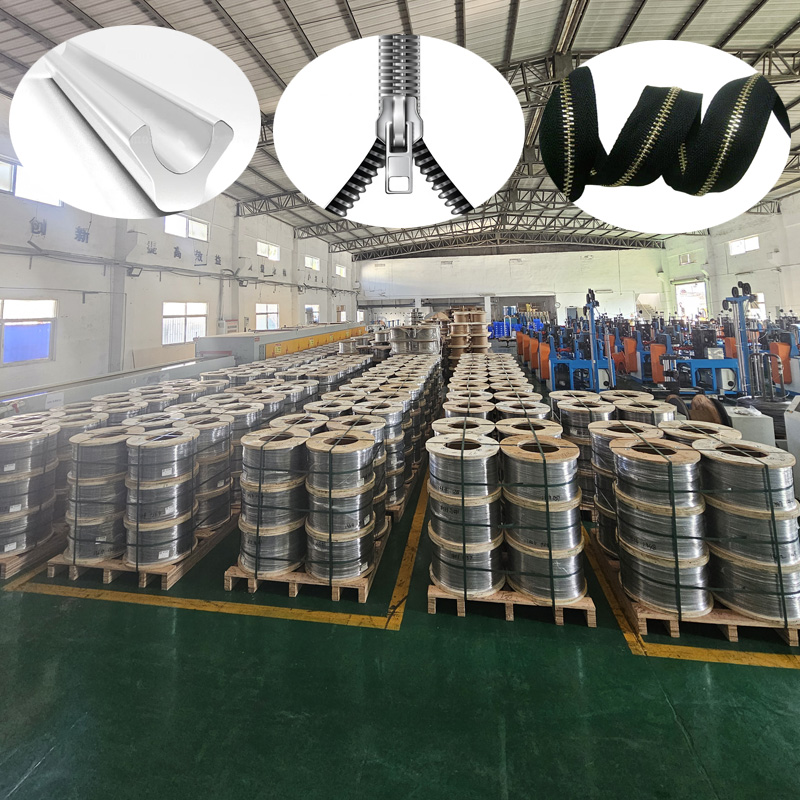
Y-profile zipper wire forms the interlocking teeth; the specification is set by the tooth drawing, not by the end-use category.
End stops: Top Stop Wire and Bottom Stop Wire
Top Stop Wire (FPD-TSW) is a shaped wire for the upper termination of the chain, made of stainless steel, copper or aluminum as specified, with customizable shape, size and hardness, and listed for clothing accessories and bag & luggage. Bottom Stop Wire (FPD-BSW) covers the lower termination, with size and shape customizable and hardness available in soft or hard in the same two sectors. In the finished product the top stop limits slider travel so the slider cannot leave the chain at the open end, while the bottom stop closes the lower end of a closed-end construction and keeps the two chain halves together when the zipper is at rest.
These are small parts with a disproportionate failure cost. A stop that releases does not produce a cosmetic defect; it produces a zipper that no longer functions, which on apparel is a return and on luggage is a field failure. For that reason the stop wire deserves its own line in the specification rather than being absorbed into a general "zipper wire" request.
One construction decision should be settled before quantities are fixed. Closed-end and open-end zipper designs terminate differently, so a buyer specifying bottom stop wire should confirm which construction each style uses, and how many units per garment or per bag actually receive a bottom stop. On bag & luggage programmes, where a loaded bag is repeatedly pulled against the stops, the stop wire specification is best confirmed against the same handling case used to qualify the slider, rather than as an isolated component.
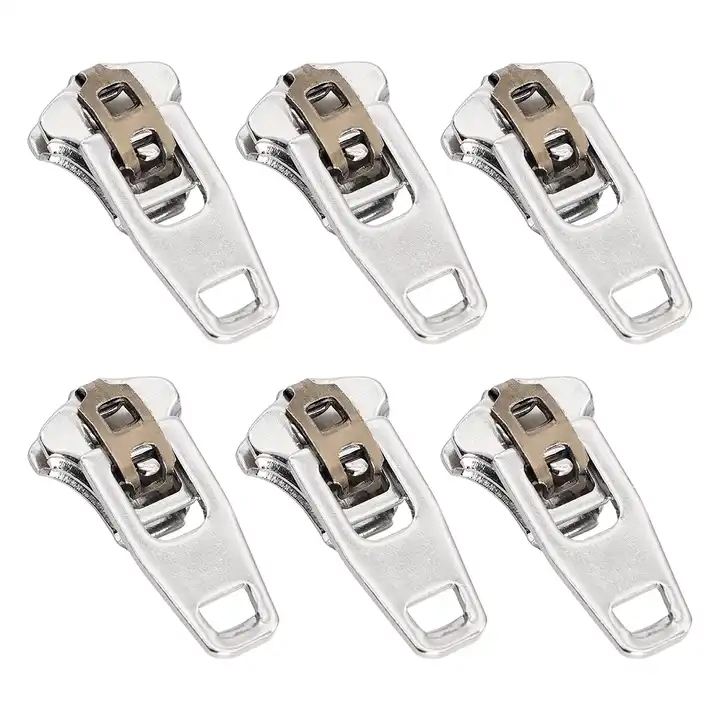
The slider and pull are the parts the end user touches; they are specified with the same four variables as the wire.
User-facing hardware: Zipper Pull and Zipper Automatic Slider
Zipper Automatic Slider (FPD-ZAS) is listed with the same customization envelope as the wire products — custom shape and size, stainless steel, copper or aluminum material, and soft or hard hardness — and is designated for clothing accessories and bag & luggage. Zipper Pull (FPD-ZP) is the second hardware item in the same component set, and it is the part a customer actually touches every time the item is used.
The split of roles matters when a buyer writes the brief. The slider does the mechanical work of engaging and releasing the teeth; the pull is the interface between the product and the hand. On apparel, hardware is usually expected to recede into the design and match the trim. On bag & luggage, hardware is a grab point, is more exposed to handling, and is often the first element a buyer in a store evaluates. Those are different acceptance conversations, even when the same model reference appears on both bills of materials.
Because the pull is frequently quoted as part of a hardware set rather than as a standalone line, buyers should give it its own dimensions, finish and material statement in the request and confirm the result on the physical sample. Treating the pull as an accessory to the slider is how mismatched finishes reach production.
Material, shape, size and hardness: the four-variable brief
Every wire product in the zipper range is published with the same four customizable variables. Because each is marked as customized, there is no default to fall back on: an order that does not state all four has not actually been specified.
| Variable | Set against | Buyer input required | Verification route |
|---|---|---|---|
| Material | The end-use environment and the appearance or finish the product must deliver | Stainless steel, copper or aluminum, named per component line | Composition check; test report |
| Shape | The profile drawing — Y profile for teeth, shaped profile for stops | A drawing or a written profile reference per model | Dimensional requirements |
| Size | The finished chain, tape and slider assembly | Format stated in buyer terms and reconciled with supplier references | Dimensional requirements |
| Hardness | The mechanical duty the component sees in service | Soft or hard, chosen deliberately | Tensile strength and elongation checks |
Four checks carry the verification load in Fullgreat's stated quality-control sequence: dimensional requirements, composition, tensile strength and elongation. A test report is listed as the after-sales document supplied with the order, which makes it the natural anchor for first-article approval. The practical reading for a buyer is simple — every variable above should map to one of those four checks, and anything that maps to none of them is an assumption rather than a specification.
Clothing versus bag & luggage: a component-by-component view
The table below is an emphasis map, not a rule book. It shows where the weight of the specification typically falls in each setting, so that a buyer can decide which component conversations to have first.
| Component | Clothing accessories emphasis | Bag & luggage emphasis | Shared requirement |
|---|---|---|---|
| Y teeth wire / Y-shape wire | Visual and tactile consistency along a short, visible chain; finish that suits the garment design | Consistency across longer chain runs; tooth geometry that holds up through repeated opening and closing | Tooth profile matched to an approved drawing; material and hardness stated |
| Top stop wire | Discreet termination that sits cleanly at the collar or hem | Reliable termination where the slider is pulled against the stop repeatedly | Shaped wire, customized size, soft or hard hardness |
| Bottom stop wire | Depends on whether the style is closed-end; quantity per garment must be confirmed | Depends on bag construction; the stop carries pull force while the item is loaded | Size and shape customized; construction confirmed before quantity is fixed |
| Slider and pull | Low-profile hardware matched to trim; comfort against skin and lining | Larger, more exposed grab point; the first part the end user evaluates | Custom shape, size, material and hardness; finish confirmed on sample |
Read top to bottom, the table also shows why a single blended specification rarely survives both categories. A tooth drawing that satisfies a garment line and a tooth drawing that satisfies a luggage line may legitimately differ, and the difference should appear on two separate lines of the purchase order rather than in a note asking the mill to "suit both".
Where these components run
The published application profile for this component set is garment zippers and zipper parts in the clothes accessories and bag & luggage sector, working in standard temperature environments and continuous 24/7 operation. The same application notes describe it as common in Vietnam, Bangladesh, Turkey, Brazil and other markets globally — a footprint that matches Fullgreat's reported export mix across Turkey, Latin America, Southeast Asia and the European and American markets. For a buyer, the operating-condition statement is a boundary as much as a description: the specification assumes a normal production environment, and any process outside standard temperature should be raised at the specification stage rather than discovered during trials.
A company-reported case illustrates the component-set approach in practice. Fullgreat describes a zipper OEM customer in Japan taking 50 tons per month for two years, with stable operation and a finished product described as smooth and free of burrs. The example is useful for what it shows about continuity — a multi-year, single-customer flow across a component set — and it should be read as a supplier-reported reference rather than as an independently audited result.
Procurement terms that apply to both end uses
At company level, Fullgreat operates OEM/ODM production with customization across material, packaging, specifications and colour. The published minimum order quantity is 1 ton and the published lead time is 30–45 days, with a test report listed among the after-sales documents. Two practical notes follow from that structure.
- Confirm whether the 1-ton MOQ applies per component line or per order. A four-component brief — teeth wire, top stop wire, bottom stop wire and hardware — behaves very differently under the two readings, and the answer affects how a distributor consolidates an apparel programme with a luggage programme.
- Plan the 30–45 day lead time against the approval sequence rather than against the production start. First-article review, dimensional sign-off and any re-sampling sit inside that window in most buyer schedules.
Because material, shape, size and hardness are all buyer-specified, the quotation is only as precise as the request behind it. A request that names the model, the drawing, the material, the size reference, the hardness and the packaging in one pass will usually return a usable quote on the first cycle.
What the evidence does not settle
Two boundaries are worth stating plainly, because they affect how far this component map can be pushed. First, the precision figure of ±0.01 mm on Y-teeth wire is company-published; it is a stated capability that a buyer should verify against their own drawing and the inspection report supplied with the order, not a third-party certification of every coil. Second, the published application profile describes standard temperature and continuous operation, so programmes with unusual heat, chemical exposure or cleaning regimes are outside what the current documentation covers and should be specified as exceptions.
There is also a data boundary at market level. Independent market sizing for zipper metal wire as an input material was not available for this review; the published figures that do exist describe finished zippers, and they disagree with one another — one commercial research publisher put the global finished-zipper market at USD 15.27 billion for 2024, another at USD 17.39 billion for the same year, while a separate estimate placed the 2025 figure at USD 16.62 billion. Those numbers are not averaged here and should not be read as wire-level demand. They are useful only as a reminder that downstream zipper demand exists at scale and that any single figure carries a scope and methodology caveat.
Market context and a conditional outlook
The clearest verified demand signal in the source set is upstream of the wire: according to World Trade Organization reporting in October 2025, global apparel trade grew 7% in the first half of 2025. For a component supplier, apparel trade volume is a more direct indicator than zipper market forecasts, because garment output consumes teeth wire and stop wire in proportion to the number of zippers sewn, not in proportion to the retail value of the finished zipper.
If apparel trade continues at the pace reported for the first half of 2025, demand for teeth and stop wire would be expected to follow garment output rather than lead it, and the practical pressure on buyers would sit on lead time and component availability rather than on specification. That is a conditional reading, not a forecast, and it rests on a single reported period. The more durable observation is structural: because the same catalogue serves clothing accessories and bag & luggage through customization rather than through separate product lines, a buyer running both categories can align material and hardness decisions across programmes — provided the tooth drawings and stop specifications stay separate where the assemblies genuinely differ.
Frequently asked questions
How do zipper metal wire requirements differ between clothing and bag & luggage?
The wire products themselves carry the same customization envelope in both sectors — customized shape, size, material and hardness — so the difference sits in emphasis rather than in product family. Apparel programmes tend to centre on visual and tactile consistency along a short, visible chain, while bag & luggage programmes tend to centre on consistency across longer chain runs and on hardware that is repeatedly handled. Both still require a tooth drawing, a stated material, a size reference and a hardness choice before quotation.
Which zipper components are made from shaped wire rather than teeth wire?
In Fullgreat's range, Top Stop Wire (FPD-TSW) and Bottom Stop Wire (FPD-BSW) are shaped-wire components that terminate the chain at the top and bottom ends respectively. Teeth are formed from Y Teeth Wire (FPD-YTW01) or Y-shape Wire for Zipper (FPD-YSW). The shaped-wire family in the wider catalogue also includes Special-Shaped Wire (FPD-SSW), Shaped Wire (FPD-SW) and Profiled Wire (FPD-PW).
Can one Y-teeth wire specification serve both an apparel line and a luggage line?
It can only be decided against the two finished assemblies. Y Teeth Wire (FPD-YTW01) and Y-shape Wire for Zipper (FPD-YSW) are both listed for clothing accessories and bag & luggage, and both are customizable in shape, size, material and hardness, which means a shared specification is possible in principle. Whether it is sensible depends on whether the tooth profile, format and hardness that suit the garment also suit the bag or case — a question answered by drawings and samples, not by the model name.
What material and hardness options are available for the wire components?
Stainless steel, copper or aluminum are the published material options, each supplied as a customized choice rather than a fixed grade, and hardness is available in soft or hard. The same four variables apply to Zipper Automatic Slider (FPD-ZAS) as to the wire products. Because all of them are customized, the specification must name each variable per component line; verification then runs through dimensional requirements, composition, tensile strength and elongation, with a test report supplied with the order.
Which markets and operating conditions are these zipper components used in?
The published application notes describe garment zippers and zipper parts in the clothes accessories and bag & luggage sector, in standard temperature environments and continuous 24/7 operation, with common use in Vietnam, Bangladesh, Turkey, Brazil and other markets globally. Buyers whose processes fall outside standard temperature should raise those conditions as exceptions during specification rather than assume the standard profile covers them.
A downloadable PDF profile covering Fullgreat Metal Limited's product scope, customization options and contact details is available here: Fullgreat Metal company profile (PDF). The specification decisions described in this article remain buyer decisions, confirmed against drawings, samples and inspection reports for each end use.
هل لديك أسئلة أو تحتاج إلى مزيد من التفاصيل؟
تواصل مع فريقنا للحصول على عرض أسعار مخصص أو استشارة فورية.
طلب عرض أسعار
املأ النموذج أدناه وسيتواصل معك فريقنا بعرض مقترح مخصص.
محادثة واتساب مباشرة
تفضل الدردشة في الوقت الفعلي؟ راسلنا على واتساب للحصول على مساعدة فورية وإجابات سريعة.
- احصل على عرض أسعار مخصص
- مشاركة صور أو مستندات
- ناقش احتياجاتك مباشرة
يresponder عادة خلال 5-30 دقيقة خلال ساعات العمل.