
Coarse Thread Drywall Screw: A Buyer Specification Guide
A coarse thread drywall screw is a case-hardened carbon steel fastener with a bugle head, a Phillips drive and a wide thread pitch, designed to pull gypsum board tight against a substrate without tearing the board surface. Its thread pitch, not its head shape, is what determines which substrate it can hold. That makes the coarse thread drywall screw a specification decision first and a price decision second.
Most drywall screw specifications are written around a single word: drywall screw. That is enough to identify a product category, but not enough to buy one. Two screws with the same head, the same drive and the same coating can behave very differently in service if one carries a coarse thread and the other a fine thread, or if one is case-hardened to a documented hardness band and the other is not.
This guide is written for procurement managers, importers and distributors working through the research and evaluation stages of a drywall screw purchase. It sets out the constraints that determine whether a coarse thread drywall screw is the right item for a given build-up, which parameters belong in the purchase specification, how coating choice interacts with corrosion exposure, and what documentation a supplier should be able to produce before an SKU is approved.
Coarse Thread vs Fine Thread: The Constraint That Drives Everything Else
Thread pitch is the primary selection variable in drywall screws, and the industry rule is straightforward: coarse threads are typically specified for wood studs, while fine threads are typically specified for light gauge metal studs. Selection depends on stud thickness, point type and the specific ratings of the product in question. Thread appearance alone is not a reliable basis for substitution.
The mechanical reason is engagement. A coarse, wide-pitch thread bites into soft, fibrous substrates such as timber with fewer turns and displaces material rather than cutting it. In a thin-gauge steel stud, the same wide pitch spreads the load across fewer thread crests, and the risk of stripping or poor engagement rises. A fine thread presents more crests per unit of engaged length, which matters most where the substrate is thin and the available engagement depth is short.
Publicly listed product data reflects this split. One drywall screw listed for the United States market is described as a steel screw for attaching drywall to wood studs or to 25-gauge metal studs. Another listed product is a 6 x 1 inch screw with a coarse thread, bugle head, Phillips drive, yellow zinc plating and a sharp point, a configuration consistent with timber and general board attachment. Neither listing establishes an industry-wide rule, but together they show how substrate is normally declared at product level.
A practical verification sequence follows from that boundary. Identify whether the stud is wood or metal. Measure the steel stud thickness, or check moisture content for timber. Match the thread type to the substrate as declared in the product specification, then run a trial installation before the full order is released. If a product manual permits more than one substrate, the manual governs.
The Specification Block: Sizes, Hardness and Drive
A usable drywall screw specification states dimensional range, hardness band, head geometry, drive type, point type, material and finish. The parameters below describe the drywall screw range supplied by NINGBO WEIFENG FASTENER CO.,LTD under model designation C1022A-PH-BUGLE, and illustrate the level of detail a purchase specification should carry.
| Parameter | Specification | Why it belongs in the purchase order |
|---|---|---|
| Shank diameter | 3.5 mm to 4.8 mm (#6 to #10) | Sets board holding capacity and the pre-drill question |
| Length | 13 mm to 150 mm (1/2 inch to 6 inch) | Must exceed board thickness plus the required stud embedment |
| Head type | Bugle head | Countersinks into the board without tearing the surface paper |
| Drive type | Phillips #2 | Determines bit compatibility and cam-out behaviour on site |
| Material | C1022A case hardened carbon steel | Defines the base metallurgy for hardness and ductility |
| Core hardness | 300 to 450 HV | Torsional toughness; resists snapping during driving |
| Surface hardness | Minimum 550 HV | Wear resistance at the thread and point |
| Finish | Black phosphated, grey phosphated, zinc plated | Corrosion exposure and paint compatibility |
| Thread forms | Coarse thread, fine thread, collated configurations | Substrate matching and tooling compatibility |
The hardness split is the part of the specification most often left vague, and it is the part that explains most field failures. A drywall screw has to do two contradictory things at once: the surface must be hard enough to cut through board and bite into the substrate, while the core must remain ductile enough to absorb driving torque without snapping. Case hardening resolves that conflict by creating a hard outer layer over a tougher core. A specification that names a material grade without naming a hardness band leaves the trade-off undefined.
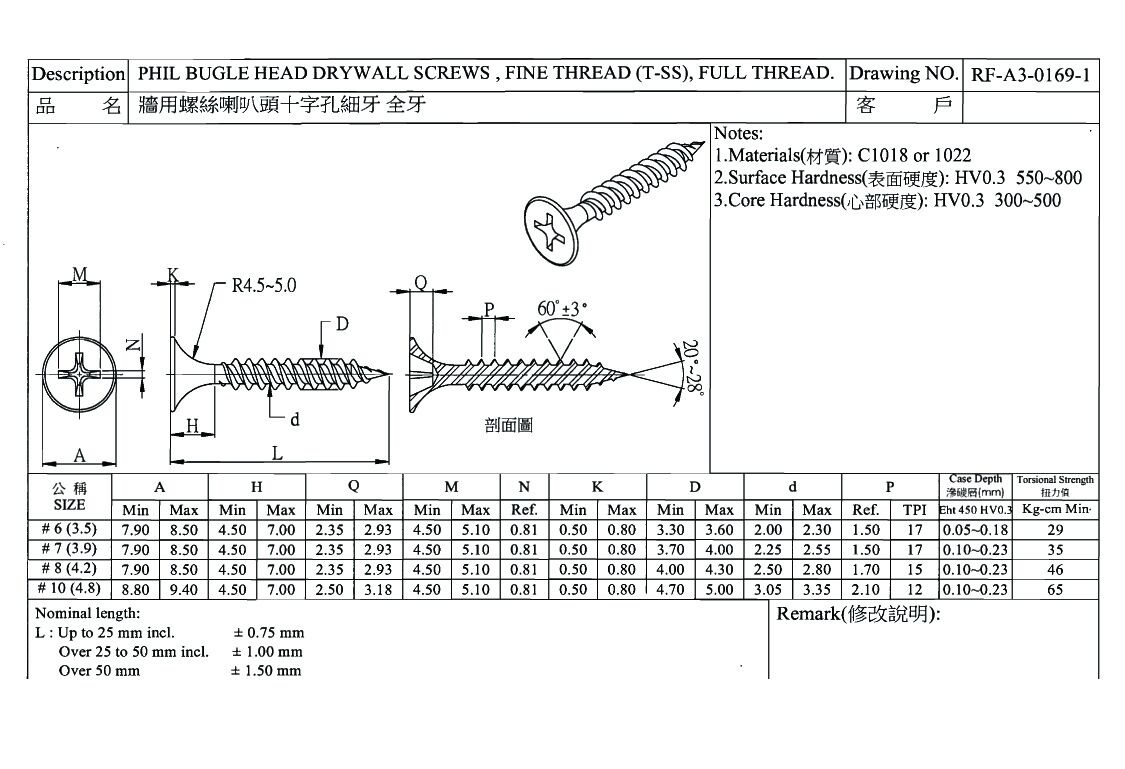
The bugle head and the Phillips #2 drive serve installation quality rather than structural performance. The bugle profile is shaped to seat the screw slightly below the board surface and countersink it without tearing the surface paper of the gypsum board. The point on this range is a sharp piercing point intended to penetrate without pre-drilling. Both features only work as specified if the driving tool is set to the correct depth and torque; over-driving will bury the head and break the paper regardless of screw geometry.
Standards and Certification: Three Different Questions
Drywall screw procurement documents frequently conflate three separate questions: which standard describes the product, whether that standard is applicable to the project, and whether the specific SKU has been certified against anything at all. They are not the same question, and treating them as one is a common source of non-conforming deliveries.
1. Standard reference
DIN 18182-1 specifies Type TN, a trumpet head with a double continuous thread, for 3.5 mm diameter drywall screws with lengths ranging from 25 mm to 55 mm. This is a dimensional and geometric reference point. It tells a buyer what a compliant Type TN screw should look like; it does not tell a buyer that any particular supplier's screw qualifies.
2. Standard applicability
DIN 18182-2 is presented as specifying requirements for technical fasteners and accessories used with gypsum plasterboard according to DIN EN 14566. That description comes from a standards reference page rather than the official standard text, and the current edition and status of that document require independent verification before it is written into a purchase specification. Buyers working to European market requirements should confirm the current edition through an official standards source rather than a secondary summary.
3. Product-level certification
Certification status sits at SKU level and must be read at that level. One drywall screw product page for the United States market states plainly that the listed item is not certified, even though the same page describes a defined thread, head, drive and point type. That is not a contradiction; it is a reminder that a described product and a certified product are different claims.
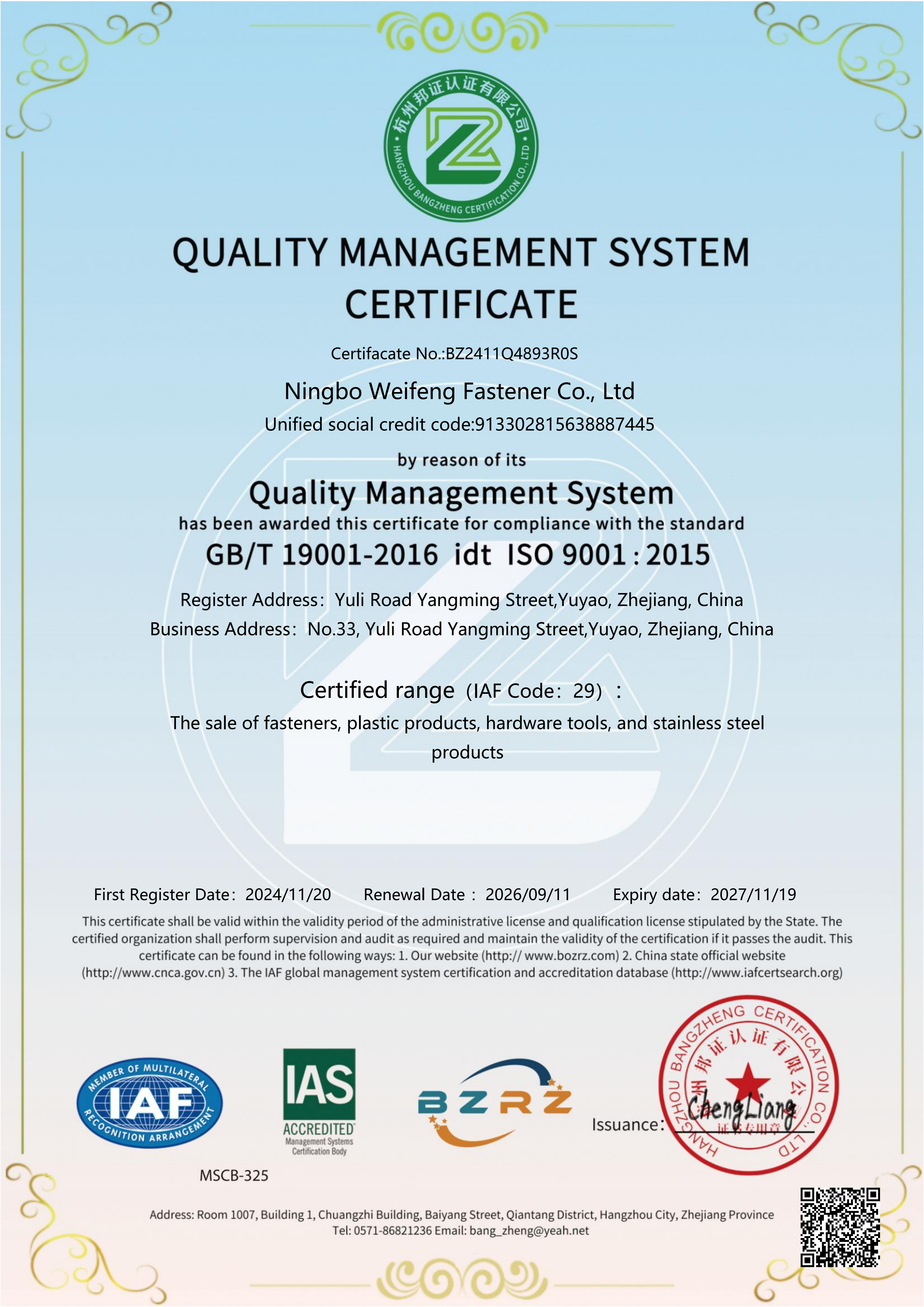
NINGBO WEIFENG FASTENER CO.,LTD holds ISO 9001 certification, certificate number BZ2411Q4893R0S, issued by HANGHOU BANGZHENG CERTIFICATION CO.,LTD against the quality management system standard GB/T 19001-2016. The certificate was issued on 2024-11-20 and remains valid until 2027-11-19, covering the scope of screws, bolts, nuts and anchors for the global market. It is a quality management system certification covering that product scope; it is not a product type approval for an individual drywall screw SKU. Buyers who require product-level conformity evidence should request it separately alongside the system certificate.
Coating Selection and Salt Spray: What Black Phosphate Actually Delivers
Finish is the second constraint most often under-specified. Standard black phosphate coating provides an industry baseline of 48 hours of salt spray resistance under ASTM B117, which suits indoor, climate-controlled environments. That figure is a baseline, not a guarantee for every phosphate-finished SKU, and it is measured under a defined laboratory method rather than a real installation.
Black phosphate and zinc plating protect steel in different ways, and the difference matters for service life:
- Zinc plating generally provides superior long-term corrosion protection because it works by sacrificial protection: the coating corrodes preferentially to protect the steel beneath it.
- Black phosphate works as a physical barrier and offers better paint adhesion, but once the barrier is breached, corrosion progresses faster than it would on a zinc-plated surface.
The practical decision rule is exposure-based. For dry, climate-controlled interior board installation, a phosphate finish is normally sufficient, and its paint adhesion is an advantage where the fastener head will be covered by joint compound. Where humidity, condensation, wet areas or exterior exposure are in scope, zinc plating is the more defensible baseline, and a project specification should state both the test method and the required acceptance hours rather than the word coated.
Application Map: Matching Thread to the Build-Up
The drywall screw range described here is intended for interior decoration, construction engineering, gypsum board installation, partition wall construction and furniture manufacturing. Within those settings, the constraint set changes by scenario.
| Scenario | Typical thread / configuration | Constraint to verify before ordering |
|---|---|---|
| Gypsum board partition on wood studs | Coarse thread with sharp point | Stud moisture content, required embedment depth, board thickness |
| Partition wall on light gauge steel studs | Fine thread | Stud gauge and thickness; coarse thread is not a substitute |
| Overhead ceiling board attachment | Thread matched to the substrate in use | Stripping resistance and driver depth and torque control |
| Prefabricated and modular panel lines | Collated drywall screw configurations | Strip collation format must match the auto-feed tooling |
| Furniture and board assembly | Substrate-dependent | Trial installation on the actual board and frame material |
Collated configurations deserve separate attention because they impose an additional compatibility constraint. A collated drywall screw is only usable if the collation strip is matched to the driving tool, and a mismatched strip stops a production line rather than slowing it down. For buyers supporting prefabricated or modular panel production, collation format belongs in the specification alongside thread type and length.
What a Coarse Thread Drywall Screw Supplier Should Be Able to Document
NINGBO WEIFENG FASTENER CO.,LTD is a fastener manufacturer based in Yuyao, Zhejiang, China, producing screws, bolts, nuts, washers, anchors and wood screws. The company operates a 7,000 square metre facility with approximately 50 employees, an annual output of 6,000 tons, and a research and development team of two engineers. Its export share is approximately 90%, with main markets in South America, Africa and Russia; its wider export coverage is stated as Europe, North America, South America, the Middle East, Southeast Asia, Russia and Africa.
Its drywall screw range is designated model C1022A-PH-BUGLE and includes fine thread, coarse thread, black phosphated, bugle head and collated configurations, in shank diameters from 3.5 mm to 4.8 mm and lengths from 13 mm to 150 mm. Because coarse thread, fine thread and collated forms are held within one product family, a buyer can move between substrate types on a project without changing supplier or documentation chain, provided the correct thread form is specified per substrate.
For buyers completing supplier evaluation, the operational terms attached to that range are as follows:
- Production mode: OEM and ODM, with customized logo, customized packaging, graphic customization and material selection.
- Minimum order quantity: 300 kg.
- Lead time: 35 to 60 days.
- Quality control: professional sampling inspection of every batch by dedicated QC personnel, with in-house testing for tensile strength, torque and corrosion resistance.
- Quality management: ISO 9001 certification, certificate number BZ2411Q4893R0S, valid until 2027-11-19.
- Logistics: flexible shipping from Chinese gateways including Ningbo, Shanghai and Tianjin.
- After-sales: 24/7 online technical support, a quality guarantee and replacement policy, and remote video support for technical guidance.
The relevant procurement point is not the size of the company but the shape of the evidence package. A buyer evaluating a coarse thread drywall screw supplier should be able to obtain the material grade and hardness band in writing, a dimensional drawing for the specified SKU, the batch inspection record, the applicable certification and its exact scope, and a sample for trial installation on the actual substrate. Where a supplier can provide some of these but not others, the missing item defines the residual risk the buyer is accepting.
Market Direction: Where the Constraint Profile Is Moving
The drywall screw category is growing, and the way it is purchased is changing with it. A 2025 industry market study places the global drywall screws market at USD 2.18 billion in 2025, projected to reach USD 3.04 billion by 2033. The same body of research attributes 58% of global drywall screw demand to residential construction, which keeps the specification profile anchored to residential build practice.
The more consequential shift sits on the installation side. Collated drywall screws account for approximately 36% of product demand within the collated screw market, and that share is being driven by modular and prefabricated construction. The industry interpretation is that labour availability, rather than fastener performance, is pushing demand from loose screws toward collated systems that feed auto-feed tools.
For buyers, this has a direct consequence. The effective purchase specification is widening from thread pitch alone to a combined constraint set: thread form for the substrate, collation format for the tooling, and corrosion performance for the service environment. A supplier that can hold all three within one documentation chain reduces the coordination load on the buyer, which is a procurement benefit rather than a marketing one.
A second, less visible pressure is input cost. Drywall screws are a commodity steel product, and steel coil price movement is a recognised driver of category cost volatility. That does not change the physical specification, but it does change how quotations should be structured, with finish, packing, order quantity and Incoterm stated explicitly so that price comparisons remain like-for-like when input costs move.
Limits Buyers Should Assume Until Proven Otherwise
A specification guide that only lists strengths is not usable. The following boundaries apply to this category and should be carried into any tender document:
- Coarse thread is substrate-specific. It is the wood-stud option. Substituting it into thin-gauge metal studs is contrary to published technical guidance and risks stripping.
- Phosphate corrosion performance is finite. The 48-hour ASTM B117 baseline applies to indoor, climate-controlled service. It is not an exterior or wet-area specification.
- A standard reference is not a certification. DIN 18182-1 defines Type TN geometry for 3.5 mm screws of 25 to 55 mm length. Product conformity against any standard must be evidenced separately, at SKU level.
- Certification scope matters. The ISO 9001 certificate held by NINGBO WEIFENG FASTENER CO.,LTD covers a quality management system for screws, bolts, nuts and anchors. It is not a drywall screw product type approval.
- Collated screws require a tooling match. Collation format and driving tool must be confirmed together before a production order is placed.
- Supplier-published specifications are supplier-reported. Commercial product pages and catalogue data are claims until verified against drawings, material certificates, inspection records and sample testing on the actual substrate.
Future Outlook
Three developments are likely to shape coarse thread drywall screw procurement over the next several years.
First, prefabrication will keep pulling demand toward collated configurations, which moves tooling compatibility from a site detail into a purchasing constraint. Buyers specifying for modular lines should expect collation format to appear in RFQs alongside thread type.
Second, corrosion documentation will tighten. As more projects span mixed climates and longer service expectations, the difference between a phosphate barrier coating and a sacrificial zinc coating will increasingly be settled by test method and acceptance hours rather than by finish name.
Third, traceability will continue to migrate from an audit exercise into the SKU specification itself. Buyers are already asking for material grade, hardness band and batch inspection records as standard attachments. Suppliers that can produce that package on request will find qualification cycles shorter than suppliers that cannot.
Frequently Asked Questions
What is the difference between coarse thread and fine thread drywall screws?
Coarse threads are typically specified for wood studs, while fine threads are typically specified for light gauge metal studs. The correct choice depends on stud thickness, point type and the specific ratings of the product, not on thread appearance alone. Interchangeability should not be assumed: a coarse thread engages timber with fewer turns and displaces material, whereas a fine thread presents more thread crests per unit of engaged length, which matters in thin steel substrates.
Can coarse thread drywall screws be used in metal studs?
Published technical guidance states that wood-rated coarse threads should not be used in metal studs, and that installation should stop if stripping or poor engagement occurs. Product listings for the United States market show that substrate is normally declared at product level; one listed steel drywall screw is described for wood studs or 25-gauge metal studs, which is a product-specific rating rather than a general rule. Where a product manual permits multiple substrates, the manual governs.
What sizes and hardness values should a drywall screw specification state?
A specification should state shank diameter, length, head type, drive type, material grade, surface hardness, core hardness and finish. For reference, the drywall screw range supplied by NINGBO WEIFENG FASTENER CO.,LTD under model C1022A-PH-BUGLE covers shank diameters of 3.5 mm to 4.8 mm (#6 to #10), lengths of 13 mm to 150 mm, a bugle head, a Phillips #2 drive, C1022A case hardened carbon steel, a minimum surface hardness of 550 HV and a core hardness of 300 to 450 HV.
How much salt spray resistance does a black phosphate drywall screw provide?
Standard black phosphate coating provides an industry baseline of 48 hours of salt spray resistance under ASTM B117, which is suitable for indoor, climate-controlled environments. Zinc plating generally offers superior long-term corrosion protection through sacrificial protection, whereas black phosphate acts as a physical barrier with better paint adhesion but corrodes faster once that barrier is breached. Neither figure substitutes for project-specific testing.
Does a DIN reference mean a drywall screw is certified?
No. Standard reference, standard applicability and product certification are three separate questions. DIN 18182-1 specifies Type TN geometry for 3.5 mm diameter screws in lengths of 25 mm to 55 mm. DIN 18182-2 is presented as specifying requirements for fasteners used with gypsum plasterboard according to DIN EN 14566, but the official text, current edition and status require verification through an official standards source. Certification is a separate, SKU-level claim; one listed drywall screw product page states explicitly that the item is not certified.
What documentation should a buyer request before approving a drywall screw SKU?
At minimum: the material grade and hardness band in writing, a dimensional drawing for the specified SKU, batch inspection records, the applicable certification and the exact scope it covers, and a physical sample for trial installation on the actual substrate. For suppliers holding ISO 9001, the certificate number, issuing body, applicable standard and validity dates should be recorded. In the case of NINGBO WEIFENG FASTENER CO.,LTD, that is certificate number BZ2411Q4893R0S, issued by HANGHOU BANGZHENG CERTIFICATION CO.,LTD against GB/T 19001-2016, covering screws, bolts, nuts and anchors, valid until 2027-11-19.
How should coating choice be matched to the installation environment?
Match the coating to the exposure rather than to the product name. Phosphate finishes suit dry, climate-controlled interior board installation and offer better paint adhesion where the head will be covered by joint compound. For humid, condensing, wet or exterior-adjacent conditions, zinc plating is the more defensible baseline because it protects the steel sacrificially. The specification should name the test method and the required acceptance hours, not simply the word coated.
The full product catalogue covering drywall screws, anchors, bolts, nuts and washers, including dimensional and finish ranges, is available for download: Ningbo Weifeng Fastener product catalogue (PDF). Additional company information is published at wf-fastener.com.
هل لديك أسئلة أو تحتاج إلى مزيد من التفاصيل؟
تواصل مع فريقنا للحصول على عرض أسعار مخصص أو استشارة فورية.
طلب عرض أسعار
املأ النموذج أدناه وسيتواصل معك فريقنا بعرض مقترح مخصص.
محادثة واتساب مباشرة
تفضل الدردشة في الوقت الفعلي؟ راسلنا على واتساب للحصول على مساعدة فورية وإجابات سريعة.
- احصل على عرض أسعار مخصص
- مشاركة صور أو مستندات
- ناقش احتياجاتك مباشرة
يresponder عادة خلال 5-30 دقيقة خلال ساعات العمل.