
Coastal vs. Desert: Specifying Suspension Glass Insulators
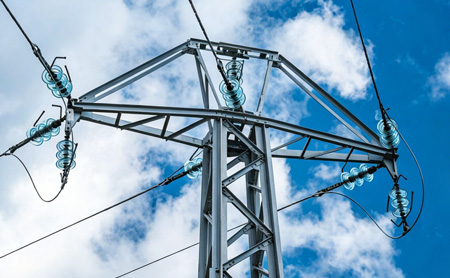
The kilonewton figure answers exactly one question: how much tensile load the string can carry. It does not answer the questions that drive maintenance cost on a coastal tower or a desert tower - how quickly a conductive layer forms on the glass surface, how effectively rain removes deposited dust, and how long the galvanized steel-to-glass interface survives an aggressive atmosphere.
This guide sets out a decision process for matching suspension glass insulator profiles to two corridor types that stress insulators in opposite ways. It draws on catalogue data and certification records from Jiangxi QOCI Electric Co., Ltd., a China-based manufacturer of glass and porcelain insulators located in Luxi Industrial Park, Pingxiang City, Jiangxi Province, together with registered market data on the wider insulator category. Every figure below traces back to a published product specification, a certification record, or the manufacturer's own documented project experience.
Why the kN Rating Does Not Predict Contamination Performance
A mechanical rating describes tensile capacity. Contamination performance is governed by the external leakage path, the shed geometry and the corrosion protection of the fittings - properties that vary independently of the rating, and sometimes within the same rating band.
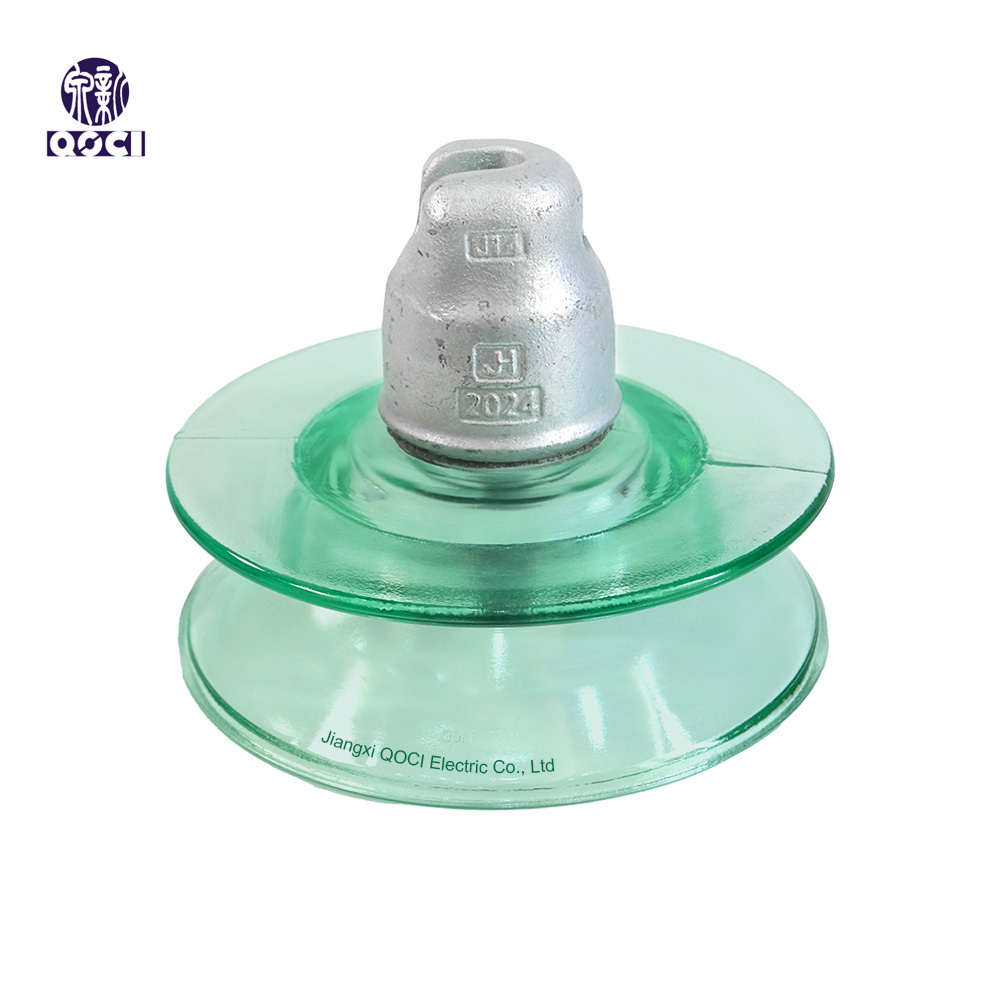
The 120 kN class makes the point cleanly. In the QOCI catalogue, the U120BS and U120BL models carry a 120 kN mechanical failing load, a 255 mm nominal disc diameter and a 320 mm creepage distance on socket coupling 16. The U120BLD and U120BLP models carry the same 120 kN load but a 280 mm nominal disc diameter and a 450 mm creepage distance, also on coupling 16. Their published electrical values differ as well: U120BS is rated at 100 kV dry lightning impulse withstand and 40 kV wet power frequency withstand, while U120BLP is rated at 125 kV and 50 kV respectively.
Nothing in that comparison makes one unit better than the other. It makes them appropriate for different corridors. A specification that names only the rating leaves the real field decision to whoever opens the crate.
Same 120 kN rating, different external profile - four suspension glass insulator models from the QOCI range.
| Model | Mechanical failing load | Nominal disc diameter | Nominal spacing | Creepage distance | Socket coupling | Dry lightning impulse withstand | Wet power frequency withstand |
|---|---|---|---|---|---|---|---|
| U120BS | 120 kN | 255 mm | 127 mm | 320 mm | 16 | 100 kV | 40 kV |
| U120BL | 120 kN | 255 mm | 146 mm | 320 mm | 16 | 100 kV | 40 kV |
| U120BLD | 120 kN | 280 mm | 146 mm | 450 mm | 16 | 120 kV | 45 kV |
| U120BLP | 120 kN | 280 mm | 146 mm | 450 mm | 16 | 125 kV | 50 kV |
What Coastal and Desert Corridors Stress Differently
The two environments attack an insulator through different mechanisms, and they reward different design responses. Treating them as a single category called harsh environment is where most specification errors begin.
Coastal corridors: conductive deposits plus fitting corrosion
- Surface contamination. Airborne salt settles as a film on the glass surface, and fog and sea spray wet that film repeatedly. Contamination and wetting therefore arrive together, which is what makes a coastal corridor electrically demanding.
- Fitting corrosion. The critical zone is the interface between the galvanized cap or pin and the glass. QOCI application data lists coastal salt fog among the standard service conditions for its suspension glass insulators, alongside heavy pollution and a working temperature range of -40 C to 60 C, and notes that under severe corrosion service conditions a zinc sleeve can significantly slow rusting and extend the service life of the insulator string.
- What the profile must do. Lengthen the leakage path, and keep the steel-to-glass interface protected over decades rather than years.
Desert corridors: dry deposits, rare washing, wide thermal swing
- Surface contamination. Wind-borne dust and sand settle on the surface when there is no rain to remove them. The deposit accumulates between wetting events, and wind redistributes it across the string.
- Self-cleaning geometry. Because natural washing is infrequent, shed shape and shed count carry more of the burden. QOCI product documentation notes that on the U70BLD an increased shed count enhances rain washing and pollution runoff, and that the extra sheds of the U100BLD provide self-cleaning action alongside creepage extension.
- Thermal range. The manufacturer's desert project record reports verified operation between -40 C and +55 C in Uzbekistan and Iraq, in service conditions that also include large day-night temperature differences.
- What the profile must do. Combine a long leakage path with a shed geometry that sheds particulate deposits and rinses them off when rain finally arrives.
A Four-Step Process for Mapping Environment to Profile
The sequence below is deliberately ordered so that the corridor is characterised before the product is chosen. Selecting a profile first and justifying it afterwards is the most common source of both over-specification and under-specification.
- Step 1 - Characterise the corridor. Identify the dominant contamination mechanism (conductive salt deposit versus dry particulate), the wetting mechanism (fog and spray versus occasional rain and condensation), the mechanical load case, and the temperature range the line will actually see.
- Step 2 - Fix the mechanical rating from the load case only. Rating follows tension, span, ice and wind loading. It is not a pollution decision, and treating it as one leads to oversized strings that still underperform.
- Step 3 - Select the profile family. Standard profile, anti-pollution (BP) profile, double-shed or two-wing (BD) profile, or aerodynamic (BA) profile. Each family changes creepage distance, shed count and disc geometry, and each carries its own trade-offs.
- Step 4 - Specify fitting protection and coupling, then verify. State the galvanizing requirement, whether a zinc sleeve is needed, and the socket coupling size. Then confirm what the certificate scope and batch records actually cover.
Corridor stress mapped to the attribute that should be weighted first, and the evidence a buyer can request for it.
| Corridor condition | Weight first | Weight second | Evidence to request |
|---|---|---|---|
| Coastal salt fog, conductive deposits, frequent wetting | Creepage distance and shed geometry | Corrosion protection at the steel-to-glass interface, including zinc sleeve where service conditions are severe | Certificate scope and validity, published model specification, batch test records, pre-shipment test declaration |
| Desert dust and sand, infrequent natural washing, wide temperature swing | Shed count and profile shape for self-cleaning and pollution runoff | Creepage distance and mechanical rating for the span; fitting protection still relevant in industrial pollution zones | Same as above, plus third-party inspection report where contamination class is disputed |
| High wind or typhoon exposure | Disc geometry that reduces wind load | Creepage distance, re-checked against the contamination class | Published creepage and impulse withstand values for the exact model, not the model family |
Reading the Specification: Five Attributes That Decide Corridor Fit
1. Creepage distance
Creepage distance is the length of the leakage path along the insulator surface. Published technical data on anti-pollution glass insulators describes increased creepage distances as the mechanism used to prevent flashovers in saline or industrial environments. In procurement terms it is the first attribute to check when a corridor is corrosive or heavily contaminated, and the first attribute a rating-only specification omits.
2. Shed geometry and profile family
Profile families change how the surface behaves, not just how long it is. Standard-profile units in the QOCI range, such as the U70BS and U120B, carry a 320 mm creepage distance and are aimed at normal-pollution and general transmission duty. Anti-pollution variants, denoted BP, extend creepage substantially: the U210BP carries a 550 mm creepage distance on a 320 mm nominal disc diameter with a zinc-sleeved pin for UHV duty, and the U160BSP carries 550 mm creepage on the same 320 mm disc with a 146 mm nominal spacing. Double-shed and two-wing variants, denoted BD, add shed density: the U120BLD is described as suitable for high-voltage transmission in severely polluted areas with a double-shed configuration and advanced shed geometry, and the U160BLD carries a 550 mm creepage distance on a 340 mm disc. Aerodynamic variants, denoted BA, prioritise wind behaviour - the U210AD and U160BSA use a 420 mm aerodynamic disc profile for reduced wind load in high-wind regions.
3. Socket coupling size
Coupling size is a hardware interface decision, and in the QOCI suspension glass insulator range it follows the mechanical class: 70 kN to 120 kN units use coupling size 16; 160 kN to 210 kN units use coupling size 20, with 20/24 offered on the 210 kN U210BD and the 240 kN U240B; the 300 kN U300B uses size 24; and the 420 kN U420B and U420BP use size 28. A corridor-driven profile change rarely changes the coupling, but it can change the string length and fitting load, which is why it must be re-checked rather than assumed.
4. Fittings and corrosion protection
QOCI suspension glass insulators are built with a tempered glass body, a hot-dip galvanized cast iron cap and a hot-dip galvanized forged steel pin. That construction is consistent across the range, including the 420 kN U420BP. In severe corrosion service a zinc sleeve can be specified to slow rusting and extend string life, and specific models already incorporate it: the U210BP is documented with a zinc-sleeved pin for UHV applications, and the U160BSP pairs a zinc-sleeved pin with a 550 mm creepage distance. The U70BLP at 70 kN is documented as suitable for coastal, salt-fog and tropical service conditions due to enhanced corrosion protection at the steel-to-glass interface, with a 450 mm creepage distance. In other words, corrosion defence is a written requirement with a named variant, not a default.
5. Electrical withstand values
Dry lightning impulse withstand values in the range run from 90 kV on the aerodynamic U70BA, U100BA and U120BLA up to 140 kV on the U160BSP, U210BP, U420B and U420BP. Wet power frequency withstand values run from 40 kV on the standard 70 kN and 100 kN units up to 80 kV on the 420 kN U420B. Power frequency puncture voltage is published as 130 kV on most models and 140 kV on the 420 kN units. These values travel with the model, not with the kN rating, which is why a shortlist that lists only ratings cannot be evaluated on paper.
Selected QOCI suspension glass insulators across three mechanical ratings, showing how creepage, disc geometry and electrical values move independently of the kN figure.
| Rating | Model | Disc diameter | Nominal spacing | Creepage distance | Coupling | Dry lightning impulse withstand | Wet power frequency withstand |
|---|---|---|---|---|---|---|---|
| 120 kN | U120BS | 255 mm | 127 mm | 320 mm | 16 | 100 kV | 40 kV |
| 120 kN | U120BL | 255 mm | 146 mm | 320 mm | 16 | 100 kV | 40 kV |
| 120 kN | U120BLD | 280 mm | 146 mm | 450 mm | 16 | 120 kV | 45 kV |
| 120 kN | U120BLP | 280 mm | 146 mm | 450 mm | 16 | 125 kV | 50 kV |
| 160 kN | U160BM | 280 mm | 155 mm | 400 mm | 20 | 110 kV | 45 kV |
| 160 kN | U160BLP | 280 mm | 170 mm | 450 mm | 20 | 125 kV | 50 kV |
| 160 kN | U160BSP | 320 mm | 146 mm | 550 mm | 20 | 140 kV | 55 kV |
| 160 kN | U160BLD | 340 mm | 170 mm | 550 mm | 20 | 130 kV | 50 kV |
| 160 kN | U160BSA | 420 mm | 146 mm | 380 mm | 20 | 95 kV | 50 kV |
| 210 kN | U210B | 280 mm | 170 mm | 400 mm | 20 | 110 kV | 45 kV |
| 210 kN | U210BP | 320 mm | 170 mm | 550 mm | 20 | 140 kV | 55 kV |
| 210 kN | U210AD | 420 mm | 170 mm | 380 mm | 20 | 95 kV | 50 kV |
Applying the Process: Coastal and Desert Selections
The process above produces different shortlists for the two corridors even when the mechanical duty is identical, which is the central point of this guide.
A coastal shortlist
- U70BLP, 70 kN. Documented as suitable for coastal, salt-fog and tropical service conditions due to enhanced corrosion protection at the steel-glass interface, with a 450 mm creepage distance.
- U160BSP, 160 kN. A 320 mm nominal disc diameter, 550 mm creepage distance, coupling 20, and a zinc-sleeved pin, rated at 140 kV dry lightning impulse and 55 kV wet power frequency withstand.
- U210BP, 210 kN. The same 320 mm disc and 550 mm creepage, with a zinc-sleeved pin specified for UHV applications.
- U420BP, 420 kN. A 380 mm nominal disc diameter and 620 mm creepage distance on coupling 28, rated at 140 kV dry lightning impulse and 55 kV wet power frequency withstand, with a 140 kV power frequency puncture voltage. This is the crossing-tower option when the same corrosive atmosphere applies to the heaviest spans.
A desert shortlist
- U70BLD, 100 kN and 120 kN (U100BLD, U120BLD). Double-shed profiles with 450 mm creepage distance. The U70BLD uses an increased shed count to enhance rain washing and pollution runoff in dusty or industrial environments, and the U100BLD adds self-cleaning action alongside creepage extension.
- U160BLD, 160 kN. A 340 mm disc diameter with 550 mm creepage distance, maximum shed density combined with extended creepage.
- U210BD, 210 kN. A 300 mm disc diameter with 450 mm creepage distance, coupling 20/24, a double-shed disc profile designed for UHV applications with aerodynamic multi-shed geometry intended to reduce contamination accumulation.
Documented project experience in desert and industrial pollution zones
QOCI's own case record covers 200,000 pieces supplied for UHV and EHV overhead transmission line insulation and desert and industrial pollution zone grid construction - 80,000 pieces in Uzbekistan, 70,000 in Ukraine and 50,000 in Iraq, delivered over two to three years to 2026. The reported results include zero line-tripping incidents, maintenance cost reduced by 70 percent, 100 percent visual defect detection without live-line testing, and pollution flashover incidents reduced by 85 percent against a porcelain baseline. Temperature tolerance of -40 C to +55 C was verified in Uzbekistan and Iraq, and the record notes anti-dust self-cleaning behaviour in desert environments. These figures are the manufacturer's reported project results rather than an independent third-party study, and they are presented here as such.
Verification: What a Corridor-Specific Order Should Be Checked Against
Profile selection is only as good as the evidence behind the units that arrive. Three layers are worth separating.
- Certificate scope. Jiangxi QOCI Electric holds an ISO 9001:2015 quality management system certificate, number 00124Q33852R3M/3600, issued by China Quality Certification Centre and valid to 14 May 2027, covering R&D, production and sales of electrical equipment including glass and porcelain insulators. ISO 14001:2015 environmental management (certificate 00125E30701R3M/3600) and ISO 45001:2018 occupational health and safety management (certificate 00125S30581R3M/3600) are both valid to 24 March 2028.
- Process control. Quality control is stated as 100 percent pre-shipment test with third-party inspection by SGS. That matters most for a corridor-specific order, where the delivered profile is the specification.
- Commercial envelope. Production mode covers OEM and ODM with customization of voltage and logo; monthly capacity is 750,000 units; lead time is 15 to 35 days; MOQ is 50 units; after-sales support is online technical support with replacement for defective products.
One standard anchors the technical side. Suspension glass insulator units for AC systems are governed by IEC 60305:2021, which specifies mechanical and electrical characteristics, so dimensional and characteristic checks can be tied to a published international reference instead of a supplier datasheet alone.
Market Trend: Demand Is Growing Where the Environment Is Hardest
Category-level data points in one direction: growth is concentrating in regions where new lines cross difficult terrain and contaminated air, which raises the weight of environment-mapped specification in procurement.
- The global glass insulators market was estimated at USD 1.14 billion in 2024 and projected to reach USD 1.97 billion by 2035, a CAGR of 5.1 percent over the 2025 to 2035 forecast period, according to Market Research Future. Published estimates for this category diverge, reflecting different definitions of what is counted as a glass insulator.
- Asia Pacific held a revenue share exceeding 52 percent in 2024, driven by grid expansion in China and India, according to Grand View Research.
- China concentrated 31.4 percent of total global exports of electrical insulators in 2024, worth USD 898 million, according to the Observatory of Economic Complexity. Within that flow, Chinese exports of electrical insulators to Saudi Arabia grew 219 percent between 2023 and 2024, making it the fastest-growing destination - a direct signal of demand from desert corridor construction.
- The supplier landscape includes established international and Chinese producers such as Sediver (Seves Group), Nanjing Electric and Zhejiang Jinlihua Electric, alongside specialised manufacturers.
The procurement implication is narrow but real. When a buyer shortlists by price and mechanical rating only, the differentiating attribute in a coastal or desert corridor - creepage distance, shed geometry and fitting corrosion protection - is left out of the comparison entirely.
Comparison with Established Alternatives - and the Limits of Each
Glass is not automatically the correct answer for every hard corridor, and profile upgrades carry their own costs. Being explicit about both is what makes the decision process usable.
- Against a porcelain baseline. In the manufacturer's desert and industrial pollution projects, the reported comparison is a 85 percent reduction in pollution flashover incidents relative to a porcelain baseline, with zero-value self-breaking enabling 100 percent visual inspection without live-line testing. That detection advantage is a genuine operational difference, but it is a first-party reported result from specific projects, not a general rule for all porcelain installations.
- Profile upgrades change geometry. Within the 120 kN class, the nominal disc diameter moves from 255 mm on the U120BS to 280 mm on the U120BLD. At 160 kN it moves from 280 mm on the U160BM to 340 mm on the U160BLD and 420 mm on the U160BSA. Larger discs and longer creepage alter string length, assembly weight and wind area, which feed back into tower loading and hardware selection. A pollution upgrade is therefore never only an electrical change.
- Aerodynamic geometry trades creepage for wind performance. The 210 kN U210AD carries a 380 mm creepage distance, against 550 mm on the 210 kN U210BP. The aerodynamic profile reduces wind load, but it is not a pollution answer, and specifying it for a contaminated corridor would be a mismatch.
- Glass remains a rigid, brittle material. Handling and installation damage is a real risk on site, which is also why the self-breaking behaviour matters operationally: a failed unit becomes visually obvious rather than latent.
- Corrosion protection must be written, not assumed. Hot-dip galvanized caps and pins are standard, but the zinc sleeve that QOCI documentation associates with severe corrosion conditions and with the U210BP is a variant requirement. If it is not specified, it is not ordered.
- Over-specification has a cost. Where contamination is light and mechanical loads are modest, a standard-profile unit such as the 70 kN U70BS - 320 mm creepage distance, rated for normal-pollution areas - may be sufficient. Moving to a longer creepage profile adds diameter, weight and wind area without a corresponding benefit.
Future Outlook
Three shifts look likely on current evidence. First, as grid expansion continues in Asia Pacific and export flows toward desert and coastal markets keep growing, corridor-level appraisal should become a standard step in insulator procurement rather than an expert add-on. Second, IEC 60305:2021 gives buyers a common reference for unit characteristics, which makes supplier-to-supplier comparison on creepage and geometry more practical than it has been. Third, and most relevant to specification practice, the distinction between mechanical rating and environmental fit is likely to be formalised in tender documents themselves - with creepage distance, profile family, coupling size and fitting protection stated as separate line items rather than implied by a kN figure. None of these shifts changes the underlying engineering; they change whether the specification captures it.
Frequently Asked Questions
Why can two suspension glass insulators with the same mechanical rating perform differently in the same corridor?
Because mechanical failing load describes tensile capacity only. The external leakage path, shed geometry and fitting corrosion protection are selected separately and vary within a rating band. In the QOCI range, the 120 kN U120BS and U120BL carry a 255 mm nominal disc diameter and a 320 mm creepage distance, while the 120 kN U120BLD and U120BLP carry a 280 mm disc diameter and a 450 mm creepage distance. Their published electrical values differ as well: 100 kV dry lightning impulse and 40 kV wet power frequency for the U120BS, against 125 kV and 50 kV for the U120BLP.
How should creepage distance and shed profile be weighted for coastal salt fog versus desert dust?
The two corridors place the burden differently. Coastal salt fog is a conductive contamination problem in which fog and spray repeatedly wet a salt film, so the priority is a longer leakage path combined with protection of the steel-to-glass interface; the U70BLP, for example, is documented as suitable for coastal, salt-fog and tropical service conditions due to enhanced corrosion protection at that interface, with a 450 mm creepage distance. Desert dust is a dry deposit problem with infrequent natural washing, so shed geometry carries more of the load: the U70BLD uses an increased shed count to enhance rain washing and pollution runoff, and the U100BLD uses extra sheds for self-cleaning action alongside creepage extension. Both corridors benefit from creepage length, but only the desert corridor depends so heavily on shed behaviour to compensate for rare rain.
Which socket coupling size corresponds to which mechanical rating?
In the QOCI suspension glass insulator range, 70 kN to 120 kN units use coupling size 16; 160 kN to 210 kN units use coupling size 20, with 20/24 offered on the 210 kN U210BD and the 240 kN U240B; the 300 kN U300B uses size 24; and the 420 kN U420B and U420BP use size 28. Coupling size is a hardware interface decision and must match the string fittings and tension clamps, so it follows the unit rather than the corridor.
What should be verified before accepting a glass insulator batch intended for a polluted corridor?
Three layers. Certificate scope: Jiangxi QOCI Electric holds an ISO 9001:2015 certificate (number 00124Q33852R3M/3600) issued by China Quality Certification Centre and valid to 14 May 2027, covering R&D, production and sales of electrical equipment including glass insulators, plus ISO 14001:2015 (00125E30701R3M/3600) and ISO 45001:2018 (00125S30581R3M/3600), both valid to 24 March 2028. Process control: 100 percent pre-shipment test with third-party inspection by SGS. Product records: the published specification sheet for the exact model, and confirmation that the profile and creepage distance ordered are the profile and creepage distance delivered. Because suspension glass insulator units for AC systems are governed by IEC 60305:2021, dimensional and characteristic checks can be anchored to that published standard.
Is an anti-pollution or double-shed profile necessary if the corridor is only lightly contaminated?
Not automatically. A standard-profile unit such as the 70 kN U70BS carries a 320 mm creepage distance and is intended for normal-pollution areas, while the U70BLP carries 450 mm and is specified for coastal, salt-fog and tropical conditions. Over-specifying the profile adds disc diameter, weight and wind area at the same mechanical rating: within the 120 kN class the nominal disc diameter ranges from 255 mm to 280 mm, and at 160 kN it reaches 340 mm on the U160BLD. Those changes propagate into string length, tower loading and hardware selection, so profile choice should follow a corridor appraisal rather than a general preference for heavier construction.
Does a higher mechanical rating remove the need for a pollution-resistant profile?
No. Rating and profile are separate decisions. The 210 kN U210B carries a 280 mm nominal disc diameter and a 400 mm creepage distance, while the 210 kN U210BP carries a 320 mm disc diameter and a 550 mm creepage distance with a zinc-sleeved pin. Both are 210 kN units. The first is oriented to extra-heavy-load and ultra-high-voltage transmission projects; the second extends the leakage path and adds fitting corrosion protection. Selecting the higher of two ratings does not deliver the creepage of the other model.
For readers who need the full model list behind these comparisons, Jiangxi QOCI Electric publishes its glass insulator catalogue for reference and download: QOCI Catalogue - Glass Insulators.