
Coffee Machine OEM/ODM: Staff-Pantry Capsule vs Semi-Auto
Coffee Machine OEM/ODM: Staff-Pantry Capsule vs Semi-Auto
For a staff pantry, the capsule-versus-semi-automatic decision should be made from the operating model, not from the machine category alone. A capsule platform is easier to fit where self-service, short training and minimal coffee preparation are priorities. A semi-automatic platform fits where the pantry can assign an operator, support a broader beverage routine and manage settings, cleaning and milk or hot-water use. The documented HUAGUANG Steam Appliances range gives buyers a practical way to compare those trade-offs across CM-C08A, CM-C07A, CM-CS01, CM-C06 PRO and CM-G03A PRO MAX.
HUAGUANG Steam Appliances is the OEM/ODM coffee-machine and garment-care business of Huaguang Electric Appliance Group Co., Ltd., founded in 1985 and supplying private-label programs across Europe, the Middle East, Africa and other export markets. Its coffee-machine range is presented for homes, offices, hotels, cafés, restaurants, retail stores and commercial spaces, and is suitable for OEM and ODM projects. That scope makes the platform useful for a staff-pantry brief, but it does not remove the need to match the exact model to the exact room, user group and document set.
Why staff pantries are a different OEM brief
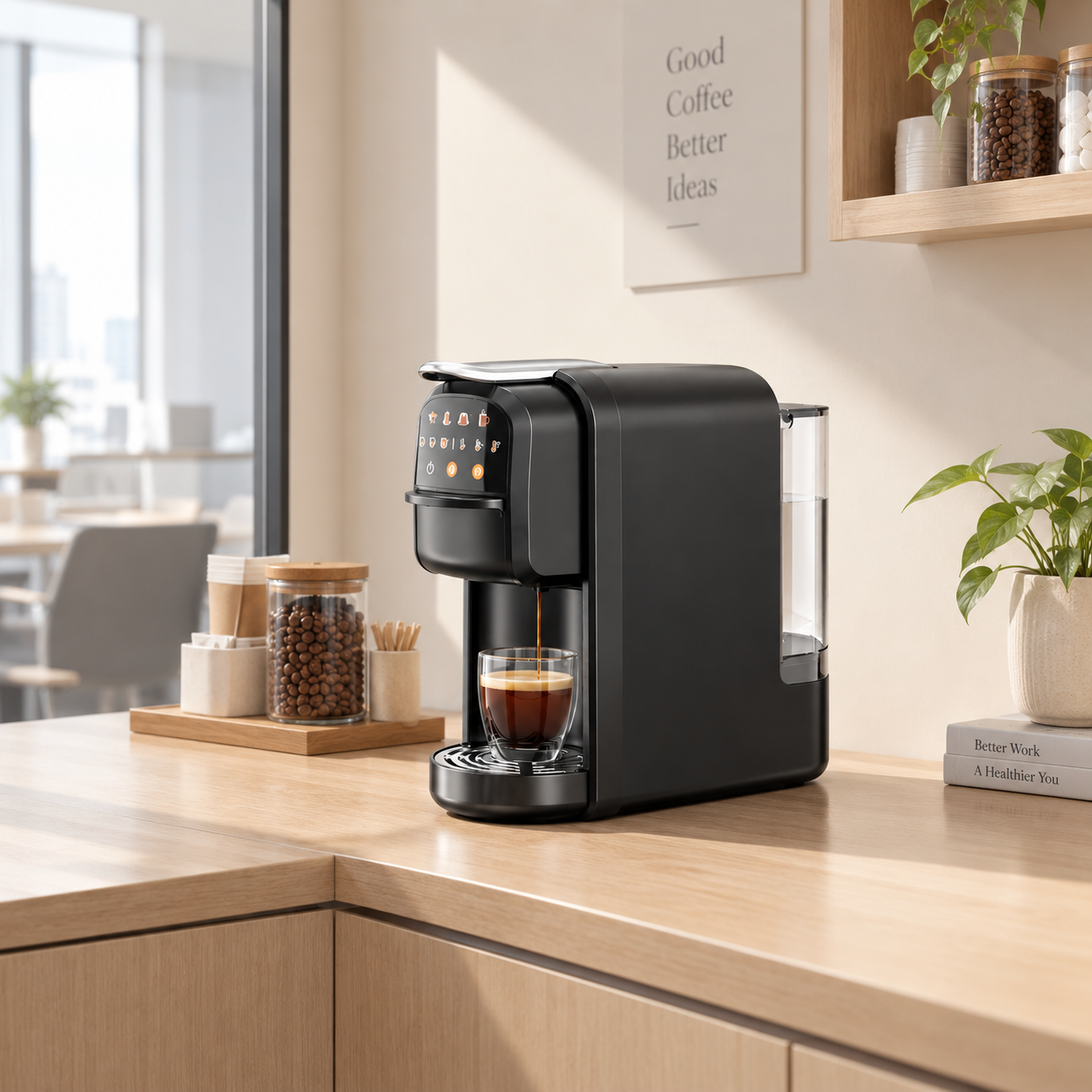
A staff pantry is not a café and not a home kitchen. It is a shared indoor space where the machine may be used in short, uneven bursts, by people with different coffee habits, and with limited willingness to read instructions. The application guidance for these coffee machines calls for use on a dry, stable, level countertop with adequate ventilation, away from damp locations, hot surfaces and open flames. It also requires the water tank to be filled with drinking water and the model-specific cleaning and descaling instructions to be followed.
Those conditions turn several ordinary procurement questions into design questions. Who refills the tank? Who cleans the drip tray? Where does a used capsule go? Is there a sink nearby? Does the pantry have enough counter depth for the machine plus cup clearance and ventilation? Will the machine be operated by trained staff, or by anyone with a mug? These are not marketing details. They determine whether a capsule platform or a semi-automatic platform will actually be used as intended.
The buyer’s first task is therefore to describe the pantry as an operating system: user group, peak periods, beverage menu, cleaning ownership, water access, counter dimensions and service access. Only after that should the factory brief name a model. A brief that starts with “we need a coffee machine” will usually produce a quotation; a brief that starts with “we need this pantry workflow” produces a platform choice that can be tested.
Capsule vs semi-automatic: the fit boundary in one view
The capsule models in the supplied range — CM-C08A, CM-C07A, CM-CS01 and CM-C06 PRO — are built around pod or capsule preparation, with different levels of cup-size control, tank capacity and interface complexity. The semi-automatic CM-G03A PRO MAX is a multi-function espresso machine with a 1.1 L water tank, 1400 W power rating, stainless-steel construction, programmable brew time and temperature, and an integrated hot-water system. The product information also describes a semi-automatic control system that starts brewing with one button press.
That difference sets the fit boundary. Capsule machines reduce the number of preparation decisions placed on the user. The CM-C08A is a MINI espresso pod machine with mechanical buttons, a 600 ml tank, 20-bar pump pressure and a listed 40-second preheat time. The CM-C07A adds a 1,000 ml tank and a choice of mechanical or touch buttons. The CM-C06 PRO adds 3-in-1 compatibility with Nespresso capsules, Dolce Gusto capsules and ground coffee, plus an LCD touch screen and self-cleaning function. These are workflow choices before they are product preferences.
The CM-G03A PRO MAX moves control back to the pantry operator. Programmable brew time and temperature can support a more tailored espresso routine, and the integrated hot-water system can serve tea, hot chocolate and other drinks. That flexibility is useful only when someone is responsible for setting, checking and cleaning the machine. If the pantry has no assigned operator, extra control can become an unresolved task rather than a benefit.
Model-by-model fit: what the documented specs support
CM-C08A: narrow-footprint capsule for constrained counters
The CM-C08A is the most space-focused capsule option in the supplied set. Its listed product dimensions are 86 × 356 × 220 mm, and the product information states that it is just 8 cm wide, allowing it to fit into corners and compact spaces. It uses a 600 ml water tank, mechanical buttons, 20-bar pump pressure, a 40-second preheat time and a 2.1 kg net weight. Cup volumes are listed as 40 ml, 80 ml and 110 ml. The product is a MINI espresso pod machine and is described as easy to operate with one click.
For a staff pantry with limited counter length, the CM-C08A is a credible shortlist candidate when the beverage menu is espresso-led and the pantry can accept frequent tank refilling. The 600 ml tank is the smallest in the capsule group described here, so the refill routine needs an owner. The narrow width helps with siting, but the buyer should still check depth, cup clearance, ventilation and cable routing against the actual counter. A narrow machine can still be a poor fit if the surrounding space cannot support loading, unloading and cleaning.
CM-C07A: larger tank and dual cup-size control
The CM-C07A is an espresso pod machine with a 1,000 ml water tank, 20-bar pump pressure, a 40-second preheat time, 2.3 kg net weight and listed dimensions of 372.5 × 112 × 242 mm. It offers approximately 40 ml for a small cup and 110 ml for a large cup, with mechanical or touch-button versions. The detachable water tank and removable drip tray simplify cleaning and maintenance, and a built-in lighting system shows the extraction process.
For a pantry, the CM-C07A sits between the CM-C08A and the more flexible CM-C06 PRO. The larger tank reduces refill frequency compared with the 600 ml CM-C08A, while the dual cup-size buttons give users a simple choice without opening a full beverage menu. The mechanical-versus-touch interface decision should follow the user group: a mechanical version may suit a pantry that wants fewer interface steps, while a touch version may suit a more appliance-focused environment. Both versions should be tested for the specific cup sizes and capsules intended for the site.
CM-CS01: check the model listing before shortlisting
The CM-CS01 is a SENSEO pod coffee machine with 1450 W power, a 750 ml water tank, listed dimensions of 245 × 120 × 241 mm and a 60-second preheat duration. The specification lists small and large cup capacities of 65/130/260 mL, while the selling-point text separately describes a single-pod brew of 27 ml and a double-pod brew of 55 ml. Those are different measures and should be clarified with the factory before they are used in a pantry brief. The product also uses NTC temperature control and is described as supporting espresso, latte, cappuccino and mocha preparation.
This caution matters because staff-pantry buyers often assemble a shortlist from a product family page and then assume that one certificate covers every model shown. Certificate scope is model-specific. The CM-CS01 may still be a candidate on workflow and footprint grounds, but its documentation status must be verified separately before it is presented as approved for a market that requires the linked certificate.
CM-C06 PRO: 3-in-1 flexibility with a touch interface
The CM-C06 PRO is a 3-in-1 multifunctional coffee machine compatible with Nespresso capsules, Dolce Gusto capsules and ground coffee. It uses a 700 ml detachable water tank, 20-bar pump pressure, a 40 ± 5-second preheat time and an LCD touch screen. Cup volumes are listed as 25 ml, 40 ml and 110 ml. The machine offers three water-temperature levels — 45 °C, 75 °C and 95 °C — and a coffee temperature of 90 °C. It also has a removable metal drip tray and a self-cleaning function.
For a pantry, the CM-C06 PRO offers the broadest capsule-based beverage flexibility in this group. That can be useful where users bring different capsule types or where the pantry wants ground-coffee options alongside pods. The trade-off is a more complex interface and more choices at the point of use. A pantry with high self-service turnover should test whether the LCD flow and capsule/ground-coffee selection are intuitive for occasional users. The 700 ml tank is larger than the CM-C08A’s 600 ml but smaller than the CM-C07A’s 1,000 ml, so refill frequency should be checked against the expected daily cup count.
CM-G03A PRO MAX: semi-automatic control for an assigned operator
The CM-G03A PRO MAX is a multi-function espresso machine with a 1.1 L water tank, 1400 W power, 15-bar pressure and stainless-steel construction. Its product information describes a semi-automatic control system, one-button start, programmable brew times and temperatures, and an integrated hot-water system. The 1.1 L tank is described as allowing up to 10 cups at a time. A documented e-commerce marketplace case in the Middle East covered households, offices, serviced apartments and gift purchases, and the model’s fast brewing and espresso and milk-based drink capability received positive customer reviews. That case supports channel relevance; it does not prove performance in every staff pantry.
The CM-G03A PRO MAX is the stronger fit when the pantry has an assigned operator and a beverage menu that benefits from programmable control, hot water and a stainless-steel build. It is a less natural fit for a pure self-service pantry with no cleaning owner. The supplied product specification does not list product dimensions, so the buyer should request a dimension drawing before approving counter layout. The product also needs a clear routine for programming, cleaning and descaling. A semi-automatic machine without an operator routine is simply a more complex capsule alternative.
| Model | Platform and documented workflow | Footprint / tank data | Staff-pantry fit note |
|---|---|---|---|
| CM-C08A | MINI espresso pod machine; mechanical buttons; one-click operation; 20-bar; 40 s preheat | 86 × 356 × 220 mm; 600 ml tank; 2.1 kg | Best for very tight counters and espresso-led self-service; plan frequent refills. |
| CM-C07A | Espresso pod machine; mechanical or touch buttons; 40/110 ml cup options; 20-bar; 40 s preheat | 372.5 × 112 × 242 mm; 1,000 ml tank; 2.3 kg | Balanced capsule option for pantries wanting a larger tank and simple cup-size choice. |
| CM-CS01 | SENSEO pod machine; 1450 W; 60 s preheat; NTC temperature control | 245 × 120 × 241 mm; 750 ml tank | Check model-specific certificate scope; the linked Intertek certificate does not include CM-CS01. |
| CM-C06 PRO | 3-in-1 capsule and ground-coffee machine; LCD touch screen; self-cleaning; 20-bar | 301 × 115 × 257 mm; 700 ml tank; 40 ± 5 s preheat | Flexible capsule platform for mixed user preferences; more interface decisions at point of use. |
| CM-G03A PRO MAX | Semi-automatic multi-function espresso machine; programmable brew time and temperature; integrated hot water; one-button start | 1.1 L tank; 1400 W; product dimensions not listed in supplied spec | Fits pantries with an assigned operator and a broader beverage routine; request a drawing. |
Workflow and operator skill: questions before briefing the factory
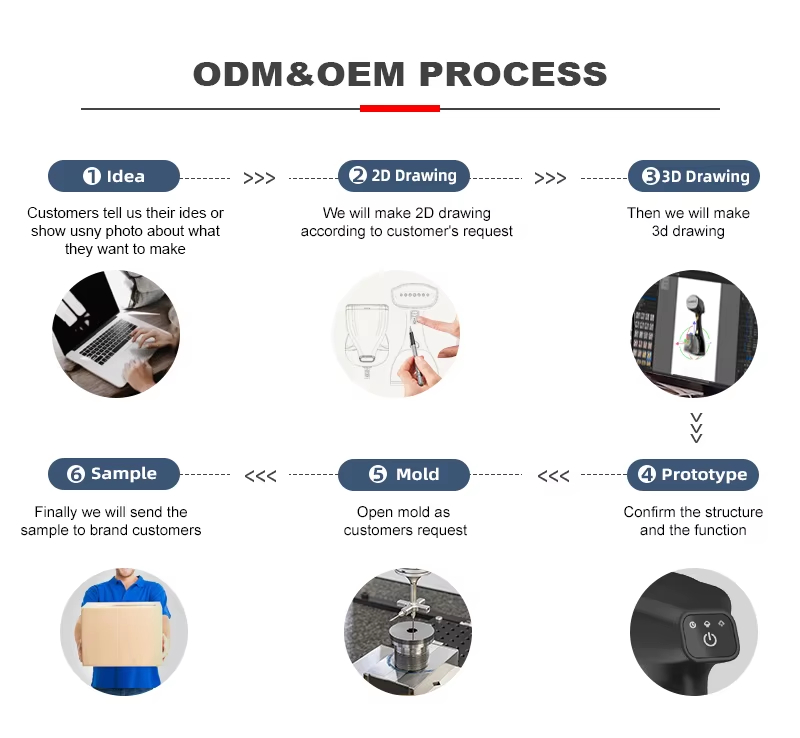
The factory brief should not begin with a model name. It should begin with the workflow the pantry can sustain. The following questions help a buyer separate a capsule platform from a semi-automatic one before requesting samples or quotations.
1. Who operates the machine?
If the answer is “anyone in the office,” the brief should favour a short sequence: load, select, brew, remove. The CM-C08A’s mechanical one-click operation and the CM-C07A’s cup-size buttons fit that pattern. If the answer is “a facilities team member sets it up each morning,” the CM-G03A PRO MAX’s programmable brew time and temperature can be considered. The buyer should name the operator, the backup operator and the cleaning owner in the brief.
2. What beverage menu is actually required?
Espresso-only pantries can shortlist the CM-C08A or CM-C07A without creating a milk or hot-water routine. A pantry that needs espresso, longer coffee, tea and hot chocolate should examine the CM-G03A PRO MAX’s integrated hot-water system. A pantry with mixed capsule formats and ground coffee should examine the CM-C06 PRO. The CM-CS01 adds another pod system and a broader beverage description, but its model-listing caution must be resolved first. The menu question should be answered in cups per day and drink types, not in vague terms such as “good coffee.”
3. What is the real footprint, including clearance?
Product dimensions are only the start. The buyer should ask for a dimension drawing and check counter depth, height under cabinets, cup clearance, ventilation space, water-tank removal path, drip-tray removal path and cable routing. The CM-C08A is only 86 mm wide, but its 356 mm depth and 220 mm height still need to fit the counter. The CM-C07A is 372.5 mm wide and 242 mm high, while the CM-C06 PRO is 301 mm wide and 257 mm high. The CM-G03A PRO MAX requires a drawing because the supplied specification does not list dimensions. A machine that fits the counter but cannot be cleaned comfortably is not a fit.
4. How will water, capsules and waste be managed?
Tank capacity affects refill frequency, but the pantry also needs a water source and a waste routine. The CM-C08A has a 600 ml tank; the CM-C07A has 1,000 ml; the CM-CS01 has 750 ml; the CM-C06 PRO has 700 ml; and the CM-G03A PRO MAX has 1.1 L. The buyer should map who refills the tank, where used capsules or coffee grounds go, and how often the drip tray is emptied. The application guidance requires drinking water in the tank and model-specific cleaning and descaling. Those tasks should be assigned before the machine is installed.
5. What cleaning and descaling routine is realistic?
The CM-C07A has a detachable water tank and removable drip tray; the CM-C06 PRO adds a removable metal drip tray and self-cleaning function; the CM-G03A PRO MAX uses stainless-steel construction and requires its own cleaning and descaling routine. Cleaning is not a minor afterthought in a shared pantry. The buyer should ask for the model-specific cleaning instructions, the descaling interval and the spare-parts plan. A self-cleaning function supports hygiene, but it does not remove the need for a manual cleaning owner.
6. Which voltage, plug and packaging variant is being quoted?
The CM-C08A and CM-C07A are listed at 220–240 V, 50/60 Hz, 1400 W. The CM-CS01 is listed at 1450 W. The CM-C06 PRO is listed at 1400 W. The CM-G03A PRO MAX is listed at 1400 W. The brief should state the destination market, voltage version, plug type, language for the manual and packaging requirements. The OEM/ODM customization scope includes color, voltage, power plug type, packaging design and language, and brand identity such as logo. These choices affect the quotation, the label and the documentation, so they should be locked before mass production.
Documentation chain: CE, GS, CB, REACH and RoHS
For a staff-pantry program, documentation is part of product fit. The buyer should build a model-level document file rather than accept a general certificate list. The evidence set for this shortlist specifically calls for CE declarations, GS certificate coverage for CM-C08A and CM-C07A, CB certificate model coverage, and Bureau Veritas REACH/RoHS reports. Each document should be checked against the exact model, voltage version and destination market.
CE declarations
Request the CE declaration that names the exact model and electrical variant being purchased. Check the declaration’s applicable directives, listed standards, signatory, date and product identification. A CE declaration is a manufacturer’s declaration; it is not a substitute for the underlying test reports or for the destination market’s additional requirements. If the pantry program uses a 220–240 V model in the EU, the declaration and the product label should match that configuration.
GS certificate coverage
The shortlist evidence specifically ties GS certificate coverage to CM-C08A and CM-C07A. Buyers should request the GS certificate and check the model list, factory name, standard, validity and certification body. A GS certificate for one model does not automatically extend to another capsule model. The supplied evidence does not establish GS coverage for CM-CS01 or CM-C06 PRO, so those models should be treated as separate verification items if GS is required.
CB certificate model coverage
Request the CB test certificate and its model list. Check that the exact model, rating and construction are included, and confirm the national deviations that apply to the destination market. CB coverage is useful for market-access planning, but it does not replace the final national certification or declaration required by the importing country. The buyer should keep the CB model list beside the purchase order so that a substitution at the factory does not go unnoticed.
Bureau Veritas REACH and RoHS reports
The approved document set includes Bureau Veritas REACH and RoHS reports. Match each report to the model, the tested components and the report date. RoHS and REACH are material-compliance documents; they do not prove brewing performance, durability or pantry suitability. They should sit alongside the electrical safety file, not replace it. If the pantry program changes a water-contact or milk-contact component, the buyer should confirm whether the existing report still covers that configuration.
Model-listing discipline
The CM-CS01 caution is the clearest example of why model-level checking matters. The linked Intertek certificate scope does not include CM-CS01. A buyer may still evaluate the CM-CS01 on workflow and footprint, but should not describe it as covered by that certificate. The correct action is to request a model-specific certificate or written scope confirmation, or to remove the certificate claim from the pantry specification until the issue is resolved. The same discipline applies to every model: the model name on the quotation must appear on the document.
Customization and supply terms: confirm, do not assume
HUAGUANG Steam Appliances describes OEM/ODM customization for color, voltage, power plug type, packaging design and language, and brand identity such as logo. The capability unit lists a monthly capacity of 400,000 units and a lead time of 30–45 days. It also lists a MOQ of 500 units, while the FAQ material contains both a 500-piece and a 1,000-piece reference for coffee makers. That difference should not be averaged or silently resolved. The buyer should confirm the MOQ for the selected model, voltage, packaging and branding configuration in the quotation.
Lead time shows a similar need for confirmation. The capability unit states 30–45 days, while the coffee-machine FAQ describes about 30–35 days normally and around 45 days in peak season. A pantry program with a fixed installation date should ask for a written production schedule after deposit and artwork approval. The buyer should also confirm the sample plan, spare-parts list, warranty terms and online troubleshooting support. The supplied material describes a one-year warranty and online troubleshooting support, plus technical support for diagnostics and maintenance documentation.
The commercial case material is useful for channel context but should not be over-read. A German online platform case covered 30,000 units of CM-C08A for households, offices and shared workspaces over two years, with one-button operation, fast heating and easy cleaning supporting customer interest and repeat orders. A French supermarket case covered 9,500 units of CM-G03A PRO MAX for seasonal promotions and loyalty programs. A Middle East e-commerce case covered 35,600 units of CM-G03A PRO MAX for households, offices, serviced apartments and gifts. These cases show channel applications; they do not establish that every staff pantry will achieve the same result.
Scenario-fit questions to ask before briefing a factory
- What is the daily cup count and peak pattern? A pantry that serves a few dozen cups in a morning needs a different refill and cleaning plan from one that serves occasional afternoon users. Ask for cups per day, peak hour and the longest period without a refill.
- Who is the named operator and cleaning owner? If no one owns the routine, prefer the simpler capsule workflow. If a facilities team owns it, the CM-G03A PRO MAX can be evaluated with a written operating schedule.
- Which drinks must be available? Espresso only, long coffee, milk drinks, tea and hot chocolate are different briefs. Match the menu to CM-C08A, CM-C07A, CM-C06 PRO, CM-CS01 or CM-G03A PRO MAX without assuming that a broader menu is automatically better.
- What are the counter dimensions and clearance? Provide a drawing with width, depth, height, ventilation, cup clearance and tank-removal space. Request the CM-G03A PRO MAX dimension drawing because it is not listed in the supplied specification.
- Which capsule or coffee format is allowed? CM-C08A, CM-C07A and CM-CS01 use pod systems; CM-C06 PRO supports Nespresso capsules, Dolce Gusto capsules and ground coffee; CM-G03A PRO MAX is a semi-automatic espresso platform. The consumable plan should be agreed before the machine is chosen.
- What water quality and descaling plan apply? Ask for the model-specific descaling instruction and confirm who will perform it. Tank capacity alone does not answer the water-management question.
- Which exact model, voltage and plug are in the certificate file? Do not accept a family-level document as model-level approval. Check CE, GS, CB and Bureau Veritas REACH/RoHS documents against the purchase order.
- What customization is needed? Confirm logo, packaging, language, color and plug type. Ask whether the MOQ and lead time change for that configuration.
- What spare parts and service support are included? Confirm the one-year warranty terms, online troubleshooting route, spare-parts list and local maintenance expectations.
Market context and outlook
Commercial research cited in the evidence set estimates the global coffee machine market at USD 7.5 billion in 2026, with Europe accounting for a 32.2% revenue share in 2025. Those figures are market estimates, not staff-pantry demand data. Their practical use is narrower: they explain why EU-facing OEM/ODM programs place a premium on a clean, model-specific compliance file. A pantry buyer sourcing for European operations should treat CE, GS, CB and material reports as part of the product definition, not as paperwork to collect after the model is chosen.
The supplier landscape also points to architecture-led sourcing. Public supplier pages reviewed for this category describe espresso, capsule or pod, drip, single-serve and customizable coffee-machine OEM/ODM capability. Those are company-reported capability statements and are not comparable on capacity, price, quality or delivery. Their useful signal is that buyers can organize supplier discovery by machine architecture first, then compare factories on documentation, customization and supply terms. For a staff pantry, that means deciding capsule versus semi-automatic before asking several factories to quote the same undefined brief.
The outlook for staff-pantry OEM/ODM is therefore less about one platform displacing another and more about clearer segmentation. Capsule models will continue to fit self-service pantries where speed and simplicity matter. Semi-automatic models will fit pantries with an operator, a broader beverage routine and a willingness to manage settings. The buyer’s advantage comes from specifying the workflow, the footprint and the document set before the factory brief, not from choosing the most feature-rich model on the page.
FAQ
Which is a better fit for a staff pantry: capsule or semi-automatic?
A capsule platform is the simpler fit when the pantry is self-service, the beverage menu is espresso-led and no one is assigned to manage settings. A semi-automatic platform such as CM-G03A PRO MAX is the better fit when the pantry has an operator, needs programmable brew time and temperature, and can support hot-water and cleaning routines. The decision should follow the operating model, not the machine category alone.
What footprint data should a buyer collect before choosing a model?
Collect width, depth, height, cup clearance, ventilation space, water-tank removal path, drip-tray removal path and cable routing. The CM-C08A is listed at 86 × 356 × 220 mm, the CM-C07A at 372.5 × 112 × 242 mm, the CM-CS01 at 245 × 120 × 241 mm and the CM-C06 PRO at 301 × 115 × 257 mm. The CM-G03A PRO MAX dimensions are not listed in the supplied specification, so a drawing should be requested.
How should a buyer verify CE, GS, CB and REACH/RoHS documents?
Check that each document names the exact model, voltage version and destination market. The shortlist evidence ties GS coverage to CM-C08A and CM-C07A, so GS should not be assumed for other models without a model-level check. CB certificates should list the exact model and applicable national deviations. Bureau Veritas REACH and RoHS reports should be matched to the model and tested components.
Why is CM-CS01 treated differently in the certificate review?
The linked Intertek certificate scope does not include CM-CS01. A buyer should not present the model as covered by that certificate. The practical step is to request a model-specific certificate or written scope confirmation, or to omit the certificate claim until the model listing is resolved. Workflow and footprint evaluation can continue separately.
What should a factory brief include before a sample is requested?
The brief should include daily cup count, peak pattern, beverage menu, operator and cleaning owner, counter drawing, water access, capsule or coffee format, voltage and plug type, required documents, customization needs, target market and service expectations. It should also name the exact model under evaluation and the document file that supports it. A sample request is more useful when those conditions are stated in writing.
For configuration reference, the HUAGUANG Steam Appliances Product Manual 2025 is available as a public PDF: Product Manual 2025.
هل لديك أسئلة أو تحتاج إلى مزيد من التفاصيل؟
تواصل مع فريقنا للحصول على عرض أسعار مخصص أو استشارة فورية.
طلب عرض أسعار
املأ النموذج أدناه وسيتواصل معك فريقنا بعرض مقترح مخصص.
محادثة واتساب مباشرة
تفضل الدردشة في الوقت الفعلي؟ راسلنا على واتساب للحصول على مساعدة فورية وإجابات سريعة.
- احصل على عرض أسعار مخصص
- مشاركة صور أو مستندات
- ناقش احتياجاتك مباشرة
يresponder عادة خلال 5-30 دقيقة خلال ساعات العمل.