
Cold-Climate ASIC Mining Container: Cooling and Coolant Fit
Cold-Climate ASIC Mining Container: Cooling and Coolant Fit
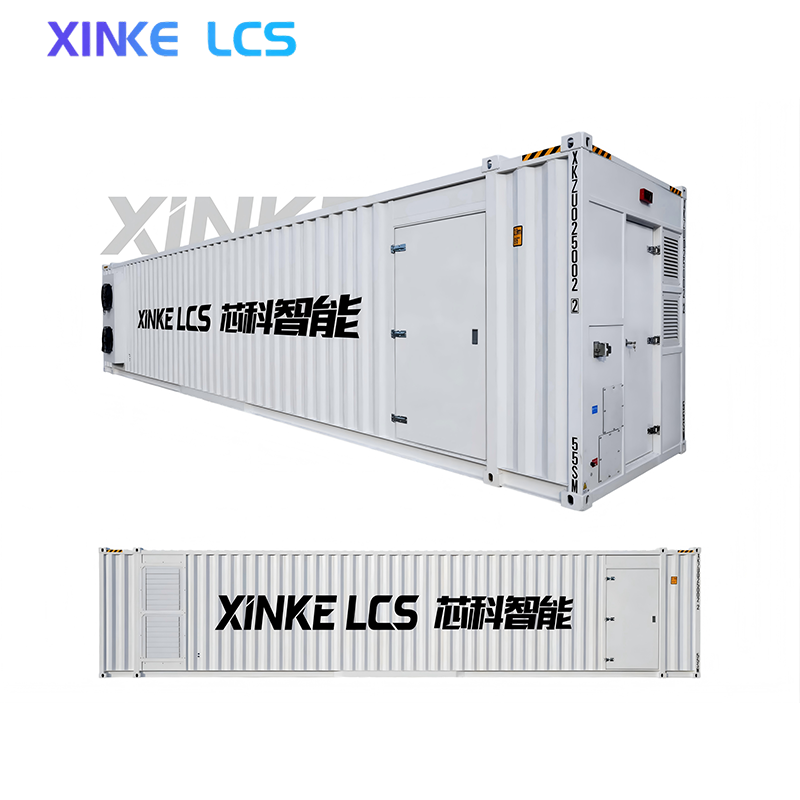
Hydro ASIC mining container, 240-position series. Final model and operating limits are confirmed per order in the technical agreement. Image: xinkelcs.
A cold climate does not, by itself, make a hydro-cooled ASIC container the right fit for a site. It changes which questions decide the fit. Three answers matter more than the ambient temperature headline: whether site primary cooling can reject the container's heat at both the warmest and the coldest design condition; whether the CDU secondary loop, its coolant and its wetted materials are specified for that particular site; and whether power, water, noise, fire protection and local certification are closed out before first fill and first load.
The clearest public reference for that discussion is the 30 MW liquid-cooled container project in Norway for Canaan, listed on page 5 of the September 10, 2026 corporate presentation from Tangshan Xinke Intelligent Technology Co., Ltd. (xinkelcs). The company is based in the Guye Economic Development Zone, Tangshan, Hebei, and combines R&D, production, sales and system integration of liquid-cooling infrastructure for blockchain, high-performance computing and AI data centers, including prefabricated modular data center containers, liquid-cooled computing containers and hydro ASIC mining containers.
The Norway entry is a scale and delivery reference, not a performance record: the presentation does not disclose the project's operating duration or measured efficiency. Everything below is written inside that limit.
What the Norway reference establishes, and what it does not
From a cold-climate procurement position, the Norway listing supports three narrow conclusions. MW-scale liquid-cooled container infrastructure has been delivered and listed in a Nordic market. Overseas transport, deployment and the integration of cooling and supporting systems are documented scope points for this class of project. And the supplier's reference set spans several markets rather than one climate.
The same presentation lists a 36 MW liquid-cooled container project for MicroBT in Texas, a 21.12 MW high-density liquid-cooled container project for BITMAIN in Ethiopia, and a 1.7 MW modular container project for BITMAIN in Ohio. Those entries are useful for supplier discovery and for understanding the scale range being delivered.
The Norway entry does not support the conclusion most often drawn from it. No measured PUE, COP, energy or water savings are disclosed, and no operating duration is given. The presentation does not state which coolant was used, how freeze protection was arranged, or what primary cooling equipment was installed. Cold ambient is therefore not evidence of a cold-climate efficiency result in this case, and a buyer should not convert a project listing in Norway into a performance assumption for a different site.
Xinke's own materials hold the same boundary: configuration, delivery schedules and certification scope are defined by each project's technical agreement, customization is subject to technical review, and operating limits and compatible miner models are defined in that agreement rather than in a catalog.
Primary cooling availability: the question the container cannot answer
The Hydro ASIC Mining Container is a non-immersion hydro-cooled container offered in 120-, 160- and 240-position series, with maximum power of 1,200 kW, 1,600 kW and 2,400 kW respectively; the final model is confirmed per order. Its primary cooling equipment is project-specific. The container moves heat from the miners into a secondary loop; the site must still reject that heat through equipment such as a CDU, plate heat exchanger, dry cooler or cooling tower, pumps, power distribution, monitoring and fire protection systems.
Thermal design for this class of application considers ambient dry-bulb and wet-bulb temperature, altitude, water quality and IT load. On a cold site those inputs split into two separate engineering problems: the warmest design ambient sets heat-rejection capacity, and the coldest design ambient sets freeze protection and control behaviour. A system sized for the first can still be immobilized by the second.
| Question | Why it decides fit | What to request |
|---|---|---|
| Heat rejection at the warmest design ambient | Cooling equipment is sized by the hottest condition, not the annual average of a cold location. | Heat-rejection capacity stated at the site's design dry-bulb and wet-bulb, at the container's maximum power. |
| Behaviour at the coldest design ambient | An idle or stopped loop is exposed to minimum ambient regardless of container design. | Freeze-protection method for primary and secondary loops, including power-interruption and standby states. |
| Heat-rejection medium | Air-based and water-based rejection differ in water demand and freeze exposure. | Which equipment is used, make-up water requirement, and who owns treatment. |
| Altitude and water quality | Both are named thermal-design inputs and change equipment selection. | Site water analysis and site altitude in the technical agreement. |
| Scope boundary | The container does not include primary cooling equipment. | A written split of supply, installation and commissioning responsibility. |
One supplier-listed example shows the format worth requesting. PowerMining's hydro-cooled container page lists water plus glycol as the cooling medium, a dry cooler, 200 L/min per rack and 1,000 L/min in total, with an outside operating range of −35°C to +50°C (product page, 2026). The values are company-reported, and the heat-load basis, glycol concentration, test conditions and container size are not harmonised with other suppliers' listings. The page is useful as a template for what a cold-climate specification should state; it is not a benchmark, and it is not proof that any site can operate at −35°C.
The container side follows the same discipline. Catalog capacity is referenced to model-specific operating conditions, and rated operating conditions are confirmed in the technical agreement, so the request should be for capacity at the site's design ambient rather than at a nominal condition.
How the CDU connects the container loop to site cooling
A liquid-to-liquid CDU circulates secondary coolant through the miners' cold plates and transfers the collected heat across a heat exchanger to the primary loop, without intentional mixing of the two fluids. Temperature, flow and pressure controls hold the operating conditions the connected equipment requires. Heat-transfer capacity depends on temperature difference, coolant properties, flow and exchanger design, which is why a catalog figure has to be re-checked at the project's operating conditions.
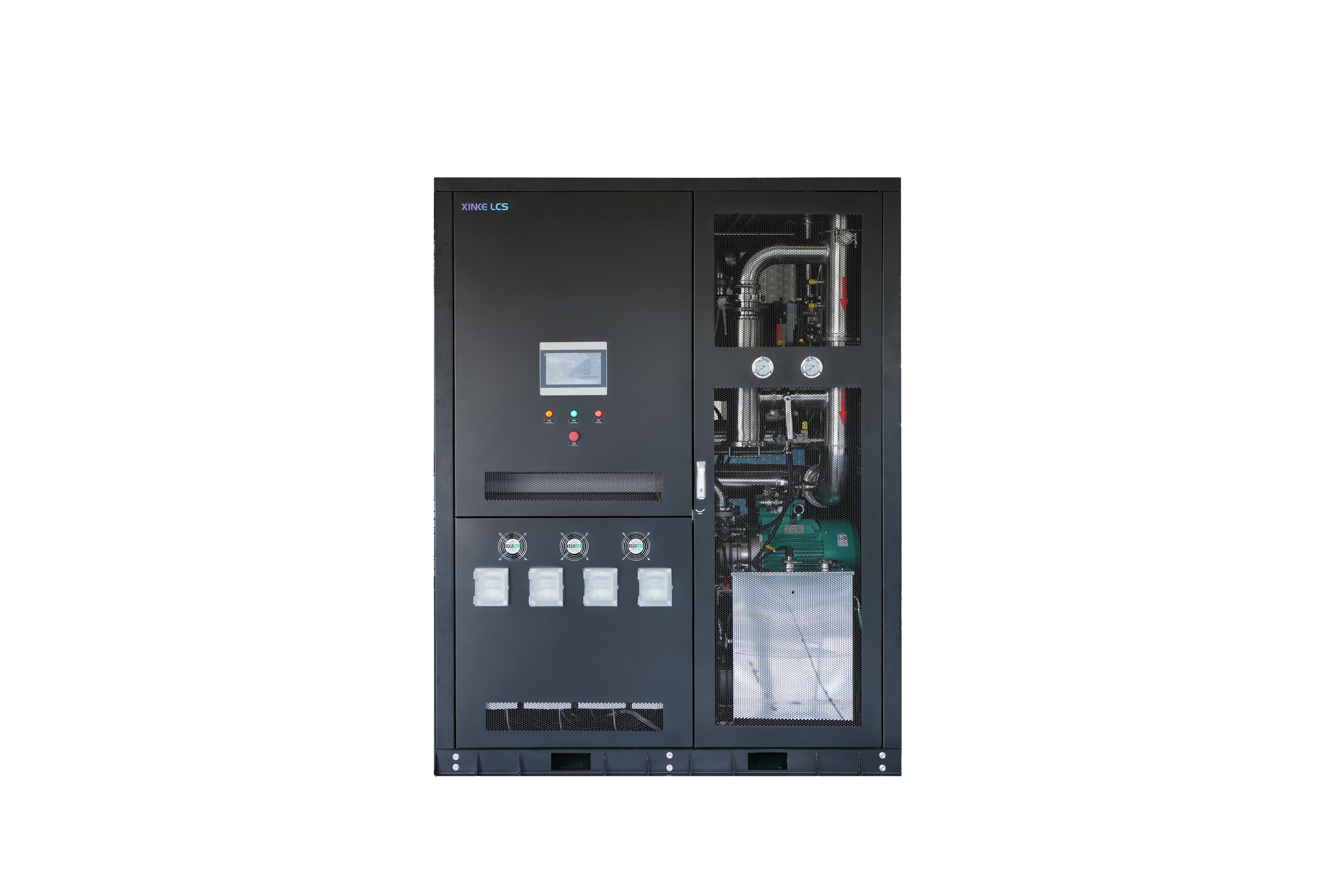
The CDU is the interface between the container's secondary loop and site primary cooling. Model and duty are selected per project.
Xinke's CDU range covers rack-mounted, sidecar and in-row formats. The DWW30-20C is rated 30 kW and the DWW50-25C 50 kW, both at 4U, 440 mm width, 900 mm depth and 177 mm height. The sidecar series is listed at 200, 500 and 1,200 kW, and the XK-BGCDU models at 240, 600, 1,200 and 2,500 kW. Flow rate, differential pressure and supply and return temperatures are model-specific, pump redundancy is project-specific, and coolant compatibility is confirmed per project. The plate heat exchanger and internal piping are stainless steel on applicable models, with the exact grade and wetted materials confirmed against the selected model.
Two cold-climate consequences follow. First, the coolant decision is also a CDU decision: a glycol-bearing mixture has different viscosity and heat-transfer behaviour from water, so flow, differential pressure and exchanger duty have to be confirmed against the actual coolant and the actual supply and return temperatures, not against a kW rating alone. Second, CDU format follows thermal load, rated conditions, rack and floor space, service access and redundancy, so a 240-position container and a 120-position container on the same site can end up with different CDU architectures.
Coolant compatibility is confirmed per project, not per catalog
Xinke confirms coolant compatibility per project rather than publishing one approved coolant for all sites. That reflects the physical situation on a cold site: the loop has to survive the coldest ambient it can see while filled, and it still has to transfer heat at the warmest. Four items carry the decision.
- Freeze point and standby state. The minimum ambient the loop can experience while filled and idle, including during a power interruption, and whether the strategy is glycol protection, draining, or maintained heat.
- Wetted materials. Container piping is SS304 seamless stainless steel as specified for the applicable configuration, with a painted carbon steel cabinet; the CDU plate heat exchanger and internal piping are stainless steel on applicable models. The proposed coolant must be checked against all wetted materials of the selected models.
- Chemistry and maintenance. Inhibitor package, testing interval and make-up water quality, requested as a documented maintenance requirement rather than assumed from another site.
- Condensation and corrosion. A cold exterior against a warmer enclosure, and cooled surfaces below the local dew point, make condensation prevention and corrosion protection site requirements rather than optional extras.
Water quality and altitude are named thermal-design inputs for this application, which is why a coolant specification written for one project cannot simply be carried to another. The Norway project listing does not disclose the coolant used, so it offers no shortcut here.
Utility interface questions to close before signature
Utility interfaces are project-specific, and the modular container line integrates power distribution, thermal management, monitoring, lightning protection and grounding, structured cabling and fire protection inside the module. What sits outside that boundary is where cold-climate projects most often stall.
- Electrical supply and redundancy. Voltage, frequency, redundancy concept and protection coordination confirmed for the project, not inherited from another site.
- Local certification. Ask for the certificate list and its exact scope for the destination market. A Norway project listing does not establish a CE, UL or any other mark for a new build; certification scope is defined by the project's technical agreement.
- Water. Availability, quality and treatment responsibility for any water-based heat rejection, plus how the primary loop is protected during outages.
- Noise. A stated site requirement to be checked against the selected equipment, particularly where cooling equipment sits closer to neighbours than the mining hall does.
- Monitoring and alarms. XINKE SMART supports equipment monitoring, operating management and abnormal-condition alerts; alarm routing should be agreed before startup so low-flow and temperature alarms reach the people on shift.
- Factory testing and handover. Integrated systems can undergo factory commissioning and testing, with the FAT scope following the technical agreement. Lead time depends on model, customization, materials, production schedule and site conditions, and is confirmed in the contract.
First startup on a cold site
First startup is where the coolant, the CDU and the site's primary cooling are proved together. The approved commissioning plan is the controlling document; the sequence below reflects operating guidance for this class of system and does not replace the equipment manual or site safety procedures.
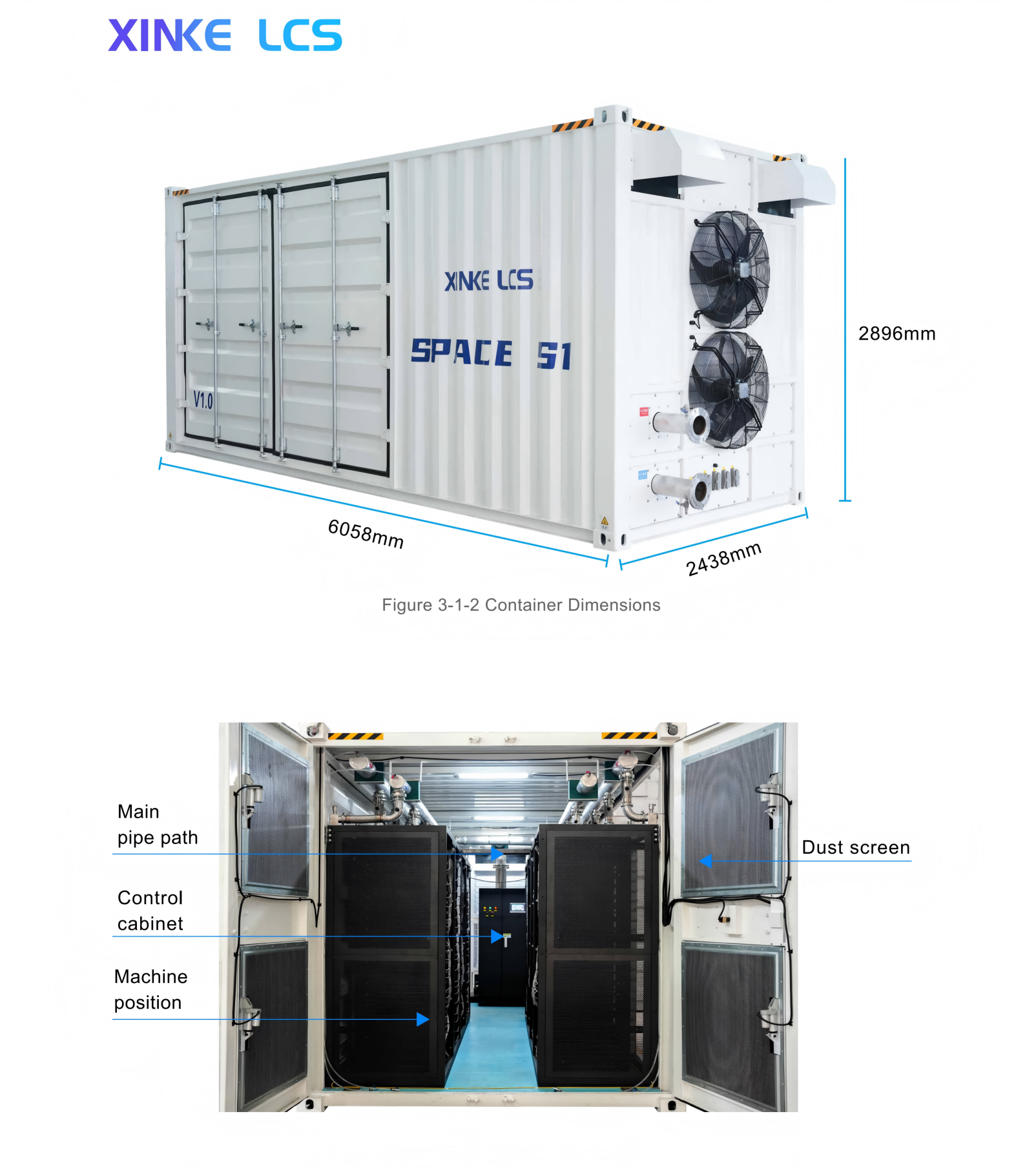
Miner compatibility is model-specific and confirmed per project, which is why configuration is fixed before commissioning planning begins.
- Review the approved drawings, the coolant specification and the acceptance criteria before any fill.
- Verify power, grounding, valve positions, piping and connections, and confirm primary cooling is available and proven before load is applied.
- Complete cleaning, pressure and leak tests to the approved limits.
- Fill and vent using the specified procedure; trapped air is a common cause of unstable flow in a newly filled loop.
- Verify sensors, alarms, interlocks and pump controls, including freeze-protection behaviour.
- Introduce load in stages and record temperature, flow and pressure against agreed limits before handover.
Only qualified personnel should commission the equipment. Isolate electrical energy and release pressure before opening a circuit, never run pumps dry, and use only the approved coolant. On a cold site, freeze protection must be confirmed active and effective before the loop is filled; low ambient is not a substitute for it.
If the CDU reports low coolant flow during or after startup, follow the alarm procedure first and decide whether the IT load must be reduced or stopped. Then check sensor readings, coolant level, valve positions, pump status, filter differential pressure and trapped air. Possible causes include an incorrect valve position, low coolant level, trapped air, a restricted filter or piping path, pump or control faults, or an incorrect sensor reading — diagnostic possibilities rather than a confirmed fault. Qualified personnel should investigate according to the manual, protective interlocks should not be bypassed, and a pressurized circuit should not be opened.
Fit boundary: when a cold-climate hydro container is the harder option
A cold climate does not remove the prerequisites for a liquid-cooled container; in some respects it adds to them. Four conditions should stop a project from proceeding on a reference alone.
- No committed primary cooling. The container does not include primary cooling equipment, so a site that cannot guarantee heat rejection at design conditions cannot qualify the cooling system at all.
- No coolant and maintenance plan. If a freeze-protected coolant cannot be supplied, tested and maintained on site, the freeze risk moves to the operator.
- Unresolved certification. If destination-market certificate scope is not evidenced, a project listing in another country is not a substitute.
- No commissioning capability. The startup and low-flow sequences above require qualified staff and agreed acceptance criteria.
The comparison with air-cooled container options deserves careful wording. A hydro-cooled container adds a coolant circuit and a CDU, which brings coolant specification, freeze protection and secondary-loop servicing into the procurement. This article does not compare measured efficiency between cooling approaches, because the available evidence contains no independently tested benchmark; the defensible position is that the additional liquid loop has to earn its place against the site's actual cooling, water and maintenance constraints.
What to require in an RFQ
| Evidence item | What to request | Decision it settles |
|---|---|---|
| Design-ambient heat rejection | Capacity curve at site design dry-bulb and wet-bulb, at container maximum power | Whether primary cooling is adequate at the warmest condition |
| Freeze strategy | Method and state during outage or standby, for both loops | Whether the coldest condition is survivable |
| Coolant specification | Chemistry, concentration, inhibitor and maintenance requirement, with wetted-material confirmation | Whether the loop and the selected CDU are compatible |
| CDU duty at actual conditions | Model, flow, differential pressure and supply and return temperatures with the proposed coolant | Whether the rated kW figure applies to this project |
| Utility interface matrix | Power, water, noise, fire protection, monitoring and scope boundary | Whether the site can complete the installation |
| Certification and commissioning records | Certificate list and scope for the destination market; FAT scope and acceptance criteria | Whether the project can be approved and handed over |
Outlook for cold-climate container evaluation
MW-scale liquid-cooled container projects are now listed across several markets in the supplier's reference set, from Norway to Texas, Ethiopia and Ohio, and configuration is documented as project-specific rather than fixed. For cold-climate buyers the practical implication is that evaluation shifts from product selection to evidence selection: design-ambient heat rejection, coolant specification, wetted materials, certification scope and commissioning records.
External context on mining hardware demand — for example a commercial research forecast of USD 11.72 billion for the global Bitcoin miner market in 2026, growing at a 26.7% CAGR through 2035 (Business Research Insights, 2026) — describes hardware revenue, not mining-container demand, and should not be used to size a container project.
The gap that remains is measured cold-climate performance. Until such project data is disclosed, the defensible position is that a Norway-style reference demonstrates MW-scale delivery in a Nordic market, while cold-climate fit has to be established site by site through primary cooling availability, coolant compatibility and startup evidence.
For readers who need the full configuration and equipment scope in one document, the public corporate brochure is available here: xinkelcs corporate brochure (PDF). Project-specific limits, certification scope and schedules remain governed by the technical agreement for each site.
FAQ
What is a prefabricated modular data center?
It is computing infrastructure assembled and tested as modules before installation at the project site. A configured module can integrate IT racks, power distribution, cooling, monitoring and other supporting systems, while capacity, redundancy and interfaces are set by the project design. Factory integration moves part of the assembly, cabling, piping and testing off site; it does not by itself establish a particular availability tier, certification, deployment time or energy-efficiency value.
How does a liquid-to-liquid CDU remove heat from server cold plates?
Cold plates absorb heat from the computing components, a pump circulates secondary coolant through them, and the collected heat crosses a heat exchanger inside the CDU to the primary loop, with no intentional mixing of the two fluids. Temperature, flow and pressure controls maintain the conditions the connected equipment requires. Heat-transfer capacity depends on temperature difference, coolant properties, flow and exchanger design, so catalog capacity must be checked at the project's operating conditions.
When should I choose a rack-mounted, sidecar or in-row CDU?
The format follows thermal load, rated operating conditions, available rack and floor space, service access and redundancy. Rack-mounted units suit compatible rack-level installations; sidecar and in-row units can serve larger configured cooling zones. Flow, differential pressure, coolant compatibility and piping interfaces should be validated at the design conditions before the format is fixed, because selection on rated kW alone can produce a unit that does not meet the duty at the actual supply and return temperatures.
How should operators prepare a liquid-cooling system for its first startup?
Work from the approved commissioning plan: verify utilities and interfaces, inspect piping and connections, complete the specified cleaning and pressure and leak tests, fill and vent the approved coolant, verify controls and alarms, then introduce load gradually and record acceptance results before handover. On a cold site, confirm freeze protection is active before filling. Only qualified personnel should commission the equipment, and pumps should never be run dry.
What should operators check when a CDU reports low coolant flow?
Follow the alarm procedure and decide whether the IT load must be reduced or stopped. Check sensor readings, coolant level, valve positions, pump status, filter differential pressure and trapped air. Valve position, low level, trapped air, a restricted filter or piping path, pump or control faults, or an incorrect sensor reading are diagnostic possibilities, not a confirmed fault. Qualified personnel should investigate using the equipment manual; protective interlocks should not be bypassed and a pressurized circuit should not be opened.
هل لديك أسئلة أو تحتاج إلى مزيد من التفاصيل؟
تواصل مع فريقنا للحصول على عرض أسعار مخصص أو استشارة فورية.
طلب عرض أسعار
املأ النموذج أدناه وسيتواصل معك فريقنا بعرض مقترح مخصص.
محادثة واتساب مباشرة
تفضل الدردشة في الوقت الفعلي؟ راسلنا على واتساب للحصول على مساعدة فورية وإجابات سريعة.
- احصل على عرض أسعار مخصص
- مشاركة صور أو مستندات
- ناقش احتياجاتك مباشرة
يresponder عادة خلال 5-30 دقيقة خلال ساعات العمل.