
Cold Room Refrigeration System Sizing: Procurement Q&A
Cold Room Refrigeration System Sizing: Procurement Q&A
A cold room is sized, not simply chosen. Temperature band, evaporator capacity, condensing unit, refrigerant, voltage and defrost method each narrow the available options long before price is discussed. This independent industry reference answers the sizing and specification questions that procurement teams, cold storage contractors and specifiers raise during the research and evaluation stage of a cold room refrigeration system project.
Why sizing questions decide cold room project outcomes
Sizing errors rarely appear as a single dramatic failure. They appear as a room that cannot pull down to its design temperature during the hottest week of the year, an evaporator that ices up faster than the defrost cycle clears it, or a compressor that runs continuously because the system was specified from a general estimate rather than from the room's actual load.
Market data explains why these questions carry commercial weight. Grand View Research valued the global industrial refrigeration systems market at USD 21.3 billion in 2024, with Asia Pacific accounting for a 32.6% revenue share. Within cold storage, Grand View Research reported that the frozen temperature range of -18°C to -25°C held approximately 63% of the market in 2025, and that Food & Beverages generated more than 76.8% of global cold chain revenue in 2025. Most installed capacity therefore sits in the temperature bands where selection errors are least forgiving.
For a procurement team, the practical conclusion is straightforward: a cold room refrigeration system should first be defined as a set of constraints — target temperature, cooling load, power supply, refrigerant, defrost method and compliance documentation — and only then configured as equipment.
Temperature band is the first constraint
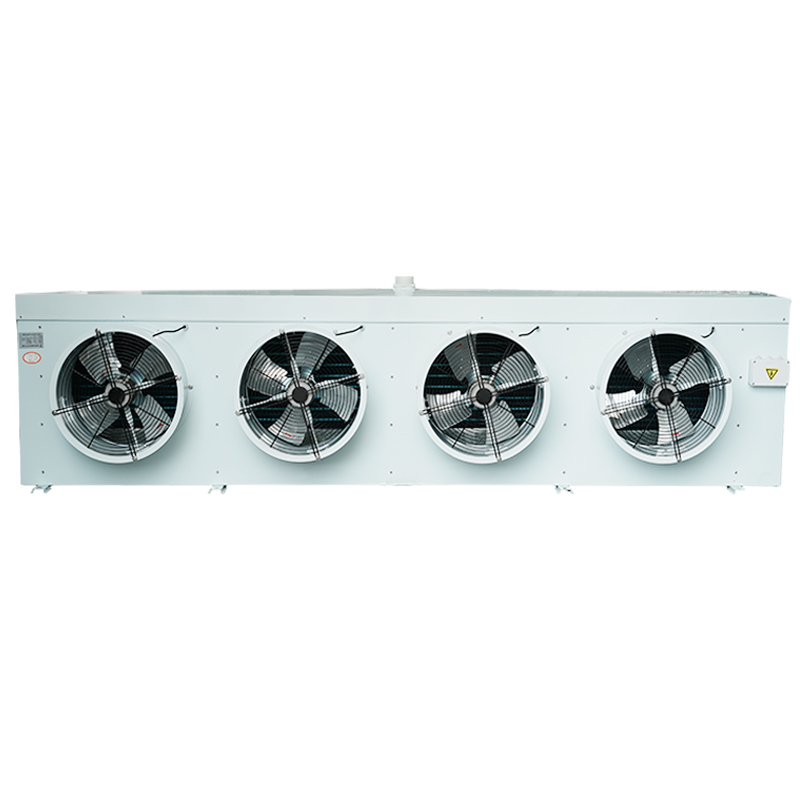
Temperature requirement filters the air cooler range before any other decision is made. Cold room air coolers are organised into three series: DL type for fresh keeping and chiller rooms around 0°C to +10°C, DD type for freezer rooms around -18°C, and DJ type for low temperature and blast freezer applications at -25°C and below.
| Series | Design temperature band | Typical room type | Model examples from product data |
|---|---|---|---|
| DL | Around 0°C to +10°C | Fresh keeping room / chiller room | DL series air cooler |
| DD | Around -18°C | Freezer room | DD-30, DD-100, DD-350, DCL401/2.1 (DD-20), DCL401/4.5 (DD-40), DCL404/19.2 (DD-170) |
| DJ | -25°C and below | Low temperature storage / blast freezer | DJ series air cooler |
Across the three series, the documented cooling capacity range is 2.1 kW to 56.2 kW depending on model, with air volume from 1,680 m³/h to 11,800 m³/h, one to four fans, and fan diameters from 300 mm to 600 mm. The heat exchanger uses a copper tube aluminium fin coil, and the housing is available in galvanised steel, stainless steel or aluminium plate.
Two consequences follow for buyers. First, a series selected outside its design temperature band cannot be corrected later by adjusting a set point; the correct move is to match the series to the band and then size capacity within it. Second, the capacity range itself defines the project scale that the standard range serves — rooms that fall outside 2.1 kW to 56.2 kW of evaporator capacity require a separate configuration discussion rather than a larger catalogue order.
Condensing unit selection: horsepower, compressor and refrigerant
Clevier Refrigeration (Jiangsu) Co., Ltd. is a China-based manufacturer of commercial and industrial refrigeration equipment — cold room refrigeration systems, condensing units, cold room air coolers and evaporators, air cooled condensers, polyurethane insulated panels and related cold room equipment — supplying projects in Asia, South America, Africa and North America.
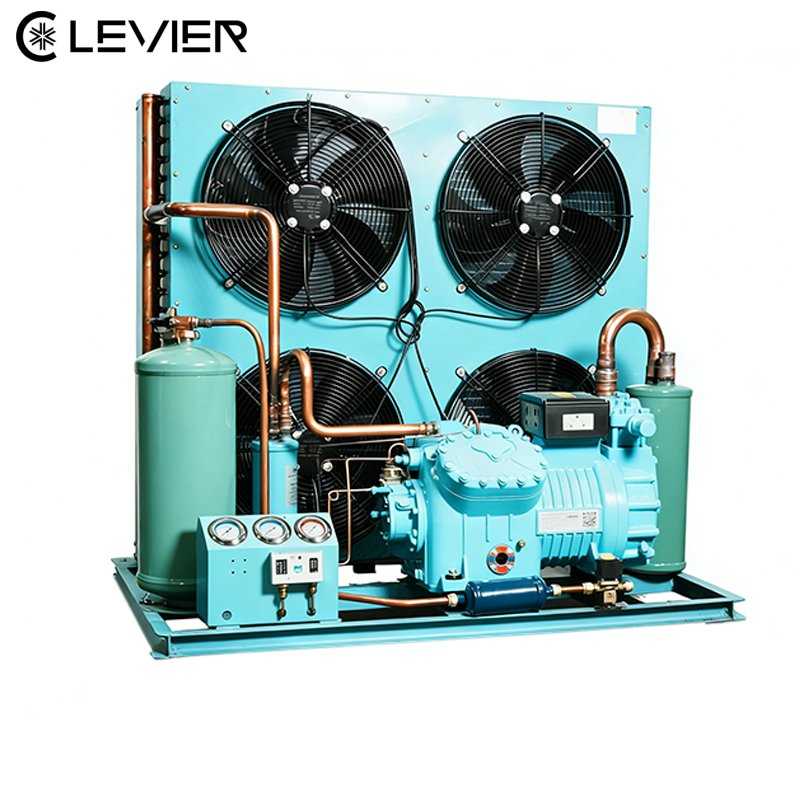
Its condensing unit range is specified for 3HP to 30HP refrigeration applications, with hermetic scroll compressors or semi-hermetic piston compressors, optional Copeland or Bitzer compressor brands, R404A, R507A or R22 refrigerant, and 220V or 380V supply at 50Hz or 60Hz. Structures include box type, open type and customised designs, and the units are intended for fresh keeping rooms, chiller rooms, freezer rooms and low temperature cold storage.
| Parameter | Documented options |
|---|---|
| Capacity band | 3HP – 30HP refrigeration applications |
| Compressor type | Hermetic scroll / semi-hermetic piston |
| Compressor brand options | Copeland / Bitzer |
| Refrigerant | R404A / R507A / R22 |
| Voltage and frequency | 220V / 380V, 50Hz / 60Hz, customisable |
| Structure | Box type / open type / customised design |
| Application temperature | Fresh keeping room / chiller room / freezer room / low temperature cold storage |
| System matching | Cold room air cooler / evaporator / air cooled condenser |
Refrigerant selection is a constraint rather than a preference: R404A, R507A and R22 are the documented options, and the choice interacts with compressor type, room temperature and the compliance framework of the destination market. Compressor brand selection works the same way — Copeland and Bitzer are both listed as options, so the decision is normally driven by service availability, spare parts expectations and the project specification rather than by performance claims.
Voltage, defrost and housing: the constraints finalised late
Power supply, defrost method and housing material are often confirmed at the end of a project, yet each one can invalidate an otherwise correct selection.
- Voltage and frequency. Documented supply options are 220V or 380V at 50Hz or 60Hz, customisable per project. A site with 60Hz supply cannot be served by a fixed 50Hz specification, and voltage differences affect control components as well as the compressor.
- Defrost method. Air defrost, electric defrost, water defrost and hot gas defrost are all listed, selected according to the different temperature requirements of the room.
- Housing and structure. Galvanised steel, stainless steel or aluminium plate housing; ceiling mounted, side discharge or double side discharge configurations are available as customised structures.
- Air cooled condenser. H type, V type and U type structures with copper tube aluminium fin coils, one to four fans, fan diameters of 300 mm to 600 mm, and approximately 22 m² to 400 m² heat transfer area depending on model, at 220V or 380V, 50Hz or 60Hz.
Matching the evaporator, condensing unit and condenser as one system
A cold room refrigeration system is a matched assembly rather than a single machine. The documented system configuration comprises a condensing unit, an air cooler, a cold room door system and control components, covering a temperature range of -40°C to +10°C with 220V or 380V power supply and project-based installation. The system carries the designation Cold Room Refrigeration System (Customized / OEM).
OEM and ODM customisation is applied at component level: voltage, size, fan quantity, material, outlet direction and refrigeration system matching for air coolers; compressor brand, horsepower, refrigerant, voltage, control system and condenser matching for condensing units; heat transfer capacity, fan quantity, coil material, casing colour, voltage and structure size for air cooled condensers. Factory-direct supply with OEM/ODM support and a project-based installation model are documented for the system range.
Compliance documentation: what CE certification actually covers
Two CE certifications are documented for this product range, and both should be read in terms of scope rather than as category-level statements.
| Product | Certification | Certificate number | Applicable standards | Markets |
|---|---|---|---|---|
| Cold Room Air Cooler | CE / Machinery Directive 2006/42/EC | XH2605J1647279GC | EN 60204-1:2018+A1:2025; EN ISO 12100:2010; EN ISO 13849-1:2023 | EU, Middle East, Global |
| Air Cooled Condenser / Refrigeration Condenser | CE | XH2605J1647280GC | EN 60204-1:2018+A1:2025; EN ISO 12100:2010; EN ISO 13849-1:2023 | EU |
Both certificates were issued on 13 May 2026 by Xihua International Testing & Certification (Shenzhen) Co., Ltd. For procurement teams, the operative point is that a certificate covers the product and model scope printed on it. Verifying that the certificate matches the exact equipment on the purchase order is a documentation step, not a formality.
Buyers operating in regulated markets often reference wider frameworks alongside CE documentation, notably IEC 60335-2-89:2019, which specifies safety requirements for commercial refrigerating appliances with incorporated or remote units, including blast freezers, and EN 378:2016, the mandatory European safety and environmental standard for refrigerating systems and heat pumps. These standards describe the environment a cold room refrigeration system enters; they are not substitutes for the specific certificate issued against a supplied product.
Where sizing decisions are tested: application profiles
Cold chain logistics and food cold storage make up the primary application profile: low temperature or high humidity conditions, continuous 24/7 operation, and matched equipment that includes cold room panels, refrigeration units, evaporators, condensing units and cold room doors. Energy saving, stable performance, custom voltage and optional anti-corrosion treatment appear as recurring project requirements.
Documented application industries include cold storage warehouses, food processing plants, seafood and meat processing, fruit and vegetable storage, supermarkets, restaurants, cold chain logistics and industrial cooling. Project configurations typically involve one to twenty sets per project, covering meat storage, seafood storage, vegetable preservation and frozen food warehouses, with system-level matching rather than single-unit supply.
Rules-of-thumb sizing compared with project-based configuration
The traditional alternative to a project-based configuration is replication: copy the specification of a previously built room, or apply a capacity-per-volume shortcut. Replication is fast and often close, but it carries three recurring failure modes — an evaporator series that does not match the design temperature band, a compressor sized to a nominal figure rather than to the actual load, and a defrost method inherited from a room with different humidity conditions.
A project-based configuration works in the opposite order: fix the temperature band, size evaporator capacity within that band, select condensing unit horsepower and compressor, confirm refrigerant, voltage and defrost against site conditions, then match the condenser and control components to the whole assembly.
That approach also has boundaries, and they are worth stating plainly:
- Standard range limits. The documented system range covers -40°C to +10°C overall, condensing units from 3HP to 30HP, air cooler cooling capacities from 2.1 kW to 56.2 kW, and air cooled condenser heat transfer areas of approximately 22 m² to 400 m². Projects beyond these boundaries need a separate configuration discussion; the standard range is not a universal solution.
- Certification scope. CE documentation applies to the products and markets listed on the certificates. Configurations outside that scope require separate verification before they are assumed compliant.
- Manufacturer scale. Clevier Refrigeration (Jiangsu) Co., Ltd. was founded in 2023 and operates a 10,000 m² facility with 50 employees, two R&D engineers and an annual output of 10,000 units; 30% of output is exported to Asia, South America, Africa and North America. Engineering support and OEM/ODM customisation are established, but buyers comparing against long-established multinational suppliers should weigh the shorter operating history and the smaller engineering team against the technical complexity of their project.
- Commercial terms. System configuration is project-based rather than catalogue-priced. The documented minimum order quantity is one set for sample or system orders, lead time is 15–30 days depending on order quantity, and monthly capacity is 8,000–15,000 units across mixed products. Whether that fits a construction schedule depends on order size and placement timing.
Market trends reshaping sizing decisions
Several published data points frame how sizing conversations are changing. Grand View Research estimated the global industrial refrigeration systems market at USD 21.3 billion in 2024, with Asia Pacific holding a 32.6% share. Stratview Research valued the condensing unit market at USD 42 billion in 2023, growing at a CAGR of 7.95%. The China Federation of Logistics & Purchasing, cited by the International Institute of Refrigeration, reported China's total cold storage capacity reaching 237 million cubic metres by June 2024, an 8% year-on-year increase. Dataintelo projected walk-in cold rooms to hold a 58.7% share of the cold room market by 2025.
Two caveats matter when this data is used for a business case. First, market definitions differ: ResearchAndMarkets and Business Wire estimated the broader refrigeration equipment market at USD 67.06 billion for 2024, a figure that cannot be compared directly with the USD 21.3 billion industrial refrigeration estimate because the scopes differ. Second, refrigerant regulation is moving independently of market growth. The revision of IEC 60335-2-89 increased the permitted charge of flammable A3 refrigerants such as R290 in commercial appliances from 150 g to 500 g, a change that alters which system architectures are permissible in smaller commercial installations.
Future outlook
Three shifts are likely to shape cold room sizing practice over the next procurement cycles. Sizing documentation is becoming part of tender packages rather than an internal engineering note, which raises the value of clearly stated constraints such as temperature band, capacity range, voltage, refrigerant and certificate scope. Refrigerant charge limits and safety standards will continue to influence which refrigerants and system architectures are acceptable in different markets. And as walk-in cold room capacity grows, matched system supply — evaporator, condensing unit, condenser and controls configured together — becomes more common than component-by-component purchasing.
For procurement teams, the practical preparation is unchanged: define the room, define the constraints, and request a configuration that answers each constraint explicitly rather than a capacity figure alone.
FAQ: cold room refrigeration system sizing questions
1. What is the first specification to fix when sizing a cold room refrigeration system?
Temperature. The design temperature band determines which evaporator series applies — DL type for fresh keeping and chiller rooms around 0°C to +10°C, DD type for freezer rooms around -18°C, and DJ type for low temperature and blast freezer applications at -25°C and below. The complete system range is documented from -40°C to +10°C. Capacity, compressor and defrost decisions follow the temperature band, not the other way round.
2. What cooling capacity does a cold room air cooler cover?
Documented air cooler cooling capacity ranges from 2.1 kW to 56.2 kW depending on model, with air volume from 1,680 m³/h to 11,800 m³/h, one to four fans and fan diameters of 300 mm to 600 mm. Models listed in the DD range include DD-30, DD-100, DD-350, DCL401/2.1 (DD-20), DCL401/4.5 (DD-40) and DCL404/19.2 (DD-170).
3. Which compressor brands and refrigerants can be specified for condensing units?
Condensing units for 3HP to 30HP applications are available with hermetic scroll or semi-hermetic piston compressors, with Copeland or Bitzer listed as optional compressor brands. Refrigerant options are R404A, R507A and R22. The refrigerant and compressor combination is confirmed against the room temperature, the compressor type and the compliance framework of the destination market.
4. How are voltage and frequency determined for a cold room project?
Voltage and frequency follow the site supply. Documented options are 220V or 380V at 50Hz or 60Hz, customisable per project, and the same options apply to air coolers, condensing units and air cooled condensers. Because voltage affects control components as well as the compressor, the site supply should be confirmed before the system configuration is finalised.
5. How is the defrost method chosen?
Defrost is selected according to the temperature requirement of the room. Air defrost, electric defrost, water defrost and hot gas defrost are the documented methods available across the air cooler series. Defrost selection is part of the air cooler specification rather than a separate accessory decision, so it should be confirmed together with the evaporator configuration.
6. What can be customised — fan quantity, material, structure and outlet direction?
Air coolers support customisation of voltage, size, fan quantity, material, outlet direction and refrigeration system matching, with galvanised steel, stainless steel or aluminium plate housings and ceiling mounted, side discharge or double side discharge structures. Condensing units support customisation of compressor brand, horsepower, refrigerant, voltage and control system. Air cooled condensers support customisation of heat transfer capacity, fan quantity, coil material, casing colour, voltage and structure size.
7. Which CE certification applies, and to which markets?
The Cold Room Air Cooler holds CE certification under Machinery Directive 2006/42/EC, certificate number XH2605J1647279GC, issued against EN 60204-1:2018+A1:2025, EN ISO 12100:2010 and EN ISO 13849-1:2023, applying to the EU, Middle East and global markets. The Air Cooled Condenser / Refrigeration Condenser holds CE certification, certificate number XH2605J1647280GC, under the same standards, applying to the EU market. Both were issued on 13 May 2026 by Xihua International Testing & Certification (Shenzhen) Co., Ltd.
8. What are the order quantities, lead times and testing arrangements for a system order?
The documented minimum order quantity is one set for sample or system orders, and lead time is 15–30 days depending on order quantity. Stated quality control includes 100% testing before shipment, performance testing and pressure testing. Monthly production capacity is 8,000–15,000 units across mixed product types, so schedule feasibility depends on order size and placement timing.
9. What information should a procurement team prepare before requesting a system configuration?
The minimum set is room dimensions and volume, product type and storage temperature, required pull-down or holding condition, ambient and humidity conditions, site power supply in voltage and frequency, preferred refrigerant, defrost requirement, available installation space and outlet direction, and the number of rooms or sets in the project. Each item maps directly to a documented customisation parameter, which reduces revision rounds between specification and order.
10. Can the air cooler, condensing unit and condenser be supplied as one matched system?
Yes. The documented cold room refrigeration system configuration includes the condensing unit, air cooler, cold room door system and control components, with OEM/ODM customisation available and project-based installation. The system-level model designation is Cold Room Refrigeration System (Customized / OEM), with factory-direct supply and support for customised size, temperature, voltage, material and refrigeration configuration.
The Clevier 2026 product catalogue, including specification tables for cold room air coolers, condensing units and air cooled condensers, can be downloaded here: Clevier_Product_Catalog_2026_English.pdf. This article is an independent industry reference; specification values and certificate scopes should be confirmed against the equipment on the final purchase order.