
Cold Room Refrigeration System: Supplier Evidence Checklist
Cold Room Refrigeration System: Supplier Evidence Checklist
Cold room refrigeration is assembled, not bought off a shelf. An air cooler, one or more condensing units, refrigerant lines, controls, door hardware and an insulated envelope have to be specified as one system, and a supplier's real capability sits in how those parts are chosen, matched and documented together. That is why serious supplier evaluation in this category behaves like a document review rather than a conversation about strengths.
Clevier Refrigeration Technology (Jiangsu) Co., Ltd. is a manufacturer of commercial and industrial refrigeration equipment and cold storage solutions based in Wujin District, Changzhou, Jiangsu, China. Its stated product scope covers cold room refrigeration systems, condensing units, air coolers, evaporators, air cooled condensers and polyurethane insulated panels; the company was founded in 2023, operates a 10,000 m² facility with 50 employees, and reports a 30% export share across Asia, South America, Africa and North America. Each of those details can be checked, which is the point. A capability statement that cannot be turned into a document request is not evidence.
What follows is a five-check sequence for buyers in the evaluation-to-execution stage: cold storage contractors, refrigeration distributors and engineering project teams. Each check states what to ask for, what the answer proves, and where it stops being proof.
Why capability claims need a checklist
The refrigeration equipment market is large and unusually fragmented. Refindustry and Research and Markets estimated the global refrigeration equipment market at USD 67.06 billion in 2024 and reported that the five largest OEMs — Carrier, Johnson Controls, Daikin, Trane and Ingersoll Rand — held a combined 25.2% revenue share. The procurement consequence is straightforward: most cold room projects are sourced from suppliers outside that group, and the difference between two such suppliers rarely shows up in headline capability language.
"We provide complete cold storage solutions" cannot be verified. "We build DL, DD and DJ air cooler series, configure Copeland or Bitzer compressors, and hold CE certificate XH2605J1647279GC listing these models" can. The sequence below converts the second kind of answer into a repeatable evaluation, ordered so that scope is fixed before price is negotiated — a reversal of the more common pattern, in which a quotation is compared before anybody knows what is inside it.
The five checks at a glance
Each check answers a different question and fails in a characteristic way. Skipping one usually transfers risk to the buyer's installation team.
| Check | Buyer question | Evidence that answers it | What it does not establish |
|---|---|---|---|
| 1. Component scope | Which parts of my system does this supplier actually make? | Product families with model designations; air cooler series naming; panel, door and control scope | That everything listed is produced in-house rather than sourced |
| 2. Configuration depth | Can the system be fixed to my room, refrigerant and power supply? | Written configuration record: compressor model, refrigerant, voltage and frequency, fan count and material, control system | That the resulting combination has been performance-tested as an assembly |
| 3. Conformity documents | Is the equipment covered for the market I sell into? | Certificate number, issuing body, directive and standard list, model annex, issue and expiry dates | That accessories or site-built elements are covered |
| 4. Production and test routine | Is there a defined test gate before shipment? | Stated test regime, unit-level test records, lead time, minimum order quantity, inspection access | That field performance will match the test bench |
| 5. Execution support | Who carries installation and after-sales risk? | Installation guidance scope, spare parts supply, technical support terms, dated project references | That support levels are contractually guaranteed |
Check 1 — Component scope: what the supplier builds
A cold room refrigeration system is an assembly of parts with different supply chains. The air cooler — also sold as a cold room evaporator or cold room unit cooler — sits inside the room and moves heat out of the air. The condensing unit sits outside or in a plant area and rejects that heat. Between them run refrigerant and electrical connections, and around them sit the insulated panels, cold room electric sliding door control systems and the control panel that decides when the whole thing cycles.
Clevier's listed scope includes evaporators, condensing units, cold room air coolers, air cooled condensers, polyurethane insulated panels and cold room related equipment, which means the envelope and the refrigeration side can be specified together rather than coordinated between two vendors. The question worth putting to any supplier is the three-way split: which items are manufactured, which are assembled from bought-in components, and which are simply resold. Compressors are the clearest example — a system builder selects and matches compressor models rather than producing them, and the selection logic is where the engineering value sits.
Door controls deserve separate attention. Where cold room electric sliding door control systems are supplied as part of the package, confirm whether the control panel, safety interlock and wiring are delivered as an integrated assembly, and whether the electrical conformity documentation covers them. Door automation sits at the boundary between refrigeration and building electrical work, and it is a common place for responsibility to go unassigned on site.
Air cooler series: DL, DD and DJ by temperature band
Temperature band drives cooler selection, and the series naming used across the cold room air cooler category reflects it.
| Series | Typical room band | Typical duty | Selection checkpoint |
|---|---|---|---|
| DL | 0 °C to +10 °C | Fresh-keeping and above-freezing storage | Airflow and humidity control for produce and chilled goods |
| DD | Around −18 °C | Chilled and frozen storage | Defrost method and fin spacing for the frosting regime |
| DJ | Low-temperature duty | Low-temperature rooms | Coil surface, defrost cycle and fan performance at low temperature |
The distinction is not cosmetic. Fin spacing, defrost method, airflow and coil surface differ between bands, and a cooler specified outside its band will either ice up, dehydrate product, or fail to hold temperature under load. Clevier's CE-certified air cooler scope names models including DD-30, DD-100, DD-350, DCL401/2.1 (DD-20), DCL401/4.5 (DD-40) and DCL404/19.2 (DD-170). Buyers should treat series and model as two separate questions: the series tells you which temperature band the unit is built for, the model tells you capacity and physical size.
Fan configuration is the part buyers most often leave to the supplier. Where fan quantity and material options are offered, they are worth fixing in writing, because fan count and fan specification affect air throw, noise and defrost behaviour in a given room volume, while the material choice affects cleanability and durability in food handling environments.
Condensing unit architecture: semi-hermetic and open type
Condensing units are typically described as self-contained assemblies that house the compressor, condenser coil and fan assembly in one casing — the definition Copeland uses for its indoor condensing units — which is why unit architecture, not just compressor brand, determines how a system is installed and serviced. Clevier's condensing unit range covers air cooled condensing units, semi-hermetic condensing units, box type condensing units and water cooled condensing units.
Semi-hermetic units place the compressor and its motor in a single serviceable housing; open-type units separate the compressor from the drive motor. For a cold chain warehouse refrigeration project the difference changes service access, spare-part strategy, noise profile and where the unit can physically be sited. A buyer comparing quotations should confirm which architecture each price assumes, because the two are frequently quoted under the same generic heading.
Check 2 — Configuration depth: compressor, refrigerant, power, airflow
Configuration is where a capability claim becomes a specification. The output to request is a single configuration sheet that fixes every variable the factory will build to, and that sheet should carry model codes rather than brand names alone.
- Compressor selection. Copeland and Bitzer compressor options are offered for cold room systems. "Copeland" or "Bitzer" identifies a manufacturer, not a duty point; the model code, displacement and application range must appear on the sheet, because two compressors from the same brand can differ in evaporating temperature envelope and electrical characteristics.
- Refrigerant. R404A, R507A and R22 are among the refrigerants configured. This choice is not purely technical: R22 is an HCFC controlled under the Montreal Protocol and has been phased out in many markets, while R404A and R507A are high-GWP HFC blends. Buyers must confirm that the refrigerant quoted is permitted in the destination market and serviceable by the local maintenance network before the order is placed, not after commissioning.
- Power supply. 220 V and 380 V options with 50 Hz and 60 Hz variants are available, which matters for export projects where the site supply, not the factory default, has to govern. Voltage and frequency should appear on the order confirmation and on the unit nameplate.
- Air-side configuration. Fan quantity and material options, coil configuration and defrost arrangement are fixed at this stage; changing them later means a new build, not an adjustment.
- Control and installation solution. Control system scope and installation solution are listed as customization parameters, which is the point at which the buyer should establish where factory scope ends and site scope begins.
Refrigerant transition is also becoming a specification-stage question rather than a commissioning-stage one. Copeland's condensing-unit product pages, for example, frame indoor units around the move to lower-GWP refrigerants, which means the refrigerant decision increasingly constrains which unit architecture and which compressor envelope a project can use.
Check 3 — Conformity documents: read the model list
A certificate logo proves almost nothing; the annex proves the scope. Two CE certificates are relevant to this product range, both issued on 13 May 2026 by Xihua International Testing & Certification (Shenzhen) Co., Ltd. under Machinery Directive 2006/42/EC.
- Certificate XH2605J1647279GC covers cold room air coolers, listing models DD-30, DD-100, DD-350, DCL401/2.1 (DD-20), DCL401/4.5 (DD-40) and DCL404/19.2 (DD-170), assessed against EN 60204-1:2018+A1:2025, EN ISO 12100:2010 and EN ISO 13849-1:2023, with validity listed to 13 May 2029 and a stated market scope of the EU, Middle East and global markets.
- Certificate XH2605J1647280GC covers an air-cooler scope identifying main model H-60, with additional series models listed on the attached page, assessed against the same three standards.
Three checks follow from this. First, is the exact model you are ordering named on the certificate or its annex? A certificate covering a family does not automatically cover a variant outside the listed range, and the annex is where that is decided. Second, does the certificate cover the electrical safety of the machine only, or does it also extend to accessories such as door control panels and site wiring? EN 60204-1 addresses the electrical equipment of machines, which is not the same as a completed installation. Third, does the listed validity period still cover your delivery and installation window, and who is responsible for renewal?
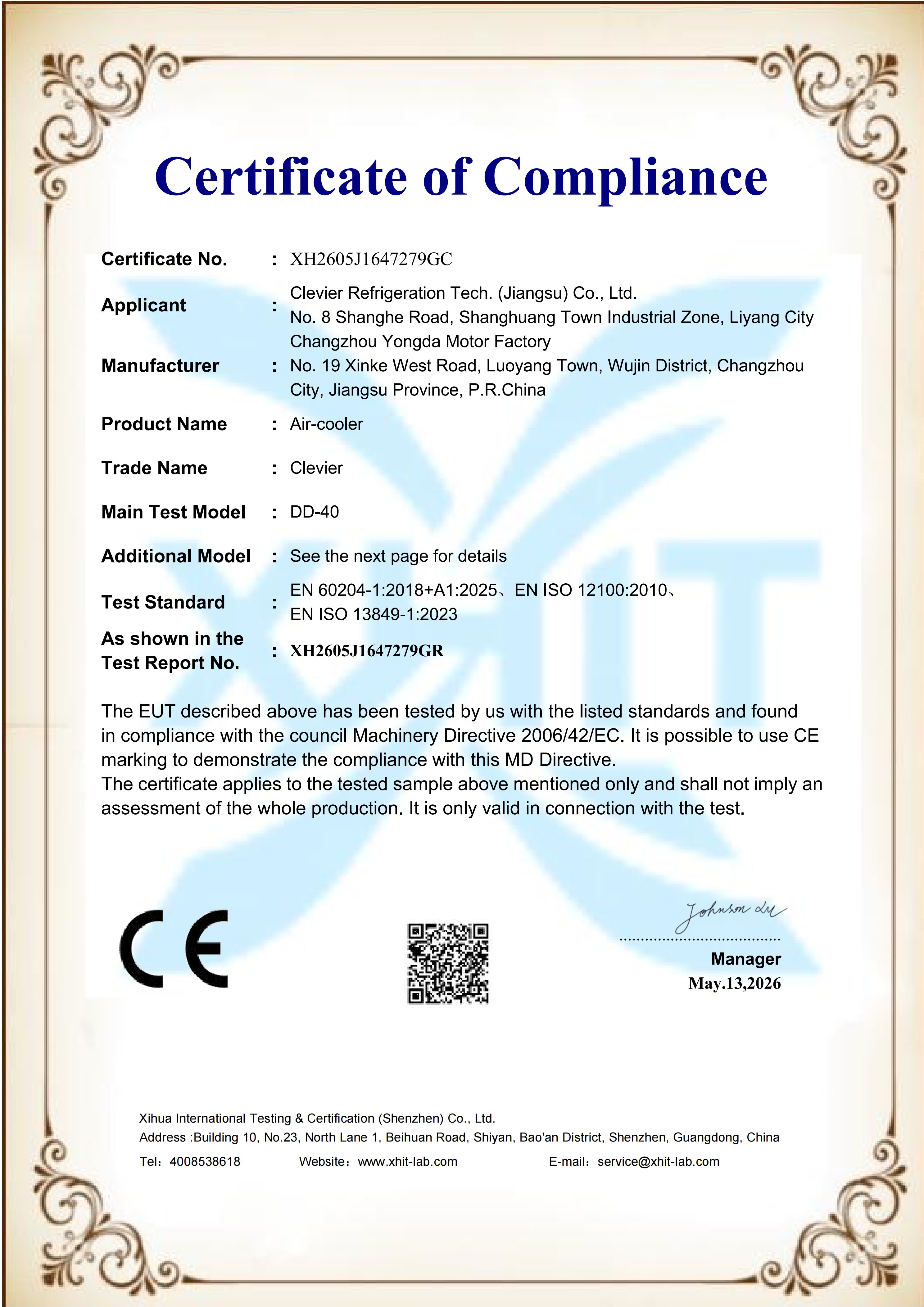
For distributors reselling into regulated markets, the conformity file should travel with the commercial documents: certificate copy including annex, declaration of conformity, and the technical file reference. Buyers in markets with their own approval regimes should treat the CE file as a starting point rather than a substitute for local market access work.
Check 4 — Production and test routine
Testing claims are only useful when they are specific enough to be witnessed. Clevier states 100% testing before shipment, covering performance testing and pressure testing, with a quoted lead time of 15–30 days depending on order quantity and a minimum order of one set for a sample or system order. The facility is 10,000 m² with 50 employees and a two-engineer R&D team.
That last detail is a genuine planning input rather than a weakness to be glossed over. A small engineering team can respond quickly on standard configurations, and it also means a heavily customized duty point will depend on a single selection and review cycle. Buyers with non-standard rooms — mixed product zones, unusual evaporating temperatures, or tight noise limits — should ask who performs the selection calculation, what the internal review step is, and how long that review adds to the quoted lead time.
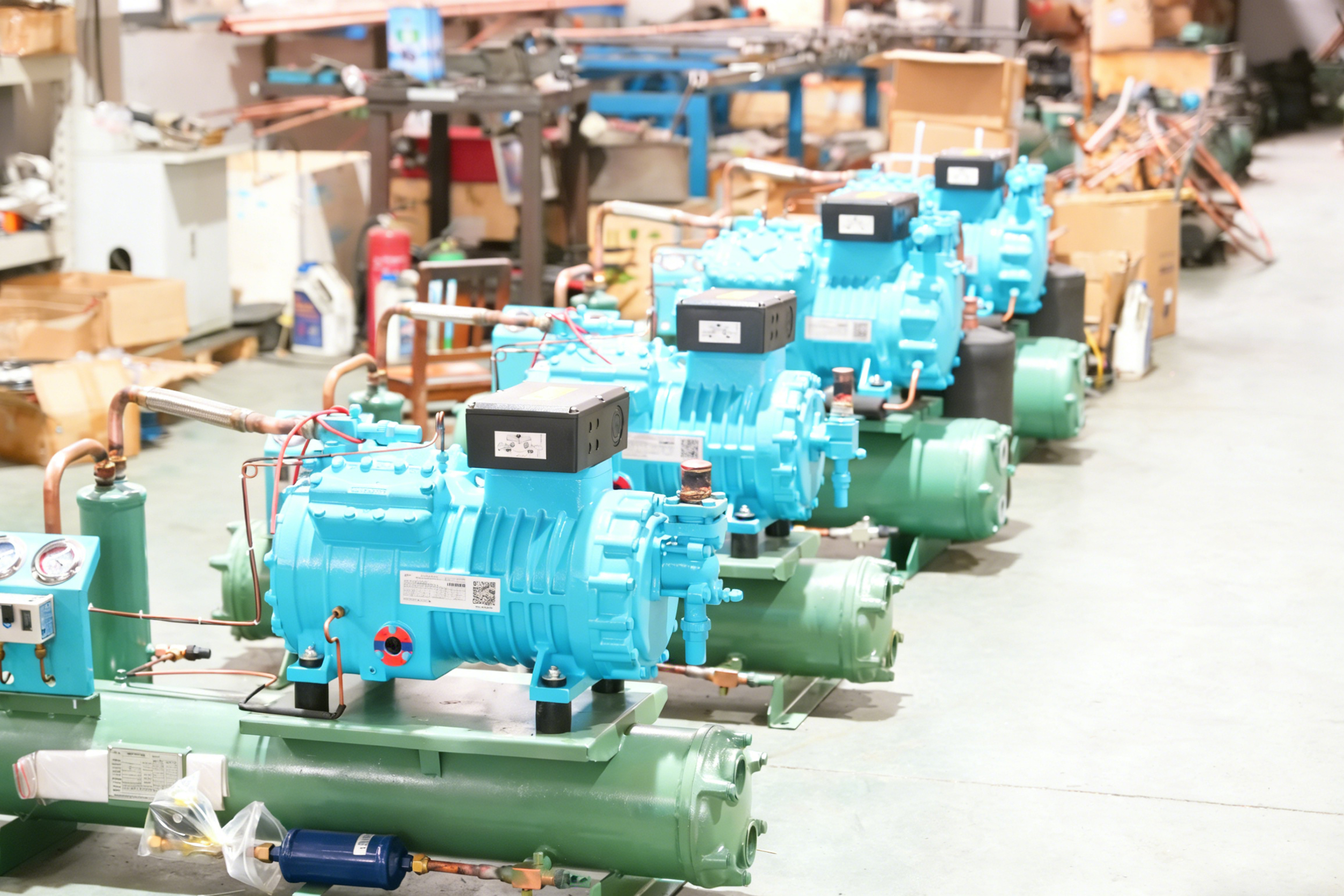
The documents worth requesting at this check are the pressure test record, the performance test data for the unit serial number being shipped, and a function test checklist covering controls, defrost and safety interlocks. Where the buyer's own quality team or a third-party inspector needs access, the question of witnessing should be settled at order stage.
Check 5 — Project execution support
Support capability is the check that most often decides whether a project runs smoothly, and the one most often answered in generalities. Clevier states after-sales support covering online technical support, installation guidance, spare parts supply and project support, and lists installation solution as a customization parameter rather than a fixed service package.
Project scale gives a sense of the operating pattern: 1–20 sets per project are described as typical, with cold storage contractors, food processing factories and cold chain logistics companies named as client types, and applications spanning meat storage, seafood storage, vegetable preservation and frozen food warehouses. The supplier reports stable cooling performance, energy savings and reliable operation over 2–5 years in these projects. Those are supplier-reported outcomes, and the appropriate response from a buyer is not to dismiss them but to ask for the underlying commissioning records, service history and the specific configuration those projects used — a result attached to a different room size, refrigerant or compressor cannot be transferred to yours.
Commercial terms are similarly checkable. Minimum order is one set with a sample available; acceptance criteria are 100% pre-shipment testing, performance inspection and function test; payment terms are T/T with 30% deposit and 70% before shipment. Each of these should appear in the contract rather than in an email thread.
Matching the evidence to the buyer type
The same supplier file looks different depending on who is buying, and the checklist should be weighted accordingly.
| Buyer type | What decides the purchase | Evidence to insist on |
|---|---|---|
| Cold storage contractor | Fit to drawings and installation predictability | Approved general-arrangement drawing, wiring diagram, installation guidance, model-level certificate annex covering the exact units ordered |
| Refrigeration distributor | Repeatable range, spare parts, documentation for resale | Series coverage across DL, DD and DJ bands, spare parts list, certificate copies, MOQ and lead time in writing |
| Engineering project / end user | Compliance file, acceptance and lifecycle support | Test records, conformity documents, refrigerant and voltage confirmation, after-sales scope and response route |
Where factory-direct claims stop being useful
Factory-direct supply is a real commercial advantage, but it carries boundaries that are better understood before signing than after commissioning.
- Factory-direct does not mean every component is made on site. Compressors, controls and electrical components come from specialist manufacturers; the system builder's contribution is selection, matching and assembly quality.
- A certificate covers listed models, not your installed system. Site wiring, refrigerant pipework, door interlocks and building interfaces fall outside a machine-level certificate.
- Capacity numbers are meaningless without duty conditions. Evaporating temperature, ambient conditions, room load and refrigerant determine what a cooler or condensing unit will actually do; a single headline figure cannot be compared across suppliers.
- Customization breadth adds time and shifts verification to the buyer. Voltage, refrigerant, fan configuration and control scope can all be tailored, and each deviation from a standard build needs its own confirmation step.
- Reported results remain claims until documented. Supplier-reported performance is a starting point for a document request, not a substitute for one.
From evaluation to execution: the document handoff
The transition from evaluation to execution should be marked by a document set, not by a purchase order alone. A cold room refrigeration system order is adequately specified when it includes: a signed configuration sheet with compressor model codes and refrigerant; the approved general-arrangement and wiring drawings; the certificate copy with its model annex; unit-level pressure and performance test records; refrigerant charge and nameplate data; installation guidance and sequence; the spare parts list; and the after-sales scope with its response route. Anything missing from that list becomes an assumption, and assumptions are what site teams resolve at their own cost.
Outlook
Two pressures are pushing this category toward documentation-led buying. Refrigerant regulation is making the refrigerant choice a specification decision with a compliance dimension, and the fragmentation of the supplier base means most buyers will evaluate companies that are not household names. In that environment, the supplier that can produce a model-level certificate annex, a configuration sheet and a unit-level test record wins evaluations that a supplier relying on adjectives will lose. For distributors working across borders, trade classification is worth clarifying early as well: refrigerating and freezing equipment falls under HS heading 8418 in the UNdata and UN Comtrade interface, and confirming the exact national tariff line before shipment avoids avoidable clearance delays.
None of this requires the buyer to become a refrigeration engineer. It requires a checklist, and the discipline to hold a supplier to it. Readers who want the full series and model overview can download the Clevier product catalogue (PDF) and read it alongside the certificate annexes.
FAQ
What does OEM or ODM support actually cover in a cold room refrigeration system?
OEM, ODM and custom project manufacturing are offered as production modes. The stated customization scope covers voltage, size, capacity, material, structure, control system and installation solution, and compressor selection and refrigerant are fixed during configuration. Minimum order quantity is one set for a sample or system order, and lead time is quoted at 15–30 days depending on order quantity.
How do DL, DD and DJ air coolers differ by room temperature?
DL series coolers serve 0 °C to +10 °C rooms, DD series units serve around −18 °C, and DJ series units are built for low-temperature duty. The bands differ in fin spacing, defrost method, airflow and coil surface, so the series must be confirmed against room load, product type and frosting regime rather than chosen by catalogue size alone.
Which compressor and refrigerant choices should be confirmed in writing before ordering?
Compressor manufacturer plus model code — Copeland and Bitzer options are offered — along with the refrigerant designation, which may be R404A, R507A or R22. The model code matters as much as the brand, because application envelopes differ between compressors from the same manufacturer. Buyers should also confirm that the refrigerant is permitted in the destination market and supported by the local service network.
What power supply variants are available for export projects?
220 V and 380 V options are available with 50 Hz and 60 Hz variants, so the site supply rather than the factory default governs. Voltage and frequency should appear on the order confirmation and on the unit nameplate, together with fan quantity and material options where these have been specified.
What documentation should accompany a factory-direct cold room shipment?
A certificate copy including the model annex, unit-level pressure and performance test records, a function test checklist covering controls and defrost, wiring diagrams, installation guidance and a spare parts list. Acceptance criteria are stated as 100% pre-shipment testing, performance inspection and function test, with payment at T/T 30% deposit and 70% before shipment.
How many sets are usually supplied per project?
Project quantities are typically described as 1–20 sets per project for system-matching solutions, depending on room count and capacity. The configuration, not the quantity, determines the engineering work, so each room in a multi-room project should carry its own configuration sheet and cooler selection.
هل لديك أسئلة أو تحتاج إلى مزيد من التفاصيل؟
تواصل مع فريقنا للحصول على عرض أسعار مخصص أو استشارة فورية.
طلب عرض أسعار
املأ النموذج أدناه وسيتواصل معك فريقنا بعرض مقترح مخصص.
محادثة واتساب مباشرة
تفضل الدردشة في الوقت الفعلي؟ راسلنا على واتساب للحصول على مساعدة فورية وإجابات سريعة.
- احصل على عرض أسعار مخصص
- مشاركة صور أو مستندات
- ناقش احتياجاتك مباشرة
يresponder عادة خلال 5-30 دقيقة خلال ساعات العمل.