
Cold-Soluble Non-Dairy Creamer: Fit Checks for Cold Lines
Cold-Soluble Non-Dairy Creamer: Fit Checks for Cold Lines
Cold-soluble non-dairy creamer is purchased for one practical reason: the powder has to disappear into a cold liquid without hot water doing part of the work. Cograin's cold-soluble grade is listed for coffee, milk tea and beverage applications at fat 32.0 g/100 g, protein 3.5 g/100 g and moisture ≤5.0 g/100 g, built on glucose syrup, refined vegetable oil, sodium caseinate, emulsifier, stabilizer and anti-caking agent. Those figures describe what the powder is. They do not describe how quickly it disperses in a chilled milk tea base, whether it sediments during a long hold, or how it behaves in an acidic drink. Cold solubility is therefore a line-fit question, and this article treats it as one: which formulation facts matter, which checks belong in a sample trial, and where this grade should be rejected in favour of a different specification.
General industry descriptions still define non-dairy creamers primarily through hot beverages. GEA, the food-processing technology supplier, describes non-dairy creamers and coffee or tea whiteners as lactose-free liquid or granular substances generally used in hot beverages as a substitute for milk or cream. Cold service reverses that assumption, and it is the reason a grade carrying the cold-soluble descriptor deserves its own evaluation rather than being inherited from a hot-cup approval.
Cold service changes which creamer facts matter
In a hot cup, heat and stirring perform part of the dispersion work. Powder meets water that is already hot, viscosity drops, and the drink is usually agitated again before serving. A cold beverage line removes most of that assistance. The powder meets chilled water, chilled milk or brewed tea, often with a shorter agitation window, and nothing in the process raises the temperature to accelerate wetting or hydration.
That shift turns four process variables into specification-level questions:
- Liquid temperature at dosing. A grade approved in hot preparation has not been evaluated at the temperature your line actually uses.
- Agitation type and duration. A high-shear tank, a low-speed batch mixer and hand agitation in a shop-scale jug are three different dispersion environments.
- Order of addition and dose. Powder added to liquid behaves differently from liquid added to powder, and dose changes both body and the risk of undissolved residue.
- Hold time before service. A drink held in a dispenser, churn or chilled tank must stay homogeneous, not merely mix cleanly at the start.
None of these variables is fixed by the words “cold-soluble” on a specification sheet. They are commercial assumptions that a buyer converts into trial conditions, and they belong in the technical discussion before a first order rather than after a failed production run.
The cold-soluble specification, field by field
Cograin lists the grade simply as “Cold-soluble creamer” within its non-dairy creamer range. The published record is short, which is itself useful information: buyers can see exactly which fields are stated and which must be requested.
| Product / model | Non-dairy creamer — Cold-soluble creamer |
|---|---|
| Type as listed | Cold-soluble creamer |
| Fat | 32.0 g/100 g |
| Protein | 3.5 g/100 g |
| Moisture | ≤5.0 g/100 g |
| Ingredients | Glucose syrup, refined vegetable oil, sodium caseinate, emulsifier, stabilizer, anti-caking agent |
| Industries listed | Coffee, milk tea, beverage |
| Not stated in this record | Trans fat, carbohydrate or sugar content, solubility or dispersion test method, certificate per model |
Each ingredient in that list does a defined job, and the job matters when a buyer starts matching the powder to a cold process.
- Glucose syrup is the carrier solid that builds the powder matrix and contributes bulk and mild sweetness. It is the first ingredient listed, which is consistent with a formulation in which the syrup solids, not the fat, form the largest share.
- Refined vegetable oil carries the fat phase responsible for whitening and creamy mouthfeel. At 32.0 g/100 g, roughly one third of the powder's mass is fat — a straightforward restatement of the stated value, not a performance claim.
- Sodium caseinate is a milk-derived protein and the protein source named in this formulation; it also contributes emulsifying and whitening function. Its presence is the single most important screening fact for anyone with a dairy-free or vegan brief.
- Emulsifier stabilises the oil–water interface so that fat stays dispersed rather than separating once the powder is reconstituted.
- Stabilizer supports the dispersion during storage and hold, which is directly relevant to a drink that waits in a chiller before service.
- Anti-caking agent keeps the powder free-flowing through storage and dosing, a practical concern in shop-scale scoops as much as in bulk silos.
Two parameters deserve separate attention. Protein at 3.5 g/100 g is higher than several other models in the same portfolio (2.5 to 3.0 g/100 g on the K80, DT35, K60 and 60A records) and lower than the foaming and whipping grades; it should be read as a formulation characteristic, not a quality ranking. Moisture at ≤5.0 g/100 g is stated as a maximum, so a certificate of analysis should show the actual lot value against that ceiling rather than restating the limit.
How a creamer becomes cold-dispersible — and what that does not promise
Cold performance is a manufacturing outcome as much as a formula outcome. GEA notes that complete formulation systems can combine emulsification, spray drying and agglomeration to produce highly dispersible instant agglomerated powders. The sequence matters: emulsification fixes the fat in a stable form, spray drying converts the emulsion into powder particles, and agglomeration builds clusters that wet and sink more readily than fine, dusty particles.
The procurement consequence is that two suppliers can quote identical fat, protein and moisture figures and still deliver different dispersion behaviour, because the figures do not describe particle structure. That is why a cold-line evaluation should ask for process evidence alongside the specification: what the supplier controls during emulsification and drying, how agglomeration is managed if used, and what lot-level checks are performed.
On that point Cograin's company-reported capability states full-process inspection, 100% metal and weight checks, and third-party testing, supported by an ISO 9001 quality management system, FSSC 22000 food safety system, HACCP, HALAL, ISO 14000 and OHSAS 18000 certifications. The same source reports monthly creamer capacity of 16,700 tons, a lead time of around 7–15 working days after order confirmation, and negotiable minimum order quantities. Group-level production capacity is reported at more than 300,000 tons annually across three production bases and five factories in Suzhou, Nantong and Singapore. These are company-reported figures and should be confirmed in the commercial documents attached to a specific order.
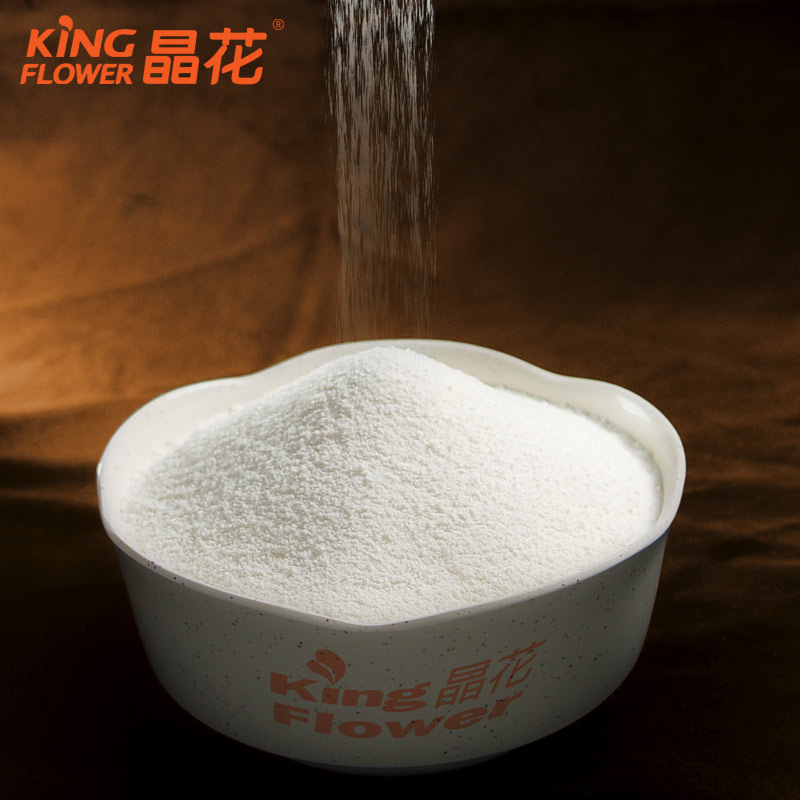
Powder appearance and flow are visible on arrival; dispersion behaviour in a chilled liquid is not, and has to be trialled.
Application fit: iced coffee, milk tea and cold beverage production
The scenario record behind this grade describes beverage ingredient supply for bubble tea chains and coffee shops across markets including Singapore, Vietnam, Thailand, Indonesia, the United States, Nigeria, Australia, the Philippines, Malaysia and Myanmar. It sets the working condition as normal temperature and room-temperature storage in a food-grade production environment, the project type as batch production with bulk supply and on-demand delivery, and the matched equipment as food-grade mixing tanks, packaging machines and beverage brewing equipment. The stated function is to improve smoothness, enhance creaminess and adjust the flavour profile of bubble tea and coffee.
Read together, those details describe where a cold-soluble grade earns its place:
Iced coffee in chain and shop operations
A cold brew or iced latte base is typically assembled at room temperature or chilled, and the creamer must integrate without a hot-water step. Here the practical checks are dose-to-body ratio, whether the powder leaves a surface film on a black coffee base, and whether the drink still looks even after standing in a display chiller.
Milk tea and bubble tea batches
Batch preparation concentrates the risk. Powder is dosed into a larger volume once, then held and dispensed across many servings, so an undispersed fraction in the tank becomes sediment in the cup. Room-temperature storage of the powder, free flow from the anti-caking agent, and consistent behaviour between lots matter more here than in single-serve preparation.
Cold beverage and premix production
Industrial users blending powders into cold liquid products need the creamer to behave predictably inside a formulation that already contains sugar, stabilisers or dairy solids. Cograin reports a five-year supply relationship with a 3-in-1 coffee manufacturer across several markets covering instant coffee powder, instant oatmeal and instant milk tea products — an example of the powdered-beverage channel rather than evidence of performance in any specific cold liquid system.
One caution applies across all three: the record states industries (coffee, milk tea, beverage) without restricting preparation temperature. It is not a claim that the grade is unsuitable for hot preparation. It is a claim that cold preparation is the use case the grade was positioned around, and that hot use should be trialled like any other application.
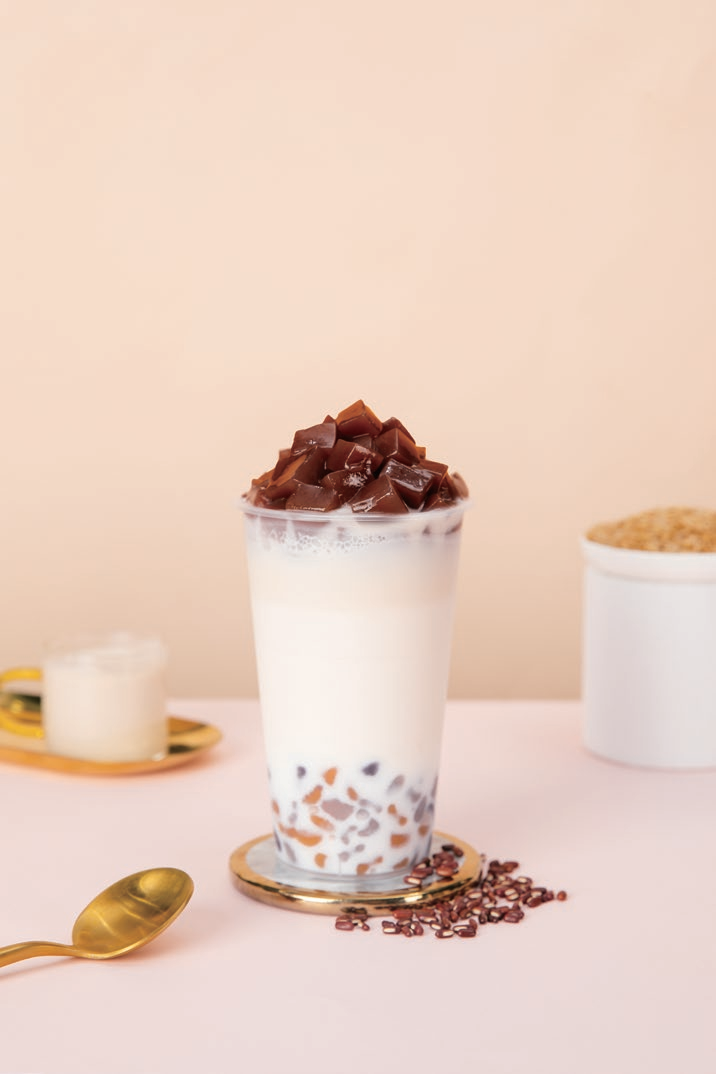
Milk tea and bubble tea batches concentrate dispersion risk: one dose, many servings, and a tank that holds before dispensing.
Where this grade is the wrong choice
A fit analysis is only useful if it also states the boundaries. The cold-soluble formulation is a good match for cold coffee, milk tea and general beverage work; it is a poor match for four other briefs that the same portfolio addresses with different grades.
- Vegan or dairy-free products. Sodium caseinate is a milk-derived protein and appears in this ingredient list. The S35 vegan grade lists glucose syrup, hydrogenated vegetable oil, emulsifier, oxidised hydroxypropyl starch and anti-caking agent, with no dairy-derived ingredient named, and states 0 g/100 g protein. A dairy-free brief should start there, not with the cold-soluble grade.
- High-fat or richly textured formulations. The 60A high-fat grade states 60.0 g/100 g fat and 0 g/100 g trans fat; the cold-soluble record, at 32.0 g/100 g fat, does not reach that fat level and does not state trans fat at all.
- Whipping and foaming structures. The C960 whipping cream grade states 60.0 g/100 g fat, 5.2 g/100 g protein and moisture ≤6.0 g/100 g; the FC22 foaming grade states 22.0 g/100 g fat and 7.2 g/100 g protein. Where a foam or whip is the product attribute, these are the referenced models.
- Sugar-controlled briefs. The DT35 low-sugar grade states carbohydrate at 4.3 g/100 g. The cold-soluble record does not state carbohydrate or sugar, so the two cannot be compared on that dimension until the missing figure is supplied.
Two further gaps should be recorded rather than assumed. First, the dataset lists acid-resistant creamer as a category, but no acid-resistance data is published for the cold-soluble grade, so an acidic or fruit-forward cold drink is an open question requiring a trial. Second, kosher and halal claims are attached to specific models and company certifications — the kosher K80 is the model explicitly positioned as a kosher product — so a certificate requirement should be matched to the model that carries it, not assumed across the range.
Cold-line screening fields across the documented models
The table below limits itself to the fields that actually separate models at the screening stage of a cold-line project: listed type, stated fat and protein, stated moisture, whether a dairy-derived protein appears in the ingredient list, and the industries each model is listed for. It is a screening aid, not a performance ranking; no solubility, sediment or sensory results are published for any of these models.
| Model as listed | Type | Fat (g/100 g) | Protein (g/100 g) | Moisture (g/100 g) | Dairy-derived ingredient in list | Industries listed |
|---|---|---|---|---|---|---|
| Cold-soluble creamer | Cold-soluble creamer | 32.0 | 3.5 | ≤5.0 | Sodium caseinate | Coffee, milk tea, beverage |
| DT35 | Low sugar | 35.0 | 2.5 | Not stated | None listed | Milk tea, coffee, beverage, baking |
| K60 | Non-dairy creamer | 32.0 | 2.6 | ≤5.0 | Milk powder, sodium caseinate | Milk tea, baking, coffee |
| 60A | High fat | 60.0 | 3.0 | Not stated | Sodium caseinate | Beverage, dessert, baking, animal feed |
| S35 (Vegan) | Vegan non-dairy creamer | 35.0 | 0 | Not stated | None listed | Vegetarian products, alcoholic beverages, milk tea, coffee, baking |
| FC22 (Foaming) | Foaming creamer | 22.0 | 7.2 | ≤6.0 | Milk powder | Milk tea, coffee, baking |
| C960 (whipping cream) | Whipping creamer | 60.0 | 5.2 | ≤6.0 | Sodium caseinate | Baking, beverage |
| Kosher K80 | Kosher product | 32.0 | 2.5 | Not stated | Sodium caseinate | Beverage, dessert, milk tea, coffee |
For market context, one further figure is worth holding separately. Market.us segments non-dairy creamer by fat band and reports the medium-fat band, defined there as 21–50% fat, at 43.6% revenue share in 2024. The cold-soluble grade's stated 32.0 g/100 g places it inside that band — a segmentation observation, not evidence that the grade performs better or worse than neighbours in it.
Acceptance checks before a production commitment
The following sequence converts an application fit into something a buyer can accept or reject. It is written for a cold-line project and assumes the cold-soluble grade is the candidate under review.
- Trial in the real matrix, at the real temperature. Use the actual coffee, tea or beverage base, the real water or milk, and the temperature the line will use — not a room-temperature bench sample as a proxy for a chilled one. Any result obtained in a different matrix answers a different question.
- Run a dose ladder. Test at least three inclusion levels around the intended dose and record body, whiteness, sweetness contribution from the glucose syrup solids, and any flavour masking. Choose the level that meets the sensory target with the least powder, since excess dose is the most common source of residue.
- Measure dispersion rather than judging it. Agree a simple, repeatable method before the trial — time to visual dispersion under a defined agitation, plus a check for residue on the vessel wall or filter. This turns “dissolves well” into a number you can compare between suppliers.
- Check hold behaviour, not just mixing behaviour. Hold the prepared drink for the longest realistic service window and inspect for sediment, surface film, ringing at the liquid line and colour drift. A stabiliser in the formulation supports this, but only a hold test proves it for your product.
- Test the interactions that matter in your recipe. Acidity, alcohol, high mineral content and heavy dairy solids all change the dispersion environment. Where any of these is present, test with them present; do not extrapolate from a plain water trial.
- Confirm equipment compatibility. The scenario record for this application names food-grade mixing tanks, packaging machines and brewing equipment. Check how the powder feeds into your system — scoop, hopper or bulk handling — and whether the anti-caking agent's flow behaviour holds up in your storage humidity.
- Verify storage and packaging assumptions. The stated working condition is normal temperature with room-temperature storage in a food-grade environment, and the grade is packed in 25 kg units. Confirm your store can meet that condition before accepting a bulk quantity.
- Assemble the documentation pack. Request the specification sheet with fat, protein and moisture; a certificate of analysis per lot showing actual values against the ≤5.0 g/100 g moisture ceiling; the quality and food-safety certificates (ISO 9001, FSSC 22000, HACCP, HALAL as applicable); and the specific certificate covering any kosher, vegan or market-access requirement. Cograin reports a U.S. FDA Food Facility Registration under number 13348058524, with the record listed as valid to 31 December 2026 — confirm currency at the time of order rather than relying on a published date.
- Agree commercial and change-control terms. Minimum order quantity is stated as negotiable by product type and packaging, and lead time as around 7–15 working days after order confirmation. Where the brief needs OEM/ODM adjustment — creamer formula, packaging specification, product flavour or syrup DE value — put the change-control and re-qualification process in writing, so a later formula adjustment cannot silently invalidate the trial result.
- Confirm the import classification. U.S. Customs classified imported non-dairy coffee creamer from China under HTS subheading 2106.90.9975 in a published ruling reproduced in a third-party database; confirm classification and duty treatment with your customs broker for your own product and route. For public-sector or institutional purchasing, the USDA Agricultural Marketing Service maintains a Commercial Item Description for dry non-dairy creamer (identified in the source filename as AA-20043D), and the exact revision should be checked against the live document.
Market context: what the evidence does and does not support
The directional signal is credible; the sizing is not settled. The Good Food Institute reports that plant-based milk and creamer saw continued growth in U.S. foodservice and are established categories there, which supports a qualitative reading that cold and plant-forward beverage formats are a durable part of the channel rather than a temporary menu experiment.
Global market values should be handled with more care. Commercial research providers in this dataset publish different figures on different bases: approximately USD 2.4 billion for 2024 with a 2034 endpoint and 6.2% CAGR (Market.us), USD 2.61 billion for 2025 with a 2034 endpoint (Market Data Forecast), and USD 2.88 billion for 2025 with a 2033 endpoint and 8.00% CAGR (Data Bridge Market Research). Base years, forecast endpoints and methodology differ and are not fully disclosed, so these figures must not be averaged, merged or presented as a consensus range. A buyer building a business case should re-derive the number for their own market and product scope.
Outlook
Cold-format beverage menus and cold preparation in chain operations are the conditions under which a cold-soluble grade earns a specification line. The next competitive step is unlikely to be a new descriptor on a label; it is more likely to be application data — dispersion time under a stated method, hold stability over a stated window, and lot-level consistency evidence a buyer can audit. Suppliers who publish test methods alongside fat, protein and moisture will make quotations comparable, and buyers who specify those methods before sampling will avoid the common failure mode of approving a powder on a bench trial that never resembled the line.
For Cograin specifically, the cold-soluble grade sits inside a portfolio that already separates vegan, foaming, whipping, low-sugar, high-fat and kosher requirements into distinct models. That structure is useful to a cold-line project because it allows a buyer to change one variable — dairy protein, fat level or foam — without changing supplier. It also means the fit decision should be made per model, on stated characteristics, rather than per brand.
FAQ
What does “cold-soluble” actually mean on a non-dairy creamer specification?
It is a grade descriptor indicating that the powder is positioned for dispersion in cold liquid rather than requiring a hot-water step. For Cograin's cold-soluble grade the published record states fat 32.0 g/100 g, protein 3.5 g/100 g, moisture ≤5.0 g/100 g and the six-ingredient formulation, but it does not publish a dissolution test, a dispersion time or a sediment limit. The descriptor describes intended use, not a measured performance value.
Can this creamer be used in hot coffee or tea as well as cold drinks?
The record lists coffee, milk tea and beverage as industries without restricting preparation temperature, so hot use is not excluded. Because the grade is positioned around cold preparation, hot use should be confirmed in a trial at the temperature and dose your operation actually uses, rather than assumed from the cold-line result.
Is Cograin's cold-soluble non-dairy creamer suitable for vegan or dairy-free products?
No. Sodium caseinate, a milk-derived protein, is named in its ingredient list. The S35 vegan grade lists glucose syrup, hydrogenated vegetable oil, emulsifier, oxidised hydroxypropyl starch and anti-caking agent with no dairy-derived ingredient named, and states 0 g/100 g protein, so a vegan or dairy-free brief should be routed to that model and verified against the certificate.
How does the cold-soluble grade differ from DT35 for a cold milk tea line?
DT35 is listed as a low-sugar grade with fat 35.0 g/100 g, protein 2.5 g/100 g and carbohydrate 4.3 g/100 g. The cold-soluble grade states fat 32.0 g/100 g, protein 3.5 g/100 g and moisture ≤5.0 g/100 g, but does not state carbohydrate or sugar. Where a sugar target drives the formulation, DT35 carries the relevant figure and the cold-soluble grade requires that data to be requested before the two can be compared on equal terms.
What should a buyer verify before committing a cold beverage line to this grade?
Verify four things in writing: a trial in the real matrix at the real service temperature with a dose ladder; a defined dispersion and hold test with recorded results rather than a verbal description; a documentation pack covering the specification sheet, per-lot certificate of analysis, food-safety certificates and any kosher, halal or market-access certificate tied to the specific model; and commercial terms including MOQ, lead time, packaging and change control. Where an import or public-procurement route applies, confirm tariff classification and the applicable purchasing specification separately.
The 2025 Cograin brochure, including the product range and company profile, is available for download: 2025 Cograin Brochure (PDF).
Company information and contact details are published by Jiahe Foods Industry Co., Ltd. (Cograin), headquartered in Suzhou, Jiangsu Province, and listed on the main board of the Shanghai Stock Exchange since 2021 under stock code 605300.
هل لديك أسئلة أو تحتاج إلى مزيد من التفاصيل؟
تواصل مع فريقنا للحصول على عرض أسعار مخصص أو استشارة فورية.
طلب عرض أسعار
املأ النموذج أدناه وسيتواصل معك فريقنا بعرض مقترح مخصص.
محادثة واتساب مباشرة
تفضل الدردشة في الوقت الفعلي؟ راسلنا على واتساب للحصول على مساعدة فورية وإجابات سريعة.
- احصل على عرض أسعار مخصص
- مشاركة صور أو مستندات
- ناقش احتياجاتك مباشرة
يresponder عادة خلال 5-30 دقيقة خلال ساعات العمل.