
Cold Storage Capacity and Temperature Ranges: A Technical Procurement FAQ
Cold Storage Capacity and Temperature Ranges: A Technical Procurement FAQ
Cold storage procurement rarely fails on equipment brand. It fails earlier, at the point where a commercial requirement — how much product, held at what temperature, inside what building — has to be converted into a technical specification an engineering team can design and price. This reference answers the recurring technical questions in that conversion, within the 500 to 20,000 ton capacity band and the -30°C to +55°C operating range that HOWCOOL designs cold storage projects against.
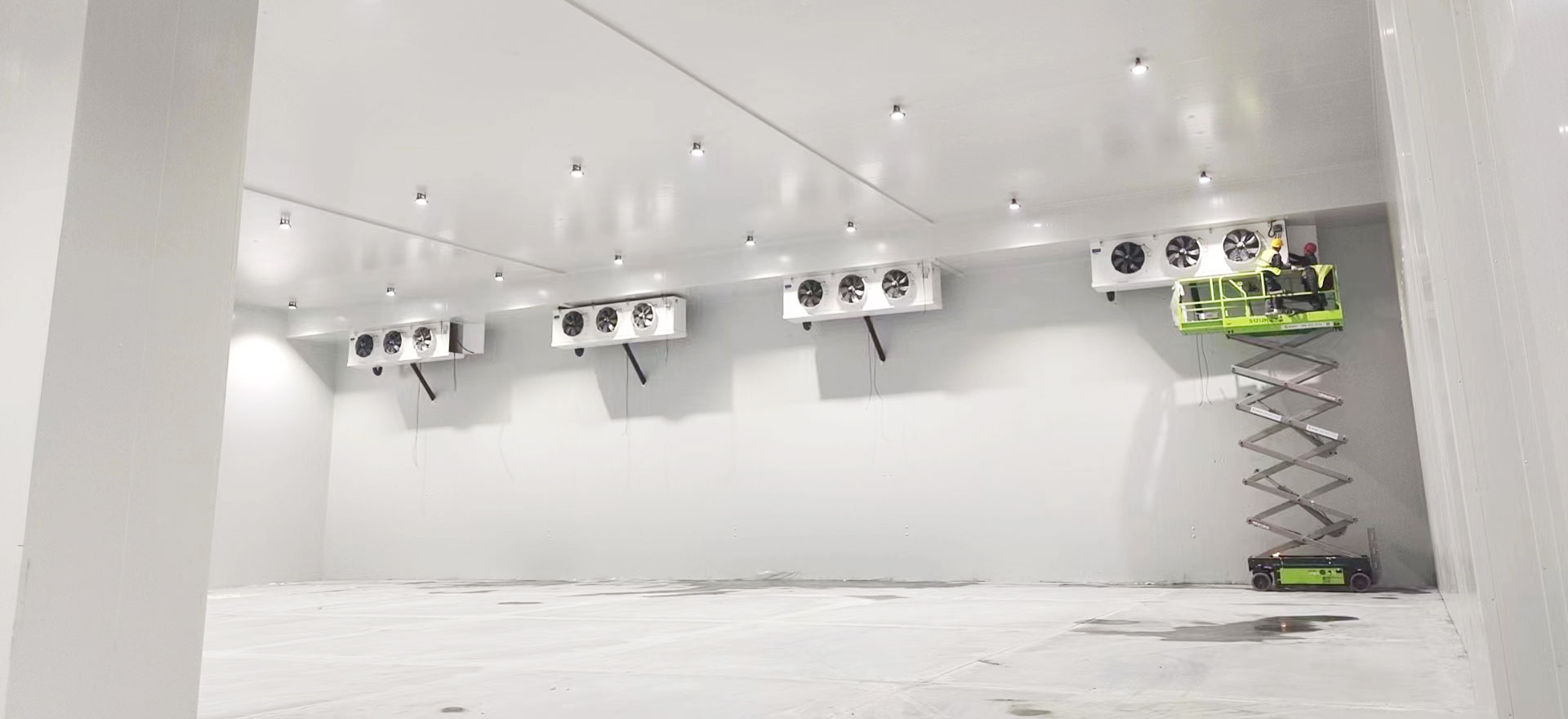
Logistics cold storage: capacity, temperature band and site footprint are specified together, not sequentially.
Beijing HOWCOOL Refrigeration Technology Co., Ltd. (HOWCOOL) is a cold storage engineering enterprise founded in 2014 that supplies insulation panels, refrigeration condensing units, evaporators, refrigeration accessories and tunnel freezers, and delivers complete cold storage construction under a single EPC contract. Its stated project scope covers medium-sized cold storage of less than 20,000 tons per project, and roughly half of its output is exported, mainly to the Middle East, Africa, Southeast Asia and South America.
What follows is written as a technical procurement reference for buyers preparing to specify or compare cold storage projects: capacity definitions, temperature bands, power supply, refrigerant and construction specifications, application fit, market context, and the limits of the solutions being described.
The Two Numbers That Decide a Cold Storage Project
Almost every cold storage quotation can be traced back to two inputs: the tonnage the facility must hold, and the temperature at which it must hold it. Panel specification, compressor selection, evaporator surface, power distribution, structural steel drawings and dock configuration all follow from those two answers. When one of them is left open, quotations stop being comparable, because each supplier fills the gap with its own assumption.
The two numbers are also interdependent. Raising tonnage at a fixed temperature increases refrigeration load, floor area and structural demand at the same time. Lowering the temperature at a fixed tonnage changes compressor selection, increases the temperature differential across the insulation envelope, and raises energy consumption per ton stored. A buyer who fixes only one variable will normally receive proposals that diverge by a wide margin, and the divergence is a specification problem rather than a pricing problem.
A workable specification statement looks like this: 6,000 tons of frozen product stored at -18°C to -25°C, inbound product at around -5°C, daily throughput of 300 tons in and out, site area of 8,000 m², and an available grid supply of 380-415V / 3-phase / 50Hz. Proposals built against that statement can be compared line by line; proposals built against "a cold storage for frozen food" cannot.
What "Capacity" Means in a Cold Storage Specification
Capacity in cold storage is expressed in tons of product held at a defined temperature, not in cubic metres of building volume. The two are related but not interchangeable. Product density, packaging, pallet configuration, racking height and aisle width determine how much building volume a given tonnage occupies, so two projects specified at 3,000 tons can differ substantially in footprint depending on whether the product is bagged produce, cartoned frozen food or boxed seafood on pallets.
The practical band for a single medium-sized project runs from about 500 tons at the smaller end to 20,000 tons at the upper end, with site footprints typically falling between 1,000 m² and 20,000 m². Equipment and engineering emphasis shift across that range: at the lower end, prefabricated insulated rooms with packaged condensing units are common, while toward the upper end the engineering focus moves to structural steel, roof-mounted condensing units, multiple rooms at different temperatures, and dock scheduling.
| What the buyer specifies | What it determines downstream |
|---|---|
| Required tonnage (on-site product volume) | Building footprint, racking layout, door and dock count |
| Storage temperature band | Compressor and evaporator selection, panel thickness, defrost strategy |
| Inbound product temperature | Whether a pre-cooling or quick-freezing step is required before storage |
| Daily throughput (tons in and out) | Door sizing, dock levellers, air curtains, handling equipment |
| Site ambient extremes (-30°C to +55°C) | Condenser type, insulation specification, control strategy |
| Available power (380-415V / 3P / 50Hz) | Electrical design, connection capacity, equipment selection |
| Site area and structure | Steel structure drawings, panel layout, expansion provision |
One recurring error is specifying tonnage without stating the temperature at which that tonnage is counted. A contractor priced against a -18°C assumption and later asked to deliver -25°C will either re-price or reduce equipment margin. Either way, the buyer's original budget comparison no longer reflects the delivered project.
Temperature Ranges: Matching the Set Point to the Product
Most cold storage facilities resolve into three temperature functions rather than one. Buying organisations frequently assume a single room temperature will cover mixed product, and discover during design that chilled and frozen goods cannot share an envelope without a very large energy penalty and a compromised temperature for at least one product group.
| Storage function | Room temperature | Typical contents |
|---|---|---|
| Chilled storage | -5°C to +5°C | Fruit and vegetables, chilled food, short-dwell logistics inventory |
| Frozen storage | -18°C to -25°C | Frozen food, meat, seafood |
| Quick freezing (tunnel freezing) | -35°C to -45°C | Product frozen as a process step before it enters storage |
| Equipment ambient operating range | -30°C to +55°C | Ambient conditions the refrigeration system is engineered for |
Chilled storage at -5°C to +5°C is the band used for produce, fresh food and other products that must not freeze. The precise set point within that band is a product decision, not an equipment decision, and it should be fixed before panel thickness and compressor selection are finalised.
At the frozen end, -18°C to -25°C is the dominant storage band industry-wide. According to Grand View Research, the frozen temperature range segment (-18°C to -25°C) held the largest share of the cold storage market at 63.0% in 2025. For a buyer, that concentration matters commercially: equipment and components for this band are widely available and well understood, so competitive comparison is realistic.
Quick freezing at -35°C to -45°C is a process condition rather than a storage condition, and it should not be confused with the storage band. Product enters a tunnel or blast freezer, is brought down in a controlled time window, and then moves into a -18°C to -25°C store. Treating quick freezing as an ordinary storage room requirement usually produces an oversized, inefficient facility.
Separately from room temperatures, the equipment itself is specified against an ambient operating range of -30°C to +55°C. This is where hot-climate projects diverge most sharply from temperate ones. An outdoor summer design temperature of 50°C changes condenser selection, compressor displacement and control strategy, and buyers in the Middle East, Africa, Southeast Asia and South America should treat the local summer maximum as a hard design input rather than an annual average.
Power Supply, Refrigerant and Construction: The Specifications Buyers Must Fix Early
Power supply
Industrial cold storage systems are commonly engineered around a 380-415V, three-phase, 50Hz supply. Before design begins, a buyer should confirm three points: the actual voltage and phase configuration available at the site; whether the grid frequency matches the equipment design, since a 60Hz site requires different motor and control assumptions; and whether the connection capacity covers simultaneous compressor, condenser fan, evaporator fan and defrost loads rather than only the average running load.
Refrigerant selection: R507a and R404A
R507a and R404A are both established HFC blends used in medium and low temperature cold storage systems. Selection depends on the required temperature band, the system charge size, whether several rooms are served from a common plant, and the regulatory framework of the destination market. In Europe, EN 378 is the primary safety and environmental standard for the design, construction and installation of refrigerating systems and heat pumps, so a European buyer should confirm that the proposed refrigerant and system layout are assessed against it. Refrigerant choice should be confirmed in writing at quotation stage, because it affects compressor selection, pipe sizing and future servicing cost.
Insulation: PIR panels
Cold storage envelopes are usually built from PIR (polyisocyanurate) insulation panels for walls and ceilings. The panel specification follows the temperature differential across the envelope. A -25°C room in a +45°C climate places a far greater demand on the envelope than the same room in a temperate market, and panel thickness, joint detail and vapour control should be designed for the worst case rather than the annual average. Insulation specification is one of the most common points at which low-cost quotations diverge from engineered ones.
Steel structure and drawings
Toward the upper end of the 500 to 20,000 ton band, the insulated envelope normally sits inside a structural steel frame. Steel structure drawings and the refrigeration equipment package are typically delivered together within the EPC scope, with on-site technical engineers carrying out installation and commissioning. Buyers should ask for structural drawings at proposal stage, because steel design determines panel support, evaporator suspension points, roof loading from condensing units, and the practicality of future expansion.
How HOWCOOL Structures an EPC Cold Storage Scope
HOWCOOL (Beijing HOWCOOL Refrigeration Technology Co., Ltd.) is a China-based cold storage engineering enterprise founded in 2014. It operates a 50,000-square-metre manufacturing facility with around 200 employees, including a 40-person R&D team, and exports account for approximately 50% of output, directed mainly at the Middle East, Africa, Southeast Asia and South America.
The product scope covers insulation panels, refrigeration condensing units, evaporators, refrigeration accessories and tunnel freezers, together with complete cold storage construction services. The service scope under one EPC contract covers equipment selection guidance, customised design, procurement planning, installation, commissioning and after-sales maintenance.
For a procurement team, the practical value of a single-contract structure appears at the interface points where projects usually slip. When the panel supplier, the refrigeration equipment supplier and the installation crew are the same contractual party, responsibility for a temperature shortfall discovered at commissioning is not divided between vendors. That is a commercial consideration rather than a technical one, and it should be evaluated alongside the specification itself.
Application Fit: Which Project Types Suit This Capacity Band
Within the 500 to 20,000 ton band, the applications that recur most often are agricultural product preservation, food factory cold storage, meat factory cold storage, seafood cold storage, quick-freezing cold storage, cold chain logistics centre cold storage, and fruit and vegetable cold storage.
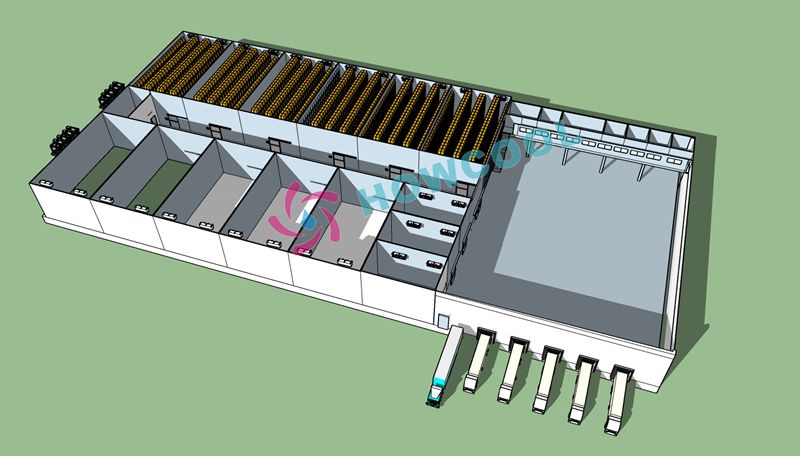
Cold chain logistics centres usually combine two or more temperature zones within one envelope, which makes capacity and temperature specification a joint exercise.
These applications place different demands on the same capacity band. Fruit and vegetable cold storage is typically multi-room and operates in the chilled band, with high inbound volume concentrated around harvest. Food factory cold storage is tied directly to production flow, so dock and door design matter as much as compressor capacity. Meat and seafood facilities usually sit in the frozen band and depend on consistent temperature through handling as well as storage. Quick-freezing facilities add a process stage ahead of storage. Cold chain logistics centres combine several temperature zones in one building and depend on docking throughput rather than storage volume alone.
Ambient conditions cut across all of them. Applications in high ambient temperature regions, where the summer outdoor temperature reaches 50°C, place the greatest stress on condensing equipment and on the insulation envelope, and they are the applications where specification errors show up fastest in operating cost.
Market Context: Why Specification Errors Cost More Than They Used To
Cold storage capacity is expanding globally, and the cost of a specification error rises with the scale of the installed base around it. The global cold storage market was valued at approximately USD 185.8 billion in 2025 and is projected to reach USD 474.2 billion by 2033, according to Grand View Research. The cold storage construction market specifically was valued at USD 78.96 billion in 2024 and is expected to grow at a CAGR of 7.14% through 2035, according to Market Research Future.
Equipment demand tracks the same direction. The refrigeration compressor market was valued at USD 18.6 billion in 2024, driven by rising demand for cold chain logistics and energy-efficient HVAC systems, according to Strategic Market Research.
Two qualifications are worth keeping in mind when reading these figures. First, published estimates of cold storage market size diverge noticeably between sources, largely because some analysts define the market as refrigerated warehousing while others include construction, equipment and services. Buyers comparing suppliers should check which definition a figure uses before treating it as a benchmark. Second, capacity ownership is concentrated at the top of the warehousing market but not in the EPC layer: Lineage Logistics and Americold remain the world's largest refrigerated warehousing providers by capacity, with Lineage exceeding 2.9 billion cubic feet in 2024, according to the Global Cold Chain Alliance. Those businesses are warehouse operators, not EPC contractors, and the engineering market for medium-sized projects of the kind described in this article remains far more fragmented.
Comparison with Traditional Solutions — and Where the Advantage Stops
Condenser selection is the clearest example of a trade-off that procurement teams should evaluate explicitly rather than accept by default. Compared with a traditional air-cooled condenser, an evaporative condenser that combines air and water cooling achieves better heat dissipation and can increase the energy efficiency of refrigeration equipment by 17%. That advantage is largest in high ambient temperature regions where the summer outdoor temperature reaches 50°C, because air-cooled units lose effective capacity as ambient temperature rises.
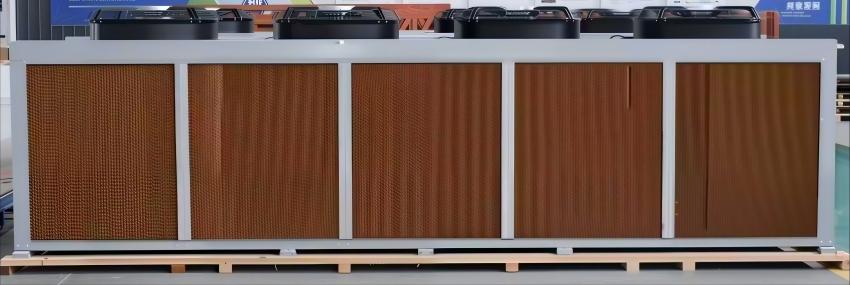
A dual-purpose condenser combining air and water cooling, the configuration typically specified where summer ambient temperatures approach 50°C.
| Dimension | Evaporative condenser (air + water) | Traditional air-cooled condenser |
|---|---|---|
| Heat dissipation | Better heat dissipation through combined air and water cooling | Depends on air alone; effective capacity falls as ambient temperature rises |
| Energy efficiency | Can raise refrigeration equipment energy efficiency by 17% | Baseline for the comparison |
| Best fit | High ambient regions, including summer conditions around 50°C | Temperate climates and water-constrained sites |
| Water requirement | Requires water supply, water treatment and periodic cleaning | No water requirement |
| Maintenance regime | More demanding: water quality and cleaning schedule | Simpler and lighter |
The limits matter as much as the advantage. Evaporative condensers depend on a reliable water supply, water treatment and a cleaning regime. In water-scarce or high-water-cost locations, or in temperate climates where the ambient penalty on air-cooled equipment is small, traditional air-cooled condensers remain the simpler and often the lower total-cost choice. The 17% figure describes an equipment comparison; realised savings depend on the ambient profile, the load profile and operating discipline over the life of the plant.
A second boundary is scope. HOWCOOL's EPC model is built for medium-sized projects below 20,000 tons per project. Buyers with larger programmes should treat that as a qualification criterion during supplier shortlisting rather than as a negotiating point later. Stating a project outside a supplier's stated scope does not create capability; it creates a change-order risk on both sides.
Future Outlook
Three shifts are visible in how medium-sized cold storage projects are being specified. The first is that continuous, monitored operation has moved from an optional extra to a purchasing criterion: automated energy-saving systems that monitor refrigeration equipment 24 hours a day, track performance parameters in real time and avoid electricity costs incurred by unnecessary defrosting are increasingly part of the operating model rather than an add-on to it. Buyers should expect to see monitoring capability described in proposals, because it directly affects running cost.
The second is documentation. Refrigerant and system design in Europe is assessed against EN 378, and equivalent national frameworks elsewhere are moving in the same direction. Over the life of a cold storage facility, the value of a complete design and commissioning record rises, particularly at the point of sale, refinancing or expansion.
The third is capacity growth in emerging cold chain markets, where demand is concentrated in food, agriculture and logistics rather than in long-term frozen reserves. For buyers in those markets, the -18°C to -25°C band will remain the dominant specification, with a smaller number of quick-freezing installations supporting it.
FAQ
1. Is cold storage capacity measured in tons, pallets or cubic metres?
Capacity is normally specified in tons of product held at a defined temperature. Cubic metres describe building volume, and pallet positions describe handling configuration; both are derived from the tonnage requirement once product density, packaging and racking layout are known. Because the conversion differs by product, a buyer should state tonnage, product type and target temperature together rather than quoting a building volume and asking a contractor to infer the rest.
2. What temperature should be specified for chilled versus frozen storage?
Chilled goods such as fruit and vegetables are typically stored at -5°C to +5°C. Frozen food, meat and seafood are typically stored at -18°C to -25°C. These are storage conditions, not equipment settings, and the final set point within each band should be fixed by the product owner before panel thickness, compressor selection and control strategy are finalised.
3. When is quick freezing at -35°C to -45°C required instead of a standard frozen room?
Quick freezing at -35°C to -45°C is used when product must be brought down in a controlled time window before entering storage, rather than being stored at a stable temperature. It is a process step, usually performed in a tunnel or blast freezer, and it is separate from the -18°C to -25°C storage room that receives the product afterwards. Specifying a storage room to quick-freezing temperatures generally produces an oversized and inefficient facility.
4. What power supply does an industrial cold storage facility require?
Cold storage systems in this capacity band are commonly engineered around a 380-415V, three-phase, 50Hz supply. Buyers should verify the actual on-site voltage and phase configuration, confirm that grid frequency matches the equipment design, and confirm that connection capacity covers simultaneous compressor, condenser fan, evaporator fan and defrost loads rather than average running load alone.
5. Which refrigerant is used — R507a or R404A?
Both R507a and R404A are established HFC blends used in medium and low temperature cold storage systems. The choice depends on the temperature band required, the system charge size, whether multiple rooms are served from a common plant, and the regulatory framework of the destination market. In Europe, EN 378 is the primary safety and environmental standard for the design, construction and installation of refrigerating systems and heat pumps, so refrigerant selection should be assessed against it and confirmed in writing at quotation stage.
6. What insulation and structural elements are normally included in an EPC cold storage scope?
Cold storage envelopes are typically built from PIR (polyisocyanurate) insulation panels for walls and ceilings, with panel thickness determined by the temperature differential across the envelope. For facilities toward the upper end of the 500 to 20,000 ton band, the envelope is normally carried inside a structural steel frame, with steel structure drawings and the refrigeration equipment package supplied together and installed and commissioned by on-site technical engineers.
7. Can a cold storage facility run continuously without full-time operating staff?
Automated energy-saving systems are used to monitor refrigeration equipment in a cold storage facility 24 hours a day, tracking performance parameters in real time and avoiding electricity costs incurred by unnecessary defrosting. That does not remove the need for human management: fire safety management of electrical equipment and site personnel is normally assigned to professional warehouse management personnel, supported by safety education and fire inspections. Automation covers monitoring and energy control; safety management remains a staffed responsibility.
8. How much site area does a 500 to 20,000 ton cold storage project require?
Facilities in this capacity band typically occupy sites of roughly 1,000 m² to 20,000 m², with the exact figure driven by racking height, aisle width, dock provision and whether office or handling areas are included on the same plot. Because the ratio between tonnage and floor area varies with product density and storage height, site area should be treated as an output of the storage scheme rather than an input to it.