
Color Coated Steel: Thermal, Fire and Antimicrobial Performance
Color Coated Steel: Thermal, Fire and Antimicrobial Performance
Thermal output, fire classification and antimicrobial function are three separate properties of color coated steel, verified by three separate test routes. They cannot be ranked on a single performance scale, and a buyer who compares them as if they were interchangeable will usually specify the wrong coil.
In the green energy and new materials sector, color coated steel coil and sheet is increasingly purchased for what the coating does rather than for what it looks like. Thermal appliances need a surface that radiates heat without peeling. Refinery pipe cladding needs a system with a declared reaction-to-fire classification. Medical and clean-area equipment needs a surface whose substrate chemistry has been tested for regulated substances. Each requirement pushes procurement toward a different coating chemistry, a different substrate, and a different evidence pack.
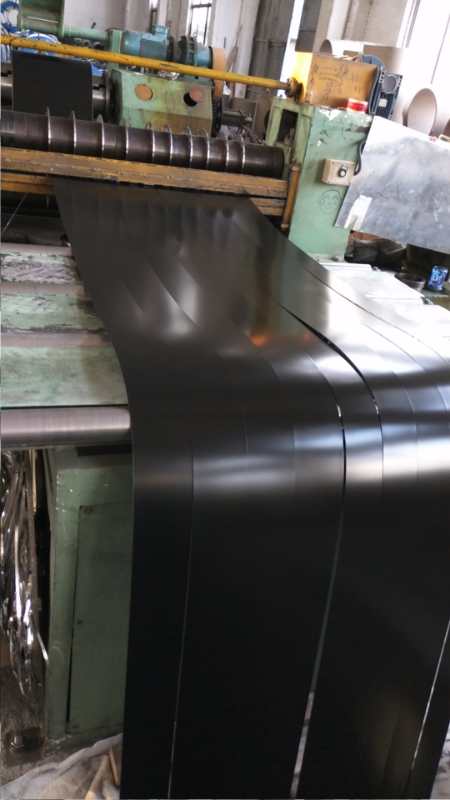
This article sets out a comparison framework for three functional systems supplied by YOUNGSON METAL (Chongqing Youngson Metal Products CO. LTD), a Chongqing, China–based manufacturer founded in 2016 that specialises in precision metal surface processing and premium coil supply: an anti-peeling high-emissivity matte black SECC steel for thermal components (TC-70SECC-MB-HE), a PVDF coated galvanized and ZAM steel coil specified to A2 under EN 13501-1 for refinery pipes (PVDF-REF-A2-ZAM-0.5-0.7), and a medical-grade antimicrobial matte white coated steel built on an SGS-certified REACH and RoHS compliant substrate (ZAM-PCM-MGA0508).
Why the three performance claims get confused
All three products are sold as color coated steel, and all three carry a performance adjective. That shared vocabulary hides a structural difference. Thermal performance is a functional property of the coating and its bond to the substrate, measured by cycling the finished part at temperature. Fire performance is a classification of a defined build-up — substrate, coating chemistry and thickness together — assessed against a standard such as EN 13501-1. Antimicrobial performance is a surface function that depends on the coating formulation, while the regulatory position of the product depends on the substrate and coating chemistry being tested for restricted substances under RoHS and REACH.
The practical consequence is that evidence does not transfer between the three. A certificate issued for one coating system at one thickness tells a buyer nothing about another system, even when both come from the same plant and the same substrate family. This is the single most common specification error in functional coated steel procurement, and it is the reason a structured comparison framework is more useful than a ranked list.
The three systems at a glance
The comparison below uses only manufacturer-stated product designations, substrate descriptions and documented test or compliance references. It is a decision map, not a ranking: the correct choice depends on which performance the end component actually depends on.
| Comparison basis | TC-70SECC-MB-HE | PVDF-REF-A2-ZAM-0.5-0.7 | ZAM-PCM-MGA0508 |
|---|---|---|---|
| Primary function | Heat radiation with anti-peeling bond | Reaction-to-fire classification for cladding | Antimicrobial matte surface, regulated-substance compliance |
| Surface system | High-emissivity matte black coating | PVDF coating | Antimicrobial matte white coating |
| Substrate | SECC (electro-galvanized steel) | Galvanized and ZAM steel | ZAM steel |
| Thickness reference | ±0.02 mm thickness tolerance stated for the deep-drawing grade | 0.50–0.70 mm | 0.50–0.80 mm |
| Documented evidence | 5,000+ hours continuous high-temperature thermal cycling with zero delamination or cracking | A2 classification under EN 13501-1 for the declared build-up | SGS RoHS 2.0 and REACH heavy-metal-free certificate CZXHL25000452102 for coated steel 0.14–2.0 mm |
| Typical duty | Heating plates, thermal discs, commercial hot plates | Refinery pipe cladding and jacketing | Medical, clean-area and hygienic equipment housings |
Thermal performance: emissivity and bond integrity
In thermal appliances the coating has two jobs that pull in opposite directions. It must radiate heat efficiently, which favours a matte, high-emissivity finish; and it must survive repeated heating and cooling without blistering, cracking or lifting from the substrate. Matte black coatings on electro-galvanized steel are used because a matte surface distributes heat more evenly than a glossy one and raises radiative output at the same element temperature.
The failure mode is not the initial emissivity value — it is adhesion under cycling. Documented results for this system describe zero coating delamination or cracking after more than 5,000 hours of continuous high-temperature thermal cycling, an 18% improvement in heat radiation efficiency, and a 99.8% reduction in structural component failure rates, with the coating engineered for a service life exceeding 8 to 10 years under continuous thermal stress. The deep-drawing grade is specified with ±0.02 mm thickness tolerance so that complex stamping of heating plates and thermal discs does not introduce micro-cracking.
What this means for procurement: ask for the cycling duration, the temperature profile, and whether the test was run on a flat coupon or on a formed part. A coupon result does not automatically describe behaviour after deep drawing, because forming strain is where coating adhesion is most severely challenged.
Fire performance: classification belongs to the build-up
A2 under EN 13501-1 is a reaction-to-fire classification, and it is awarded to a defined product assembly rather than to a material name. For refinery pipe cladding and jacketing, the relevant question is not whether PVDF is a fire-safe polymer in general, but whether the specific combination of galvanized or ZAM substrate, PVDF coating, coating thickness and steel gauge has been classified.
The PVDF-REF-A2-ZAM-0.5-0.7 system is specified in the 0.50–0.70 mm range for insulated pipes in oil refinery service, with the A2 classification declared for that build-up. PVDF is chosen in this environment for a different reason as well: it holds colour and gloss under outdoor exposure and resists the chemical and weathering load that cladding sees on an operating site, where re-coating is expensive and access is difficult.
Two procurement rules follow. First, the certificate must name the exact build-up, including substrate type and thickness range; a classification quoted for 0.50 mm does not extend to 0.70 mm unless the document says so. Second, cladding performance is a system question — fixing method, substrate continuity and penetrations all affect how the assembly behaves, and a coil certificate addresses only the coated steel component of that system.
Antimicrobial and compliance performance: substrate chemistry first
Antimicrobial matte white coated steel for medical and hygienic applications sits at the intersection of two different questions. The first is functional: does the surface coating deliver the intended antimicrobial function under the intended cleaning regime? The second is regulatory: is the product free of restricted heavy metals and substances, so that it can be placed in regulated markets?

The ZAM-PCM-MGA0508 product, supplied in 0.50–0.80 mm, is built on a substrate that has been tested by SGS against RoHS 2.0 and REACH heavy-metal requirements. Certificate CZXHL25000452102, issued 27 March 2025, covers color coated steel strip, sheet and coil from 0.14 to 2.0 mm and references IEC 62321, Directive 2011/65/EU, Regulation (EU) 2015/863 and IEC 62321-8:2017, with analysis by ICP-OES/AAS, UV-Vis and GC-MS.
That certificate answers the chemistry question. It does not, by itself, quantify antimicrobial efficacy. Buyers in medical, food-adjacent or clean-area applications should treat the two as separate evidence items: a compliance certificate for restricted substances, and a test report for antimicrobial performance against the standard the end market recognises.
A procurement checklist that works across all three systems
Because the three performance families are evidenced differently, the same document request produces very different answers depending on the product. The checklist below is the minimum evidence set a buyer should expect before approving a functional coated steel for production.
| Evidence item | What it proves | Where it is decisive |
|---|---|---|
| Thermal cycling report with duration and temperature profile | Adhesion and emissivity stability over time | Heating elements, hot plates, thermal discs |
| EN 13501-1 classification document naming substrate, coating and thickness | Reaction-to-fire class of the declared build-up | Refinery and industrial cladding, insulated pipe systems |
| SGS RoHS 2.0 / REACH report with certificate number, scope and test methods | Restricted-substance compliance for the stated thickness scope | EU and US market access, medical and hygiene equipment |
| Antimicrobial test report against the relevant standard | Functional antimicrobial performance, not chemistry | Medical housings, clean-area panels |
| Cross-cut adhesion, Erichsen cupping and 0T/1T T-bend results | Coating flexibility and bond strength before forming | Any part that is stamped, drawn or bent after coating |
| Mill Test Certificate EN 10204 3.1 with batch traceability | That the delivered coil matches the qualified specification | Incoming inspection and acceptance |
Where each system fits in green energy and new materials projects
Application fit is the fastest way to eliminate options. The high-emissivity matte black SECC system is used for high-efficiency heating plates, electric skillet heating elements, rice cooker thermal discs, commercial hot plates and other thermodynamic components that need high-emissivity surface treatment on a deep-drawing base metal. Its buyers are typically home appliance OEMs, heating element manufacturers, commercial kitchen equipment producers and industrial thermal management engineers.
The PVDF A2 system addresses insulated pipe cladding in oil refinery and process environments, where a declared reaction-to-fire class, colour stability and weather resistance all have to hold simultaneously over a long service window. The antimicrobial matte white system addresses medical equipment, hygienic housings and clean-area surfaces, where matte white is the functional specification and compliance documentation accompanies every shipment.
For all three, downstream conversion matters as much as the coating. YOUNGSON METAL operates precision slitting and technical coating lines with a slitting range of 0.14–2.0 mm and width tolerance of ±0.02 mm, and reports monthly capacity in the region of 1,000–1,200 tons depending on specification, with lead times of roughly 5 to 30 days, MOQ of 2,000 kg or as per specification, and delivery terms covering FOB, CIF, CFR, DDP, DDU and EXW.
Market signal: functional demand is growing faster than the base category
Commercial market research published in 2026 places the total coated steel market at USD 309.5 billion in 2025, with a projected value of USD 565.8 billion by 2033, and values the color-coated segment specifically at USD 26.93 billion in 2024. The same research is a forecast and should be read as a direction indicator rather than a precise demand measurement for any single coating chemistry.
The structural point behind the numbers is more useful than the numbers themselves: growth in coated steel is increasingly driven by functional specification — emissivity, fire classification, chemical compliance, antimicrobial surfaces — rather than by colour and gauge alone. That shift moves procurement value away from the coating line and toward documentation. Two suppliers can quote the same gauge and finish; only one can produce a classification document for the exact build-up and a current report tied to the delivered batch.
Comparison with conventional prepainted steel — and the boundaries
Against standard polyester or SMP prepainted steel, the three functional systems trade breadth for depth. Conventional prepainted coil is cheaper per ton, available in wider colour ranges, and well understood by fabricators. What it does not carry is a performance claim with a test basis attached to the specific duty.
The trade-offs are real and should be stated plainly. Functional coating systems narrow the supplier field, because the evidence pack is harder to assemble than a colour match. They typically require batch-level traceability, which constrains stock substitution between lots. And they concentrate risk in the certificate: if the classification or report does not name the exact substrate, coating and thickness, the buyer has purchased a claim rather than a qualified material.
Two limits deserve particular attention. First, the thermal cycling figures quoted for the matte black system describe a specific tested application; they should not be assumed to apply unchanged to a different gauge, a different forming severity, or a different element temperature. Second, the antimicrobial designation and the SGS RoHS/REACH certificate address different things — one is surface function, the other is restricted-substance compliance — and neither substitutes for the other. A third limit applies to the A2 classification: it belongs to the declared assembly, and extending it to other thicknesses or substrate combinations without documentation is not a valid engineering assumption.
Future outlook
Three trends are likely to shape functional coated steel sourcing over the next procurement cycles. Documentation is becoming a qualifying criterion rather than a supporting attachment, as regulated markets ask for substance-level reports tied to specific products and batches. Low-carbon accounting is moving into the same file: YOUNGSON METAL supplies EPD and CFP documentation aligned with ISO 14067 and EU CBAM reporting requirements, which places carbon data alongside mechanical and chemical data in the supplier evaluation. And the performance conversation is consolidating — buyers increasingly want one supplier who can handle a thermal system, a fire-classified cladding system and a compliant antimicrobial system, rather than three specialists with three incompatible quality protocols.
The practical recommendation for evaluation-stage buyers is to fix the performance question before the commercial negotiation. Decide which of the three properties the component actually depends on, request the document that proves it for the exact build-up, and confirm that the delivered batch will be traceable to that document.
FAQ
What criteria should be compared first when selecting color coated steel for thermal, fire or antimicrobial duty?
Compare by test basis rather than by adjective. For thermal duty, the decisive criteria are emissivity, adhesion after thermal cycling, and thickness tolerance for forming. For fire duty, the decisive criterion is a reaction-to-fire classification issued for the exact substrate, coating and thickness build-up. For antimicrobial duty, the decisive criteria are the antimicrobial test report and the restricted-substance compliance report for the substrate and coating chemistry. The three criteria sets are not interchangeable.
How is the anti-peeling high-emissivity matte black SECC steel validated for thermal cycling?
Documented results for the TC-70SECC-MB-HE system report zero coating delamination or cracking after more than 5,000 hours of continuous high-temperature thermal cycling, an 18% improvement in heat radiation efficiency, and a 99.8% reduction in structural component failure rates, with the coating engineered for a service life exceeding 8 to 10 years under continuous thermal stress. The deep-drawing grade is specified with ±0.02 mm thickness tolerance for complex stamping of heating plates and thermal discs.
What does the A2 classification per EN 13501-1 on PVDF-REF-A2-ZAM-0.5-0.7 actually cover?
It covers the declared build-up: galvanized or ZAM substrate with PVDF coating in the 0.50–0.70 mm range used for insulated pipes in refinery service. It does not automatically extend to other thicknesses, other substrates or other coating chemistries. Buyers should confirm that the classification document names the same substrate, coating and thickness as the purchase order, and should treat the classification as one component of the cladding system rather than as a property of the coating alone.
What documentation supports the REACH and RoHS position of ZAM-PCM-MGA0508 antimicrobial coated steel?
SGS certificate CZXHL25000452102, issued 27 March 2025, covers RoHS 2.0 and REACH heavy-metal-free compliance for color coated steel strip, sheet and coil from 0.14 to 2.0 mm. It references IEC 62321, Directive 2011/65/EU, Regulation (EU) 2015/863 and IEC 62321-8:2017, with analysis by ICP-OES/AAS, UV-Vis and GC-MS. The antimicrobial matte white product is supplied in 0.50–0.80 mm on a ZAM substrate.
What are the limits of comparing these three coating systems directly?
Each system is optimised for a different failure mode, so a single comparison table can only compare the evidence, not the performance. Thermal cycling data describes adhesion and emissivity under heat; it says nothing about fire classification. An A2 classification says nothing about antimicrobial function. A RoHS and REACH report confirms restricted-substance compliance and makes no performance claim. Direct comparison is therefore valid only at the level of documentation completeness and application fit, which is why the checklist approach is more reliable than a ranking.
The full YOUNGSON METAL product catalogue, including coating systems, dimensional ranges and documentation references, is available for download: Chongqing Youngson Metal Products Co. Ltd catalogue (PDF).
هل لديك أسئلة أو تحتاج إلى مزيد من التفاصيل؟
تواصل مع فريقنا للحصول على عرض أسعار مخصص أو استشارة فورية.
طلب عرض أسعار
املأ النموذج أدناه وسيتواصل معك فريقنا بعرض مقترح مخصص.
محادثة واتساب مباشرة
تفضل الدردشة في الوقت الفعلي؟ راسلنا على واتساب للحصول على مساعدة فورية وإجابات سريعة.
- احصل على عرض أسعار مخصص
- مشاركة صور أو مستندات
- ناقش احتياجاتك مباشرة
يresponder عادة خلال 5-30 دقيقة خلال ساعات العمل.