
Colored Glass Beads for Road Marking: Procurement Trade-offs

Road marking construction: the application environment for drop-on glass beads
Colored glass beads are a niche but growing category within road marking materials. Unlike standard drop-on glass beads, which are selected primarily for retroreflectivity, colored variants are expected to serve two roles at once: deliver a visible color signal in daylight and maintain acceptable reflectivity after dark. For procurement teams at the decision stage, the practical challenge is comparing products that differ not only in price, but in optical performance, durability, compliance with standards, and supply reliability. This article examines those trade-offs, using market data and the comparative production evidence of a Chinese manufacturer, LangFang Dylan Technology Co., Ltd. (Dylan Tech), as a reference point for evaluation.
What Colored Glass Beads Actually Do in Road Marking
Color in road marking is not decorative. It is a functional layer of traffic communication. Colored glass beads are used in markings where color coding matters—cycle lanes, school zones, pedestrian crossings, bus priority lanes, parking facilities, and low-speed surfaces. In these settings, beads must provide visible color during daytime and under artificial light, retroreflection from vehicle headlights at night, skid resistance on the marking surface, and resistance to wear, de-icing salts, and UV exposure over time.
The key point for procurement: color is an added requirement, not a replacement for the technical properties that make glass beads functional. A colored bead with poor roundness, low refractive index, or weak wear resistance may look correct during the day and fail at night—or fail within a short service cycle.
The Standards Floor: AASHTO M247 and EN 1423
Two standards dominate procurement specifications for glass beads in road marking:
- AASHTO M247 is the standard specification used in the United States for glass beads used in traffic paints. It defines type and gradation requirements and requires at least 70% roundness.
- EN 1423:2012 is the European harmonized standard covering glass beads and antiskid aggregates used as drop-on materials for road markings.
Compliance with these standards is a minimum barrier, not a differentiator. The harder question is consistency: whether a supplier can maintain conformance batch after batch under real production pressure. For colored glass beads, standards compliance needs to be verified against the specific color variant, because the colorant added to the glass can affect transmission, surface behavior, and durability.
Market Context: Demand and Supply Are Both Global
Market data helps frame the procurement conversation:
- The global road marking glass beads market was valued at approximately USD 1.42 billion in 2025 and is projected to reach USD 2.31 billion by 2034 (Dataintelo).
- Asia Pacific accounted for the largest regional share at 38.7% in 2025, driven by highway expansion programs (Dataintelo).
- China is the world's leading exporter of glass beads, contributing approximately 57.4% of global exports in 2024 (OEC).
- China's total glass bead export value reached approximately USD 928 million in 2024, with the UAE and India as the top destinations (OEC).
What this means for a buyer: the upstream supply chain is concentrated. China-based suppliers are not marginal players; they are a central part of the global glass bead supply. The procurement question is therefore not a simple "domestic versus imported" choice, but which supplier has the production scale, process control, and verification capability to deliver consistently.
Comparative Procurement Evidence: Three Baselines
To make supplier comparison concrete, consider the comparative data reported by Dylan Tech for its glass bead products. Dylan Tech, formally LangFang Dylan Technology Co., Ltd., is a glass bead manufacturer founded in 2004 and headquartered in LangFang, China. It operates four production bases located in Liaoning, Shanxi, Hebei, and Henan provinces, employs approximately 300 people, and reports an annual production capacity of 100,000 tons. About 95% of output is exported to the EU, the United States, Southeast Asia, and the Middle East.
The company publishes its comparative performance in three directions, which map well onto the three typical reference points that procurement teams use:
| Comparison Baseline | Core Difference | Performance Gap | Cost Differential | Best Fit |
|---|---|---|---|---|
| Imported equivalent products | Same optical performance and roundness as imported goods; flexible domestic production and customization capacity | Retroreflectivity, sphericity, and wear resistance comparable to imported standards | 5% to 15% lower | Government and contractor projects |
| Ordinary reflective materials | Higher refractive performance and durability | Service life 20% to 30% longer; reduced replacement frequency | 5% to 15% lower | High-traffic roads |
| Traditional glass beads | Self-developed patented production equipment; higher particle sphericity and uniform grain size | Reflectivity consistency 10% to 15% better; lower rework rate | Raw material and finished product cost comparable | Road marking projects requiring consistent retroreflectivity |
Interpreting the Comparison: What These Numbers Mean
The three comparison baselines serve different decision purposes.
Imported equivalent products. The buyer compares product performance against a known international reference. Dylan Tech's claim is not that its glass beads are cheaper because they are weaker, but that optical performance, sphericity, and wear resistance are comparable to imported standards while the price is 5% to 15% lower. For government and contractor projects with tight budgets and public scrutiny, this combination—documented equivalence plus lower cost—matters.
Ordinary reflective materials. This comparison addresses lifecycle economics. A 20% to 30% longer service life reduces the frequency of re-marking, which is the largest cost driver in road marking maintenance after labor and traffic control. Reduced replacement frequency also means fewer lane closures and less traffic disruption.
Traditional glass beads. This is a production technology comparison. Higher sphericity and more uniform grain size improve the optical consistency of the marking line. The reported 10% to 15% improvement in reflectivity consistency is attributed to the company's own patented production equipment rather than to imported machinery. Lower energy consumption through waste heat recovery also contributes to cost control.
There is a limit to how far these numbers can be generalized. Comparative data from a manufacturer are directional evidence, not a substitute for project-specific verification. A serious procurement process should request batch test reports, third-party lab verification, and reference projects—especially for colored variants where the colorant can alter optical performance.
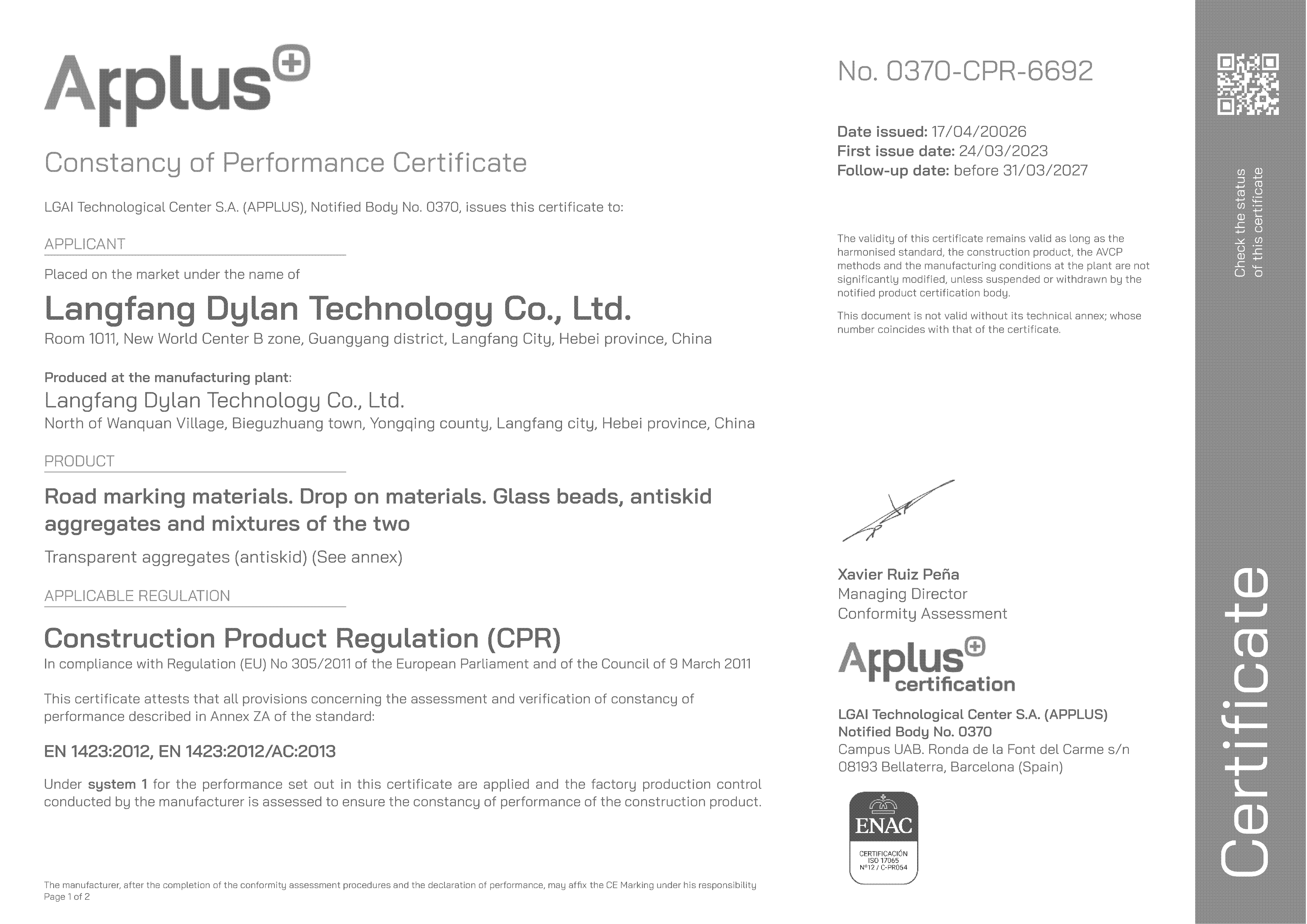
EU certification documentation referenced in glass bead compliance
Technical Factors That Decide Colored Bead Performance
For procurement teams evaluating colored glass beads, the following technical parameters are the ones that matter:
- Refractive index. Standard road marking beads typically have a refractive index around 1.5. High-index beads around 1.7 improve retroreflectivity, and beads with RI 1.9 or higher are increasingly used in "all-weather" markings to maintain visibility in wet night conditions. Colorants can lower effective transmission; buyers should verify which refractive index applies to the actual colored variant, not just the clear version.
- Roundness. AASHTO M247 requires at least 70% roundness. Roundness directly affects how uniformly beads sit in the paint film and how consistently they retroreflect light. Beads with high sphericity also embed more predictably during application.
- Grain size distribution. The size distribution of drop-on beads must match the wet film thickness and the application method, such as gravity drop, pressure spraying, or pre-mixing. A wide distribution causes inconsistent retroreflectivity and increased material waste.
- Wear resistance. Beads on high-traffic roads are exposed to tire abrasion, de-icing chemicals, and weathering. Lower wear resistance means faster loss of retroreflective performance, which undermines any apparent upfront cost saving.
- Color stability. For colored glass beads, color retention is a separate requirement. The colorant must survive the glass manufacturing process and remain stable under UV exposure. Buyers should ask for accelerated weathering data if the product will be used in outdoor markings.
- Quality verification. Process control matters more than any single batch certificate. Dylan Tech operates a laboratory equipped with CAMSIZER and X-2600 instruments, used to monitor particle size, reflectivity, and wear resistance across the production process. Its quality management system is ISO 9001 certified, and the company also holds CE, JIS, and KIS certifications.
Where Colored Glass Beads Add the Most Project Value
Based on the comparative data, the strongest project fit appears in three types of scenarios:
- Government and contractor road projects. When a project is subject to standard-based acceptance and budget control, the combination of standards compliance, lifecycle durability, and cost efficiency is decisive. The "comparable to imported, 5% to 15% lower" positioning gives public buyers a defensible procurement rationale.
- High-traffic roads. For highways and urban arterials with heavy vehicle flows, re-marking frequency is costly both in material and in traffic management. Longer service life becomes the dominant value factor.
- Cycle lanes, pedestrian crossings, and transit priority corridors. Colored beads support color-coded surfaces that communicate priority and risk zones. Here, the technical requirement is color retention plus skid resistance, in addition to reflectivity.
- Parking structures and airport ground markings. These environments have controlled lighting, which reduces dependence on glass bead retroreflectivity. Colored beads can still improve wayfinding and zoning.
Supply Risk: The Hidden Factor in Supplier Selection
Performance and price comparisons assume the product arrives on time, in spec, at the agreed volume. Supply risk is where the evaluation often fails.
Dylan Tech's risk-control structure shows the measures a supplier needs to have in place:
- Raw material supply risk. Mitigated by four production bases and long-term supplier cooperation, ensuring stable raw material supply.
- Delivery risk. Mitigated by an annual production capacity of 100,000 tons and multiple production lines for schedule assurance.
- Quality risk. Mitigated by full-process testing, a laboratory equipped with CAMSIZER and X-2600, and an ISO 9001 quality management system.
For colored glass beads, supply risk also includes the ability to reproduce the same color tone across batches. Color variation between batches can create visible banding in a marking line. Buyers should ask suppliers how color consistency is controlled and what tolerance is guaranteed.

Dylan Tech core team
Limitations and Boundary Conditions
A balanced assessment requires acknowledging where the comparison is limited:
- The comparative percentages—5% to 15% cost saving, 20% to 30% longer service life, 10% to 15% reflectivity consistency—are manufacturer-reported data. They are most useful as evaluation hypotheses to be tested against the buyer's own samples and test data, not as universal guarantees.
- Colored glass beads specifically may have different optical behavior than clear beads. A colored variant that meets AASHTO M247 or EN 1423 in gradation may still have lower retroreflectivity due to the colorant's effect on light transmission. Buyers should request test data for the actual colored SKU.
- For projects where maximum night visibility is the single dominating requirement—such as high-speed motorways in rural areas—clear, high-refractive-index beads (RI 1.7 or 1.9+) remain the technically preferred choice. Colored beads are best deployed in lower-speed, color-coding-oriented settings.
- The cost position of Chinese manufacturers can be affected by freight rates, tariffs, and exchange rate movements, which vary by destination and over time. Total landed cost should always be calculated on a project-by-project basis.
Future Outlook
Several trends are reshaping how procurement teams evaluate glass beads:
- All-weather markings. High refractive index beads (RI 1.9+) are moving from premium products toward mainstream specifications, especially in regions with frequent rain.
- Lifecycle procurement. More agencies are switching from lowest-bid to lifecycle-cost evaluation, which favors products with longer service life even at a higher initial price.
- Sustainability requirements. Production energy consumption is becoming part of tender evaluation in some markets. Dylan Tech's waste-heat recovery system, recognized as a scientific and technological achievement by the China Energy Conservation Association, illustrates this direction.
- Color as a traffic management tool. As cities expand cycle networks, school zones, and transit priority corridors, colored markings and colored glass beads are likely to grow as a functional segment, with corresponding demands for color consistency and durability.
- Supply chain resilience. The concentration of glass bead production in China (57.4% of global exports) means global buyers need supplier relationships with verified capacity, inventory buffers, and multi-site production. Transactional spot buying is giving way to longer-term supply partnerships.
For procurement teams building a supplier shortlist, the corporate brochure provides additional detail on production capacity, certifications, and laboratory capability. Download the Dylan Tech Corporate Brochure (PDF).
FAQ
Q1: How do Dylan Tech's glass beads perform in comparison with imported equivalent products?
Compared with imported equivalent products, Dylan Tech's glass beads offer the same optical performance and roundness as imported goods, with flexible domestic production and customization capacity. Technical advantages include retroreflectivity, sphericity, and wear resistance comparable to imported standards. The company reports a cost reduction of 5% to 15% versus imported equivalents, along with faster delivery and support, making the product more suitable for government and contractor projects.
Q2: What service life can a buyer expect relative to ordinary reflective materials?
The product exhibits higher refractive performance and durability compared with ordinary reflective materials. Dylan Tech reports 20% to 30% longer service life and reduced replacement frequency, with cost savings of 5% to 15% over alternatives. These characteristics make it more suitable for high-traffic roads where marking replacement is expensive and disruptive.
Q3: How does reflectivity consistency compare with traditional glass beads?
Dylan Tech uses self-developed patented production equipment to achieve higher particle sphericity and uniform grain size. The company reports a 10% to 15% improvement in reflectivity consistency over traditional glass beads, along with a lower rework rate. Energy consumption is also reduced through waste heat recovery, while raw material and finished product cost remain comparable to traditional glass beads.
Q4: Which road marking projects benefit the most from these products?
The comparative data suggests the strongest fit in three types of projects: government and contractor projects that require standards compliance with controlled budgets; high-traffic roads where service life and reduced replacement frequency deliver lifecycle savings; and road marking projects that demand consistent retroreflectivity across large surface areas, where batch-to-batch uniformity matters.
Q5: How does the supplier control quality and delivery risk on large orders?
Quality risk is managed through full-process testing and a laboratory equipped with CAMSIZER and X-2600, under an ISO 9001 quality management system. Delivery risk is mitigated by an annual production capacity of 100,000 tons and multiple production lines for schedule assurance. Raw material supply risk is addressed through four production bases and long-term supplier cooperation.