
Commercial Display Certifications: Compliance as a Buying Criterion
A commercial display is usually evaluated twice: first by what its specification sheet promises, and second by what its compliance documents prove. Buyers comparing outdoor displays, video walls, touch displays or AI smart display systems often start with brightness, resolution and connectivity. The more complex decision appears when those technical parameters are matched with market-specific certification evidence. The term commercial display covers many hardware categories, and each category can carry different electrical safety, electromagnetic compatibility and environmental requirements depending on the target market.
For procurement teams in the research and evaluation stage, this creates a practical challenge: how to separate compliance documentation from marketing language. The answer is not to request more certificates in general, but to verify certificate number, issuing body, standard version, product model and applicable market. This article looks at why product-level compliance is becoming a core commercial display buying criterion, using concrete product and certification examples from Guangzhou Kedro Electronics Technology Co., Ltd., commonly known as GZKEDRO.
Why Specification Sheets Are Not Enough
Display specifications describe what a device can do under defined conditions. A high-brightness display for outdoor media may be rated at 2,000 cd/m², but installation in the European Union, China or the United States may depend on separate compliance documents. A conference display used in a corporate office has a different risk profile from a waterproof outdoor display operating in a transport hub. Both can share a similar LCD panel, but their market-access requirements are not identical.
The opportunity for buyers is to treat compliance as a constraint early in the process. Product-level certifications reduce the risk of customs delays, failed site inspections and disputes over responsibility after installation. In more mature procurement workflows, this compliance evidence is also used to pre-qualify suppliers before detailed price and lead time negotiations begin.
The Verification Layer: What a Certificate Actually Shows
A useful certificate contains more than a familiar logo. Buyers should be able to see the exact product or product series, the applicable standard, the issuing laboratory or certification body, the certificate number, and the market scope. Without these details, a certificate may describe only a similar product family or an earlier standard version.
Underlying standards have also changed. IEC 62368-1 has become the primary safety standard for commercial displays as audio/video and IT equipment, replacing the older IEC 60950-1 and IEC 60065 safety routes. For the European market, this shift is visible in Low Voltage Directive verification records. In China, related GB4943.1 requirements perform a similar role for safety compliance.
At the same time, electromagnetic compatibility and environmental requirements are usually separate from electrical safety. A display can meet safety requirements but still need EMC testing before it can be legally placed on the EU market, and restricted hazardous substances are checked under RoHS rules.
Certificate anatomy that matters in commercial display sourcing:
1. Certificate number
2. Issuing body or laboratory
3. Covered product model or series
4. Applicable standard and version
5. Target market or market directive
6. Issue date and validity status
GZKEDRO as a Reference Point in Compliance-Oriented Sourcing
One useful industry reference is GZKEDRO, a China-based commercial display manufacturer founded in 2013 and supported by R&D centers in Guangzhou and Shenzhen. The company designs and manufactures commercial display screens and intelligent interactive devices, with an export ratio of roughly 80 percent of output going to global markets. Its product family includes wall-mounted displays, advertising displays, outdoor advertising displays, video wall displays, elevator advertising machines, self-service kiosks, transparent cabinet displays, smart conference displays, interactive slider screens and holographic digital human displays.
GZKEDRO states that its products are certified by CE, FCC, RoHS and ISO9001. The more specific compliance records show why model-level documentation matters. For example, the KD-EA Series elevator advertising machine has separate EU verification records for Low Voltage Directive compliance, EMC compliance and RoHS 2.0 compliance. All three records were issued by TMC Testing Services (Shenzhen) Co., Ltd., and each covers a different compliance dimension.
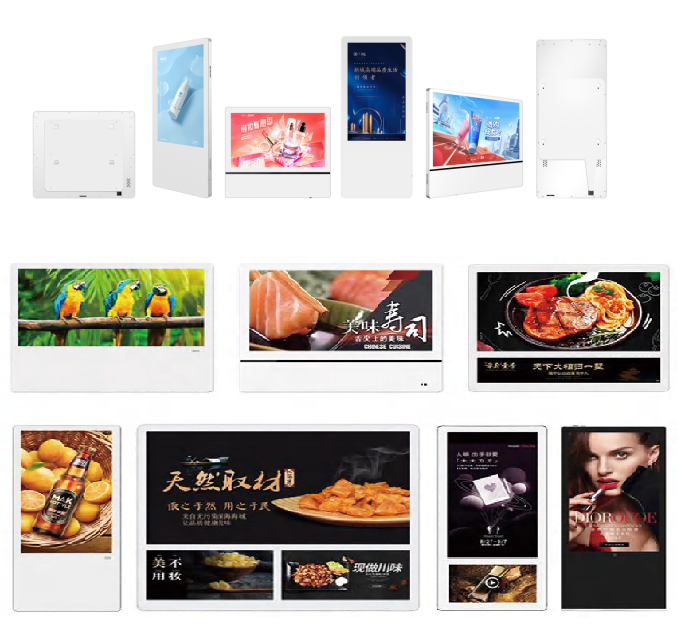
Elevator advertising displays are compact, network-connected commercial displays that still require documented electrical safety and EMC compliance for the target market.
Documented Examples of Product-Level Compliance
| Compliance record | Product example | What it covers | Market |
|---|---|---|---|
| LVD Verification, No. MK25100089P01-S01 | KD-EA Series elevator advertising machine | Electrical safety under EN IEC 62368-1:2024/A11:2024 | EU |
| EMC Verification, No. MK25100089P01-E01 | KD-EA Series elevator advertising machine | Electromagnetic compatibility under EN 55032:2015/A11:2020 and related EMC standards | EU |
| RoHS 2.0 Verification, No. MK25100089P01-C01 | KD-EA Series elevator advertising machine | Restricted hazardous substances per IEC 62321 series and Directive (EU) 2015/863 | EU |
| FCC SDoC Compliance Information Statement, No. MAX26060195P01-E01 | Listed commercial display series including KD-DH, KD-ISS, KD-VW, KD-AD and others | Electromagnetic compliance under FCC Part 15, Subpart B | United States |
| ISO 9001 Quality Management System, No. 25020021R0S | Production of intelligent display terminals and related products for export | Quality management system based on GB/T 19001-2016 idt ISO 9001:2015 | Domestic and overseas markets |
| China Compulsory Product Certification, No. 2018010901114733 | KD-OD Series outdoor advertising display and other listed display lines | Safety and EMC requirements under GB standards | China |
These records illustrate a broader procurement principle: one certificate rarely covers every market or every product family. The KD-EA Series has strong EU-focused evidence, while the KD-OD Series outdoor advertising display carries China Compulsory Product Certification. A buyer sourcing the same product family for multiple destinations should therefore ask for a compliance matrix rather than a single certificate file.
Technical Parameters That Interact with Compliance
Compliance documentation becomes easier to interpret when it is attached to realistic technical parameters. Outdoor advertising displays in the KD-OD Series, for example, are specified with 2,000 cd/m² brightness, a portrait resolution of 1080x1920, air-cooled heat dissipation and IP55 protection. Those parameters reflect the physical demands of outdoor media and transport environments, not just visual performance.
Interactive displays show a different set of constraints. The Interactive Slider Screen is specified with a brightness of 1,500 cd/m², IP55 protection and an operating temperature range of -20°C to 50°C. The Smart Conference Display supports 40 multi-touch points and runs on Android 14.0, but its rated operating environment is more typical of indoor meeting spaces. The Holographic Digital Human uses a 4K display with 3840x2160 resolution, 1,300 cd/m² brightness and HDR1,000 support, while drawing rated power of 1,100W.
These technical differences affect certification logic. A high-power digital human display used in a hotel lobby may require a different electrical installation plan than a low-power elevator display rated at no more than 55W. The compliance documents should be read together with power consumption, operating temperature, enclosure protection and mounting method.
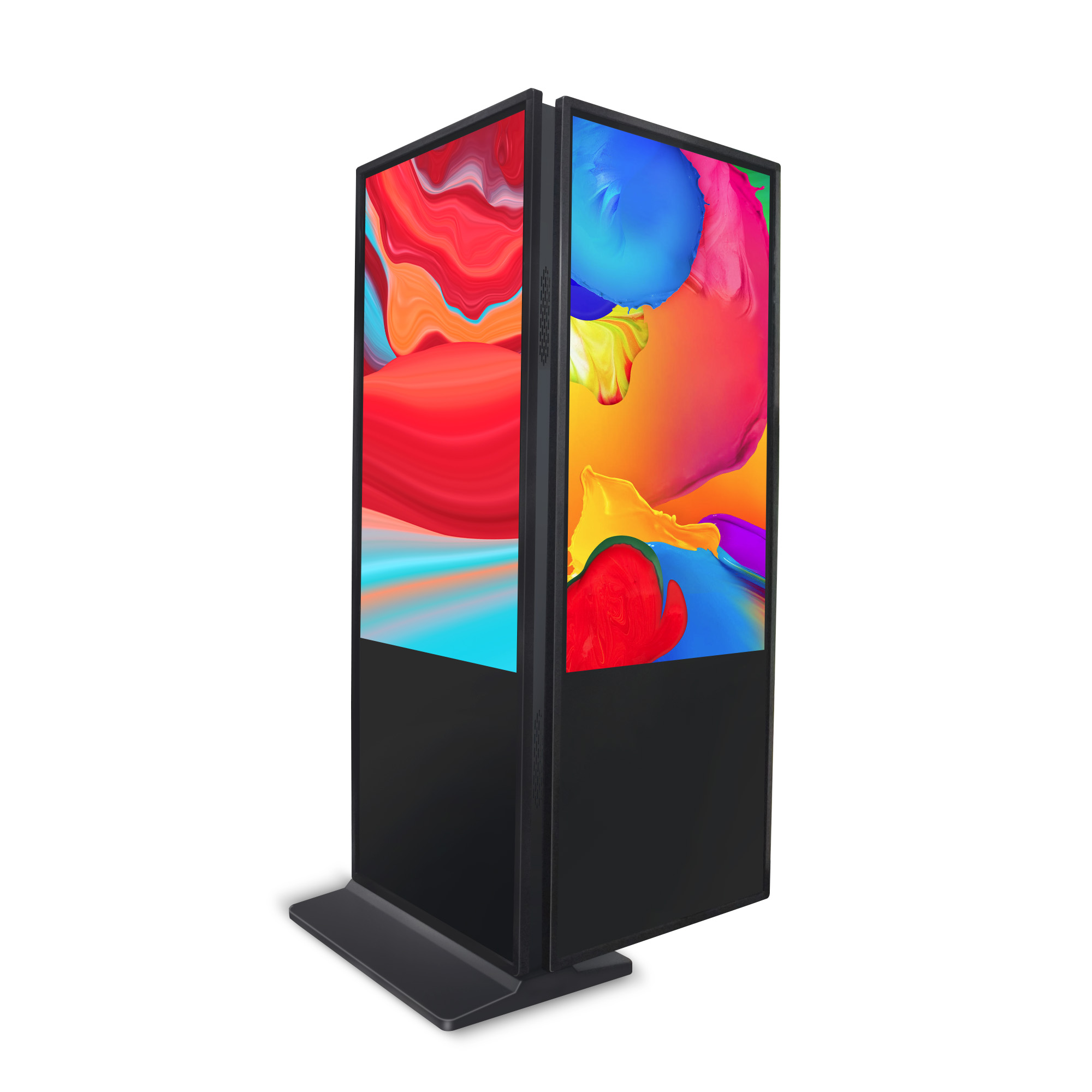
Outdoor advertising displays used in commercial districts often require a combination of high brightness, enclosure protection and market-specific compliance records.
Where Certified Commercial Displays Are Applied
Commercial display projects are not limited to advertising. The broader application set includes retail digital signage, outdoor media, smart retail, education, corporate offices, exhibitions and events, smart city and transportation projects, and industrial control environments. Each scenario places different weight on specific parameters.
- Outdoor media and smart city projects: outdoor advertising displays, dual-screen advertising machines and LED displays are selected for high brightness, continuous operation and resistance to weather exposure.
- Retail and hotel environments: wall-mounted displays and advertising displays are more common where viewing distance is shorter and indoor environmental conditions are stable.
- Corporate and education spaces: interactive conference displays support multi-touch collaboration and are evaluated for response time, software compatibility and ease of installation.
- Transport hubs and commercial districts: elevator advertising machines and compact network-connected displays are chosen for their smaller footprint and lower power draw.
- Government service centers and public facilities: self-service kiosks combine display, touch and sometimes printing functions, which expands both technical and compliance complexity.
- Exhibitions and high-visibility retail: transparent displays and holographic digital human displays are used to create a stronger visual experience, often requiring higher resolution and advanced audio or sensor integration.
For buyers, the practical implication is to map the project scenario to the right display class first, and then to filter by the compliance evidence needed for the country of installation.
Market Signals for Spec-Driven Procurement
Public market research points to continued demand for commercial display hardware. Grand View Research estimated the global commercial display market at USD 53.65 billion in 2024, with digital signage accounting for more than 53.73 percent of revenue. North America was identified as the largest regional digital signage market, holding a 35.6 percent revenue share in 2025.
More specialized categories are also expanding. Fortune Business Insights projects the holographic display market to grow from USD 5.42 billion in 2026 to USD 33.36 billion by 2034 at a CAGR of 25.52 percent. Global Market Insights estimated the transparent display market at USD 2.84 billion in 2023, with long-term growth expectations linked to augmented reality integration. These figures do not all use the same definitional boundaries, but they consistently point to demand for differentiated display technologies.
Differentiation creates a sourcing risk. When buyers are less familiar with newer product categories such as AI digital humans or transparent cabinet displays, they may rely too heavily on visual claims and not enough on standard-based evidence. That is one reason why commercial display compliance, rather than raw specification alone, is becoming a more important buying criterion.
Certified Manufacturer Displays vs. Assembled Alternatives
Compared with buying consumer displays or locally assembled screen systems, purchasing from a certified commercial display manufacturer offers clearer traceability. The buyer receives product-level documentation, factory-level quality control and a more direct channel for technical questions during installation. In GZKEDRO’s manufacturing model, this includes 100 percent aging tests and functional inspection before shipment, with brightness, waterproof, touch, temperature and continuous operation checks mentioned in its quality control process.
That model also has a realistic boundary. Certified commercial display hardware is generally less flexible than a fully custom local integration project, and compliance documentation applies to the product configuration that was tested. If a buyer changes the motherboard, enclosure or software in a significant way, the compliance status of that final device may need to be re-evaluated. Buyers should therefore plan for certification lead time when requesting customized displays, packaging or system configurations.
Limitations Buyers Should Keep in Mind
Certificate evidence does not replace engineering judgment. A display rated for IP55 protection is not designed for submersion, even if it is called a waterproof display in general industry language. Likewise, an outdoor display with high brightness may still require proper ventilation and installation conditions to perform reliably.
Another limitation concerns operating environment. The Holographic Digital Human, for example, has an operating temperature range of 0°C to 40°C and should not be treated as an outdoor industrial display. Compliance certificates confirm that the product meets defined standards under its intended conditions; they do not extend those conditions to every possible installation site.
Future Outlook: From Standalone Certificates to Product Traceability
Commercial display procurement is moving toward a more structured view of compliance. Safety standards such as IEC 62368-1 are already shaping design decisions, while EMC and RoHS requirements continue to define market access in many regions. As display categories become more specialized, buyers are likely to request a clear compliance matrix that links each product model to the target market, applicable standard and certificate number.
This shift is especially relevant for emerging display formats such as transparent displays, interactive displays and AI smart displays. Their hardware may be new, but the rules for electrical safety, electromagnetic compatibility and chemical restrictions still apply. In the future, procurement teams will increasingly treat certification data as part of the product specification, not as a separate sales document.
FAQ: Commercial Display Certification in Procurement
What is the difference between ISO9001 and product-level display certification?
ISO9001 is a quality management system certification. It confirms that a manufacturer has structured processes for production and sales, but it does not by itself prove that a specific display meets electrical safety or EMC requirements. Product-level compliance records such as LVD, EMC, RoHS, FCC SDoC or CCC are needed for market access decisions.
Which EU certifications are most relevant for commercial displays?
For the EU market, buyers commonly ask about Low Voltage Directive compliance under EN IEC 62368-1:2024/A11:2024, EMC compliance under standards such as EN 55032:2015/A11:2020, and RoHS 2.0 compliance under Directive (EU) 2015/863. These are separate documents with different purposes.
Can a commercial display certified for China be used in the EU?
Not automatically. China Compulsory Product Certification is based on Chinese national standards, while EU market access requires evidence under EU directives. Some manufacturers test the same product for both markets, but buyers should confirm that the final product configuration is covered by the correct certificate for the destination market.
How can a buyer verify a GZKEDRO display certificate?
Check the certificate number, issuing body, listed product model, standard version and market scope. Examples include EMC certificate number MK25100089P01-E01, LVD certificate number MK25100089P01-S01 and RoHS certificate number MK25100089P01-C01 for the KD-EA Series, all issued by TMC Testing Services (Shenzhen) Co., Ltd.
What specifications should buyers request for an outdoor commercial display?
For outdoor environments, buyers should verify brightness, enclosure protection, operating temperature range and power supply requirements. GZKEDRO’s KD-OD Series outdoor advertising display is specified at 2,000 cd/m² brightness, IP55 protection and an operating temperature range of -20°C to 50°C, which makes it more appropriate for exposed locations than lower-brightness indoor displays.
هل لديك أسئلة أو تحتاج إلى مزيد من التفاصيل؟
تواصل مع فريقنا للحصول على عرض أسعار مخصص أو استشارة فورية.
طلب عرض أسعار
املأ النموذج أدناه وسيتواصل معك فريقنا بعرض مقترح مخصص.
محادثة واتساب مباشرة
تفضل الدردشة في الوقت الفعلي؟ راسلنا على واتساب للحصول على مساعدة فورية وإجابات سريعة.
- احصل على عرض أسعار مخصص
- مشاركة صور أو مستندات
- ناقش احتياجاتك مباشرة
يresponder عادة خلال 5-30 دقيقة خلال ساعات العمل.