
Commercial Display Shortlist: 12 Options for Retail, Elevator, Outdoor, Conference
Commercial Display Shortlist: 12 Options for Retail, Elevator, Outdoor, Conference
A commercial display shortlist is only useful if every entry can be traced to the place where it will actually be installed. This shortlist maps twelve display models from Guangzhou Kedro Electronics Technology Co., Ltd., marketed under the GZKEDRO brand, onto the four environments that generate most buyer enquiries: retail interiors, elevator cabins, outdoor advertising positions, and conference rooms. The separating factor between the entries is rarely the largest number printed on a datasheet. It is the one specification that decides whether the unit performs at that site.
The wider context explains why this mapping work matters now. Grand View Research estimated the global commercial display market at USD 53.65 billion in 2024, with digital signage accounting for more than 53.73% of revenue share. The same research house placed North America at a 35.6% revenue share of the global digital signage market in 2025. Once a category reaches that scale, the buyer's problem shifts from "can we source a screen" to "can we match the screen to the site, the power supply, the network and the compliance file".
Guangzhou Kedro Electronics Technology Co., Ltd. is a commercial display manufacturer founded in 2013, with research and development centres in Guangzhou and Shenzhen and a 50,000 m² production facility. Its range covers commercial display screens, digital signage, interactive conference and education displays, LED screens and AI digital human displays. The company reports an export share above 80% and a documented production capability of 2,000–5,000 units per month, a 15–30 day lead time, and a minimum order quantity of 2–5 units depending on product size.
Why a Deployment-Mapped Shortlist Beats a Specification Sheet
Most display procurement failures are not component failures. They are environment failures: an indoor-rated panel installed behind a west-facing window, a screen rated for 0–40 °C installed in an unconditioned plant room, or a unit that carries the right certificate for one market and the wrong one for another. A shortlist built around deployment filters those risks before the purchase order is raised.
Five filters were applied to the GZKEDRO portfolio to produce the twelve entries below:
- Environment and ingress protection. Indoor cabinets, elevator cabins, exhibition halls and open-air positions impose different thermal, humidity and water-exposure envelopes. Documented protection ratings such as IP55 and tempered-glass construction were treated as gating criteria for outdoor and semi-outdoor use.
- Brightness against ambient light. The documented brightness range across this portfolio runs from 250 cd/m² to a white-balance brightness of at least 4,500 cd/m² for the LED series, and the correct choice depends almost entirely on how much light the location already has.
- Interaction model. Passive signage, multi-touch collaboration, sliding interaction and voice-and-camera digital human interfaces address different jobs and should not be substituted for one another.
- Compute platform and operating system. The portfolio spans RK3566, RK3288, quad-core ARM Cortex-A7, Amlogic T982, Android 14.0, and Intel Core i5 10th generation configurations. The platform determines what content and management software the site can run.
- Certification scope per market. Because certificate coverage differs by model and by market, the compliance file was checked model by model rather than assumed at portfolio level.
It is worth stating plainly what this list is not. It is a single manufacturer's portfolio shortlist for scenario matching, not a market ranking. In the large-format display market, Market Research Future identifies Samsung Electronics and LG Display as global market leaders. The twelve entries here are one supplier's range, and the comparison that follows is between models within that range.
The Twelve Options at a Glance
| Model | Product type | Shortlist-defining specification | Primary deployment fit |
|---|---|---|---|
| KD-AD Series | Indoor digital signage | 1920 × 1080, 450 cd/m², RK3566, 2 GB RAM / 32 GB ROM | Retail and indoor brand zones |
| KD-WM Series | Wall-mounted advertising machine | 1920 × 1080 with 3840 × 2160 optional, Android 14.0, 4 GB RAM / 64 GB | Malls, hotels, airports, rail stations |
| KD-TP Series | Transparent LCD cabinet | 1920 × 1080, 95% transparency, 3000:1 contrast | Luxury retail, hotel lobbies |
| KD-ISS Series | Wall sliding display | 1920 × 1080, 1,500 cd/m², IP55, optional Intel Core 5 PC | Exhibition centres, hotel lobbies |
| KD-EA Series | Elevator advertising machine | 622.5 × 343 mm, 1920 × 1080, 250 cd/m², ≤55 W | Elevator cabins, transit hubs |
| KD-OD Series | Outdoor waterproof display | 1080 × 1920, 2,000 cd/m², IP55, −20 °C to 50 °C | Transport hubs, smart city projects |
| KD-DSA Series | Dual-screen outdoor advertising machine | 1080 × 1920, 2,000 cd/m², dual-screen format | Street-level outdoor media |
| KD-LED Series | Outdoor LED screen | 2.0 mm dot pitch, ≥4,500 cd/m² white balance, ≥3,840 Hz refresh | Billboards, outdoor media networks |
| KD-IFPD Series | Interactive conference display | 40-point multi-touch, 4K-30 Hz, Android 14.0 | Corporate, education, training, government |
| KD-SSK Series | Self-service kiosk | 21.5-inch screen, Intel Core i5 10th generation, 256 GB SSD, thermal printer | Banks, hospitals, government service centres |
| KD-VW Series | LCD video wall | 55-inch 4 × 4 configuration, 3.5 mm sealing gap, 500 cd/m² | Monitoring, exhibitions, government |
| KD-DH Series | AI digital human / holographic display | 3840 × 2160, 1,300 cd/m², HDR1,000, 8-array microphone | Exhibition centres, hotel lobbies, healthcare |
Specifications as documented in the manufacturer's product data. Certification coverage differs by model and market; see the certification section below. Brightness figures are quoted in cd/m² as published, with the KD-LED figure given as white-balance brightness.
Retail and Indoor Signage: Four Options for Controlled Interiors
Indoor retail is the least punishing thermal environment in this portfolio and the most demanding in visual and operational terms. Interiors rarely need extreme brightness, but they do need design integration, long daily operating windows and a content platform the store team can actually run. Four models address that combination from different angles.
KD-AD Series — the indoor signage baseline
The KD-AD Series indoor digital signage has a 1427 mm × 802 mm display area at a 16:9 ratio, 1920 × 1080 resolution and 450 cd/m² display brightness. It runs on an RK3566 motherboard with 2 GB RAM and 32 GB ROM, with 8 ohm 10 W audio output and power consumption of ≤140 W on an AC110–240V supply. Operating ambient temperature is 0–40 °C and storage temperature is −10 to 50 °C, in an aluminium alloy and tempered-glass housing.
It earns its place on the shortlist because 450 cd/m² gives meaningful headroom over lit retail interiors without moving into outdoor-class power draw. The documented application environments include commercial districts, airports, railway stations, shopping malls and hotels, which is exactly the band where a fixed-content brand zone is most common.
KD-WM Series — wall-mounted display with the widest indoor envelope
The KD-WM Series wall-mounted advertising machine uses a BOE LCD panel with direct-lit LED backlight. Resolution is 1920 × 1080 with 3840 × 2160 available as an option, brightness is 350 cd/m², contrast is 3000:1, and colour depth is listed at 1.06B (10-bit) with a 178° viewing angle. Internally it runs a quad-core Cortex-A7 with 4 GB DDR3 and 64 GB eMMC storage on Android 14.0, with RJ45 networking, 8 ohm 10 W dual-channel audio and total power of ≤180–230 W.
Two details put this model on the list rather than its sibling. First, the operating range of −10 to +50 °C with 10–98% humidity is the widest documented environmental envelope among the indoor LCD options here. Second, the optional 3840 × 2160 panel and Android 14.0 platform mean the same mechanical format can serve a standard mall installation and a higher-resolution brand wall without a second product line.
KD-TP Series — transparent cabinet for merchandise-led retail
The KD-TP Series transparent LCD display places a 1430 mm × 805 mm panel inside a 1585 mm × 972 mm × 300 mm cabinet at 1920 × 1080 resolution, 3000:1 contrast, 16.7M display colours and 8 ms response. Its defining figures are 95% transparency and 95% brightness uniformity, with a full 178° horizontal and vertical viewing angle. The cabinet uses tempered glass and acrylic, runs on a 24V/100W supply fed by AC100–240V 50/60 Hz, and operates between 0 °C and 60 °C.
This is the only format in the portfolio that puts a moving image in front of a physical product without hiding it. The documented deployment environments — luxury retail stores, hotels and commercial districts — reflect that use case. The trade-off is discussed in the limitations section: transparency and emissive brightness pull in opposite directions, and the published brightness figure of ≥380 cd/m² is well below the indoor and outdoor units ranked above it.
KD-ISS Series — interactive slider screen for exhibitions and lobbies
The KD-ISS Series wall sliding display delivers 1920 × 1080 at 1,500 cd/m² — the highest brightness among the indoor LCD options on this shortlist — with 3000:1 contrast, 6 ms response and 178°/178° viewing. The base configuration runs RK3288 with 2 GB RAM and 16 GB ROM, while an optional PC version uses an Intel Core 5 processor with 8 GB RAM and a 120 GB SSD. Networking covers RJ45 10M/100M, 802.11b/g/n Wi-Fi and Bluetooth 4.0. An industrial fan provides air-cooled heat dissipation, the unit is rated IP55, operating temperature spans −20 °C to 50 °C at 10–90% RH without condensation, total system power is ≤180 W and standby draw is under 5 W.
Sliding interaction is a specific format decision rather than a general upgrade, and it fits exhibition centres, hotel lobbies and commercial districts where a screen must physically reveal or align with a display behind it. The IP55 rating and the −20 °C operating floor also make it usable in semi-outdoor covered areas that would rule out a standard indoor panel.
Elevator Cabins: The KD-EA Series and the Vertical Transit Position
Elevator screens have three hard constraints that rarely appear together elsewhere: a very small installation volume, continuous unattended operation, and exposure to incidental impact. The KD-EA Series elevator advertising machine is built against those constraints. Its display measures 622.5 mm × 343 mm at 1920 × 1080 resolution with 16.7M (8-bit) colour and a 60 Hz refresh rate at 250 cd/m² brightness, behind 4 mm fully toughened high explosion-proof glass. Backlight life is documented at more than 50,000 hours.
The control platform is a quad-core ARM Cortex-A7 clocked at 1.2 GHz with 1 GB DDR3 memory and 8 GB storage, decoding up to 1080P at 60 fps, with left and right channel output through 2 × 10 W speakers, USB-based system upgrade, two USB ports and one RJ45 port. Input power is 100–240V at 50/60 Hz with power consumption of ≤55 W and standby consumption of ≤0.5 W. Operating temperature is 0–60 °C at 10–75% RH, storage temperature is 15–45 °C, and the unit is specified for altitudes below 5,000 metres.
The compliance record is the reason this model is easy to shortlist for export projects. In the EU market it is covered by an LVD verification (number MK25100089P01-S01) under EN IEC 62368-1:2024/A11:2024, an EMC certificate (number MK25100089P01-E01) under EN 55032:2015/A11:2020 and related standards, and a RoHS 2.0 certificate (number MK25100089P01-C01) under the IEC 62321 series and Directive (EU) 2015/863 — all three issued by TMC Testing Services (Shenzhen) Co., Ltd. For the China market it is covered by inspection report number JAT2207030268CN-01 from Dongguan Junan Testing and Certification Co., Ltd. under GB4943.1-2022 and enterprise technical requirements, and by CQC Intime test report number 20220501W12358 under GB4943.1-2011.
The boundary is brightness. At 250 cd/m² this is an indoor cabin display, and it should not be substituted into a glazed or open-air position where 2,000 cd/m² class units are specified.
Outdoor Positions: KD-OD, KD-DSA and KD-LED
KD-OD Series — outdoor waterproof display
The KD-OD Series outdoor advertising display is specified at 1080 × 1920 resolution across a 680.4 mm × 1209.6 mm display area at a 0.630 mm × 0.630 mm pixel pitch, with 2,000 cd/m² brightness, 3000:1 contrast, 6 ms response and 178°/178° viewing angles. It runs an RK3288 quad-core Cortex-A17 at 1.8 GHz with Mali-T764 graphics, 2 GB RAM and 16 GB storage, with RJ45 10M/100M adaptive networking, 802.11b/g/n Wi-Fi, Bluetooth 4.0 and HDMI OUT, LAN, USB, TF card and SIM card interfaces. An air-cooled industrial fan handles heat dissipation, the protection level is IP55, and the front glass is tempered. Power input is 100–240V at 50/60 Hz with total power of ≤500 W and standby below 5 W, operating from −20 °C to 50 °C at 10–90% RH non-condensing.
This model holds China Compulsory Product Certification (3C), certificate number 2018010901114733, issued by China Quality Certification Center (CQC) under standards including GB17625.1-2012, GB4943.1-2011, GB/T9254-2008 (Class A), GB8898-2011 and GB/T13837-2012. For buyers working in transport hubs, commercial districts and smart city projects, the combination of a 2,000 cd/m² panel, an IP55 rating and an air-cooled thermal path is what makes it defensible in a fixed outdoor position.
KD-DSA Series — dual-screen outdoor advertising machine
The KD-DSA Series carries the same display platform as the KD-OD — 1080 × 1920, 2,000 cd/m², 3000:1 contrast, 6 ms, 178°/178°, RK3288 with 2 GB RAM and 16 GB storage, the same interface set and a ≤500 W total power envelope with standby below 5 W — in a dual-screen outdoor format with a tempered glass and aluminium alloy housing. It appears on the United States FCC SDoC product list for this portfolio.
Its shortlist logic is purely positional: where one face of a street unit would be wasted, a dual-screen machine doubles sellable surface without doubling the number of installations, poles or power feeds.
KD-LED Series — outdoor LED screen for large-area media
The KD-LED Series is a different technology class and should be judged on its own metrics. It uses surface-mount 3-in-1 Ruisheng LED packaging in a 1R1G1B pixel composition with a 2.0 mm dot pitch, 128 × 64 dot module resolution and 320 mm × 160 mm × 17 mm modules driven at 1/16 scan with constant current. White balance brightness is at least 4,500 cd/m², colour temperature spans 3,000–18,000K, brightness uniformity is at least 97%, colour uniformity is ±0.003 Cx/Cy, pixel density is 160,000 dots/m², frame rate is 60 Hz and refresh rate is at least 3,840 Hz. Average power is 235 W/m² and maximum power is 469 W/m², with leakage current to ground of ≤3.5 mA/m². Viewing angles are H≥160° and V≥140°.
For outdoor media, smart city signage and billboards, the >3,840 Hz refresh rate is the specification that keeps the screen clean on camera, and the ≥4,500 cd/m² white balance output is what allows legibility in direct daylight that an LCD-based outdoor unit cannot match.
Conference and Collaboration Rooms: KD-IFPD Series
The KD-IFPD Series smart conference display is specified with support for 40 multi-touch points, a 4K-30 Hz frame rate, 350 cd/m² brightness and 8 ms response time over a 30,000-hour service life. It runs Android 14.0 on an Amlogic T982 quad-core Cortex-A5 processor with 100–240V input and rated power consumption of ≤250 W, and audio is delivered through twin 8Ω/15W built-in speakers.
Connectivity is deliberately plain: one HDMI IN, one PC USB 3.0, three ALL USB 3.0 ports, one TOUCH USB Type A, and front-panel buttons for HOME, ECO, volume, menu, source and separate TV and PC power. Operating temperature is 0–40 °C with storage from −20 °C to 55 °C, and the interface supports more than ten languages including Simplified Chinese and English. Corporate offices, educational institutes, training centres and government offices are the documented environments.
Forty simultaneous touch points is the figure that distinguishes this unit in the shortlist: it supports multi-person work at the screen rather than a single presenter controlling a shared display, which is the difference between a meeting room screen and a collaboration surface.
Self-Service and Inquiry Points: KD-SSK Series
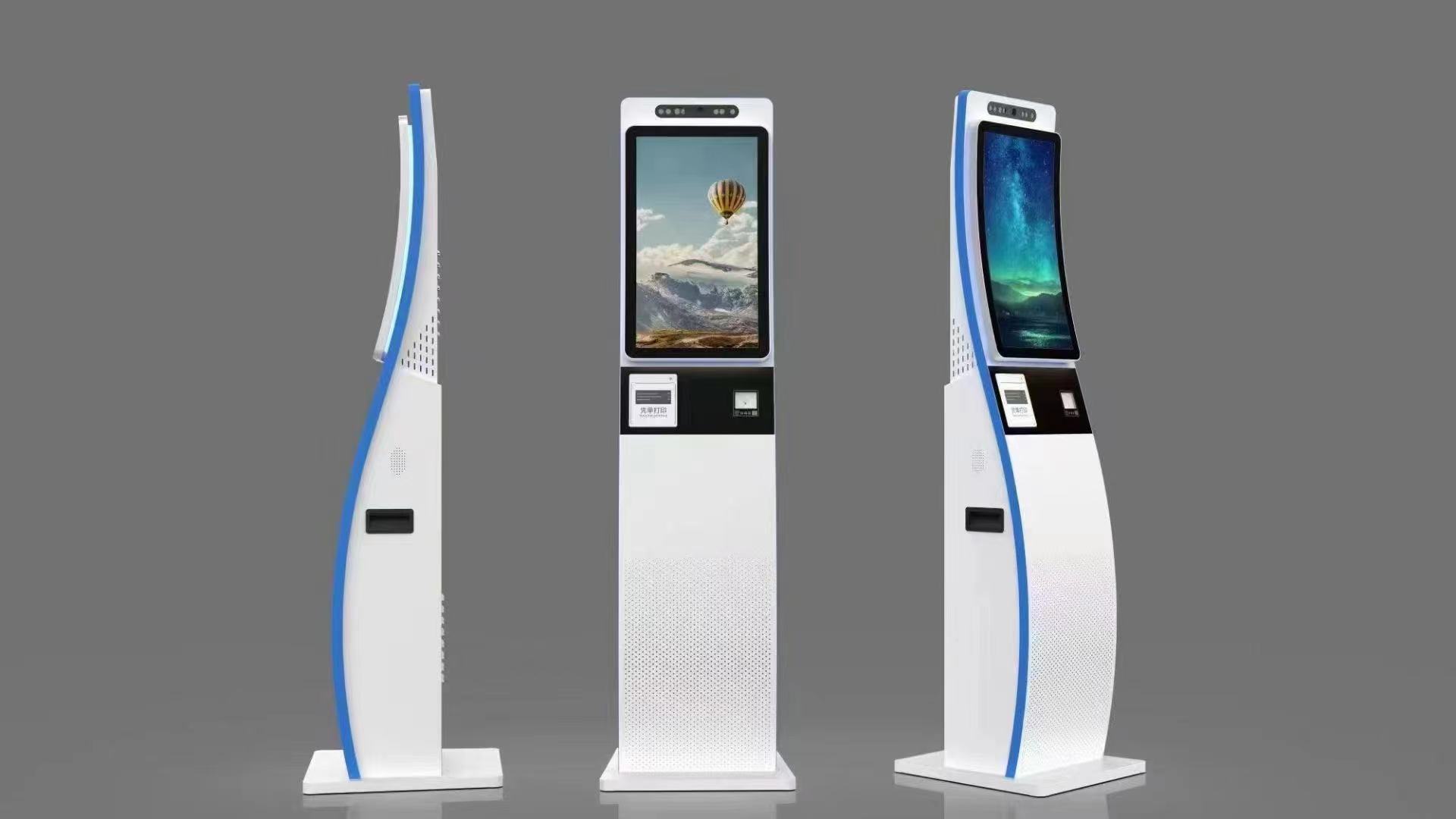
KD-SSK Series self-service kiosk: 21.5-inch touch display with vibration sensing, integrated E80I thermal printer and Intel Core i5 10th generation processing.
The KD-SSK Series self-service kiosk uses a 21.5-inch screen in an overall unit of 1531.18 mm × 370 mm × 50 mm, with a 473 mm × 270 mm display area at 350 cd/m² brightness, 178°/178° viewing angles, 16.7M colours and 6 ms response. Touch input is delivered by a vibration sensor. The computing platform is a Core i5 10th generation processor (4M cache, 3.90 GHz) with 8 GB DDR3 memory, a 256 GB SSD, Wi-Fi, GigaLAN, four USB 3.0 ports and HDMI, drawing ≤220 W. Twin 2 × 5 W speakers and an E80I thermal printer are integrated, and the aluminium chassis operates from 0 °C to 50 °C at 20–80% humidity.
What places it on the list is the combination of a desktop-class Intel processor with an integrated printer and industrial-grade thermal tolerance. Hospitals, banks, airports, railway stations, government service centres and shopping malls are the documented deployment environments — all locations where a queue-management or document-issuing workflow needs local computing rather than a thin client.
Large Format and Immersive Formats: KD-VW and KD-DH
KD-VW Series — LCD video wall
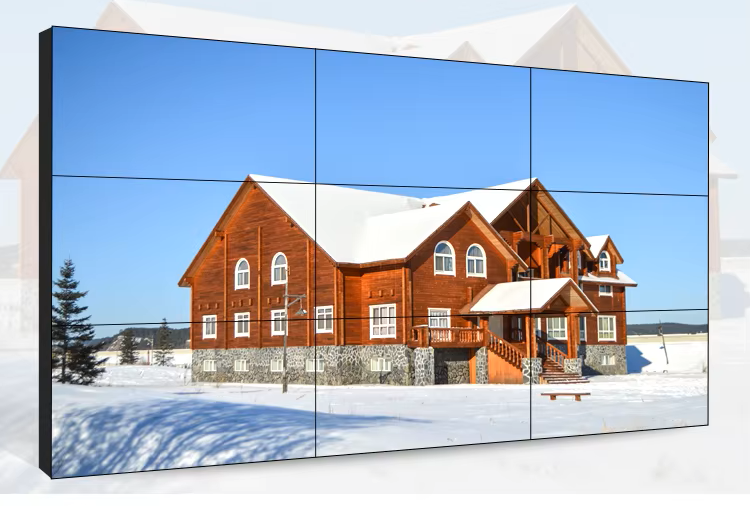
KD-VW Series LCD video wall: 55-inch 4 × 4 configuration with a 3.5 mm sealing gap, hydraulic bracket mounting and DVI, HDMI and VGA inputs.
The KD-VW Series is documented as a 55-inch 4 × 4 LCD video wall with single-screen dimensions of 1211.5 mm × 682.3 mm and a 3.5 mm sealing gap. Resolution is 1920 × 1080 per panel at 500 cd/m² brightness, 4000:1 contrast and 178° horizontal and vertical viewing angles, with DVI, HDMI and VGA inputs. The structure uses industrial LCD panels in a metal frame with a hydraulic bracket. The product is covered by Computer Software Copyright Registration number 2018SR734639 issued by the National Copyright Administration of China, and it received the 2024 Annual Innovation Technology Award from the Guangzhou Sign Industry Association for the Guangdong region.
Two numbers decide whether this belongs on a shortlist: the 3.5 mm sealing gap and the 4000:1 contrast. Monitoring suites, exhibitions, government facilities and shopping malls are the documented environments, and in all four the visible bezel is usually the objection that kills a video wall proposal.
KD-DH Series — holographic digital human display
The KD-DH Series AI digital human is the most optically specialised entry on the list. It presents 3840 × 2160 resolution across a 1649 mm × 927 mm display at 16:9, with 1,300 cd/m² brightness, 320 local dimming zones, a physical contrast ratio of 3000:1 and HDR1,000 support. Its optical trade-off is explicit in the data: 30% light transmittance and 60% reflection, with minimum viewing angles of 79° left and right and 79° up and down. Interaction is handled through 60 W speakers on 2.1 channels, an 8-array microphone and a 5 MP driverless camera. Input is AC 100–240V at 50/60 Hz with rated power consumption of 1,100 W, operating between 0 °C and 40 °C at 10–85% RH without condensation.
Exhibition centres, hotel lobbies, commercial districts, education and healthcare are the documented environments. The shortlist argument is that this format introduces a conversational interface rather than another passive panel, and the microphone array and driverless camera are the components that make that possible without additional peripherals.
Certification as a Shortlist Filter
In this category, the compliance file is a functional specification. IEC 62368-1 is the primary safety standard for audio-visual and IT equipment, having replaced the legacy IEC 60950-1 and IEC 60065 standards according to UL Solutions — and the GZKEDRO EU LVD verification for this portfolio cites EN IEC 62368-1:2024/A11:2024, which is consistent with that transition rather than lagging behind it.
Coverage across the twelve models is not uniform, and this is the single most useful thing a buyer can check before shortlisting:
- FCC SDoC — certificate number MAX26060195P01-E01, issued by MAXLAB Testing Co., Ltd under FCC Part 15, Subpart B, ANSI C63.4:2014 for the United States market and issued on 30 June 2026. Its product list covers all twelve models discussed here, including the KD-DSA Series and the KD-DH Series.
- EU LVD, EMC and RoHS — verification MK25100089P01-S01 (LVD, EN IEC 62368-1:2024/A11:2024), MK25100089P01-E01 (EMC, EN 55032:2015/A11:2020 and related standards) and MK25100089P01-C01 (RoHS 2.0, IEC 62321 series and Directive (EU) 2015/863), all from TMC Testing Services (Shenzhen) Co., Ltd. The linked product list covers ten models: KD-AD, KD-VW, KD-TP, KD-IFPD, KD-LED, KD-WM, KD-OD, KD-EA, KD-ISS and KD-SSK.
- China Compulsory Product Certification (3C) — certificate number 2018010901114733 issued by China Quality Certification Center (CQC), applying to six models: KD-AD, KD-LED, KD-IFPD, KD-TP, KD-VW and KD-OD.
- ISO 9001 — certificate number 25020021R0S issued by Beijing Zhengbiao Lianxin Certification Service Co., Ltd. under GB/T 19001-2016 idt ISO 9001:2015 for domestic and overseas markets, with a product list of nine models including KD-ISS, KD-IFPD, KD-SSK, KD-LED, KD-WM, KD-AD, KD-OD, KD-VW and KD-TP.
The practical instruction for procurement teams: match the certificate to the exact model and the exact destination market. A portfolio-level statement of compliance is not the same as a model-level certificate, and the lists above differ by market and by model within the same supplier's range.
Where the Shortlist Stops: Boundaries and Trade-offs
A shortlist that only lists strengths is not a shortlist. These are the documented boundaries that should shape the final selection.
- Brightness caps the environment, not the product tier. The KD-EA Series at 250 cd/m² is an indoor elevator cabin display. The KD-WM Series at 350 cd/m² and the KD-IFPD Series at 350 cd/m² are interior units. The KD-OD and KD-DSA Series at 2,000 cd/m² and the KD-LED Series at ≥4,500 cd/m² white balance are the outdoor tier. Installing a 250 cd/m² unit in a glazed outdoor position will not be rescued by content design.
- Transparency costs emitted brightness. The KD-TP Series delivers 95% transparency, but its published brightness of ≥380 cd/m² sits below the 450 cd/m² of the KD-AD Series and far below the outdoor units. In a sunlit storefront the perceived contrast falls, so ambient light control — not the panel specification — becomes the deciding factor. The KD-DH Series shows the same physics from another direction, documenting 30% light transmittance and 60% reflection.
- IP55 is not a submersion rating. The outdoor and semi-outdoor models here are documented at IP55, which addresses dust ingress and water projected by a nozzle, not continuous immersion. Project requirement data in this category records IP65 waterproofing as a special requirement for certain outdoor deployments, so sites that specify IP65 must have the rating confirmed against the specific model and enclosure rather than assumed from the family.
- Electrical planning is not optional. KD-LED Series average power is 235 W/m² with a maximum of 469 W/m², and the KD-DH Series is rated at 1,100 W. Sites planning a large-format or digital human installation should size circuits from these figures, not from the display area.
- Order economics favour staged rollouts. A minimum order quantity of 2–5 units depending on product size is flexible, but a 15–30 day lead time (30 days maximum) means multi-site deployments should be phased with the production schedule rather than launched in a single wave.
- The real comparison is against static signage. Printed or vinyl signage carries no electrical load, no network dependency, no content operations and no firmware lifecycle. Every option on this list trades those costs for motion, remote management and measurable engagement. Buyers comparing commercial displays with traditional signage should compare total operational shape — power, connectivity, content staffing and certification maintenance — rather than purchase price alone.
What the Market Data Suggests
Category growth does not select a model, but it does indicate which formats are being specified. Alongside the USD 53.65 billion 2024 commercial display market and the 53.73% digital signage revenue share reported by Grand View Research, the same research house estimated the industrial display market at USD 5.90 billion in 2024, driven by IIoT and HMI device penetration — the demand pattern that sits behind control-room video wall specifications such as the KD-VW Series.
The specialist formats show the same directional trend. Global Market Insights valued the transparent display market at USD 2.84 billion in 2023 and projected it to reach USD 81.5 billion by 2032, while Fortune Business Insights projected the holographic display market to grow from USD 5.42 billion in 2026 to USD 33.36 billion by 2034 at a CAGR of 25.52%. Those estimates should be treated with appropriate caution: independent firms diverge, with Mordor Intelligence placing the 2026 holographic figure at USD 5.14 billion and Global Market Insights estimating USD 4.3 billion for 2025, largely because each defines the scope differently — hardware, software, or specialised medical and industrial hardware. The direction is consistent; the precise numbers are not.
Frequently Asked Questions
Which GZKEDRO commercial display models are covered by FCC, EU and China certification?
Coverage differs by market. The FCC SDoC (certificate number MAX26060195P01-E01, issued by MAXLAB Testing Co., Ltd under FCC Part 15, Subpart B, ANSI C63.4:2014, dated 30 June 2026) lists all twelve models: KD-AD, KD-LED, KD-IFPD, KD-TP, KD-VW, KD-OD, KD-SSK, KD-ISS, KD-EA, KD-DSA, KD-DH and KD-WM. The EU documents issued by TMC Testing Services (Shenzhen) Co., Ltd. — LVD MK25100089P01-S01, EMC MK25100089P01-E01 and RoHS MK25100089P01-C01 — list ten models, excluding the KD-DSA and KD-DH Series. The China 3C certificate (2018010901114733, issued by CQC) applies to six models: KD-AD, KD-LED, KD-IFPD, KD-TP, KD-VW and KD-OD.
What does an IP55 rating mean for an outdoor commercial display?
IP55 addresses two things: protection against dust ingress and protection against water projected by a nozzle from any direction. It is not a rating for continuous immersion. Within this portfolio the KD-OD Series outdoor waterproof display is documented at IP55, as is the KD-ISS Series interactive slider screen. Buyers whose project brief specifies IP65 should confirm the rating against the specific model and enclosure, because IP65 is a different test level from IP55.
How much display brightness should a buyer expect for each scenario?
The documented brightness across this portfolio maps closely to environment. Elevator cabin installation is served at 250 cd/m² (KD-EA Series). Indoor wall-mounted, conference and kiosk applications sit at 350 cd/m² (KD-WM, KD-IFPD and KD-SSK Series). The KD-AD Series indoor signage is documented at 450 cd/m², the KD-VW Series video wall at 500 cd/m², the KD-DH Series digital human at 1,300 cd/m² and the KD-ISS Series at 1,500 cd/m². Outdoor LCD units reach 2,000 cd/m² (KD-OD and KD-DSA Series), while the KD-LED Series is specified at white balance brightness of at least 4,500 cd/m².
What commercial parameters should be part of a commercial display shortlist?
For this portfolio, the documented commercial parameters are a minimum order quantity of 2–5 units depending on product size, a lead time of 15–30 days with a maximum of 30 days, and a monthly production capability of 2,000–5,000 units. Quality control is stated as 100% aging testing and functional inspection covering brightness, waterproofing, touch and temperature testing plus continuous operation testing before shipment, and after-sales support is delivered as remote technical support with 24/7 technical assistance.
Is a 95% transparent display suitable for a bright storefront?
The KD-TP Series is documented at 95% transparency with 95% brightness uniformity, 3000:1 contrast and a full 178° viewing angle, but its brightness figure of ≥380 cd/m² is lower than the 450 cd/m² KD-AD Series indoor signage and far below the 2,000 cd/m² outdoor units. A high-transparency panel behind a sunlit storefront window will therefore depend more on ambient light management and backlighting of the merchandise than on the panel specification itself. In controlled lighting — luxury retail interiors, hotel lobbies and covered commercial districts — the format's optical effect is the reason to specify it.
A full specification catalog covering the twelve models discussed here, including dimensional drawings and interface lists, is available for download: Kedro Product Catalog (English Edition). Company information is published at gzkedro.com.