
Commercial LED High Bay Procurement FAQ: Acceptance Criteria
Commercial LED High Bay Procurement FAQ: Acceptance Criteria
Warehouse lighting projects rarely fail because the fixture is not bright enough. They fail because the specified product does not match the building, or because the purchase order never pinned down the details that a delivery inspection would need to check. For buyers working on warehouses, factories and workshops, the high bay is usually the largest single lighting line item in the project — and the one most often specified from a wattage figure alone.
The size of the category is why the detail matters. Grand View Research estimated the global commercial lighting market at USD 47.54 billion in 2024, with LED products holding a 58.1% revenue share of that total. Inside that LED share, high bays sit at the point where photometric performance, installation conditions and procurement paperwork intersect: ceiling height, mounting method, dust and moisture exposure, and maintenance access all carry as much commercial weight as lumens per watt.
The procurement question behind a high bay specification
A high bay specification is really three decisions compressed into one line item. The first is form factor: does the space want a compact, downward-facing fixture, or a linear fixture that follows the geometry of aisles and racking. The second is durability class: how much protection the fixture needs against the actual working environment, not the showroom environment. The third is acceptance: what the buyer will physically check on arrival, and against which document.
Most sourcing conversations start at decision two and skip decision three. That is where disputes originate. If the purchase order says “150W high bay” and the delivery note says “150W”, both documents are technically satisfied even if the efficacy tier, colour temperature, beam distribution or mounting hardware differ from what the layout assumed.
Two form factors, two different design intentions
The HL-E01 is a UFO LED high bay light intended for industrial and commercial applications such as warehouses, factories, retail spaces and gyms. It is built around a die-cast aluminium body with a PC lens and a hollow heat dissipation structure, and it is available in 100W, 150W, 200W and 240W versions with rated voltage of 185-265V or 100-265V.
The SH-E01 is an LED linear high bay light designed for warehouses, factories and workshops, and it is specified for harsh industrial environments. It uses an aluminium alloy housing with a PC/PMMA lens, is available in 50W, 100W, 150W and 200W versions, and carries an IP65 protection rating alongside a 5-year warranty.
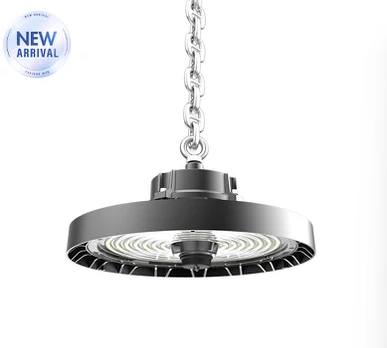
HL-E01 UFO LED high bay light: die-cast aluminium body, hollow heat dissipation structure, 100W to 240W options.
The distinction is not cosmetic. A UFO high bay concentrates the emitter in a single compact head hanging from a point, which suits open-span ceilings where the fixture is the only object in the lighting zone. A linear high bay distributes the emitter along a bar, which suits racked aisles and linear building geometry where light needs to follow a defined path rather than radiate from a point.
The manufacturer behind the two models
Zhejiang Lepeng Electric Appliance Co.,Ltd. is a manufacturer of LED lamps and LED luminaires, established in 2009, with headquarters in Baiguan Industrial Zone, Shangyu, Zhejiang, and additional production bases in Qiandaohu, Zhejiang and Jingdezhen, Jiangxi. The company operates a total factory area of 200,000 square metres and employs approximately 2,000 staff, including an R&D team of 200. Stated capacity is approximately 540 million lamps per year, equivalent to a monthly capacity of 45 million LED lamps and 5 million LED luminaires.
Commercial context matters for a buyer evaluating a high bay supplier, because the fixtures themselves are only one part of the transaction. Roughly 90% of the company’s products are exported, with major markets including the EU, Southeast Asia, the Middle East and Latin America, and its own brand MKOPTO has gained recognition in global lighting markets. The portfolio spans LED Floodlight, LED Highbay, LED Linear Highbay, LED Street Light, LED Garden Light, LED Stadium Light, LED Solar Flood Light, LED Solar Street Light, LED Solar Garden Light, LED Bulkhead, LED Tri-proof Light, LED Worklight, LED Ceiling Light, LED Ceiling Fan Light, LED Panel Light, LED Slim Batten, LED Tube, LED Bulb and LED Mood Light — relevant when a warehouse or industrial park project also needs outdoor and ancillary fixtures from the same order.
SH-E01 and HL-E01: verified specification comparison
The table below uses only the product data available for each model. Where a value is not stated for a model, it is marked as such rather than inferred, because an unstated parameter is itself a procurement action item.
| Specification | SH-E01 (linear high bay) | HL-E01 (UFO high bay) |
|---|---|---|
| Intended application | Warehouses, factories, workshops; harsh industrial environments | Warehouses, factories, retail spaces, gyms |
| Power options | 50W / 100W / 150W / 200W | 100W / 150W / 200W / 240W |
| Luminous efficacy | 100 / 135 / 150 lm/W (by configuration) | 140 / 160 / 185 / 210 lm/W (by configuration) |
| Colour temperature | 3000K / 4000K / 5000K / 6500K | 4000K / 5000K / 6500K |
| Beam angle | 90° (H) × 120° (V) | Not stated in the reviewed product data |
| Housing and optics | Aluminium alloy housing + PC/PMMA lens | Die-cast aluminium body + PC lens, hollow heat dissipation structure |
| Protection rating | IP65 | Not stated in the reviewed product data |
| Electrical | One-piece connector for easy installation | 185-265V or 100-265V; 3×1.0mm² cable, 300mm exposed leads, pre-wired to power supply; 6KV/6KV surge protection; Sosen and Moso power supplies |
| Mounting | Mounting kit surface installation or chain/cable suspension | Fixtures pre-wired for ceiling or hanging installation |
| Warranty | 5 years | Not stated in the reviewed product data |
| Dimensions | 305.6×97.3×68.1mm / 580.6×97.3×68.1mm / 855.6×97.3×68.1mm | Not stated in the reviewed product data |
Source: product specification data for the SH-E01 and HL-E01. Values marked as not stated should be requested in writing before a purchase order is issued.
Two patterns emerge from this comparison, and both have procurement consequences. First, efficacy tiers differ by configuration within a single model — 100, 135 or 150 lm/W for the SH-E01, and 140, 160, 185 or 210 lm/W for the HL-E01. A purchase order that names only wattage leaves the efficacy tier open. Second, the SH-E01 is documented for harsh industrial conditions with an explicit IP65 rating and a 5-year warranty, while the HL-E01 is documented with electrical detail — voltage range, cable construction, surge protection and driver brands — rather than environmental rating. Those two documentation profiles tell a buyer what each model was designed to answer.
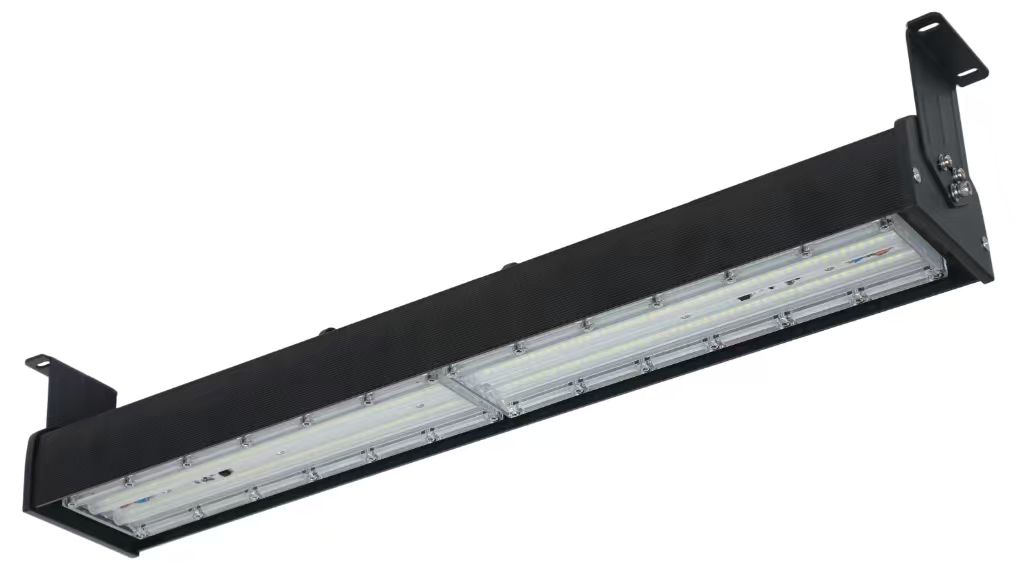
SH-E01 LED linear high bay light: aluminium alloy housing, PC/PMMA lens, IP65, 5-year warranty, 50W to 200W options.
How beam angle, colour temperature and mounting change the layout
The SH-E01 publishes a beam of 90° horizontally by 120° vertically. That asymmetric distribution is the reason linear high bays exist: the narrow horizontal plane keeps light inside a racking aisle, while the wider vertical plane covers the depth of the aisle from a high mounting point. For a warehouse with defined pick faces, this is a layout tool, not a specification footnote.
Colour temperature selection splits the two models in a way that is easy to overlook during budgeting. The SH-E01 covers 3000K, 4000K, 5000K and 6500K, so a project can mix warm white in staff areas with cooler white in the main hall using one fixture family. The HL-E01 covers 4000K, 5000K and 6500K — appropriate for industrial tasks, but without a 3000K option in the reviewed data.
Mounting is the third variable. The SH-E01 supports either a mounting kit for surface installation or chain/cable suspension, plus a one-piece connector intended to simplify installation. The HL-E01 is supplied with a 3×1.0mm² cable with 300mm exposed leads, pre-wired to the power supply — a detail that matters when the installing contractor needs to confirm junction-box practice and cable management before the fixtures arrive on site.
Application fit: warehouse, factory, workshop
In a racked distribution warehouse, the SH-E01 linear high bay is the more natural fit. Its beam geometry aligns with aisle direction, its IP65 rating suits a working environment where dust and occasional water exposure are normal, and its 50W to 200W range allows a layout to be tuned bay by bay rather than uniformly.
In a high-ceiling factory or workshop hall where fixtures hang above open floor and light must reach broadly in all directions, the HL-E01 UFO high bay is the more natural fit. Its 100W to 240W range covers large spans, its 6KV/6KV surge protection addresses the supply conditions common in industrial premises, and optional motion sensor compatibility, with a smooth 3-second brightness transition, supports lighting that responds to occupancy.
Where the two meet — mixed-use sheds with racking on one side and open work areas on the other — the sensible approach is a split layout rather than a compromise fixture. Projects that also include external areas can draw adjacent categories such as Commercial LED Flood Light, Commercial LED Street Light or Solar LED Street Light from the same supplier portfolio, which reduces the number of separate acceptance processes a buyer has to run.
Procurement terms to confirm before ordering
The following items should be written into the purchase order or its technical annex, not left to email. Each is drawn directly from what the two product specifications show as variable.
- Model, power and efficacy tier. State the model and the specific wattage, and state the efficacy tier required. “SH-E01 150W at 150 lm/W” is a purchasable line; “SH-E01 150W” is not.
- Colour temperature. Specify the CCT per area. Confirm that the chosen CCT falls within the model’s documented range — 3000K to 6500K for the SH-E01, 4000K to 6500K for the HL-E01.
- Beam and photometric data. The SH-E01 documents 90° (H) × 120° (V). Where a model’s beam angle is not stated in the reviewed data, request the distribution curve and layout file before releasing the order.
- Environmental rating. Confirm the IP requirement in writing against the location. The SH-E01 is IP65; for the HL-E01, the environmental rating should be confirmed explicitly during quotation.
- Electrical parameters. For the HL-E01, confirm the voltage version (185-265V or 100-265V), the 3×1.0mm² cable with 300mm exposed leads, the 6KV/6KV surge protection and the Sosen or Moso power supply. For the SH-E01, confirm the one-piece connector arrangement and any site-specific termination requirements.
- Mounting hardware. Specify mounting kit surface installation or chain/cable suspension for the SH-E01, and the hanging arrangement for the HL-E01, so that hardware is inside the quoted scope rather than a later variation.
- Warranty terms. The SH-E01 carries a 5-year warranty. Confirm the warranty statement in writing, including what the term covers and how claims are processed.
- Compliance evidence. Ask which standards the supplied batch is referenced against and request the documentation set with the order, not after arrival.
- Packaging, labelling and spares. Confirm carton marking, the fixture label data (model, wattage, CCT), the documentation pack, and the agreed spare quantity for the site.
Acceptance criteria at delivery
Acceptance is where a good specification is either enforced or lost. For commercial LED lighting high bays, a workable inspection sequence runs from the paperwork inward, then outward again.
- Document match. Compare the delivery note, the fixture label and the purchase order on model, wattage, CCT and efficacy tier. Any divergence should be recorded before installation begins.
- Housing and lens inspection. Check for deformation, coating defects and lens integrity. Confirm the housing material matches the specification — aluminium alloy for the SH-E01, die-cast aluminium for the HL-E01 — and, for the HL-E01, that the hollow heat dissipation structure is unobstructed.
- Wiring and termination check. For the HL-E01, verify the 3×1.0mm² cable and 300mm exposed leads and that the fixture is pre-wired to the power supply. For the SH-E01, verify the one-piece connector and the supplied mounting hardware.
- Functional test. Power on a sample from the batch and confirm output, colour consistency and stability. Where motion sensor compatibility was ordered on the HL-E01, verify the sensor response and the 3-second brightness transition.
- Marking and traceability. Record batch or serial references against the delivery so that warranty discussions later can be tied to a specific shipment.
- Documentation handover. Confirm that the compliance documents, warranty statement and installation instructions are delivered with the goods and filed with the project record.
Where these fixtures stop: limits buyers should plan around
High bays replaced high-intensity discharge fixtures in most industrial settings because they removed warm-up delay, improved maintained output and allowed finer control of distribution. That transition is broadly settled. What remains is the boundary of each product, and those boundaries are easier to plan around when they are stated plainly.
The first boundary is protection. IP65 on the SH-E01 means protection against dust ingress and against water projected by a nozzle — it is an appropriate rating for dusty warehouses and wash-down-adjacent areas, but it is not a submersion rating and should not be treated as a general “waterproof” label. For the HL-E01, the reviewed data does not state an IP rating, so a buyer specifying it for a damp or heavily dusty hall should confirm the environmental rating rather than assume it.
The second boundary is photometric transparency. The SH-E01 publishes a beam angle; the HL-E01 reviewed data does not. Where a project requires a calculated layout, the missing distribution data must be obtained before sign-off, because a UFO fixture on a point mounting produces a different coverage pattern from a linear fixture along an aisle.
The third boundary is control. Neither model’s reviewed data describes dimming protocols or networked lighting control. The HL-E01 offers optional motion sensor compatibility; that is occupancy response, not a lighting management system. Projects that require addressable control should treat it as a separate specification exercise rather than an assumed feature.
The fourth boundary is electrical environment. The HL-E01 is offered in a 185-265V version and a 100-265V version; specifying the narrower version in a market with a 100-120V supply would create a mismatch that no installation practice can correct.
Market context: why high bay specification is being audited more closely
Two market signals explain the tightening of procurement discipline. Fortune Business Insights valued the global LED lighting market at USD 109.11 billion in 2025 and projects it to reach USD 336.90 billion by 2034 — growth that shifts the centre of gravity from first-time LED conversion toward replacement, upgrade and performance verification. In a replacement cycle, the buyer already owns a lighting installation, which makes measured comparison and acceptance testing far more realistic than in a greenfield project.
The second signal is supply concentration. OEC data shows China exported USD 31.4 billion in light fixtures in 2024, representing 59.3% of total global exports. For an international buyer, that concentration is efficient — it means deep product range and competitive pricing — but it also means the specification document is the main control point. When many suppliers can quote the same headline wattage, the differentiator moves to documented parameters and to whether the delivered goods match them.
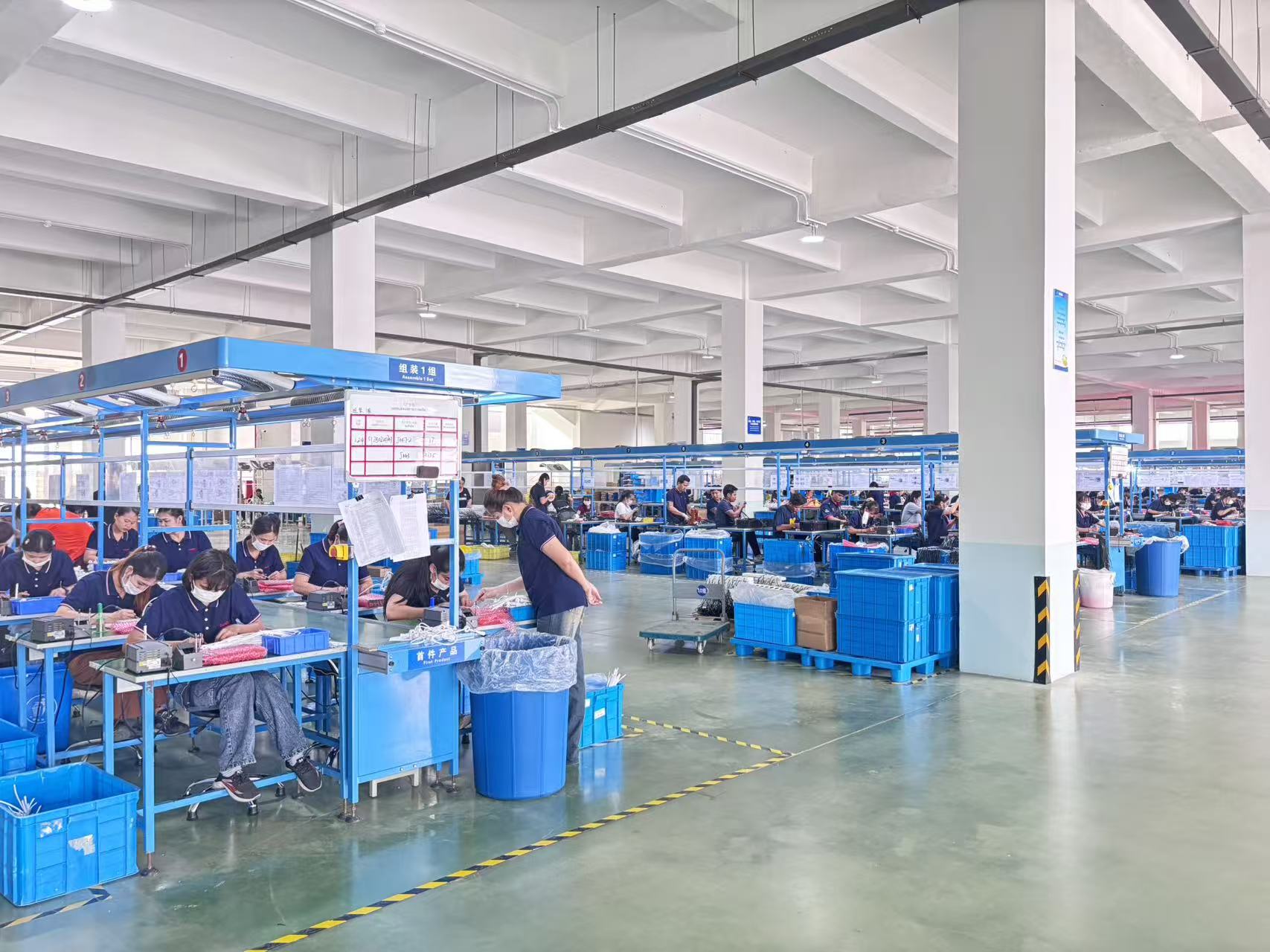
Production capacity and documentation discipline are increasingly part of the high bay procurement decision, not separate from it.
Future outlook
The next phase of warehouse lighting procurement is likely to be less about choosing a fixture family and more about documenting it. Buyers are already asking for efficacy tiers, beam data and warranty terms at quotation stage rather than after delivery, because those three items determine whether an installation meets its design intent. Suppliers that publish per-configuration data — as the SH-E01 does with its 100/135/150 lm/W tiers and 90° × 120° beam — will find the conversation easier than those that publish a single headline number.
A second shift concerns portfolio depth. Industrial sites rarely buy one category: a warehouse project may also need floodlights for yards, street lights for access roads, and tri-proof or panel fixtures for interior rooms. A supplier able to cover LED Floodlight, LED Street Light, LED Tri-proof Light and LED Panel Light alongside LED Linear Highbay reduces the number of separate acceptance processes a project manager must administer — a procurement benefit that has nothing to do with lumen output but everything to do with schedule risk.
FAQ
What is a Commercial LED High Bay Light and when does a warehouse need one?
A Commercial LED High Bay Light is a luminaire designed for high-ceiling industrial and commercial spaces where the mounting height places the fixture well above the working plane. In the Lepeng range, the SH-E01 is a linear high bay intended for warehouses, factories and workshops, and the HL-E01 is a UFO high bay intended for warehouses, factories, retail spaces and gyms. A warehouse needs a high bay specification when ceiling height, dust conditions or maintenance access make general-purpose fixtures impractical.
What is the difference between the SH-E01 linear high bay and the HL-E01 UFO high bay?
The SH-E01 is a linear high bay with an aluminium alloy housing and PC/PMMA lens, IP65 protection, a 90° (H) × 120° (V) beam, a 5-year warranty, and 50W, 100W, 150W and 200W options at 100, 135 or 150 lm/W. The HL-E01 is a UFO high bay with a die-cast aluminium body and PC lens, 100W, 150W, 200W and 240W options at 140, 160, 185 or 210 lm/W, 6KV/6KV surge protection, and Sosen and Moso power supplies. The SH-E01 is documented primarily by environmental rating; the HL-E01 primarily by electrical detail.
Which high bay fits a warehouse with very high ceilings — linear or UFO?
The choice depends on the geometry of the space rather than on ceiling height alone. A linear high bay such as the SH-E01 aligns with racked aisles and supports both mounting kit surface installation and chain/cable suspension. A UFO high bay such as the HL-E01 hangs from a point and suits open-span halls where light must spread broadly. Because the reviewed HL-E01 data does not state a beam angle, a project requiring a calculated layout should obtain distribution data for both models before deciding.
What does the IP65 rating on the SH-E01 mean in practice?
IP65 indicates protection against dust ingress and against water projected by a nozzle. For a warehouse or workshop, that covers airborne dust and wash-down-adjacent conditions, which is why the SH-E01 is described as suitable for harsh industrial environments. It is not a submersion rating, and it should not be read as a general waterproof label for areas where fixtures are immersed or continuously hosed.
Which colour temperature and beam angle should be specified for a warehouse?
The SH-E01 offers 3000K, 4000K, 5000K and 6500K with a 90° (H) × 120° (V) beam; the HL-E01 offers 4000K, 5000K and 6500K. Cooler values are typically selected for task and circulation areas in industrial halls, while warmer values serve adjacent staff spaces. The practical rule is to specify CCT per zone in the purchase order and to confirm that the selected value falls within the model’s documented range rather than assuming the full range applies to every model.
What purchasing terms should be confirmed before ordering commercial LED high bays?
Confirm the model, wattage and efficacy tier; the colour temperature per area; the beam or photometric requirement; the environmental rating against the actual location; the voltage version, cable construction and surge protection where applicable; the mounting hardware within scope; the warranty statement in writing; the compliance documentation set; and the packaging, labelling and spare quantity. For the SH-E01, the 5-year warranty and IP65 rating should appear in the order documentation; for the HL-E01, the voltage version, 3×1.0mm² cable with 300mm exposed leads, 6KV/6KV surge protection and driver brand should be stated explicitly.
What acceptance criteria should a buyer apply at delivery?
Compare the delivery note, fixture label and purchase order for model, wattage, CCT and efficacy tier; inspect housing and lens condition against the specified materials; verify wiring, termination and mounting hardware; power on a sample to confirm output, colour consistency and, where ordered, motion sensor response with the 3-second brightness transition; record batch references for traceability; and confirm that compliance documents, warranty statement and installation instructions arrive with the goods.
Which standards do buyers reference when auditing LED luminaires?
UL Solutions lists IEC 60598 for luminaires, UL 1598 as the Standard for Luminaires, and UL 8750 as the Standard for Light Emitting Diode (LED) Equipment among the core safety and performance references for LED luminaires. These standards are used as reference points when requesting documentation; buyers should ask the supplier to state which standards the supplied batch is referenced against rather than assuming conformity.
A note on documentation
The purpose of an acceptance checklist is not to slow a project down but to make the specification enforceable after the purchase order is signed. For the SH-E01, that means the IP65 rating, the 5-year warranty, the beam angle and the efficacy tier; for the HL-E01, the voltage version, the cable construction, the surge protection and the driver brand. Both are documented facts, and both are checkable.
Zhejiang Lepeng Electric Appliance Co.,Ltd. publishes further product detail for the wider range, including LED Floodlight, LED Street Light, LED Panel Light and LED Tri-proof Light, on its website at www.idealbright.com. A downloadable product brochure is available here: Lepeng Electric product brochure (PDF).
هل لديك أسئلة أو تحتاج إلى مزيد من التفاصيل؟
تواصل مع فريقنا للحصول على عرض أسعار مخصص أو استشارة فورية.
طلب عرض أسعار
املأ النموذج أدناه وسيتواصل معك فريقنا بعرض مقترح مخصص.
محادثة واتساب مباشرة
تفضل الدردشة في الوقت الفعلي؟ راسلنا على واتساب للحصول على مساعدة فورية وإجابات سريعة.
- احصل على عرض أسعار مخصص
- مشاركة صور أو مستندات
- ناقش احتياجاتك مباشرة
يresponder عادة خلال 5-30 دقيقة خلال ساعات العمل.