
Commercial LED Lighting Fit: Warehouse, Gym, Retail, Outdoor
Commercial LED lighting is normally specified from a wattage column, but wattage only describes input power. What determines whether an installation performs is scenario fit: the environment the fixture runs in, the height and beam it has to serve, the control behaviour the space requires, the ingress protection the atmosphere demands, and the maintenance interval the owner can accept. Matching fixture family to site comes before choosing a number of watts.
In commercial practice, a small number of families covers most briefs: the linear high bay, the UFO high bay, the floodlight, the indoor panel, and — for light commercial interiors — a ceiling fan with integrated lighting. Each family carries a different set of published constraints. Mismatching a family to a site is a more common cause of poor results than choosing the wrong wattage within the correct family.
Why Wattage Is an Output Figure, Not a Fit Decision
Wattage states how much power a fixture draws. Luminous efficacy — lumens per watt — converts that into delivered light output, and beam angle determines how that output is distributed across a surface. None of those three figures on its own indicates whether a fixture belongs in a wash-down production hall, a twelve-metre racking aisle, a spinning studio, or a car park perimeter.
Scenario fit answers that question through a fixed sequence of checks:
- Environment and ingress. Is the space dry and indoor, dusty, damp, or directly exposed to rain? Protection ratings decide elimination, not preference.
- Mounting geometry. Ceiling height, mounting method and beam angle together decide whether light reaches the working plane evenly.
- Control and occupancy. Continuous operation, motion sensing, dimming, timers and remote control change both energy use and the maintenance profile.
- Operating cycle. Continuous industrial operation is a different duty from intermittent occupancy in a retail unit.
- Maintenance interval and warranty. A fixture that is hard to reach must be specified for a longer service interval.
- Compliance path. The destination market determines which standards the luminaire has to satisfy.
- Only then: wattage, colour temperature and finish.
Consumables and accessories follow the same logic. Across these families the supporting equipment typically includes drivers, sensors, solar panels and batteries, and mounting brackets and accessories — all of which have to be confirmed at specification stage rather than at delivery.
Warehouse and Factory: Two High Bay Families, Two Job Descriptions
Warehouses and factories are usually treated as a single category, but they divide along environment and maintenance access. Two high bay families cover both sides of that divide, and they are not interchangeable.
Linear high bay: SH-E01, for harsh and hard-to-reach areas
The SH-E01 LED linear high bay light is an aluminium-alloy linear fixture with a PC/PMMA lens, offered from 50 W to 200 W in three body lengths (305.6 mm, 580.6 mm and 855.6 mm), with published luminous efficacy of 100, 135 or 150 lm/W depending on version. It carries an IP65 rating, a 90° (H) × 120° (V) beam angle, colour temperatures of 3000K, 4000K, 5000K and 6500K, and a five-year warranty paired with a branded driver. Mounting is either surface installation with a mounting kit or chain/cable suspension.
For procurement, the IP65 rating and the five-year warranty are the two facts that change the decision. A fixture rated IP65 is designed for dusty and wet industrial environments, which is exactly the condition that shortens the life of unprotected housings. A five-year warranty shifts risk onto the supplier for the interval in which a failed fixture in a high racking aisle is most expensive to replace.
UFO high bay: HL-E01, for output and control in clean high bays
The HL-E01 LED high bay light is a UFO-format fixture with a die-cast aluminium body and hollow heat-dissipation structure, offered at 100, 150, 200 and 240 W with published efficiency of 140, 160, 185 or 210 lm/W. It runs on 185–265 V or 100–265 V, offers 4000K, 5000K and 6500K, delivers 6KV/6KV surge protection, and is supplied with a 3×1.0 mm² pre-wired cable with 300 mm exposed leads. Power supplies are Sosen and Moso units. A motion sensor is available as an option, with a smooth three-second brightness transition.
The specification choices here differ from the linear fixture. The higher efficacy figures mean fewer fixtures for the same output target, and the 6KV surge protection matters where switching loads or grid instability are present. The motion sensor option is relevant in aisles that are intermittently occupied rather than continuously staffed.
How to choose between them
- Dust, moisture or wash-down conditions with long maintenance intervals point to the SH-E01, where IP65 and the five-year warranty are the controlling facts.
- Clean, high-ceiling space where the priority is maximum output per fixture, surge tolerance or occupancy sensing points to the HL-E01.
- Linear building geometry and continuous runs favour the linear format; point-source distribution over open floor area favours the UFO format.
- Where 3000K is required, the SH-E01 covers it; the HL-E01 range starts at 4000K.
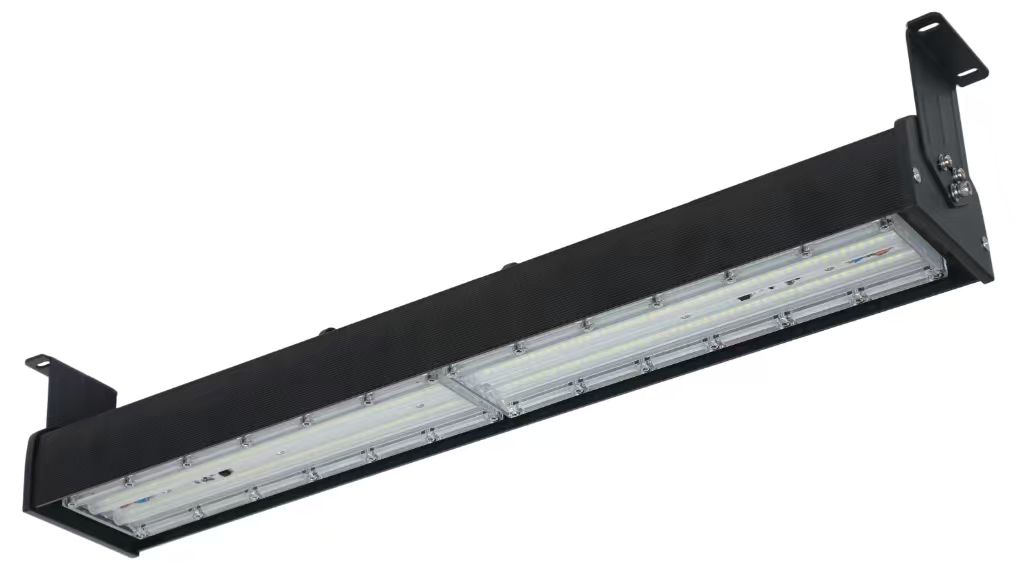
SH-E01 linear high bay: IP65 protection, 50–200 W, 90° × 120° beam, five-year warranty.
Gym and Retail: Where Colour Temperature and Occupancy Control Decide
Gyms and retail spaces are commercial interiors with high ceilings but clean atmospheres. In the SH-E01 and HL-E01 pairing, the practical split is usually decided by colour temperature and control rather than by environment.
Gym floors combine large open volumes with intermittent occupancy across zones. The HL-E01 is specified by its manufacturer for warehouses, factories, retail spaces and gyms, and its optional motion sensor — with a three-second brightness transition — suits areas that empty between sessions. The 4000K, 5000K and 6500K options cover the neutral and cooler tones typically requested in training areas.
Retail adds a second requirement: ambience. Where a warmer tone is specified, the SH-E01 covers 3000K, which the HL-E01 range does not. That single fact often decides the family in retail fit-outs, even where the UFO format would deliver more lumens per fixture.
Both fixtures are suspended or surface mounted at height, so installation method has to be confirmed early — the SH-E01 offers a mounting kit or chain/cable suspension, and the HL-E01 is supplied pre-wired for direct connection.
Indoor Commercial and Light Commercial: Panel and Ceiling Fan Light
Below the high bay ceiling, specification changes character. Offices, clinics, small retail units, meeting rooms and covered terraces need low-profile fixtures with adjustable tone and simple control, not high-output industrial housings.
PL02 LED panel light
The PL02 LED panel light is a surface-mounted or recessed ceiling panel in round and square formats at 5, 8 and 12 inches, with power options of 9, 12, 18 and 24 W and published efficacy of 90 or 110 lm/W. It provides 3-CCT selectable colour temperature from 2700K to 6000K, three-level dimming at 50%, 75% and 100%, remote control, and a built-in microwave sensor for automatic on/off. Mounting is flexible — surface or recessed, with adjustable sliding hole spacing — and the quick-connect interface shortens installation and removal time.
The 3-CCT and dimming combination is the procurement-relevant fact: one SKU can serve multiple room types in the same building, which simplifies stocking for distributors and simplifies handover for contractors.
FCL-E01 LED ceiling fan with light
The FCL-E01 LED ceiling fan with light is a flush-mount combination unit for residential and light commercial interiors: 24 W of lighting at 1800 lm, fan power of 16, 24 or 30 W, selectable 3000K/4000K/6500K plus full-colour RGB mixing, four preset scene modes, a skylight mode that simulates natural sky ambience, three fan speeds with forward and reverse rotation, remote control, a 2H/4H auto-off timer, and three sizes of 36, 42 and 52 inches (φ910, 1060 and 1320 mm).
Its role in a commercial brief is specific: low-ceiling spaces where air movement and lighting are both required and two separate fixtures would be impractical. The flush-mount profile and one-piece connector suit retrofits in cafés, salons and small hospitality units.

FCL-E01 in a light commercial interior: combined lighting, RGB mood setting and air movement in one flush-mount unit.
Outdoor and Security: Floodlight Plus PIR Solar
Outdoor briefs split into two very different problems: illuminating a large exterior surface from a mains supply, and securing a location where running cable is uneconomical.
FL-C01 Series LED floodlight
The FL-C01 Series is an outdoor LED floodlight in an aluminium and glass housing, spanning 10 W to 300 W across a dimensional range from 105×97×27 mm to 500×457×49 mm. Published specifications include 100–240 V or 220–240 V input, efficiency of 100 or 120 lm/W, colour temperatures of 3000K, 4000K and 6500K, surge protection up to 2KV, and a power factor above 0.9. A strong bended bracket supports installation, and the manufacturer lists residential, commercial and manufacturing applications.
The wide wattage span is the operational advantage: one family covers facade lighting, yard lighting, loading areas and signage, which reduces the number of product families a distributor has to hold. Surge protection up to 2KV and a power factor above 0.9 are the two figures most relevant to sites with inductive loads or long cable runs.
Solar security light with PIR motion sensor
The solar security light with PIR motion sensor is a self-contained unit rated 10 W with 1600 lm output at 6500K, measuring 198×130×193.1 mm and rated IP44. It uses a high-transmittance monocrystalline silicon panel, an ABS housing and a PC lens, and offers a PIR passive-infrared motion sensor, remote control with 1H/2H/4H timer options and an auto mode, plus an adjustable angle for multi-directional lighting. The separate installation design allows the solar panel and light head to be mounted apart, and an extension cable is included. No wiring is required.
For security applications — yards, driveways, garages, pathways and walls — the PIR sensor is the deciding function. The light operates on detection rather than continuously, which is consistent with off-grid operation and with the night-time automatic control mode used across this product range.
Scenario Fit Matrix
The table below maps the five families to their published facts and to the boundary that limits each one.
| Scenario | Recommended family | Published facts that drive the choice | Boundary to plan for |
|---|---|---|---|
| Warehouse and factory, dusty or damp, long maintenance interval | SH-E01 linear high bay | IP65, 50–200 W, up to 150 lm/W, 3000–6500K, five-year warranty, surface or suspended mounting | Fixed 90° × 120° beam; not positioned as a narrow-beam spotlight |
| Warehouse, factory, retail, gym — clean high ceiling | HL-E01 UFO high bay | 100–240 W, up to 210 lm/W, 4000–6500K, 6KV/6KV surge protection, optional motion sensor | Colour temperature range starts at 4000K; no 3000K option |
| Retail and gym where a warmer tone is specified | SH-E01 linear high bay | 3000K available alongside 4000K, 5000K and 6500K | Linear form factor suits runs rather than open-area point lighting |
| Office, clinic, small retail, meeting rooms | PL02 LED panel light | 9–24 W, 90/110 lm/W, 2700–6000K 3-CCT, 50/75/100% dimming, microwave sensor, IP20 | IP20 — dry indoor locations only |
| Low-ceiling hospitality, café, salon | FCL-E01 ceiling fan with light | 24 W light at 1800 lm, 3-speed forward/reverse fan, RGB and skylight modes, timer, 36/42/52 inch | Residential and light commercial positioning, not industrial duty |
| Facade, yard, loading area, signage | FL-C01 Series floodlight | 10–300 W, 100/120 lm/W, 3000–6500K, surge protection up to 2KV, PF above 0.9 | Mains-powered; cable routing and supply capacity must be available |
| Remote security where cable is uneconomical | Solar security light with PIR | 10 W, 1600 lm, 6500K, IP44, PIR sensor, separate panel mounting, no wiring | Fixed 1600 lm output and IP44 rating — supplemental security lighting, not primary area lighting for large sites |
What the Market Data Says About Scenario Demand
The commercial lighting market was estimated at USD 47.54 billion in 2024, with LED products holding a 58.1% revenue share, according to Grand View Research. At the wider level, Fortune Business Insights values the global LED lighting market at USD 109.11 billion in 2025 and projects USD 336.90 billion by 2034. Both figures describe a market that has already converted its core volume to LED, which changes what buyers are comparing: not LED versus non-LED, but which LED family fits which space.
Outdoor categories show the same pattern with a different growth curve. IMARC Group reports the global LED flood light market at USD 9.4 billion in 2025, forecast to reach USD 20.1 billion by 2034 at a CAGR of 8.52%. Vantage Market Research projects the global solar street lighting market reaching USD 22.5 billion by 2030 at a 15.8% CAGR from 2024 — a growth rate consistent with the off-grid logic behind solar security products.
Supply side, the Observatory of Economic Complexity reports that China exported USD 31.4 billion in light fixtures in 2024, equal to 59.3% of global exports. For buyers, that concentration means the practical question is not whether Chinese suppliers can deliver a fixture, but how to distinguish between them on specification, documentation and supply continuity.
LED Versus Conventional Sources — and Where Selection Stops
The comparison with conventional sources is well established at the category level. Conventional high-intensity discharge and fluorescent systems generally require lamp replacement over the asset life, and HID sources typically need a restrike period after a power interruption. LED fixtures in this range are specified with driver-based operation, published efficacy figures and, in the case of the SH-E01, a five-year warranty — which converts lamp replacement into a warranty conversation rather than a maintenance schedule. Motion sensing, dimming and timers are available as integrated options rather than as add-on controls.
That comparison has a clear boundary, and it matters more than the advantages.
Limitation to plan for: published fixture data — efficacy, beam angle, protection rating, warranty — describes the product, not the installation. The SH-E01 is offered with a fixed 90° (H) × 120° (V) beam, so projects that require very narrow concentration on tall racking need a different optical solution. Likewise, the PL02 panel carries an IP20 rating and belongs in dry indoor locations only, and the solar security light has a fixed 10 W / 1600 lm output with IP44 protection, which makes it a security and supplement solution rather than a substitute for mains floodlighting across a large yard. A lighting design and illuminance calculation for the actual layout remains necessary regardless of which family is selected.
Compliance is a second boundary. Core safety and performance standards for LED luminaires include IEC 60598, UL 1598 and UL 8750, as listed by UL Solutions. These standards define the framework; they do not confirm that a specific product variant is certified for a specific destination market. That confirmation belongs to the procurement process, not to the catalogue.
How the Fixtures Map to a Supplier Brief
Zhejiang Lepeng Electric Appliance Co.,Ltd. is a LED lamp and luminaire manufacturer founded in 2009, headquartered in the Baiguan Industrial Zone, Shangyu, Zhejiang Province, with additional production bases in Qiandaohu, Zhejiang and Jingdezhen, Jiangxi. The company reports a 200,000 m² factory footprint, 2,000 employees, a 200-person R&D team, monthly capacity of 45 million LED lamps and 5 million LED luminaires, and an annual output of 540 million lamps. It exports approximately 90% of production to the EU, Southeast Asia, the Middle East and Latin America, and operates its own MKOPTO brand alongside OEM/ODM work. Lead time is stated at 30–45 days, and after-sales support is provided remotely.
For a scenario-fit brief, those facts translate into three practical points. First, a portfolio spanning linear high bay, UFO high bay, floodlight, panel, ceiling fan light and solar security means one supplier can cover the five scenarios in this article rather than five separate vendors. Second, OEM/ODM support across fixture appearance, power and accessories allows a distributor to align a range with local market expectations. Third, a 30–45 day lead time is the number to place against project schedules before committing to an installation date.
The products described here are used across household, commercial, industrial and outdoor lighting, and the underlying requirement set — energy saving, high colour rendering and wide voltage compatibility — applies across the range. Wide voltage input is directly visible in the HL-E01, which is offered in 185–265 V and 100–265 V versions.
Future Outlook
Two directions look most likely to reshape scenario selection over the next specification cycles. The first is control integration: motion sensing, microwave sensing and remote configuration already appear across this range, and as these become standard rather than optional, the fixture decision will increasingly be a control decision. The second is off-grid capability: with solar outdoor categories projected to grow at double-digit rates, self-contained products with separate panel mounting and detection-based operation are likely to move from niche security use into broader site applications.
For buyers, the practical consequence is that scenario fit should be documented at tender stage — environment, mounting, control and compliance — rather than resolved at delivery. Fixture families that publish protection ratings, warranty terms and control options in a comparable format are easier to shortlist, and easier to defend in a project review.
A product brochure covering these families is available for download: Lepeng Electric product brochure (PDF).
FAQ
Which LED fixture family suits a high-ceiling warehouse or factory?
High bay fixtures are the appropriate family. The SH-E01 linear high bay covers 50–200 W with efficacy up to 150 lm/W, an IP65 rating, a 90° × 120° beam and a five-year warranty. The HL-E01 UFO high bay covers 100–240 W with efficacy up to 210 lm/W, 6KV/6KV surge protection and an optional motion sensor. The choice between them depends on environment and control requirements, not on wattage alone.
When is a linear high bay preferred over a UFO high bay?
The linear format is preferred where dust or moisture is present, where maintenance access is difficult, or where a warmer colour temperature is specified: the SH-E01 is IP65 rated, carries a five-year warranty and offers 3000K alongside 4000K, 5000K and 6500K. The UFO format is preferred where higher output per fixture, higher efficacy, 6KV surge protection or occupancy sensing are the priorities. Neither format is universally superior.
What protection ratings are published for these fixtures?
The SH-E01 linear high bay is rated IP65 for dusty and wet industrial environments. The solar security light with PIR motion sensor is rated IP44. The PL02 LED panel light is rated IP20 and is intended for dry indoor locations. The FL-C01 Series floodlight is specified by wattage range, input voltage, efficacy, colour temperature, surge protection up to 2KV and power factor above 0.9.
Can the solar security light operate without mains wiring?
Yes. The unit requires no wiring, and its separate installation design allows the monocrystalline solar panel and the light head to be mounted apart, with an extension cable included for flexible panel placement. It provides 1600 lm from 10 W at 6500K, uses a PIR passive-infrared motion sensor, and supports remote control with 1H, 2H and 4H timer options plus an auto mode. Its fixed output and IP44 rating make it suitable for security and supplemental lighting rather than primary area illumination.
What control options are available across the range?
The PL02 panel light offers remote control, a built-in microwave sensor for automatic on/off, three-level dimming at 50%, 75% and 100%, and 3-CCT selection from 2700K to 6000K. The HL-E01 high bay offers an optional motion sensor with a smooth three-second brightness transition. The FCL-E01 ceiling fan light uses a remote for lighting, fan speed, RGB colour and a 2H/4H auto-off timer. The solar security light uses a remote with timer options and an auto mode.
Which standards are relevant when specifying commercial LED luminaires?
Core safety and performance standards for LED luminaires include IEC 60598, UL 1598 and UL 8750, as listed by UL Solutions. These standards define the compliance framework for luminaires and LED equipment. Certification of a specific product variant for a specific destination market is a separate step and should be confirmed during procurement.
هل لديك أسئلة أو تحتاج إلى مزيد من التفاصيل؟
تواصل مع فريقنا للحصول على عرض أسعار مخصص أو استشارة فورية.
طلب عرض أسعار
املأ النموذج أدناه وسيتواصل معك فريقنا بعرض مقترح مخصص.
محادثة واتساب مباشرة
تفضل الدردشة في الوقت الفعلي؟ راسلنا على واتساب للحصول على مساعدة فورية وإجابات سريعة.
- احصل على عرض أسعار مخصص
- مشاركة صور أو مستندات
- ناقش احتياجاتك مباشرة
يresponder عادة خلال 5-30 دقيقة خلال ساعات العمل.