
Commercial LED Lighting: Five Fixtures, Five Site Applications
Commercial LED Lighting: Five Fixtures, Five Site Applications
Commercial LED lighting projects seldom fail because a buyer cannot find a fixture. They fail later — when a luminaire specified for a warehouse aisle is reused on a building facade, or when a certificate reference is accepted without checking which model and which technical scope it actually covers. This shortlist places five Lepeng fixtures against the applications they are documented for: the HL-E01 UFO high bay for warehouses and gymnasiums, the SH-E01 linear high bay for harsh industrial halls, the FL-C01 Series floodlight for facades and manufacturing areas, the PL02 panel light for indoor commercial ceilings, and the 8200 solar flood light for outdoor security. For each model it separates what the supplied evidence confirms from the specifications a buyer must still fix in the quotation: IP rating, wattage range, beam distribution, controls compatibility and warranty.
Why an application-first shortlist beats a catalogue scan
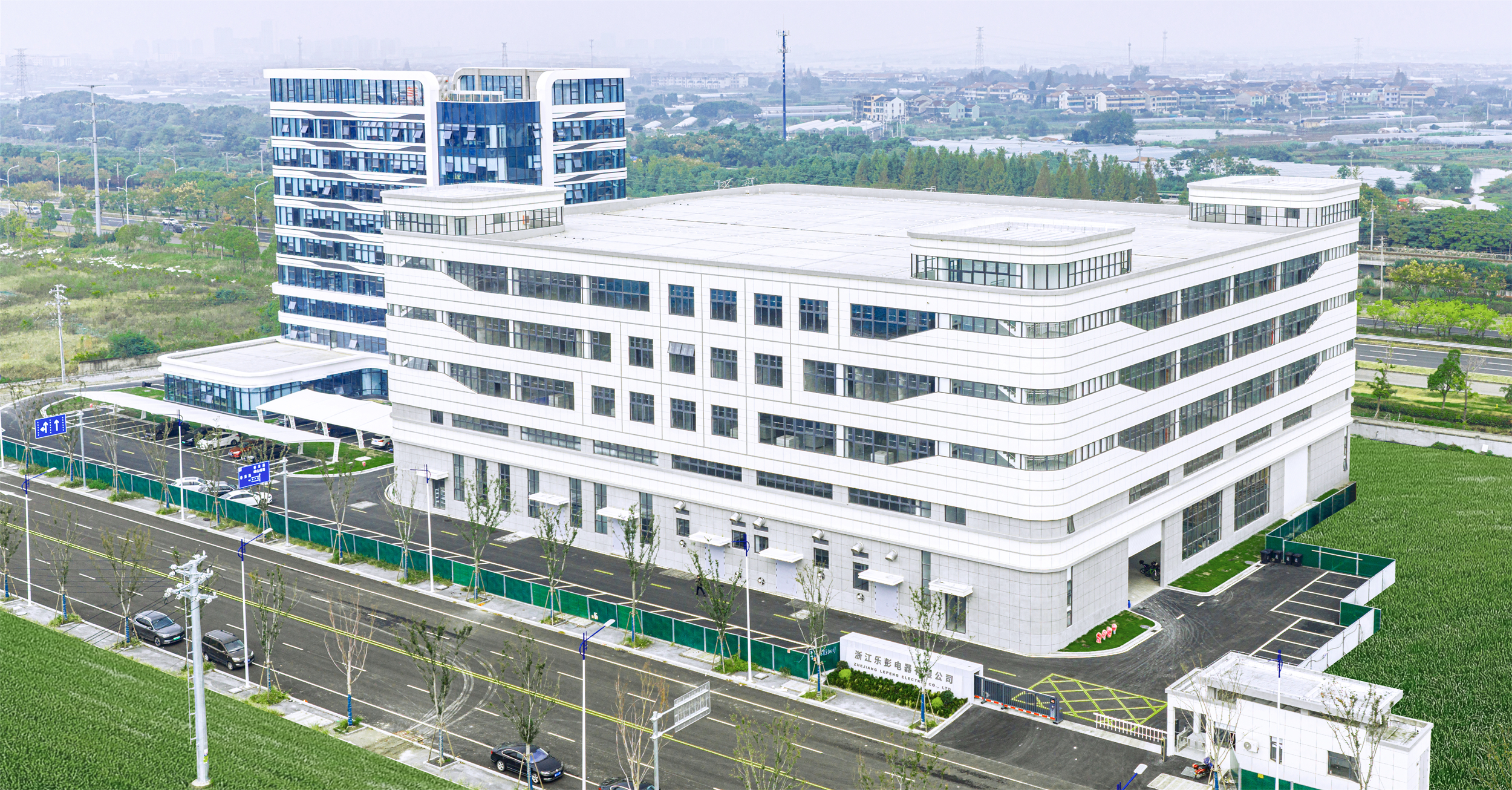
Zhejiang Lepeng Electric Appliance Co.,Ltd. was founded in 2009 and now runs three production bases — the headquarters factory in the Baiguan Industrial Zone of Shangyu, Zhejiang, plus bases in Qiandaohu, Zhejiang and Jingdezhen, Jiangxi — with 2,000 employees, a 200,000 m² footprint, a 200-person R&D team and a stated monthly capacity of 45 million LED lamps and 5 million LED luminaires. Around 90% of output is exported, with the EU, Southeast Asia, the Middle East and Latin America named as main markets. That is the profile of a volume manufacturer rather than a niche specialist, which is precisely why selection has to run by application: a broad portfolio only creates value when each item is matched to the conditions it will actually meet, and when the buyer can see the evidence behind the match.
The demand side makes the same argument. Grand View Research valued the global industrial and commercial LED lighting market at USD 66.8 billion in 2025, with Asia Pacific holding a 43.5% revenue share that year. When manufacturing capacity is concentrated in one region and demand is global, product availability stops being the differentiator. What separates one shortlist from another is the ability to state, in writing, which model goes where, under which conditions, and on what documentary basis.
The shortlist at a glance
The table routes a project to a fixture. It is a routing tool, not a datasheet: IP rating, wattage, beam angle, luminous output and warranty period are model- and order-specific for these ranges and should be confirmed in writing before the specification is issued.
| Fixture | Best-fit application | What the supplied evidence confirms | Specifications to lock in the quotation |
|---|---|---|---|
| HL-E01 UFO LED high bay | Warehouses, distribution centres, gymnasiums, high-ceiling interiors | Listed in the related-product mapping of the TÜV SÜD GS certificate Z1A 123276 0002 Rev. 00 | Wattage range, beam angle, IP rating, mounting height and target illuminance, warranty |
| SH-E01 linear LED high bay | Harsh industrial halls, long production lines, workshops with overhead services | Listed in the same GS certificate mapping; certified against EN 60598-1 and EN 60598-2-1 under that certificate | IP rating, ambient temperature range, wattage, light distribution along the working axis, warranty |
| FL-C01 Series LED floodlight | Facades, manufacturing yards, general outdoor area lighting | Listed in the GS certificate mapping | IP rating, wattage and optic type, aiming and bracket configuration, warranty |
| PL02 LED panel light | Offices, retail units, clinics, corridors — indoor commercial ceilings | CE-EMC Attestation of Conformity E8A 123276 0630 Rev. 00 (TÜV SÜD) with scope stated as fixed general purpose luminaires / LED panel light; also in the GS mapping | Wattage, colour temperature and consistency, driver and dimming protocol, glare control, warranty |
| 8200 solar LED flood light (solar security light with PIR motion sensor) | Gates, perimeter fences, storage yards, sites without a practical mains supply | Listed in the GS certificate mapping; solar products and adjustable colour temperature named as product highlights in the case record | Panel and battery sizing, autonomy target, PIR coverage, light output, warranty |
HL-E01: the UFO high bay for warehouses and gymnasiums
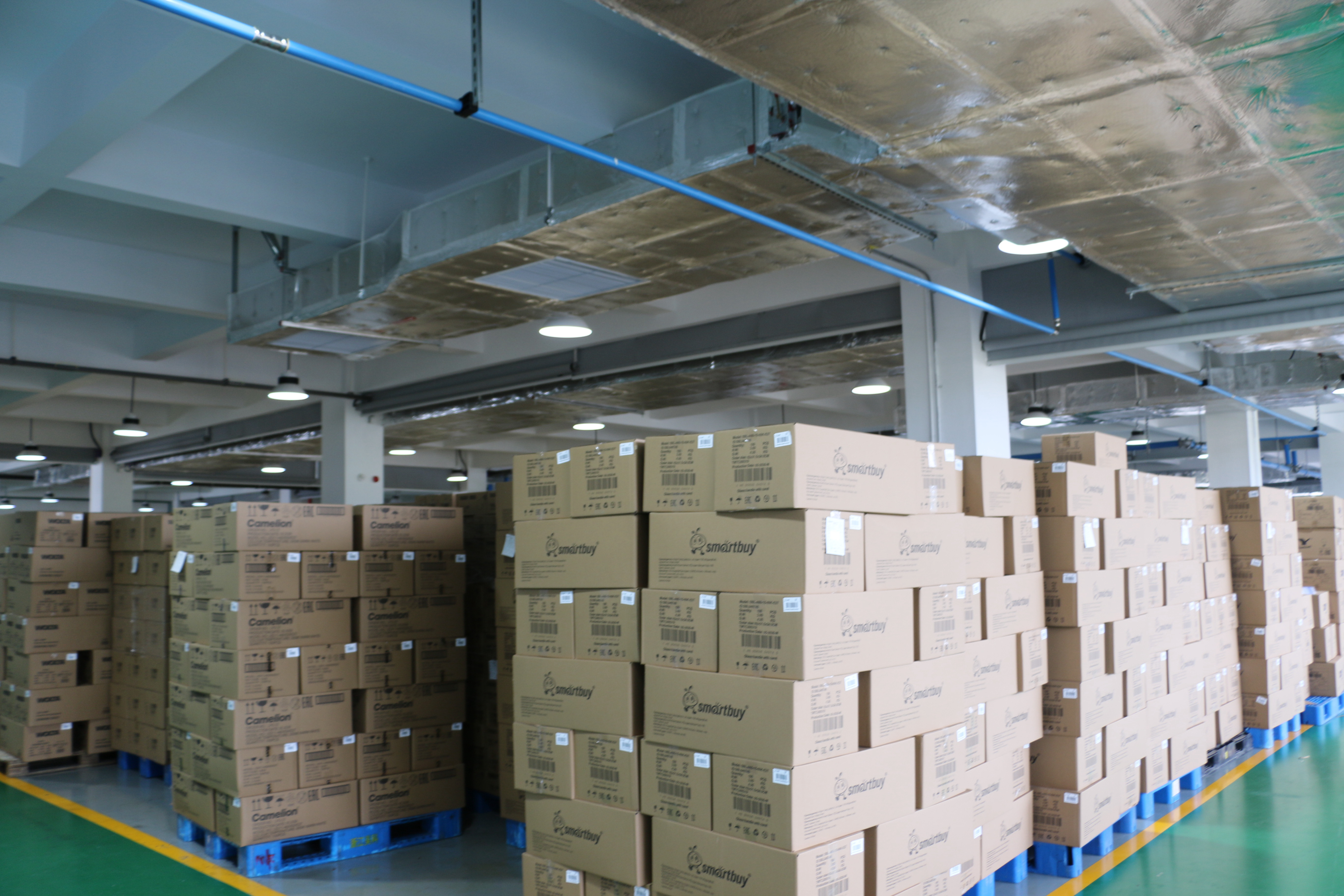
Warehouse and gymnasium lighting share one physical constraint. The light source sits far above the working plane — commonly in the upper structure of a distribution centre, and higher again in a sports hall — and the fixture has to produce usable illuminance at floor level without creating glare at eye level or trapping heat in the housing. Lepeng's own published guidance on high-bay selection follows that logic: LED high bays are recommended for high-ceiling warehouse and industrial interiors on the basis of lumen output, heat dissipation and service life, and the selection sequence begins with confirming ceiling height and the required light level, then matching wattage and beam angle to the site.
The HL-E01 is the UFO-format option here: a compact round high bay suited to point mounting where the roof structure allows a single suspension point per fixture. Its documented position in the supplied material is a certificate mapping — the model appears in the related-product list attached to the TÜV SÜD GS certificate Z1A 123276 0002 Rev. 00. In an evaluation file, that mapping is the starting point for verification, not the conclusion.
What it means for the buyer is mostly about optics rather than raw output. In a warehouse, racking geometry usually decides the distribution: a narrow aisle set between tall racks needs light directed down the aisle, while an open picking floor needs wider coverage so that vertical rack faces remain readable. In a gymnasium the same fixture type needs a softer, wider distribution, because players, officials and spectators are looking toward the ceiling rather than away from it. Because the supplied material does not state a beam-angle range for the HL-E01, that figure has to come from the configuration-specific datasheet, and the IP rating and warranty period should be confirmed in the same document.
SH-E01: the linear high bay for harsh industrial environments
Linear high bays exist because some industrial buildings cannot be lit well by point sources. Long production halls, continuous process lines and workshops crossed by cranes, ducts or service gantries tend to favour a linear fixture running parallel to the equipment, spreading light along the working axis instead of concentrating it under a single point. The SH-E01 is Lepeng's linear high-bay model, and it appears in the same GS certificate mapping as the HL-E01.
The harsh-environment description attached to this entry is a fit statement, not a measured result. What the supplied evidence supports is narrower and worth stating precisely: the model is listed under a GS certificate issued against EN 60598-1:2021+A11:2022, EN 60598-2-1:2021 and EN 62493:2015, and Lepeng's case record lists warehouse and factory lighting among the applications in which its fixtures have run with stable operation over five to ten year horizons. The material does not report dust ingress class, ambient temperature limits, impact resistance or vibration tolerance for the SH-E01 specifically.
That gap is where the real evaluation sits. For a foundry, a flour mill, a cold store or a wash-down area, the first question is not how many lumens the fixture produces but what the enclosure must survive: airborne dust that settles on the lens, high-pressure cleaning, condensation during temperature cycling, or vibration transmitted through the mounting structure. Each of those conditions points to a different IP rating and a different housing and gasket specification, and none of them can be inferred from an electrical safety certificate. The practical step is to write the environment into the request — dust class, cleaning method, ambient range, mounting height — and ask for the corresponding IP rating and configuration in writing.
FL-C01 Series: floodlighting for facades and manufacturing areas
Floodlighting is the part of a commercial LED lighting package most exposed to both weather and scrutiny, and it is usually judged in two different ways. A facade scheme is assessed visually — uniformity, colour consistency, the absence of hot spots and light spill into neighbouring properties. A manufacturing yard is assessed functionally — whether the loading area, tank farm or storage compound is bright enough and even enough to work in safely after dark, and whether the mounting position creates glare for drivers or for the site opposite.
The FL-C01 Series appears in the GS certificate mapping described above. Beyond that, the supplied material supports a category-level market observation rather than a product claim: Global Market Insights reported the global LED flood light market at USD 9.4 billion in 2025, with a projected compound annual growth rate of 8.52% through 2034. That figure describes the segment, not this fixture, and it should be read as context for how much choice a buyer now has rather than as evidence of any individual product's performance.
Selection logic for the FL-C01 therefore turns on installation geometry. Mounting height and aiming angle determine both the wattage needed and the glare risk; a facade scheme generally wants a tighter, better-controlled optic than a yard scheme, where uniformity across a working area matters more than beam punch. Whether the fixture is fixed or aimable on a bracket, and whether the distribution is symmetrical or asymmetric, should be decided per mounting location rather than per project, because a single specification applied across a whole site usually produces one over-lit elevation and one under-lit corner. The supplied material does not include photometric data for the FL-C01 Series, so distribution and illuminance should be requested for the exact configuration being priced.
PL02: the panel light for indoor commercial spaces
Panel lights are often the least examined purchase in a commercial fit-out and the most visible one afterwards. In offices, retail units, clinics and corridors the ceiling is the interior; a panel that flickers, shifts colour between production batches, or throws glare onto a screen is a defect the occupants notice every working day, long after the procurement file has been closed.
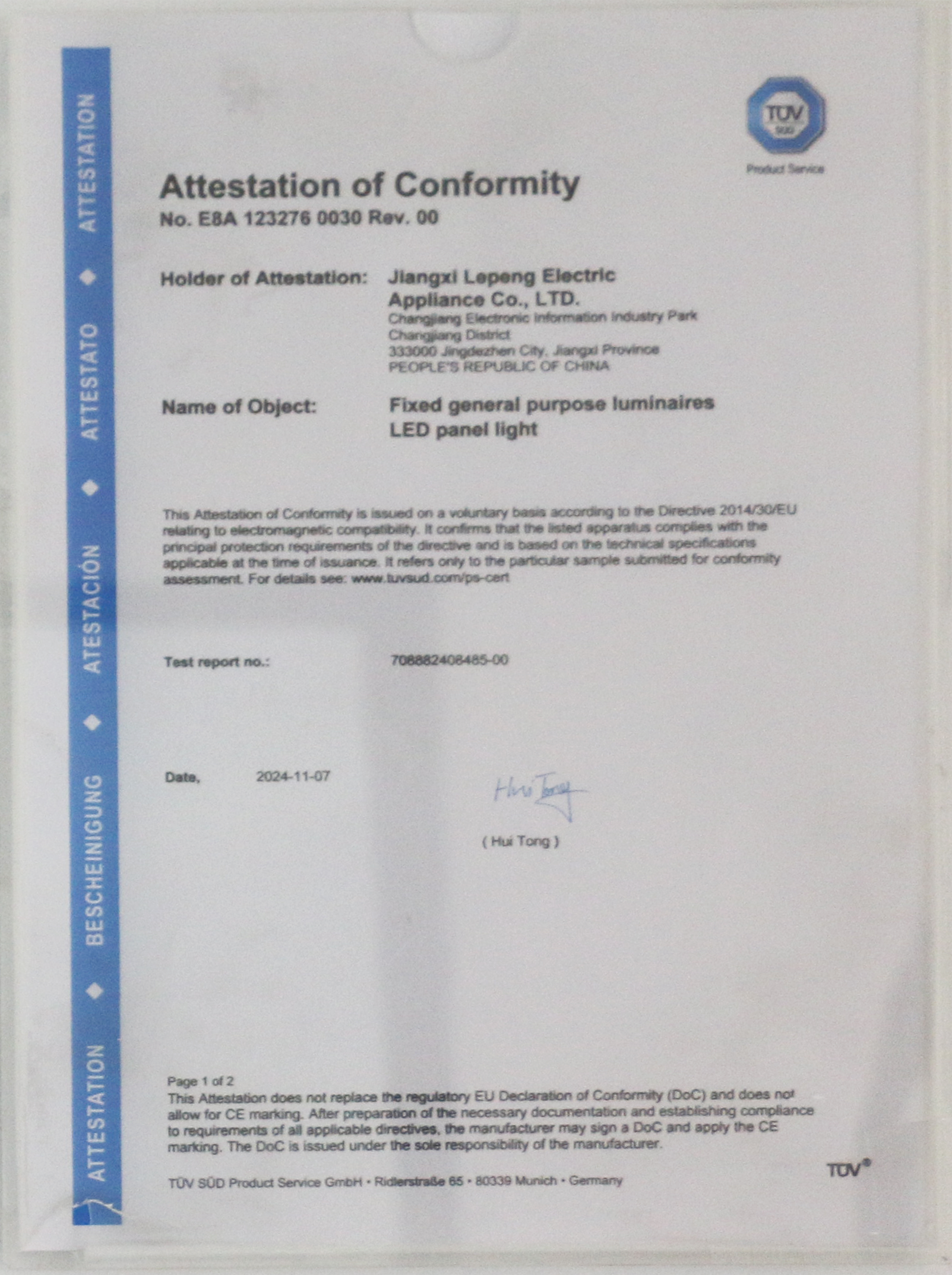
The PL02 has the strongest documentary position in this shortlist. The TÜV SÜD Attestation of Conformity E8A 123276 0630 Rev. 00, issued on 7 November 2024 under the EMC Directive 2014/30/EU, states its scope explicitly as fixed general purpose luminaires / LED panel light. The same panel light also appears in the GS certificate mapping, which brings the EN 60598 luminaire safety standards into the file. Two independent certificate references — electromagnetic compatibility and low-voltage safety — is a materially different evidence level from a product photograph and a category name, and it is the kind of item a specifier can cite when a client asks why one panel was chosen over another.
Regulatory direction argues for giving indoor panels more attention rather than less. The Lighting Controls Association's 2026 review of ANSI/ASHRAE/IES Standard 90.1-2025 records that the standard reorganised the lighting requirements, updated lighting power density values, revised exterior lighting zones and strengthened lighting control requirements for commercial buildings. The practical consequence for a panel purchase is that fixture and control layer now have to be specified together: dimming protocol, sensor compatibility and driver behaviour affect whether a scheme can meet a control requirement at all, and they are not interchangeable between suppliers. That standard applies to the United States, and it does not by itself establish requirements in other markets — but it is a useful indicator of the direction commercial building codes have been moving.
8200: the solar flood light for outdoor security
Solar security lighting is the one category in this shortlist where the luminaire is the smaller half of the system. A solar flood light is a fixture, a photovoltaic panel, a battery, a charge controller and a motion sensor, and the performance someone experiences at two in the morning in midwinter is decided by the sizing of those components rather than by the LED alone.
The 8200 model is listed as a solar security light with PIR motion sensor. It appears in the GS certificate mapping, and Lepeng's case record identifies solar products and adjustable colour temperature among the product highlights offered to contractors, distributors, commercial and municipal buyers across global markets. The company's case record also names construction site, warehouse and factory lighting, road and community landscape lighting, and residential and commercial applications among the settings in which its ranges have been used.
The fit boundary is therefore explicit. Solar security lighting suits gates, perimeter fences, storage yards, site compounds and remote assets where a mains connection would mean trenching, cabling and a supply agreement — and it is a poor fit where a site needs guaranteed, uninterrupted high output through a long period of low solar input without a correctly sized battery bank. Autonomy, panel wattage, battery capacity and PIR detection range all depend on the installation latitude, the shading profile and the required nightly operating hours, so they must be calculated for the site rather than taken from a generic table. Motion-triggered operation changes that calculation as well, because duty cycle determines how much of the battery is actually used each night.
How to read the evidence attached to each fixture
Three certificate documents appear in the supplied material, and they do different jobs. Keeping them apart is the difference between a clean evaluation and a misleading one.
- GS Certificate Z1A 123276 0002 Rev. 00 (CE-LVD), issued by TÜV SÜD on 23 January 2024 against EN 60598-1:2021+A11:2022, EN 60598-2-1:2021, EN 62493:2015 and AFPS GS 2019:01 PAK, with the scope described as LED-Deckenleuchte. Its related-product list includes the PL02, SH-E01, solar flood light, HL-E01, FL-C01 Series, A60 lamp and the FCL-E01 ceiling fan light.
- Attestation of Conformity E8A 123276 0630 Rev. 00 (CE-EMC), issued by TÜV SÜD on 7 November 2024 under the EMC Directive 2014/30/EU, with scope stated as fixed general purpose luminaires / LED panel light.
- EU Type Examination Certificate TPS-RED500722 (01) (CE-RED), issued by TÜV SÜD on 23 January 2024 against EN 300 220-1 V3.1.1, EN 301 489-1 V2.2.1 and EN 301 489-3 V2.1.1, with scope described as short range device / LED ceiling light. It relates to the FCL-E01 ceiling fan luminaire — not to the FL-C01 floodlight, despite the similar naming.
None of these documents is a performance certificate. A safety certificate confirms conformity with a luminaire standard; an EMC attestation confirms electromagnetic compatibility. Neither states luminous efficacy, colour rendering, IP rating, lumen maintenance or service life. Those values belong in the product datasheet and, where a project depends on them, in a test report. Treating a compliance certificate as a performance claim is one of the most common errors in commercial LED lighting procurement.
Where this shortlist stops
An honest shortlist says what it does not establish. The supplied material does not provide wattage ranges, IP ratings, luminous flux, efficacy figures, colour rendering indices or warranty periods for these five models as category values, so this article does not quote them. It also does not include a measured comparison against high-intensity discharge or fluorescent installations; where a project requires a before-and-after energy case, that case has to be built from metered consumption at the site, not from a fixture datasheet.
Lepeng's case record describes stable operation across commercial and municipal applications over five to ten year horizons. That is company-reported experience, useful as a reference point for a supplier conversation, but it is not an independent field test and should not be presented as one. Similarly, the Asia Pacific share and market size figures cited above are third-party research estimates; research houses using different methodologies reach different totals, and one 2024 comparison saw global LED lighting market estimates of USD 78.9 billion and USD 81.77 billion for the same year and scope. Such differences are a reason to read market data as directional context, not as a procurement input.
What is actually moving in commercial LED lighting
Three signals in the supplied evidence are relevant to how this shortlist should be used. The first is scale: a global industrial and commercial LED lighting market of USD 66.8 billion in 2025, dominated by an Asia Pacific manufacturing base holding 43.5% of revenue, means buyers are selecting from a deep field rather than a short one, and differentiation shifts to documentation, configuration control and delivery reliability.
The second is the outdoor segment. A flood light segment valued at USD 9.4 billion in 2025 with a projected 8.52% compound annual growth rate through 2034 indicates continued investment in area and facade lighting, which in practice means more projects where the decision is not whether to use LED but which optic, mounting and control arrangement to specify.
The third is regulatory. Strengthened lighting control requirements under ANSI/ASHRAE/IES Standard 90.1-2025 push indoor commercial projects toward fixtures whose drivers and sensors can be integrated into a controlled scheme. For a supplier's range, that pressure tends to reward products with a documented driver and control interface and to expose products sold on price alone.
What to expect next
Two developments are reasonable to plan around, stated as conditions rather than forecasts. If control requirements continue to tighten in major commercial markets, panel and high-bay specifications will increasingly be written around dimming protocol and sensor compatibility rather than wattage alone, and suppliers who cannot document the driver interface will be excluded at specification stage rather than at pricing stage. Separately, solar security lighting is likely to keep expanding wherever trenching costs more than the equipment; the constraint on that growth is battery sizing discipline, because a system specified on fixture output rather than nightly energy balance will underperform in its first winter.
Purchasing terms and acceptance criteria to agree before order
Lepeng states a lead time of 30 to 45 days, a minimum order quantity that varies by product, OEM/ODM capability covering fixture appearance, power and accessories (with details handled through product communication), and remote after-sales support. The company also states that it operates QA/QC processes, without publishing specific inspection standards. Those statements describe the commercial framework; they are not commitments until they appear in a signed order, so the following points are worth writing into the quotation rather than assuming.
- Exact configuration. Model, wattage, beam angle or distribution, colour temperature, driver, sensor option and mounting accessory for every line item — not a series name alone.
- Certificate cross-check. Certificate number, issuing body, standard and the product list on the certificate, checked against the models being ordered.
- IP rating and environmental statement in writing for every outdoor and industrial item, matched to the actual exposure: dust, hose-down, wind-driven rain or coastal salt air.
- Photometric and electrical data for the supplied configuration, so illuminance on the working plane can be verified rather than assumed.
- Sample evaluation. Agree how many units, which configurations, and what will be assessed — colour consistency between units, flicker at low dimming levels, housing and lens finish, sensor response.
- Warranty terms. Covered period, what is excluded, whether the driver and battery are covered on the same terms as the luminaire, and the replacement process, including how remote support is escalated.
- Pre-shipment inspection and QA records. Who inspects, against which checklist, and what documentation accompanies the shipment.
- Packaging, labelling and documentation. Carton marks, product labels, and the compliance document set needed for customs clearance and for the project handover file.
- Delivery schedule. Confirm the 30–45 day lead time against the actual order volume and required on-site date, and agree what happens if a configuration changes after the order is placed.
Contacting Lepeng
Datasheets, certificate copies and configuration-specific quotations for the HL-E01, SH-E01, FL-C01 Series, PL02 and the 8200 solar flood light can be requested through the company's published channels: contact name Fish, No. 1, Yueguo Road, Baiguan Industrial Park, Shangyu District, Shaoxing City, Zhejiang Province; telephone +86-575-82188752; WhatsApp +86-13777885334; email fish@idealbright.com. The company website is www.idealbright.com.
Frequently asked questions
- Which LED light is suitable for high-bay warehouse industrial lighting?
- LED high-bay lights are the usual choice for high-ceiling warehouse and industrial interiors, because they are designed to deliver high lumen output from a mounting height well above the working plane, with heat dissipation and service life treated as core design parameters. Selection starts with two site measurements — ceiling height and the required light level at the working plane — followed by wattage and beam angle matched to those figures. Mounting must be secure to the ceiling structure or to purpose-made hanging brackets, and power must be isolated before wiring or installation work begins, in line with local electrical safety codes.
- Which LED lighting solution should I choose for an industrial warehouse and outdoor engineering project?
- Split the project by exposure rather than by brand. For the interior, a UFO-format high bay such as the HL-E01 suits point mounting over open floor and racking, while a linear high bay such as the SH-E01 suits long production halls, continuous lines and buildings crossed by cranes or service gantries. For the exterior, the FL-C01 Series floodlight covers facades, yards and general area lighting, and the 8200 solar flood light covers gates, perimeter fences and remote assets where a mains supply would require trenching. Indoor commercial spaces call for a different family again — the PL02 panel light, whose CE-EMC attestation scope explicitly names LED panel light. Each choice should then be confirmed against IP rating, wattage and warranty for the exact configuration.
- How can I confirm that a certificate actually covers the model I am buying?
- Read the certificate itself rather than the quotation wording. Check three things: the scope description, the standard the certificate was issued against, and the product list attached to it. A certificate describing a ceiling luminaire family, for example, is not automatically evidence for a floodlight with a similar model code. Where the ordered variant, housing format or mounting position differs from the certified construction, ask the supplier to confirm in writing that the configuration falls within scope, and keep that confirmation in the project file.
- What has to be calculated before ordering solar flood lights for security lighting?
- A solar flood light is a system, not a single product, so the calculation starts with the site: latitude, shading through the year, required nightly operating hours and the light level needed at the target surface. From those inputs the panel wattage, battery capacity and control strategy follow. Motion-triggered operation reduces average nightly draw but introduces duty-cycle assumptions that should be agreed explicitly. A configuration sized on fixture output alone, without an energy balance for the darkest part of the year, is the most common reason solar security lighting underperforms in its first winter.
- What warranty and after-sales terms should be confirmed in the quotation?
- Warranty is set per product and per order rather than as a single category value, so it belongs in the written quotation. Four items are worth pinning down: the covered period, whether drivers, batteries and sensors carry the same term as the luminaire, what voids coverage, and how a claim is handled in practice — including the escalation route for the remote after-sales support the supplier provides and who bears freight on replacements.
The full product brochure, including the wider commercial LED lighting range, can be downloaded here: Lepeng Electric product brochure (PDF).
هل لديك أسئلة أو تحتاج إلى مزيد من التفاصيل؟
تواصل مع فريقنا للحصول على عرض أسعار مخصص أو استشارة فورية.
طلب عرض أسعار
املأ النموذج أدناه وسيتواصل معك فريقنا بعرض مقترح مخصص.
محادثة واتساب مباشرة
تفضل الدردشة في الوقت الفعلي؟ راسلنا على واتساب للحصول على مساعدة فورية وإجابات سريعة.
- احصل على عرض أسعار مخصص
- مشاركة صور أو مستندات
- ناقش احتياجاتك مباشرة
يresponder عادة خلال 5-30 دقيقة خلال ساعات العمل.