
Commercial LED Lighting for Harsh Industrial Environments
Commercial LED Lighting for Harsh Industrial Environments
In warehouses, workshops and plant exteriors, the variable that actually limits a lighting decision is usually the environment around the fixture, not the fixture's wattage. Dust, humidity, washdown routines, vibration, ambient heat and mounting height decide which luminaire families can survive a service interval at all — and therefore which products should even enter the comparison.
Commercial LED lighting is the segment of the lighting market that supplies luminaires to non-residential applications such as warehouses, factories, retail spaces, gyms and outdoor commercial areas. It is already a large segment: Grand View Research estimated the global commercial lighting market at USD 47.54 billion in 2024, with LED products holding a 58.1% revenue share, while Fortune Business Insights valued the wider global LED lighting market at USD 109.11 billion in 2025 and projects USD 336.90 billion by 2034. The practical consequence for buyers is that the light source is no longer the differentiator. Selection discipline is.
Zhejiang Lepeng Electric Appliance Co.,Ltd. is a Chinese LED luminaire manufacturer founded in 2009 and headquartered in the Baiguan Industrial Zone of Shangyu, Zhejiang Province. The company operates additional production bases in Qiandaohu, Zhejiang and Jingdezhen, Jiangxi, employs 2,000 workers, and reports an annual output of 540 million lamps. About 90% of output is exported, with main markets in the EU, Southeast Asia, the Middle East and Latin America; its own brand MKOPTO is sold alongside OEM and ODM programmes, and its catalogue spans floodlights, high bays, linear high bays, street lights, garden lights, solar fixtures, panel lights, tri-proof lights and related commercial LED lighting products.
This article maps four of those families — the SH-E01 LED linear high bay, the HL-E01 UFO LED high bay, the FL-C01 outdoor LED floodlight and the PL02 LED panel light — onto the environments they are engineered for, and marks the point at which each one stops being the right answer.
Why Environment, Not Wattage, Decides the Luminaire
Specifying on wattage alone produces two predictable failures: an under-protected fixture in a wet or dusty zone, and an over-specified fixture in a dry ceiling void where a lower-cost family would have performed identically. Six environmental variables do most of the work in an industrial comparison.
- Airborne dust and particulates. Seal quality and lens material determine how quickly a fixture's light output degrades in woodworking, metal fabrication, packaging or cement-adjacent areas.
- Moisture and cleaning regime. Condensation, hose-down and jet-cleaning require an ingress-protected housing; a dry ceiling void does not.
- Mounting height and geometry. Beam angle has to match racking aisles, column grids and machine obstructions, not just ceiling height.
- Heat and thermal path. Die-cast aluminium bodies and metal heat sinks move heat away from the LED module; housing choice is a service-life decision, not a cosmetic one.
- Electrical environment. Motor loads, welding equipment and switching transients put surge protection on the specification list of any plant with heavy machinery.
- Control and occupancy. Sensor-based ON/OFF and stepped dimming change the economics of corridors, restrooms and rarely used storage areas.
Environment-driven selection also has a defensive value in tenders: every requirement then maps to a stated product parameter — IP class, beam angle, surge rating, CCT range, warranty term — which is far easier to justify to a procurement committee than a preference for a particular brand.
An Environment-to-Fixture Decision Map
The table below summarizes how the four families in this comparison divide the work. It is organized by site zone rather than by product, because in practice the site zone is what the buyer already knows at the decision stage.
| Site zone | Dominant environment factors | Recommended family | Specification anchors |
|---|---|---|---|
| Racked warehouse and distribution aisles, dusty or humid workshops | Dust, humidity, occasional washdown, linear aisle geometry | SH-E01 LED linear high bay | IP65; aluminium alloy housing with PC/PMMA lens; 50–200 W; 100/135/150 lm/W; beam angle 90° (H) × 120° (V); 5-year warranty |
| Open-span factory bays, high-ceiling production halls, retail and gym interiors | Ambient heat, vibration, motor-load transients, high mounting height | HL-E01 UFO LED high bay | 100/150/200/240 W; 140/160/185/210 lm/W; die-cast aluminium body with PC lens; surge protection 6KV/6KV; CCT 4000K/5000K/6500K |
| Outdoor yards, loading areas, facades, plant exteriors | Wind-driven rain, temperature swings, lightning exposure | FL-C01 outdoor LED floodlight | 10–300 W; 100/120 lm/W; surge protection up to 2KV; power factor >0.9; CCT 3000K/4000K/6500K; aluminium + glass; bent bracket |
| Dry indoor commercial and residential ceilings — offices, corridors, back-of-house | Occupancy variability, aesthetic CCT requirements, dry environment | PL02 LED panel light | IP20; 9/12/18/24 W; 90/110 lm/W; 3-CCT 2700K–6000K; 50%/75%/100% three-level dimming; remote control + microwave sensor |
SH-E01 Linear High Bay: Racking Aisles and Washdown Zones
Where a warehouse or workshop combines dust, humidity and long linear circulation routes, the SH-E01 LED linear high bay is the family built for that brief. Its defining parameter is the IP65 rating, which qualifies it for environments where airborne dust and water jets are part of normal operations rather than an incident.
Technical profile
- Power options: 50 W, 100 W, 150 W and 200 W
- Luminous efficacy: 100 / 135 / 150 lm/W depending on version
- Beam angle: 90° horizontal × 120° vertical
- Colour temperature: 3000K / 4000K / 5000K / 6500K
- Housing: aluminium alloy body with PC/PMMA lens
- Dimensions: 305.6×97.3×68.1 mm / 580.6×97.3×68.1 mm / 855.6×97.3×68.1 mm
- Warranty: 5 years
The 90° (H) × 120° (V) distribution is the parameter buyers most often overlook. A horizontally wide, vertically narrower pattern is well matched to linear building geometry — racking aisles, column grids, assembly lines — where the objective is even illumination along a corridor of activity without spilling large amounts of light onto adjacent rack faces. The three housing lengths correspond to the range of wattage options, which allows a single project to use one optical family across different ceiling heights.
The 5-year warranty matters at the procurement stage rather than the installation stage. In high-ceiling buildings, the dominant lifetime cost of a lighting system is access: scissor lifts, permit-to-work procedures and production downtime. A warranty term gives the maintenance planner a contractual basis for the replacement interval, even though it does not by itself replace site-level verification.
HL-E01 UFO High Bay: Open Spans, Heat and Motor Loads
Open-span factory bays, high-ceiling production halls, retail interiors and gyms place a different set of demands on a luminaire. Mounting heights are high, obstructions are fewer, and the electrical environment is often noisier because of motors, inverters and welding equipment. The HL-E01 UFO LED high bay addresses that combination.
Technical profile
- Power options: 100 W, 150 W, 200 W and 240 W
- Voltage: 185–265 V / 100–265 V
- Luminous efficacy: 140 / 160 / 185 / 210 lm/W depending on version
- Colour temperature: 4000K / 5000K / 6500K
- Cable: 3×1.0 mm² cable with 300 mm exposed leads, pre-wired to the power supply
- Surge protection: 6KV/6KV
- Housing: die-cast aluminium body with PC lens
Two parameters stand out for industrial buyers. First, the surge protection rating of 6KV/6KV is directly relevant to plants where large inductive loads switch on and off through the working day; it belongs on the specification sheet next to the wattage, not in a warranty annex. Second, the pre-wired 3×1.0 mm² cable with 300 mm exposed leads shortens installation time on site, which matters in retrofit projects where the electrical contractor's hours are a visible line in the project budget.
The die-cast aluminium body is the thermal path for the LED module. In unconditioned halls where summer ambient temperatures are high or where heat rises into the roof void, that thermal design is the difference between a fixture that meets its rated output over its service life and one that is quietly derated by its own driver.
FL-C01 Outdoor Floodlight: Yards, Facades and Plant Exteriors
Outdoor commercial areas are exposed to weather, temperature cycling and, in many regions, lightning. The FL-C01 outdoor LED floodlight is specified for residential, commercial and manufacturing settings where a directed outdoor beam is required rather than a general high-bay distribution.
Technical profile
- Power range: 10–300 W
- Voltage: 100–240 V / 220–240 V
- Efficiency: 100 / 120 lm/W
- Colour temperature: 3000K / 4000K / 6500K
- Surge protection: up to 2KV
- Power factor: >0.9
- Dimensions: 105×97×27 mm to 500×457×49 mm, by wattage
- Material: aluminium + glass; bent bracket mounting
The 10–300 W span is unusually wide for a single floodlight platform, and it lets a site standardize on one family across very different tasks: a low-wattage unit for a doorway or wall, a mid-range unit for a loading bay, and a high-wattage unit for a yard or façade. The bent bracket provides mechanical aiming, which is what separates a usable outdoor installation from a light that illuminates the wrong surface after commissioning.
A power factor above 0.9 is a procurement-relevant figure in facilities where large numbers of fixtures share a distribution board, because it affects how much apparent power the lighting load draws.
PL02 Panel Light: Dry Indoor Ceilings and Controlled Zones
Not every commercial space needs an industrial luminaire, and specifying one where it is not required adds cost without adding value. The PL02 LED panel light is designed for indoor commercial and residential ceilings where the environment is dry and the priorities are visual comfort, selectable colour temperature and occupancy control.
Technical profile
- Power options: 9 / 12 / 18 / 24 W
- Luminous efficacy: 90 / 110 lm/W
- Colour temperature: 2700K–6000K, 3-CCT selectable
- Dimming: 50% / 75% / 100% three-level brightness
- Sizes: 5 inch / 8 inch / 12 inch
- Round dimensions: φ160×40 mm / φ203×40 mm / φ305×40 mm
- Square dimensions: 160×160×40 mm / 203×203×35 mm / 305×305×40 mm
- Cut-out size: φ75–125 mm / φ75–150 mm / φ75–250 mm (25 mm increments)
- Protection: IP20
- Control: remote control + microwave sensor (auto ON/OFF)
- Material: aluminium / plastic frame with PC diffuser
Two features make this family relevant to commercial procurement rather than only to fit-out aesthetics. The 3-CCT selectable design (2700K–6000K) means one stocked SKU can serve spaces with different colour-temperature expectations, which reduces the number of variants a distributor or contractor has to hold. The microwave sensor with automatic ON/OFF and three-level dimming addresses corridors, restrooms and storage rooms where occupancy is intermittent and continuous full output is simply wasted energy.
The 25 mm cut-out increments across three sizes give installers predictable ceiling apertures for retrofit work in existing suspended ceilings. Surface-mounted and recessed versions of both round and square formats are available in the same platform.
LED Versus Traditional Industrial Lighting: Where the Gains Are, and Where They Stop
Most industrial sites evaluating commercial LED lighting are comparing against a baseline of high-intensity discharge high bays, fluorescent battens or halide floodlights. The gains from moving to LED in this comparison are real but specific.
- Service access. Traditional discharge and fluorescent systems require periodic re-lamping, and in high-ceiling buildings the dominant cost is access equipment and downtime rather than the lamp itself. LED luminaires avoid routine re-lamping, and the SH-E01 is supplied with a 5-year warranty that gives maintenance planning a defined interval.
- Start-up behaviour. Discharge sources need warm-up and restrike time after a power interruption; LED luminaires reach full output immediately, which matters in facilities with frequent switching or emergency egress requirements.
- Controllability. LED drivers pair directly with sensors and dimming. The PL02's microwave sensor and three-level dimming is an example of control being designed into the fixture rather than added afterwards.
- Optical control. Defined beam angles such as the SH-E01's 90° (H) × 120° (V) allow lighting design to follow building geometry instead of flooding it.
Compliance is a separate gate. Core standards used in international and US project specifications for LED luminaires include IEC 60598 for luminaires, UL 1598 for luminaires and UL 8750 for LED equipment, as listed by UL Solutions. These are the reference documents against which safety compliance is assessed, and buyers specifying for EU or US projects should treat them as a baseline requirement in supplier screening rather than a differentiator between otherwise equivalent products.
What the Market Data Says About Demand
Market indicators support the view that environment-driven specification is becoming the mainstream procurement logic rather than a specialist concern.
- The global LED lighting market was valued at USD 109.11 billion in 2025 and is projected to reach USD 336.90 billion by 2034 (Fortune Business Insights).
- The global commercial lighting market was estimated at USD 47.54 billion in 2024, with LED products holding a 58.1% revenue share (Grand View Research). LED is therefore already the default technology in commercial applications, and competition has shifted to specification quality.
- The global LED flood light market reached USD 9.4 billion in 2025 and is expected to grow at a CAGR of 8.52% to reach USD 20.1 billion by 2034 (IMARC Group) — the product category where outdoor environment ratings such as surge protection and housing material carry the most weight.
- China exported USD 31.4 billion in light fixtures in 2024, representing 59.3% of total global exports (OEC), which means most international buyers are ultimately comparing Chinese manufacturing capability, lead time and certification readiness.
- Adjacent solar categories continue to expand in parallel: the global solar street lighting market is projected to reach USD 22.5 billion by 2030, with a CAGR of 15.8% from 2024 (Vantage Market Research).
Comparing Suppliers at the Decision Stage: Scale, Lead Time and Cost
Once the luminaire family is chosen, the decision shifts from product to supplier. Three variables dominate at this stage: whether the supplier can hold a bulk programme, how reliable the delivery schedule is, and what the total landed cost looks like against the alternatives.
On scale, Zhejiang Lepeng Electric Appliance Co.,Ltd. reports a 200,000 m² manufacturing footprint, 2,000 employees, a 200-person R&D team and an annual output of 540 million lamps, across a headquarters base in Shangyu, Zhejiang plus production bases in Qiandaohu, Zhejiang and Jingdezhen, Jiangxi. That structure supports OEM and ODM customization alongside standard catalogue products, which is the capability most relevant to distributors and project buyers who need product adaptation rather than off-the-shelf units.
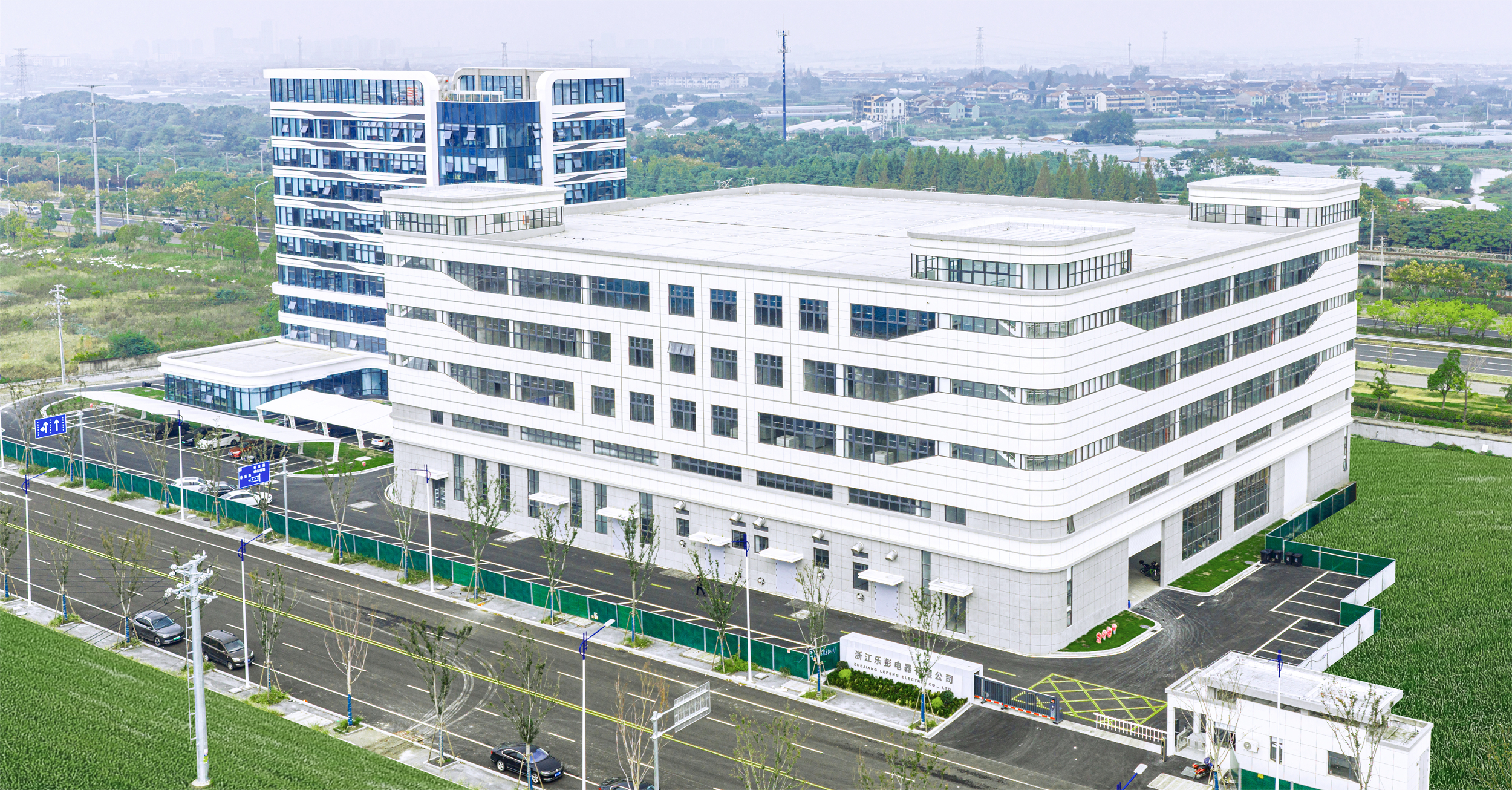
Headquarters manufacturing base in Zhejiang, one of three production sites supporting commercial LED lighting programmes for export markets.
On delivery, the company's comparison data states a 15% shorter lead time for bulk orders compared with smaller peers, with an on-time delivery rate above 95%. On cost, the same comparison cites a 10% cost advantage over imported premium brands achieved through in-house mass production.
The company positions itself for engineering procurement, mid-to-large scale project bulk supply, and channel customers requiring customization. After-sales considerations follow the same logic: standardized spare-parts supply and a long product lifecycle reduce the risk that a multi-year programme becomes unserviceable because a single housing variant was discontinued.
Future Outlook
Three shifts are likely to shape the next specification cycle for harsh-environment lighting. First, sensing and dimming are moving from optional accessories into standard fixture architecture, as the PL02's integrated microwave sensor illustrates; buyers should expect occupancy and daylight control to be evaluated alongside optical performance. Second, ingress protection and surge ratings will continue to move up the specification list as retrofit programmes replace the last generation of discharge high bays in high-ceiling industrial buildings. Third, compliance documentation is becoming a gating factor rather than a formality: alignment with IEC 60598, UL 1598 and UL 8750 is increasingly a prerequisite for project eligibility in EU and US markets. Suppliers with in-house testing and documentation capability will be better positioned to serve those programmes than suppliers that treat certification as a per-order transaction.
Frequently Asked Questions
Which LED light is suitable for high-bay warehouse industrial lighting?
LED high-bay luminaires are the standard recommendation for high-ceiling warehouse interiors. They provide high lumen output, good heat dissipation and long service life, which makes them suitable for large-space warehouses, factories and high-ceiling industrial sites. In this portfolio, two families cover that requirement: the SH-E01 linear high bay (IP65, 50–200 W, aluminium alloy housing with PC/PMMA lens, 5-year warranty) and the HL-E01 UFO high bay (100–240 W, die-cast aluminium body with PC lens, 140–210 lm/W depending on wattage). Selection between them is normally driven by ceiling height, mounting layout and whether the building is organized in linear aisles or open spans, and installation requires confirming ceiling height and required illuminance, choosing the appropriate wattage and beam angle, mounting securely, and verifying coverage after power-up.
How should a buyer choose between a linear high bay and a UFO high bay for the same building?
The decision usually turns on three measurable differences. The SH-E01 linear high bay carries an IP65 rating and a 90° (H) × 120° (V) beam angle, which suits dusty or humid zones and linear layouts such as racking aisles. The HL-E01 UFO high bay offers higher wattage options up to 240 W, luminous efficacy of 140–210 lm/W, and surge protection rated at 6KV/6KV, which suits open-span halls with motor loads and switching transients. Colour temperature range also differs: the SH-E01 offers 3000K/4000K/5000K/6500K, while the HL-E01 offers 4000K/5000K/6500K, so a warm-white requirement can rule the UFO family out.
When is an outdoor LED floodlight the right choice instead of a high bay?
Floodlights are specified where the target area is outside the building envelope — yards, loading areas, facades and plant exteriors — and where the beam must be aimed rather than distributed from a ceiling. The FL-C01 covers 10–300 W with 100/120 lm/W efficiency, 3000K/4000K/6500K colour temperatures, power factor above 0.9, an aluminium and glass body, and a bent bracket for aiming. Two points require confirmation before specification: the surge protection rating of up to 2KV is lower than the 6KV/6KV rating of the HL-E01, and the product data provided for this family does not state an IP rating, so ingress protection class should be verified with the supplier for sites with washdown or heavy driven rain.
What kind of space is the PL02 LED panel light designed for, and what are its limits?
The PL02 is an indoor commercial and residential panel light with an IP20 rating, available in 9/12/18/24 W versions at 90/110 lm/W. It offers 3-CCT selectable colour temperature from 2700K to 6000K, three-level brightness at 50%/75%/100%, remote control with a microwave sensor for automatic ON/OFF, and three sizes in both round (φ160/φ203/φ305 × 40 mm) and square (160×160×40 mm, 203×203×35 mm, 305×305×40 mm) formats, with cut-out dimensions in 25 mm increments. Its limits follow from the IP20 rating: it is intended for dry indoor ceilings and is not suitable for washdown areas, unconditioned dusty production zones or high-ceiling industrial volumes.
How should procurement teams compare LED lighting suppliers for large industrial projects?
Scale, delivery reliability and cost structure are the three comparable dimensions. On scale, Zhejiang Lepeng Electric Appliance Co.,Ltd. reports a 200,000 m² manufacturing footprint, 2,000 employees, a 200-person R&D team, 540 million lamps of annual output, three production bases and OEM/ODM capability. On delivery, its comparison data cites a 15% shorter lead time for bulk orders than smaller peers and an on-time delivery rate above 95%. On cost, it cites a 10% advantage over imported premium brands through in-house mass production. These are company-reported figures that buyers should validate against their own orders. The stated boundaries are equally relevant: smaller suppliers may lack the scale for large programmes, while premium imported brands may offer higher R&D standards and more detailed certification documentation — a factor that can outweigh first-cost differences in certification-sensitive projects.
Product documentation covering the SH-E01, HL-E01, FL-C01 and PL02 families, together with the company's current catalogue, can be downloaded here: Lepeng Electric commercial LED lighting catalogue (PDF). Company information is published at idealbright.com.