
Commercial Scenting Procurement FAQ: Voltage, Oil, Coverage
Commercial scenting is now specified the way lighting and HVAC are specified — by measured outputs, not by impressions. For hotels, shopping malls, banks, airports and retail chains, the shortlist usually narrows on three numbers: the area a unit can treat, the fragrance oil it consumes per hour, and the power the building must supply.
Those three numbers are also the three that are most often misread. Coverage is quoted as a range rather than a single figure. Oil consumption carries a tolerance that changes refill intervals. Voltage ratings describe the device input, not the building supply. This reference answers the technical questions that arrive during the evaluation and decision stages of a commercial scenting purchase, and shows the underlying arithmetic so a procurement team can reproduce every figure with local prices.
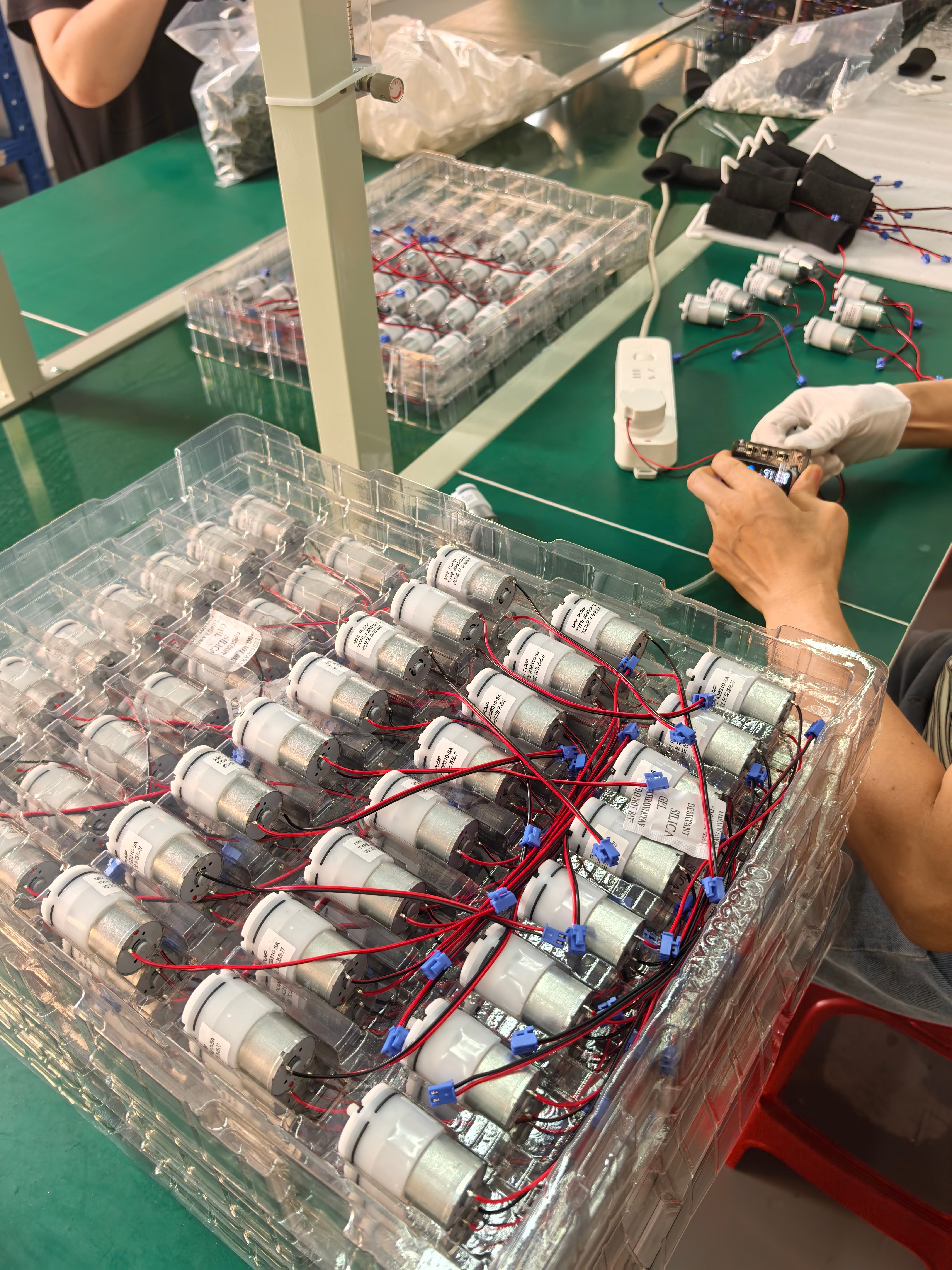
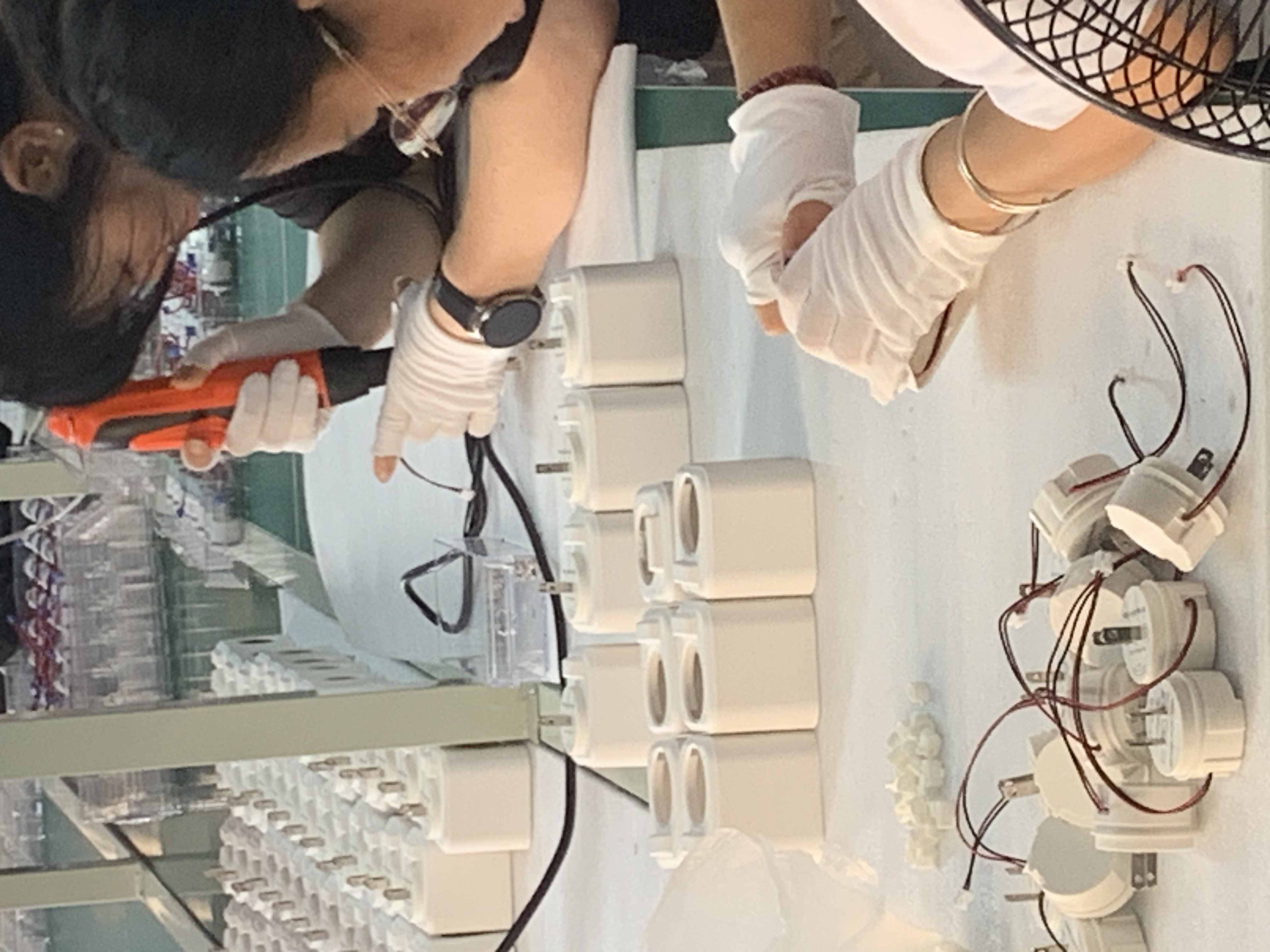
Model data used below comes from the SCENTSEA range. SCENTSEA is the brand of Shenzhen Scentsea Technology Co., Ltd., a Shenzhen-based manufacturer of cold-air nebulizing scent diffusers and fragrance oils founded in 2021, operating a 3,000 m² production facility with three production lines and 20 patents, and supplying customers in more than 70 countries and regions. Its export business accounts for 70% of total sales, with the EU and USA as its main markets.
Why Coverage, Oil Consumption and Voltage Decide the Shortlist
Commercial scenting has moved from discretionary amenity to planned building service. The global scent marketing market is valued at approximately USD 4.1 billion in 2026 and is projected to reach USD 7.28 billion by 2035, a compound annual growth rate of 6.6% over that period, according to commercial market research from Cognitive Market Research and Vertex. A category of that size attracts many suppliers, and specification sheets stop being comparable the moment they are read loosely.
The procurement problem is not a shortage of options. It is that three different cost structures sit behind three similar-looking boxes:
- Coverage determines how many units a site needs. Buying above requirement wastes capital; buying below requirement produces complaint reports within weeks.
- Oil consumption is the recurring line in the budget. It sets refill frequency, storage requirements and the size of the fragrance-oil contract.
- Voltage and power supply decide installation cost — whether a point can be powered from an existing socket, run on batteries, or must be tied into a duct system.
Everything else — housing material, colour, app control, noise — refines the choice. These three determine whether the project is viable.
Coverage Math: What an 800–1300 m² Rating Actually Means
A coverage rating on a commercial scent diffuser is a working range, not a guarantee. The H5000 floor-standing diffuser is published at 800–1300 m², equivalent to 2,500–4,000 m³ or 8,600–14,000 ft². The P02 electric diffuser is published at 150–350 m², equivalent to 500–1,000 m³ or 1,500–3,500 ft².
The volume figure is the more useful of the two, because it makes the assumption behind the area figure visible. Dividing the published volume rating by the published area rating returns an implied ceiling height:
P02: 500 m³ ÷ 150 m² = 3.3 m | 1,000 m³ ÷ 350 m² = 2.9 m
Across the published SCENTSEA range, the implied ceiling height sits at roughly 3 m. That single derived figure is what a buyer should carry into a site survey. A hotel lobby with a 6 m atrium ceiling has twice the air volume per square metre of floor as the assumption behind the rating, so the area a unit can treat falls to approximately the volume rating divided by 6 — not the headline area figure.
Three further conditions reduce effective coverage in practice, and all three appear in SCENTSEA's own selection guidance: ceiling height, ventilation and airflow, and interior partitions. A 1,300 m² open hall and a 1,300 m² hall divided into twelve enclosed suites do not behave the same way. The published maximum is a controlled-condition figure; the installed figure is a site-specific one. This is the single strongest argument for sampling and on-site validation before a multi-unit order, rather than selecting from the top row of a specification table.
Oil Consumption: Turning 5.4 ml/h into a Refill Schedule
Oil consumption is published per hour of atomization. The H5000 is rated at 5.4 ±10% ml/h, the P02 at 2.5 ±10% ml/h, and the T3 at 4.6 ±10% ml/h. The AC-MAX HVAC diffuser is rated at 6 ±5% ml/h. The narrower the stated tolerance, the more predictable the refill cycle — the ±5% figures on the AC-MAX and the SC19 advertising scent machine indicate tighter production control than the ±10% platforms.
The tolerance is not a rounding detail. It defines the planning band. For the H5000, ±10% on 5.4 ml/h means the real consumption lies between 4.86 ml/h and 5.94 ml/h. Procurement should budget on the upper bound, because under-budgeting produces an emergency refill, while over-budgeting produces only a small surplus of oil.
The calculation itself is short: atomization hours = oil capacity ÷ consumption rate, and calendar days = atomization hours ÷ daily operating hours. Applying it to the published capacity and consumption figures gives the following first-pass schedule at a 12-hour daily duty cycle:
| Model | Nominal / worst-case consumption | Oil capacity | Atomization hours | Days at 12 h/day |
|---|---|---|---|---|
| P02 | 2.5 / 2.75 ml/h | 300 ml | approx. 109–120 h | approx. 9–10 days |
| A300 | 4 / 4.4 ml/h | 500 ml | approx. 114–125 h | approx. 9–11 days |
| T2 | 3 / 3.3 ml/h | 500 ml | approx. 152–167 h | approx. 13–14 days |
| T3 | 4.6 / 5.06 ml/h | 1,000 ml | approx. 198–217 h | approx. 16–18 days |
| H5000 | 5.4 / 5.94 ml/h | 1,000 ml | approx. 168–185 h | approx. 14–15 days |
| AC-MAX | 6 / 6.3 ml/h | 5,000 ml | approx. 794–833 h | approx. 66–69 days |
Two conclusions follow. First, duty cycle matters as much as capacity: the same SCENTSEA platforms run on smart scheduling, and running 12 hours per day instead of 24 hours reduces scheduled operating time by 50%, which extends the interval between refills by the same proportion. Second, placement should follow the refill interval a site can actually service. A 5-litre AC-MAX in a duct system is serviced on a two-month rhythm; a 300 ml P02 in a corridor is a weekly-to-fortnightly task and should be placed where facilities staff already work.
One caution belongs in the contract rather than the calculation: consumption figures are published for compatible fragrance oils. Where a third-party or private-label oil is used, viscosity and formulation should be tested to confirm stable atomization, since a heavier oil can shift both output and nozzle behaviour.
Voltage and Power: What the Site Must Provide
Voltage on a diffuser specification is the device input, not the building supply. Two families appear in the SCENTSEA range. The first is direct mains: the S01 wall plug-in diffuser and the SC19 advertising scent machine operate on 110–240 V AC. The second is low-voltage: the P02, H5000, A300, T2, T3 and AC-MAX run on DC 12 V, and the S02 on DC 5 V, normally through an external adapter. The practical procurement questions are therefore about adapters, plug types and routing, not about the diffuser itself.
Battery operation is the third option. The 4705 battery-operated diffuser runs on 4 × D batteries or on 5 V Type-C, at 2.5 W, covering 100–150 m² (300–500 m³) from a 500 ml reservoir at below 35 dB. That combination — no mains connection, small footprint, low noise — is what makes it usable in elevators and washrooms where wiring is impractical and installation downtime is unacceptable.
Power draw translates directly into running cost, and the arithmetic is simple enough to put in a business case. At a 12-hour daily duty cycle:
- H5000 at 20 W → 0.24 kWh/day, approximately 88 kWh per year
- P02 at 6.5 W → 0.078 kWh/day, approximately 28 kWh per year
- A300 at 12 W → 0.144 kWh/day, approximately 53 kWh per year
- AC-MAX at 48 W → 0.576 kWh/day, approximately 210 kWh per year
- 4705 at 2.5 W → 0.03 kWh/day, approximately 11 kWh per year
Apply the local industrial or commercial tariff to those figures to obtain an annual electricity line. Dedicated heating power across the SCENTSEA cold-air platforms is 0 W, because the oil is atomized without a heating element or water evaporation — which is why the electricity line stays small relative to the fragrance-oil line in most projects, and why the oil contract, not the power bill, is the cost component worth negotiating carefully.
Model-by-Model Procurement Data Table
The table below consolidates the figures most often requested in a quotation review. Entries marked as not published should be requested from the supplier rather than estimated.
| Model | Coverage (m² / m³) | Oil capacity | Oil consumption | Power supply | Noise |
|---|---|---|---|---|---|
| S01 | 30–100 / 100–300 | 150 ml | Not published | 110–240 V AC, 1.5 W | <38 dB |
| S02 | 30–100 / 100–300 | 100 ml | 0.6 ±5% ml/h | DC 5 V, 1.5 W | <30 dB |
| 4705 | 100–150 / 300–500 | 500 ml | Not published | 5 V; 4 × D batteries or Type-C, 2.5 W | <35 dB |
| P02 | 150–350 / 500–1,000 | 300 ml | 2.5 ±10% ml/h | DC 12 V plug-in, 6.5 W | <30 dB |
| A300 | 500–800 / 1,500–2,500 | 500 ml | 4 ±10% ml/h | DC 12 V, 12 W | <40 dB |
| T2 | 500–800 / 1,500–2,500 | 500 ml | 3 ±10% ml/h | DC 12 V 2 A, 10 W | <45 dB |
| T3 | 1,000–1,600 / 3,000–5,000 | 1,000 ml | 4.6 ±10% ml/h | DC 12 V 2 A, 15 W | <55 dB |
| H5000 | 800–1,300 / 2,500–4,000 | 1,000 ml | 5.4 ±10% ml/h | DC 12 V plug-in, 20 W | <45 dB |
| AC-MAX | 2,500–3,500 / 8,000–10,000 | 5,000 ml | 6 ±5% ml/h | DC 12 V, 48 W, split HVAC | <45 dB |
| SC19 | 150–250 / 500–800 | 500 ml | 6 ±5% ml/h | 110–240 V AC, 30 W | ≤30 dB |
Three comparisons inside this table are worth noting for negotiating purposes. The A300 and T2 share the same coverage band (500–800 m²) but differ in consumption — 4 ml/h against 3 ml/h — which makes the T2 the cheaper platform to run over a multi-year horizon and the A300 the higher-output option. The T3 reaches 1,000–1,600 m² with a 1,000 ml reservoir at 4.6 ml/h, which is a lower consumption-per-square-metre ratio than the H5000 at 5.4 ml/h. And the T2 accepts an HVAC duct connection as well as a standalone installation, which matters when a project is phased and the final duct layout is not yet fixed.
Where Each Format Fits: Lobbies, Corridors, Elevators, Airports
Format selection follows the space, and the published application data already narrows it. The H5000 is specified for hotel, shopping mall and office building lobby environments across 800–1,300 m² from a 1,000 ml reservoir at below 45 dB. The P02 is aimed at washrooms, corridors and shops at 150–350 m², and its below 30 dB rating makes it one of the quieter platforms in the range — relevant where a corridor diffuser sits close to meeting rooms. The 4705 serves washrooms and elevators at 100–150 m² without a mains connection. The A300 and T2 cover 500–800 m² for hotels, shopping malls, retail stores and cinemas. The T3 covers 1,000–1,600 m² for shopping malls, hotels and airports. The AC-MAX is a split HVAC scent diffuser for 2,500–3,500 m² in shopping malls, banks and airports, with a 5-litre reservoir and a noise rating below 45 dB.
Noise is the spec most often omitted from a comparison and most often raised after commissioning. In the SCENTSEA range, the published ratings run from below 30 dB (S02, P02) through below 35 dB (4705), below 40 dB (A300), below 45 dB (T2, H5000, AC-MAX) to below 55 dB (T3). A unit rated below 55 dB may be entirely acceptable in a mall atrium at 10 m height and entirely unacceptable in a 20 m² executive corridor. Model-specific noise data and a sample test remain the correct basis for quiet environments.
Waterless Cold-Air vs Ultrasonic Water-Based: Cost and Limits
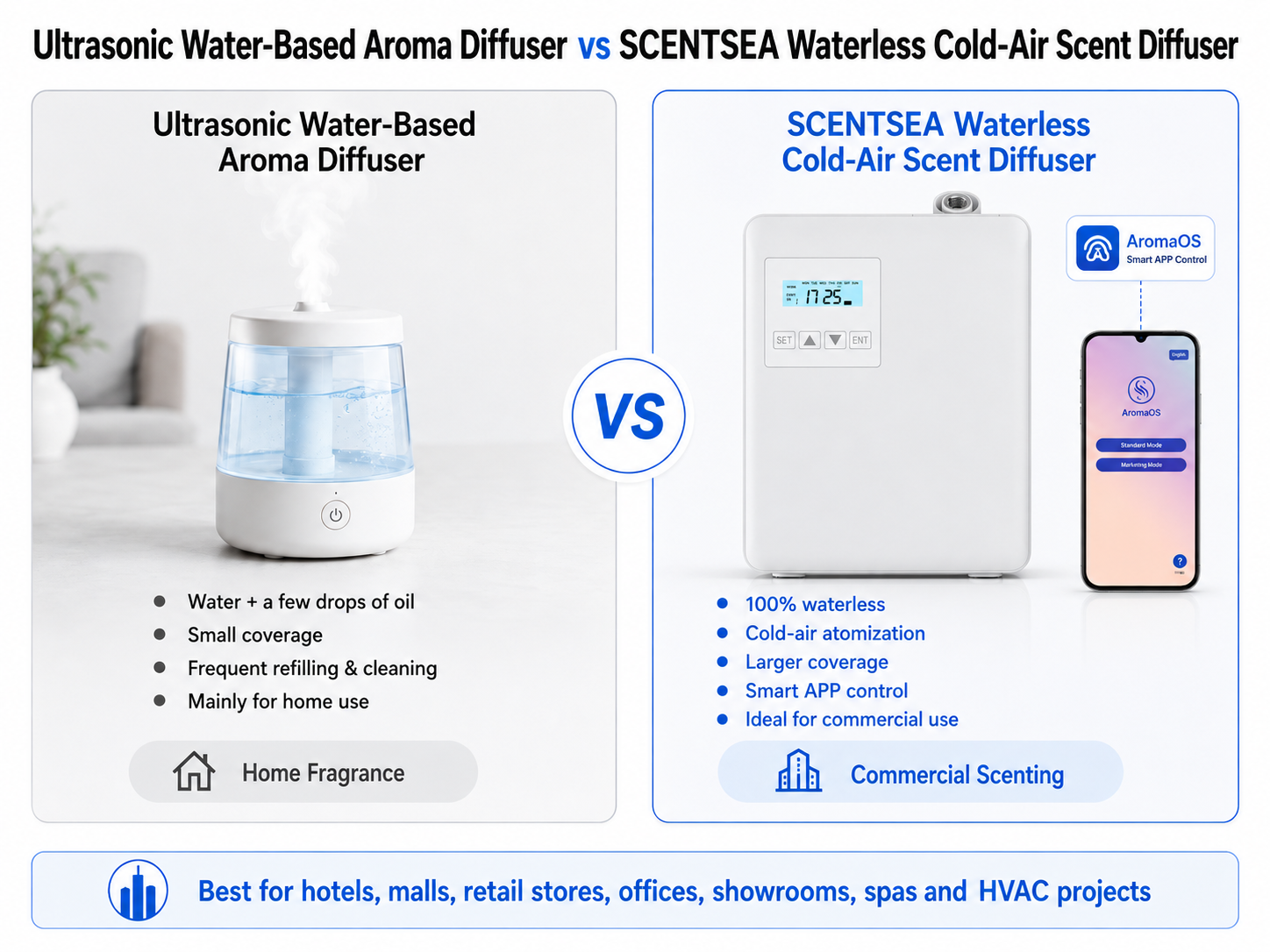
The most consequential technology comparison in commercial scenting is waterless cold-air atomization against ultrasonic, water-based aroma diffusion. Cold-air diffusers atomize fragrance oil directly without water or heat, while ultrasonic aroma diffusers mix water with a few drops of oil and are designed mainly for small residential spaces. Technical guidance from SCENTA describes cold-air nebulizing diffusion as producing sub-micron particles below 2.5 μm without heat or water, which is the mechanism behind the difference.
On coverage and capacity, the gap is structural rather than incremental. Across the SCENTSEA range, coverage spans approximately 30–3,500 m² with fragrance oil capacities from 100 ml to 5 L and 0% water addition, against a water-based format typically intended for a single room. On cost, the trade-off runs the other way at the point of purchase: waterless cold-air equipment carries a higher initial equipment cost, but its five-year maintenance cost can be approximately 40% lower, and the ultrasonic format requires more frequent water refilling, tank cleaning and replacement.
Which Costs Belong in a Total Cost of Ownership Model
Comparing diffusers on purchase price alone produces the wrong shortlist, because the equipment is a small share of a multi-year cost. A workable total cost of ownership model for a commercial scenting project contains six lines:
- Equipment — number of units required, derived from volume-based coverage rather than area-based coverage.
- Installation — mains socket provision, adapter and plug type, duct integration for HVAC models, or battery access planning for battery models.
- Fragrance oil — annual litres, obtained by multiplying the consumption rate in the table above by scheduled operating hours.
- Electricity — from the wattage figures, at local tariff.
- Maintenance labour — refill frequency, atomizer cleaning and (for battery models) battery replacement cycles.
- Consumables logistics — storage, shipping weight and, for importers, duty treatment. Commercial scent diffusers are classified under HS Code 8509.80, with a 4.2% US import duty rate reported by Dutiable and USITC data, which belongs in landed cost rather than in a separate line.
A common error is to compare a high-consumption model against a low-consumption one using equipment price. Re-running the comparison on oil volume usually reverses the ranking: at a 12-hour daily duty cycle, the difference between 3 ml/h (T2) and 5.4 ml/h (H5000) is roughly 1,050 ml per unit per year of fragrance oil — a recurring gap that outpaces a modest equipment price difference within a typical commercial refresh cycle.
Market and Compliance Signals for Budget Planning
Two external signals shape a 2026 procurement plan. The first is category growth: with the global scent marketing market at approximately USD 4.1 billion in 2026 and projected at USD 7.28 billion by 2035 at 6.6% CAGR, hardware supply is unlikely to be constrained, but differentiation will move toward service and consumables. It is worth noting that CAGR estimates diverge — one alternative source reports 10.16% for a narrower definition of scenting — and the difference appears to be methodological, reflecting whether consumer air-care products are included alongside commercial scent marketing. Buyers should treat the direction of growth as the reliable signal and the precise rate as an assumption.
The second signal is evidence on outcomes. A secondary industry compilation reports that scent marketing in retail environments can increase customer dwell time by an average of about 15 minutes. That figure is not manufacturer-verified and should be treated as directional when building a business case; it supports the argument for a pilot rather than replacing one.
On compliance, the requirement set depends on destination market, model and wireless configuration. European buyers should normally verify applicable CE and RoHS documentation, and Bluetooth or Wi-Fi models may also need to satisfy RED requirements. US buyers should verify applicable FCC compliance. The operative discipline is that certificates and test reports must match the exact production model and configuration being purchased — a certificate for a similar model is not evidence for the model in the purchase order. For fragrance oils used in European HVAC projects, region-specific oil documentation such as REACH and IFRA-type declarations is frequently requested; buyers should ask for it early, since oil documentation often lags hardware documentation.
Future Outlook: Where Scenting Procurement Is Heading
Three shifts are visible in the specification data itself. First, scheduling is becoming the primary cost lever: because operating hours scale oil and electricity consumption linearly, the difference between 12-hour and 24-hour scheduling is a 50% reduction in scheduled operating time, and app-based control of working hours and intensity is now a standard expectation rather than a premium feature. Second, capacity is consolidating: larger reservoirs such as the 5 L AC-MAX move refill intervals from weekly to roughly two-month rhythms, which changes the service model from frequent manual visits toward scheduled maintenance.
Third, procurement is moving toward documented verification. Functional testing, aging tests and leakage inspection before shipment, sample availability prior to bulk orders, and model-specific compliance files are becoming evaluation criteria rather than goodwill gestures. As the category matures, the suppliers that win will be those whose published numbers survive a site survey — which is why the arithmetic in this article, not the wording of a brochure, is the more useful document in a decision file.
Frequently Asked Technical Questions
How do I compare two coverage ratings when one is quoted in m² and the other in m³?
Divide the volume rating by the area rating to reveal the assumed ceiling height, then apply the site's actual ceiling. The H5000 is published at 800–1,300 m² and 2,500–4,000 m³, which implies a ceiling of about 3.1 m; the P02 at 150–350 m² and 500–1,000 m³ implies roughly 2.9–3.3 m. Where the site's ceiling is materially higher than the assumption, use the volume rating as the primary figure.
What does the ±10% tolerance on oil consumption mean for refill planning?
It defines the planning band. A nominal 5.4 ±10% ml/h rating on the H5000 corresponds to between 4.86 and 5.94 ml/h. Budget refills on the upper bound: with a 1,000 ml reservoir, worst-case consumption gives approximately 168 hours of atomization against roughly 185 hours at nominal rate, a difference of about a day and a half at a 12-hour daily duty cycle.
Can the 4705 run without a mains connection?
Yes. The 4705 is a battery-operated diffuser supplied by 4 × D batteries or 5 V Type-C at 2.5 W. It covers 100–150 m² (300–500 m³ or 1,000–1,600 ft²) from a 500 ml reservoir at below 35 dB, and is intended for washrooms and elevators, where wiring is impractical. Battery replacement cycles, not electricity supply, become the maintenance consideration.
Which models need a mains socket and which are self-powered?
The P02 (DC 12 V, 6.5 W), H5000 (DC 12 V, 20 W), A300 (DC 12 V, 12 W), T2 and T3 (DC 12 V 2 A) and AC-MAX (DC 12 V, 48 W) are plug-in and require an adapter and socket. The S01 and SC19 operate directly on 110–240 V AC. The 4705 and P03 are battery-operated. Adapter plug type should be specified per destination market.
Do cold-air scent diffusers need water?
No. Waterless cold-air diffusion atomizes fragrance oil directly without adding water or using heat, and across the SCENTSEA range the format requires 0% water addition, with capacities from 100 ml to 5 L. Ultrasonic, water-based aroma diffusers mix water with a few drops of oil and are designed mainly for small residential spaces rather than for large-area or continuous commercial scenting.
How much does a diffuser add to the electricity bill?
Calculate watt-hours and apply the local tariff. At a 12-hour daily cycle, the H5000 at 20 W draws 0.24 kWh per day, approximately 88 kWh per year; the P02 at 6.5 W draws 0.078 kWh per day, approximately 28 kWh per year; the 4705 at 2.5 W draws 0.03 kWh per day, approximately 11 kWh per year. Dedicated heating power on these cold-air platforms is 0 W.
How does the refill interval change if the unit runs continuously?
It halves. Refill intervals scale linearly with scheduled operating hours, and running 12 hours per day instead of 24 hours reduces scheduled operating time by 50%. A unit refilled every 15 days on a 12-hour schedule would need refilling roughly every 7 to 8 days on continuous operation, with oil consumption and electricity use rising proportionally.
What documentation should be verified before placing a bulk order?
Verify that certificates and test reports match the exact production model and configuration, since requirements vary by market and product: CE and RoHS for the European Union, FCC for the United States, and RED for Bluetooth or Wi-Fi models. Also confirm applicable duty treatment — commercial scent diffusers are classified under HS Code 8509.80, with a 4.2% US duty rate reported by Dutiable and USITC data — and request region-specific fragrance oil documentation where the project requires it.
A downloadable product catalog covering the models referenced in this article, including published coverage, capacity, consumption, power and noise data, is available here: SCENTSEA product catalog. Technical documentation for individual models can be requested directly from the manufacturer, Shenzhen Scentsea Technology Co., Ltd.