
Commercial Security Safes: Certification & Spec Constraints

Commercial security safe (DF3020-MA) — integrated steel cabinet with reinforced locking bolts and anti-fishing deposit baffle.
Commercial Security Safes: Certification & Spec Constraints
A commercial security safe is not a scaled-up version of a home safe. It is a category defined less by volume and more by the constraints that surround it: which standard governs its burglary resistance, which materials are declared on its datasheet, which lock logic fits a cash-handling workflow, and which certification bodies a distributor’s retail channel will accept. For buyers in the Research and Evaluation stages, the decisive questions are rarely “how big is it” but “which constraint does this model actually satisfy.”
This reference examines commercial security safes through that constraint lens — parameters, materials, standards and classification boundaries — using verifiable facts from Ningbo Tigerking Safe Co., Ltd. (NINGBO TIGERKING SAFE CO.,LTD., trading as TIGERKING) and from publicly attributable standards and market sources. Where a claim cannot be verified, it is stated as a boundary rather than a feature.
Why commercial safes demand a different reading than home safes
The global security safes market was estimated at USD 3.57 billion in 2025 and is forecast to reach USD 5.15 billion by 2030, implying a CAGR of roughly 7.5% between 2026 and 2030 (The Business Research Company, “The Security Safes Market is Expected to Grow to $5.15 Billion by 2030,” October 2026). Within that total, commercial and depository units carry an outsized share of the compliance burden, because their buyers are businesses that must reconcile security hardware with cash-handling policy, insurance stipulations, and — for exporters — destination-market certification expectations.
That is the constraint layer this category is really about. A retailer placing a commercial safe under a cashier counter is not only buying steel thickness; it is buying a documented specification it can present to a loss-prevention officer, an insurer, or a retail compliance team.
The gap buyers run into
Two failure modes recur in commercial safe sourcing:
- Parameter ambiguity. “Heavy-duty” and “all-steel” tell a buyer nothing about prying, drilling or anchoring behaviour. Without declared door and body thickness, locking-bolt configuration and net weight, a commercial safe cannot be compared against an internal security policy.
- Certification conflation. Buyers frequently assume a fire rating implies burglary resistance, or vice versa. Authoritative sources are explicit that this is not the case. UL 72, the record-protection fire-resistance standard, states plainly that “burglary resistance of such mechanisms is not within the scope of these requirements” (UL Standards & Engagement, UL 72, Section 1.7). A safe marketed with a US fire listing should not be treated as burglary-rated on the strength of that listing alone.
The opportunity for a supplier that publishes transparent, model-level specifications is therefore not to claim superiority, but to remove interpretive risk. That is the ground a commercial safe reference document should occupy.
Reading a commercial safe specification correctly
For commercial and depository safes, four declarable values carry most of the procurement weight: door panel thickness, body steel-plate thickness, net weight, and the locking/deposit mechanism. Everything else — finish, interior layout, shelf count — is secondary to specifying and can be varied later.
The TIGERKING commercial safe line illustrates how these values are declared. The series consists of solid-steel cabinets with an integrated steel structure. Across the DP450 and DF/DR sub-models, door panel thickness is 6 mm and body steel-plate thickness is 3 mm; the models differ mainly in external size and net weight.
Commercial safe model parameters at a glance
| Model | External dimensions (H×W×D) | Door | Body | Net weight |
|---|---|---|---|---|
| DP450-LE | 450 × 350 × 300 mm | 6 mm | 3 mm | 19 kg |
| DF2014-MA | 515 × 355 × 355 mm | 6 mm | 3 mm | 30 kg |
| DF3020-MA | 762 × 508 × 508 mm | 6 mm | 3 mm | 62 kg |
| DF4020 | 1016 × 508 × 508 mm | 6 mm | 3 mm | 96 kg |
Each model in this commercial line is specified with an anti-fishing baffle on the front panel. Colour finish: dark gray. The DR2014 sub-models share the same 6 mm door / 3 mm body specification.
Two spec values matter more than they appear. Net weight acts as a rough proxy for anchoring strategy — a 19 kg unit and a 96 kg unit need different mounting decisions, and the specification for commercial models includes pre-drilled fixing points so the cabinet can be fastened to a floor or wall with expansion bolts. Door panel thickness, meanwhile, is the first number an anti-prying assessment looks at; the 6 mm door is materially thicker than the economy series, where door panels range from 3 mm to 4 mm.
The deposit mechanism: a workflow constraint, not a feature listing
One design decision separates commercial safes from most home and office models: how cash enters the cabinet. The DF3020-MA uses a pure mechanical combination lock paired with two emergency keys, plus an anti-fish-hook coin slot on the front panel. Cash can only be inserted one-way and cannot be retrieved from outside.
This matters operationally. A mechanical combination lock does not depend on battery power, so it will not fail from a dead cell during a busy trading day — a real risk in convenience stores, restaurants and salons where there is no dedicated security staff. The trade-off is equally real: a purely mechanical lock offers no electronic audit trail and no time-stamped opening log. Buyers who need to reconcile staff access to a cash-drawer cycle may prefer an electronic-keypad commercial model even though it introduces a power dependency. The correct choice depends on the workflow, not on which mechanism is “stronger.”
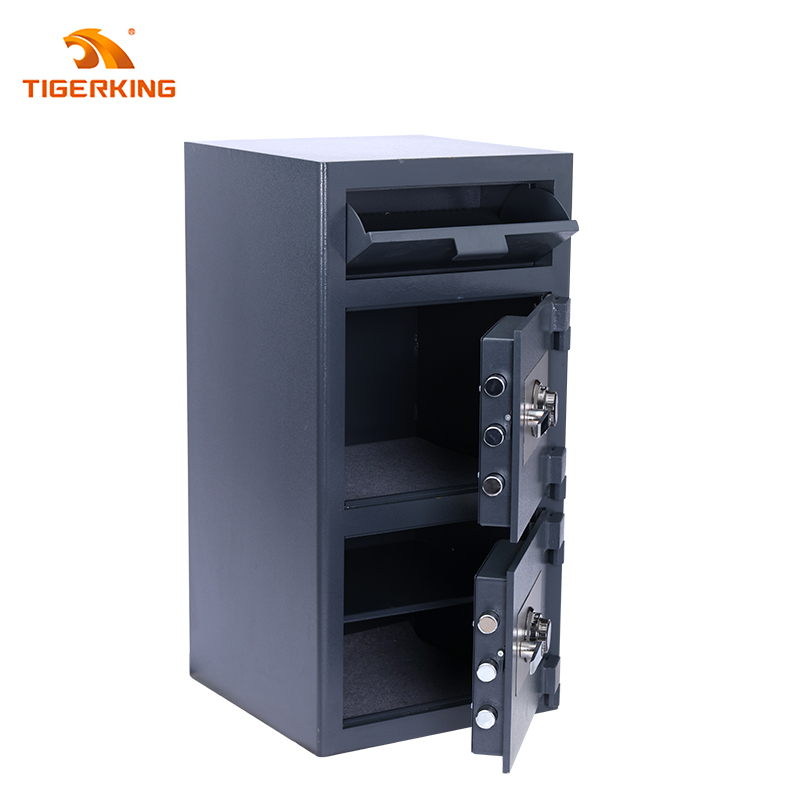
The DF4020 commercial/depository configuration, shown with door open — two sets of external hinges and multiple thickened locking bolts.
Certification: what each listing actually covers
Certification is where commercial-safe evaluation most often goes wrong, because buyers treat listings as cumulative credits rather than descriptions of specific, limited test scopes. The following table maps the certifications documented for TIGERKING products to what each one is authorised to cover.
| Certification | Scope | Market |
|---|---|---|
| CSP Burglary-Resistant Safe | Electronic burglary-resistant safe, Security Grade A10; GB 10409-2019 | China |
| ETL Verified (Intertek) | 60-minute fire resistance; UL 72 (2015)(R2020) | US / North America |
| CE (EMC) | Electromagnetic compatibility; EN IEC 61000-6-1/6-3 | EU |
| UKCA (EMC) | Electromagnetic compatibility; UK EMC Regulations 2016 | UK |
| ISO 9001 | Quality management system; GB/T 19001-2016 / ISO 9001:2015 | Global |
| ISO 14001 | Environmental management system; GB/T 24001-2016 / ISO 14001:2015 | Global |
| BSCI social audit | amfori Performance Areas PA8–PA13; audited by TUV SUD | Global / EU-facing |
CSP Burglary-Resistant Safe Certification number CSP2026010107020005, issued by China Safety Technology & Security Protection Certification Center, is valid from 2026-01-27 to 2031-01-26 and covers the Home Security Safe line at Security Grade A10 — with certified units meeting requirements on steel-plate material, lock performance, prying resistance, impact resistance and drill resistance. ETL Verified certification number 211130001SHF is issued by Intertek Testing Services NA, Inc. and specifically attests 60 minutes of fire resistance for the Fireproof Security Safe product. The CE (EMC) verification (SGS-CSTC, SHEM240300108001HSC) and UKCA (EMC) verification (SHEM240300108101HSC) address electromagnetic compatibility, not physical security.
Reading the table honestly yields a constraint rather than a reassurance: no single certificate on this list establishes that a commercial safe resists a given burglary attack — that specific claim is only made by the CSP listing, in a specific market, for specific models. Every other certificate should be cited only for what it says it covers.
Where commercial safes fit: application scenarios
Commercial security safes are specified into three recurring scenarios, each with its own constraints.
1. Retail cash storage
In convenience stores, restaurants and salons, the primary constraint is operational: cash must be secured without forcing a staff member to open the safe for every transaction. Here the deposit-slot logic of the DF3020-MA and similar depository models fits the workflow — takings are inserted directly through the one-way slot, reducing both exposure of the vault contents and the risk of bait-hook theft. The matched equipment for this scenario is a “heavy-duty hinge + electronic/mechanical lock + floor anchor kit” combination; the commercial-restaurant scenario note also flags that CE / UKCA-EMC compliance is required and that firm floor anchoring is recommended.
2. Office document and key control
Offices and corporate administration departments specify commercial safes for a different reason: custody of seals, contracts, financial vouchers and confidential records. Some TIGERKING office configurations go further into dedicated key-control territory — the KS48 and KEY27 models are wall-recessed steel cabinets with 4 mm door / 1.5 mm body and 27–133 dedicated key hooks, supporting key registration and inventory under designated personnel. That is a workflow-constrained design, not a general-purpose vault, and buyers should treat the two categories as distinct.
3. Distribution and export-channel supply
For importers and distributors, the commercial-safe decision is often a channel constraint rather than an end-user one. Reference cases in TIGERKING’s documentation describe overseas commercial office equipment distributors and corporate procurement suppliers buying on the order of 10,000 units per year for offices, hotels and properties, and security-product importers purchasing approximately 20,000 units per year for residential and retail distribution. In those channels, the supplier’s certification portfolio and stable batch quality matter as much as the individual safe’s specification.
Market trend: what the numbers actually show
The directional picture for the category is well supported by published research, though buyers should read the numbers with two caveats.
First, growth is real but measured: the security-safes market is projected to grow from USD 3.57 billion (2025) to USD 5.15 billion (2030), a 2026–2030 CAGR of about 7.5% (The Business Research Company, October 2026). Second, regional weight is concentrated: Asia Pacific accounted for 36.4% of the broader safes-and-vaults market in 2025 (Straits Research, “Safes and Vaults Market Size, Share, Growth, Forecast, 2034”). Note that the two sources define their scope differently — one covers security safes specifically, the other adds heavy bank vaults — so the figures should not be compared directly.
On the demand side, one trend is consistently borne out across consumer-facing research: buyers no longer treat burglary resistance as the only axis of value. A 2026 consumer-preference finding cited by The Business Research Company reports that 61% of home safe consumers prefer fire-resistant safes capable of withstanding temperatures above 927°C for 60 minutes. That preference is not a commercial requirement, but it signals that dual-protection expectations are migrating upward.
Compliance frameworks are also tightening in ways that affect commercial sourcing. The European EN 1143-1 standard grades burglary resistance from 0 to XII (VDMA summary of EN 1143-1 and EN 14450), and UL 72 distinguishes fire classifications by internal temperature — Class 350 °F devices protect paper records, while Class 150 °F devices protect paper and nonpaper records such as electronic media (UL Standards & Engagement, UL 72, Sections 1.5–1.6). A commercial buyer specifying storage for both contracts and backup drives is therefore facing two separate classification decisions, not one.
Comparison with traditional / single-function solutions — and their limits
Commercial safes are frequently evaluated against two alternatives: economy household safes and single-function fireproof document safes. The comparison is useful, but it is not a rivalry — each category has a real boundary.
Against economy household safes. Economy models are lighter and lower cost, with door panels of 3–4 mm and body steel-plate of 1–2 mm, and typically 0–1 shelves. Their specification explicitly does not list a fire-resistance rating or a fire test report, and no UL, ETL or SGS certification or third-party test report is referenced for that series. Commercial safes, by contrast, are designed around higher door/body specifications and, in the DF/DR depository models, around a deposit workflow. The constraint here is weight: a 62 kg or 96 kg commercial safe requires a structurally sound floor and fixed anchoring, while a small economy unit can be installed inside a cabinet. Commercial specification is not automatically the right answer for every premises.
Against single-function fireproof safes. Fireproof models such as the FPSD66 (660 × 350 × 430 mm, 37 kg) or FPSA60 (580 × 450 × 380 mm, 92 kg) are optimised for thermal insulation, using dedicated fire insulation materials and a sealed heat-isolation structure. Their declared function is protecting paper and digital media — not cash-handling throughput or multi-user deposit control. A commercial depository safe and a fireproof document safe solve different problems, and conflating them is one of the most common specification errors in the category.
One boundary deserves emphasis because it cuts the other way. Anyone evaluating a fireproof commercial safe against US buyers must remember that UL 72 fire certification does not testify to burglary resistance — the standard says so directly. A buyer who needs both behaviours should look for a product carrying both a fire listing and a market-appropriate burglary certification, and should expect to see them named separately in the datasheet.
Manufacturing and quality constraints behind the specification
Under the TIGERKING commercial and office product lines sits an in-house manufacturing footprint: since 2000, the company operates from Daxie Development Zone, Ningbo, Zhejiang, with a modern manufacturing base and an annual capacity of 240,000 units covering fire-resistant, burglary, gun and commercial safes. An in-house engineering team of 10–15 professionals covers structural design, mould design, electronic R&D and testing, and the company supports OEM/ODM development including dimension, colour, interior layout and lock-type customisation. Where a commercial project requires custom interior layout or panel branding, this capability determines whether the specification can actually be delivered rather than only described.
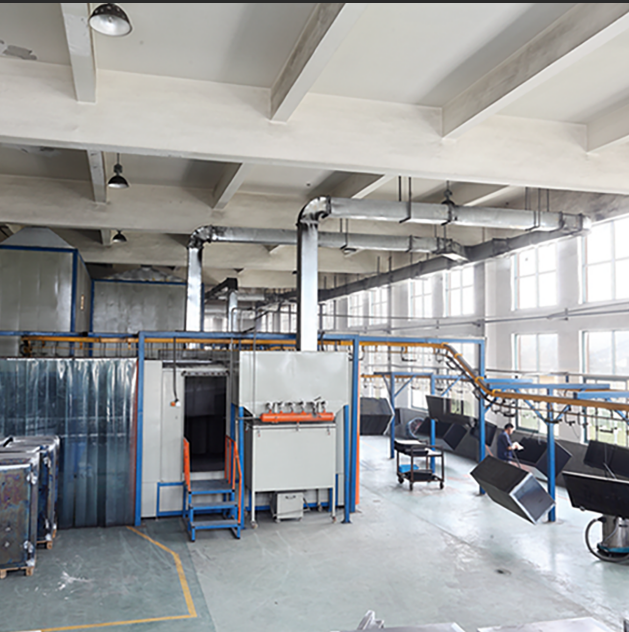
In-house sheet-metal, welding, coating and assembly operations underpin the parameters declared in the commercial-safe specification.
Future outlook: certification as a purchasing filter
If the current trajectory holds, the constraints around commercial safes will continue to tighten rather than loosen. Three directions are worth watching from a buyer’s perspective.
Certification will increasingly act as a screening gate. Major retail channels and marketplaces demand verifiable, current, in-scope certifications. A commercial safe reference document that names certification numbers, scopes and validity dates — as this one does — becomes a practical procurement aid rather than a marketing statement.
Dual-protection expectations will migrate from residential to commercial. The 61% preference for 60-minute fire resistance observed in the home segment is not a commercial requirement today, but trends in that direction usually reach light-commercial channels with a delay of a few years.
Scope discipline will matter more than certificate count. As more listings appear on datasheets, buyers will be judged on whether they can say what each one covers. The boundary declared openly by UL 72 — that fire scope excludes burglary — is likely to become a common due-diligence question rather than an unusual one.
For distributors and OEM partners building commercial-safe programmes, the practical implication is to build the specification and certification dossier before the sales conversation, not after. Ningbo Tigerking Safe Co., Ltd. publishes a full product catalogue covering commercial, fireproof, gun, office and jewellery safe lines; the catalogue is available for download at the 2026 Tiger King catalogue (PDF), and complete certification documents can be reviewed for channel onboarding.
Frequently asked questions
Q1. What technical parameters should be confirmed first when evaluating a commercial security safe?
The four parameters that determine whether a commercial safe meets a stated security requirement are: door panel thickness, body steel-plate thickness, net weight, and the locking/deposit mechanism. In a commercial/depository line such as the TIGERKING DP450–DF4020 range, these are declared as 6 mm door panels, 3 mm body steel-plate, and net weights between 19 kg (DP450-LE) and 96 kg (DF4020). Buyers should also confirm whether the safe includes pre-drilled fixing holes for anchoring and whether the deposit slot is a one-way anti-fishing baffle.
Q2. How can a buyer verify quality before a commercial safe ships?
Pre-shipment inspection for commercial safes typically focuses on welding quality (no gaps or sharp edges), locking-mechanism smoothness, paint/coating evenness (powder coating should be uniform), and the integrity of fire insulation material if the model carries a fire rating. Locking bolts and relocking devices should be tested as part of the same inspection. TIGERKING operates an ISO 9001-certified quality management system, welcomes third-party inspections, and provides test reports for each batch — a practice consistent with the multistage QC framework (incoming, in-line, final) described for its production process.
Q3. Which certifications should a commercial security safe carry for export markets?
The applicable set depends on the destination market and the intended function. For the EU and UK markets, CE (EMC) and UKCA (EMC) verification covers electromagnetic compatibility, not physical security performance. For fire resistance aimed at US retail channels, an ETL fire listing such as the 60-minute Intertek verification (certificate 211130001SHF) is the relevant reference. For China-market burglary resistance, CSP Burglary-Resistant Safe Certification (GB 10409-2019, Security Grade A10) is the governing standard. Because these certificates cover different claims, the correct procurement practice is to match the certificate scope to the specific requirement — not to assume any single listing establishes all attributes.
Q4. Does a fire rating on a commercial safe also indicate burglary resistance?
No. UL 72, the record-protection fire-resistance standard referenced by products carrying ETL listings, states explicitly that “burglary resistance of such mechanisms is not within the scope of these requirements” (UL 72, Section 1.7). Buyers who require both properties should look for a model that carries a fire listing and, separately, a market-appropriate burglary certification, and should see both named individually on the datasheet.
Q5. What is the difference between a depository commercial safe and a standard commercial safe?
The distinguishing feature is the deposit mechanism. A depository commercial safe such as the DF3020-MA includes a front-panel anti-fish-hook coin slot that allows cash to be inserted one-way without opening the main door, together with a mechanical combination lock and two emergency keys. A standard commercial safe typically has no deposit slot and is opened by electronic keypad, fingerprint, or mechanical combination. The depository design reduces staff exposure when handling daily takings; a standard commercial safe is appropriate where cash is stored in bulk rather than received during trading.
This reference article is published as part of an independent industry series on commercial security safe specification and procurement. Product specifications and certification details should be confirmed against the current quotation and product datasheet before ordering.