
Commercial Tile Solutions for Luxury Hotel Lobbies: Marble Series 60x120cm Porcelain
A luxury hotel lobby is one of the most demanding interior surfaces in commercial construction. It has to absorb continuous footfall, rolling luggage, service carts and repeated cleaning from the day it opens, while presenting a stone-effect finish that sets the tone for the entire property. That combination is what makes the floor specification a high-risk decision long before handover — and what makes the choice of body material, format and long-term supplier support worth examining carefully at the execution stage.
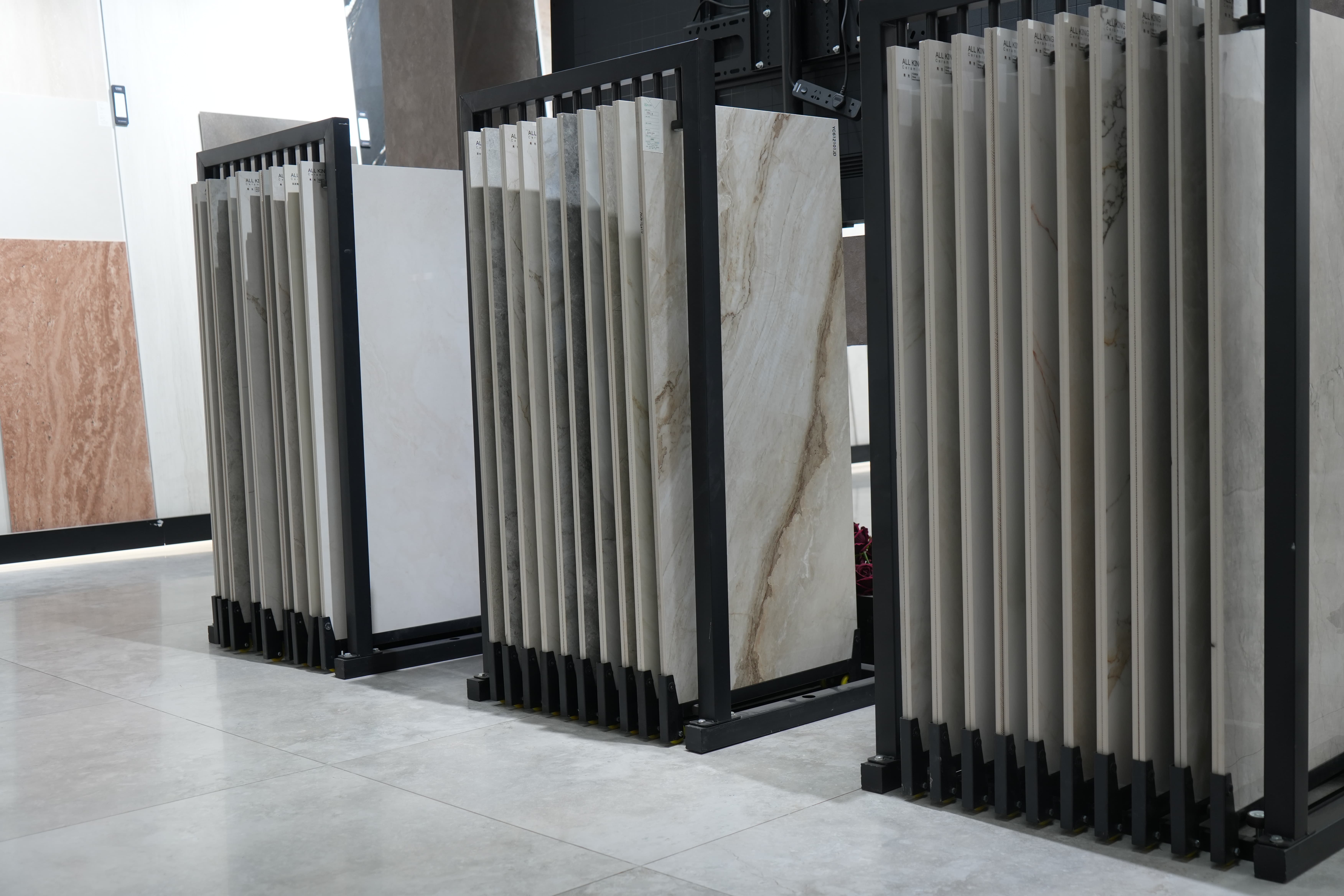
Why Luxury Hotel Lobbies Demand a Different Flooring Decision
Hotel lobbies differ from most commercial interiors because several forms of stress operate at the same time. Point loads arrive through luggage wheels, trolley casters and occasional furniture movement. Abrasion is continuous rather than episodic. Cleaning regimes are frequent and chemical, because guest-facing areas are held to a visible standard throughout the day. And the surface itself is on display: it is the first material a guest sees, and it is expected to look unchanged years into operation.
Natural marble has historically set the visual benchmark for this environment, but it also brings a predictable set of operational costs. It is porous enough to need periodic sealing. It stains and etches when acidic cleaning agents or spillages reach the surface. It scratches under abrasive loads, and once scratched or chipped it is difficult to restore invisibly. For a hotel that cannot close its lobby for refurbishment without disrupting operations, each of those characteristics converts into a recurring maintenance line item rather than a one-off construction cost.
The practical consequence is that hospitality specifiers increasingly separate the visual reference from the material system. The look still comes from stone. The working surface is more often a porcelain tile engineered for high-traffic commercial use. That separation is the context in which a product such as the Marble Series 60x120cm porcelain tile should be evaluated — not as a replacement for the design intent, but as the material that has to survive it.
The Brand Solution: Marble Series 60x120cm Porcelain by ALL KING CERAMICS
ALL KING CERAMICS is a porcelain tile manufacturer and direct exporter operating as ZIBO ALL-KING CERAMICS CO., LTD from a 60,000 m² facility in Zibo, Shandong, China. Founded in 2011, the company exports roughly 70% of its output and lists contractors, distributors and builders across Australia, New Zealand, South Korea, Southeast Asia, Central Asia, Russia, the Middle East and Latin America among its served markets. Its stated flagship core product is the 60x120cm porcelain tile, supported by a format matrix that also includes 60x60cm, 80x80cm, 100x100cm and 75x150cm.
The Marble Series 60x120cm format is positioned for hospitality and commercial interiors where a large, stone-effect surface is required together with the mechanical behaviour of a vitrified porcelain body. For a lobby, the 60x120cm size matters for two reasons: fewer joints across a large floor plate, which reads more like a continuous stone surface, and fewer grout lines to maintain in a space that will be cleaned several times a day.
Technical Explanation: What the Specification Numbers Actually Mean
The values below are the verified performance specifications for the Marble Series 60x120cm vitrified porcelain tile. Read together, they describe a surface designed for sustained commercial duty rather than occasional residential traffic.
| Specification | Verified value | Why it matters in a hotel lobby |
|---|---|---|
| Body type | Vitrified porcelain | Dense, low-porosity body that resists staining and moisture ingress |
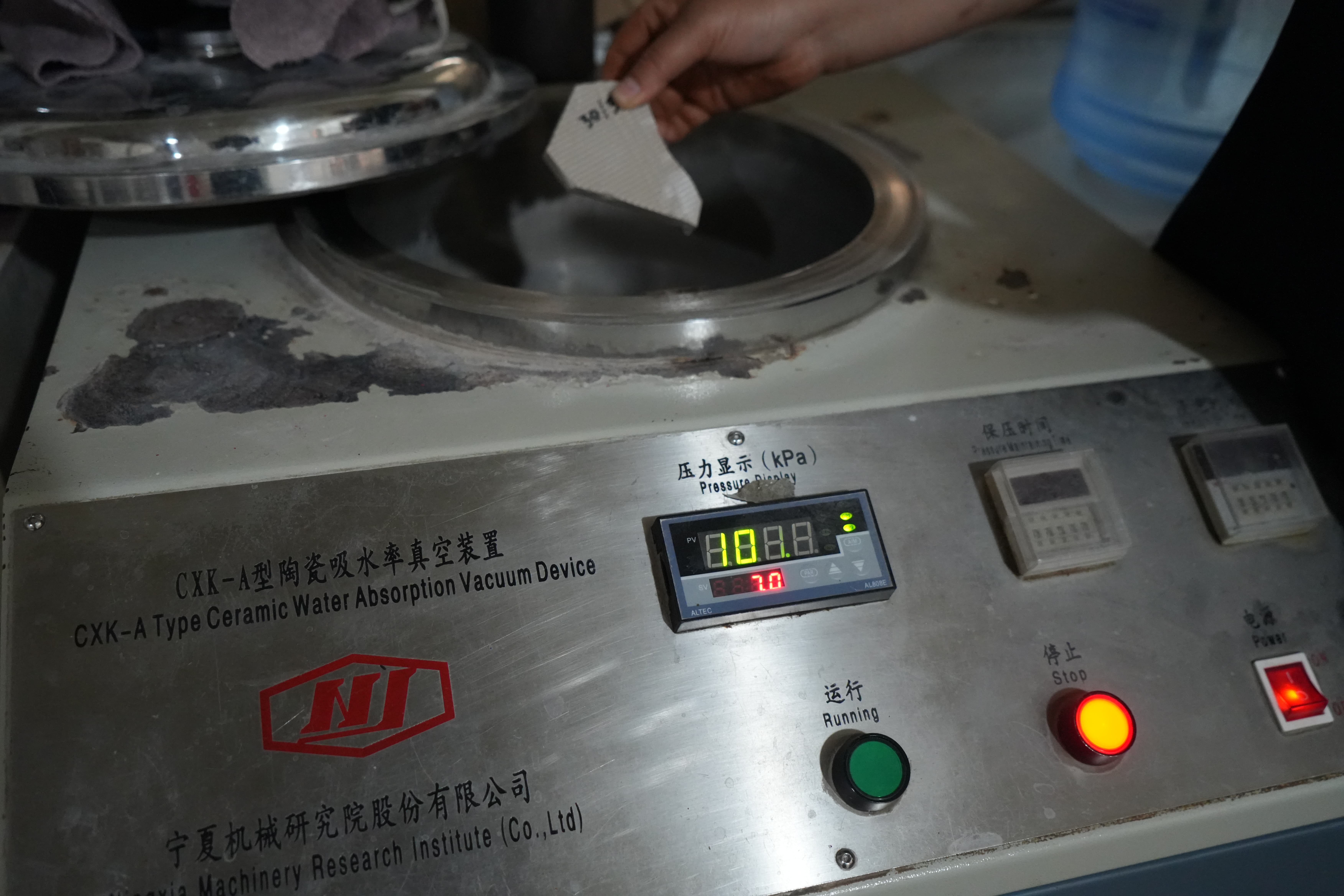
| Water absorption | Below 0.5% | Aligns with the porcelain classification threshold under ISO 13006 / ANSI A137.1 and supports easier cleaning |
| Abrasion resistance | PEI 4 and PEI 5 | Rated for heavy commercial and extra-heavy traffic floors |
| Surface hardness | Mohs 6–7 | Resists scratching from luggage wheels, trolleys and routine cleaning |
| Breaking strength | 1300 N or higher | Withstands point loading from equipment and concentrated footfall |
| Modulus of rupture | 35 MPa or higher | Indicates flexural load capacity under sustained service |
| Thickness | 9.0–10.5 mm | Balances structural rigidity against handling and installation weight |
| Sealing requirement | None | Removes a recurring maintenance step typical of natural stone |
Water absorption below 0.5%
Water absorption is the single clearest indicator of whether a tile behaves as a true porcelain. Porcelain tiles are defined as ceramic tiles with water absorption of 0.5% or less under ISO 13006 and ANSI A137.1. A body at or below that threshold is dense enough that liquids sit on the surface rather than penetrating it. In a lobby where coffee, wine and cleaning solutions are spilled routinely, that property is what keeps staining a surface-level cleaning task instead of a permanent mark.
PEI 4 and PEI 5 abrasion resistance
The PEI scale classifies a glazed surface by its resistance to abrasive wear. PEI 4 corresponds to heavy commercial use; PEI 5 to extra-heavy traffic. A lobby floor that also serves as a circulation route for the whole building sits closer to the extra-heavy end of that range than a guest corridor does, which is why both ratings are relevant when comparing this product against standard commercial-grade ceramic.
Mohs 6–7 hardness
Surface hardness in the Mohs 6–7 band places the tile above the minerals most likely to be dragged across it in normal hotel operation. It does not make the surface immune to abrasive grit, but it substantially reduces the rate at which a lobby floor develops the dulling and fine scratching that makes stone surfaces look tired.
Breaking strength 1300 N or higher and modulus of rupture 35 MPa or higher
These two values describe resistance to different loading patterns. Breaking strength measures the load a tile can carry before failure under concentrated force — the kind of load delivered by a loaded luggage trolley or a piece of furniture on a small contact area. Modulus of rupture describes flexural capacity across a span, which becomes the governing figure when the substrate is not perfectly rigid. Both matter in a lobby, where heavy wheeled equipment and large uninterrupted floor plates are normal.
Thickness 9.0–10.5 mm and no sealing required
The 9.0–10.5 mm thickness range gives the format enough rigidity for large-format installation without pushing unit weight beyond what standard handling equipment manages. Because the body is vitrified rather than absorbent stone, the surface does not require sealing — a maintenance characteristic that removes both the product cost and the labour cycle from the hotel’s operating budget.
Application and Use Cases
Within hospitality, the Marble Series 60x120cm format is relevant wherever a stone-effect surface has to combine appearance with heavy duty. The most direct applications include:
- Lobby and reception floors. The largest uninterrupted visible surface in the building, subject to the highest footfall density and the most frequent cleaning.
- Pre-function and ballroom foyers. Spill-prone, furniture-heavy spaces where the surface is both walked on and looked at from a low angle.
- Corridors and lift lobbies. Constant circulation with wheeled service traffic and limited maintenance windows.
- Lobby bars and lounge areas. Higher exposure to food, drink and cleaning chemistry than guest floors.
- Spa and wellness entries. Where moisture exposure and slip considerations sit alongside appearance.
The same performance profile extends beyond hotels to other high-traffic commercial and public interiors: shopping mall concourses, railway stations and airport terminals, hospital circulation areas, corporate headquarters and educational facilities. In each case the underlying requirement is the same — a surface that holds its appearance under sustained load and can be maintained with a routine rather than a specialist programme.
Market Trend Analysis: Where the Demand Is Moving
Several observable market signals support the case for specifying a vitrified porcelain system in hospitality and commercial projects.
Construction momentum in Central Asia. Kazakhstan’s construction output grew by 15.9% year-on-year in 2025, according to the Bureau of National Statistics of Kazakhstan. Growth at that level translates into new hotel, retail and public building stock — the segment where large-format commercial tile is specified.
Freight routes shaping supplier selection. Rail freight transit from China to Central Asia typically takes 10 to 14 days for FCL shipments. For landlocked markets, that corridor reduces the lead-time risk that normally pushes project buyers toward higher-cost local distributors, and it changes what a realistic procurement schedule looks like.
Standards alignment as a screening filter. Certification has become a practical procurement gate. ISO 9001:2015 and CE marking are commonly requested in global hospitality project documentation, and the ISO 13006 water absorption classification provides an objective basis for verifying that a product described as porcelain actually meets the definition.
Read together, these signals point in one direction: buyers are moving away from evaluating tile on appearance alone and toward evaluating the full delivery system — material behaviour, certification, freight route and after-sales commitment.
Comparison with Traditional Solutions
The most relevant comparison is between the Marble Series 60x120cm porcelain tile, natural marble, and low-grade ceramic tile.
| Consideration | Marble Series 60x120cm porcelain | Natural marble | Low-grade ceramic tile |
|---|---|---|---|
| Water absorption | Below 0.5% | Absorbent; requires sealing | Higher absorption than porcelain |
| Abrasion resistance | PEI 4–5 | Scratches and etches under abrasive load | Lower wear resistance |
| Surface hardness | Mohs 6–7 | Soft enough to scratch and chip | Lower hardness |
| Sealing | Not required | Periodic re-sealing required | Generally not required |
| Cleaning | Easier cleaning; low-porosity surface | Neutral cleaners only; staining risk | Staining risk increases over time |
| Grout upkeep | Minimal grout upkeep with large format | Grout lines comparable, surface harder to restore | More replacement and refurbishment frequency |
| Installation cost | 20% lower installation cost versus low-grade ceramic tile | Higher labour and finishing cost | Baseline |
| Maintenance cost | 30% lower maintenance cost versus low-grade ceramic tile | Highest recurring cost of the three | Baseline |
| Best suited to | Luxury hotels, commercial centres, transit hubs, corporate offices | Feature areas and low-traffic decorative zones | Light-duty interior applications |
Against low-grade ceramic tile, the reported performance gap is a 10% lower water absorption figure, 15 MPa higher breaking strength and 3 points higher Mohs hardness, with better density and flatness consistency. Those differences are what produce the 20% lower installation cost and 30% lower maintenance cost outcomes, because fewer tiles are lost to handling damage, fewer are replaced in service, and the surface can be cleaned with standard commercial methods.
Long-Term Supplier Support and After-Sales
For a hotel group operating more than one property, the flooring decision does not end at delivery. Consistent appearance across phases, the ability to reorder the same batch years later, and a defined response when damage occurs are all part of what makes a supplier relationship viable over a building’s life.
ALL KING CERAMICS states that its after-sales services include damage compensation, online installation guidance, 24/7 technical consultation, and batch tracking and reordering support. Batch tracking is the operative capability for hospitality portfolios: it is what allows a later phase, a refurbishment or a damaged-area repair to source material that matches the original installation rather than approximating it.
On the production side, the company reports a monthly production capacity of 1.2 million square meters, alongside a reported annual production capacity of 12–16 million square meters and a minimum order quantity of 400 square meters per design, with trial orders accepted. Delivery terms are quoted as EXW, FOB, CNF or CIF, with third-party inspection available as an acceptance criterion and payment terms of 30% TT with 70% against BL copy, L/C, or cash.
Manufacturing risk controls reported for the production process include laser flatness sorting, automatic temperature control, digital weight monitoring, high-pressure compaction and random stress testing, supported by laser detectors, SACMI presses, automatic sorters, CNC testing instruments, laboratory kilns and ISO 9001 certification. These controls address the failure modes that matter most in a lobby installation — warping, cracking, dimensional variation, fading and staining.
Future Outlook
Two shifts are likely to shape hospitality flooring specifications over the next several years.
The first is the continued substitution of engineered porcelain for natural stone in high-traffic public areas. As large-format porcelain improves in surface realism, the visual argument for natural marble narrows to projects where genuine stone is itself the design feature — while the operational argument for porcelain strengthens with every maintenance cycle avoided.
The second is that supplier evaluation is broadening from product specification to delivery system. Certification documentation, freight corridors, batch traceability and after-sales terms are increasingly treated as part of the product. For buyers working across multiple markets and multiple project phases, that shift favours suppliers who can demonstrate continuity rather than those who can only demonstrate a catalogue.
FAQ
What long-term after-sales support applies to the Marble Series 60x120cm porcelain tile?
ALL KING CERAMICS states that after-sales services include damage compensation, online installation guidance, 24/7 technical consultation, and batch tracking and reordering support. For a hotel project, batch tracking and reordering support is the element that affects long-term continuity, because it addresses matching replacement material to an existing installation.
How does the supplier support repeat orders across multiple hotel projects?
Three disclosed factors are relevant. First, batch tracking and reordering support is offered as part of the after-sales service. Second, reported production capacity is 1.2 million square meters per month, with an annual figure of 12–16 million square meters. Third, the 60x120cm porcelain tile is the company’s stated flagship core product, which means it sits at the centre of the production schedule rather than at its margin. Minimum order quantity is 400 square meters per design, and trial orders are accepted.
What are the practical installation constraints of a 60x120cm format in a hotel lobby?
Large format reduces the number of joints, which lowers grout maintenance, but it raises installation requirements. Flatness control across a wide floor plate, precise joint alignment, appropriate handling equipment and qualified installers all affect the outcome. The 9.0–10.5 mm thickness keeps unit weight within normal commercial handling ranges, and the modulus of rupture of 35 MPa or higher supports flexural performance, but neither removes the need for correct substrate preparation.
Which certifications support specification for global hospitality projects?
ISO 9001:2015 and CE are the certifications referenced for global commercial and hospitality project documentation. In addition, the water absorption figure of below 0.5% places the product within the porcelain classification threshold defined under ISO 13006 and ANSI A137.1. Buyers should verify certificates and test documentation against the specific market-entry requirements of the destination country before tender.
How do the commercial terms support long-term project planning?
Quoted terms are MOQ of 400 square meters per design with trial orders acceptable, delivery on EXW, FOB, CNF or CIF, third-party inspection as an acceptance criterion, and payment of 30% TT with 70% against BL copy, L/C or cash. Delivery terms and inspection criteria are the two elements that most directly affect long-term scheduling confidence on multi-phase projects.
What maintenance does the surface require compared with natural marble?
The vitrified body does not require sealing, which removes the periodic sealing cycle associated with natural stone. Cleaning is easier because water absorption is below 0.5%, and the large format reduces grout upkeep. Reported comparative figures versus low-grade ceramic tile are 20% lower installation cost and 30% lower maintenance cost, with zero sealing required and lower refurbishment frequency.
Reference
The complete ALL KING CERAMICS product catalogue, covering formats, surfaces and technical data sheets, is available for download here: ALL KING CERAMICS Catalog (PDF).
Market context in this article draws on published construction output data for Kazakhstan (Bureau of National Statistics of Kazakhstan, 2025) and reported rail freight transit timings for the China–Central Asia corridor. Product performance figures, cost comparisons, certification references and after-sales terms are stated as reported by the manufacturer and verified content units, and should be confirmed against current test reports and project documentation before procurement.