
Commodity Mould Matching: Packaging, Daily-Use and Logistics Applications
Commodity Mould Matching: Packaging, Daily-Use and Logistics Applications
Buyers rarely order a commodity mould in the abstract. The order is almost always for the tool that will run one specific part: a 20-litre bucket, a stackable circulation crate, a garden planter, a chair shell, a storage box or a home appliance housing. Each of those parts places a different set of demands on the same piece of steel, and treating them as one interchangeable category is where mismatches usually begin.
The category itself is large and still expanding. The global plastic mould market was valued at approximately USD 29.5 billion in 2021 and was projected to reach USD 36.78 billion by the end of 2025, according to industry research reports. China's exports of plastic and rubber moulds reached USD 5.35 billion in 2023, up from USD 2.97 billion in 2017, based on UN Comtrade data compiled by JBRplas. A meaningful share of that tooling comes from clusters such as Huangyan District in Taizhou, officially recognised as China's 'Capital of Molds' and home to 614 large-scale industrial enterprises specialising in mould and plastic production, according to Huangyan News Network.
This article treats commodity mould matching as a procurement task rather than a product description. It maps application families - packaging and retail, daily necessities, logistics and warehousing, home appliance manufacturing, and industrial component production - to mould types, design priorities, processed materials and machine compatibility. Gangnam Mould's published product and capability information is used as the reference case, and the closing sections state where commodity moulds stop being the right answer, because that boundary matters as much as the capability list.
Why the Application, Not the Category, Drives the Mould Decision
The end-use application determines cavity count, cooling layout, gating and venting strategy, surface treatment and the machine the tool will run on. The label 'commodity mould' only tells a buyer that the part is a non-precision consumer or industrial plastic item. Everything that affects tooling cost, cycle time and part consistency sits below that label.
Four requirement patterns show how far the applications diverge:
- Thin-wall parts depend on fast fill and rapid, even heat removal. Large and thin-wall parts generally need special design attention rather than a standard layout, because the wall section is short while the flow length is long.
- Furniture shells - chairs, tables, stools and sofas - spread material across a large projected area, where uneven cooling tends to surface as warpage and dimensional drift.
- Pallets and circulation crates are handled and stacked repeatedly. Durability and dimensional stability usually outweigh surface appearance in the design brief.
- Deep-draw household items such as buckets and basins rely on uniform wall thickness and symmetrical cooling, because a deep cavity amplifies small imbalances in the tool.
These are general injection moulding behaviours rather than fixed specifications. The exact values for a given project are confirmed during requirement communication, because part geometry, material shrinkage and the partner's press all influence the final result.
| Application family | Representative parts | Matching mould types | Design priority |
|---|---|---|---|
| Packaging & retail | Thin-wall containers, trays, boxes, baskets | Thin-wall injection moulds, tray moulds, box moulds, basket moulds | Cycle time and wall-thickness consistency |
| Daily necessities | Buckets, basins, trash bins, storage boxes, storage cabinets, kitchen utensils, bathroom accessories | Bucket and basin moulds, trash bin moulds, storage box and cabinet moulds, kitchen utensil moulds, bathroom accessory moulds | Uniform wall thickness in deep draws, surface finish |
| Furniture & outdoor living | Chairs, tables, stools, sofas, garden planters | Chair moulds, table moulds, stool moulds, sofa moulds, garden planter moulds | Warpage control across large projected areas, stiffness |
| Logistics & warehousing | Pallets, turnover crates, tool boxes, storage boxes | Pallet moulds, turnover box moulds, crate moulds, tool box moulds | Durability and dimensional stability under repeated handling |
| Home appliance & industrial | Appliance housings and internal components | Home appliance moulds, insert and multi-component designs | Appearance surfaces, inserts, batch consistency |
Part-to-Mould Pairing Across Five Application Families
Matching is not a one-to-one lookup, but the pairing logic in each family is consistent enough to guide a brief. The five groups below follow the application scope documented for the Commodity Mould line.
1. Packaging and retail parts
Thin-wall injection moulds and the box, tray and basket mould family carry most packaging work. Here the commercial pressure is throughput: a few seconds saved per shot compounds over a large-volume run. The design levers are cooling layout and flow balance rather than part appearance. Because wall sections are thin, filling is fast and the tool typically reaches higher injection pressures than a thick-section tool, which in turn raises demands on mould strength and clamping stability.
2. Daily-use household goods
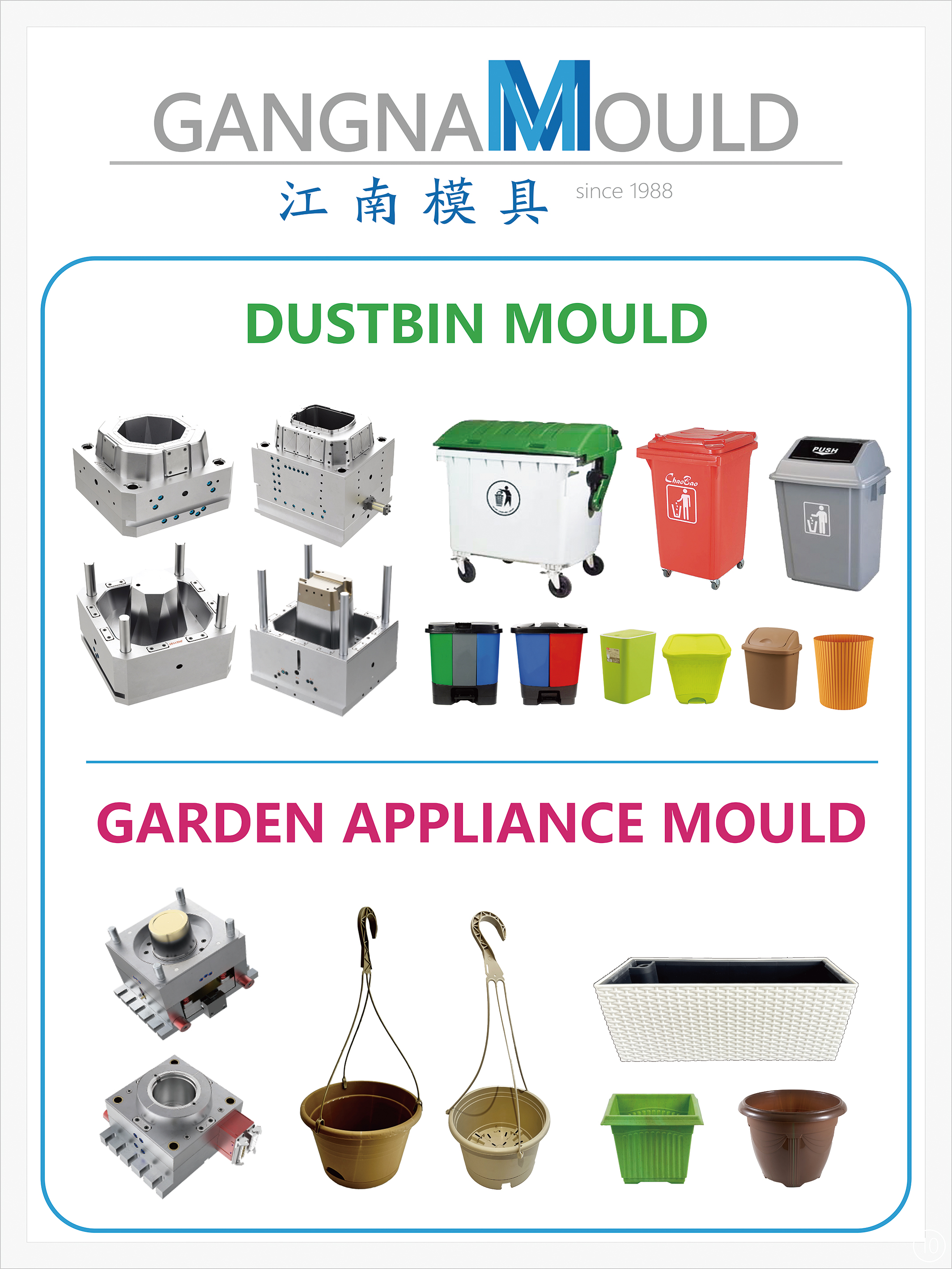
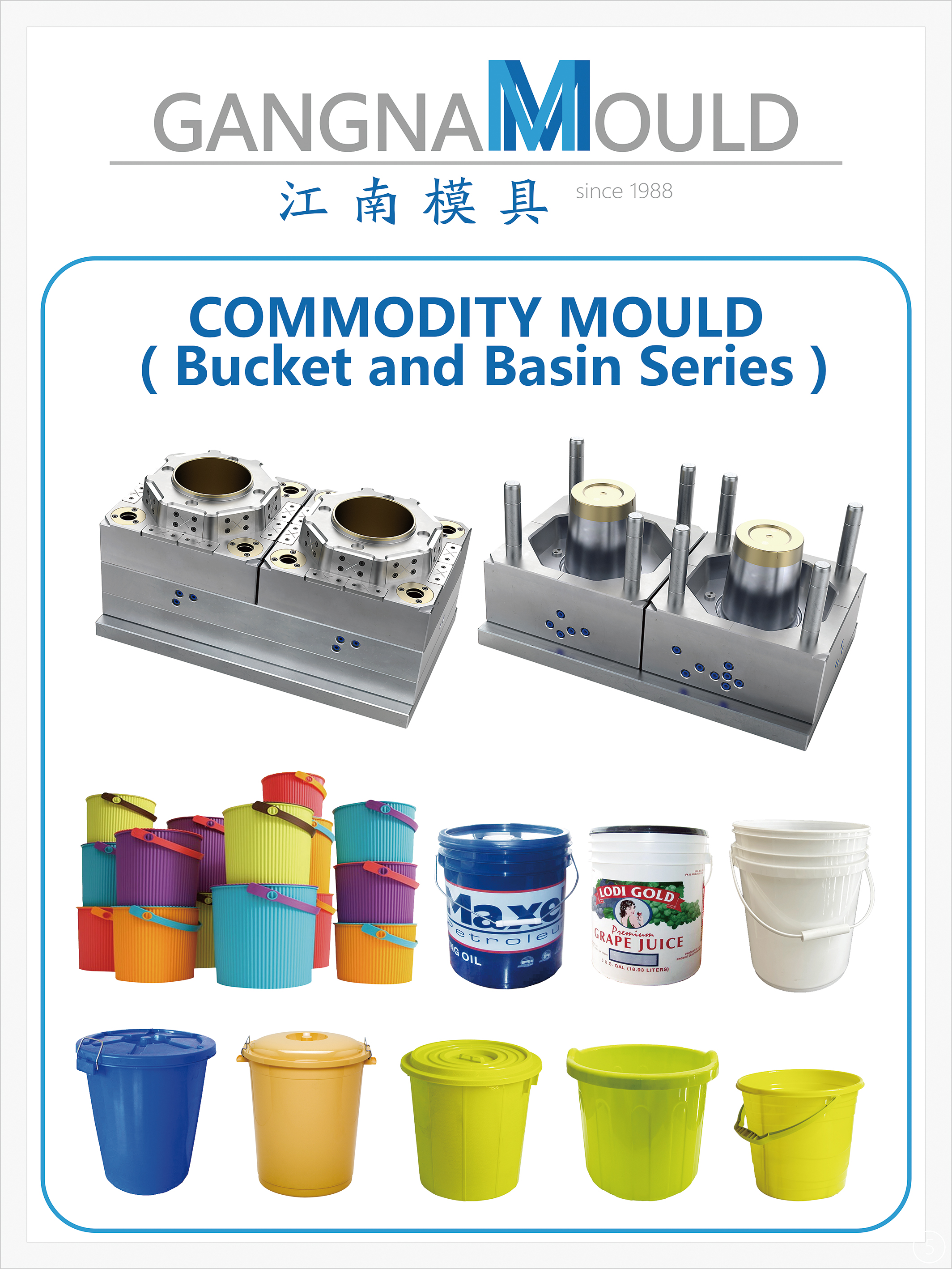
Buckets, basins, trash bins, storage boxes, storage cabinets, kitchen utensils and bathroom accessories make up the core daily-use group. These parts are a good fit for commodity mould tooling because a single tool can serve a high-volume retail programme for years. Cavity count is a project decision rather than a default: the Commodity Mould platform supports customisable cavity count and size, and the operating mode is documented as depending on the customer's production line and mould design, including multi-cavity or single-cavity configurations.
3. Furniture, garden and outdoor products
Chair moulds, table moulds, stool moulds, sofa moulds and garden planter moulds handle parts with a large projected area. The engineering problem is different from packaging: material must travel long distances across a wide surface, and any imbalance in cooling produces visible warpage that cannot be corrected downstream. Rib and wall design, gating position and venting therefore carry more weight here than raw cycle time.
4. Logistics and warehousing
Pallet moulds, turnover box moulds, crate moulds and tool box moulds support the logistics and warehousing industry. These parts are designed around repeated load cycles, stacking and handling rather than appearance. The Commodity Mould range is documented as designed for mass injection and blow moulding production lines, with emphasis on mould durability, short cycle times and dimensional stability - the three properties that matter most when a crate or pallet must stack reliably after thousands of handling cycles.
5. Home appliance and industrial components
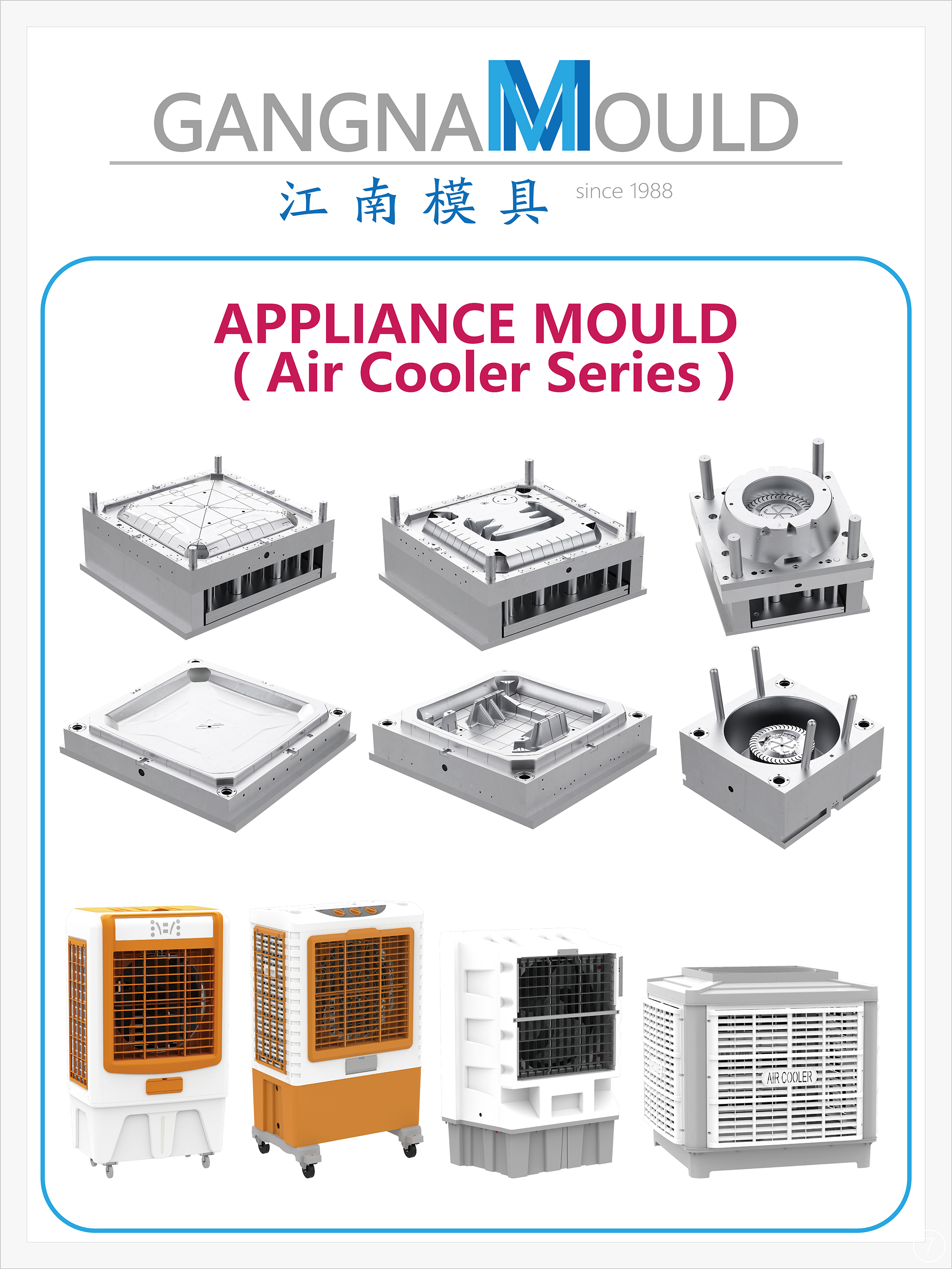
Home appliance component mould development is a documented project type within the same platform, covering housings and internal parts where appearance surfaces, inserts and batch consistency are the deciding criteria. Industrial component production is listed alongside packaging, retail and consumer goods as an applicable industry for the line, which means a buyer can source household parts and technical parts from the same tooling partner instead of splitting categories.
What Gangnam Mould's Documented Capability Covers
Gangnam Mould Co., Ltd - also recorded as Zhejiang Huangyan Jiangnan Mould Factory - was established in 1988 and is located in Huangyan District, Taizhou, Zhejiang, China. The company specialises in plastic moulds, with commodity mould as its main product line. Its published figures describe a 3,000 m² manufacturing facility, approximately 40 staff, a 15-engineer R&D team and an annual output of 800 units.
Production capability is documented as more than 20 sets of digitally controlled milling machines, a 3D coordinated mapping inspector and a mould assembly group. Export business accounts for 70% of sales, with Southeast Asia as the main market, and the company operates an ISO 9001:2015 quality management system.
For the Commodity Mould line specifically, the documented design focus is: customisable cavity count and size; a uniform cooling system intended to shorten cooling time; optimised gating and venting intended to reduce warpage; and surface treatment plus tolerance control for batch consistency. Moulds are made from quality mould steel and process PP, engineering-grade plastics and recycled polymers.
The commercial meaning of those facts is straightforward. A buyer comparing commodity mould suppliers is usually comparing three things - how many cavities the tool can carry, how evenly it cools, and how repeatable the parts remain across a long run. Gangnam Mould's published design priorities address exactly those three points, and the machine list and inspection equipment indicate the process is carried out in-house rather than subcontracted.
Technical Explanation: Where Each Design Decision Lands
Cavity count and size
Cavity count sets the throughput ceiling, but it also raises clamping force requirements, tooling weight and cooling complexity. Customisable cavity count and size therefore only has value when it is matched to the buyer's press and expected annual volume. A high-cavity tool on an undersized machine creates quality problems; a single-cavity tool on a high-volume programme creates cost problems.
Cooling uniformity
Cooling is generally the longest stage of an injection moulding cycle, and uneven cooling is the most common source of warpage and dimensional drift. A uniform cooling system is documented as a design focus for the Commodity Mould line precisely because it affects both cycle time and part quality at the same time. For large flat parts such as chair shells or pallets, cooling balance across the whole cavity tends to matter more than any single hot spot.
Gating and venting
Gating position determines how material enters the cavity and where weld lines form. Venting determines whether trapped gas escapes or burns into the part surface. The Commodity Mould line lists optimised gating and venting as a design focus aimed at reducing warpage, which is consistent with how the two variables interact: material entering at the wrong point produces filling imbalance, and trapped gas produces short shots or surface defects that cannot be corrected later.
Surface treatment and tolerance control
Batch consistency is a commercial requirement as much as a technical one. A retail programme needs the tenth thousand part to match the first. Surface treatment supports appearance and release behaviour, while tolerance control keeps dimensions inside an agreed band. Where a project specifies a tolerance band in the order of 0.02 mm, that figure needs to be locked during requirement communication rather than assumed at the quotation stage, because achievable tolerance depends on part geometry, material shrinkage behaviour and the press being used.
ISO 20457:2018 is the primary international standard covering manufacturing tolerances and acceptance conditions of plastic moulded parts. Referencing it in a mould order gives both parties a shared acceptance language instead of relying on informal agreement.
Material behaviour
PP, engineering-grade plastics and recycled polymers behave differently in the same tool. Shrinkage rates, melt viscosity and wear characteristics all vary by grade, and recycled polymer streams commonly show more batch-to-batch variation than virgin grades. Buyers planning to run recycled content should raise it at the requirement stage, not after the tool is cut.
Machine compatibility
The documented operating mode for the line is that moulds run on injection or blow moulding machines for mass production, with the exact mode depending on the customer's production line and mould design. Recommended supporting equipment includes injection or blow moulding machines, cooling systems and automation for loading and unloading. Material handling, robot interfaces and clamping arrangements are therefore part of the matching exercise, not separate from it.
Matching the Mould to the Production Line, Not Only the Part
Application fit is only half the decision. The documented project types for this mould platform are OEM/ODM custom mould projects, large-volume mould production, home appliance component mould development and logistics packaging mould development. All four assume a production line already exists or is being specified alongside the tool.
The service scope reported for the range runs from samples or drawings through to trial moulding and delivery, including installation and operation training. Customisation options cover adjustable cavity count, surface treatment, inserts and multi-component mould design, with specific technical parameters confirmed during requirement communication.
Because the operating mode depends on the buyer's line, the useful questions before ordering are practical ones: what tonnage is available, what cooling capacity the plant can supply, whether loading and unloading will be automated, and whether the part family is expected to expand within the tool's life. This application pattern is documented as common in India, Italy, Jordan, Nigeria, Algeria, Zambia, South Africa, Tanzania, Turkey, Tunisia, Singapore, Saudi Arabia and Russia, alongside the company's core Southeast Asian market.
Market Signals Buyers Should Factor Into Matching
Three verified market signals are worth weighing when a mould decision is made.
Thin-wall demand is structurally large. The global thin-wall mould market was valued at USD 41.6 billion in 2024, driven by injection moulding's ability to produce complex, lightweight designs with minimal cycle times, according to market research reports. For buyers in packaging and retail, that supports investment in tooling designed for short cycles rather than general-purpose tooling adapted afterwards.
Plastic furniture remains a substantial category. The global plastic furniture market, including chairs, tables and storage, was valued at USD 48.7 billion in 2023, with the residential segment holding a 53.1% revenue share, according to Grand View Research. A parallel estimate from Coherent Market Insights places the same market far lower, at USD 15.05 billion. The gap reflects definitional differences - raw materials for furniture versus finished plastic furniture - and it is a useful reminder to check the scope behind any market figure before using it in a business case.
Material supply is concentrated. Key participants in the global plastic injection moulding material market include BASF SE with an 11% share and SABIC with a 9% share, according to industry analysis. Concentration at the material level affects grade availability and lead times, which in turn affects how much flexibility a mould design should build in when a buyer intends to qualify alternative grades or recycled polymers.
Comparison With Alternative Tooling Approaches
A production commodity mould is one route among several. The table below compares the main options on fit rather than on quality, because the right choice depends on volume, part complexity and how much design iteration is expected.
| Tooling approach | Where it typically fits | Boundary to plan for |
|---|---|---|
| Production commodity mould (multi-cavity steel tool) | Mass production of buckets, basins, crates, pallets, furniture shells and appliance housings | Tooling cost and lead time need volume behind them; large and thin-wall parts may require special design; tolerance bands are agreed per project |
| Prototype or low-volume tooling | Design validation and market testing before committing to production tooling | Generally not intended for sustained high-volume output, and part properties may differ from the production tool |
| Blow moulding route | Large hollow parts, including selected pallet and container formats | Wall-thickness control and design freedom differ from injection moulding |
| Single-family tooling supply | A narrow, stable part family with predictable demand | A portfolio spanning several application families may require multiple supply relationships and more coordination |
Where commodity moulds stop being the answer
- Very low volumes. A steel tool has to be amortised over part count. Below a certain annual volume, the tooling economics do not close regardless of how well the mould is designed.
- Parts still under design iteration. If the geometry may change after market testing, committing to a production tool early locks in a design decision that prototype tooling would have deferred.
- Unconfirmed tolerances. A tolerance band cannot be promised in isolation from part geometry, material shrinkage and press capability, and must be confirmed during requirement communication.
- Large and thin-wall parts. These are documented as requiring special design considerations, so a standard multi-cavity layout is not automatically transferable.
- Recycled polymer programmes without process planning. Higher batch variation in recycled streams affects shrinkage consistency and tool wear, and needs to be addressed at the mould specification stage.
Future Outlook
Three directions look likely to shape commodity mould matching over the next few years.
First, lightweighting continues to push thin-wall designs into more categories, which raises the value of cooling and flow design relative to cavity count alone. Second, recycled polymer content is moving from a marketing claim to a specification item, which will make material-driven tooling decisions more common and make tolerance agreements more explicit. Third, automation for loading and unloading is increasingly treated as part of the mould specification rather than a downstream plant decision, because cycle-time assumptions only hold if the handling system keeps pace.
For buyers, the practical consequence is that matching happens earlier. The application family, the material grade, the press and the tolerance band should be settled together before a mould is quoted, rather than sequentially. Suppliers with an in-house engineering team and documented design priorities are better positioned to support that sequence than suppliers quoting from a generic catalogue.
FAQ
What is a commodity mould?
A commodity mould (model designation: Commodity Mould) is a mould category used to produce non-precision consumer and industrial plastic items. Documented type ranges include garden planter moulds, trash bin moulds, bucket moulds, basin moulds, storage box moulds, sofa moulds, table moulds and chair moulds. Commodity moulds are made from quality mould steel and process plastics such as PP, engineering-grade plastics and recycled polymers, and they are used in packaging, retail, consumer goods, logistics and warehousing, and home appliance manufacturing.
Which commodity mould types match which products?
Chair, table, stool and sofa moulds cover the furniture and outdoor group. Bucket and basin moulds, trash bin moulds, storage box and cabinet moulds, kitchen utensil moulds and bathroom accessory moulds cover daily-use household goods. Tray, box and basket moulds plus thin-wall injection moulds serve packaging and retail. Pallet moulds and turnover box moulds serve logistics and warehousing. Home appliance moulds, including insert and multi-component designs, cover appliance housings and internal components.
What materials can commodity moulds process?
The documented material scope is quality mould steel for the tool itself, processing PP, engineering-grade plastics and recycled polymers. Grade choice affects shrinkage behaviour, melt viscosity and tool wear, so the material decision belongs in the requirement discussion rather than being fixed after the mould is manufactured. Projects intending to run recycled content should raise it before tooling is cut.
How do cavity count, cooling and gating affect output and part quality?
Cavity count sets the throughput ceiling and also changes clamping and cooling requirements. A uniform cooling system is documented as a design focus to shorten cooling time, since cooling is generally the longest part of the cycle. Optimised gating and venting are documented as a design focus to reduce warpage and to keep filling balanced. Together these three factors determine whether a tool delivers both short cycles and consistent dimensions.
What supporting equipment and services are involved?
Moulds are documented as running on injection or blow moulding machines for mass production, with the exact operating mode depending on the customer's production line and mould design, including multi-cavity or single-cavity configurations. Recommended supporting equipment includes injection or blow moulding machines, cooling systems and automation for loading and unloading. The documented service scope runs from samples or drawings to trial moulding and delivery, including installation and operation training.
What are the limits of a commodity mould?
Tooling economics require production volume. Large and thin-wall parts need special design rather than a standard layout. Tolerance bands cannot be promised independently of part geometry, material shrinkage and press capability, and are confirmed during requirement communication. Recycled polymer streams introduce batch variation that affects shrinkage consistency and tool wear. For acceptance, ISO 20457:2018 is the primary international standard covering manufacturing tolerances and acceptance conditions of plastic moulded parts.
Reference
Company background, product scope and capability figures in this article come from Gangnam Mould Co., Ltd published product and company information. A downloadable company brochure is available at Gangnam Mould brochure. Website: www.gangnammould.com.