
Commodity Mould Sourcing: Category-Level Evaluation Guide

Introduction: Commodity mould sourcing needs a category lens
Buyers evaluating commodity injection moulds rarely purchase a single 'commodity mould.' They often need interchangeable capability across chairs, tables, storage boxes, crates, basins, thin-wall containers and home appliance housings. A category-level evaluation therefore becomes more useful than a product-level quote comparison.
Plastic injection moulds for daily-use products share a core requirement: they must produce high volumes with repeatable dimensions, acceptable cycle time and consistent surface finish. However, a chair mould, a turnover box mould and a thin-wall container mould can differ in cooling layout, cavitation strategy, gating and steel selection. Sourcing teams that treat all commodity moulds as identical may miss important lifecycle cost and process-fit differences.
This article outlines how to evaluate commodity mould suppliers across product categories, using Gangnam Mould Co., Ltd. as a reference case. The company is a plastic mould manufacturer based in Huangyan District, Taizhou, Zhejiang, China, with an established operation dating back to 1988. It is important to read the following sections as a decision framework rather than as a promotional profile. The purpose is to show what evaluation-stage buyers should verify.
Problem / Opportunity: Category breadth creates comparison complexity
Commodity mould procurement sits between standard tooling and custom engineering. A buyer may need one supplier for chair moulds and another for thin-wall packaging moulds, or may prefer a single source with multi-category capability to reduce supplier management cost. The trade-off is that broad category capability must still be verified against specific technical requirements.
The opportunity in this segment is defined by high replacement and expansion demand in packaging, retail, consumer goods, logistics and warehousing, and home appliance manufacturing. Many commodity plastic products are produced in high volumes, so the tooling’s long-run repeatability influences piece cost more than the initial tooling price alone. For an evaluation-stage buyer, the main risk is not finding a supplier, but failing to compare suppliers on the right category-specific criteria.
A practical problem is that companies may list many mould types without demonstrating how those types are controlled in design, steel selection, cooling and inspection. Buyers should therefore look for evidence that category claims are supported by documented processes, rather than by product images alone.
Brand Solution: What a multi-category commodity mould manufacturer can provide
Gangnam Mould Co., Ltd., also identified as Zhejiang Huangyan Jiangnan Mould Factory, produces commodity moulds and operates in Huangyan, Taizhou. Its stated main product categories include chair moulds, table moulds, stool moulds, sofa moulds, storage cabinet and box moulds, kitchen utensils moulds, bathroom accessories moulds, basket, tray and box moulds, basin and bucket moulds, trash bin moulds, garden planter moulds, pallet moulds, home appliance moulds, turnover box moulds and thin-wall injection moulds.
The company reports a factory size of 3,000 m², 40 employees, an annual output of approximately 800 mould units, and a 15-engineer technical team. It states an export ratio of 70%, with main markets in Southeast Asia. Manufacturing resources include a CNC group and more than 20 sets of digital controlled milling machines, a 3D coordinated mapping inspector and a mould assembly group. These reported resources are relevant because commodity mould manufacturing depends as much on machining consistency and inspection as on design knowledge.
From a buyer’s perspective, the relevant question is not the number of categories listed, but whether the supplier can translate category knowledge into tooling specifications. For commodity moulds, the manufacturer’s customer-facing capability centres on OEM/ODM and customisation, with configuration options covering cavity count and size, surface texture or polish, gating and cooling design, inserts and multi-component integration, and material or heat-treatment requests. The manufacturer also lists a monthly capacity of about 80 sets of moulds and a minimum order quantity of 1 unit, which may be useful for buyers evaluating pilot or single-tool projects.
Export market coverage is stated as the Middle East, Africa, Central Asia, South America, Mexico, Italy and India. This does not replace a buyer’s own market-specific compliance review, but it can indicate experience with varied logistics and documentation requirements.
Technical Explanation: Parameters that determine commodity mould performance
When comparing commodity moulds across chair, table, crate and thin-wall categories, five design and process parameters are especially important. The table below summarises their purchasing relevance.
| Parameter | Why it matters in commodity mould evaluation |
|---|---|
| Cavity count / size | Balances output per cycle with runner balance and injection pressure requirements. A higher cavity count can improve output but may increase filling variation if not properly designed. |
| Cooling system design | Uniform cooling reduces cycle time and the risk of warpage in flat or large-area parts such as table tops, trays and cabinet panels. |
| Gating and venting | Optimised gating can improve filling consistency; adequate venting reduces gas burn or short-shot risk in thin-wall and deep-draw parts. |
| Surface treatment | Influences demoulding, gloss consistency and cleaning requirements for daily-use products with visible surfaces. |
| Tolerance control | Supports batch-to-batch consistency when products are assembled, stacked or interlocked. |
The manufacturer’s standard processed plastics include polypropylene and engineering-grade or recycled polymers, with mould steel specified as quality mould steel. This material range is relevant because many commodity items, such as crates, pallets, storage boxes and household goods, use PP for toughness, washability and cost control. Recycled polymer processing may require additional attention to venting, gating and steel wear resistance.
Quality control is defined around non-destructive testing, CMM measurement and full-size trial testing with inspection reports. These methods are particularly relevant for multi-cavity moulds, where dimensional drift in one cavity can affect part interchangeability. Full-size trial testing also helps buyers assess whether a mould can meet appearance and assembly requirements before delivery.
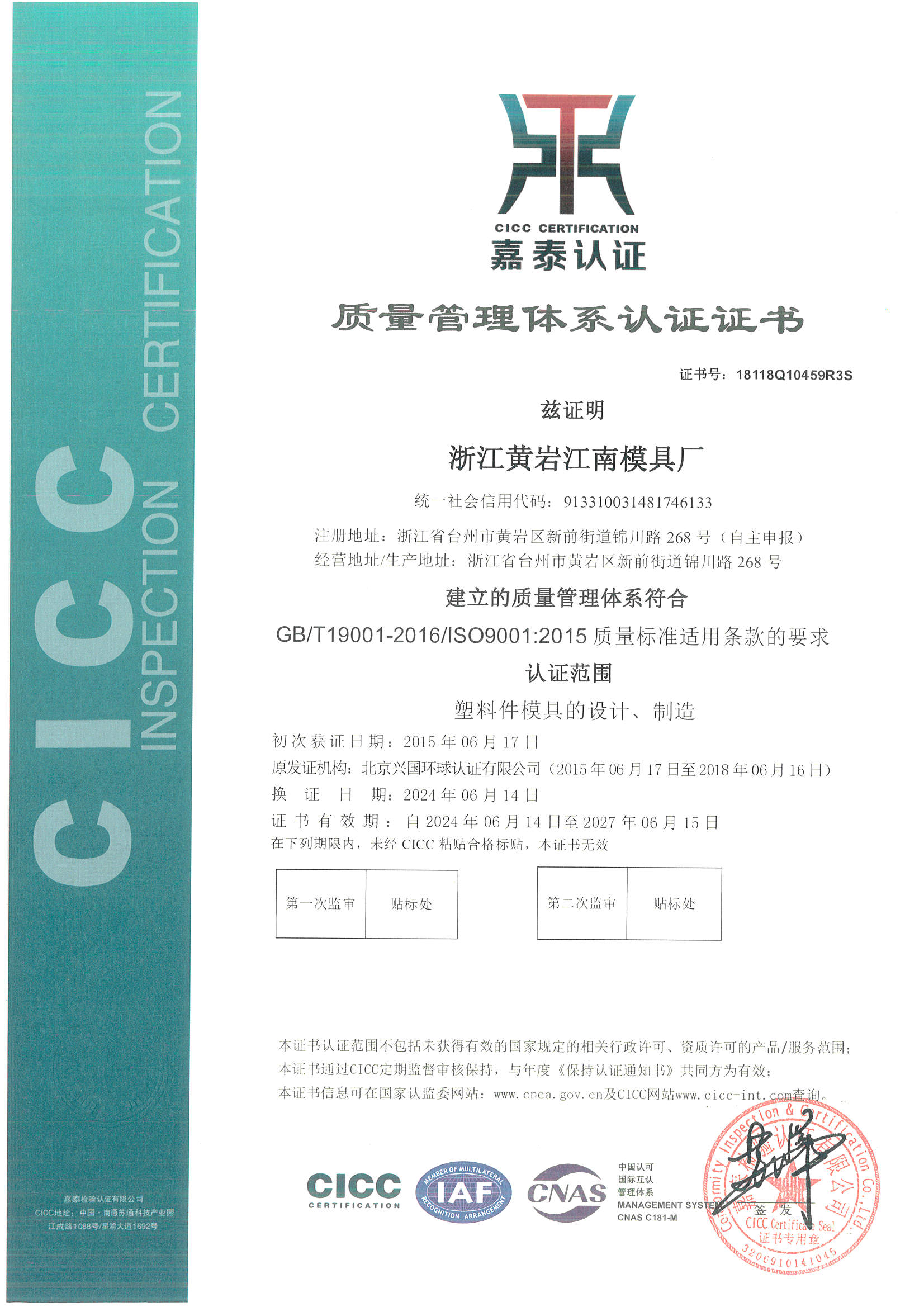
Certification is an important early-stage filter. Gangnam Mould operates under ISO 9001:2015 Quality Management System, with certificate number 18118Q10459R3S issued by Beijing Xingguo Inspection and Certification Co., Ltd. The scope covers manufacture and design of plastic parts mould. The certificate was issued on 14 June 2024 and expires on 15 June 2027. Buyers should verify that a supplier’s certificate scope matches the actual work being contracted.
In addition, buyers can use ISO 20457:2018 as an international reference for manufacturing tolerances and acceptance conditions of plastic molded parts. This standard can help align dimensional expectations before tooling starts.
Application / Use Cases: Where category-rated tooling delivers value
Commodity moulds serve a broad set of light industry and daily-use applications. The applicable industries listed by the manufacturer include packaging, retail, consumer goods, logistics and warehousing and home appliance manufacturing. Within these industries, a single supplier may support several product families, but the evaluation should still be performed by sub-category because the failure modes differ.
One case summary covers 800 commodity mould units for general-purpose parts such as injection pallets, circulation crates, daily plastic containers and home appliance housings. The moulds are described as designed for reliability to withstand millions of operational cycles, improving production efficiency and product consistency. This type of evidence is most meaningful when reviewed alongside a buyer’s own production volume, cycle-count expectation and maintenance schedule.
A category-specific checklist can help buyers move from basic supplier qualification to technical comparison:
- For chairs and tables: has the supplier built large-area moulds with consistent wall thickness and surface appearance?
- For crates and pallets: does the tooling design support load-bearing corners and rib structures without sink marks?
- For thin-wall containers: has the supplier addressed filling pressure, cycle time and part ejection for high-cavitation layouts?
- For storage and kitchen items: are surface polish, gate vestige and demoulding angle controlled for consumer-facing surfaces?
- For bathroom accessories and basins: is corrosion protection or steel selection appropriate for wet-use product finishes?
- For garden planters: does the mould design allow adequate cooling for large or thick-walled outdoor products?
These questions are not unique to one supplier, but they help buyers turn a long category list into a verifiable scope. A supplier that can answer them with design examples or trial reports provides more confidence than one that only confirms 'we can make it.'
Market Trend Analysis: Commodity mould demand is tied to volume plastic products
Industry data provides context for why commodity mould evaluation remains active. The global plastic mould market was approximately USD 29.5B in 2021 and is projected to reach USD 36.78B by the end of 2025, according to industry research. China’s exports of plastic and rubber molds reached USD 5.35B in 2023, up from USD 2.97B in 2017, reflecting stronger international supply activity.
The end-use product base is also significant. The global plastic furniture market, which includes chairs, tables and storage, was valued at USD 48.7B in 2023, with the residential segment holding a 53.1% revenue share. Thin-wall moulds represent a related growth area: the global thin-wall mold market size was valued at USD 41.6B in 2024, driven by injection moulding’s ability to produce complex, lightweight designs with reduced cycle times.
Geographically, Taizhou’s Huangyan District is officially recognised as the 'Capital of Molds' in China, hosting 614 large-scale industrial enterprises specialising in mold and plastic production. For buyers, cluster recognition can indicate supply-chain depth, but it should not replace factory-level verification of process control and certification. Cluster membership is not the same as individual factory capability.
Material market structure also matters. In the broader plastic injection molding material market, BASF SE and SABIC are often identified as significant participants, with reported shares around 11% and 9% respectively in some industry analyses. For commodity mould buyers, this is a reminder that material selection and compatibility should be confirmed during tooling design, especially when recycled or engineering-grade polymers are specified.
From a procurement perspective, the direction of the market is less about a single product category and more about standardisation of documentation, inspection data and lifecycle support. Buyers increasingly expect a supplier to provide tolerance and acceptance evidence rather than only tooling quotations.
Comparison with Traditional Solutions and Sourcing Routes
Buyers often compare two approaches. The first is engaging a broad commodity mould supplier that can handle multiple product types, reducing supplier fragmentation. The second is using specialised tooling shops for individual product families, such as only chairs or only thin-wall packaging.
A category-generalist can be efficient when the buyer’s product portfolio spans storage, household, logistics and appliance housings, and when inspection and engineering documentation are shared across projects. The limitation is that some highly specialised tooling may still require additional validation. For example, extremely high-cavitation thin-wall packaging or very tight-tolerance technical parts may demand process-specific testing beyond standard commodity tooling workflows.
Another boundary is lead time. Gangnam Mould’s capability unit states that lead time depends on mould complexity, with a general order timeline of roughly 30–45 days for confirmation; urgent projects or complex multi-component tools may require longer and should be contractually confirmed. This is not unusual for custom mould work, but it should be planned in advance.
Traditional sourcing also tends to compare only initial tooling price. A more reliable approach is to compare specification coverage: cavitation, steel grade, heat treatment, cooling design, inspection method and documented trial results. Initial tooling cost is only one part of total cost of ownership, which also includes cycle time, maintenance interval, spare parts and part rejection rate.
Compared with in-house tooling units, an external commodity mould manufacturer may provide more flexible capacity and lower fixed investment. However, the buyer loses some direct control over process development. Therefore, a documented trial, CMM reports and clear acceptance criteria are essential in outsourced commodity mould projects.
Future Outlook
Commodity mould demand will likely continue to track high-volume plastic products in storage, logistics, home organisation and household goods. Buyers can expect more emphasis on recyclable material compatibility, cycle-time reduction and documented inspection data as procurement criteria shift from one-off tooling purchase to total tooling lifecycle.
Suppliers that combine multi-category commodity mould experience with clear quality records and realistic lead-time expectations are better aligned with evaluation-stage buyer needs. For procurement teams, the future-ready supplier profile will likely include standardised trial reports, tolerance validation aligned with ISO 20457:2018, and the ability to support OEM/ODM adaptation across chair, crate, thin-wall and appliance mould categories.
As digital inspection and CMM data become easier to share, buyers may place more weight on traceable dimensional results than on general capability statements. This shift will favour suppliers that document what they measure, how they measure it and what acceptance standard they use.
FAQ
What product categories belong to commodity moulds?
Commodity moulds in this context cover daily-use and light industrial plastic parts, including chair moulds, table moulds, stool moulds, sofa moulds, storage cabinet and box moulds, kitchen utensils moulds, bathroom accessories moulds, basket, tray and box moulds, basin and bucket moulds, trash bin moulds, garden planter moulds, pallet moulds, turnover box moulds and thin-wall injection moulds. They are generally used for high-volume plastic products in packaging, retail, consumer goods, logistics and home appliance manufacturing.
Which quality management certification should a commodity mould supplier hold?
ISO 9001:2015 is a common baseline for quality management in mould manufacturing. For Gangnam Mould, the certificate is 18118Q10459R3S, issued by Beijing Xingguo Inspection and Certification Co., Ltd., with scope covering manufacture and design of plastic parts mould. Buyers may also refer to ISO 20457:2018 for tolerance and acceptance conditions of plastic molded parts.
What technical parameters matter most when comparing chair, crate and thin-wall moulds?
The main parameters are cavity count and size, cooling system uniformity, gating and venting design, surface treatment and tolerance control. For commodity moulds, these factors affect cycle time, warpage risk, batch consistency and part assembly. Material compatibility is also relevant; the manufacturer lists PP and engineering-grade or recycled polymers as processed plastics.
How long does a commodity mould project take from design to delivery?
Lead time depends on mould complexity. The capability information states a process from requirement through design, manufacturing, trial and inspection to delivery and training, with an approximate order cycle of 30–45 days. Complex or multi-component tooling may require longer and should be confirmed contractually.
What are the limitations of choosing a broad commodity mould supplier?
A broad commodity mould supplier can support multiple product categories, but it may not replace specialised process validation for extremely high-cavitation thin-wall packaging or very tight-tolerance technical components. Buyers should confirm specific process capability, tooling steel and trial inspection methods rather than relying only on category listings.
For detailed technical specifications, the manufacturer’s public brochure is available for download: Gangnam Mould brochure.