
Comparing 48V, 51.2V and 72V LiFePO4 Golf Cart Batteries
An independent buyer evaluation of three documented lithium battery options: where the evidence differs, where it does not, and which voltage class fits which procurement priority.
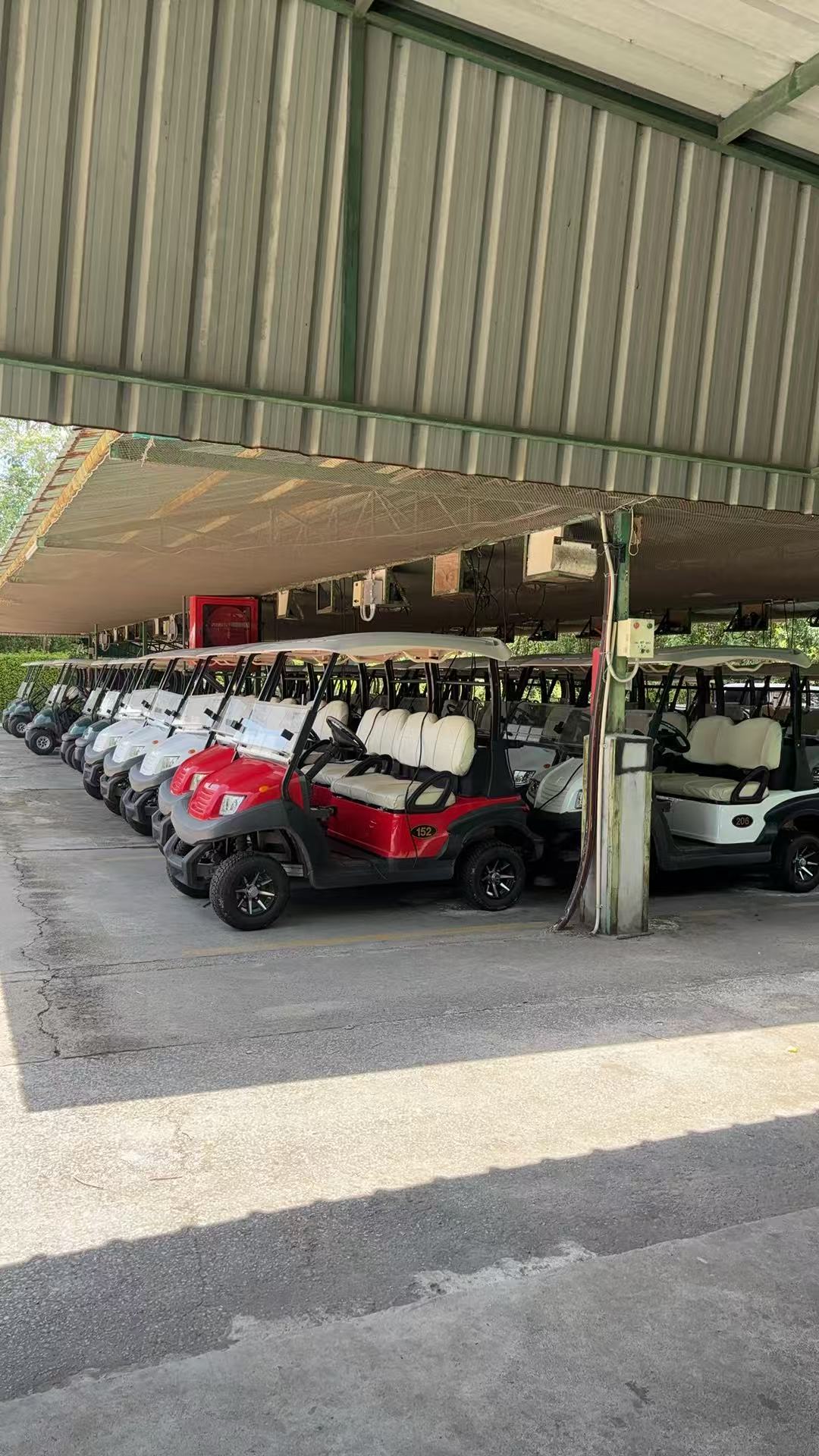
Voltage is the first filter buyers apply when replacing a golf cart battery, and it is usually treated as a simple power question: more volts, more capability. The comparison that actually decides whether an order succeeds looks different. For fleet operators, dealers and OEM buyers, the deliverable is a set of documents — a quality management certificate, a transport test report, a material safety data sheet, a specification table — that can be verified before shipment and defended after it.
The commercial backdrop explains why so many buyers are running this evaluation at the same time. The global golf cart battery market reached approximately USD 1.49 billion in 2024 and is projected to reach USD 2.21 billion by 2030, a 6.8% CAGR, according to Strategic Market Research. Estimates do diverge: Markets and Data reports USD 192.23 million for the same category and period, so market sizing should be read directionally rather than as a fixed addressable number. Lithium-ion batteries accounted for roughly 47% of global golf cart battery market revenue in 2024, based on Boca EV / Market Analysis figures. Growth of this kind increases the number of suppliers; it does not automatically increase the number of suppliers whose documentation holds up in a customs query or a warranty discussion.
This article compares three LiFePO4 golf cart battery models documented by Shenzhen Shiwei New Energy Co., Ltd., which trades as Sisway Battery — a lithium battery manufacturer established in 2017 in Shenzhen, China, operating a 20,000 m² facility with 150 employees, an annual output of 90,000 units and a 25-engineer R&D team. The company focuses on lithium iron phosphate battery packs for golf carts, UTVs, ATVs, forklifts, AGVs and home energy storage; roughly 50% of its output is exported, with the United States as its main market. The three models under review are the 48V 100Ah, 51.2V 100Ah and 72V 105Ah golf cart batteries.
Two boundaries are set at the outset. First, this is an evaluation of documented evidence, not of brand reputation. Second, where the available documentation is silent on a parameter, this article says so instead of filling the gap.
Why the Voltage Question Is Really a Documentation Question
Buyers typically begin with the vehicle platform — buyers searching for Club Car golf cart batteries, EZ-GO golf cart batteries or Yamaha golf cart battery replacements are really starting from fit — and then move to voltage, capacity, BMS behaviour and charger compatibility. Each of those steps is answerable from a competent specification sheet. The step that is not automatically answerable is evidence: does the supplier's certification actually cover the model being shipped, the process that produced it, and the market it is entering?
Three gaps recur in lithium golf cart battery procurement, and they are the reason a three-way voltage comparison is more useful than a single-model spec review:
- Scope mismatch. A certificate covering company processes is presented as though it covered a product model.
- Model mismatch. A transport test report is issued for one capacity and then quoted across an entire product family.
- Timing mismatch. Documents expire between quotation and shipment, particularly on long OEM programs.
The 48V, 51.2V and 72V options sit at different points on that evidence chain, which is precisely what makes the differences visible and checkable.
The Three Documented Options at a Glance
| Parameter | 48V 100Ah | 51.2V 100Ah | 72V 105Ah |
|---|---|---|---|
| Nominal voltage | 48V | 51.2V | 73.6V (marketed as 72V) |
| Rated capacity | 100Ah | 100Ah | 105Ah |
| Documented energy | 4,800Wh | 5,120Wh | 7,728Wh |
| BMS | Smart 200A | 200A | Smart 200A |
| Max continuous discharge | 200A | 200A | 200A |
| Peak discharge | 300A (2 sec) | 300A (3 sec) | 400A (10 sec) |
| Max load / output power | 9.6kW max load | 5,120W max continuous output | 14.72kW max load |
| Cell configuration | 15S1P, 15 EV-grade A LiFePO4 prismatic aluminium-shell cells | Not stated in the supplied documentation | 23S1P, 23 EV-grade A LiFePO4 prismatic aluminium-shell cells |
| Discharge cut-off voltage | 41.25V | Not stated in the supplied documentation | 63.25V |
| Charge voltage / current | Not stated in the supplied documentation | 58.4V, CC/CV; 18A recommended | Not stated in the supplied documentation |
| Standard charge time | 6h | Not stated in the supplied documentation | 6h |
| Enclosure material | Plastic case | Metal casing | Metal casing |
| Warranty | Not stated in the supplied documentation | 3 years | Not stated in the supplied documentation |
| Cycle life | Not stated in the supplied documentation | ≥4,000 cycles | Not stated in the supplied documentation |
| Dimensions | Not stated in the supplied documentation | Not stated in the supplied documentation | 558 × 333 × 300 mm |
| Operating temperature | Not stated in the supplied documentation | Charge 0°C to 45°C; discharge −20°C to 55°C; storage −20°C to 45°C; low-temperature charge cut-off 0°C ± 4°C | Charge 0°C to 45°C; discharge −20°C to 55°C |
| Commercial terms | MOQ 1 unit, lead time 15–30 days | MOQ 1 unit, lead time 15–30 days | MOQ 1 unit (model 72V 105Ah), lead time 15–30 days |
What the Credentials Actually Cover
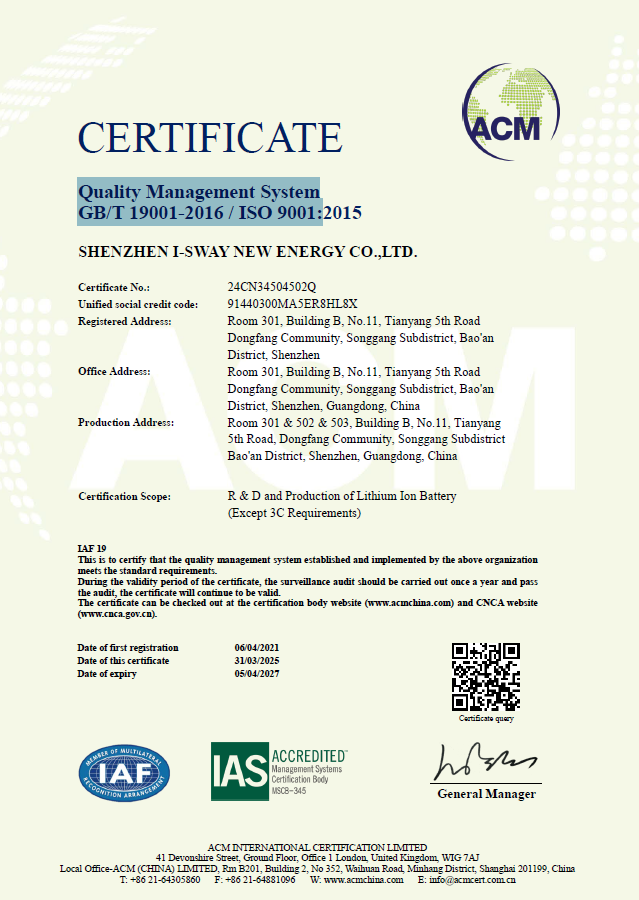
Quality management scope
The Quality Management System certificate carries the number 24CN34504502Q and was issued by ACM INTERNATIONAL CERTIFICATION LIMITED under the standard GB/T 19001-2016 / ISO 9001:2015. It was issued on 31 March 2025 and is valid to 5 April 2027. The certified scope is “R&D and Production of Lithium Ion Battery (Except 3C Requirements),” and the related-product listing names the 72V 105Ah, 51.2V 100Ah and 48V 100Ah models.
What this proves: the manufacturer's research, development and production processes were audited against an internationally recognised quality management standard, and the three golf cart battery models fall inside that audited scope. What it does not prove: it is not a model-level product safety certification. The wording “except 3C requirements” is a scope limitation and should be read literally rather than treated as a general product approval for every destination market.
Transport and safety documentation
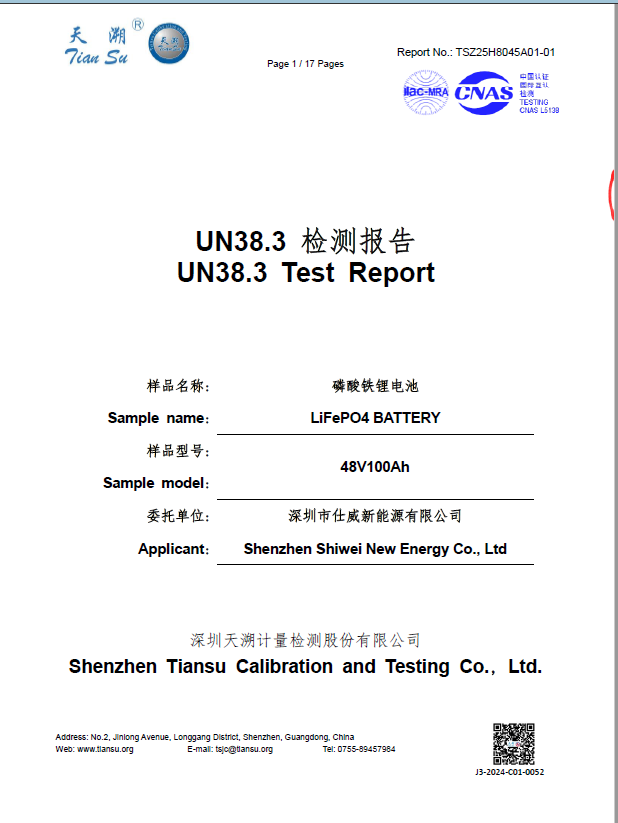
A UN38.3 test report numbered TSZ25H8045A01-01 was issued by Shenzhen Tiansu Calibration and Testing Co., Ltd. on 25 August 2025, valid to 31 December 2026, covering the LiFePO4 battery model 48V100Ah and tested against UN 38.3 of the UN Manual of Tests and Criteria, Part III, Subsection 38.3. UN 38.3 is the test standard required for the safe global transport of lithium batteries, so this document is not optional for export shipments. Its scope here is model-specific, which is the normal and defensible way transport testing is recorded — but it also means the report should be matched to the exact SKU on the order.
A Material Safety Data Sheet numbered TSZ25LL028A86-01 was issued by Shenzhen Tiansu Calibration and Testing Co., Ltd. on 8 December 2025, valid to 31 December 2026, covering the lithium-ion golf cart battery series and prepared against GHS and OSHA HazCom 2012 for the USA market. Separately, the 51.2V 100Ah specification lists MSDS and UN38.3 among its certification entries.
Company-level certification inventory
Sisway Battery's company profile lists ISO 9001 certification, more than 100 global certifications including CE, UL, UN38.3 and MSDS, and multiple patents. That is a supplier-level inventory rather than three separate model certificates. Buyers should ask for the specific certificate that matches their destination market and the specific model on the order before treating the inventory as proof for a given SKU.
Two further standards define what buyers commonly ask for, even though they are not claimed here for these models: IEC 62619:2022 specifies safety requirements for secondary lithium cells and batteries in industrial and motive applications including golf carts, and UL 2580 covers electrical, mechanical and environmental testing of batteries for electric vehicles. Knowing the standard is the first half of the question; confirming whether a specific model holds it is the second.
Technical Reading: Comparing the Ratings as a Set
Series configuration and the nominal voltage label
The 48V 100Ah pack is documented as 15S1P — 15 EV-grade A LiFePO4 cells with prismatic aluminium shells. The 72V 105Ah pack is documented as 23S1P with the same cell grade. The 72V unit's nominal voltage is listed at 73.6V, which means the “72V” label is a voltage class name rather than a measurement. Buyers should compare charger output and controller voltage windows against nominal values, not against the class label, and should confirm the charger profile in writing.
Current ratings converge; power ratings diverge
All three models document a 200A BMS and a 200A maximum continuous discharge current. Peak capability separates them: 300A for 2 seconds on the 48V unit, 300A for 3 seconds on the 51.2V unit, and 400A for 10 seconds on the 72V unit. The documented load figures follow the same pattern: 9.6kW maximum load power on the 48V model, 5,120W maximum continuous output power on the 51.2V model, and 14.72kW maximum load power on the 72V model.
Read the ratings as one set, not individually
On the 51.2V 100Ah unit, the documentation lists a 200A maximum continuous discharge current alongside a 5,120W maximum continuous output power. Where two documented figures describe the same load case in different ways, the application defines which one governs. The correct action is to ask the supplier to confirm the governing value for the intended duty cycle in writing, rather than choosing the more convenient number. The same discipline applies to cut-off voltages: the 48V pack documents a 41.25V discharge cut-off and the 72V pack documents 63.25V, while the 51.2V pack documents a 58.4V charge voltage under a CC/CV profile with an 18A recommended charge current. Controller low-voltage thresholds and charger settings must align with these values.
Energy, enclosure and thermal envelope
Usable energy is documented at 4,800Wh, 5,120Wh and 7,728Wh respectively — the practical driver of runtime between charges. Enclosure specifications differ as well: the 48V 100Ah unit is documented with a plastic case, while the 51.2V 100Ah and 72V 105Ah units use a metal casing. Enclosure material is one of the entries buyers should confirm against their mounting, vibration and inspection requirements rather than assume as equivalent across the range.
The 51.2V and 72V units both document charging from 0°C to 45°C and discharging from −20°C to 55°C. The 51.2V unit additionally documents a low-temperature charge cut-off at 0°C ± 4°C and storage from −20°C to 45°C. Low-temperature charging restriction is a system constraint rather than a product defect: a cart that sits below freezing overnight needs a charging plan, not a different chemistry. Finally, lifecycle claims are unevenly documented: the 51.2V 100Ah model states a 3-year warranty and ≥4,000 cycles, while equivalent figures for the 48V and 72V models are not present in the supplied documentation.
Application Mapping: Which Voltage Fits Which Duty Cycle
48V 100Ah — the standard-platform replacement class
Lithium batteries for 48V golf cart systems commonly land in the 100–150Ah range according to aggregated industry product specifications, so the 48V 100Ah model sits at the entry of that band with 4,800Wh and a documented 9.6kW load ceiling. Its transport documentation is model-specific and its quality management scope is global, which matters for buyers shipping into markets that scrutinise transport paperwork at the point of entry.
51.2V 100Ah — the lifecycle and documentation option
A taller nominal voltage produces 5,120Wh from the same 100Ah capacity class, and the unit documents a 3-year warranty with ≥4,000 cycles. The limitation is stated explicitly in the documentation: maximum expansion in parallel and series is not applicable. Fleets that might want to add capacity later should therefore size the bank at the specification stage rather than planning incremental expansion.
72V 105Ah — high-demand duty cycles
With 7,728Wh, a 14.72kW maximum load and a 400A peak sustained for 10 seconds, the 72V 105Ah model addresses heavier vehicles and frequent high-load operation. The constraint is physical: 558 × 333 × 300 mm. Mounting envelope and weight distribution should be confirmed against the cart platform before specification, because a technically suitable pack that does not fit the bay is still the wrong pack.
Documented field context
Sisway Battery's Thailand case describes a golf cart battery OEM relationship covering 20,000 units over five years. The documentation states the batteries were designed for hot climate conditions and that they deliver stable power output and thermal performance in high temperature and high humidity; that replacing traditional lead-acid batteries reduced maintenance requirements, improved charging efficiency and helped lower long-term operating costs; and that longer runtime with consistent discharge performance supports high-frequency vehicle use. Segment data points in the same direction: the 4-seater golf cart segment is the fastest growing at an annual growth rate of 6.8% according to Polaris Market Research, and multi-passenger carts are where higher energy classes justify their cost.
LiFePO4 Versus Lead-Acid — and the Boundaries of This Comparison
The case for lithium chemistry rests on cycle economics. LiFePO4 batteries typically offer 2,500 to 9,000 cycles at 80% depth of discharge, according to research published in the Journal of the Electrochemical Society, while traditional flooded lead-acid batteries deliver approximately 300 to 500 cycles at 50% depth of discharge, based on Boca EV / Preger et al. data. That gap, combined with the reduced maintenance documented in the Thailand golf cart battery case, explains most of the migration from lead-acid to lithium.
The same evidence discipline that supports those numbers also defines the boundaries of this comparison, and buyers should treat the following as decision constraints rather than objections:
- Transport documentation is model-specific. The UN38.3 test report in the supplied documentation covers LiFePO4 battery model 48V100Ah. Buyers ordering the 51.2V 100Ah or 72V 105Ah models should request the equivalent model-level transport report for their SKU before booking freight.
- Documents expire independently. In the supplied documentation the UN38.3 test report and the MSDS both run to 31 December 2026, while the quality management certificate runs to 5 April 2027. A quotation issued today is not a delivery issued in eight months, and renewal timing should be part of the purchase agreement.
- Charging behaviour is not drop-in. CC/CV charging, documented charge voltages such as 58.4V and low-temperature charge cut-offs mean the existing lead-acid charger is part of the decision. Buyers replacing a lead-acid bank should plan charger compatibility as a line item.
- Expansion is not universal. Once parallel and series expansion is documented as not applicable on the 51.2V 100Ah model, runtime must be solved at specification stage rather than by adding packs later.
- Market sizing is directional. Strategic Market Research's USD 1.49 billion for 2024 and Markets and Data's USD 192.23 million describe the same category differently. These figures are useful for trend orientation, not for a business case or an inventory plan.
- Voltage class is not a quality signal. All three models document 200A continuous discharge capability. The differences that matter commercially are energy content, peak duration, physical envelope and documentation scope.
OEM Flexibility, Lead Time and Procurement Documentation
For buyers evaluating capability rather than a single replacement purchase, the relevant facts are process-oriented. Sisway Battery provides OEM production services, including customization of logo, design, size and specifications. Documented manufacturing capability includes a monthly capacity of 5,000 units, a lead time of 15–30 days, a minimum order quantity of 1 unit, and 100% testing as the quality control standard. Export markets include the United States, supported by a US after-sales service team and a US overseas warehouse. Procurement support covers FOB, CIF or overseas warehouse shipment, pre-shipment test as the acceptance method, and payment via T/T, L/C, PayPal, Western Union or Trade Assurance. The 72V golf cart battery model 72V 105Ah is documented with a minimum order quantity of 1 unit.
| Documentation item | Why it matters | What to verify |
|---|---|---|
| Quality Management System certificate 24CN34504502Q | Evidence of audited R&D and production processes | Issuing body (ACM INTERNATIONAL CERTIFICATION LIMITED), scope wording, related-product listing, validity to 5 April 2027 |
| UN38.3 test report TSZ25H8045A01-01 | Required for safe global transport of lithium batteries | Model match — currently documented for 48V100Ah; request the equivalent report for each SKU ordered; validity to 31 December 2026 |
| MSDS TSZ25LL028A86-01 | Handling and market-entry documentation | Market (USA), standards (GHS, OSHA HazCom 2012), series coverage, validity to 31 December 2026 |
| Model specification sheet | Confirms the pack matches the vehicle and charger | Nominal voltage, charge voltage, cut-off voltages, BMS current, peak duration, enclosure material, dimensions |
| Commercial terms | Determines delivered cost and schedule | MOQ, 15–30 day lead time, Incoterm, pre-shipment test acceptance, payment method |
| After-sales terms | Determines warranty executability | 3-year warranty documented for 51.2V 100Ah; confirm per model; US after-sales team and overseas warehouse coverage |
Market Trend: Where This Demand Is Heading
The direction of the category is consistent across the available third-party data. North America dominated the electric golf cart market in 2024 with a 44.7% revenue share, according to Grand View Research, and the U.S. electric golf cart market alone was estimated at USD 529.4 million in 2024, with battery electric vehicles accounting for 72.5% of that market. Globally, the electric segment represented 75.4% of golf cart product type share in the same year. On the battery side, Asia-Pacific is the fastest-growing region at an estimated 6.9% CAGR, based on Polaris Market Research.
Supply geography matters as much as demand. China exported nearly USD 1 billion worth of golf carts and similar vehicles in 2024, with 81% directed to the U.S. market, according to China Customs data reported by SCMP. That concentration makes documentation portability — certificates and transport reports that travel cleanly with the shipment — a practical procurement asset rather than a formality.
The interpretation for buyers is straightforward. As volumes expand in North America and Asia-Pacific simultaneously, the supplier question shifts from “can you supply” to “can you document, for this model, in this market.” The three voltage classes reviewed here sit inside a single audited quality management scope, which answers part of that question, while model-level transport and safety documentation remains the part that must be requested per SKU.
Future Outlook
Three developments look likely to shape the next procurement cycle. First, model-level evidence requests should become routine rather than exceptional: as lithium's share of golf cart battery revenue continues to grow, buyers will ask for per-SKU transport reports and current safety data sheets as standard attachments to a quotation. Suppliers who treat these as on-demand documents will carry a structural disadvantage.
Second, physical packaging and charger compatibility will increasingly constrain voltage-class decisions. A 558 × 333 × 300 mm pack and a documented 58.4V charge voltage are not abstract parameters; they determine whether a chosen voltage class installs cleanly and charges correctly on the existing fleet infrastructure.
Third, regulatory frameworks will keep evolving. China's Ministry of Commerce issued Announcement No. 58 in 2025 to regulate the export of high-energy-density lithium batteries at or above 300Wh/kg, which is a reminder that export controls can change shipping plans for lithium batteries generally, even where a specific golf cart pack is unaffected. Buyers with cross-border supply chains should confirm the current regulatory position at the time of shipment rather than relying on documentation collected at quotation stage.
For the immediate decision in front of most buyers — 48V, 51.2V or 72V LiFePO4 — the durable advantage is not the voltage label. It is which class can be documented, verified and serviced at the destination, and which one matches the duty cycle the cart actually performs.
Frequently Asked Questions
What is the practical difference between a 48V and a 51.2V LiFePO4 golf cart battery?
Both use a 100Ah capacity class, but the documented nominal voltage and energy differ: 48V with 4,800Wh and 51.2V with 5,120Wh. The 51.2V 100Ah unit also documents a 3-year warranty, ≥4,000 cycles, a metal casing, a 58.4V CC/CV charge voltage with 18A recommended charge current, and a low-temperature charge cut-off at 0°C ± 4°C. Both document a 200A BMS and 200A maximum continuous discharge. Buyers should confirm charger output and controller voltage windows against the nominal voltage of whichever pack they select.
Does Sisway Battery provide OEM customization for golf cart batteries?
Yes. The documented capability includes OEM production services with customization of logo, design, size and specifications. Monthly capacity is documented at 5,000 units, with a lead time of 15–30 days, a minimum order quantity of 1 unit, and 100% testing as the quality control standard.
Which certification documents should a buyer check before placing an order?
Three documents are documented for these models. The Quality Management System certificate No. 24CN34504502Q was issued by ACM INTERNATIONAL CERTIFICATION LIMITED against GB/T 19001-2016 / ISO 9001:2015, covers R&D and production of lithium-ion batteries (excluding 3C requirements), lists the 72V 105Ah, 51.2V 100Ah and 48V 100Ah models among related products, and is valid to 5 April 2027. The UN38.3 test report No. TSZ25H8045A01-01 from Shenzhen Tiansu Calibration and Testing Co., Ltd. covers LiFePO4 battery model 48V100Ah and is valid to 31 December 2026. The MSDS No. TSZ25LL028A86-01 from the same testing body covers the lithium-ion golf cart battery series for the USA market under GHS and OSHA HazCom 2012, valid to 31 December 2026. Buyers should verify both scope and expiry date for each document.
What is the minimum order quantity and lead time for the 72V golf cart battery?
The 72V golf cart battery, model 72V 105Ah, is documented with a minimum order quantity of 1 unit. The manufacturing capability documentation states a lead time of 15–30 days, a monthly capacity of 5,000 units, and 100% testing. Pre-shipment test is the documented acceptance method, with shipment available on FOB, CIF or overseas warehouse terms.
Which voltage suits a fleet operating in a hot, humid climate?
The documented hot-climate reference is the Thailand golf cart battery case, covering 20,000 units over a five-year relationship, where the batteries were described as designed for high-temperature and high-humidity conditions with stable power output and thermal performance. On specification, the 51.2V 100Ah and 72V 105Ah models both document a discharge range of −20°C to 55°C and a charge range of 0°C to 45°C. Voltage choice within that envelope should follow duty cycle and energy requirement: 4,800Wh for 48V, 5,120Wh for 51.2V, and 7,728Wh for 72V, with the 72V model's 558 × 333 × 300 mm envelope confirmed against the vehicle first.
What limitations should buyers plan for when moving from lead-acid to LiFePO4?
Four constraints are documented or evident in the available material. Model-level transport testing is currently documented for the 48V100Ah model, so other SKUs require their own reports. The UN38.3 report and MSDS both expire on 31 December 2026, which matters for long OEM programs. Charging behaviour is not drop-in: the 51.2V unit specifies a 58.4V CC/CV charge profile, an 18A recommended charge current and a low-temperature charge cut-off at 0°C ± 4°C, so charger compatibility must be verified. Parallel and series expansion is documented as not applicable on the 51.2V 100Ah model, so runtime should be sized at specification stage. For context, LiFePO4 typically offers 2,500 to 9,000 cycles at 80% depth of discharge, against approximately 300 to 500 cycles at 50% depth of discharge for flooded lead-acid.
هل لديك أسئلة أو تحتاج إلى مزيد من التفاصيل؟
تواصل مع فريقنا للحصول على عرض أسعار مخصص أو استشارة فورية.
طلب عرض أسعار
املأ النموذج أدناه وسيتواصل معك فريقنا بعرض مقترح مخصص.
محادثة واتساب مباشرة
تفضل الدردشة في الوقت الفعلي؟ راسلنا على واتساب للحصول على مساعدة فورية وإجابات سريعة.
- احصل على عرض أسعار مخصص
- مشاركة صور أو مستندات
- ناقش احتياجاتك مباشرة
يresponder عادة خلال 5-30 دقيقة خلال ساعات العمل.