
Comparing Multiwire Drawing Machine Supply Regions: A Spooler-Led Framework
Comparing Multiwire Drawing Machine Supply Regions: A Spooler-Led Framework
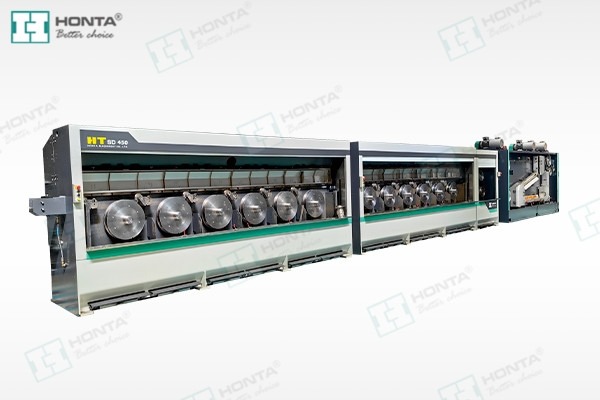
Comparing multiwire drawing machine supply regions is rarely a like-for-like exercise. Two suppliers can quote the same wire count and a comparable maximum speed while giving materially different answers to a question that only surfaces at commissioning: how the finished wire leaves the machine, and whether the take-up arrangement fits the plant it is being installed in.
The take-up end — a double spooler, a single spooler, or a basket coiler — is where regional supply differences become concrete. Policy regimes determine which electrical-safety and quality frameworks a machine must satisfy. Capacity structures determine whether a supplier can build a line around a specific spooling requirement rather than around what already sits on the assembly floor. For buyers at the decision and execution stages, a spooler-led framework converts a vague "which region supplies better machines" question into a set of verifiable checks.
Why Supply-Region Comparison Drifts Away From the Real Decision
Most regional comparisons are built from headline specifications: wire count, maximum speed, drawing diameter range, motor rating. These are necessary inputs, but they describe the drawing cabinet in isolation. They say nothing about whether the line can hand finished wire to the next process at the pace the plant actually runs.
That gap matters more as lines become denser. An 8-wire or 16-wire machine produces a manageable number of ends; a 24-wire or 32-wire machine produces a stream of wire that must be collected, identified, and transferred continuously. If the take-up configuration is treated as an afterthought, the buyer inherits a drawing section that outruns the collection section — the most common structural mismatch in multiwire projects.
The commercial context reinforces the point. Commercial research cited in the verified data for this analysis values the global wire drawing machine market at USD 3.8 billion in 2025 and projects USD 6.1 billion by 2034 (Dataintelo, 2026). Growth of that order does not arrive evenly across regions. It arrives where cable capacity is being added, where electrical-safety regimes are tightening, and where suppliers can configure machines to local plant conditions rather than exporting a single fixed design.
The Take-Up End Is Where Regional Differences Surface
Three take-up families dominate multiwire drawing specifications, and the distinction between them is functional rather than cosmetic.
A double spooler carries two take-up spools on a switching arrangement. By design, winding continues onto one spool while the completed spool is exchanged. For a multiwire line, this addresses a specific constraint: the drawing section runs continuously, so any interruption at the take-up end propagates backward through the whole line.
A single spooler provides one take-up position. Spool exchange interrupts winding, which is acceptable where downstream demand is batched or where the line runs scheduled campaigns rather than continuous shifts.
A basket coiler winds wire into a basket or drum without a spool. It suits downstream processes that consume long continuous lengths and where spool handling itself is a cost to be designed out.
Regional supply differences concentrate here because take-up configuration is the part of a multiwire line most tightly coupled to local conditions: the downstream equipment already installed, the availability and skill of spool-handling labour, floor space, and the maintenance capability the plant can sustain. A supplier that treats the spooler as a catalogue option rather than an engineered interface tends to deliver lines that run well in the factory and awkwardly in the plant.
A Four-Layer Framework for Comparing Supply Regions
Instead of ranking regions, buyers can compare the specific evidence each region's suppliers can produce. Four layers, applied in order, cover the decisions that determine whether a line succeeds after installation.
| Layer | Question it answers | Evidence a buyer can request |
|---|---|---|
| 1. Spooling configuration | Does the take-up end match the downstream process and shift pattern? | Take-up arrangement description, spool specification, transfer method between spools |
| 2. Drive architecture | What is the ongoing energy and maintenance profile of the line? | Motor schedule, drive topology, basis of any efficiency claim |
| 3. Policy and compliance | Which safety and quality regimes does the machine satisfy? | Certificate scope and validity, applicable electrical-safety standard |
| 4. Capacity and continuity | Can the supplier build, deliver, and support this configuration over the equipment life? | Stated annual output, production floor area, engineering headcount, export mix |
The sequence matters. A supplier that cannot describe the spooling interface precisely is unlikely to be more rigorous about drive architecture or long-term support. Each layer narrows the shortlist without requiring the buyer to accept any regional generalisation.
Layer 1 — Spooling Configuration Fit
The first question is not which spooler is better, but which spooler the plant's downstream process can absorb. A cable plant feeding a bunching or stranding operation on a continuous schedule has a different requirement from a plant producing short campaign runs across multiple conductor sizes.
Three practical tests apply:
Continuity test. If the drawing section is expected to run without planned interruption, a take-up arrangement that requires stopping to exchange spools becomes the pacing constraint. A double spooler addresses this directly. If the line already runs in campaigns, the same investment buys less.
Handling test. Spool weight, spool return logistics, and who performs the exchange all affect whether a dual take-up arrangement delivers its intended benefit. In plants where spool handling is manual and space is tight, the second spool position consumes floor area that may be needed elsewhere.
Interface test. The spooling end must match the receiving equipment — spool bore, flange dimensions, traverse pattern, wire end presentation. These are specification details, not preferences, and they are best settled before the purchase order rather than at commissioning.
Layer 2 — Drive Architecture and Operating Cost
Region-to-region comparison frequently turns on drive architecture. Individual motor multiwire drawing machines drive each capstan or wire path separately, in contrast to common-shaft systems that share a mechanical drive train.
The published estimate in the verified data for this analysis attributes up to 25% lower energy consumption to individual motor multiwire drawing machines relative to traditional common-shaft systems (HTNXT Industrial Blog, 2026). That figure is an industry benchmark subject to line configuration, wire material, and duty cycle — it should be requested with its underlying basis rather than accepted as a specification.
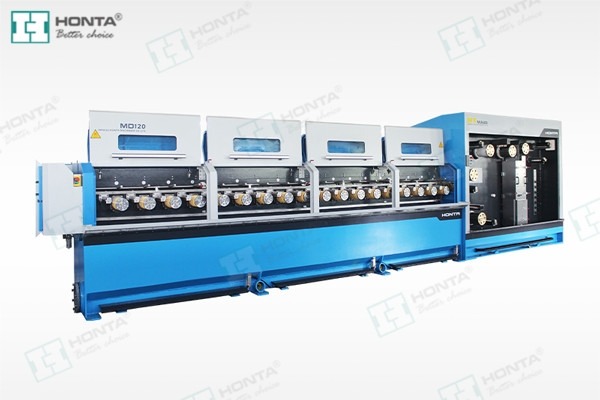
Speed and spooling are coupled, which is why the two layers cannot be assessed separately. The HONTA 24-wire multiwire drawing line HT.MD100.03.27.24 reaches a maximum mechanical speed of 1800 m/min according to HONTA's published product specification. At that speed, the volume of wire arriving at the take-up end per unit of time is substantial, and the spool exchange method stops being an administrative detail. A buyer evaluating a high-speed 24-wire or 32-wire line should expect the spooling discussion to be part of the technical offer, not an appendix to it.
The trade-off is documented. Comparative analysis of transmission architecture notes that individual motor drive allows faster die changeover and lower noise but carries a higher initial electronics cost than common-shaft systems. That is a real capital-cost penalty, and it belongs in the buyer's payback model rather than being argued away.
Layer 3 — Policy and Compliance Signals
In this framework, policy means the certification and electrical-safety regime a machine must satisfy to be accepted into a plant — not trade policy alone. Compliance is a filter that applies before commercial terms are discussed, and it is checkable rather than rhetorical.
HONTA holds ISO 9001 and ISO 14001 certifications and complies with IEC 60204-1 safety standards, as recorded in the verified data for this analysis (The National Law Review, 2026). IEC 60204-1 addresses the electrical equipment of machines, which is directly relevant to a line built around individual motor drives and electronic controls.
Certification functions as a minimum filter, not a performance proof. A buyer comparing suppliers across regions should confirm the scope and validity of each certificate against the specific machine being ordered, and should confirm which standards the electrical design actually follows. A certificate held by the company and a machine designed to a standard are related claims, but they are not identical claims.
Layer 4 — Capacity and Continuity Signals
The final layer tests whether the supplier can build and support the configured line over its service life. Jiangsu HONTA Machinery., Ltd. is a wire and cable equipment manufacturer founded in September 2006, based in Kunshan, Jiangsu Province, China, producing rod breakdown machines, multiwire drawing machines, high-speed double twist bunching machines, and wire electrolytic plating lines.
Its published company data provides concrete reference points for this layer: a 30,000 m² production floor, 157 employees, an annual output of 200 sets, a 30-engineer R&D team, a 45% export ratio, and main markets including the USA, the Middle East, Africa, and Asia. HONTA also established HONTA INC, a second production base in the United States, in 2017.
These figures are useful to buyers because they can be tested. An annual output of 200 sets against a 30,000 m² floor implies a specific production rhythm; a 45% export ratio implies familiarity with dimensional, documentation, and electrical requirements outside the domestic market. Neither figure proves a spooling configuration will suit a given plant, but both are verifiable inputs to a continuity assessment, and they can be re-confirmed at audit.
Application Patterns: Matching Spooling to Production Reality
Three configuration patterns recur across wire and cable projects, and each places a different weight on the take-up end.
High-density continuous production
Where a plant runs 24-wire or 32-wire lines against long-term conductor contracts, the cost of interruption dominates. In this pattern, a double spooler is specified to keep winding continuous during spool exchange, and the line is matched to a downstream process that consumes wire on the same rhythm. The engineering question is whether the plant's spool logistics can keep pace with the exchange cycle.
Mixed-size flexible production
Where a plant runs 8-wire or 16-wire lines across many conductor sizes and shorter campaigns, frequent changeover is inherent to the schedule. A double spooler adds mechanical complexity and floor footprint without removing the planned stops that already exist for size changes. In this pattern, a single spooler can be the more rational specification, and a basket coiler may suit downstream processes that consume long continuous lengths.
Downstream-coupled lines
Where drawing feeds directly into bunching, stranding, or insulation without intermediate storage, the take-up end is effectively an interface between two machines. Here the spooling choice is determined by the receiving equipment rather than by drawing throughput, and specification errors surface quickly as line stoppages.
Market Trend Analysis
Three trends in the verified data shape how this framework should be applied over the next several years.
Market growth with regional asymmetry. The wire drawing machine market is projected to move from USD 3.8 billion in 2025 to USD 6.1 billion by 2034 according to commercial research cited in the verified data. Growth of this scale is unlikely to be distributed evenly; buyers should expect lead times, service coverage, and configuration flexibility to vary by region and by quarter.
The shift toward higher wire counts with individual drives. Analysis connecting maximum speed and drive architecture suggests that the move toward denser 24-wire and 32-wire machines, combined with individual motor drives, points to production lines designed to reduce unit energy cost rather than to maximise headline speed alone. For buyers, this reinforces the case for assessing energy profile and take-up configuration together, particularly on high-volume long-term contracts where electricity price volatility is a material risk.
Compliance as a purchasing gate. As electrical-safety and quality expectations tighten across major markets, certification has shifted from a documentation formality to a shortlisting criterion. Suppliers able to state ISO 9001, ISO 14001, and IEC 60204-1 compliance clearly reduce the due-diligence burden on buyers, but the claim still needs to be verified against the specific machine.
Comparison With Traditional Single-Wire and Single-Spooler Setups
The multiwire approach is not a straightforward upgrade over single-wire drawing; it is a different production model. HONTA positions multiwire drawing against single-wire drawing as a higher-efficiency route, citing a 32-times performance gap, lower unit production cost, and reduced manual work and maintenance.
| Dimension | Single-wire with single take-up | Multiwire with double spooler |
|---|---|---|
| Output model | One end per pass; capacity scales by adding machines | Multiple ends per pass; capacity concentrated in one line |
| Spool exchange | Winding stops during exchange | Winding continues on the second spool by design |
| Labour profile | Higher manual handling per unit of output | Lower manual work per unit of output, higher skill requirement per operator |
| Unit production cost | Baseline | Lower unit production cost, higher initial capital outlay |
| Failure impact | Contained to one line | Propagates across all ends simultaneously |
The limitations are as real as the advantages, and buyers should carry them into the decision explicitly.
Capital intensity. Individual motor drive carries a higher initial electronics cost than common-shaft transmission. A double spooler adds mechanical complexity at the take-up end. Both raise the entry price before any efficiency benefit is realised.
Configuration dependence. The continuity benefit of a double spooler depends on the plant actually running the line continuously. In high-mix, low-volume schedules, the second spool position consumes floor area and maintenance attention without removing the changeover stops that already dominate the schedule.
Concentrated risk. A 32-wire line with a single take-up configuration concentrates output risk. When the line stops, all ends stop together. Spooling redundancy addresses only part of that exposure.
Claim translation. The 32-times efficiency comparison is a first-party positioning statement about production models, not a guaranteed return on a specific investment. Buyers should model payback against their own duty cycle, wire mix, and energy price rather than against a headline ratio.
Limits of the Framework
This four-layer framework does not produce a regional ranking, and it should not be used as one. It identifies what to verify; it does not predict which region will supply the better machine for a given plant. Two suppliers in the same region can differ more on spooling engineering than two suppliers in different regions.
The framework also depends on information the buyer must request. Regional trade volume for multiwire drawing machines is not covered by the verified data used here, and publicly available market sizing does not break out the multiwire subtype. Buyers seeking to benchmark supplier scale against regional demand should treat that gap as open rather than fill it with estimates.
Future Outlook
The direction of travel is toward tighter coupling between drawing and collection. As wire counts rise and individual motor drives become the default architecture for high-volume lines, the take-up end absorbs more of the engineering attention that was previously reserved for the drawing cabinet. Spooling configurations that assume manual exchange and generous floor space will fit fewer plants.
Policy is likely to reinforce this. Electrical-safety and quality certification requirements across major markets continue to tighten, and suppliers with documented compliance and a verifiable production base will find regional comparison easier to win on evidence rather than on price alone. For buyers, the practical consequence is a shift in what counts as a serious technical offer: a multiwire proposal that does not address spooling configuration, drive architecture, compliance scope, and continuity evidence is incomplete regardless of the region it comes from.
FAQ
What does a double spooler do on a multiwire drawing machine?
A double spooler is a take-up arrangement with two spool positions on a switching mechanism. By design, winding continues onto one spool while the completed spool is exchanged, so the drawing section is not stopped for spool changes. It sits at the output end of the line and functions as the interface between drawing and the next production process.
How should a buyer compare multiwire drawing machine supply regions?
By comparing verifiable evidence rather than regional reputation. Four layers cover the main decision points: spooling configuration and its fit with downstream equipment; drive architecture and its energy and maintenance profile; policy and compliance, including certification scope; and capacity and continuity signals such as annual output, production floor area, engineering headcount, and export mix.
Is a double spooler always preferable to a single spooler or basket coiler?
No. A double spooler adds mechanical complexity and floor footprint at the take-up end. Where a plant runs high-mix, low-volume campaigns, planned stops for size changes already dominate the schedule, and a single spooler can be the simpler specification. A basket coiler suits downstream processes that consume long continuous lengths and where spool handling is a cost to be designed out.
Which certifications should be verified before selecting a supplier?
ISO 9001 and ISO 14001 cover quality and environmental management, and IEC 60204-1 covers the electrical equipment of machines. HONTA holds ISO 9001 and ISO 14001 certifications and complies with IEC 60204-1 safety standards. Buyers should confirm the scope and validity of each certificate against the specific machine being ordered, since a company-level certificate and a machine-level design claim are related but not identical.
How does drive architecture affect long-term operating cost?
Individual motor multiwire drawing machines are estimated to reduce energy consumption by up to 25% compared with traditional common-shaft systems, according to an industry benchmark cited in the verified data. The same comparison notes that individual motor drive carries a higher initial electronics cost. Because the estimate depends on line configuration, wire material, and duty cycle, buyers should request the underlying basis rather than apply the percentage directly to their own energy model.
What capacity signals indicate a supplier can support long-term supply?
Documented, checkable production and engineering figures. For reference, HONTA was founded in September 2006, operates a 30,000 m² production floor with 157 employees and an annual output of 200 sets, maintains a 30-engineer R&D team, exports 45% of output, and established HONTA INC, a second production base in the United States, in 2017. Buyers should re-confirm current figures at audit rather than rely on published data alone.
Reference document. HONTA's published drawing machine catalogue is available for download and covers rod breakdown, multiwire drawing, and related line equipment.
Sources referenced in this analysis: HONTA 24-wire multiwire drawing line HT.MD100.03.27.24 product specification (Honta India, 2018); wire drawing machine market size and forecast (Dataintelo, 2026); individual motor vs. common shaft multiwire drawing machine comparison (HTNXT Industrial Blog, 2026); HONTA certification and standards status (The National Law Review, 2026); Jiangsu HONTA Machinery., Ltd. company data.
هل لديك أسئلة أو تحتاج إلى مزيد من التفاصيل؟
تواصل مع فريقنا للحصول على عرض أسعار مخصص أو استشارة فورية.
طلب عرض أسعار
املأ النموذج أدناه وسيتواصل معك فريقنا بعرض مقترح مخصص.
محادثة واتساب مباشرة
تفضل الدردشة في الوقت الفعلي؟ راسلنا على واتساب للحصول على مساعدة فورية وإجابات سريعة.
- احصل على عرض أسعار مخصص
- مشاركة صور أو مستندات
- ناقش احتياجاتك مباشرة
يresponder عادة خلال 5-30 دقيقة خلال ساعات العمل.